How Do We Ease our Workload?

Financial FAQs

occupydemocrats.com

Why do Americans worker harder with longer hours than in other developed countries? And why is America’s income inequality the worst in the developed world?

Both questions can be quickly encapsulated by NYTimes’ columnists Bret Stephens and Gail Collins in a back and forth Q&A opinion column.

To Gail Collins question whether Stephens was still enthusiastic about Joe Biden’s big spending initiatives, he said he liked most of them, but:

“…the program I most oppose is the child tax credit, which sounds like liberal nirvana but would be difficult to administer and has no work requirements, which effectively reverses the gains the country made after Bill Clinton’s welfare reform. I’m also not too fond of the huge Medicare expansion, another noble-sounding effort that will further push a financially strained program toward insolvency.”

Stephens in this case repeats the conservative mantra that government-paid benefits strain the taxpayers’ coffers, and discourage work. But in reality, he is parroting conservatives’ opposition to any public spending that grows government programs, which is the reason Americans have been deprived of the welfare benefits of other developed countries—e.g., universal health care, paid family leave, a livable minimum wage, and nationally mandated paid vacations.

Denmark is probably the best example of what modern technology has enabled to ease the workloads of working folk, with its $20 per hour minimum wage and 33-hour average work week.

Whereas, according to NYTimes guest columnist Bryce Covert, “Prepandemic, nearly a third of Americans clocked 45 hours or more every week, with around 8 million putting in 60 or more. While Europeans have decreased their work hours by about 30 percent over the past half century, ours have steadily increased.”

EPI.org

There is no secret where the increased wealth generated by modern technology has gone in the US; to the owners of capital—stock holders, CEOs, and financial entities that hold their debt—rather than wage-earning employees.

Why? It has been outright wage suppression since the 1980s, at least, as the Federal Reserve under Paul Volcker fought any form of incipient inflation by tightening credit, which largely suppressed wage growth while Big Business began its lobbying campaigns to enact anti-labor legislation that weakened unions’ collective bargaining efforts.

Much of the anti-government rhetoric came under the guise that government was less efficient in producing overall wealth than the private sector. The pandemic is also bringing another problem to light that requires more government oversight—more work from home in an expanded ‘gig’ economy.

Steven Hill in an article for Project Syndicate, says “According to an April 2020 survey in the United States, 74% of companies are planning to “shift some employees to remote work permanently.” Similarly, a May 2020 analysis by researchers at the Federal Reserve Bank of Atlanta found that companies expect the share of working days spent at home to increase threefold, with many employees operating remotely 1-3 days per week.”

Working from home or other sites away from the office will hurt employees in so many ways without a government that clearly defines these new working conditions—because it blurs the line between regularly employed workers with clearly defined benefits and independent contractors that must provide their own safety net (e.g., healthcare, hours worked), for starters.

What does all this ultimately lead to? More work will be performed by algorithms and robots, of course, which can easily be trained to perform repetitive, predictable tasks.

“Historically, researchers have found that automation is adopted faster during economic downturns, and the COVID-19 recession was no exception. At the height of the crisis in advanced economies, the bots appeared to be making major advances,” says Hill.

“The net effect of this technological adoption over time will be to render more humans obsolete. Yes, some experts predict that new jobs will be created to service the robots and artificial-intelligence (AI) systems. But whether those jobs will be as numerous, pay as much, or be of the same quality as previous jobs remain open questions.“

So we have it in a nutshell. America will have to find new ways to benefit workers in this new economy, as other developed countries are doing—i.e., with the help of their governments working for them, rather than for Big Business.

Harlan Green © 2021

Follow Harlan Green on Twitter: https://twitter.com/HarlanGreen

Posted in Consumers, COVID-19, Economy, Keynesian economics, Weekly Financial News | Leave a comment

Retail Sales Splurge Won’t Last

Calculated Risk

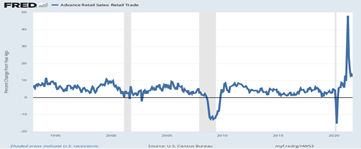
“Advance estimates of U.S. retail and food services sales for June 2021, adjusted for seasonal variation and holiday and trading-day differences, according to the US Census Bureau, but not for price changes, were $621.3 billion, an increase of 0.6 percent from the previous month, and 18.0 percent above June 2020.”

Consumers have been spending like there’s no tomorrow since January, but how long can that continue with the coronavirus Delta variant causing infection rates to soar among the unvaccinated?

COVIDTracker

Retail sales should continue to decline from current nosebleed levels, since surveys show that consumers are most worried about a COVID-19 resurgence.

The CDC reports that “the current 7-day moving average of daily new cases (26,306) increased 69.3% compared with the previous 7-day moving average (15,541). The current 7-day moving average is 89.6% lower than the peak observed on January 10, 2021 (251,880) and is 129.3% higher than the lowest value observed on June 20, 2021 (11,472). A total of 33,797,400 COVID-19 cases have been reported as of July 14.”

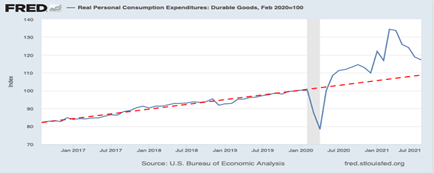
Households are still buying plenty of goods, but they have shifted their spending toward services they avoided during the pandemic, “dining out, entertainment, travel, vacation trips and so forth,” reported MarketWatch.

And this is where any future super-spreader events will occur. That is why the US Surgeon General is saying masks should again be worn in crowded indoor locations with poor ventilation—such as bars and restaurants. This will certainly cause consumers to take notice.

Take bars and restaurants, the only category in the monthly retail report that involves services. Sales jumped 2.3 percent in June, the government said Friday, and rose sharply for the fourth month in a row. And through the first six months of 2021 receipts are up almost 38 percent.

We know consumers also would have bought more new cars and trucks last month, but automakers cannot produce enough of them because of a shortage of computer chips. Semiconductors are now a critical component in modern vehicles.

Another hit to higher retail sales could be a reluctance for more workers to return to work. I reported last week that the job-listing site Indeed did a 5,000 person survey that gave an additional reason why workers are reluctant to return to work.

“Among the unemployed, concern about COVID-19 is the most commonly cited reason for a lack of urgency in looking for work,” wrote Nick Bunker, the economic research director for North America at the Indeed Hiring Lab, in a blog post on the survey results. Some 23% of unemployed people said fear of the virus was keeping their job search “non-urgent.”

So it may be that retail sales return to the five percent average that has prevailed since the early 1990s (see Calculated Risk graph), as the pandemic stimulus payments subside.

Retail sales comprise roughly 50 percent of consumer spending, so its trend may mirror how long this post-pandemic prosperity will last, which will be dependent on how quickly product shortages end, and the uncertainty of future job prospects in an economy that is vastly changed since January of last year.

Harlan Green © 2021

Follow Harlan Green on Twitter: https://twitter.com/HarlanGreen
Posted in Consumers, COVID-19, Economy, Weekly Financial News | Leave a comment

Why Keep Interest Rates This Low?

Financial FAQs

FREDPersavings

Inflation isn’t yet a problem, but are very low interest rates becoming a problem? Interest rates have been at record lows for years, thanks to the Federal Reserve that has been buying up enough bonds and mortgage securities to hold down longer-term rates as well. Is that good for most of US, or just the wealthy?

Fed chair Jerome Powell has stated it is to encourage a return to full employment by keeping the cost of borrowed money as low as possible. But this policy has mostly boosted assets owned by higher-income earners rather than wage-earners.

A recent NYTimes Op-ed by banking analyst Karen Petrou says just 10 percent of Americans own most stock assets that have benefited from the cheap money and approximately 60 percent of households own homes with values rising in double digits over the past year from record low mortgage rates.

The rest of US with less cash to spare must rely on accumulating unspent income in less risky, federally insured savings accounts that do not ride the boom-and-bust cycles of American-style capitalism.

The personal saving rate has spiked of late (see FRED graph) because consumers had little to buy until now, but that is transitory with the sudden re-opening of businesses causing inflation indicators to rise sharply.

Such an inflation spike is also transitory, said Fed Chair Powell in his latest congressional testimony.

“Inflation has increased notably and will likely remain elevated in coming months before moderating,” Powell said, in testimony delivered to the House Financial Services panel.

Ms. Petrou wants the Fed to raise interest rates sooner to encourage savings that would benefit wage-earners, she says, and mitigate some of the inflation that dampens consumer demand. She uses the example of investing $10,000 in stocks vs. saving money conventionally since 2007. Savers would have lost money after inflation with just a savings account.

I must say this Fed is doing a welcome about face from the Paul Volcker led Fed of the 1980s and 90s that raised interest rates at the slightest hint of inflation, thus tamping down wage growth while benefiting Wall Street investors. It was trickle-down economics on a tear.

“These corporate and policy decisions had the most adverse consequences for low- and middle-wage workers,” said a recent EPI labor think-tank research paper on the roots of inequality, “who are disproportionately women and minorities, the groups whose legacy of being discriminated against in labor markets means that they especially need low unemployment, unions, strong labor standards, and policy supports for leverage when bargaining with employers.”

It is difficult to credit Ms. Petrou with much insight into what benefits ordinary wage-earners. Higher interest rates will certainly deflate stock and bond values that rely on cheap borrowed money to reach today’s highs (stocks) and lows (bond yields) and increase the propensity to save, but how much can wage-earners save without higher incomes?

She is a bank analyst, after all, who will want to buttress lenders’ bottom line that increases profits with rising interest rates. And American’s historical savings’ rates of 5-10 percent should continue that have been in line with that in other developed countries.

The best way to increase the wealth of wage-earners, vs. wealth-owners is to boost their incomes, which in turn would increase their wealth. Use governmental policy to increase labor’s collective bargaining position that has been severely weakened and rescind much of the anti-labor legislation that has created some 26 right to work states that do not require workers to pay dues to the union shop that benefits them.

The same debate over when to tighten credit happened in 1937, by the way. Roosevelt caved to Republicans that wanted to re-balance the federal budget after so much New Deal spending. But in cutting back on government support and raising borrowing costs prematurely, the 1930’s economy went back into a second recession, and became the Great Depression.

Harlan Green © 2021

Follow Harlan Green on Twitter: https://twitter.com/HarlanGreen

Posted in Consumers, COVID-19, Economy, housing market, Keynesian economics, Politics, Weekly Financial News | Leave a comment

Too Many Jobs to Fill?

Popular Economics Weekly

Calculated Risk

There are too many job vacancies at the moment, per the Labor Department’s JOLTS report; though it actually signals that  businesses seem to want workers for the same old jobs, but there’s now a mismatch.

Many workers no longer want the ‘same old’ jobs, and are using the pandemic break to find work more to their liking. One survey said they were looking for “more job opportunities”, code for more rewarding work.

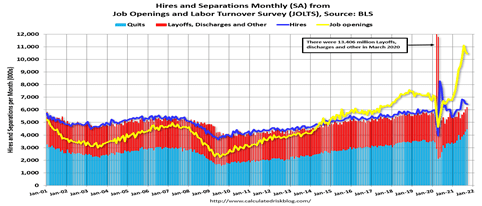
“The number of job openings (yellow line in graph) was little changed at 9.2 million on the last business day of May, the U.S. Bureau of Labor Statistics reported today. Hires (dark blue line) were little changed at 5.9 million. Total separations decreased to 5.3 million. Within separations, the quits rate decreased to 2.5 percent. The layoffs and discharges rate (red column), while little changed over the month, hit a series low of 0.9 percent.”

Quits (light blue column) are generally voluntary separations initiated by the employee, says the BLS. Therefore, the quits rate can serve as a measure of workers’ willingness or ability to leave jobs. Layoffs and discharges are involuntary separations initiated by the employer.

Although the U.S. created 850,000 new jobs in June, it would take more than a year at that rate to restore employment to pre-pandemic trends, says MarketWatch’s Jeffry Bartash.

“The competition for workers has given jobseekers the upper hand. A record 4 million people quit two months ago — most to take a better or better-paying job. That’s nearly double the number of people quitting a year earlier.”

White House chair of economic advisors Cecilia Rouse summarized the jobs picture. Employment remains 6.8 million jobs below our pre-pandemic level, she says. Looking at the three-month average, most of the jobs are going to leisure and hospitality, adding 326,000 jobs on average over the last three months. Government has added about 100,000 jobs on average.

White House

And the job-listing site Indeed did a 5,000 person survey that gave an additional reason why workers are reluctant to return to work.

“Among the unemployed, concern about COVID-19 is the most commonly cited reason for a lack of urgency in looking for work,” wrote Nick Bunker, the economic research director for North America at the Indeed Hiring Lab, in a blog post on the survey results. Some 23% of unemployed people said fear of the virus was keeping their job search “non-urgent.”

The unemployed workers said they will be more interested in getting back to work after they see certain milestones happen, such as more job opportunities, more vaccinations, and school starting up in the fall, the Indeed survey found. 

Harlan Green © 2021

Follow Harlan Green on Twitter: https://twitter.com/HarlanGreen

Posted in Consumers, COVID-19, Economy, Uncategorized, Weekly Financial News | Leave a comment

A Good Jobs Report

Popular Economics Weekly

Market Watch

We should be wishing everyone a Happy July Fourth, with the Bureau of Labor Department’s June unemployment report. Workers’ wages in the service sector are rising, with 850,000 new nonfarm payroll jobs added to the labor force.

Even better news is wages are rising where most needed, in the lower paying service sector. The June jobs report showed a 2.3 percent month-over-month increase in average hourly earnings in the leisure and hospitality industry. Overall average earnings rose 0.3 percent last month.

“Job gains should pick up in coming months as vaccinations rise, easing some of the pandemic-related factors currently weighing them down,” Federal Reserve Chair Jerome Powell told Congress on June 22.

So there is a way to go to return to the full employment experienced before COVID-19, said the BLS:

“Both the unemployment rate, at 5.9 percent, and the number of unemployed persons, at 9.5 million, were little changed in June. These measures are down considerably from their recent highs in April 2020 but remain well above their levels prior to the coronavirus (COVID-19) pandemic (3.5 percent and 5.7 million, respectively, in February 2020).”

The separate Household Survey reported the number of persons employed part time for economic reasons decreased by 644,000 to 4.6 million in June. This decline reflected a drop in the number of persons whose hours were cut due to slack work or business conditions.

And the number of persons not in the labor force who currently want a job was 6.4 million, little changed over the month but up by 1.4 million since February 2020. These individuals were not counted as unemployed because they were not actively looking for work during the last 4 weeks or were unavailable to take a job.

This can give us an idea of the huge size of our labor force, with more than 5 million jobs created each month, and 9 million jobs waiting to be filled, due to the sudden surge in economic activity. It is a reminder that we were at full employment in February 2020.

In fact, 6.2 million persons reported in June that they had been unable to work because their employer closed or lost business due to the pandemic—that is, they did not work at all or worked fewer hours at some point in the last 4 weeks due to the pandemic.

Reuters reports, “the underlying theme in the labor market outlook will continue to be that the jobs recovery is being held back by a shortage of willing workers rather than lack of employer demand.  The “jobs-plentiful” index in Tuesday’s consumer confidence report from the Conference Board surged to a 21-year high.  In yesterday’s NFIB small business jobs report, 46% of firms on a net basis reported that they had vacancies they were unable to fill.”

Well, as President Biden said in a recent aside to reporters: “Pay them more!”

We might be returning to a time when the pay gap between high-school and college-educated workers was much less. It has happened before, so a Happy Fourth and better times ahead, maybe.  

Harlan Green © 2021

Follow Harlan Green on Twitter: https://twitter.com/HarlanGreen

Posted in Consumers, COVID-19, Economy, Weekly Financial News | Leave a comment

Consumer Confidence, Home Prices Soar For How Long?

Financial FAQs

Conference Board

Consumer confidence is at record highs, as growing numbers of consumers believe the roaring 2020’s recovery is here to stay. And it’s also sending home price increases to record highs. But this isn’t another housing bubble. Too few homes are being built rather than too many, as builders try to catch up to the decades-long housing shortage, which could take another decade.

“Consumer confidence increased in June and is currently at its highest level since the onset of the pandemic’s first surge in March 2020,” said Lynn Franco, Senior Director of Economic Indicators at The Conference Board. “Consumers’ assessment of current conditions improved again, suggesting economic growth has strengthened further in Q2. Consumers’ short-term optimism rebounded, buoyed by expectations that business conditions and their own financial prospects will continue improving in the months ahead.“

So the Case-Shiller home price index increased 14.6 percent in April, as it runs a 3-month average for same-home sale prices. This is that best of all worlds with demand so high. Current interest rates are below the inflation rate, so that mortgages held longer term really have zero or negative yields, which means actual inflation shows up in housing prices.

“Phoenix, San Diego, and Seattle reported the highest year-over-year gains among the 20 cities in April,” said Case-Shiller. “Phoenix led the way with a 22.3% year-over-year price increase, followed by San Diego with a21.6% increase and Seattle with a 20.2% increase. All 20 cities reported higher price increases in the year ending April 2021versus the year ending March 2021.”

“In fact, the proportion of consumers planning to purchase homes, automobiles, and major appliances all rose—a sign that consumer spending will continue to support economic growth in the short-term. Vacation intentions also rose, reflecting a continued increase in spending on services,” said the Conference Board.

Consumers’ assessment of the labor market also improved. The Conference Board graph shows that jobs plentiful minus jobs hard to get blue line is soaring, with 54.4 percent of consumers said jobs are “plentiful”, up from 48.5 percent, and 10.9 percent of consumers claimed jobs are “hard to get”, down from 11.6 percent.

Conference Board

This is no wonder, as economists are predicting 9-10 percent GDP growth in Q2, and maybe six percent plus for all of 2021, before returning to a more normal growth pattern.

The American Rescue Plan has inserted $1.9 trillion into the U.S. economy, and Repubs and Democrats have agreed on an additional $1 trillion for infrastructure and other much needed physical improvements that will create more high-paying jobs.

So why shouldn’t consumers be this optimistic for awhile?

Harlan Green © 2021

Follow Harlan Green on Twitter: https://twitter.com/HarlanGreen
Posted in Consumers, COVID-19, Economy, Housing, housing market, Weekly Financial News | Leave a comment

Can We Fix the Housing Shortage?

The Mortgage Corner

Calculated Risk

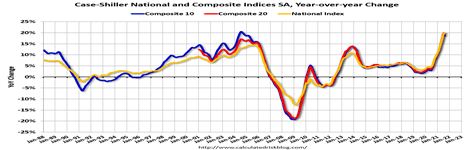
Existing-home sales of single-family, condos and apartments were down slightly from their recent highs for a number of reasons. This is while demand for housing is skyrocketing with home prices up 20 percent year-over-year, but there just isn’t enough inventory, especially at the low, affordable end where young adults can buy a home or condominium, and builders are scrambling to catch up.

The Calculated Risk graph shows that last year during the pandemic existing-home sales reached the highest sales rate since 2006 and the pre-Great Recession housing bubble. So the worry is how to fulfill the exploding housing needs of Americans after the pandemic has caused a record number of homeless and at least 10 million homeowners behind on their mortgage payments.

The National Association of Realtors reported in May:

Total existing-home sales,1 https://www.nar.realtor/existing-home-sales, completed transactions that include single-family homes, townhomes, condominiums and co-ops, dropped 0.9% from April to a seasonally-adjusted annual rate of 5.80 million in May. Sales in total climbed year-over-year, up 44.6% from a year ago (4.01 million in May 2020).

“Home sales fell moderately in May and are now approaching pre-pandemic activity,” said Lawrence Yun, NAR’s chief economist. “Lack of inventory continues to be the overwhelming factor holding back home sales, but falling affordability is simply squeezing some first-time buyers out of the market.”

So how will we provide enough homes to fill the rising demand for housing—not only to house those that can afford to buy, or rent, but for the homeless?

Housing economists predict that partly due to the pandemic, America is short some 5 million housing units, including rental housing.

Forbes Magazine summarizes a compendium of reports from WSJ and others that there would be 5.5 million more housing units today, if as many were built since 2000 as were built for baby boomers from 1968 to 2000.

“To make up the shortage, the NAR report says the U.S. would have to build 2.1 million homes each year for a decade—more than it built each year during the housing boom of the mid-2000s,” says Forbes.

That could be a problem with last month’s residential housing starts increasing 3.6 percent in May to a seasonally adjusted annual rate of (just) 1.57 million units off a downwardly revised April reading, according to a report from the U.S. Department of Housing and Urban Development and the U.S. Census Bureau.

FREDsfrstarts

This is third highest, per the St. Louis Fed’s single-family starts since 1960, which shows the record for starts was 1.8 million in January 2006 at the beginning of the housing bubble, and the last time interest rates were lower than the inflation rate, as they are today with the Fed’s various quantitative easing purchases of treasury bonds and mortgage-backed securities.

The May reading of 1.57 million starts is the number of housing units builders would begin if development kept this pace for the next 12 months, says the National Association of Home Builders. Within this overall number, single-family starts increased 4.2 percent to a 1.10 million seasonally adjusted annual rate. The multifamily sector, which includes apartment buildings and condos, increased 2.4 percent to a 474,000 pace.

So how can we increase production? “[W]e’ll need to do something dramatic to close this gap,” said Yun in a press release. The association proposed increasing the housing supply by creating or expanding tax credits, loans or grants for builders who renovate or build new housing in low-income areas and who convert old malls and factories into homes. They also asked for incentives for cities to allow denser zoning, an approach that President Biden included in his infrastructure proposal, Reuters reported.

The White says the President’s infrastructure plan proposal invests $213 billion “to produce, preserve, and retrofit more than two million affordable and sustainable places to live. It pairs this investment with an innovative new approach to eliminate state and local exclusionary zoning laws, which drive up the cost of construction and keep families from moving to neighborhoods with more opportunities for them and their kids.” 

So it’s now up to the Senate to reach a final agreement on the bill, which will determine if we can even begin to cure the housing shortage.

Harlan Green © 2021

Follow Harlan Green on Twitter: https://twitter.com/HarlanGreen
Posted in Consumers, COVID-19, Housing, housing market, Weekly Financial News | Leave a comment

What is Normal Inflation?

Popular Economics Weekly

FREDcpi

The financial markets were shocked, yes shocked, when the May Consumer Price Index for retail prices jumped 4.9 percent year-over-year. Just kidding. No one was really surprised because one year ago it wasn’t rising at all (well, just 0.22 percent). It was predicted to rise substantially with the $4 trillion plus in government aid already being injected into companies and individuals.

Inflation has averaged around two percent since the 1990s, per the above St. Louis Fed graph that dates back to 1950, so everyone business economist should know that it would eventually trend back to the historical average, given the just-in-time worldwide supply chain that has tamed prices.

In fact, CPI inflation was rising as high as 5.5 percent annually in July 2008 during the Great Recession, before another jaw-dropping plunge to -0.32 percent in 2009. You get the drift. So who is worrying about these temporary ‘blips’ in inflation? The financial markets, of course.

They love to use other peoples’ (borrowed) money to finance their stock, bond and commodity market transactions, if possible. And interest rates have been at rock bottom over the past year; close to zero for short-term rates, and the 10-year benchmark treasury yield below one percent for much of the time. It is still in a daily trading range of 1.5-1.6 percent, per the below FRED graph.

FRED10yr

This is one reason market indexes have been at record highs, and why they gyrate so wildly on almost a daily basis as traders try to guess what the Fed will do next in its almost daily pronouncements on when they might allow short-term interest rates to rise.

Consumers don’t have to worry so much, because it has been extremely difficult for the Federal Reserve, or anyone else, to keep CPI inflation above two percent, especially during this once in a 100-year coronavirus pandemic. Inflation below that range has invariably meant there is too little aggregate demand—consumers aren’t buying, investors aren’t investing, and banks aren’t lending.

CEPR’s Dean Baker just remarked on what has boosted inflation of late. It’s gasoline prices and insurance rates spiking because of the sudden surge in travel, as consumer bust out of their prolonged at home hibernation.

“Overall, the story this month is overwhelmingly that bounce back inflation was 100 percent predictable, coupled with soaring car prices (both new and used) due to temporary shortages. There’s not much here to get excited about,” he said.

“The overall CPI was up 0.6 percent (monthly), the core rose 0.7 percent. New and used cars were major factors, rising 1.6 percent and 7.3 percent, respectively. The jump in used and new car prices added 0.3 percentage points to the inflation rate for the month.”

And, he continues:

  • · Even though it’s hard to get good help, restaurant prices outpaced food prices by just 0.1 percentage points over the last three months, 1.0 percent to 0.9 percent.
  • · The medical care index fell 0.1 percent in May, up just 0.9 percent over last year. Drug prices were flat, down 1.9 percent over last year.
  • · Rent indexes: rent proper increase just 0.2 percent; owner equivalent rent rose 0.3 percent in May.
  • · Apparel prices jumped 1.2 percent in May, car insurance 0.7 percent, and air fares 7.0 percent. The indexes are respectively 2.2 percent, 0.2 percent, and 6.3 percent below the February 2020 level.

It is also why the housing market is booming. Interest rates are this low because bond traders see very little danger of longer-term inflation, and the Fed promising to hold short-term rates close to zero for at least one more year.

Harlan Green © 2021

Follow Harlan Green on Twitter: https://twitter.com/HarlanGreen

Posted in Consumers, COVID-19, Economy, Weekly Financial News | Leave a comment

When the Return to Normal Activity?

Financial FAQs

Calculated Risk

When will most American workers return to work, and the U.S. economy return to normal activity? The Calculated Risk-FRED graph since 1992 tells us that retail sales have historically never varied substantially from a 5 percent annual increase, except during the blue bar recession periods indicated in the graph, and consumers and businesses have spent most of their pandemic aid. It could take another year.

The U.S. Census Bureau reportedAdvance estimates of U.S. retail and food services sales for May 2021, adjusted for seasonal variation and holiday and trading-day differences, but not for price changes, were $620.2 billion, a decrease of 1.3% from the previous month, but 28.1% above May 2020.”

Altogether, the number of people reportedly still receiving benefits from eight separate state and federal programs totaled 14.8 million as of May 29, reports MarketWatch’s Greg Robb. It is down about 560,000 from the prior week. Last year, 30 million Americans were receiving these extra benefits, while the historical range receiving claims is in the mid-200,000s, so one can see why it might take another year for economic activity to return to normal.

Retail sales began to rebound last April with the first aid checks, and really took off this January with the additional recovery dollars going to individuals. Clothing and accessory sales are up 200 percent from May 2020, while food service and drinking places surged 71 percent and electronic and appliance stores gained 91 percent.

This sudden prosperity is creating many bottlenecks, raising all prices and shrinking the housing supply, with builders struggling to meet the increased demand.

Privately‐owned housing starts in May were at a seasonally adjusted annual rate of 1,572,000. This is 50.3 percent above the May 2020 rate of 1,046,000, but is not enough construction to satisfy the soaring demand for more housing—new or used.

NAR chief economist Lawrence Yun commented on the May starts: “Despite the month-to-month trend, or even year-to-year changes, America is facing a massive housing shortage due to multiple years of underproduction in relation to population growth. We estimate around 5.5 to 6.8 million additional housing units need to be built. America is on track for only 1.6 million and 1.7 million new housing units this year and next, respectively. That would represent the best two-year performance in 15 years, yet it would still be inadequate. Therefore, expect both rents and home prices to outpace overall consumer price inflation in the upcoming years.”

Calculated Risk

Where is this housing supply to come from? Estimates of population growth, demographic change, and demolitions suggest about 1.3 million households will form annually for the next few years, Goldman Sachs analysts said in a May note cited by Business Insider.

“Millennials are just reaching peak homebuying age and set to keep demand strong for the foreseeable future. Elevated lumber prices and lot shortages will continue to drag on construction even as starts accelerate. And while mortgage rates have risen from their pandemic-era floor, they still sit at historically low levels and should keep demand robust, the bank said.”

In 2021, the Mortgage Bankers Association (MBA) forecasts single-family housing starts to be around 1.134 million. And that could just be the beginning, as projections going forward are even rosier: 1.165 million single-family homes in 2022 and 1.210 million in 2023.

And we should see more entry-level homes under construction in 2021, says Joel Kan, associate vice president economic and industry forecasting at the MBA. That could help a potential pinch point, as too many entry-level buyers are helping to push up prices, making those homes unaffordable for that very group.

“We’ll see more affordable homes come onto the market as builders try to meet demand for these homes,” Kan says.

“Some 5.16 million people who have exhausted state compensation were also getting extra $300 a week in federal benefits as of May 29, down about 75,000 from the prior week,” says Robb. “The federal program ends in September and more than two dozen states are going to end the program early starting in the middle of this month.”

We know that will slow down the return to normal growth in those 25 states that are coercing their lower-paid workers to return to jobs they might not like. And that is on top of the need to find adequate housing.

Harlan Green © 2021

Follow Harlan Green on Twitter: https://twitter.com/HarlanGreen

Posted in Consumers, COVID-19, Housing, housing market, Weekly Financial News | Leave a comment

There Are More Jobs Than Ever!

Financial FAQs

Calculated Risk

The number of job openings reached a series high of 9.3 million on the last business day of April, the U.S. Bureau of Labor Statistics reported last Tuesday. Hires were little changed at 6.1 million. Total separations increased to 5.8 million. Within separations, the quits rate reached a series high of 2.7 percent while the layoffs and discharges rate decreased to a series low of 1.0 percent.

American workers are finally in a position to pick and choose from what is a record number of job openings. As proof, the number of quits jumped to a new all-time high of 4.0 million, versus 3.6 million last month.  These are voluntary exits from one job to a presumably better job.

This is panicking 25 states with Republican governors into terminating the additional $300 per week in unemployment benefits early, believe it or not. They seem to be afraid that their workers might take the time to shop for a job with better pay and benefits, which is what anecdotal evidence is already showing.

The blue line in Calculated Risk’s graph tells us that hirings have actually returned to a more normal level, but sudden opening of the economy has orders pouring in for goods and services, which is more demand that can be satisfied at the moment, and this is boosting workers’ wages.

Reuters said “Higher worker mobility undoubtedly contributed to the surge in hourly earnings in the past two employment reports, as employers must not only pay higher wages to attract new workers but may feel more pressure to raise compensation to retain their existing employees.”

There are still too many unvaccinated employees that don’t feel safe returning to work, and most schools are still out or having only partial re-openings for many women to return to work.

Treasury Secretary Janet Yellen also claimed data does not support the argument that increased unemployment benefits are leading to a workforce shortage. She said when they looked at states and sectors where supplemental benefits were high, there weren’t lower job finding rates as the argument would suggest, and in fact it was the “exact opposite.”

Equitablegrowth.org

The simple truth is that Republican governors en masse that suppress additional aid for their workers is in keeping with their small government principles. Why else give up $26 billion that will flow to them if they allow their workers to keep the additional benefits?

Sadly, research is showing that this hurts those states, report a number of researchers. A report cited by The Center For Equitable Growth, for example, concludes that workers salaries increased as much as five percent when their unemployment benefits were extended to 99 weeks in 2010-11 following the Great Recession.

And as of May’s jobs report released last Friday, the country is still down 7.6 million jobs from before the pandemic, reports The Hill. The May jobs report also indicated that there are 9.3 million people who are officially unemployed — meaning they are actively looking for work and unable to find it. In most industries, the number of jobseekers still exceeds the number of job openings

We are in a different world with COVID-19 that is killing more than all the world wars, in other words, a time like the Great Depression and New Deal when small government ideology makes no sense. 

Harlan Green © 2021

Follow Harlan Green on Twitter: https://twitter.com/HarlanGreen

Posted in Consumers, COVID-19, Economy, Keynesian economics, Politics, Weekly Financial News | Leave a comment