Job Openings Highest in Two Years

Financial FAQs

Tradingeconomics.com

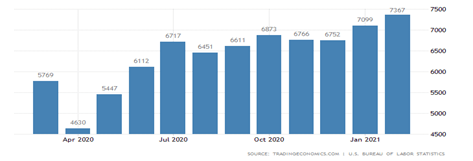
Job openings in the U.S. rose in February to the highest level in more than two years as the economy emerged from a winter slowdown tied to a record increase in coronavirus cases. The number of job openings jumped to 7.37 million from 7.1 million in January, the Labor Department said Tuesday.

“Job openings now top prepandemic levels and aren’t far from the record high of 7.57 million in November 2018,” said MarketWatch’s Jeffry Bartash.. “Many companies are looking to hire more workers in anticipation of the economy strengthening as most of the American populace gets vaccinated.”

This is a further sign (with last Friday’s U.S. unemployment report) that we could return to some form of full employment by the end of this year.

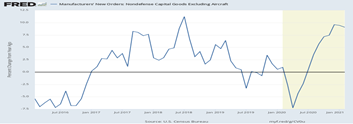
Both US manufacturing and service sectors are expanding faster. American manufacturers’ Institute of Supply Managers (ISM) index hit a 38-year high, another economic indicator pointing to gathering momentum in the U.S. economy.
FREDmanufactureneworders

Timothy R. Fiore, CPSM, C.P.M., Chair of the Institute for Supply Management® (ISM®) Manufacturing Business Survey Committee said, “The manufacturing economy continued its recovery in March. However, Survey Committee Members reported that their companies and suppliers continue to struggle to meet increasing rates of demand due to coronavirus (COVID-19) impacts limiting availability of parts and materials.”

The Institute for Supply Management said its manufacturing index jumped to 64.7 percent from 60.8 percent in the prior month. Readings over 50 percent indicate growth, and anything over 55 percent is considered exceptional.

Job openings increased in health care and social assistance (+233,000), accommodation and food services (+104,000), and arts, entertainment, and recreation (+56,000); but declined in state and local government education (-117,000), educational services (-35,000), and information (-34,000).

I close with a short note by Professor James Galbraith, son of John Kenneth Galbraith, the best-selling author and defender of FDR’s New Deal. In speaking of inflation worries over the huge recovery and prosed infrastructure spending of the Biden administration, he said:

“Short of that (an outright war with China), U.S. households are not suffering from a shortage of smartphones, dishwashers, and running shoes. What they lack is confidence and security…Yes, some (of the spending) will be spent on services that were missed over the past year, reviving jobs in those sectors to a degree. Some will be used for housing maintenance, repairs, or upgrades—expenses that were neglected when people feared incurring the extra cost of a plumber, electrician, or painter. And some will go toward building new houses, as is already happening.”

These are all good reasons for spending huge amounts of money on reviving the U.S. economy and jobs, in other words.

Harlan Green © 2021

Follow Harlan Green on Twitter: https://twitter.com/HarlanGreen

Posted in Consumers, COVID-19, Economy, Weekly Financial News | Leave a comment

March Employment Augers A Roaring 2020’s

Popular Economics Weekly

MarketWatch.com

It may be difficult for the naysayers that believe too much aid is going into social programs to find fault with the March unemployment report that added 916,000 new nonfarm payroll jobs. It looks like March economic data augers a recovery that may lead to a decade of robust growth in the overall economy.

Companies are already hiring en masse, in spite of a winter that froze Texas and the record floods and tornadoes that have devastated much of the south.

Almost all business sectors are hiring, including a huge jump in the ISM’s Manufacturing Index to a 38-year high of 64.7, which means some 65 percent of manufacturing businesses surveyed were expanding.

Much of the hiring has come because happy consumers with an additional $1400 checks in their pockets are dining out and traveling more, but also because the housing market is booming—prompting 110,000 new construction hires in March.

The 916,000 new payroll jobs are just the beginning of this hiring boom that must bring back 10 million jobs to return to pre-pandemic levels. That is why Biden’s $3 trillion infrastructure spending will be needed as well.

So thank goodness for the $5 trillion in recovery aid already raised by congress that is encouraging even restaurants and other leisure servicers to hire 280,000 new workers, Education and Health 101,000, and Government 136,000 workers that are just the beginning of what is needed to make this decade this into a decade-long recovery.

The official unemployment rate, meanwhile, slipped to 6 percent from 6.2 percent, the Labor Department said Friday. Yet the official rate doesn’t capture nearly 4 million people who lost their jobs last year and weren’t counted in the numbers because they left the labor force.

It is also why Consumer confidence surged in March to a one-year high as more Americans were vaccinated and states began to open up for business. The index of consumer confidence shot up to 109.7 this month from a revised 90.4 in February, the Conference Board said Tuesday.

Confidence may be rising because some 3 million vaccines now administered per day may have 70 percent of American adults vaccinated by July, say the experts.

But new variants of COVID-19 are beginning to pop up, which has epidemiologists worried because it’s causing a plateauing of the infection rates at an unacceptably high level, according to the CDC.

According to the CDC, 153.6 million doses have been administered. 21.7 percent of the population over 18 is fully vaccinated, and 38.4 percent of the population over 18 has had at least one dose (99.6 million people have had at least one dose).

COVID.CDC.gov

Infection rates have plateaued because too many variants Of COVID-19 are popping up in some states that worry the CDC. Winning the race between the spreading variants and administering enough vaccinations to stop their spread is the key to winning this race.

“I think a package that consists of investments in people, investments in infrastructure, will help to create good jobs in the American economy,” testified Treasury Secretary Janet Yellen in congressional hearings last week, “and changes in the tax structure will help to pay for those programs.”

Yellen and Fed Chair Jerome Powell said there was no problem with any inflationary bulges that might occur with so much spending because it was spending that would boost productivity as well as employment, generating even more growth.

Harlan Green © 2021

Follow Harlan Green on Twitter: https://twitter.com/HarlanGreen

Posted in Consumers, COVID-19, Economy, Housing, Weekly Financial News | Leave a comment

Why the Inflation Worries?

Financial FAQs

Reuters.com

There has been too much talk of inflation, as so-called ‘bond vigilantes’ seek to take advantage of the fear that too much pandemic recovery aid will saturate the financial markets, creating runaway inflation and boosting interest rates.

That makes sense when so many dollars are in play, right? Not really.

Who are the so-called bond vigilantes that worry about inflation and bond prices? They are usually the most highly leveraged funds that have been buying assets with borrowed money at the record low interest rates that have prevailed since the pandemic and have pushed up some stock prices to stratospheric levels.

A great example is what happened on Monday to a highly leveraged hedge fund investor, reports MarketWatch:

“U.S. stocks pared losses Monday afternoon despite jitters tied to reports that a large investment fund recently was forced to sell massive holdings ($30B) in stocks, causing prices to tumble. Investors were monitoring news reports that former Tiger Asia manager Bill Hwang’s Archegos Capital Management had unwound big bets late last week after facing margin calls.”

We know that margin calls are lenders requesting investors to sell the underlying assets that were bought on margin when said asset prices have fallen significantly.

So where is the runaway inflation they speak of? The Fed says they want moderate inflation but have the tools to prevent runaway inflation, and will keep a close-to-zero percent short term rate policy through at least 2002.

There is lots of precedence for the Fed holding real interest rates below inflation rates. It helped to finance World War Two, and GW Bush’s invasions of Iraq and Afghanistan. This is when the real cost of money close to zero, with borrowing needs high during such exigencies.

And we are fighting a world war against COVID-19 that is disrupting economies and killing more people than all the other wars.

Another problem with bond vigilantes’ thesis is the root cause of most inflation—higher demand than existing supply. The demand for products and services has not exceeded supply for decades—since globalization and lower trade tariffs have made goods in particular cheaper to produce and more plentiful.

There has been little problem with the supply-side of the equation in recent decades, in other words, unless we have major disruptions such as this pandemic that creates temporary bottlenecks in the delivery of said products.

“Even before the coronavirus crisis, central banks globally were struggling with sluggish inflation, and the pandemic-induced downturn has only made the challenge worse,” said Reuter’s Ann Saphir.

“Too-low inflation is typically a sign of a weak economy. It also tends to drag on interest rates and makes it difficult for central banks to fight recessions with their usual tools that focus on the cost of money.”

That is why several European countries are struggling with what amounts to negative interest rates, such as Denmark where even mortgage interest rates are less than zero.

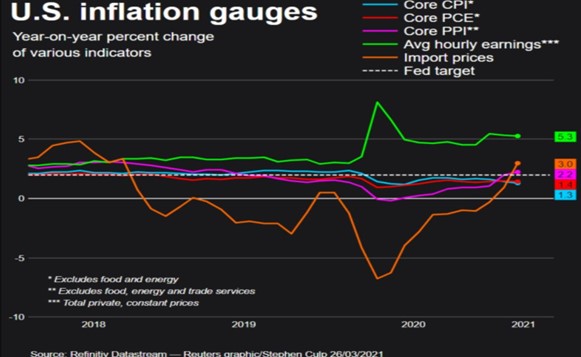
The above Reuters graph shows that inflation has barely budged (light blue and red lines), even as average hourly earnings are rising at a 5.3 percent clip. One can call this another goldilocks economy with neither too hot nor too cold growth at the moment.

So those most fearful of soaring inflation and borrowing costs are those that are highly leveraged. And we will see that leveraging disappear soon enough as business activity returns to a new normal the Fed is wanting—holding interest rates at or below inflation, stimulating a higher demand for goods and services that stimulates a robust recovery.

Harlan Green © 2021

Follow Harlan Green on Twitter: https://twitter.com/HarlanGreen
Posted in Consumers, COVID-19, Economy, Keynesian economics, Weekly Financial News | Leave a comment

We Need A Green Infrastructure Plan

Popular Economics Weekly

Washington Post

The Biden administration’s $3 trillion infrastructure plan is next on their agenda to boost economic growth. And it will need a tax raise to pay for it.

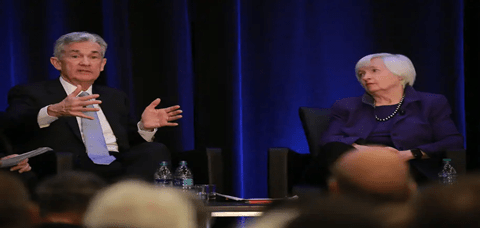
“I think a package that consists of investments in people, investments in infrastructure, will help to create good jobs in the American economy,” testified Treasury Secretary Janet Yellen in congressional hearings this week, “and changes in the tax structure will help to pay for those programs.”

Yellen and Fed Chair Jerome Powell said there was no problem with any inflationary bulges that might occur with so much spending because it was spending that would boost productivity as well as employment, generating even more growth.

“Our best view is that the effect on inflations will be neither particularly large nor persistent,” said Powell during the same hearings.

The circa $3 trillion infrastructure bill President Biden is proposing should really be treated as if we are fighting another world war, as we treated spending during world War Two. This war to overcome the coronavirus pandemic has killed more people than all prior world wars.

So why even worry about inflation or budget deficits? In fact, rising inflation during WWII created negative real interest rates at the time because the Fed kept rates low to finance the war, just as it is doing now, which really means it is interest-free money (That is, real interest rates less than zero as it was during WWII).

And the infrastructure bill must be a green, environmentally friendly bill because much of it has to mitigate the damage to infrastructure from global warming. Need we be reminded of the recent breakdowns in power grids that can leave millions without water and electricity for days, as demonstrated by the Texas power crisis this year?

The National Resources Defense Council (NRDC) in a 2008 report said, “New research shows that if present trends continue, the total cost of global warming will be as high as 3.6 percent of gross domestic product (GDP). Four global warming impacts alone—hurricane damage, real estate losses, energy costs, and water costs—will come with a price tag of 1.8 percent of U.S. GDP, or almost $1.9 trillion annually (in today’s dollars) by 2100.”

This means an 80 percent reduction in U.S. greenhouse gases alone to meet Paris Accord goals, phasing out most uses of fossil fuels and replacing them with electric energy sources such as wind and solar power.

“Mr. Biden’s infrastructure plan will deal with the meat-and-potato issues that Republicans and Democrats agree are an urgent need,” say NYTimes reporters Jim Tankersley and Anni Karney. “It seeks to rebuild roads, bridges, transit, rail and ports, while also improving power grids and increasing the number of electric vehicle charging stations.”

The plan also requires the development of universal broadband, such as 5G networks that China is already building on a grand scale, a major issue in rural communities. Documents suggest it will include nearly $1 trillion in spending on the construction of roads, bridges, rail lines, ports, electric vehicle charging stations, and improvements to the electric grid and other parts of the power sector, according to Tankersley

There is much more to Biden’s infrastructure plan that will be detailed as we get more particulars. Any delays in passing it will only increase the costs from damage caused by the increasing frequency of hurricanes, tornadoes, wildfires, power failures; so much so that even the U.S. Pentagon says climate change has become a national security threat.

Over the past decade, the Pentagon has consistently, repeatedly cited climate change as a serious threat to America’s national security in official public documents.

“Climate change is a threat in their eyes because it’s going to degrade their ability to deal with conventional military problems, said Michael Klare in an Vox interview about his new book about the Pentagon’s role in combatting global warming, titled All Hell Breaking Loose: The Pentagon’s Perspective on Climate Change. “It’s going to create chaos, violence, mass migrations, pandemics, and state collapse around the world, particularly in vulnerable areas like Africa and the Middle East.”

“It is difficult to put a price tag on many of the costs of climate change: loss of human lives and health, species extinction, loss of unique ecosystems, increased social conflict, and other impacts extend far beyond any monetary measure, says the NRDC report. “But by measuring the economic damage of global warming in the United States, we can begin to understand the magnitude of the challenges we will face if we continue to do nothing to push back against climate change.”

If we can protect ourselves from COVID-19, then we surely can protect ourselves from a warming planet.

Harlan Green © 2021

Follow Harlan Green on Twitter: https://twitter.com/HarlanGreen
Posted in Consumers, COVID-19, Economy, Keynesian economics, Weekly Financial News | Leave a comment

We Can Pay for the American Rescue Plan

Popular Economics Weekly

“Consumer sentiment rose in early March to its highest level in a year due to the growing number of vaccinations as well as the widely anticipated passage of Biden’s relief measures,” said the University of Michigan sentiment survey. “The gains were widespread across all socioeconomic subgroups and all regions, although the largest monthly gains were concentrated among households in the bottom third of the income distribution as well as those aged 55 or older (dark blue and gray lines in graph).” 

Sentiments are soaring because the just passed American Rescue Plan (AMR) will boost benefits of lower and middle income consumers, raising incomes for the poorest 20 percent of families by an average of 20 percent, according to the Tax Policy Center’s analysis, while top earners would see their income rise less than 1 percent in an NPR interview.

NPR

America can pay for the $1.9 trillion tab because it does not substantially raise the cost of the public debt over the long term if we look at the average annual budget deficit to GDP ratio that hasn’t varied substantially since WWII—the major exceptions being the need to finance recoveries from the Great Recession, and now the coronavirus pandemic.

USGov

The cost of financing public debt has averaged little more than 3 percent, historically because economic growth that followed that spending brought the public debt back down to manageable levels, whatever interest rates prevailed at the time.

Financing the $5 trillion in debt that congress has passed since the onset of the coronavirus pandemic should follow the same trajectory. For example, the new $1.9 trillion from the American Rescue will create 7 million new jobs by December, according to the Congressional Budget Office.

“Between 1946 and 2019,” says the CBO, “the deficit as a share of GDP has been larger than that only twice. In CBO’s projections, annual deficits relative to the size of the economy generally continue to decline through 2027 before increasing again in the last few years of the projection period, reaching 5.3 percent of GDP in 2030. They exceed their 50-year average of 3.0 percent in each year through 2030.”

Predictions of real GDP growth are soaring since the AMR’s passage. The Organization for Economic Cooperation and Development projects the U.S. economy will grow by 6.5 percent this year, according to NPR. That’s more than twice the growth rate it was projecting in December — thanks in large part to more robust federal aid.

And employment is already surging, thanks to the prior pandemic aid packages. The February employment report added 465,000 private payroll jobs, with 355,000 of those jobs in leisure and hospitality — restaurants, hotels, casinos, theaters—all in the service sector.

All signs point to a robust recovery, in other words, which is why I don’t see any problem with managing a ‘new’ New Deal spending bill when it benefits so many Americans at a time of our greatest need, the need to recover from a pandemic that has cost more American lives than our combined wars.

Harlan Green © 2021

Follow Harlan Green on Twitter: https://twitter.com/HarlanGreen

Posted in Consumers, COVID-19, Economy, Keynesian economics, Weekly Financial News | Leave a comment

Why the American Rescue Plan Is So Important

Financial FAQs

There are several good reasons for passing the American Rescue Plan (ARP). Firstly, it abolishes once-and-for-all the Reagan-era myth that ‘government is the problem’.

With the thinnest of Democratic majorities, the Biden administration is getting things done; from speeding up of vaccine deliveries, to expanding Obamacare coverage, to requiring masks on interstate and international travel, and re-joining the Paris Accord on climate change—all this enabling a speedier economic recovery.

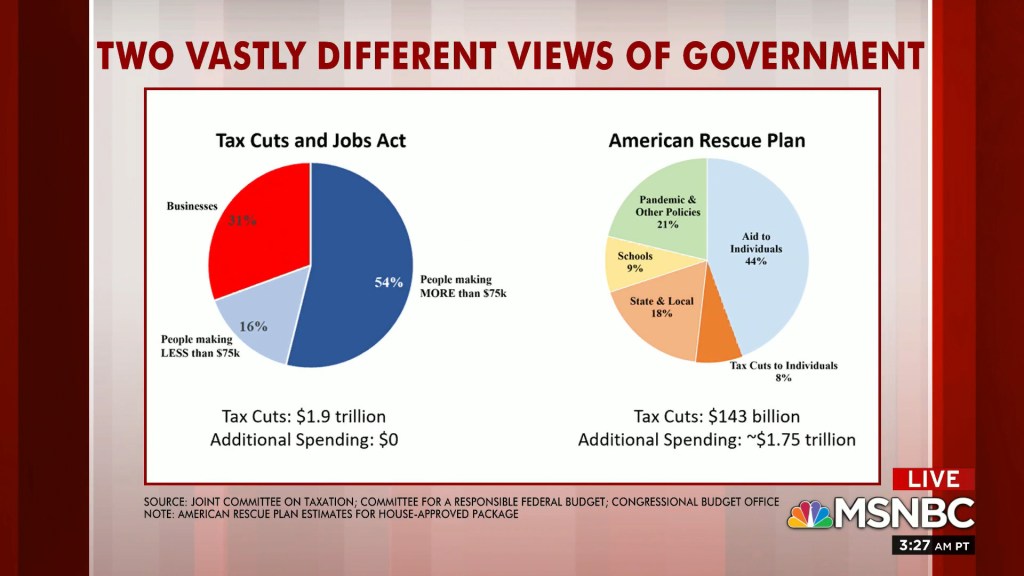
It benefits many Americans—more than 60 percent, according to economist Steven Ratner on Morning Joe, in comparing the American Rescue Plan to Trump’s Tax Cuts and Jobs Act that transferred $1.9 trillion in tax cuts to the wealthiest 10 percent of income earners with none of it supporting public spending, whereas the $1.75 trillion in spending from the ARP will benefit programs for more than 60 percent of Americans.

MorningJoe

This will include the poorest among US, including minorities and immigrants, according to the PEW Research Center’s latest survey:

“About six-in-ten White (60%) and Asian adults (58%) currently say their personal financial situation is in excellent or good shape. In contrast, a majority of Black (66%) and Hispanic (59%) Americans say their finances are in only fair or poor shape.“

The Congressional Budget Office has said that it could take five years for employment to reach prior pandemic levels without the American Rescue Plan.

The ARP’s main objective is to put people back to work as soon as possible, according to Fed Chairperson Janet Yellen.

““I think we should want a rapid recovery,” she said in a recent PBS Newshour interview. “We have a large number of workers who are long-term unemployed, and we have to make sure they’re not scarred to the point where this pandemic has a permanent impact on their lives.”

And speaking of the latest strong unemployment report that created 379,000 more payroll jobs, “at that pace it would take us more than two years to get to full employment,” Yellen said in the same interview. The “real” unemployment rate, after factoring in 4 million who dropped out of the labor force after losing their jobs, was more like 10 percent.

The PEW report said that income differences are particularly pronounced, with a gap of 60 percentage points between the shares of upper-income (86%) and lower-income (26%) adults who rate their financial situation as excellent or good. “About six-in-ten adults with middle incomes (58%) say their finances are in excellent or good shape.” 

The ARP should also boost consumer sentiment now at a six-month low in the U. of Michigan February sentiment survey, with the entire loss concentrated in the Expectation Index and among households with incomes below $75,000 (the income brackets targeted by the government cash payouts), as I said last week.

“Households with incomes in the bottom third reported significant setbacks in their current finances, with fewer of these households mentioning recent income gains than anytime since 2014,” said the U. Michigan survey.

Need we say more? This is why the American Rescue Plan is so popular with a 76 percent approval rating per the latest Politico survey.

Harlan Green © 2021

Follow Harlan Green on Twitter: https://twitter.com/HarlanGreen

Posted in Consumers, COVID-19, Economy, Keynesian economics, Politics | Leave a comment

Employment Surge Boosts Recovery Prospects

Popular Economics Weekly

MarketWatch

Another sign of a roaring 2020’s economy just came out, per the Bureau of Labor Statistics (BLS) today. The February employment report added 355,000 jobs just to payrolls in leisure and hospitality — restaurants, hotels, casinos, theaters—all in the service sector. These industries had lost 500,000 jobs during the pandemic.

A total of 379,000 jobs were created with manufacturing, wholesale trade and retail sales adding to the total.

“The rebound in job creation in February is likely the start of a major new cycle of hiring. Warmer weather, falling coronavirus cases, rising vaccinations and another massive increase in federal stimulus are likely to act as jet fuel for the economy in the spring and summer,” says MarketWatch’s Jeffry Bartash.

A rebound in the service sector is what economists have been waiting for. It means more consumer spending on travel, dining out, and visits to public venues like sports and museums.

There is one caveat, however. Dr. Fauci and other health experts are warning that the pandemic fight isn’t over. There could be an infection surge in the spring with new variants of the virus beginning to appear for which the current vaccines are not as effective.

COVIDTrackingProject

CDC head, Dr. Rochelle Walensky, has repeatedly warned that declining case numbers have stalled at a high level, and urged Americans to stick with the recommended safeguards — frequent hand washing, social distancing and wearing a face mask in public — until it’s their turn to be vaccinated.

“Things are tenuous,” Dr. Rochelle Walensky said at a White House briefing. “Now is not the time to relax restrictions.” The U.S. is still averaging about 70,000 cases a day and the seven-day average is higher today than it was earlier in the week, she said. “This recent shift in the pandemic must be taken seriously,” she said. If the infection rate remains at such a high level, the virus, and new variants of the virus, will continue to spread, she said. “We may be done with the virus, but the virus is not done with us,”

This happened with the Spanish flu pandemic of 100 years ago, which prolonged the original ‘roaring 20’s’ recovery for another year. It is literally a race to vaccinate as many people as possible to limit the spread of these new variants.

Harlan Green © 2021

Follow Harlan Green on Twitter: https://twitter.com/HarlanGreen
Posted in Consumers, COVID-19, Economy, Weekly Financial News | Leave a comment

Manufacturing At Two-Year High

Financial FAQs

Tradingeconomics

Manufacturing activity is roaring back. It joins construction and housing sales as the main drivers of economic growth at the moment. And we need all the drivers of economic growth to keep this economy in the black with what is coming–more climate unpredictability; the Texas deep-freeze being the latest example.

The ISM Manufacturing Index that measures purchasing managers’ sentiments is at 60.8 percent, a two-year high. This means almost 61 percent of manufacturing purchasing managers see increased activity ahead. Reuters lists its strengths:

  • The headline index hit a new post-pandemic high of 60.8, versus 58.7 last month and a forecast of 59.0.
  • The delivery lead-time index was the largest single contributor to the increase (up 3.8 points to 72.0), which is not entirely a positive development, but the orders and production indexes posted solid gains to 64.8 and 63.2 respectively.
  • The customers’ inventory slipped again to another new 11-year low of 32.5, which implies sustained demand in the months ahead.
  • Sentiment remained upbeat in the anecdotal portion of the survey. The survey managers reported that positive comments outnumbered cautious remarks by five to one this month, up from three to one in both December and January.

BEA.gov

And Fourth Quarter GDP growth was just revised upward to 4.1 percent from 4.0 percent in the ‘initial’ estimate, according to the U.S. Bureau of Economic Analysis (BEA).

The increase in real GDP reflected increases in exports, nonresidential fixed investment, PCE, residential fixed investment, and private inventory investment that were partly offset by decreases in state and local government spending and federal government spending. Imports, which are a subtraction in the calculation of GDP, per the BEA

What is the main driver of all this activity? Higher Personal Income and Outlays, also per the U.S. Bureau of Economic Analysis (BEA).

Personal income increased 10.0 percent (monthly rate) while consumer spending increased 2.4 percent in January as provisions of the Coronavirus Response and Relief Supplemental Appropriations (CRRSA) Act enacted on December 27, 2020, began to take effect.

That is a huge jump in personal incomes, thanks to the $900 billion December pandemic aid package, with much of it being saved by consumers rather then spent as consumers wait for the pandemic to subside before spending more on leisure services like entertainment and travel.

Consumer sentiment had edged downward in early February and is at a six-month low in the U. of Michigan sentiment survey, with the entire loss concentrated in the Expectation Index and among households with incomes below $75,000 (the income brackets targeted by the government cash payouts), as I said last week.

“Households with incomes in the bottom third reported significant setbacks in their current finances, with fewer of these households mentioning recent income gains than anytime since 2014 (see the chart),” said the U. Michigan survey.

That is the main reason the $1.9 trillion American Rescue Plan should soon pass, with or without Republican votes. It will go to those that need it the most to survive this once-in-a-century pandemic.

It is extremely popular with a 76 percent approval rating per the latest Politico survey. And why not with upcoming climate changes predicted to cause even more natural disasters?

Harlan Green © 2021

Follow Harlan Green on Twitter: https://twitter.com/HarlanGreen

Posted in Consumers, COVID-19, Economy, Politics, Weekly Financial News | Leave a comment

January Home Sales Exceed Expectations

The Mortgage Corner

Calculated Risk

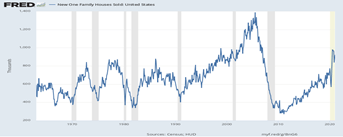
The Calculated Risk/FRED graph shows that new-home sales are approaching the 2000 level at the start of the last housing bubble that ultimately resulted in the Great Recession (blue bars are recessions). But that doesn’t mean we are at the beginning of another housing bubble.

New home sales for January were reported at 923,000 on a seasonally adjusted annual rate basis (SAAR), said US Census Bureau, resulting in the decline to just 4.0 months of supply remaining for sale. That and still record low interest rates are boosting prices. But there is no bubble forming because there is not enough supply to satisfy current demand. Sales for the previous three months were revised up, also.

Existing-home sales are soaring this early in the year as well because last year’s selling season had a delayed fall start due to the pandemic, according to the National Association of Realtors (NAR). We can expect this surge to also continue because of ongoing demand.

Total existing-home sales,https://www.nar.realtor/existing-home-sales, completed transactions that include single-family homes, townhomes, condominiums and co-ops, increased 0.6 percent from December to a seasonally-adjusted annual rate of 6.69 million in January. Sales in total climbed year-over-year, up 23.7 percent from a year ago (5.41 million in January 2020).

Demand is so hot that the median existing-home sales price rose to $303,900, 14.1 percent higher from one year ago. And as of the end of January, existing-home inventory fell to a record-low of 1.04 million units, down by 25.7 percent year-over-year – a record decline.

“Home sales continue to ascend in the first month of the year, as buyers quickly snatched up virtually every new listing coming on the market,” said NAR chief economist Lawrence Yun. “Sales easily could have been even 20% higher if there had been more inventory and more choices.”

Residential construction is pushing hard to catch up to demand, as I said last week. Privately-owned housing starts in December were at a huge seasonally adjusted annual rate of 1,669,000, said the Census Bureau. This is 5.8 percent above the revised November estimate of 1,578,000 and is 5.2 percent above the December 2019 rate of 1,587,000.

Home sales are repeating their traditional role as a leading indicator with economic growth predicted to surge this year. Economists are now predicting a ‘V’ shaped recovery with Deutsche Bank increasing its GDP growth forecasts for 2021 and 2022, assuming the final fiscal aid package will be worth $1.6 trillion to $1.7 trillion, reports Reuters. “Their inflation numbers pushed a bit higher too with risks on the upside,” wrote Jim Reid, a strategist at the bank.

Reuters also reports Pimco, one of the world’s largest fixed income managers, said in a research note that the additional stimulus could “contribute to 2021 real GDP growth of over 7%,” a level not seen since “the great inflationary episode of the 1970s-1980s.”

Chief economist Yun expects more jobs to return in his press release, which will spur home buying in the coming months. He predicts existing-home sales will reach at least 6.5 million in 2021, even as he says mortgage rates are likely to inch higher due to the rising budget deficit and higher inflation.

But interest rates are still at recession lows, with the 30-year conforming fixed interest rate currently 2.75 percent with one origination point for the best credit holders.

With housing inventory at the end of January down 25.7 percent from one year ago, the unsold existing-home inventory sits at a record 1.9-month supply at the current sales pace, down from the 3.1-month amount recorded in January 2020.

All this news means the housing revival will continue.  What better sign is there of a consumer spending revival this year?

Harlan Green © 2021

Follow Harlan Green on Twitter: https://twitter.com/HarlanGreen

Posted in Consumers, Housing, housing market, Weekly Financial News | Leave a comment

Retail Sales Start 2020’s Boom

Popular Economics Weekly

Calculated Risk

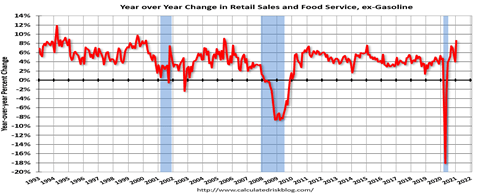
It looks like the 2020’s economy is beginning to roar as retail sales jumped 5.3 percent in January 2021, and 7.4 percent since last January. This is just as President Biden’s approximately $1.9 trillion American Rescue Plan wends its way through congress.Advance estimates of U.S. retail and food services sales for January 2021, adjusted for seasonal variation and holiday and trading-day differences, but not for price changes, were $568.2 billion, an increase of 5.3 percent from the previous month, and 7.4 percent above January 2020, said the US Census Bureau report.

Pundits and some economists worry that this is too much “untargeted” money sloshing around the economy already beginning to recover, including an additional $1400 per person that will supplement the $600 payments made in January to those making less than $75,000 per person.

Nobel laureate Paul Krugman does not think so, he said in a recent Op-ed, because those that need it will spend it immediately, while the less needy will squirrel it away for another rainy day; a good thing given these uncertain times.

And there is little inflation now, as the Consumer Price Index (CPI) retail inflation measure did not increase at all last month and is up just one percent over the past year.

Sales were strong in every category. Department store chains, Internet retailers, electronic stores and home-furnishing outlets all recorded double digit gains in percentage terms.

Bars and restaurants also registered a nearly 7 percent increase in sales after receipts had fallen three months in a row. Cold weather and new business restrictions imposed after a record increase in coronavirus cases, slammed restaurants toward the end of 2020, but states started to lift restrictions early in the new year as the pandemic began to wane again, reports MarketWatch’s Jeffry Bartash.

“The increase in spending last month was fueled in part by $600 federal stimulus checks for millions of Americans and more generous unemployment benefits. What also helped were loosened state restrictions on business brought on by a sharp decline in coronavirus cases,” said Bartash.

FREDrealpersonalincome

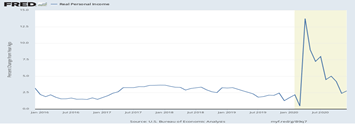
Now is not the time to worry about inflation, in other words. Rising prices increase profits and wages, especially in the recovery stage of this recession. Slow real personal income growth portrayed in this FRED graph has been one reason for slow economic growth since the Great Recession ended some 11 years ago and kept US from spending more on upgrading our deteriorating infrastructure.

Personal income has fluctuated between 2 to 3 percent since then, which is not enough to boost household incomes above the long-term inflation rate. In fact, household income has not risen enough for most Americans to weather such natural disasters as this pandemic, and what is to come with global warming and future geopolitical uncertainty that accompanies a changing climate (droughts, immigration woes, increasing wildfires, hurricanes, etc.)

The Texas freezes from the current Polar Vortex episode that could last through this weekend is but one example. As reported in the LA Times by a Houston reporter, “Extreme weather events are becoming more frequent and more severe as the climate crisis worsens. And the U.S. power grid is not prepared to handle the hotter heat storms, more frigid cold snaps and stronger hurricanes of a changing planet.”

What better time is there to prepare for such future emergencies?

Harlan Green © 2021

Follow Harlan Green on Twitter: https://twitter.com/HarlanGreen

Posted in Consumers, COVID-19, Economy, Keynesian economics, Weekly Financial News | Leave a comment