Finding the Path to Greater Prosperity!

Popular Economics Weekly
CenterforEquitableGrowth

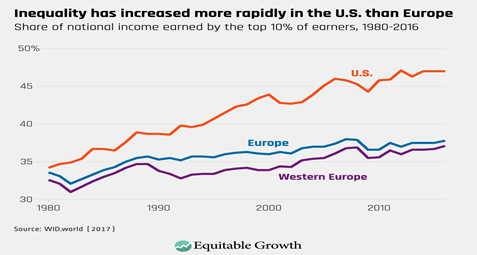
Economic theory is finally catching up to political theory by showing policymakers how to right the record income inequality—worst in the developed world—that has plagued working Americans since the 1970s.

It is about time when we have just witnessed one of the consequences of that inequality—the storming of the US Capital by domestic terrorists bent on overthrowing our duly-elected government that was in the midst of verifying the electoral victory of President-elect Joe Biden and Vice president-elect Kamala Harris.

Economists are modernizing New Deal Keynesian economics that brought us out of the Great Depression and World War II, the economics that says government must be part of the solution to today’s problems,; including the protection of workers’ rights, the environment, and keeping America strong and prosperous for all Americans, not just the one percent.

For instance, a recent MIT research project confirmed that Four decades ago, for most U.S. workers, “…the trajectory of productivity growth diverged from the trajectory of wage growth. This decoupling had baleful economic and social consequences: low-paid, insecure jobs held by non-college workers; low participation rates in the labor force; weak upward mobility across generations; and festering earnings and employment disparities among races that have not substantially improved in decades.”

Much of that divergence was caused by trickle-down economics, a political theory from the Reagan era that rationalized making the wealthy wealthier with the teaser that some of that wealth might trickle down to the 80 percent, which are wage and salary earners that power most economic activity.

While new technologies have contributed to these poor results that promote labor-saving AI and robotics, researchers are now saying these outcomes were not an inevitable consequence of technological change, nor of globalization, nor of market forces. Similar pressures from digitalization and globalization affected most industrialized countries, and yet their labor markets fared better.

It was, “…the decay of unions and collective bargaining, the explicit hardening of business (by the Business Roundtable formed in the 1970s), the popularity of right-to-work laws (mainly in conservative red states), and the fact that the wage lag seems to have begun at about the same time as the Reagan presidency all pointing he same direction: the share of wages in national value added may have fallen because social bargaining power of labor has diminished,” said the MIT study.

And therein lies the solution that only government policymakers and legislators can enact by expanding government healthcare, raising the minimum wage, more progressive taxation, making college education more affordable, and expanding workers’ collective bargaining rights that red state right-to-worker laws have drastically curtailed.

This list of economic can-dos has been obvious to any professional economist that has not been defending the one percent’s right to most of the wealth created by working Americans. Free market ideologies have held sway for the past 40 years—not based on empirical research—that advocated unfettered economic growth by any means, and enshrined maximized profits as the greatest good, while ignoring business ethics and a morality that promotes caring for our brothers and sisters.

The economic disparities are growing due to the pandemic, as I reported earlier. In April, nearly 12 million low-wage workers were laid off, while some 6 million workers who were earning between $18 to $29 an hour were laid off. By November, all but 400,000 of those workers earning $18 to $29 an hour had returned to work, Raj Chetty, a Harvard economics professor, has said. Meanwhile, some 6 million workers who earned less than $13 an hour have yet to return to work.

Now the coronavirus pandemic has reinforced the need for an economic science that recognizes we are all in this together. As many have said that is even truer today, we are poorer if we ignore the plight of the poorest.

Harlan Green © 2020

Follow Harlan Green on Twitter: https://twitter.com/HarlanGreen
Posted in Economy, Keynesian economics, Politics, Weekly Financial News | Leave a comment

Deaths of Despair, Part II—The Wall of Ignorance

Answering the Kennedys’ Call

NBER.org

Something can be done about the “Deaths of Despair” among the non-college educated white males that Anne Case and Angus Deaton have been writing about that I discussed in Deaths of Despair, Part I, and has been exacerbated by the current COVID-induced recession.

But first we must counteract the wall of ignorance that has blocked efforts to ameliorate their suffering to date, a wall that was built on the denial of scientific studies from epidemiologists and the Trump administration’s own experts at the CDC and other NIH entities.

The Trump administration is responsible for the misinformation campaign that has denied the efficacy of mask-wearing and testing to control the pandemic, for starters. And, harsh as it may sound, the Republican Party is largely responsible for the dumbing down of its electorate with its continual denial of scientific knowledge that confirms the basic facts for global warming and even evolution.

The coronavirus pandemic is wreaking havoc among the less-educated Americans, according to Case and Deaton, who wrote about the growing divide between those with a four-year college degree and those without in their recent book, Deaths of Despair and the Future of Capitalism.

“The rise in deaths that we describe is concentrated almost entirely among those without a bachelor’s degree, a qualification that also tends to divide people in terms of employment, remuneration, morbidity, marriage, and social esteem – all keys to a good life,’ said Case and Deaton.”

The economic disparities are growing due to the pandemic. In April, nearly 12 million low-wage workers were laid off, while some 6 million workers who were earning between $18 to $29 an hour were laid off. By November, all but 400,000 of those workers earning $18 to $29 an hour had returned to work, Raj Chetty, a Harvard economics professor, has said. Meanwhile, some 6 million workers who earned less than $13 an hour have yet to return to work.

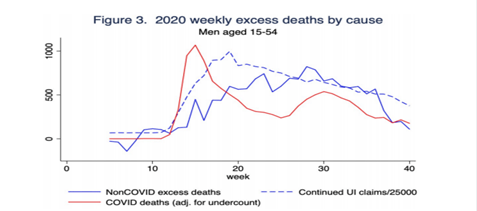
The pandemic and recession were associated with a 10 percent to 60 percent increase in deaths of despair above already high pre-pandemic levels, according to a working paper by Casey Mulligan, professor of economics at the University of Chicago. He found these non-COVID excess deaths are disproportionately experienced by men aged 15-55, per the above NBER graph.

“Mortality in 2020 significantly exceeds what would have occurred if official COVID deaths were combined with a normal number of deaths from other causes,” he wrote. “The demographic and time patterns of the non-COVID excess deaths (NCEDs) point to deaths of despair rather than an undercount of COVID deaths. The flow of NCEDs increased steadily from March to June and then plateaued. They were disproportionately experienced by working aged men, including men as young as aged 15 to 24.”

Because drug epidemics tend to follow major episodes of “social upheaval and destruction”, we can expect more of the same economic disparities and consequent social unrest that has followed, unless something is done.

And that requires a major educational effort to bolster K-12 public education institutions that have been purposely downplayed by Trump’s own Department of Education, in favor of private, for-profit learning, even transferring funds earmarked for public education to for-profit programs.

The high wall of ignorance that has built up over more than a decade of denial of scientific knowledge by one political party is a wall that needs to be torn down to even begin to mitigate the social unrest among those suffering from Deaths of Despair and rebuild their faith in democratic processes.

Harlan Green © 2020

Follow Harlan Green on Twitter: https://twitter.com/HarlanGreen

Posted in Consumers, Economy, Politics, Weekly Financial News | Leave a comment

The Rising Deaths of Despair Amid COVID-19

Financial FAQs

ProjectSyndicate

Evidence is beginning to mount that the Trump administrations half-hearted response to the COVID-19 pandemic was intentional. And we are seeing the results in mounting suicide and drug abuse rates among the populace most affected—the lesser educated—according to Professors Anne Case and Angus Deaton

President Trump confessed to Bob Woodward in February that he knew the COVID-19 virus was more deadly than the flu, even though he many times publicly asserted the opposite.

On March 13, Trump rolled out what was supposed to be a nationwide set of drive-thru testing facilities sited at thousands of “big box” retailers and backed by a website created by “7,000 engineers from Google.”

But Trump did not follow the announcement with an actual system of either testing or case tracing. The website that he cited did not exist. And the testing facilities themselves never went past a handful of poorly supplied locations mismanaged by Jared Kushner and his college buddies.

It was an intentional decision made by Trump and his White House staff to allow COVID-19 to ravage the country because he believed it would be to his political advantage.

Professor Timothy Snyder, author of the best-selling On Tyranny asserted in a recent Christine Amanpour interview that the policy of herd immunity was also a political decision. Trump was hoping that more voters in the blue states with minorities and where infection rates were highest at the time would be incapacitated.

The result of these policies of inaction backfired, as we now know. The red states and rural regions where the less educated live and that are the mainstay of his supporters became as infected.

Anne Case and Angus Deaton have confirmed these results in a Project-Syndicate article. The coronavirus pandemic is wreaking havoc among the less-educated Americans, according to Case and Deaton, who wrote about the growing divide between those with a four-year college degree and those without in their recent book, Deaths of Despair and the Future of Capitalism.

“The rise in deaths that we describe is concentrated almost entirely among those without a bachelor’s degree, a qualification that also tends to divide people in terms of employment, remuneration, morbidity, marriage, and social esteem – all keys to a good life,’ said Professors Case and Deaton; Deaton a 2015 Nobel Prize-winner in economics.

Even with the beginning of vaccinations, the two-thirds of Americans in service-oriented jobs in leisure and hospitality, entertainment, travel and transportation will still see a worsening situation, whereas white-collar gig workers that can work online won’t be as affected.

Even in the future when vaccinations will reduce the infection and death rates, “The same cannot be said for deaths of despair (suicide, accidental drug overdose, and alcoholic live disease), of which there were 164,000 in 2019, compared with the past “normal” US level of roughly 60,000 per year (based on data from the 1980s and early 1990s),” write Case and Deaton.

COVIDTrackingProject

It is the less-educated workers that will be most affected with our inadequate employer-based, exorbitantly expensive health care system that only works for those with a job. And because drug epidemics tend to follow major episodes of “social upheaval and destruction”, say Case and Deaton, we can expect more of the same economic disparities and consequent social unrest in the future, unless something is done about it.

Through November 2020, the economy lost 9.37 million jobs, writes Calculated Risk.   By April 2020, the economy had lost 21.7 million jobs, and then added back 12.33 million jobs by November.  But job growth has slowed over the last few months, even as stocks have soared. 

Let us therefore hope that we set up future job growth, educational and social welfare policies that address and bring down the horrific deaths of despair totals, so that we do not see a resurgence of political opportunism evinced by Trump and the Republican Party that has cost so many lives and livelihoods.

Harlan Green © 2021

Follow Harlan Green on Twitter: https://twitter.com/HarlanGreen

Posted in Economy, Politics, Weekly Financial News | Leave a comment

What Happened to Our Leaders?

Answering the Kennedys’ Call

Wikipedia

President-Elect Biden is 78 years old, and will be the oldest President in our history when he is sworn in. He continues to uphold the recent age levels of POTUS set by Donald Trump (74), Presidents Eisenhower, Reagan and GHW Bush that were all over 70 by the time they left office.

The NY Times Ian Philbrick reports that we have the oldest leaders in the western developed countries at a time when the age of elected leaders in other developed countries is falling. 

“Since 1950, the average age of heads of government in the three dozen member countries of the Organization for Economic Cooperation and Development has steadily declined, from above 60 years old to around 54 today. The average O.E.C.D. national leader is now two decades younger than Mr. Trump — and almost a quarter century younger than Mr. Biden.”

Why does that matter? I believe it is a major reason for the slow slide into populism and the dysfunctional democracy we currently endure without the increased social and economic benefits enjoyed by citizens of other western developed countries with younger and more forward-looking leaders.

The slide into a federal government led by President Donald Trump that is barely able to function has resulted in our inability to manage the new coronavirus pandemic that is infecting and killing a record number of Americans.

We seem to crave the appearance of strong leadership even if he or she eschews the main requirement of leadership, namely the necessity to keep our 50 different states plus territories, each with its own system of governance, safe and united in common purpose.

“Since 1950, the average age of heads of government in the three dozen member countries of the Organization for Economic Cooperation and Development has steadily declined, from above 60 years old to around 54 today. The average O.E.C.D. national leader is now two decades younger than Mr. Trump — and almost a quarter century younger than Mr. Biden.”

The Trump administration’s one legislative accomplishment was the 2017 Tax Cut and Jobs Act that resulted in the first $1 trillion annual budget deficit in our history, while Republicans failed in more than 80 attempts to repeal Obamacare.

Our federal government has become out of touch with younger generations in particular that are almost unanimous in wanting better schools, universal health care, a higher minimum wage, and other benefits now enjoyed by all other developed countries.

Pew Research Center survey conducted in January of this year found that about a quarter of registered voters ages 18 to 23 (22 percent) approved of how Donald Trump is handling his job as president, while about three-quarters disapproved (77 percent). Millennial voters were only slightly more likely to approve of Trump (32 percent) while 42 percent of Gen X voters, 48 percent of Baby Boomers and 57 percent of those in the Silent Generation approved of the job he is doing as president.

The Times also points out that the average age of Congress has also trended upward for decades. Nancy Pelosi, the House speaker, is 80; Mitch McConnell, the Senate majority leader, is 78. The Supreme Court’s nine justices average above 67. Mr. Trump’s cabinet averages over 60, among the oldest in the O.E.C.D.

Even younger Republicans follow Democrats in wanting more benefits in the PEW survey. Gen Z Republicans, for instance, are much more likely than older generations of Republicans to desire an increased government role in solving problems, says PEW.

“About half (52%) of Republican Gen Zers say government should do more, compared with 38% of Millennials, 29% of Gen Xers and even smaller shares among older generations. And the youngest Republicans are less likely than their older counterparts to attribute the earth’s warming temperatures to natural patterns, as opposed to human activity (18% of Gen Z Republicans say this, compared with three-in-ten or more among older generations of Republicans).”

Looked at in economic terms, our slide into extreme conservatism instituted by Ronald Reagan and the Republican Party with their credo of lower taxes and an unregulated, free market capitalist ideology, is the reason we have a federal government out of touch with most Americans.

Whereas our European cousins enjoy universal health care, higher minimum wages, and shorter work weeks for the same pay; all brought about by keeping their governments young and able to adapt to even a COVID-19 pandemic.

So where are the leaders to come that will bring in programs and policies that will govern for future generations, rather than cater to the populace of the past?

Harlan Green © 2020

Follow Harlan Green on Twitter: https://twitter.com/HarlanGreen

Posted in Economy, Politics, Uncategorized | Leave a comment

Recovery Slows As Pandemic Surges

Financial FAQs

ChicagoFed

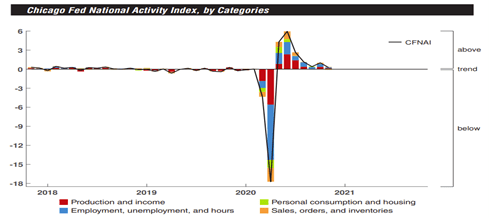
This Chicago Federal Reserve graph of national activity starkly portrays the present state of the US economy. The multi-colored bar represents deviations from the historical growth average, which is the zero line on graph. It is still barely positive though down sharply from May and June when the business lockdown ended.

“Led by slower growth in employment- and production-related indicators, the Chicago Fed National Activity Index (CFNAI) declined to +0.27 in November from +1.01 in October. Three of the four broad categories of indicators used to construct the index (production and income, employment, sales and inventories) made positive contributions in November, while personal consumption and housing declined slightly, but all four categories decreased from October. The index’s three-month moving average, CFNAI-MA3, decreased to +0.56 in November from +0.85 in October.”

COVIDTrackingProject

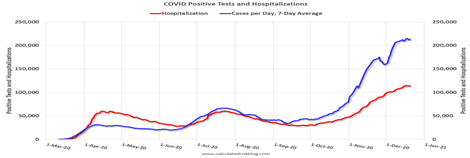
This is because successive surges in infections have had consumers saving more and spending less, while manufacturing continues to chug along. The pandemic is just not manageable at the current infections rate with more than 200,000 per day (blue line in graph) now testing positive and more than 100,000 per day (red line) being hospitalized with the virus.

It is easy to see the inverse correlation in these graphs. As total infections in cases per day rise (blue line) economic activity in the Chicago Fed bar graph declines.

There is better news coming as more than 144,000 vaccinations have already been administered in 21 states, according to the COVID Tracking Project.

MarketWatch reports that new daily cases of COVID-19 fell to 179,801 on Sunday from 193,947 on Saturday, and down from 251,447 on Friday, according to data provided by the New York Times. The daily death toll was 1,422 on Sunday, down from 2,628 on Saturday and from 2,815 on Friday.

And hospitalizations dropped to 113,630 on Sunday from 113,929 on Saturday and 113,955 on Friday, according to the COVID Tracking Project. That 3-day streak of declines snapped a 12-day streak of record hospitalizations.

But the Christmas holidays have just begun with many more traveling to family and vacation destinations, which will cause another surge in the new year and keep most consumers at home for a longer period.

In looking back at the history of the Spanish flu, there was another infection surge in the spring of 1919, even as the warm weather returned. It actually took several more years for that economy to stutter back to life.

And it will in fact take much more federal aid than the just passed $900 billion coronavirus relief package to bring back any meaningful recovery for most Americans because so many lost jobs; something the incoming Biden administration will have to tackle.

Harlan Green © 2020

Follow Harlan Green on Twitter: https://twitter.com/HarlanGreen
Posted in Consumers, Economy, Politics, Weekly Financial News | Leave a comment

What Civil War?

Answering the Kennedys’ Call

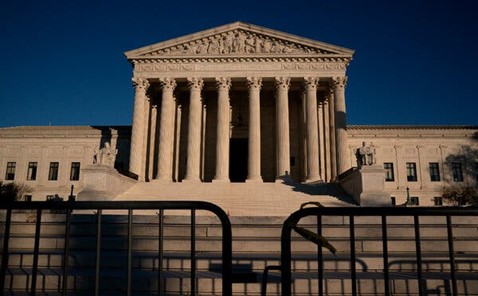
Texas, 17 other red state Attorneys General, and 126 Republican House members tried to keep President Trump in power after January 20 by breaking election laws and ignoring the United States Constitution. But the Supreme Court, arbiter of the Constitution, said they had no basis to sue four Democratic states after the election had been decided.

This has led Texas’ GOP Party Chair Alan West to suggest that these states should secede from the United States (which was quickly disavowed by other state GOP leaders).

West and Texas Republicans were in fact still fighting their own version of the 1860s civil war that abolished slavery in suing to overturn the will of a majority of Americans. President-Elect Biden was certified by the Electoral College as our new POTUS and Kamala Harris as our new Vice-President Elect on December 7.

Turning the Supreme Court’s decision on its head, West said, “This decision establishes a precedent that says states can violate the US constitution and not be held accountable,” in a statement following SCOTUS’s Friday-night ruling. “Perhaps law-abiding states should bond together and form a Union of states that will abide by the constitution.”

Turning the Supreme Court’s decision on its head, West said, “This decision establishes a precedent that says states can violate the US constitution and not be held accountable,” in a statement following SCOTUS’s Friday-night ruling. “Perhaps law-abiding states should bond together and form a Union of states that will abide by the constitution.”

Ben Schatz, the Democratic senator for Hawaii, said Mr West’s statement revealed that the Texas Republican Party had lost its mind, in a post to Twitter.

“The Texas Republican Party is officially in favor of leaving the Union. They have lost their minds,” wrote Mr Schatz. “Biden will be President, but these people are deadly serious about secession and sedition.” 

If those red states had ever thought about what they were doing, or even why they were doing it—which they obviously hadn’t—they would have realized many would be bankrupted if they ever wanted a separate union.

They would be in danger of losing much of $437.596 billion in transfer payments made to them from the federal government that is above what they contributed to the US Treasury in FY 2018, according to the Rockefeller Foundation.

There were six states like New York and New Jersey that have large tax revenue surpluses totaling $53.7 billion which are distributed to poorer, mostly red states by the federal government, such as Kentucky that has a $45 billion deficit in their balance of tax payments with the federal government.

The tax surpluses from the richer states are paid out as part of transfer payments (e.g., social security, Medicare, Medicaid, SNAP, welfare) to members of the poorer, mostly red states.

This in fact is why America is a prosperous country—wealthy states help to support the federal programs of citizens in the poorer states. No one state can pull down other states because of its financial problems, and its citizens know they will be covered by our central government, whether in blue or red states.

Then why have Republicans under Trump continued their attempts to overturn the election results? NY Times’ Op-ed columnist Charles Blow said it best. Trump realized that trying to steal the presidency is more lucrative than being president with his calls for donations to his re-election Super Pac that now total more than $200M. In conning his base into believing he won the election, “We are witnessing one of the greatest grifts in history,” said Blow.

Harlan Green © 2020

Follow Harlan Green on Twitter: https://twitter.com/HarlanGreen
Posted in Politics, Uncategorized | Tagged | Leave a comment

Retail Sales, Consumer Spending Falter

Financial FAQs

FREDretailsales

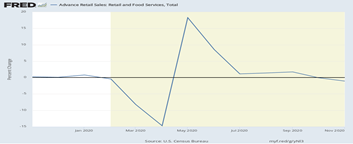
Sales at U.S. retailers fell in November for the second month in a row and posted the biggest decline since the onset of the pandemic, showing effects of the record rise in coronavirus cases. Retail sales fell -1.1 percent last month, the government said Wednesday

Sales began falling in February at the beginning of the COVID-19 recession, the gray shading in the St. Louis FED graph. It plunged -15 percent in April and jumped almost 40 percent to a +20 percent increase in June, as the various lockdown measures were eased and people went back to work. But oh, those holidays beginning with the Memorial Day and summer vacations that brought back the virus and spending declined again.

Sales fell at restaurants, auto dealers, gas stations, clothing stores, department stores and places that sell home furnishings and electronics. The only segments to post higher sales were suppliers of essentials; grocers, home centers and Internet retailers — and even then the increase in receipts were small.

Bars and restaurants suffered a 4 percent drop in sales, marking the second decline in a row and the largest since April during the height of the pandemic. More people avoided going out to eat or were unable to do so because of new government limits on indoor dining or hours of operation.

Sales also fell 1.7 percent last month at auto dealers, but it has been a good year for the industry. Low interest rates have helped boost sales and more people are driving instead of taking public transportation, say the number crunchers.

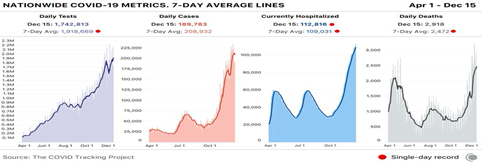
This is mainly because coronavirus infection rates have barely begun to flatten the curve. The COVI-19 Project reported 1.7 million tests, 190k cases, and 2,918 deaths, 112,816 people are currently hospitalized with COVID-19 on Tuesday. Current hospitalizations are falling in the Midwest and rising in the Northeast and Western states, per the project.

COVIDTracker

But next year may be different when the vaccines reach most Americans. Federal Reserve Chair Powell on Wednesday predicted the U.S. unemployment rate would fall faster in 2021 than it previously believed, but it stuck to a cautious forecast for the broader U.S. economic recovery.

The Fed slightly raised its 2021 forecast for economic growth to 4.2 percent from 4.1 percent, reported MarketWatch, “indicating continued caution on the part of central bank officials as they wait to see how effective the new vaccines for the coronavirus perform.”

‘The official unemployment rate slid to a new pandemic low of 6.7 percent in November and has declined a lot faster than expected, but economists also say it likely underestimates the true number of jobless Americans.”

The vaccines began rolling out in the past week. Chairman Powell also said they would do whatever it takes to keep interest rates low and credit easily available to banks and businesses for maybe years to come.

As I said earlier, there is a path to economic recovery from the worst recession since the Great Recession. The Fed is on board to assist for the foreseeable future, but will congress do its part?

They are close to agreement on a bill slightly less than $1 billion that will be announced later this week. But we have to first control the pandemic.

Harlan Green © 2020

Follow Harlan Green on Twitter: https://twitter.com/HarlanGreen
Posted in Consumers, Economy, Weekly Financial News | Leave a comment

The Path to Economic Recovery—Part II

Financial FAQs

Calculated Risk

As I said in Part I of this series, there is a path to economic recovery from the worst recession since the Great Recession. Firstly, it means studying what economic policies have worked in past recoveries.

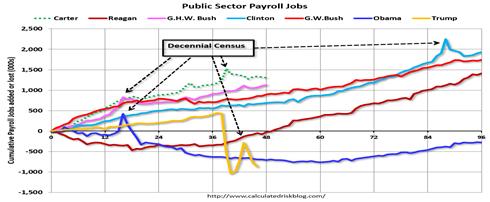
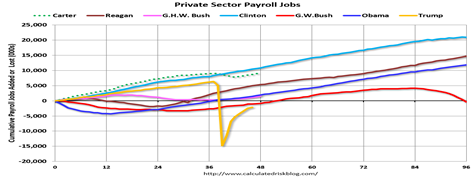
It you use job formation as the most important criteria for success, then the Clinton administration wins with its mix of government and private sector programs that cut military spending with the end of the cold war and increase in public spending at no more than 2 percent per year. The policies resulted in four years of budget surpluses from 1996-2000.

The cold war dividend also resulted in the second longest economic recovery on record—1991-2001—only topped by the Obama-Trump era recoveries cut short in February by the pandemic.

Private sector employment increased by 20,970,000 under President Clinton (light blue) in the excellent Calculated Risk, by 14,714,000 under President Reagan (dark red), 11,849,000 under President Obama (dark blue). 9,039,000 under President Carter (dashed green), and 1,511,000 under President G.H.W. Bush (light purple).

But because of COVID-19 during the 46 months of Mr. Trump’s term, the economy has lost 2,128,000 private sector jobs (yellow line) to date.

What happened? Most jobs were created, when government spending kicked in to supplement consumer and business activities. Coincidence doesn’t spell facts, as I’ve said, but we can see what worked and to create jobs.

Public payrolls also grew most also during Democratic administrations with the exception of the Reagan administration that wanted to outspend Russia in their arms race. Payrolls grew during Mr. Carter’s term (up 1,304,000), then Mr. Reagan’s terms (up 1,414,000), H.G.W. Bush’s term (up 1,127,000), during Mr. Clinton’s terms (up 1,934,000), and during Mr. G.W. Bush’s terms (up 1,744,000 jobs). 

However the public sector declined significantly while Mr. Obama was in office (down 277,000 jobs), and during the 46 months of Mr. Trump’s term, the economy has lost 870,000 public sector jobs.

Calculated Risk

What exactly did Clinton do to create 10 years of prosperity with budget surpluses to boot?? He was not afraid to raise taxes where it was needed to pay for programs that created more jobs, rather than raise the public debt.

He increased taxes with the Omnibus Budget Reconciliation Act of 1993, his first budget. The Deficit Reduction Act raised the top income tax rate from 28 percent to 36 percent for those earning more than $115,000, and 39.6 percent for income above $250,000. It increased the corporate income tax from 34 percent to 36 percent for corporations with incomes over $10 million.

It also ended some corporate subsidies, taxed Social Security benefits for high-income earners, and created the earned income tax credit for incomes under $30,000. It raised the gas tax by 4.3 cents per gallon. It also limited the ability of corporations to claim entertainment tax deductions.

The +10 years of tepid economic growth since 2010 were caused in part by limiting government programs (e.g., in infrastructure, scientific research) that would have boosted jobs and growth, and because President Obama chose to focus on bringing down national debt after the initial $800B ARRA aid package enacted to assist recovery from the Great Recession.

The irony in this history is that economists are already predicting a huge economic recovery next year once enough Americans have been vaccinated, as happened with the recovery from the 1918-19 Spanish flu-induced recession, and which became known as the euphoric “roaring twenties”.

Harlan Green © 2020

Follow Harlan Green on Twitter: https://twitter.com/HarlanGreen
Posted in Consumers, Economy, Keynesian economics, Politics, Weekly Financial News | Leave a comment

The Path to Economic Recovery

Financial FAQs

Calculated Risk

There is a path to economic recovery from the worst recession since the Great Recession—and maybe the Great Depression. But it means escaping from the free market economic orthodoxy that has prevailed since 1980, and which has been the major contributing factor of six recessions since 1980, all occurring during Republican administrations.

Concurring events don’t necessarily determine facts, but we know such a boom and bust mentality has been the hallmark of conservative calls for fewer regulations and lower taxes historically. The Federal Reserve was created in 1913 to even out such booms and busts after the stock swindles of the early 1900’s Gilded Era, and the ‘roaring twenties’ financial markets that led to the 1928 market crash and ultimately Great Depression were also eras when governments had few regulations to tame such speculation.

The most recent example occurred during the Clinton administration when budget surpluses were generated during his last four years. The moment President Bush took office, Vice President Cheney trumpeted Reagan’s maxim that “budget deficits don’t matter,” and fired Paul O’Neill, his first budget-conscious budget director that had recommended using the surplus to pay down the national debt to shore up social security and other social programs.

Bush instead proceeded to cut taxes so much that the first $trillion national debt was born and two recessions followed during his eight years, including the Great Recession of 2007.

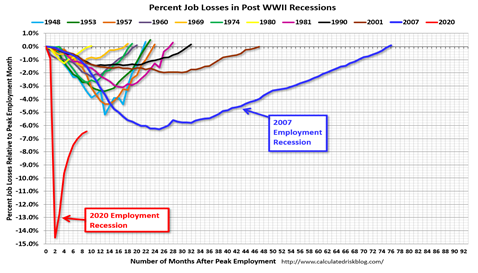
In fact, if we look at Calculated Risk’s graph history of job loss durations since 1948, we see that the longest job recoveries took place during the 1980 (black line), 2001 (brown line), 2007 (blue line), and 2020 (red line) recessions; all during Republican administrations when budget deficits no longer mattered, as I said.

It goes back to the conservative free market, small government orthodoxy that government regulations retard growth, when since 1980 it has been the de-regulation of whole industries and championing of free-market maxims that have increased the boom and bust cycles we have seen since then, while worsening our income inequality.

There is much more that went into these recessions, of course, such as Reagan’s the cold war arms race with Russia, the Desert Storm Gulf War of GW Bush, and Iraq-Afghanistan invasions of GW Bush that they paid for with borrowed money.

But the dire results of such free market orthodoxy are incontrovertible, as Rutger’s economic history James Livingston put it once in a memorable NY Times Op-ed that described what corporations do with most of their profits these days.

In the early 1900s, most business investment came from the private sector, not government, whereas by 2000 most of such investments—in public projects as well as research to develop new products and services—came from government.

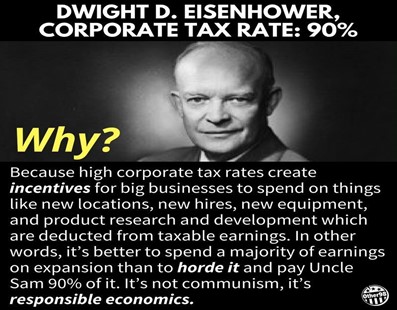
And that was in large part because of the sky-high tax rates for the wealthiest and corporations that prevailed immediately after World War Two—as high as 90 percent during the Eisenhower years and beyond. As President Eisenhower once put it, higher taxes induce people and businesses to invest more in their future, rather than pay Uncle Sam.

“So corporate profits do not drive economic growth — they’re just restless sums of surplus capital,” Professor Livingston wrote, “ready to flood speculative markets at home and abroad. In the 1920s, they inflated the stock market bubble, and then caused the Great Crash. Since the Reagan revolution, these superfluous profits have fed corporate mergers and takeovers, driven the dot-com craze, financed the “shadow banking” system of hedge funds and securitized investment vehicles, fueled monetary meltdowns in every hemisphere and inflated the housing bubble.”

The COVID-19 pandemic has created the need to do what was done when past generations faced the Great Depression and World War Two. They are government policies (more progressive taxation is one such) that will induce US to create more sustainable growth paths with fewer booms and busts, as President Eisenhower foresaw.

Harlan Green © 2020

Follow Harlan Green on Twitter: https://twitter.com/HarlanGreen
Posted in Consumers, Economy, Keynesian economics, Politics, Weekly Financial News | Tagged , , , , | Leave a comment

Unemployment Report Shows Economic Toll From COVID-19

Popular Economics Weekly

MarketWatch

Economists have been asking what if we have a ‘double-dip’ recession; i.e., should the US economy return to negative growth in the fourth quarter or Q1 of 2021? The Bureau of Labor Statistics (BLS) unemployment report is showing signs that it may happen early next year with the nonfarm payroll job creation of just 245,000 nonfarm payroll jobs in November, down from 610,000 jobs in October and 711,000 jobs in September.

Government payrolls declined almost 100,000, while private payrolls grew 344,000, the BLS reported. “Notable job gains occurred over the month in transportation and warehousing, professional and business services, and health care. Employment in transportation and warehousing rose by 145,000 in November but is 123,000 below its February level; employment rose by 82,000 in couriers and messengers and by 37,000 in warehousing and storage since February.“

The unemployment rate dropped one-tenth of a point to 6.7 percent because 400,000 stopped looking for work.

Calculated Risk

The Calculated Risk graph compares job losses since 1948, with the blue line a picture of the length in months of the 2007 Great Recession losses until returning to the prior employment peak and red line the current COVID-19 induced losses. It also dramatizes the huge the gap in current losses that must be closed to return to normal job growth.

When can that be when U.S. has the highest case tally in the world at 14.1 million and the highest death toll at 276,401, or more than a fifth of the global total as of yesterday? The U.S. counted 216,548 new cases on Thursday, and at least 2,857 people died, just below the record of 2,885 set a day earlier, according to a New York Times tracker.

“In November, 21.8 percent of employed persons teleworked because of the coronavirus pandemic, up from 21.2 percent in October,’ said the BLS. “In November, 14.8 million persons reported that they had been unable to work because their employer closed or lost business due to the pandemic—that is, they did not work at all or worked fewer hours at some point in the last 4 weeks due to the pandemic.”

There were now a record 100,667 COVID-19 patients in U.S. hospitals on Thursday, according to the COVID Tracking Project, topping Wednesday’s record of 100,226. Brazil has now the second highest death toll at 175,270 and is third by cases at 6.5 million. India is second worldwide in cases with 9.6 million, and third in deaths at 139,188. Mexico has the fourth highest death toll at 108,173 and 11th highest case tally at and 1.7 million cases, or sixth highest in the world.

That is a lot of growth to make up in the midst of this pandemic, when there is no surety of when it will end, and double-dip recessions are nothing new in our current boom or bust economic system, as I said recently. Will that change Democrats assuming power in January?

HarlanGreen © 2020

Follow Harlan Green on Twitter: https://twitter.com/HarlanGreen
Posted in Uncategorized | Tagged , , | Leave a comment