Why Has U.S. Made Such a Mess of It?

Popular Economics Weekly
image

Wrightson.com

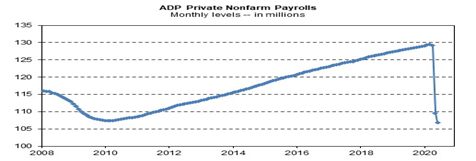
Private sector employment decreased by – 2,760,000 jobs from April to May according to the May ADP National Employment Report®, much less than the original estimate of –8 million jobs. It precedes Friday’s official government unemployment report for May.

Should we be thankful it wasn’t worse when the U.S. recovery from COVID-19 has been more damaging than in most other developed countries?

From Japan to Australia to Germany, the April unemployment rates were no more than 6.2 percent in April vs. our 14.8 percent, because they hadn’t mishandled the pandemic as had the U.S.

Friday’s unemployment report is predicted to show the U.S. May unemployment rate rising from 14.8 percent to about 19 percent. From Japan to Australia to Germany, the April unemployment rates were no more than 6.2 percent, because they hadn’t mishandled the pandemic as had the U.S.

We weren’t prepared, in other words, and with the George Floyd killing and protests, there will be even more chaos as angry protestors precipitate higher COVID-19 infection rates and shut down businesses that are just opening.

It didn’t have to be this way. President Obama had set up a commission to study police violence and policing policies, but the Trump administration abolished it as they abolished the National Security Council commission that advised the White House on how to prepare US for pandemics.

Nothing was done to prepare Americans for either of the long predicted events, in other words. It was more important for President Trump to want to abolish President Obama’s accomplishments, rather than build on them.

Such is the cost of one political party’s single-minded focus on maintaining power and what amounts to an apartheid policy—discriminating against darker-skinned people, including immigrants—that Republicans risk taking down American democracy itself.

Nobel Laureate economist Paul Krugman lamented this in a recent opinion column.

“Every day, it seems, brings another indicator of our decline: the can-do nation has become a land that can’t deal with a pandemic, the leader of the free world has become a destroyer of international institutions, the birthplace of modern democracy is ruled by would-be authoritarians. How can everything be going so wrong, so fast?”

“Well, we know the answer,” he said. “As Joe Biden put it, “the original sin of slavery stains our country today.”

What have most other developed countries done to control COVID-19? They were prepared. Australian Prime Minister Scott Morrison, a staunch conservative, listened to the scientists that predicted the oncoming pandemic early.

According to the NYTimes,“Scientists, whom Mr. Morrison’s party has derided for over a decade, were respectfully asked for their views about the novel coronavirus and, more remarkable still, these views were acted on and amplified. Mr. Morrison dismissed the idea of trying to build herd immunity among the population, calling it a “death sentence.”

Angela Merkel, Germany’s Prime Minister had a scientific background as a former research scientist with a doctorate in quantum chemistry who once co-authored a paper on the “influence of spatial correlations on the rate of chemical reactions”, according to the Guardian.

She was able to explain why abandoning the lockdown early was so dangerous to Germans, as did New York Governor Andrew Cuomo at his daily briefings.

“If the reproduction number (infection rate) of one were to go up to 1.1, Merkel explained, the German health system could be overwhelmed by October. If it were to go up to 1.2, hospitals could reach a crisis point in July, and if it went up to 1.3 the crisis point would come in June.”

Why would Republicans discount science and scientists such as Dr. Fauci, director of the Institute of Allergies and Infectious Diseases, and demote Dr, Rick Bright, former director of the Biomedical Advanced Research and Development Authority (BARDA) at HHS?

It’s very sad to see one of our two political parties be so oblivious to what has happened and is about to happen.

Prime Minister Morrison, as much an ideological opportunist as Trump, was smart enough to listen to his scientists. “That’s the advice we have taken.” Mr. Morrison went so far as to declare: “Today is not about ideologies. We checked those at the door.”

But I see hope.  The Republicans’ modern history of denigrating anything scientific that doesn’t preserve the status quo or forward their ideological agenda to maintain power is their vain attempt to defeat Mother Nature, and it won’t work. 

Harlan Green © 2020

Follow Harlan Green on Twitter: https://twitter.com/HarlanGreen

Posted in Economy, Macro Economics, Politics, Weekly Financial News | Tagged , , , , , | Leave a comment

Why Has U.S. Made Such a Mess of It?

Popular Economics Weekly

image

Wrightson.com

Private sector employment decreased by – 2,760,000 jobs from April to May according to the May ADP National Employment Report® released today that precedes Friday’s official government unemployment report for May.

Friday’s unemployment report is predicted to show the U.S. May unemployment rate rising from 14.8 percent to about 19 percent. Reuters originally predicted this morning’s Associated Data Processing (ADP) report of private payrolls would be much worse. But instead “it suggests that a decline of 4 to 5 million in Friday’s BLS series is more likely than our original estimate of -8 million.”

Why should we be thankful it wasn’t worse when the U.S. recovery from COVID-19 has been more damaging than in most other developed countries?

From Japan to Australia to Germany, the April unemployment rates were no more than 6.2 percent in April vs. our 14.8 percent, because they hadn’t mishandled the pandemic as had the U.S.

We weren’t prepared, in other words, and with the George Floyd killing and protests, there will be even more chaos as angry protestors precipitate higher COVID-19 infection rates and shut down businesses that are just opening.

It didn’t have to be this way. President Obama had set up a commission to study police violence and policing policies, but the Trump administration abolished it as they abolished the National Security Council commission that advised the White House on how to prepare US for pandemics.

Nothing was done to prepare Americans for either of the long predicted events, in other words. It was more important for President Trump to want to abolish President Obama’s accomplishments, rather than build on them.

Such is the cost of one political party’s single-minded focus on maintaining power and what amounts to an apartheid policy—discriminating against darker-skinned people, including immigrants—that Republicans risk taking down American democracy itself.

Nobel Laureate economist Paul Krugman lamented this in a recent opinion column.

“Every day, it seems, brings another indicator of our decline: the can-do nation has become a land that can’t deal with a pandemic, the leader of the free world has become a destroyer of international institutions, the birthplace of modern democracy is ruled by would-be authoritarians. How can everything be going so wrong, so fast?”

“Well, we know the answer,” he said. “As Joe Biden put it, “the original sin of slavery stains our country today.”

What have most other developed countries done to control COVID-19? They were prepared. Australian Prime Minister Scott Morrison, a staunch conservative, listened to the scientists that predicted the oncoming pandemic early.

According to the NYTimes,“Scientists, whom Mr. Morrison’s party has derided for over a decade, were respectfully asked for their views about the novel coronavirus and, more remarkable still, these views were acted on and amplified. Mr. Morrison dismissed the idea of trying to build herd immunity among the population, calling it a “death sentence.”

Angela Merkel, Germany’s Prime Minister had a scientific background as a former research scientist with a doctorate in quantum chemistry who once co-authored a paper on the “influence of spatial correlations on the rate of chemical reactions”, according to the Guardian.

She was able to explain why abandoning the lockdown early was so dangerous to Germans, as did New York Governor Andrew Cuomo at his daily briefings.

“If the reproduction number (infection rate) of one were to go up to 1.1, Merkel explained, the German health system could be overwhelmed by October. If it were to go up to 1.2, hospitals could reach a crisis point in July, and if it went up to 1.3 the crisis point would come in June.”

Why would Republicans discount science and scientists such as Dr. Fauci, director of the Institute of Allergies and Infectious Diseases, and demote Dr, Rick Bright, former director of the Biomedical Advanced Research and Development Authority (BARDA) at HHS?

It’s very sad to see one of our two political parties be so oblivious to what has happened and is about to happen.

Prime Minister Morrison, as much an ideological opportunist as Trump, was smart enough to listen to his scientists. “That’s the advice we have taken.” Mr. Morrison went so far as to declare: “Today is not about ideologies. We checked those at the door.”

But I see hope.  The Republicans’ modern history of denigrating anything scientific that doesn’t preserve the status quo or forward their ideological agenda to maintain power is their vain attempt to defeat Mother Nature, and it won’t work. 

Harlan Green © 2020

Follow Harlan Green on Twitter: https://twitter.com/HarlanGreen

Posted in Economy, Politics, Weekly Financial News | Tagged , , , , , | Leave a comment

Why the Housing Shortage?

The Mortgage Corner

image

Wrightson.com

We are now beginning to feel the recession in housing caused by the Coronavirus pandemic. What can we say with so many living on the edge because of the loss, or temporary hiatus, of their jobs? There’s still a housing shortage, for starters.

Some homeowners are falling behind on their mortgage payments, but the majority are protected from default proceedings for at least one year, if their mortgages were guaranteed by any of the government-guaranteed GSEs like Fannie, Freddie, FHA, and VA. So no one is expecting defaults to raise the number of homes available for sale.

Forbes Magazine reported on a January NAR survey that America’s housing shortage is long lasting. According to their analysis, the market needs a whopping 3.8 million additional new homes to fully meet consumer demand.

“Since 2012, nearly 10 million new households were formed in the U.S. Only 5.92 million single-family homes were built in that same period, leaving what Javier Vivas, Realtor.com’s director of economic research, calls “a nearly insatiable appetite from potential buyers, especially in the lower end of the market.”

Why? Builders were so badly burned by the housing bubble, Great Recession, and lack of entry-level homebuyers. whose incomes had suffered most from the Great Recession, that they haven’t really begun to catch up to demand.

The recovery in home sales and construction is now largely dependent on how many jobs remain after the pandemic, which in part depends on whether the Senate agrees to more financial aid to state and local governments that employ most of the “essential” workers taking care of our health and safety.

NAR’s chief economist Lawrence Yun is surprisingly optimistic about the housing market. “Given the surprising resiliency of the housing market in the midst of the pandemic, the outlook for the remainder of the year has been upgraded for both home sales and prices, with home sales to decline by only 11 percent in 2020 with the median home price projected to increase by 4%,” Yun said. “In the prior forecast, sales were expected to fall by 15 percent and there was no increase in home price.”

Why does he know this? Mortgage application volumes have been picking up in spite of the stay-in-home orders. Home owners and buyers have been been taking advantage of the still record-low interest rates to improve their overhead costs.

The Mortgage Bankers Association (MBA) Market Composite Index, a measure of mortgage loan application volume, increased 2.7 percent on a seasonally adjusted basis from one week earlier.

“The housing market is continuing its path to recovery as various states reopen, leading to more buyers resuming their home search. Purchase applications increased 9 percent last week – the sixth consecutive weekly increase and a jump of 54 percent since early April. Additionally, the purchase loan amount has increased steadily in recent weeks and is now at its highest level since mid-March,” said Joel Kan, MBA’s Associate Vice President of Economic and Industry Forecasting.

Both pending home sales and existing-home sales are falling during the pandemic, but maybe not for long.

The Pending Home Sales Index (PHSI),* www.nar.realtor/pending-home-sales, a forward-looking indicator of home sales based on contract signings, fell 21.8 percent to 69.0 in April. Year-over-year, contract signings shrank 33.8 percent. An index of 100 is equal to the level of contract activity in 2001, according to the National Association of Realtors (NAR).

Total existing-home sales, https://www.nar.realtor/existing-home-sales, completed transactions that include single-family homes, townhomes, condominiums and co-ops, dropped 17.8 percent from March to a seasonally-adjusted annual rate of 4.33 million in April, said the NAR, also not a surprise, and are down 17.2 percent from a year ago (5.23 million in April 2019).

More surprising was that housing prices are still rising, signaling there is still a strong demand because we still have that housing shortage in many markets. The median existing-home price for all housing types in April was $286,800, up 7.4 percent from April 2019 ($267,000), as prices increased in every region. April’s national price increase marks 98 straight months of year-over-year gains.

We also know that existing-home inventories are historically low. Total homes for sale at the end of April totaled 1.47 million units, down 1.3 percent from March, and down 19.7 percent from one year ago (1.83 million). Unsold inventory sits at a 4.1-month supply at the current sales pace, up from 3.4-months in March and down from the 4.2-month figure recorded in April 2019, when 6 months is the historical norm.

How many will lose their homes before this recession ends? That is the $64 question. Housing is being remarkably resilient with so many uncertainties. In my opinion, the majority of home owners or whannabe owners have to be in the top 10-20 percent income brackets not as affected by the pandemic.

Alas, it has be be because lower-income households that have suffered the most from this pandemic are mostly renters not in any position to own a home. That’s a problem politicians are not yet willing to face, but beware what the “I cannot breathe” rioters are telling them.

Harlan Green © 2020

Follow Harlan Green on Twitter: https://twitter.com/HarlanGreen

Posted in Consumers, Economy, Housing, housing market, Weekly Financial News | Tagged , , , , | Leave a comment

Why a Housing Shortage at This Time?

The Mortgage Corner

image

Wrightson.com

The Pending Home Sales Index (PHSI),* www.nar.realtor/pending-home-sales, a forward-looking indicator of home sales based on contract signings, fell 21.8 percent to 69.0 in April. Year-over-year, contract signings shrank 33.8 percent. An index of 100 is equal to the level of contract activity in 2001, according to the National Association of Realtors (NAR).

We are now beginning to feel the recession in housing caused by the Coronavirus pandemic. What can we say with so many living on the edge because of the loss, or temporary hiatus, of their jobs? There’s still a housing shortage, for starters.

What is it looking like? Some homeowners are falling behind on their mortgage payments, but the majority are protected from default proceedings for at least one year, if their mortgages were guaranteed by any of the government-guaranteed GSEs like Fannie, Freddie, FHA, and VA. So no one is expecting defaults to raise the number of homes available for sale.

Forbes Magazine reported on a January NAR survey that America’s housing shortage is long lasting. According to their analysis, the market needs a whopping 3.8 million additional new homes to fully meet consumer demand.

“Since 2012, nearly 10 million new households were formed in the U.S. Only 5.92 million single-family homes were built in that same period, leaving what Javier Vivas, Realtor.com’s director of economic research, calls “a nearly insatiable appetite from potential buyers, especially in the lower end of the market.”

Why? Builders were so badly burned by the housing bubble and Great Recession and lack of entry-level homebuyers that suffered most from the Great Recession that they haven’t really begun to catch up to demand.

The recovery in home sales and construction is now largely dependent on how many jobs remain after the pandemic, which in part depends on whether the Senate agrees to more financial aid to state and local governments that employ most of the “essential” workers taking care of our health and safety.

NAR’s chief economist Lawrence Yun is surprisingly optimistic about the housing market. “Given the surprising resiliency of the housing market in the midst of the pandemic, the outlook for the remainder of the year has been upgraded for both home sales and prices, with home sales to decline by only 11 percent in 2020 with the median home price projected to increase by 4%,” Yun said. “In the prior forecast, sales were expected to fall by 15 percent and there was no increase in home price.”

Why does he know this? Mortgage application volumes have been picking up in spite of the stay-in-home orders. Home owners and buyers have been been taking advantage of the still record-low interest rates to improve their overhead costs.

The Mortgage Bankers Association (MBA) Market Composite Index, a measure of mortgage loan application volume, increased 2.7 percent on a seasonally adjusted basis from one week earlier.

“The housing market is continuing its path to recovery as various states reopen, leading to more buyers resuming their home search. Purchase applications increased 9 percent last week – the sixth consecutive weekly increase and a jump of 54 percent since early April. Additionally, the purchase loan amount has increased steadily in recent weeks and is now at its highest level since mid-March,” said Joel Kan, MBA’s Associate Vice President of Economic and Industry Forecasting.

Meanwhile, total existing-home sales, https://www.nar.realtor/existing-home-sales, completed transactions that include single-family homes, townhomes, condominiums and co-ops, dropped 17.8 percent from March to a seasonally-adjusted annual rate of 4.33 million in April, said the NAR, also not a surprise, and are down 17.2 percent from a year ago (5.23 million in April 2019).

More surprising was that housing prices are still rising, signaling there is still a strong demand because we still have that housing shortage in many markets. The median existing-home price for all housing types in April was $286,800, up 7.4 percent from April 2019 ($267,000), as prices increased in every region. April’s national price increase marks 98 straight months of year-over-year gains.

We also know that existing-home inventories are historically low. Total homes for sale at the end of April totaled 1.47 million units, down 1.3 percent from March, and down 19.7 percent from one year ago (1.83 million). Unsold inventory sits at a 4.1-month supply at the current sales pace, up from 3.4-months in March and down from the 4.2-month figure recorded in April 2019, when 6 months is the historical norm.

How many will lose their homes before this recession ends? That is the $64 question. Housing is being remarkably resilient with so many uncertainties. In my opinion, the majority of home owners or whannabe owners have to be in the top 10-20 percent income brackets not as affected by the pandemic.

Alas, it has be be because lower-income households that have suffered the most from this pandemic are mostly renters not in any position to own a home. That’s a problem politicians are not yet willing to face, but beware what the “I cannot breathe” rioters are telling them.

Harlan Green © 2020

Follow Harlan Green on Twitter: https://twitter.com/HarlanGreen
Posted in Consumers, Economy, Housing, housing market, Politics, Weekly Financial News | Tagged , , , , | Leave a comment

Will Economic Growth Return in Fall?

Financial FAQs

image

Wrightson.com

The second estimate of first quarter real GDP growth was revised to a negative -5.0 percent from its initial estimate of -4.8 percent, with the decline in consumer services the main culprit. It only hints at how much second quarter GDP may decline.

And today’s April personal income data from the Commerce Department confirms consumers that make up 67 percent of economic activity aren’t buying, so producers aren’t producing the services that consumers use (blue section of bar in graph). Information, retail and wholesale trade, scientific, technical and professional services are the major parts of this sector.

Americans personal income rose 10.5 percent but consumer spending fell 13.6 percent after falling 6.9 percent in March. Most of the income rise was from government support payments, as wages also fell. The rise in incomes and the drop in spending pushed the savings rate up to 33 percent in April from 12.7 in the prior month.

The high rate of savings is telling us consumers won’t begin to spend again until they feel safe.

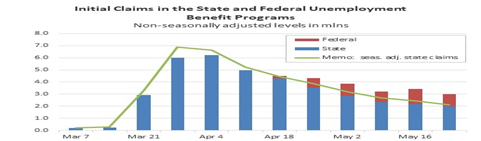
Second quarter GDP growth will inevitably shrink much more due to 2.1 million more workers applying for unemployment benefits in the latest week, bringing the total to more than 46 million. But combined with federal layoffs the total is closer to 3 million in the latest survey.  Initial claims have fallen steadily since hitting a record 6.9 million in the week ended March 28.

image

Wrightson.com

But Reuters reports the big surprise in the jobless claims data was a 3.7 million decline in the reported level of continuing claims in the regular state programs, which is a sign that more are returning to work.  In not seasonally adjusted terms, the number of state beneficiaries fell from 22.8 million to 19.1 million in the week of May 16.

The sharp rise in unemployment has made consumers more cautious, as I’ve been saying. Retail sales fell a record 16.4 percent in April. The government checks over the past two months helped consumers pay their bills but for the economy to recover, consumer spending has to rebound.

While it is possible that the decline in continuing claims reflects individuals who left the benefit program as the economy reopened,” said Reuters, “the erratic pattern in the data for some states makes us wary of reading too much into the week to week fluctuations.  (Florida’s jobless rolls fell 76% in the week of May 16, from 2.2 million to 0.5 million; California’s fell 40%, from 3.6 million to 2.1 million.)  We would not extrapolate from the May 16 level.”

One economist stated that though social distancing measures are gradually being relaxed across the country, the lingering virus fear and restrained incomes “will continue to constrain consumers’ willingness and ability to spend.”

This is while experts and Federal Reserve banks such as the Atlanta Fed are predicting GDP shrinkage of as much as 40 percent in the second quarter, as consumers continue to stay close to home.

The hope will be that activity picks up again in the fall, if the federal government will show some nationwide leadership in what is after all, a nationwide pandemic.

Harlan Green © 2020

Follow Harlan Green on Twitter: https://twitter.com/HarlanGreen

Posted in Consumers, Economy, Politics, Weekly Financial News | Tagged , , , , | Leave a comment

What Letter Will Describe This Pandemic?

Popular Economics Weekly

image

Conference-board.org

The Conference Board’s consumer confidence survey should help to predict the shape of this economic recovery from COVID-19. It’s shape will mirror the degree of “uncertainty” felt by consumers.

In the words of Lynn Franco, Senior Director of Economic Indicators, “Following two months of rapid decline, the free-fall in Confidence stopped in May…Short-term expectations moderately increased as the gradual re-opening of the economy helped improve consumers’ spirits. However, consumers remain concerned about their financial prospects…While the decline in confidence appears to have stopped for the moment, the uneven path to recovery and potential second wave are likely to keep a cloud of uncertainty hanging over consumers’ heads.”

Economists are therefore trying to determine if the US economy sinks back into recession in a second wave of infections in the fall, or even a third wave nest spring, as in past pandemics. Right now, some economists are predicting a ‘V’ shaped recovery with GDP growth gaining traction after two quarters of negative growth.

Just under half of 45 economists responding to a Reuters poll earlier this month said the U.S. economic recovery would be “U” shaped, which probably means at least two quarters of negative growth, but a very slow recovery. Ten of those polled said it would be “V” shaped, and five said it would be “W” shaped.

Fed Chairman Powell in recent comments at a press conference following the U.S. central bank’s latest policy meeting indicated he sees even more disruption than even the “W” camp. Powell said he believes the economy may go through a series of peaks and troughs for at least a year or more as the world battles to keep the virus under control.

“John Kenneth Galbraith famously said that economic forecasting exists to make astrology look respectable,” said Powell. “We are now experiencing a whole new level of uncertainty, as questions only the virus can answer complicate the outlook.”

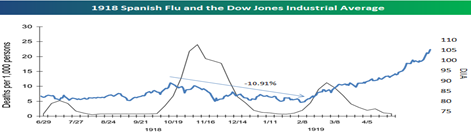
This happened with the 1918-20 Spanish Flu pandemic that killed some 700-900,000 Americans. Its fall resurgence in deaths after a summer created an 18-month recession from January 1920 to July 1922. It was considered a mild recession with GNP growth falling approximately 8 percent.

image

seekingalpha.com

A chart of the Spanish flu combined with the DOW-Jones Index shows how the stock market behaved during that time—the DOW fell with every resurgence of deaths. It wasn’t until the third death rate spike began to subside in early spring of 1919 that the DOW rose, though economic growth didn’t resume until the end of the recession in 1922, and the decade became known as the “roaring twenties”.

Two lesser-known pandemics based on bird flus in 1958 and 1968 caused more than 100,000 deaths in the US.

In February 1957, a new influenza A (H2N2) virus emerged in East Asia, triggering a pandemic (“Asian Flu”). It was first reported in Singapore in February 1957, Hong Kong in April 1957, and in coastal cities in the United States in summer 1957. The estimated number of deaths was 1.1 million worldwide and 116,000 in the United States.

Several short and mild recessions followed the two pandemics; the first in 1958 when GDP growth was a negative -1.54 percent in Q1 1958. GDP growth began to plunge again in Q1 1968 following the second Avian flu pandemic that killed approximately100,000 in the US, and ended with the 1970 recession.

The point is pandemics have always caused a substantial drop in GDP growth, and this pandemic is shaping into another Great Recession lasting at least two quarters, before beginning to recover in the fall or winter.

That is why Dr. Fauci has been so vocal in supporting continued vigilance and preparedness for an additional outbreak.

And Dr. Rick Bright, the recently transferred director of Biomedical Advanced Research and Development Authority director at HHS said, “The mortality of the pandemic could be “unprecedented” and ultimately outstrip the 50 million casualties of the 1918 influenza epidemic without a science-based national response to the pandemic.”

It’s going to be a difficult call, in other words, as to which letter will better describe the length of this recession due to the novel coronavirus.

Harlan Green © 2020

Follow Harlan Green on Twitter: https://twitter.com/HarlanGreen
Posted in Consumers, Economy, Macro Economics, Weekly Financial News | Tagged , , , | Leave a comment

Will Those Jobs Return?

The Mortgage Corner

image

Wrightson.com

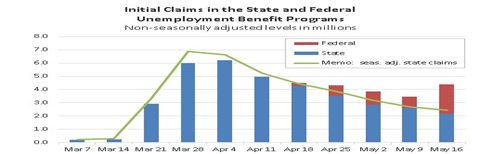
Initial claims for unemployment benefits fell by just 249K to 2.438 million in seasonally adjusted terms in the week of May 16, as the businesses begin to reopen in all 50 states.  The aggregate level of new claims not seasonally adjusted climbed to an actual 4-week high of 4.4 million when applications under federal programs are included. 

And more than 38 million workers are now out of a job, at least temporarily, in the latest week’s initial unemployment claims. However getting them back to work will be far harder than separations, especially if congress cannot agree on another aid package to extend unemployment benefits, Personal Payroll Protection (PPP) to small businesses, and aid to states in addition to the just-passed $3 trillion bill.

Republicans meanwhile are holding up more aid, because they want workers back to work sooner when their current benefits run out, regardless of the still rising infection and death rates in many states.

But what if there are no jobs to come back to? Without more aid, states that hire and pay our essential workers (eg, Police, Fire, and health care workers) will run out money and have to reduce their payrolls. The same also applies to the PPP participants that wish to retain their employees.

Why would Republicans want to “cut off their nose to spite their face,” as the saying goes, after months of fiddling while America burned?

The latest infection data analysis is staggering. If the country had begun locking down cities and limiting social contact on March 1, two weeks earlier than most people started staying home, the vast majority of the nation’s deaths — about 54,000 — would have been avoided, reported Columbia University disease modelers.

And if many essential workers no longer have jobs, especially those workers that keep us safer and healthier, then a real recovery could be years away.

Workers can’t spend what they don’t make, which Roosevelt understood very well during the Great Depression. So he had government create millions of jobs building dams, monuments, energy grids, and planting trees; any work that allowed Americans to continue to feed their families.

And here’s another irony. Republicans support the de facto civil war between red and blue states when a viable recovery will only happen with a united effort, just as we won’t conquer the COVID-19 pandemic without a united effort in testing, contact tracing and quarantining the infected.

We cannot allow the unemployed to remain unemployed for too long. This lessens the demand for producers to produce, which in turn creates more layoffs instead of hires, which lowers Gross Domestic Product (GDP) growth. The Great Recession lasted 18 months, until June 2009 before growth was restored, yet employment didn’t return to prior levels for five years.

The Labor Department (BLS) reported unemployment rates were higher in April in all 50 states and the District of Columbia that were also higher from a year earlier. The national unemployment rate rose by 10.3 percentage points over the month to 14.7 percent as we reported last Friday and was 11.1 points higher than in April 2019.

Three states exceeded a 20 percent unemployment rate already; Nevada, Michigan and Hawaii.

image

AtlantaFed

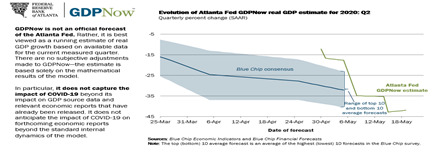
The GDPNow model estimate for real GDP growth (seasonally adjusted annual rate after inflation) in the second quarter of 2020 is -41.9 percent May 19, up from -42.8 percent on May 15.

Next Thursday’s first estimate of Q2 GDP growth will be the initial indication of just how weak are the job numbers for May. The Labor Department’s unemployment rate won’t be out until June 5. They don’t look good, with estimates as high as a negative -20 percent unemployment rate, or even –25 percent as in the Great Depression.

The powers-that-be must stop their fiddling, in other words, and cooperate in crafting programs that enable workers to get back to work safely, and consumers to shop without the fear of contagion, the same cooperation that’s needed to bring down the death rates from COVID-19.

Harlan Green © 2020

Follow Harlan Green on Twitter: https://twitter.com/HarlanGreen
Posted in Consumers, Economy, Keynesian economics, Politics, Weekly Financial News | Tagged , , , | Leave a comment

Consumer at Center of Any Recovery

Financial FAQs

image

FRED retail sales

The American economy has depended on consumers’ health, and consumer spending since the 1950s, really. Consumers generate some 70 percent of economic activity from their purchases, with government spending and capital expenditures in the private sector generating the rest of the activity.

Yet there is much doubt that American consumers will be in any position to return to their spending ways once COVID-19 is sufficiently tamed (meaning testing, tracking and quarantining programs in all states are fully operational). Consumers will feel reassured when it is safe to return to work and consume again.

We save more and spend less in times of worry, which depresses the demand for goods and services. And any diminishment in demand caused by their insecurities diminishes the production of those goods and future investment that would expand economic growth.

There is now a tremendous worry that consumers may stay-in-home for a prolonged period because of the pandemic. The personal savings rate has jumped from 8 to 13 percent just in March, when it was as low as 3 percent during boom times leading up to the Great Recession. They weren’t saving during those heady times of the housing boom and bust when housing prices were rising in double digits.

But the lower-income earners haven’t recovered, and some 40 percent of households have almost no savings to weather this downturn.

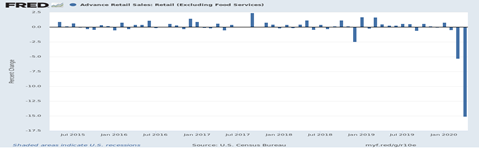
The latest retail sales tell us what is happening with consumers. Retail sales plunged 16.4 percent in April, by far the biggest drop on record and another reflection of the severity of the coronavirus pandemic on the U.S. economy. They were nearly double March’s revised decline of 8.3 percent. Spending at restaurants and bars fell by about half from a year ago, while clothing store sales slumped 89 percent due to the work lockdown and stay-at-home rules.

That can be counteracted by programs that reassure consumers. For instance the CARES Act prolonged unemployment benefits to July or longer, but need to be extended for at least another six weeks..

But a far more active federal government that develops a real social safety net with far fewer holes is the real answer.

There are some basic elements that might keep consumers from saving too much for a rainy day, if it is being saved for them by effective government social programs, like some form of universal health care that insures as many Americans as possible from expensive medical bills.

Then a much expanded education system that insures a good education for all Americans through high school, and even two-year community colleges to increase their skills. (Community College’s would be tuition-free, in other words.}

What else would reassure ordinary citizens? A safer international environment is being threatened by nationalist and populist governments that have closed their borders to any kind of international cooperation. But COVID-19 is stopping that fragmentation of necessity, as countries must work across borders to share medical science that saves their own populations from higher death rates.

We therefore see a rebuilding of the international supply chain that produces most consumer products, as well. Those products will continue to be produced overseas because of cost factors, no matter how many tariffs Trump imposes on the countries that manufacture them.

Mohamed El-Erian, former CEO of PIMCO and Chairman of President Obama’s Global Development Council, has worried about the damage COVID-19 has done to global growth, and the supply chains that connect what has become a global economy.

“Having already been buffeted by two big shocks in the last ten years, the global economy’s highly interconnected wiring is suffering a third because of the COVID-19 pandemic,” he said in a recent Project-Syndicate article. “Globalization thus faces a three-strikes-and-out situation that could well result in a gradual but rather prolonged delinking of trade and investment, which would add to the secular headwinds already facing the global economy.”

Those “headwinds” include the possibility of greater geopolitical conflicts and increased poverty levels of poorer countries from a prolonged slump in foreign trade and investment. Keeping the international supply chain from breaking is an absolute necessity for maintaining worldwide peace and prosperity, in spite of the backlash against globalization by populist governments.

I have cited NYTimes’ commentator Peter Goodman before, when he said, “For seven decades after World War II, the notion that global trade enhances security and prosperity prevailed across major economies. But in many countries—especially the United States—a stark failure by governments to equitably distribute the bounty has undermined faith in trade, giving way to a protectionist mentality in which goods and resources are viewed as zero-sum.”

We cannot allow the “protectionist mentality” to continue, in other words, if we are to recover from what Mother Nature has thrown at us.

Harlan Green © 2020

Follow Harlan Green on Twitter: https://twitter.com/HarlanGreen
Posted in Consumers, Economy, Keynesian economics, Politics | Tagged , , , , | Leave a comment

In The Age of Anxiety

Popular Economics Weekly

image

thesocialhistorian.com

We are now in a full-blown “Age of Anxiety”; not the first, of course. There was as much anxiety during the 1918-20 Spanish Flue pandemic that reportedly killed 50 million in a series of worldwide outbreaks lasting more than two years.

If we do not find ways to lessen anxiety in this age due to the novel coronavirus pandemic, we might seriously experience what Dr. Rick Bright, who was recently transferred from his position as Biomedical Advanced Research and Development Authority director at HHS has described as “the darkest winter in modern history.”

“The mortality of the pandemic could be “unprecedented” and ultimately outstrip the 50 million casualties of the 1918 influenza epidemic,” wrote Bright in his prepared testimony,“ without a science-based national response to the pandemic.”

There is much more to the current age of anxiety. New Deal economist John Kenneth Galbraith wrote a book called The Age of Uncertainty in the 1970s that attempted to explain the general anxiety brought on by post-WWII institutions that were no longer stable.

“In it we contrast the great certainties in economic thought in the last century with the great uncertainty with which problems are faced in our time,” he said. “Little of this certainty now survives. Given the dismaying complexity of the problems mankind now faces, it would surely be odd if it did.”

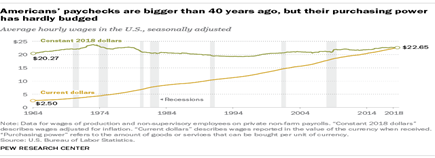
This anxiety has been compounded by a record income inequality, the worst since the Great Depression. A 2018 PEW Research survey showed the wage stagnation of American salaried workers over almost two generations.

image

PEW

Its study found that today’s real average wage (that is, the wage after accounting for inflation) has about the same purchasing power it did 40 years ago. And what wage gains there have been have mostly flowed to the highest-paid tier of workers, the top 10 percent of income earners.

I have frequently cited Robert Shiller, a Nobel Laureate economist who says anxiety has reached such a level that it is becoming a second pandemic, an anxiety pandemic that is contagious because “stories of fear have gone so viral that we often think of them constantly,” which could delay the recovery because of the public’s irrational responses.

“Business closures, soaring unemployment, and loss of income fuel financial anxiety, which may, in turn, deter people, desperate for work, from taking adequate precautions against the spread of the disease…But, unlike COVID-19 itself, the source of our anxiety is that we are unsure what action to take.”

And that is already happening with news pictures of crowded bars and restaurants  in states like Texas and Georgia, where they haven’t met the 14-day requirement of falling infection rates decreed by the CDC.

“Unless we get the virus under control, the real recovery economically is not going to happen,” says Anthony Fauci, director of the National Institute of Allergy and Infectious Diseases, in a recent interview. He goes on to say that “even if social distancing standards were relaxed, it wouldn’t restore the health of the economy as some protesters have implied it would.”

It is the economic health of Americans that most concerns Americans, which means remedies must be found to curb the rising anxiety, if there is to be something less than a Great Recession or Depression.

And it has to be a united focus of governing authorities on the scientific message that his pandemic is bringing; that we are all in this together.

Harlan Green © 2020

Follow Harlan Green on Twitter: https://twitter.com/HarlanGreen
Posted in Consumers, Economy, Keynesian economics, Politics | Tagged , , , , , | Leave a comment

The Times Are Changing

Financial FAQs

image

DOL.gov

“The Times They Are a Changin” was Bob Dylan’s song for the 1960’s. Change was happening because of the Vietnam War and civil rights era. That is nothing like the coming changes we will see in the war against COVID-19.

In the week ending May 9, the advance figure for seasonally adjusted initial claims was 2,981,000, a decrease of 195,000 from the previous week’s revised level, as the number of laid off workers has now reached 26 million, far past that of the Great Recession.

It doesn’t take rocket science to know what needs to be done to bring us out of this record economic downturn. It must be a nationally coordinated response to a worldwide pandemic, yet the White House and Republican Party are living by policies based on ignorance, with the denial of science and facts the means they use to carry out such policies. And it will not end well in the face of a virus that has no party affiliation.

The pandemic will change our way of life, just as the Great Depression and World War II changed America from an industrial and farming nation to a consumer and high tech nation.

It has highlighted the major weaknesses in our broken economic and healthcare systems, and everything else government needs to do better that the private sector can’t do

Doctor Rick Bright, former head of the federal government’s vaccine testing program testified today in front of a House committee that without a science-based national response to the pandemic, 2020 will be the “darkest winter in modern history.

“The mortality of the pandemic could be “unprecedented” and ultimately outstrip the 50 million casualties of the 1918 influenza epidemic, wrote Bright in his prepared testimony, who was recently transferred from his position as Biomedical Advanced Research and Development Authority director.

What does Dr. Bright mean by a national response? The federal government has lacked a coordinated plan to first, provide enough PPE to weather not only the current outbreak, but what may occur in the fall and next year when the annual flu season hits that killed more than 70,000 last year.

But he also mentioned the fact that there was not yet a coordinated plan to produce and distribute enough vaccine “equitably and fairly” to everyone once it was developed. And this after mentioning a 12-18 month time frame to produce a viable vaccine was “highly optimistic”. It took up to 10 years to produce an effective Ebola vaccine, for instance.

So what are the changes that are needed in this new world of dangerous pandemics, in part brought on by geopolitical strive and a crowding out of natural habitats that has put us in closer contact with those creatures that carry such viruses?

“Perhaps rebalancing is a useful word,” said the NYTimes’ Roger Cohen recently. “From consumption to contemplation, from global to local, from outward to inward, from aggression to compassion, from stranger to guest, from frenzy to stillness, from carbon to green.”

What comes to mind is the social isolation requirement that will mean less crowded conditions at work and play; also the realization that we are all in this together if we want to survive, as well as save what is left of the natural planet.

I should emphasize there will be changes to the workplace as well. There has to be more reliance on the digital world that enables work at home that will also replace all those workers in warehouses, retail and transportation with robots and Artificial Intelligence.

And what if many of the 26 million have no jobs left when this economy recovers, as work becomes more dependent on computers and AI? Then jobs will have to be created elsewhere, such as in healthcare (some 300,000 contact tracers probably needed to monitor future outbreaks), environmental protection (to have clear air and water) infrastructure (e.g., to save drowning cities), education, and above all, new Research and Development to develop future ways to live in this new world.

Harlan Green © 2020

Follow Harlan Green on Twitter: https://twitter.com/HarlanGreen

Posted in Consumers, Economy, Keynesian economics, Politics | Tagged , , , | Leave a comment