What Happened to Honest Abe?

Popular Economics Weekly

image

Wikipedia

What happened to honesty in personal behavior and in politics is a good theme to discuss on this Presidents Day that commemorates our two Presidents most touted for their honesty—Washington and Lincoln? They were celebrated for their honesty, whereas today we have a President and his subservient political party that not only tolerates, but enables the most dishonest president in history.

We are not just talking about President Trump’s 16,000 plus documented lies—many of them done for mostly propaganda purposes; but the dishonesty manifested during the impeachment hearings and trial, when Republicans parroted Russian propaganda tropes that Ukraine opposed the Trump election, and was behind the Democratic Party hackings rather than Putin’s Russia.

Why didn’t Republicans question whether Trump’s call for Ukraine and China to aid in his reelection by digging up dirt on his political opponents was somehow ethical and allowable for a President seeking reelection?

What has happened to Republicans that abet Trump’s propaganda machine which is based on outright lies, when young American children were brought up on stories of Presidential honesty; whether it was Abraham Lincoln the honest politician, or George Washington’s honesty in confessing to cut down the cherry tree as a six-year old child?

“Honest Abe’ was a nickname Lincoln adopted early in his career as a lawyer. In his Notes for a Law Lecture his entire series of notes speaks to honesty, integrity, and to do what is right.  Lincoln wrote, “resolve to be honest at all events; and if in your own judgment you cannot be an honest lawyer, resolve to be honest without being a lawyer.”

The honesty of George Washington has become almost mythical, and a beacon that we all learned as young school children.  The cherry tree tale was probably a children’s tale, but Thomas Jefferson once said of Washington, “his integrity was most pure, his justice the most inflexible I have ever known, no motives of interest or consanguinity or friendship or hatred, being able to bias his decision. He was indeed in every sense of the words, a wise, a good, and a great man.”

Why wouldn’t Republicans want to live up to their standards? It is in essence an admittance that Republicans cannot maintain their power and privileges without the aid of outright lies that other authoritarian regimes use to maintain their power with propaganda machines that also suppress truth and promote ‘alternate facts’—because their power and privileges were not always honestly acquired.

It only took America 244 years to go from “Honest Abe” and “I cannot tell a lie” to 16,241 false or misleading claims, said USA Today recently. How can we recover from such blatant dishonesty, unless we keep telling our children at the earliest age that “honesty is the best policy,” and building character the only road to a truly successful life?

Harlan Green © 2020

Follow Harlan Green on Twitter: https://twitter.com/HarlanGreen

Posted in Politics, Uncategorized | Tagged , , | Leave a comment

Why Are Retail Sales Struggling?

Financial FAQs

image

Calculated Risk

Retail sales have slowed markedly since the fall of 2019, with monthly overall sales up just 0.3 percent, and rising 3.9 percent annually without volatile gasoline prices. This means the U.S. is basically stuck in a slow growth mode, since more robust growth (+3 percent) would mean 5-6 percent annual retail sales. And that is worrisome to financial markets that have been pushing down bond yields as a hedge against a further slowing of economic activity.

Consumers seem to remain optimistic, however, in part because they love the very low consumer prices, hence low inflation, which boosts spending. But optimism is also fueled by plentiful jobs, per the University of Michigan sentiment survey.

 image

Umich.edu

“Consumer sentiment rose to 100.9 in early February to nearly match the expansion peak of 101.4, set two years ago in March 2018,” said its press release. “The Expectations Index, the main gauge of future economic conditions, rose to 92.6, also its second highest level in this long expansion. (But) both measures were still significantly below the levels recorded twenty years ago when the Sentiment Index reached a peak of 112.0 and the Expectations Index peaked at 108.6.”

Part of the sluggishness in growth comes from the decline in manufacturing, now in its fifth month of shrinkage. Employment in construction, mining, logging and manufacturing industries ramped up sharply in his first two years in office, according to the latest figures released Friday by the Bureau of Labor Statistics, but overall output fell 0.3 in January, with the biggest negative impact coming from a weather-related 4 percent drop in utility usage.  

Motor vehicle and parts production did post a 2.4 percent increase last month, but even that was a little disappointing, with Reuter’s forecast having called for a 4 percent rise.  On the other hand, the mining sector was a positive surprise, posting a solid 1.2 percent increase, per Reuters ICAP update.

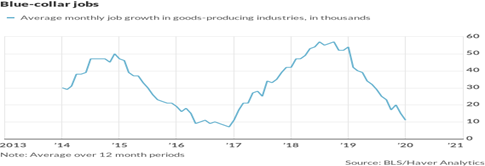
Some blue-collar jobs have come back in Trump’s first two years, but not nearly as many as had been lost. Most of the jobs have been lost forever to automation or cheaper manufacturers around the world.

image

Crippled by the trade war and collapse in investment, job growth in blue-collar sectors slowed to a trickle over the past year. Meanwhile, job growth in the services-producing industries has actually strengthened, especially in health-care and in the quintessential pink-collar and white-collar jobs, per Friday’s unemployment report.

The bottom line is that most consumers can’t spend more because they don’t earn enough to spend more, since most have jobs in the lower-paying service sector these days. And their optimism is held in check by the fact that anything can happen over the coming months, as we have been saying, which is why interest rates are extremely low and could fall further.

The 10-year bond yield slipped back to 1.59 percent Friday, which also means investors are worrying about future stock market gains with current S&P P/E ratio now 20. It is 5 points above its long term average of 15 times earnings, and corporate profits are predicted to decline this year.

Harlan Green © 2020

Follow Harlan Green on Twitter: https://twitter.com/HarlanGreen

Posted in Consumers, Economy, Weekly Financial News | Tagged , , , | Leave a comment

Who Is Fully Employed in January?

Financial FAQs

image

MarketWatch

It looks like everyone is employed in the service sector, but manufacturing is sputtering. There were 44,000 new construction jobs and a whopping 72,000 in Education and health services. But manufacturing lost another 12,000 jobs in January; the same as in December.

That is why average hourly earnings (i.e., wages) are barely rising above inflation, and interest rates and inflation remain so low. This ‘goldilocks’ scenario must be due to the 2-year trade war, and now China’s coronavirus pandemic that the World Health Organization has called a “global public-health emergency.”

In other words, American consumers are scooping up lots of cheap consumers goods from other countries, but manufacturers aren’t exporting enough to create a positive balance of payments.

So stock and bond prices are gyrating when the world economy doesn’t seem to know what to make of China’s coronavirus that has now spread to some 23 countries, according to latest reports.

Here are the latest coronavirus numbers, according to the Washington Post, as it is approaching the SARS pandemic totals of 2003, and may turn out to be more deadly as the virus mutates into a possibly more virulent strain:

Chinese health officials say they confirmed more than 31,000 cases of the coronavirus, more than 4,800 of them considered severe. The death toll surpassed 630, with fatalities almost entirely confined to China.

● An additional 41 people on board the Diamond Princess cruise liner, which has been quarantined in Japan, have tested positive for coronavirus, bringing the total to 61.

● Another cruise ship, the Westerdam, is at sea, and its crew is unsure where to go next, after being denied entry to the Philippines, Japan and South Korea. Passengers blame an ill-advised port stop in Hong Kong, where the boat took on many new passengers.

● Two charter flights carrying about 300 Americans out of the virus-hit city of Wuhan are expected to arrive in the United States on Friday. A flight carrying mainly Canadian evacuees landed in Ontario on Friday morning.

So let us take some comfort that American jobs aren’t yet at risk. In fact, the 2003 SARS pandemic occurred during the housing bubble, and record economic growth during that decade. But what followed was the Great Recession.

That’s why most economists aren’t touting January’s very robust job numbers as a harbinger of a better year just yet. There may be more bad news coming, and interest rates are still at record lows, which mean the financial markets are hedging their bets for another rainy day.

Harlan Green © 2020

Follow Harlan Green on Twitter: https://twitter.com/HarlanGreen
Posted in Consumers, Economy, Keynesian economics, Weekly Financial News | Tagged , , , | Leave a comment

Disaster Preparation—Why Irrational Exuberance?

Popular Economics Weekly

image

WTI Crude Oil

Stock and bond prices are gyrating when the world economy doesn’t seem to know what to make of China’s coronavirus that has now spread to some 23 countries, according to latest reports.

And that is not a good time for irrational exuberance to appear in U.S. financial markets, since much of the financial gyrations are driven by excess liquidity—too abundant cash from the 2017 corporate tax cuts are pushing stock prices to record highs, and bond yields to record lows—both signs of price bubbles sure to burst on signs that world trade in particular could be affected by what economists call such an unpredictable, “exogenous” event.

The medical consensus to date is that the coronavirus doesn’t seem as virulent as the 2003 SARS outbreak, yet the number of deaths and infection rate to date has already exceeded that of the SARS virus.

The NYTimes reports this respiratory virus has infected more than 17,000 people, killing “at least” 360. “But the Wuhan coronavirus may be highly transmissible, as contagious as seasonal influenza that kills many more, and the death rate is still unknown.”

Why could this pandemic that the World Health Organization has now labeled a global public health emergency be dangerous to global growth?

Nobel economist Paul Krugman says it’s because China’s economy is many times larger than it was in 2003, so the effect of closing down major Chinese cities until more is known about the virus could be economically devastating to China and other economies that depend on Chinese goods and services. The EU is one such market that is worried because 20 percent of its exports now go to China.

Crude oil imports to China, the world’s largest consumer of oil, have also dropped 20 percent and oil prices are down approximately 10 percent, which has OPEC producers scrambling to cut production quotas.

Other economists are voicing similar warnings. Yale economist Dr. Stephen Roach, former Morgan Stanley chief economist and chairman of Morgan Stanley’s Asia Desk, is making good sense with his predictions of worse things to come.

He’s talking about world trade volumes, which have dropped precipitously. And worldwide growth depends even more today on world trade, which has already been harmed by the Trump trade wars.

Roach in recent Project Syndicate comments, said that from 1990 to 2008, annual growth in world trade was fully 82 percent faster than world GDP growth. And this cushion has shrunk dramatically, to just 13 percent over the 2010-19 period, “leaving the world economy more vulnerable to all-too-frequent shocks.”

“The IMF’s latest assessment put global trade growth at just 1% in 2019 – its seventh consecutive downward revision,” said Roach. “Indeed, last year was the weakest trade performance since the historic 10.4% plunge in 2009, which was the worst contraction since the early 1930s.”

Is Roach being an unnecessary alarmist? I don’t think so, when compared to the Great Depression. Now is not the time for irrational exuberance of any kind with world economies retreating in the face of so much geopolitical uncertainty (e.g., rising isolationism from rising nationalism).

Are we prepared? 

Harlan Green © 2019

Follow Harlan Green on Twitter: https://twitter.com/HarlanGreen

Posted in Economy, Macro Economics, Politics, Uncategorized | Tagged , , , , , | Leave a comment

How We Can Build Peace in the 21st Century

Answering the Kennedys’ Call

image

It was a humbling experience to join more than 1,000 Rotarians and other peacemakers at the 2020 Rotary World Peace Conference this January. It gave me hope to see both young and old attending to learn from each other how to make the world a more peaceful place.

Let’s start with the 160 assembled presenters comprised of not only Rotary Peace scholars and Good Will Ambassadors, but representatives from the Peace Corps, CARE International, the UN Refugee Agency, The Carter Center, and even a recipient of the Nobel Peace Prize.

They shared their expertise on how to advance peace in a world of increasing dangers not only from global warming, but populations threatened by human trafficking, child abuse, spousal abuse, cyber-bullying, war trauma, sexual harassment, and violence prevention in our cities, homes and schools.

There were ongoing workshops throughout a weekend held by violence prevention experts and ‘peace activators’, such as Aussie Steve Killelea’s Institute for Economics and Peace that has created the Global Peace Index and Positive Peace Report which rank nations for their attitudes, institutions and structures that create and sustain peaceful societies.

Of particular interest are those countries and regions that have been able to increase their Gross Peace Index in 2019: The Ukraine, Sudan, Egypt, North Macedonia and Rwanda. “The 2019 GPI reveals a world in which the conflicts and crises that emerged in the past decade have begun to abate, but new tensions within and between nations have emerged,” said the Global Peace Report.

The Gross Peace Index showed the first improvement in 5 years, in part because Rotary with its 1.2 million members has improved health outcomes in particular, giving some $250 million in grants to peace organizations and projects, such as developing drinking water facilities and health clinics in many of the same countries as the Peace Corps.

Rotary clubs have been a large part of creating a more peaceful world. My local Montecito, California Rotary Club has raised more than $200,000 in financial aid for a small valley in the South Lake Kivu District of Eastern Democratic Republic of Congo to help women and children in particular recover from the devastating civil wars and rebel militias’ ongoing rape and pillaging that has killed thousands as they fought over the rich supply of so-called conflict minerals like Coltan, a rare mineral essential in cell phones.

But what raised my hope for a more peaceful world above all was the 250 high school Rotary Interact Club members from Southern California and Arizona that were there to learn and train in conflict resolution skills.

Where else should we put most of that hope for peace but in our children who will inherit this world?

Harlan Green © 2019

Follow Harlan Green on Twitter: https://twitter.com/HarlanGreen

Posted in Politics, Uncategorized | Tagged , , , , , | Leave a comment

How We Can Build Peace in the 21st Century

Answering the Kennedys’ Call

image

It was a humbling experience to join more than 1,000 Rotarians and other peacemakers at the 2020 Rotary World Peace Conference this January. It gave me hope to see both young and old attending to learn from each other how to make the world a more peaceful place.

Let’s start with the 160 assembled presenters comprised of not only Rotary Peace scholars and Good Will Ambassadors, but representatives from the Peace Corps, CARE International, the UN Refugee Agency, The Carter Center, and even a recipient of the Nobel Peace Prize.

They shared their expertise on how to advance peace in a world of increasing dangers not only from global warming, but populations threatened by human trafficking, child abuse, spousal abuse, cyber-bullying, war trauma, sexual harassment, and violence prevention in our cities, homes and schools.

There were ongoing workshops throughout a weekend held by violence prevention experts and ‘peace activators’, such as Aussie Steve Killelea’s Institute for Economics and Peace that has created the Gross Peace Index and Positive Peace Report which rank nations for their attitudes, institutions and structures that create and sustain peaceful societies.

Of particular interest are those countries and regions that have been able to increase their Gross Peace Index in 2019: The Ukraine, Sudan, Egypt, North Macedonia and Rwanda. “The 2019 GPI reveals a world in which the conflicts and crises that emerged in the past decade have begun to abate, but new tensions within and between nations have emerged,” said the Global Peace Report.

The Gross Peace Index showed the first improvement in 5 years, in part because Rotary with its 1.2 million members has improved health outcomes in particular, giving some $250 million in grants to peace organizations and projects, such as developing drinking water facilities and health clinics in many of the same countries as the Peace Corps.

Rotary clubs have been a large part of creating a more peaceful world. My local Montecito, California Rotary Club has raised more than $200,000 in financial aid for a small valley in the South Lake Kivu District of Eastern Democratic Republic of Congo to help women and children in particular recover from the devastating civil wars and rebel militias’ ongoing rape and pillaging that has killed thousands as they fought over the rich supply of so-called conflict minerals like Coltan, a rare mineral essential in cell phones.

But what raised my hope for a more peaceful world above all was the 250 high school Rotary Interact Club members from Southern California and Arizona that were there to learn and train in conflict resolution skills.

Where else should we put most of that hope for peace but in our children who will inherit this world?

Harlan Green © 2019

Follow Harlan Green on Twitter: https://twitter.com/HarlanGreen

Posted in Economy, Uncategorized | Tagged , , , , , | Leave a comment

Has the Housing Market Recovered?

The Mortgage Corner

image

FRED

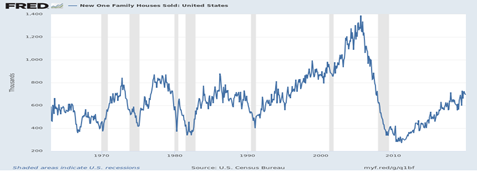
The just-released single-family sales graph highlights a very important fact. New-home sales—especially for single-family residences—are back to historical levels last seen in 2000. The Great Recession and oversupply during the housing bubble caused so much damage to home building that it has taken housing 10 years to recover.

This augers well for economic growth this year with a fully-employed economy and more younger homebuyers entering he housing market. So the question being asked is, has the home-ownership rate finally bottomed, so that it is now again on an upward trend?

Sales of new single-family homes in December were at an annual rate of 694,000, which is 23 percent above the December 2018 rate, reports HUD and the U.S. Census Bureau. Builders are finally catching up to the demand for more homes, in other words.

There are many reasons the housing recovery has taken so long—there are too few homes in the affordable range, for starters. Entry-level homebuyers (usually from the millennial generation) have been slow to form new households and pay down their college debts, so they are currently buying just 30-31 percent of existing homes, when their percentage has been closer to 40 percent in the past.

Builder confidence in the market for newly-built single-family homes has also increased five points to 76 in December off an upwardly revised November reading, according to the latest National Association of Home Builders/Wells Fargo Housing Market Index (HMI). This is the highest reading since June of 1999.

“Builders are continuing to see the housing rebound that began in the spring,” said the NAHB, “supported by a low supply of existing homes, low mortgage rates and a strong labor market. While we are seeing near-term positive market conditions with a 50-year low for the unemployment rate and increased wage growth, we are still underbuilding due to supply-side constraints like labor and land availability. Higher development costs are hurting affordability and dampening more robust construction growth.”

The average rate of new home sales in 2019 was 681,000, which was 10.3 percent higher than 2018’s pace. The median sales price for new homes was $331,400 in December, which was up from the previous month. The government estimated there was a 5.7-month supply of new homes available for sale, up slightly from November as well, and is now back to the average supply of new homes on the market before the housing bubble.

image

Calculated Risk

Calculated Risk’s Bill McBride has commented on the homeownership rate since the Great Recession, and believes it is also returning to historical levels, per his graph. It is back to 64.1 percent of households, about the average that has prevailed since the 1970s.

There is still a housing shortage, however, with more than 500,000 homeless living on the streets, according to the latest data. To put it bluntly, this is a sign that not enough affordable, entry-level homes are being built; which means that many in the younger generations will still not be able to afford to buy.

Harlan Green © 2019

Follow Harlan Green on Twitter: https://twitter.com/HarlanGreen

Posted in Consumers, Housing, housing market, Weekly Financial News | Tagged , , | Leave a comment

Martin Luther King Jr.’s Call for Peace

Answering the Kennedys’ Call

image

Daily Kos

Martin Luther King, Jr. was assassinated on April 4, 1968, and his loss is felt even more than 50 years later as we continue to fight wars both foreign and domestic. He was organizing a march on Washington when he was killed. Who knows what might its effect have been on the Vietnam War if he had lived and mobilized America to end the war sooner?

King called it the Poor People’s Campaign, said a Daily Kos commentator on Monday’s Martin Luther King, Jr. Day. He wanted to dramatize the suffering of the nation’s poor by bringing them to the capital. Poor people would live together on the National Mall – the long strip of land between the U.S. Capitol and the Lincoln Memorial – and engage in widespread civil disobedience. King wanted to force the federal government to deal with poverty.

MLK gave a speech on 4 April, 1967 to over 3,000 at New York’s Riverside Church that is memorialized at Stanford’s Martin Luther King, Jr. Research and Education Institute. The speech was drafted from a collection of volunteers, including Spelman professor Vincent Harding and Wesleyan professor John Maguire. King’s address emphasized his responsibility to the American people and explained that conversations with young black men in the ghettos reinforced his own commitment to nonviolence.

“There is at the outset a very obvious and almost facile connection between the war in Vietnam and the struggle I and others have been waging in America,” said MLK. “A few years ago there was a shining moment in that struggle. It seemed as if there was a real promise of hope for the poor, both black and white, through the poverty program. There were experiments, hopes, new beginnings. Then came the buildup in Vietnam, and I watched this program broken and eviscerated as if it were some idle political plaything on a society gone mad on war. And I knew that America would never invest the necessary funds or energies in rehabilitation of its poor so long as adventures like Vietnam continued to draw men and skills and money like some demonic, destructive suction tube. So I was increasingly compelled to see the war as an enemy of the poor and to attack it as such….”

The TET Offensive of January 30, 1968 by the Vietcong had just happened, which made Americans first realize that we weren’t winning the Vietnam War. Robert Kennedy, then campaigning in Indianapolis, gave an impromptu speech on learning of his death:

“What we need in the United States is not division; what we need in the United States is not hatred; what we need in the United States is not violence and lawlessness, but is love, and wisdom, and compassion toward one another, and a feeling of justice toward those who still suffer within our country, whether they be white or whether they be black.

So I ask you tonight to return home, to say a prayer for the family of Martin Luther King — yeah, it’s true — but more importantly to say a prayer for our own country, which all of us love — a prayer for understanding and that compassion of which I spoke.”

Robert Kennedy was assassinated two months later on June 5, 1968, just after he was declared the winner in the South Dakota and California presidential primary of the 1968 election. It looked like he would ride the Kennedy tide to become President, instead of Richard Nixon, who managed to prolong the war until 1974 and his impeachment.

These were our visionary leaders of that time that we should remember for what they stood for—that one day we may realize their hope for a peaceful America.

Harlan Green © 2019

Follow Harlan Green on Twitter: https://twitter.com/HarlanGreen
Posted in Politics, Uncategorized | Tagged , | Leave a comment

Retail Sales Strengthen Q4 Growth

The Mortgage Corner

image

FRED

It looks like consumers came through during the holidays, as retail sales jumped 0.3 percent in December and are up 3.5 percent from a year ago, per the above FRED (St. Louis Fed) graph.

It might be enough to get Q4 GDP back to a 2 percent growth rate, from predictions as low as 0.5-1.5 percent from the Atlanta Federal Reserve.

And now that the Phase I China Trade Agreement is signed, the financial markets should stabilize. But that won’t bring back economic growth in this new year, as much of the damage from the 2-year tariff wars has been done, especially in so-called capital expenditures, the seed-corn of future growth in private-sector companies.

image

FRED

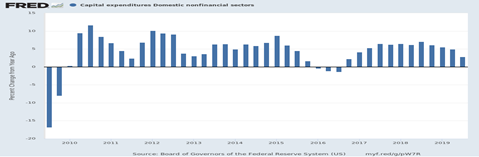
The FRED graph shows how capex spending in plants and equipment soared after the 2007 Great Recession, then leveled to around 5 percent annual increases until 2016, when it actually declined. It picked up again in 2017-18 before beginning its current decline to a 2.8 percent annual increase in Q3 2019.

And there is still real damage to growth coming from the continuing trade wars. The NYTimes and others have documented ongoing damage to the same Midwest states that elected Trump—especially in Wisconsin.

Wisconsin will wind up losing 37,000 jobs because of Trump’s trade war, according to the pro-trade group Tariffs Hurt the Heartland, while the state’s businesses and residents have already paid $598 million in higher costs for goods and services because of U.S. tariffs, per a Huffington Post article.

This is while “Railroads and trucking companies have been cutting jobs, and consumers—at least in the parts of the country most affected by the trade disputes—maybe pulling back as well,” said a recent NYTimes article. “Freight volumes in 2019 had the largest decline since the Great Depression, and transportation and warehouse companies have cut more than 10,000 jobs since December.”

That means it will be up to consumers and the retail sector to maintain U.S. economic growth at its current level. But that means no further declines in capex spending.

And here’s another thought. What if Republicans hadn’t made the draconian 2017 tax cuts to corporate profits that has now created a $1 trillion budget deficit? What if they had instead voted to save those tax revenues to begin reconstructing our ageing infrastructure, or for education, or environmental protection, or more research?

Then we wouldn’t need to have this conversation about declining growth.

Harlan Green © 2020

Follow Harlan Green on Twitter: https://twitter.com/HarlanGreen

Posted in Consumers, Economy, Weekly Financial News | Tagged , , , , | Leave a comment

Housing Construction at 13-Year High

The Mortgage Corner

image

Wrightson.com

U.S. homebuilding surged to a 13-year high in December as activity increased across the board, suggesting the housing market recovery was back on track amid low mortgage rates, and could help support the longest economic expansion on record.

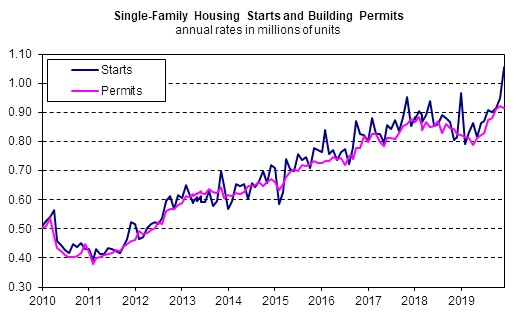
Total housing starts increased 16.9 percent in December to a seasonally adjusted annual rate of 1.61 million units, according to a report from the U.S. Housing and Urban Development and Commerce Department. This is the highest total since 2006.

The December reading of 1.61 million starts is the number of housing units builders would begin if they kept this pace for the next 12 months. Within this overall number, single-family starts increased 11.2 percent to a 1.06 million seasonally adjusted annual rate. The multifamily sector, which includes apartment buildings and condos, increased 29.8 percent to a 553,000 pace.

Total housing starts for 2019 were 1.29 million, a 3.2 percent gain over the 1.25 total from 2018. Single-family starts in 2019 totaled 888,200, up 1.4 percent from the previous year. Multifamily starts in 2019 totaled 401,600, up 7.3 percent from the previous year.

“The solid housing production numbers are in line with strong builder sentiment, supported by a low supply of existing homes, low mortgage rates and a strong labor market,” said NAHB Chairman Greg Ugalde.

“The year ended on a high note with solid gains in single-family and multifamily production,” said Danushka Nanayakkara-Skillington, NAHB’s Assistant Vice President of Forecasting and Analysis. “And while the December estimates will likely be revised down, the trend moving forward is still positive.”

Overall permits, which are a harbinger of future housing production, decreased 3.9 percent to a 1.42-million unit annualized rate in December. Single-family permits decreased 0.5 percent to a 916,000 rate while multifamily permits also fell 9.6 percent to a 500,000 pace.

The lower permit total is why the starts number may come down next month, as it is being viewed as an outlier due to warmer weather in December.

Harlan Green © 2020

Follow Harlan Green on Twitter: https://twitter.com/HarlanGreen

Posted in Consumers, Housing, housing market, Weekly Financial News | Tagged , | Leave a comment