No Job Losses Due to Coronavirus—Yet

Popular Economics Weekly
image

MarketWatch

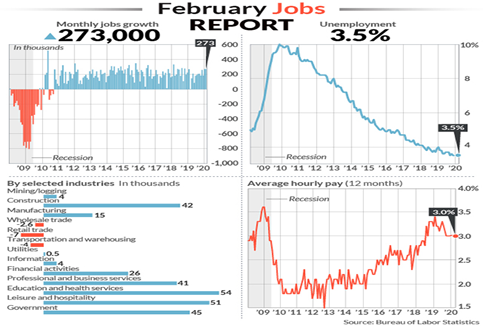
The Labor Department’s February employment survey took place in the middle of February, before the coronavirus began its worldwide spread. So we will have to wait for March employment figures to know its impact on employment, and almost every business sector in the U.S. economy.

The services industries are booming at the moment, as the above MarketWatch graph shows. There were a cumulative total of 218,000 new jobs created in the service sector, with 54,000 Education and Health service jobs leading the way. And health services may continue to grow as the health care industry will certainly be kept more than busy treating the effects of the coronavirus in the U.S. with infection totals mounting daily.

Wholesale and retail trade job totals fell slightly, but major grocery chains report emptying shelves as consumers stock up in anticipation of more school and business shutdowns in Washington and New York states, for starters.  This will boost retail sales al least temporarily.

Manufacturing also showed life with 15,000 new jobs, after consecutive 12,000 job declines in the past two months. The unemployment rate even inched back down to 3.5 percent from 3.6 percent.

Restaurants and bars filled 53,000 positions and government employment rose by 45,000, including 7,000 temporary Census workers. The federal government is expected to add up to 500,000 temporary workers for the 2020 Census and hiring is already underway.

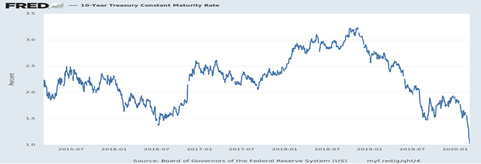
But stock investors are already seeing the oncoming recession, as interest rates have plunged to new lows. The 10-year Treasury note yield fell 18.6 basis points to an unheard of yield of 0.739 percent on Friday morning, per the St. Louis FRED graph. This is a sure sign stock investors fear the worst.
image

FRED

It will certainly boost the housing market, however, as mortgage rates are sinking to more than 50-year lows. This will make even more homes affordable to prospective buyers, as long as employment holds up. For instance, the 30-year High-Balance, Super/Conforming fixed rate has fallen to 3.125 percent with no origination fees with the most competitive lenders.

But the lack of substantial wage increases is becoming worrisome in a fully employed economy. The 3 percent average hourly wage rise in the report is barely above inflation, and so leaves no room for disruptions as I’ve been saying.

It may be the result of a service economy now able to employ only the lowest skilled, lowest paying jobs, as automation becomes a fact of American life and manufacturing continues to move overseas, in spite of the tariff raises.

Recessions begin when the economy, based on four major indicators such as the unemployment rate, manufacturing and trade, and personal incomes, have peaked that I spoke about in my last blog; and both manufacturing and personal incomes have definitely peaked. 

The NBER business cycle Dating Committee won’t wait as long this time to call a recession, in my opinion.  It was called in December 2018, 12 months after the Great Recession actually began, as I said. Let’s see what happens over the next four months—until the end of second quarter in June, when we will know more about effects of COVID-19—which may speed up the oncoming slowdown. 

Why should we know by then?  I say this because the Fed suddenly dropped their short term interest rates one-half percent last Wednesday, and are hinting at more rate cuts. The financial markets reacted in panic after a very short-lived rise. What does that tell us about business confidence? It tells us the Fed also sees a rocky economy ahead.  We don’t even yet know how COVID-19 is transmitted, much less how to treat it other than with quarantines and certain preventive measures.

The worldwide spread of the COVID-19 virus means a worldwide slowdown of economic activity. It’s now appearing in 92 countries at last count, with 101,781 cases of COVID-19, at least 3,460 deaths; 15 now in the U.S.  About 55,866 have recovered,  primarily in China’s Hubei Province, according to the latest figures.

The greatest danger to the U.S. economy is a sharp cutback in consumer confidence and spending as we retreat to our homes to wait this out, while the slow response of our public health system will mean further disruptions, and even shortages of essential supplies needed to treat COVID-19.

Harlan Green © 2020

Follow Harlan Green on Twitter: https://twitter.com/HarlanGreen
Posted in Consumers, Economy, Uncategorized | Tagged , , , , | Leave a comment

The Wages of Fear in a Recession—Part II

Financial FAQs

image

FRED

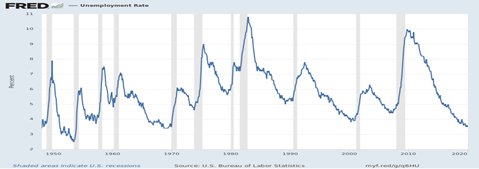
Is the U.S. economy already in recession? How can it be with more than 80 percent of the adult workforce employed? But that isn’t how recessions actually begin, as portrayed in the above St. Louis Fed unemployment rate history dating from 1950.

The latest COV-19 coronavirus news makes it a virtually certainty that the U.S. economy could go into recession this year. Why? America’s record income inequality—the worst since 1928 prior to the Great Depression—means many cannot afford to be quarantined from their work.

A recent Brookings Institute study found that 44 percent of U.S. workers are employed in low-wage jobs that pay median annual wages of $18,000. And most of the 53 million Americans working in low-wage jobs are adults in their prime working years between about 25 to 54. Their median hourly wage is $10.22 per hour — above the federal minimum wage of $7.25 an hour but well below what’s considered the living wage for many regions.

Recessions begin when the economy, based on four major indicators such as the unemployment rate, manufacturing and trade, and personal incomes has peaked; i.e., no longer continue to rise as determined by a Business Cycle Dating Committee of the National Bureau of Economic Research (NBER).

The NBER website states it thusly: “We identify a month when the economy reached a peak of activity and a later month when the economy reached a trough. The time in between is a recession, a period when economic activity is contracting. The following period is an expansion.”

The worldwide spread of the COVID-19 virus means a wholesale slowdown of economic activity in coming months. We are already seeing a slowdown in several U.S. sectors—especially manufacturing—and growth may have peaked in the consumer-driven service sector as well, though not yet contracting.

If American workplaces are shut down, as they are in China, S. Korea, Italy, Iran, and parts of Japan, these workers that have neither health plans to pay for sick-leave (a full 25 percent of the lowest paid service workers have no paid sick-leave coverage), or savings to fall back on until they can return to work, would have to rely on unemployment insurance or welfare.

Millions could therefore become unemployed, as happened during the Great Recession. One worrisome similarity is that stocks have dropped to lows last seen during the Great Recession.

In other words, the U.S. is totally unprepared for any significant epidemic, or a pandemic, as CDC officials are warning. So how do we know when economic activity has peaked and begins a sustained fall?

The Great Recession began in December 2007, yet the unemployment rate had been rising for six months—from its low of 4.4 percent in June 2007 to 5.0 percent in December. And it wasn’t the Fed that declared it a recession 12 months later, but the NBER’s Business Cycle Dating Committee based at Harvard, as I have said.

The Business Cycle Dating Committee waited until December 1, 2008 to declare that the Great Recession had started in December 2007 to be sure that the rise was a continuing trend though the unemployment didn’t peak and begin to come down until October 2009 at 10.0 percent, 4 months after the recession was declared to have ended!

This is not to say that is always how recessions begin, but recession are measured from a peak of activity to its ‘trough’, per the NBER, when activity begins to pick up again—a total of 18 months in the case of the Great Recession.

There is also reason recession begin when they do. The Great Recession in particular began because consumers and banks became so heavily indebted in an earlier era of very low interest rates that they could no longer push up housing prices that had been rising in double digits earlier in the decade.

Alan Greenspan’s Fed had also been pushing up interest rates for 2 years in an attempt to slow inflation that had also reached double digits. And borrowers than began to default as their own adjustable mortgage payments began to rise that they could no longer afford.

The U.S. economy is facing such a dangerous journey through this outbreak of the coronavirus that CNN Doctor Sanjay Gupta has said it is 20 times more deadly than the ordinary flu based on initial studies, as I said last week.

There are now 86 cases of COVID-19 in the U.S. with 2 deaths, including among 45 people who were repatriated from the Diamond Princess and from Wuhan, China, the city that first detected the virus in December. Six people are counted as recovered in the U.S.

Worldwide in 70 countries there are now 89,000 cases of COVID-19, at least 3,048 deaths, and about 45,393 people that have recovered primarily in China’s Hubei Province, according to the latest figures.

The greatest danger to the U.S. economy is a sharp cutback in consumer confidence and spending, since it is consumers that are now keeping economic growth at 2.1 percent with the 6-month decline in manufacturing activity mainly due to the trade wars. And the COVID-19 outbreak means further supply disruptions.

Harlan Green © 2020

Follow Harlan Green on Twitter: https://twitter.com/HarlanGreen
Posted in Consumers, Economy, Politics, Weekly Financial News | Tagged , , , , , | Leave a comment

The Wages of Fear In Distrustful Times

Financial FAQs

image

Goldman Sachs

The Wages of Fear is a famous 1950s French film starring Yves Montand about four men that agree to carry a very dangerous cargo of nitroglycerine, the main dynamite ingredient, through a remote South American jungle track.

Is the U.S. economy facing such a dangerous journey through this outbreak of the coronavirus that CNN Doctor Sanjay Gupta said has 20 times the death rate of the ordinary flu based on initial studies?

What could be worse should the coronavirus outbreak become a worldwide pandemic—this from a federal government and White House that has sowed distrust and disinformation in almost every American and world institution over the past three years; from the Federal Reserve, to financial markets, the intelligence services, as well as with our allies that could help to protect Americans in the event of a pandemic?

There are now 60 cases of COVID-19 in the U.S., including among 45 people who were repatriated from the Diamond Princess and from Wuhan, China, the city that first detected the virus in December. Six people are counted as recovered in the U.S. Worldwide, there are now 82,549 cases of COVID-19, at least 2,810 deaths, and about 33,252 people, primarily in China’s Hubei Province, have recovered, according to the latest figures.

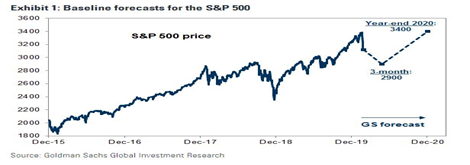
Goldman Sachs strategist David Kostin has warned that S&P 500 companies could see no earnings growth at all this year if the coronavirus spread becomes a pandemic.

In a worst-case scenario, with the virus spreading rapidly, supply-chain delays persisting, consumer demand tumbling and companies having to lay off workers to maintain margins, it could spark a recession, Kostin wrote yesterday. In that scenario, history suggests S&P 500 earnings per share could slide by 13 percent peak to trough—roughly over four quarters—before rebounding 10 percent in the next four quarters.

Not only are American institutions unprepared for anything more than a mild epidemic, but the Trump administration dissolved several of the health departments set up by the Obama administration to combat and prepare the U.S. for such outbreaks, such as the earlier SARs and Swine Flu outbreaks.

The greatest danger to the U.S. economy is a sharp cutback in consumer confidence and spending, since it is consumers that are now keeping economic growth at 2.1 percent with the smaller manufacturing sector already in recession, mainly due to supply disruptions from the ongoing trade wars.

image

FRED

Personal Consumption Expenditures haven’t yet been affected. Americans spent more on new cars and trucks in the first month of 2020. They also spent more on takeout or dining out and stayed more frequently at hotels.

The burst in income from minimum wage hikes and social security inflation adjustments, and a smaller increase in January spending pushed the savings rate up to a nine-month high of 7.9 percent from 7.5 percent in December.

The high rate of savings suggests consumers are becoming more cautious as they spend less and save more. The core PCE inflation rate without food and energy prices that is most watched by the Fed has risen just 1.6 percent in the past 12 months vs. a 1.5 percent rate in December.

And now a whistleblower alleges that some federal employees were sent to work at coronavirus quarantine locations in California without adequate safety protocols and then flew back home on commercial airplanes, says the Associated Press, and according to a person familiar with the complaint against the Department of Health and Human Services.

“The Dow Jones Index has now shed more than 4,200 points on the week, poised to mark worst weekly slide since 2008 as coronavirus routs confidence,” said one headline today. And the World Health Organisation has just warned that the coronavirus could spread to every country.

Perhaps the Trump administration is about to reap what it has sowed—fear from an almost total ignorance about what is happening, or about to happen, in a world that cannot be shut out with empty rhetoric and ongoing trade wars.

Harlan Green © 2020

Follow Harlan Green on Twitter: https://twitter.com/HarlanGreen

Posted in Consumers, Economy, Politics, Weekly Financial News | Tagged , , , | Leave a comment

Won’t You Be My Neighbor??

Popular Economics Weekly

image

DailyKos

The maxim that we are our brothers’ keeper has always been one of Christ’s teachings that Christians should follow, just as Mr. Rogers asked his TV viewers to be his good neighbor, and Martin Luther King, Jr. asked that all people be treated with equality in his many speeches and actions.

And now in the age of epidemics; such as Ebola, Zika, SARs, and now the coronavirus; can Americans follow such teachings embodied in all world religions—to care for each other in dangerous times that include not just epidemics, but global warming, an overcrowded planet, and growing authoritarian governments that exclude and exploit those they rule, rather than include?

There is news today that some American cities and states are even refusing to allow any of the 14 American coronavirus victims transported home on a commercial flight to be housed in their quarantine facilities. The Los Angeles Times reports today that citizens and officials in Orange County, California and Alabama are resisting efforts to house any of the victims in their facilities; or even at nearby military bases with such facilities.

This is happening when Trump Republicans want to “Make America Great Again”; a racial trope meant to separate the white from brown or black skins, a world of Haves and Have-nots where laws are ignored or manipulated by the powerful over the powerless.

News outlets report that since then, the virus has spread outside of China, across Asia and into Europe. More than 81,000 people have been infected world-wide and the death toll has risen above 2,750.

France has reported three new infections on Wednesday and the death of a 60-year old man among them, according to the Associated Press. Spain also reported new cases linked to travel to northern Italy, where the number of infected reached 322 and deaths rose to 11.

And it may now have traveled to South America, where Brazil just reported the case of a man who spent two weeks in Italy and returned home to spend time with his family, which means that the flight passengers and his family may have also been exposed to the virus.

So will the Trump administration be in any position to deal with this new outbreak, when they have gutted or closed outright Obama administration programs that were set up to fight the last outbreaks?

Laurie Garrett is a former senior fellow for global health at the Council on Foreign Relations and a Pulitzer Prize winning science writer writes in Foreign Policy that in 2018, the Trump administration fired the government’s entire pandemic response chain of command, including the White House management infrastructure.

“In May 2018, Trump ordered the NSC’s entire global health security unit shut down,” said Ms. Garrett, “calling for reassignment of Rear Adm. Timothy Ziemer and dissolution of his team inside the agency. The month before, then-White House National Security Advisor John Bolton pressured Ziemer’s DHS counterpart, Tom Bossert, to resign along with his team. Neither the NSC nor DHS epidemic teams have been replaced.

“The global health section of the CDC was so drastically cut in 2018 that much of its staff was laid off and the number of countries it was working in was reduced from 49 to merely 10. Meanwhile, throughout 2018, the U.S. Agency for International Development and its director, Mark Green, came repeatedly under fire from both the White House and Secretary of State Mike Pompeo.

“And though Congress has so far managed to block Trump administration plans to cut the U.S. Public Health Service Commissioned Corps by 40 percent, the disease-fighting cadres have steadily eroded as retiring officers go unreplaced.”

Is this any way to love thy neighbor, Mr. Trump?

Harlan Green © 2020

Follow Harlan Green on Twitter: https://twitter.com/HarlanGreen

Posted in Politics, Uncategorized | Tagged , , , , , | Leave a comment

Housing Market (Still) Alive and Well

The Mortgage Corner

image

FRED-ICAP

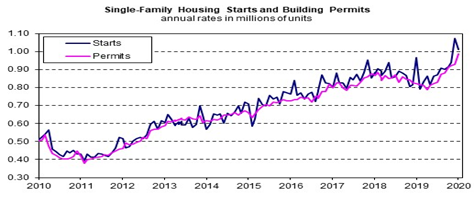
All is still well with residential housing into this new year. Both housing starts and permits exceeded predictions, with starts now at 1.57 annual units, and permits at a 13-year high of 1.551 million units annualized.

Why? Interest rates are plunging to now lows with what looks like a coronavirus pandemic that now effects at least 30 countries, including new cases in S. Korea and Italy. And there are fears it will spread further into Europe and the EU with its open borders.

The totals as of Monday morning are now 79,407 cases and 2,622 deaths, respectively. The DOW Jones is has fallen more than 1,000 points and the 10-year benchmark Treasury yield has dropped more than 20 basis points from its recently stabilized yield to 1.37 percent as investors flee to save-haven bonds to protect themselves. This is causing mortgage rates to fall to new lows, as well.

Conforming mortgage 30-year fixed rates for those with the best credit and incomes, and with all closing costs paid by the lender, have fallen as low as 3.25 percent, and the super-conforming rate of 3.375 percent, which I have never seen in my 30 plus years as a Mortgage Banker.

But won’t a possible pandemic slow housing sales? Not according to the Conference Board’s Index of Leading Economic Indicators (LEI) that has a good record of predicting economic activity six months ahead.

The Conference Board Leading Economic Index® (LEI) for the U.S. increased 0.8 percent in January to 112.1 (2016 = 100), following a 0.3 percent decline in December and a 0.1 percent increase in November, said its press release:

“The strong pickup in the January US LEI was driven by a sharp drop in initial unemployment insurance claims, increasing housing permits, consumers’ outlook on the economy and financial indicators,” said Ataman Ozyildirim, Senior Director of Economic Research at The Conference Board. “The LEI’s six-month growth rate has returned to positive territory, suggesting that the current economic expansion – at about 2 percent – will continue through early 2020. (But) While weakness in manufacturing appears to show signs of softening, the COVID-19 outbreak may impact manufacturing supply chains in the US in the coming months.”

So even the Conference Board is hedging its predictions at bit. But manufacturing is just 10 percent of the U.S. economy these days, so who knows how much such a burgeoning pandemic with affect the U.S., in particular?

We do know that interest rates are plunging to new, historic lows, however. And even the Federal Reserve may be poised to lower their short term interest rates, should the economy show more signs of slowing.

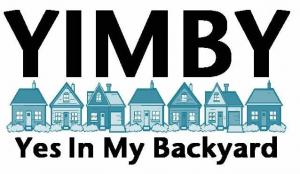
And all of this prospective residential construction is underpinned by the urgent need to supply more housing; so much so that it has jump-started a new YIMBY (Not In My Backyard) movement to build more affordable housing near transportation hubs and city centers.

So we may never have a better time to provide more housing for a growing population. It also signals the demise of suburban sprawl, as we know it. The missing piece in this effort seems to be upgrading transportation networks, as I said last week, which need to be improved to better connect where we live to where we must work, if we want to solve our very serious housing shortage.

Harlan Green © 2020

Follow Harlan Green on Twitter: https://twitter.com/HarlanGreen
Posted in Consumers, Housing, housing market, Weekly Financial News | Tagged , , , , , | Leave a comment

What Is A More Livable Community?

The Mortgage Corner

image

pccfarmlandtrust.org

There is a budding national movement to build more affordable housing with the growing housing shortage (and homeless) problem. It is just one more facet of the so-called Livable Cities movement begun in the 1980s that searched for ways to make cities safer for children as well as adults in a friendlier environment less dependent on the automobile.

The YIMBY movement is taking hold in cities all over America, from California to Massachusetts. YIMBY stands for ‘Yes in My Backyard’, a movement to build denser residential units near city centers and transportation hubs, as opposed to the NIMBY, ‘Not in My Back Yard’ syndrome affecting many upscale housing communities that have managed to keep such housing out of their backyards.

NIMBYism is really a local community incarnation of the outlawed redlining by banks that once would not loan or invest in ‘certain’ lower-income neighborhoods, but must do so today to keep their charters. NIMBYism prevails in predominately single-family based communities that have found ways to discourage the creation of high zoning densities near their housing tracts that would enable the building of more affordable housing for ‘those’ people.

“Look around, and YIMBYs are a growing presence,” said a 2017 Atlantic Monthly article as the movement took hold. “There’s a YIMBY group in Somerville, Massachusetts, and one in Los Angeles; there’s a San Francisco YIMBY party and a YIMBY group in Portland. YIMBYtown, a national conference, will take place in Oakland this month; Helsinki is hosting Yimbycon in August (2107).

The situation is most dire today in California. Its homeless population has risen to more than 150,000 in 2018, up 17 percent just from 2017, and the median home price is now $561,000, according to Zillow, with many workers priced out of living in the coastal communities that hold the best jobs.

Hence the one and two-hour commute times for those that work in Silicon Valley, but live in the Livermore.and Castro Valleys or further eastward, at least 40 miles and a two-hour drive during commuting hours, in part because alternate transportation modes such as the Bay Area’s BART light rail have yet to connect to Santa Clara County where most of Silicon Valley is located.

SB50, California’s attempt to override local zoning laws to enable smarter urban planning concepts failed for a second time, which makes it even more urgent to find a solution to California’s perennial housing shortage. It was a valiant effort that sank when some minority and homeless advocates opposed it, of all people.

Their concern was that it would gentrify in some way the areas around transportation hubs by destroying older, existing neighborhoods. It’s really hard to understand that reasoning, as “Developers, landlords, Facebook, construction unions, the state Chamber of Commerce, Realtors, environmental groups and even the AARP wanted to see the bill pass,” said Cal Matters, a legislative blog that announced its demise:

“Nonetheless Senate Bill 50, a measure that would have forced cities to allow more mid-rise apartment buildings around public transit and next to some single-family homes, failed to get enough votes in the California Legislature to survive in 2020 before time ran out,” it continued.

Younger social activists are behind much of the push for YIMBY housing and new zoning laws that create more affordable housing. Sonja Trauss, a former High School mathematics teacher, co-founded YIMBYlaw.org in 2018, a San Francisco lobbying effort whose mission is to make housing in California more accessible and affordable.

“Our method is to enforce state housing laws like the Housing Accountability Act. We send letters to cities considering zoning or general plan compliant housing developments informing them of their duties under state law, and sue them when they don’t comply,” said Ms. Trauss.

She said her efforts grew out of the frustration in getting approvals for entry-level, affordable housing, because rent control supporters could not unite with those that wanted more housing, resulting in fragmented efforts to build more affordable residences.

An earlier, rural version of YIMBYism sprang up in Washington State called pccfarmlandtrust.org is a nonprofit land trust working to protect and steward threatened farmland in Washington, and purveyors of organic produce from sustainable farming. “We work to keep land in production by making it accessible to future generations of farmers.” is part of its mission statement.

So the drive to provide more housing for a growing population is taking many forms, and signals the demise of suburban sprawl, as we know it. The missing piece in this effort seems to be transportation networks, which need to be improved to connect where we live to where we must work to support such housing.

Harlan Green © 2020

Follow Harlan Green on Twitter: https://twitter.com/HarlanGreen
Posted in Consumers, Housing, housing market, Politics | Tagged , , , , , | Leave a comment

What Happened to Honest Abe?

Popular Economics Weekly

image

Wikipedia

What happened to honesty in personal behavior and in politics is a good theme to discuss on this Presidents Day that commemorates our two Presidents most touted for their honesty—Washington and Lincoln? They were celebrated for their honesty, whereas today we have a President and his subservient political party that not only tolerates, but enables the most dishonest president in history.

We are not just talking about President Trump’s 16,000 plus documented lies—many of them done for mostly propaganda purposes; but the dishonesty manifested during the impeachment hearings and trial, when Republicans parroted Russian propaganda tropes that Ukraine opposed the Trump election, and was behind the Democratic Party hackings rather than Putin’s Russia.

Why didn’t Republicans question whether Trump’s call for Ukraine and China to aid in his reelection by digging up dirt on his political opponents was somehow ethical and allowable for a President seeking reelection?

What has happened to Republicans that abet Trump’s propaganda machine which is based on outright lies, when young American children were brought up on stories of Presidential honesty; whether it was Abraham Lincoln the honest politician, or George Washington’s honesty in confessing to cut down the cherry tree as a six-year old child?

“Honest Abe’ was a nickname Lincoln adopted early in his career as a lawyer. In his Notes for a Law Lecture his entire series of notes speaks to honesty, integrity, and to do what is right.  Lincoln wrote, “resolve to be honest at all events; and if in your own judgment you cannot be an honest lawyer, resolve to be honest without being a lawyer.”

The honesty of George Washington has become almost mythical, and a beacon that we all learned as young school children.  The cherry tree tale was probably a children’s tale, but Thomas Jefferson once said of Washington, “his integrity was most pure, his justice the most inflexible I have ever known, no motives of interest or consanguinity or friendship or hatred, being able to bias his decision. He was indeed in every sense of the words, a wise, a good, and a great man.”

Why wouldn’t Republicans want to live up to their standards? It is in essence an admittance that Republicans cannot maintain their power and privileges without the aid of outright lies that other authoritarian regimes use to maintain their power with propaganda machines that also suppress truth and promote ‘alternate facts’—because their power and privileges were not always honestly acquired.

It only took America 244 years to go from “Honest Abe” and “I cannot tell a lie” to 16,241 false or misleading claims, said USA Today recently. How can we recover from such blatant dishonesty, unless we keep telling our children at the earliest age that “honesty is the best policy,” and building character the only road to a truly successful life?

Harlan Green © 2020

Follow Harlan Green on Twitter: https://twitter.com/HarlanGreen

Posted in Politics, Uncategorized | Tagged , , | Leave a comment

Why Are Retail Sales Struggling?

Financial FAQs

image

Calculated Risk

Retail sales have slowed markedly since the fall of 2019, with monthly overall sales up just 0.3 percent, and rising 3.9 percent annually without volatile gasoline prices. This means the U.S. is basically stuck in a slow growth mode, since more robust growth (+3 percent) would mean 5-6 percent annual retail sales. And that is worrisome to financial markets that have been pushing down bond yields as a hedge against a further slowing of economic activity.

Consumers seem to remain optimistic, however, in part because they love the very low consumer prices, hence low inflation, which boosts spending. But optimism is also fueled by plentiful jobs, per the University of Michigan sentiment survey.

 image

Umich.edu

“Consumer sentiment rose to 100.9 in early February to nearly match the expansion peak of 101.4, set two years ago in March 2018,” said its press release. “The Expectations Index, the main gauge of future economic conditions, rose to 92.6, also its second highest level in this long expansion. (But) both measures were still significantly below the levels recorded twenty years ago when the Sentiment Index reached a peak of 112.0 and the Expectations Index peaked at 108.6.”

Part of the sluggishness in growth comes from the decline in manufacturing, now in its fifth month of shrinkage. Employment in construction, mining, logging and manufacturing industries ramped up sharply in his first two years in office, according to the latest figures released Friday by the Bureau of Labor Statistics, but overall output fell 0.3 in January, with the biggest negative impact coming from a weather-related 4 percent drop in utility usage.  

Motor vehicle and parts production did post a 2.4 percent increase last month, but even that was a little disappointing, with Reuter’s forecast having called for a 4 percent rise.  On the other hand, the mining sector was a positive surprise, posting a solid 1.2 percent increase, per Reuters ICAP update.

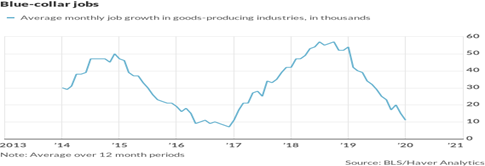
Some blue-collar jobs have come back in Trump’s first two years, but not nearly as many as had been lost. Most of the jobs have been lost forever to automation or cheaper manufacturers around the world.

image

Crippled by the trade war and collapse in investment, job growth in blue-collar sectors slowed to a trickle over the past year. Meanwhile, job growth in the services-producing industries has actually strengthened, especially in health-care and in the quintessential pink-collar and white-collar jobs, per Friday’s unemployment report.

The bottom line is that most consumers can’t spend more because they don’t earn enough to spend more, since most have jobs in the lower-paying service sector these days. And their optimism is held in check by the fact that anything can happen over the coming months, as we have been saying, which is why interest rates are extremely low and could fall further.

The 10-year bond yield slipped back to 1.59 percent Friday, which also means investors are worrying about future stock market gains with current S&P P/E ratio now 20. It is 5 points above its long term average of 15 times earnings, and corporate profits are predicted to decline this year.

Harlan Green © 2020

Follow Harlan Green on Twitter: https://twitter.com/HarlanGreen

Posted in Consumers, Economy, Weekly Financial News | Tagged , , , | Leave a comment

Who Is Fully Employed in January?

Financial FAQs

image

MarketWatch

It looks like everyone is employed in the service sector, but manufacturing is sputtering. There were 44,000 new construction jobs and a whopping 72,000 in Education and health services. But manufacturing lost another 12,000 jobs in January; the same as in December.

That is why average hourly earnings (i.e., wages) are barely rising above inflation, and interest rates and inflation remain so low. This ‘goldilocks’ scenario must be due to the 2-year trade war, and now China’s coronavirus pandemic that the World Health Organization has called a “global public-health emergency.”

In other words, American consumers are scooping up lots of cheap consumers goods from other countries, but manufacturers aren’t exporting enough to create a positive balance of payments.

So stock and bond prices are gyrating when the world economy doesn’t seem to know what to make of China’s coronavirus that has now spread to some 23 countries, according to latest reports.

Here are the latest coronavirus numbers, according to the Washington Post, as it is approaching the SARS pandemic totals of 2003, and may turn out to be more deadly as the virus mutates into a possibly more virulent strain:

Chinese health officials say they confirmed more than 31,000 cases of the coronavirus, more than 4,800 of them considered severe. The death toll surpassed 630, with fatalities almost entirely confined to China.

● An additional 41 people on board the Diamond Princess cruise liner, which has been quarantined in Japan, have tested positive for coronavirus, bringing the total to 61.

● Another cruise ship, the Westerdam, is at sea, and its crew is unsure where to go next, after being denied entry to the Philippines, Japan and South Korea. Passengers blame an ill-advised port stop in Hong Kong, where the boat took on many new passengers.

● Two charter flights carrying about 300 Americans out of the virus-hit city of Wuhan are expected to arrive in the United States on Friday. A flight carrying mainly Canadian evacuees landed in Ontario on Friday morning.

So let us take some comfort that American jobs aren’t yet at risk. In fact, the 2003 SARS pandemic occurred during the housing bubble, and record economic growth during that decade. But what followed was the Great Recession.

That’s why most economists aren’t touting January’s very robust job numbers as a harbinger of a better year just yet. There may be more bad news coming, and interest rates are still at record lows, which mean the financial markets are hedging their bets for another rainy day.

Harlan Green © 2020

Follow Harlan Green on Twitter: https://twitter.com/HarlanGreen

Posted in Consumers, Economy, Keynesian economics, Weekly Financial News | Tagged , , , | Leave a comment

Disaster Preparation—Why Irrational Exuberance?

Popular Economics Weekly

image

WTI Crude Oil

Stock and bond prices are gyrating when the world economy doesn’t seem to know what to make of China’s coronavirus that has now spread to some 23 countries, according to latest reports.

And that is not a good time for irrational exuberance to appear in U.S. financial markets, since much of the financial gyrations are driven by excess liquidity—too abundant cash from the 2017 corporate tax cuts are pushing stock prices to record highs, and bond yields to record lows—both signs of price bubbles sure to burst on signs that world trade in particular could be affected by what economists call such an unpredictable, “exogenous” event.

The medical consensus to date is that the coronavirus doesn’t seem as virulent as the 2003 SARS outbreak, yet the number of deaths and infection rate to date has already exceeded that of the SARS virus.

The NYTimes reports this respiratory virus has infected more than 17,000 people, killing “at least” 360. “But the Wuhan coronavirus may be highly transmissible, as contagious as seasonal influenza that kills many more, and the death rate is still unknown.”

Why could this pandemic that the World Health Organization has now labeled a global public health emergency be dangerous to global growth?

Nobel economist Paul Krugman says it’s because China’s economy is many times larger than it was in 2003, so the effect of closing down major Chinese cities until more is known about the virus could be economically devastating to China and other economies that depend on Chinese goods and services. The EU is one such market that is worried because 20 percent of its exports now go to China.

Crude oil imports to China, the world’s largest consumer of oil, have also dropped 20 percent and oil prices are down approximately 10 percent, which has OPEC producers scrambling to cut production quotas.

Other economists are voicing similar warnings. Yale economist Dr. Stephen Roach, former Morgan Stanley chief economist and chairman of Morgan Stanley’s Asia Desk, is making good sense with his predictions of worse things to come.

He’s talking about world trade volumes, which have dropped precipitously. And worldwide growth depends even more today on world trade, which has already been harmed by the Trump trade wars.

Roach in recent Project Syndicate comments, said that from 1990 to 2008, annual growth in world trade was fully 82 percent faster than world GDP growth. And this cushion has shrunk dramatically, to just 13 percent over the 2010-19 period, “leaving the world economy more vulnerable to all-too-frequent shocks.”

“The IMF’s latest assessment put global trade growth at just 1% in 2019 – its seventh consecutive downward revision,” said Roach. “Indeed, last year was the weakest trade performance since the historic 10.4% plunge in 2009, which was the worst contraction since the early 1930s.”

Is Roach being an unnecessary alarmist? I don’t think so, when compared to the Great Depression. Now is not the time for irrational exuberance of any kind with world economies retreating in the face of so much geopolitical uncertainty (e.g., rising isolationism from rising nationalism).

Are we prepared? 

Harlan Green © 2019

Follow Harlan Green on Twitter: https://twitter.com/HarlanGreen
Posted in Economy, Macro Economics, Politics, Uncategorized | Tagged , , , , , | Leave a comment