U.S. Loses 701,000 Jobs in March

Financial FAQs

image

MarketWatch

Total nonfarm payroll employment fell by 701,000 in March, and the unemployment rate rose to 4.4 percent, the U.S. Bureau of Labor Statistics reported today.

The changes in these measures reflect the effects of the coronavirus (COVID-19) and efforts to contain it, said the BLS. Employment in leisure and hospitality fell by 459,000, mainly in food services and drinking places. Notable declines also occurred in health care and social assistance, professional and business services, retail trade, and construction.

More than 10 million unemployment compensation claims were filed in the last two weeks, which is just the beginning of what could be many more job losses. Most were in the service sector, where the Leisure and Hospitality sector losing the most jobs, Education and health services lost 52,000, and Transportation lost 46,200 jobs.

MarketWatch’s Jeffry Bartash said a separate survey of households gave a more accurate view of what was happening. Employment measured by the household survey showed a 3 million decline in the number of people who said they were working. And 1.6 million people just dropped out of the labor force.

Just the fact that so many service workers are being laid off will not help the recovery, since they are mostly lower-paid jobs and therefore lower-spending consumers, who keep the economy functioning on many levels. E.g., fewer transportation workers mean slower deliveries, right? It will also mean a huge hit to consumer spending, which powers some two-thirds of GDP growth.

Economic growth projections have also been down-sized, with Goldman Sachs now predicting negative GDP growth for the first three quarters of this year.  Let’s hope that is all the damage.

image

Wrightson/ICAP

This Wrightson graph portrays the straight-line drop of March payrolls, which almost equals that of the 2008-09 Great Recession. Let’s hope this one doesn’t last as long.

Harlan Green © 2020

Follow Harlan Green on Twitter: https://twitter.com/HarlanGreen

Posted in Consumers, Economy, Macro Economics, Weekly Financial News | Tagged , , , | Leave a comment

Housing in the Time of COVID-19

The Mortgage Corner

image

Wolf Street

I reported in January that housing construction was slowly recovering, in part due to the extreme housing shortage and record low interest rates. Well, rates are even lower today, but purchase applications are now plunging as will new-home sales, whereas I believe refinancing will continue to surge because of even lower mortgage rates during the COVID-19 pandemic.

So it’s good to know the Fed is also supporting the mortgage-backed securities market with its Quantitative Easing from the latest $2 billion bailout bill, since the mortgage market is suffering from the same credit crunch as every other part of the fiancé industry.

And who wants to buy a home in this lockdown that could last months, anyway? Reports are coming in that home buying is also frozen in place, while everyone waits out the pandemic.

Wolf Richter for the financial blog Wolf Street writes, “In states where lockdowns started first – they were kicked off in the San Francisco Bay Area – the year-over-year plunge in purchase-mortgage applications was the most severe:

  • California: -36.4%
  • New York: -35.6%
  • Washington: -32.5%

Purchase mortgage applications plunged another 11 percent after dropping 24 percent from the equivalent week a year ago. Since the multi-year peak in January, purchase-mortgage applications have plunged by one-third, said the Mortgage Bankers Association (MBA).

Whereas the MBA’s Market Composite Index, a measure of mortgage loan application volume, increased 15.3 percent on a seasonally adjusted basis from one week earlier. This is because refinancing per the Refinance Index increased 26 percent from the previous week and was 168 percent higher than the same week one year ago.

“Mortgage rates and applications continue to experience significant volatility from the economic and financial market uncertainty caused by the coronavirus crisis. After two weeks of sizeable increases, mortgage rates dropped back to the lowest level in MBA’s survey, which in turn led to a 25 percent jump in refinance applications,” said Joel Kan, MBA’s Associate Vice President of Economic and Industry Forecasting.

“The bleaker economic outlook, along with the first wave of realized job losses reported in last week’s unemployment claims numbers, likely caused potential homebuyers to pull back,” he continued.

There will be an even more severe housing shortage, in other words, with more than 500,000 homeless living on the streets in January. Homelessness will now increase with the new coronavirus pandemic, as the many without government-insured mortgages (GSEs) from Fannie, Freddie, FHA, and the VA will probably lose their homes, if they cannot keep up their loan payments. HUD’s Federal Housing and Finance Authority has said the requirement that lenders hold off on foreclosures for one year only applies to the GSEs the FHFA regulates.

And so the housing shortage will continue. In many markets, this will mean no open houses (for new-home purchases). Face-to-face closings are to be avoided.

“But exchanging signed documents through car windows in a parking lot is OK. Under the pressure of social distancing, the doors have opened to modern document technology. In theory, homes can be sold, and mortgages can be written, but it’s now a different ballgame,” says Richter.

It will require even greater government support to keep people in their homes for the duration of the novel coronavirus pandemic; and beyond?

Harlan Green © 2020

Follow Harlan Green on Twitter: https://twitter.com/HarlanGreen

Posted in Consumers, Housing, housing market, Weekly Financial News | Tagged , , , | Leave a comment

Might We Have More Than One Pandemic?

Popular Economics Weekly
image

Wrightson/ICAP

Yes, says behavioral economist Robert Shiller, who won his Nobel prize for the study of human behavior in financial markets. Why? Financial market investors are panicking because of the COVID-19 pandemic, for starters, which could affect the general public’s financial behavior as well, and so wreak even more damage to crashing financial markets.

“We are feeling the anxiety effects of not one pandemic but two,” said Dr. Shiller in a recent Project-Syndicate article. “First, there is the COVID-19 pandemic, which makes us anxious because we, or people we love, anywhere in the world, might soon become gravely ill and even die. And, second, there is a pandemic of anxiety about the economic consequences of the first.”

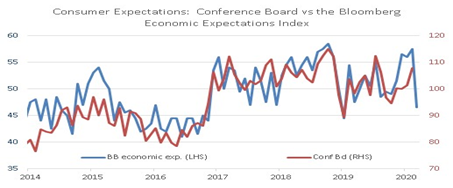
The first indication of a looming loss of confidence in the economy and jobs is showing up in consumer sentiment surveys, per Wrightson’s above graph. The University of Michigan’s consumer sentiment index fell by 12 percent in March. 

The Conference Board’s confidence survey fell as well.

“Consumer confidence declined sharply in March due to a deterioration in the short-term outlook,” said Lynn Franco, Senior Director of Economic Indicators at The Conference Board. “The Present Situation Index remained relatively strong, reflective of an economy that was on solid footing, and prior to the recent surge in unemployment claims. However, the intensification of COVID-19 and extreme volatility in the financial markets have increased uncertainty about the outlook for the economy and jobs. March’s decline in confidence is more in line with a severe contraction – rather than a temporary shock – and further declines are sure to follow.

Dr. Shiller knows a lot about human behavior, and the irrational behavior of financial market investors. He wrote about irrational exuberance in his best-seller of that name in 2000, just as the Dot-com bubble burst from overinvestment building the digital infrastructure (remember all those fiber-optic cable networks being laid?).

And the Great Recession was caused by the busted housing bubble—due to home buyers bidding up housing prices to stratospheric heights because of the popular thought that housing prices could never decline—another example of irrational exuberance.

Now what about its opposite—irrational pessimism, or a contagion of fear that stock prices have no visible bottom; or a cure or vaccine will not be found in time to save many companies from bankruptcies, due to a prolongation of social isolation and business shutdowns?

“The effects financial anxiety has on the stock market may be mediated by a phenomenon that psychologist Paul Slovic of the University of Oregon and his colleagues call the “affect heuristic,” said Shiller. “When people are emotionally upset because of a tragic event, they react with fear even in circumstances where there is no reason to fear.”

Dr. Shiller’s research has found that people tend to react to rumor, word-of-mouth, or popular media stories rather than actual facts.

In a joint paper with William Goetzmann and Dasol Kim, for example, Shiller found that people living within 30 miles of the epicenter of a substantial earthquake significantly raise their expectation that there could be a 1929- or 1987-size stock market crash.

Similar fears may have caused the plunge in market asset values today, where interest rates and Treasury bond yields have plunged to historic lows as investors flee to save haven investments in order to preserve their cash.

While many Americans might have faith in upcoming cures for COVID-19, they might not have such faith in a restoration of the economy and jobs. It took years for markets to recover from the Great Recession, even with the Fed holding their rates to almost zero.

I maintain that we will need some form of a New Deal, or even Green New Deal—prolonged market interventions by government in a word—to reassure Americans and the rest of the world that the second, anxiety pandemic can be controlled as well.

Harlan Green © 2020

Follow Harlan Green on Twitter: https://twitter.com/HarlanGreen

Posted in Consumers, Economy, Keynesian economics, Politics, Weekly Financial News | Tagged , , , , , , | Leave a comment

The Cure Has To Be Worse Than the Problem

Financial FAQs

image

Federal Reserve

President Trump on Sunday announced that he was extending his administrations guidelines on social distancing during the COVID-19 pandemic to April 30. He seems to have taken the recommendation of his top scientific advisors Drs. Fauci and Brix to heart, backing away from his assertion that the virus will have diminished enough to be able to celebrate Easter Sunday on April 12 in churches.

Why did he change his tune?  Dr. Fauci said Sunday on CNN’s “Face the Nation” that the novel coronavirus could kill from 100,000 to 200,000 people while infecting millions of others, though he said that the virus was difficult to model this early in the outbreak.

Recent scientific research and mounting anecdotal evidence show the more severe the ‘cure’, including longer social isolation and business closures, the quicker the return to economic growth once it is lifted.

Researchers from the Federal Reserve in a recent study of the 1918 Spanish Influenza pandemic that killed more than 50 million people, cited recently by MarketWatch’s Steve Goldstein, found that the more draconian the ‘cure’ in tamping down the initial spread, the more lives were saved and there was a more robust economic recovery as well.

The 1918 Flu Pandemic lasted from January 1918 to December 1920, and it spread worldwide. It is estimated that about 500 million people, or one-third of the world’s population, became infected with the virus. The number of deaths is estimated to be at least 50 million worldwide, with about 550,000 to 675,000 occurring in the United States.

“Most U.S. cities applied a wide range of NPIs in fall 1918 during the second and most deadly wave of the 1918 Flu Pandemic,” said the study. “The measures applied include social distancing measures such as the closure of schools, theaters, and churches, the banning of mass gatherings, but also other measures such as mandated mask wearing, case isolation, making influenza a notifiable disease, and public disinfection/hygiene measures.”

What are the economic consequences of the 1918 influenza pandemic was the central question of the study. And given that it was a worldwide epidemic, what are the economic costs and benefits of non-pharmaceutical interventions (NPIs), such as social isolation and quarantining of the infected?

“Using geographic variation in mortality during the 1918 Flu Pandemic in the U.S., we find that more exposed areas experience a sharp and persistent decline in economic activity,” said the study.

“(Yet) We find that cities that intervened earlier and more aggressively do not perform worse and, if anything, grow faster after the pandemic is over,” said the study, “our findings thus indicate that NPIs not only lower mortality; they also mitigate the adverse economic consequences of a pandemic.”

And there are increasing signs that the most draconian measures to contain the current COVID-19 pandemic by countries such as China, Singapore, and South Korea shortened the recovery period.

Similar results are also coming in from Germany and the Netherlands that have reacted the quickest to the pandemic and are showing lower rates of infection.

Data from Germany shows just 0.4 percent of people who tested positive for the virus have died from it, much less than the 9.5 percent in Italy and 4.3 percent in France. In the Netherlands growth in transmissions of the virus have also slowed significantly.

The Fed’s Spanish flu study found that while reacting 10 days earlier to the arrival of the pandemic in a given city increases manufacturing employment by around 5 percent in the post period, the researchers said, implementing restrictions for an additional 50 days increases manufacturing employment by 6.5 percent after the pandemic abates.

The vertical line in the Fed’s graph above measured mortality rate, while the horizontal line measured employment changes. And, the lower death rate correlated with higher employment.

“…we find that early and extensive NPIs have no adverse effect on local economic outcomes. On the contrary, cities that intervened earlier and more aggressively experience a relative increase in real economic activity after the pandemic. Altogether, our findings suggest that pandemics can have substantial economic costs, and NPIs can have economic merits, beyond lowering mortality.”

President Trump first intoned “We cannot let the cure be worse than the problem,” at the beginning of the pandemic. The experts are saying just the opposite. Unless we allow a worse cure, the problem of a return to normal economic activity from an almost ground zero of business activity, can be prolonged.

Harlan Green © 2020

Follow Harlan Green on Twitter: https://twitter.com/HarlanGreen

Posted in Economy, Keynesian economics, Politics, Uncategorized | Tagged , , , , | Leave a comment

The Coronavirus—A New World War

Popular Economics Weekly

image

Conference Board

Nobel laureate Paul Krugman has said it might take an alien invasion to bring Americans together again to counter the threat of another economic downturn possibly as great as the Great Depression.

Well, the new threat has arrived—COVID-19, the ‘new’ coronavirus. The only way it will be defeated is if Americans can come together as we once did with the creation of the New Deal under President Roosevelt.

Today, unfortunately, we have a president who would like us to gather together in churches on April 12, Easter Sunday, to celebrate our deliverance from a pandemic that will not end for months, if not years.

He has named himself a “wartime” president yet wants to declare an armistice before the enemy has been vanquished. Why? He said, “We cannot let the cure be worse than the problem.”

But the cure will be worse because the social isolation and business shutdown required to keep the coronavirus pandemic even in check can take months; enough time to bring on a recession or depression.  And in fact it will take another New Deal, or Green New Deal to defeat the economic damage caused by new coronavirus.

Economists such as Nouriel Rubini predict we could be entering a “greater” Great Depression, even with the just-passed $2 trillion aid package that gives extended benefits to all business sectors and the unemployed.

“With the COVID-19 pandemic still spiraling out of control, the best economic outcome that anyone can hope for is a recession deeper than that following the 2008 financial crisis. But given the flailing policy response so far, the chances of a far worse outcome are increasing by the day,” he said in Project-Syndicate.

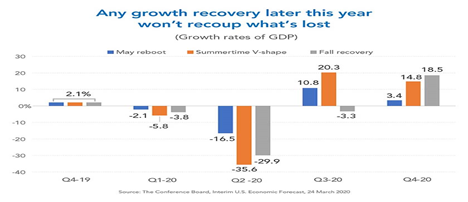
The Conference Board has predicted in three scenarios just what could be the effects of this worldwide pandemic on the U.S. economy.

  1. May reboot (quick recovery): Assuming a peak in new COVID-19 cases for the US as a whole by mid-April (with some possible variation by region), economic activity may gradually resume beginning in May.
  2. Summertime V-shape (deeper contraction, bigger recovery): The peak in new COVID-19 cases will be higher and delayed until May, creating a larger economic contraction in Q2 but a stronger recovery in Q3 than in the scenario above.
  3. Fall recovery (extended contraction): Managed control of the outbreak helps to flatten the curve of new COVID-19 cases and stretches the economic impact across Q2 and Q3, with growth resuming by September.

The April scenario is President Trump’s wish, but he would have had to act as fast and methodically as China’s Premier Xi Jinping. That can’t happen when Trump has labeled himself as a “wartime” president but has been reluctant to use the War Powers Act that would order private industry to produce what health care workers lack now to protect themselves while treating the mushrooming population of COVID-19 victims.

The other two scenarios are called ‘V’ and ‘U’-shaped recoveries by economists, meaning the recoveries would take longer. The V-shape means a quicker recovery with a more severe downturn, as can be seen in the Conference Board graph. The ‘U’ shape means the downturn and return to growth is more gradual and over a longer term.

All of the Conference Board’s predictions posit a return to GDP growth in the fourth quarter of 2020.

But not so fast, says Dr. Rubini: “While most self-serving commentators have been anticipating a V-shaped downturn – with output falling sharply for one quarter and then rapidly recovering the next – it should now be clear that the COVID-19 crisis is something else entirely. The contraction that is now underway looks to be neither V- nor U- nor L-shaped (a sharp downturn followed by stagnation). Rather, it looks like an I: a vertical line representing financial markets and the real economy plummeting.”

Which scenario will it be? It’s obvious that the just-passed $2 trillion recovery package will keep this economy alive for a few months only. Additional aid will be required, when the initial jobless claims for just this week reported 3.28 million new unemployment claims.

The Great Depression lasted 10 years, and the layoffs have just begun for this downturn. Our best hope is that a new vaccine and treatment regimen is discovered sooner rather than later. But also that Americans are able to band together to create a ‘new’ econo,ic New Deal that protects all Americans.

Harlan Green © 2020

Follow Harlan Green on Twitter: https://twitter.com/HarlanGreen

Posted in Economy, Keynesian economics, Macro Economics, Politics | Tagged , , , , , | Leave a comment

Housing Market Will Survive Coronavirus

The Mortgage Corner

image

NAHB.org

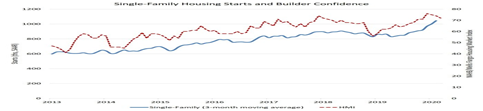
What happens to housing with the COVID-19 pandemic? It had been on the road to recovery with record low interest rates; so much so that single-family housing starts have been soaring since 2019 as more millennials have formed families and entered the housing market.

But can this last? A recent LATimes survey of homebuilders showed that builders were continuing to complete projects and selling them online (sales offices have closed, so no onsite visits allowed by prospective buyers), but not starting new construction or buying new housing sites, until there is more certainty about the U.S. economy that could lose as many as 3 million jobs during the current downturn, according to some forecasts.

HUD estimates there were 1.5 million housing starts in February, The three-month moving average for single-family construction is currently at a post-recession high. Single-family starts increased 6.7 percent to a 1,072,000 seasonally adjusted annual pace in February. Multifamily starts for units in 5+ unit properties declined 17 percent to a 508,000 annualized rate after a strong yet unsustainable start for 2020 for apartment construction.

There’s a reason for the sky-high demand for housing, especially in California. Rents have soared 40 percent from 2000 to 2018, whereas incomes have risen just 8 percent after inflation, according to UC Berkeley’s Turner Center for Housing Innovation.

Surprisingly, housing may be one of those getting the most support from government—in part because there is already a severe housing shortage, which has put governments in charge of what has become the 1.3 million unit shortage of affordable housing for low income buyers in California, alone. California’s hopes to mitigate the shortage with last year’s $6 billion housing bill to provide more affordable housing.

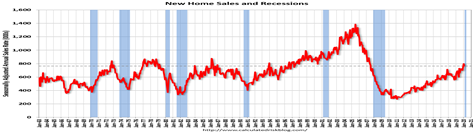
The Census Bureau just reported sales of new U.S. single-family homes are up 14.3 percent from last February. And January’s new-home sales were already at a 12-1/2-year high. It is pointing to housing market strength that could help to blunt any hit on the economy from the coronavirus and keep the longest economic expansion in history on track.

image

Calculated Risk

Builder confidence in the market for newly-built single-family homes fell just two points to 72 in March, according to the latest National Association of Home Builders/Wells Fargo Housing Market Index (HMI). Sentiment levels have held in a firm range in the low- to mid-70s for the past six months.

“Builder confidence remains solid, although sales expectations for the next six months dropped four points on economic uncertainty stemming from the coronavirus. Interest rates remain low,” says chief economist Robert Dietz, “and a lack of inventory creates market opportunities for single-family builders. However, down payment requirements are a limiting factor amid lower mortgage interest rates.”

But a housing market that remains healthy depends on a recovering economy, and we don’t know when that may be. Estimates run from 6 months to 18 months, if job loss estimates go to the 3 million extreme end of forecasts.

MarketWatch’s Jeffery Bartash reports a “flash” reading by the forecasting firm HIS Markit showed declines in its composite activity indexes. The manufacturing index slipped to 49.2 from 50.7, when anything below a reading of 50 indicates contraction. The flash service index sank to 39.1 in March from 49.4, marking the lowest level recorded since similar data became available in October 2009, IHS said.

“Although exports have suffered, most manufacturers continue to make necessary items, especially consumer goods for Americans stuck in their homes. Some large companies are even shifting production to help make critical medical equipment that’s in short supply,” said Bartash.

Why? Interest rates are plunging to new lows as investors rush to safe-haven bonds, driving down conforming 30-year fixed interest rates to as low as 3 percent.

This also caused refinance applications to surge more than 50 percent in a recent week, according to the Mortgage Bankers Association.

The housing market is in a holding pattern, in other words, with government aide a big factor, including directives not to evict renters behind in rent, or foreclose on homeowners behind in their payments for government-insured mortgages.

Harlan Green © 2020

Follow Harlan Green on Twitter: https://twitter.com/HarlanGreen

Posted in Consumers, Economy, Housing, housing market, Politics, Weekly Financial News | Tagged , , , , | Leave a comment

Why Do We Need a (new) New Deal?

Financial FAQs

image

Amazon

COVID-19 has finally done it. The new bi-partisan legislation working through congress that apportions money to the people and businesses that really need it—working (salaried) folk and small businesses with less access to credit—tell us why we are finally returning to an era when government was the solution (not the problem) to a more level playing field that distributed the products of work more equitably.

This is urgent not just because of the coronavirus pandemic. There will be little work as we have known it in coming decades for ordinary Americans, because of the onrushing ‘gig’ economy that will ultimately replace people in large segments of the economy with machines and more intelligent software.

Is this legislation a harbinger of a (new) New Deal?

It is taking more than a Great Recession that caused temporary pain to the 1 percent to return to non-partisan deal-making. Their profits came roaring back after it ended, thanks to the $700 TARP bank-Wall Street bailout and no prosecutions of the miscreants that caused it.

Non-partisan deal-making during the Great Depression was possible because we had a president and administration that understood when government should step in to soften adversity.

Government only works when there is a national consensus, in other words, such as when the unemployment rate reached 25 percent during the 1930s and there was no work to be had, and policymakers saw no other alternative.

What has triggered the sudden political consensus that has even Republican Senator Leader Mitch McConnell becoming a patriot, and now says, “this is the time for us to work together,” is the fact that the bottom seems to have fallen out of the economy. Treasury Secretary Steve Mnuchin is predicting as much as a 20 percent unemployment rate if congress doesn’t act quickly on the proposed legislation.

There are a lot of reasons for the Great Depression that plenty of economists have taken the time to explain, but not here. Just accept the fact that the private sector no longer wanted to spend, because consumers and private businesses had run out of money to buy and there was none to borrow—except from our government that creates the money, of course.

So the Roosevelt administration went heavily in debt by lending to everyone that needed it—up to 120 percent of GDP, of what we produced—so that workers were hired directly by government to build our modern infrastructure, develop the Internet, build schools, and modern technologies that sent us to the moon.

Private industry couldn’t or wouldn’t do it then, as they aren’t doing it now. Treasury Secretary Mnuchin is negotiating with House Speaker Pelosi to inject as much as $1.5 Trillion into sectors that have suffered the most during the most recent recovery from the Great Recession.

What is needed? Mnuchin and Pelosi are proposing to give “most adults” $1,000 (earning less than $125,000 for a couple, maybe?) and every child $500. Aside from the money sent to families, the White House is asking for hundreds of billions of dollars to bail out the airline and other industries that have been shut down as the nation; to slow down the spread of COVID-19, extend unemployment insurance and boost Medicare spending due to the illnesses resulting from the new coronavirus.

MarketWatch’s Jeffery Bartash says “The short-term outlook is grim, though. A JP Morgan analyst estimated the economy could shrink by as much as 14 percent on an annualized basis in the second quarter. Such a decline — the most alarming on Wall Street — would be the biggest in modern times, even surpassing the worst of the 2007-2009 Great Recession.

It could take us back to the 1930s and Great Depression, in other words. The economy did come roaring back then; thanks in part to World War Two, unfortunately. Today there is even a better reason to put government back into the growth equation; which is to build in more of the safeguards that protect people and banks from the worst excesses like Dot-com or housing bubbles.

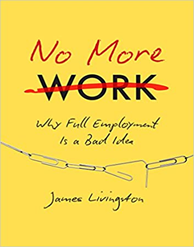
What will happen to all those less-skilled workers replaced by robots in the new gigabyte economy? Books, such as Professor James Livingston’s No More Work, Why Fill Employment Is a Bad Idea, are telling us we have to think of work in new ways, as we research how to build a better economy and social safety net for those freed from the need to work to produce the things and services in the new gig economy.

Rather than having to produce the necessities anymore via work as we have known it—robots and Artificial Intelligence will be doing those jobs—people will then be freed to find more creative ways to fulfill their need to have a meaningful life.

Harlan Green © 2020

Follow Harlan Green on Twitter: https://twitter.com/HarlanGreen

Posted in Economy, Keynesian economics, Politics, Weekly Financial News | Tagged , , , , , , , , | Leave a comment

Has the Recession Begun?

Popular Economics Weekly

image

Wikipedia

It might not matter when the so-called infection curve begins to flatten, or the epidemic “washes away”, as President Trump has said. The economic damage has already been done, due in part to the lack of preparedness by the White House, our broken health care system, and weak recovery from the Great Recession.

This recession probably began in March, said former Fed Vice-Chairman Alan Blinder recently. The first economic indicators affected by the coronavirus pandemic have plunged, including retail sales and the Empire State manufacturing index.

It is what happens when companies are shut down and workers are quarantined in what has become a just-in-time economy. This is an economy in which workers are hired ‘just’ when they are needed, and parts aren’t stockpiled, but ordered to arrive ‘just’ in time to be used—mostly from China and other low-cost Asian countries these days.

We are in this fix because corporations now think short time—i.e., about their quarterly profits rather than longer term growth prospects. It wasn’t always that way. Until the 1980s and the politicization of economic theory (i.e., trickle-down economics) corporate bosses didn’t earn that much more than their employees.

Today, the Boss is always right, and workers have lost their bargaining power to stockholders and management that want to see a quicker return. The result is corporations that have become so efficient there is no inventory or backlog of parts for automobiles, airplanes, or whatever else is still assembled in the U.S. of A.

Perhaps the first sign of what now seems inevitable—the next recession—is in retail sales that plunged 0.5 percent in February and 4 percent YOY, per the above FRED graph.

And manufacturing is already in recession. Activity has been contracting for the past six months. The Empire State’s (New York) February survey to manufacturing activity literally tanked, to use a non-economic term. It posted its biggest one-month decline on record, falling 34.5 points to an 11-year low of (-21.5). The six-month outlook index was as bad, falling almost 22 points to its own 11-year low. 

The U.S. Treasury Bond market even seemed to seize up last week, which panicked the financial markets. So the New York Fed just announced that it may buy up to $1.5 trillion in U.S. Treasury bonds and dropped their short term rates to zero, injecting more money into the general economy.

Lowest-paid workers will suffer the most, as in past downturns. Only this recession could turn into a Greater Recession, or even another Great Depression.

Why? We currently have an income inequality that reverts back to 1928 before the Great Depression. And it was this level of inequality that caused workers to borrow on the easy credit terms prevalent then. But when said borrowers couldn’t borrow any more to meet rising living costs, the U.S. economy crashed.

The Brookings Institute reports in the United States, 53 million people must get by on low wages, with median hourly earnings of $10.22. Based on a normal 40-hour week, that comes to just $21,258 annually before taxes.

It about equals the 2020 federal poverty level (FPL) income numbers of $21,720 for a family of three that is used to calculate eligibility for Medicaid and the Children’s Health Insurance Program (CHIP).

Many of these workers aren’t earning enough for decent housing; so much so that 30 percent of the homeless are such workers. That’s why we are seeing a repeat of homeless encampments last seen in the 1930s.

The so-called Hobo Jungles were a feature of the Great Depression memorialized vividly in songs such as Woody Guthrie’s, “I’ve been havin’ some hard travelin’, I thought you knowed…”

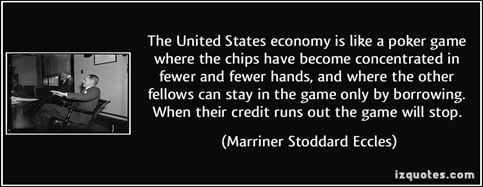
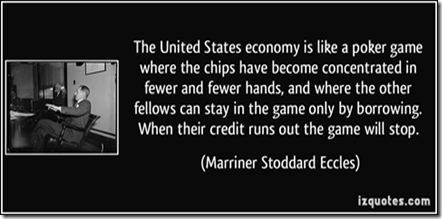
“The United States economy is like a poker game where the chips have become concentrated in fewer and fewer hands, and where the other fellows can stay in the game only by borrowing,” said Marriner Eccles, the Federal Reserve Chairman during the 1930s, “When their credit runs out the game will stop.”

We are at even greater debt levels today. A recent NYTimes Op-ed by Morgan Stanley’s chief global strategist, Ruchir Sharma, highlighted the role of too-highly leveraged Zombie companies—companies that earn too little even to make interest payments on their debt, and survive only by issuing new debt.

“Hidden within the $16 trillion corporate debt market are many potential trouble-makers, including the zombies,” said Sharma, “that account for 16 percent of all publicly traded companies in the U.S.”

There are fiscal remedies coming from congress that may provide some relief—including Democrats’ $830B proposal for outright cash payments supported by the White House, aid for the airline industry, and a range of other ideas, including President Trump’s emergency declaration that frees at least another $50B.

But more will be needed. The Troubled Asset Relief Program (TARP) approved by Congress in 2008, which made available $700 billion to the Treasury Department to buy deeply depressed assets from banks, and Obama’s $840B American Recovery and Reinvestment Act (ARRA) of 2009 wasn’t enough to bring back prosperity for most Americans.

Harlan Green © 2020

Follow Harlan Green on Twitter: https://twitter.com/HarlanGreen
Posted in Economy, Keynesian economics, Politics, Weekly Financial News | Tagged , , , , , , , , , | Leave a comment

How Do We Fight COVID-19?

Popular Economics Weekly

image

St.LouisFRED

Economists are beginning to predict the worst due to the COVID-19 outbreak that has become a worldwide pandemic.  Former Fed Vice-Chairman Alan Blinder said recently on CNBC that a recession may have already begun this March; and Jason Furman, the chief economist of Obama’s Council of Economic Advisors, told Lawrence McDonnell on MSNBC that the recent record-breaking sttock and bond market volatility feels more like 1929, and the onset of the Great Depression.

The U.S. Treasury Bond market even seemed to seize up over the past several days; so the New York Fed just announced that it may buy up to $1 trillion in U.S. Treasury bonds to inject liquidity into the bond markets, which enabled the bond market to continue to function as well as injecting more money into the general economy.

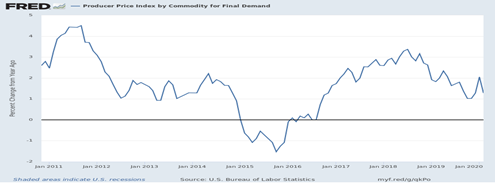
Another sign just out of a looming recession is sharply falling commodity prices.  The PPI Index of Final Demand for Commodity prices has risen just 1.28 percent YOY in February, per the St. Louis Fed graph, signaling a huge drop in the demand for such products amid declining world trade; while the coronavirus has as yet no timeline for recovery.

History books say the starting point of the Great Depression is usually listed as October 29, 1929, commonly called Black Tuesday. This was the date when the stock market fell dramatically 12.8 percent. It was after two previous stock market crashes on Black Tuesday (October 24), and Black Monday (October 28).

Sound familiar?  The current market gyrations saw the stock indexes plunge 10 percent just yesterday, after several severe plunges last week.

If such predictions prove true, then policymakers should really be looking at the need to implement  that which brought us out of said Great Depression.

It was called the New Deal that gave us good government policies and kept Americans out of serious downturns since then—until the Great Recession. The obstacle to implementing similar New Deal policies that provided federal jobs to the jobless in infrastructure building, education, and research; while protecting more than one million homeowners in danger of losing their homes; has been conservative Republican administrations since the 1980s that have worked to dilute those safeguards limiting the power of Big Business, and protecting the rights of workers.

There was also another important ingredient that created the New Deal. It was the leadership of Franklin Delano Roosevelt, one of our greatest presidents, because he inspired Americans to work together with his words.

He said, “The only thing we have to fear, is fear itself…This is preeminently the time to speak the truth, the whole truth, frankly and bold. Nor need we shrink from honestly facing conditions in our country today,” in his first Inaugural Address.

Right now, the coronavirus is an unknown fear that is devastating whole economies as businesses and individuals go into quarantine.

Yet there is no coherent national leadership today to address its spread, “to speak the truth,” just attempts to deceive and deflect from the reality of COVID-19’s contagious affects.

We will need a new leader and leaders that have this capability to speak the truth to its sufferers as the coronavirus spreads to all states, and possibly one million victims.
Let us hope that the upcoming Presidential election brings us such a leader.

Harlan Green © 2020

Follow Harlan Green on Twitter: https://twitter.com/HarlanGreen

Posted in Consumers, Economy, Keynesian economics, Politics, Weekly Financial News | Tagged , , , , , , , , | Leave a comment

Nobelist Daniel Kahneman on Thinking, Fast and Slow

Financial FAQs

image

Amazon

Thinking, Fast and Slow; what else should Nobel Laureate Daniel Kahneman be noted for, the son of Lithuanian Jewish parents fleeing the Russian Empire in the 1920s who grew up  to the sound of marching black boots during the Nazi occupation of Paris, if not the study human behavior in both wartime and peacetime?

This was the second year Dr. Kahneman came to Westmont’s annual Breakfast Lecture series that packed the Santa Barbara Hilton’s largest ballroom. I’m sure many were there because they were looking for some insight into how our species may react to the current coronavirus scare that some are characterizing as a ‘Black Swan’ event (mostly economists), meaning a very serious event with no predictable outcome.

Dr. Kahneman emphasized that our decision-making propensities come from different parts of the brain that cause us to both ‘narrow frame’ (fast process) and ‘broad frame’ (slow process) the information we take in. And we need both parts to reach a rational decision that is in our best interests.

We have a tendency, or bias, to come to a conclusion or make a decision quickly, but Dr. Kahneman says not so fast! We need the slower-thinking side of us to see the larger picture. He said it can be just a matter of closing one’s eyes for a few minutes that slows down our thought process while allowing us to process what we’ve just taken in intuitively.

We should take the time to collect all the pertinent, ‘cognitive’ facts, in order to slow down our first reaction to what is right in front of us. He used several examples of narrow vs. broad frame thinking, such as forecasting future events, or diagnosing the high rate of skin cancer among farmers.

I was particularly interested in his take on how we make economic decisions. He is at the foundation of behavioral economics, or how humans make financial decisions that are not always in our best interest; particularly if we allow so-called free, unregulated financial markets to make choices for us.

There are now at least three Noble prizes that have been awarded for information biases in how we take in information and make decisions on how to intelligently invest. And they are mostly Keynesian, or neo-Keynesian economists that believe governments must take an active role in regulating markets to prevent excessive speculation, for instance, as happened with the Dot-com bubble in 2001, or housing bubble that resulted in the Great Recession when it crashed.

Nobel economist Robert Shiller described in his best-selling book, Irrational Exuberance how many investors and homebuyers relied on rumor, hearsay, or word of mouth, rather than serious research to buy a home, or invest in the financial markets and thereby drive up asset prices (such as housing) to unsustainable levels.

Economists and Psychologists call it herd behavior when investors flock to a particular investment because others are doing the same, rather than researching the history of the company or index to see if it is overvalued.

Dr. Kahneman and his partner, Amos Twersky, found that humans have an optimistic bias in forecasting favorable outcomes that we must be aware of, when making decisions based on those forecasts. We therefore need to look at the broader picture.

How will the lowering of interest rates, as the Fed is currently doing, affect both poor and wealthy consumers, for instance? Should we save more and spend less in the event of an economic slowdown or recession?

Stock are very high in this 11th year of the current recovery just by looking at the current price-to-earnings ratio of the S&P. Why? The record profits of those corporations cannot be sustained with slower population growth and labor productivity—the two main factors that determine economic growth. Their earnings, the denominator of the P/E ratio, will therefore shrink, causing the ratio to rise above historical levels, hence certain stock assets become overvalued and will eventually fall.

That is what happened during the 2001 Dot-com stock bubble and 2007-09 Great Recession. P/E ratios soared to levels last seen before the Great Depression, which means history does provide lessons, if heeded.

Here are two of behavioral economist and Nobel prize-winner Robert J Shiller’s most memorable statements in Irrational Exuberance: “ ‘It amazes me how people are often more willing to act based on little or no data than to use data that is a challenge to assemble.”…’The ability to focus attention on important things is a defining characteristic of intelligence.”

We know it’s best to slow down one’s thinking process before making an important decision. But how often do we?

Harlan Green © 2020

Follow Harlan Green on Twitter: https://twitter.com/HarlanGreen

Posted in Economy, Housing, housing market, Weekly Financial News | Tagged , , , | Leave a comment