Why Our Endless Tariff Wars?

Popular Economics Weekly
image

Wrightson-ICAP

POTUS and the Trump administration can’t end their trade wars, although House Speaker Nancy Pelosi just announced they had reached agreement with Republicans on a new NAFTA accord with Canada and Mexico—now called the USMCA, or U.S. Mexico Canada Agreement—because it gives more protections to U.S. workers. She said there’s nothing wrong with a win for President Trump “when it’s the right thing to do (sic).”

But there is no agreement with even a Phase I trade agreement with China, and Trump has basically neutered the World Trade Organization that settles trade disputes by blocking any new appointment to its arbitration panel, which will not only prolong trade disputes but create new ones, since there’s no longer a mechanism for resolving them.

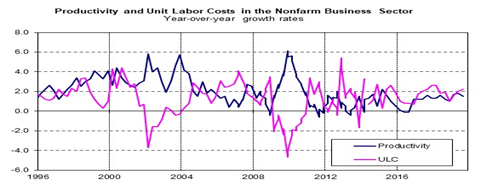
The result has been declining labor productivity and manufacturing output, which puts future economic growth in jeopardy. Productivity declined in mid-2019 after several years of acceleration, in part because companies reduced investment in manufacturing and production in response to the U.S. trade fight with China and the EU. The dispute has also undermined exports and made it harder for businesses to plan ahead.

Labor Productivity, or output per hour worked, declined for the first time since 2015. It fell at a 0.2 percent annual rate from July to September, the government said Tuesday. This means that the hours worked increased faster than output, so that it is increasing just 1.5 percent annually, which means workers will have difficulty improving their standard of living within their working lifetime. They haven’t been able to increase their median income since the 1980s, and trickle-down economic theory prevailed.

This was the theory that lower taxes and less government services lifted all boats, when it fact it only lifted the most expensive yachts. The cutback in government investments in such as infrastructure, education, and R&D, which all serve to increase productivity and efficiency, was another reason for the productivity decline.

And, “Productivity is likely to continue to lag unless there’s a rebound in business investment,” said MarketWatch’s Jeffery Bartash, “but that probably won’t happen unless the trade dispute is largely resolved.”

Higher productivity is the key to a rising standard of living, resulting in higher pay, more profits and low inflation. Low productivity is a sign of an inefficient economy.

Productivity in the U.S. has risen at an average rate of just 1.3 percent since 2007, compared with a 2.1 percent average since the end of World War II.

There are better ways to settle trade disputes, such as remaining in trade alliances like the Trans-Pacific Partnership that Trump withdrew from. The other 11 Asian trade partners then drew up their own agreement to better bargain with China, in particular; whereas, the U.S. has been unable to reach any agreement by going it alone.

So we know another path to increased productivity is the ability to get along with our economic friends and find a way to work with our enemies.

Harlan Green © 2019

Follow Harlan Green on Twitter: https://twitter.com/HarlanGreen
Posted in Economy, Keynesian economics, Macro Economics, Weekly Financial News | Tagged , , , , | Leave a comment

Big November Employment Boost

Financial FAQs

image

MarketWatch.com

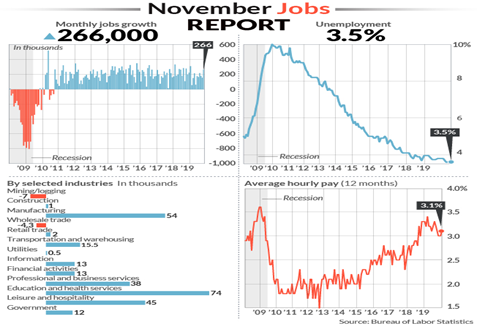
Total nonfarm payroll employment rose by 266,000 in November, and the unemployment rate was little changed at 3.5 percent, the U.S. Bureau of Labor Statistics reported today. Notable job gains occurred in health care and in professional and technical services. Employment rose in manufacturing, reflecting the return of workers from a strike.

What happened to the slowing economy, especially in manufacturing since last year’s sugar high from the 2017 Republican tax cuts? Manufacturing added 54,000 jobs, but it was mostly GM workers returning to work after their successful strike that gave them some of the enormous profits GM has been generating.

In fact, it was the 74,000 new jobs in Leisure and Hospitality highlighting strong consumer spending in restaurants and hotels that is sustaining economic growth.

Consumers are still optimistic, per the University of Michigan sentiment survey that rose to a preliminary December reading of 99.2 from a final November reading of 96.8. Consumers’ views on current conditions rose to 115.2 in December from 111.6 in November, while a barometer of their expectations rose to 88.9 from 87.3.

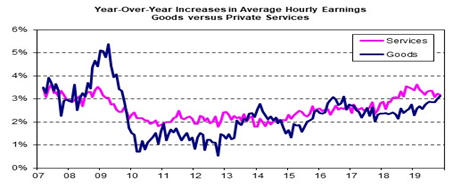
The only caveat was the slight drop in average hourly pay to 3.1 percent, down from 3.4 percent earlier in 2019. Why? It’s all the lower-paying jobs that benefit from consumer spending; like Transportation and warehousing (15.5k new jobs), and the aforementioned Leisure and Hospitality jobs.

image

Wrightson.com

Longer-term inflation expectations fell to 2.3 percent, matching a record low in the U. of Michigan survey. Federal Reserve policy makers watch this figure closely and have cited below-target inflation as one of the reasons behind the three interest- rate cuts this year. The Fed, which holds a meeting next week, has signaled it will keep rates on hold barring a material shift in the outlook.

There is little wage growth, and therefore little inflation, which means consumers can keep spending through the holidays. The ongoing trade wars aren’t yet boosting import prices enough that would bring on higher inflation, while energy prices have also fallen, keeping gas prices low.

These are all reasons to keep the economy afloat, with the additional caveat that importers can’t keep absorbing the tariff increases forever.

Harlan Green © 2019

Follow Harlan Green on Twitter: https://twitter.com/HarlanGreen
Posted in Consumers, Economy, Weekly Financial News | Tagged , , , | Leave a comment

Economic Growth…Watch Out Below—Part II!

Popular Economics Weekly

image

Wrightson.com

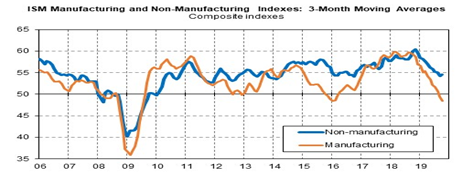
It is obvious from the above graph that manufacturing activity is contracting, whereas the service industries continue to grow.  Exports that depend mostly on manufactured goods are therefore declining, while imports that depend on consumers will contine to grow. This also means slowing economic growth, since shrinking exports add less to GDP growth, while much larger import totals actually subtract from growth.

November was the fourth consecutive month of PMI® contraction, at a faster rate compared to the prior month, said Timothy R. Fiore, Chair of the Institute for Supply Management® (ISM®) Manufacturing Business Survey Committee. “Demand contracted, with the New Orders Index contracting faster, the Customers’ Inventories Index remaining at ‘too low’ levels and the Backlog of Orders Index contracting for the seventh straight month (and at a faster rate). The New Export Orders Index returned to contraction territory, likely contributing to the faster contraction of the New Orders Index.”

Manufacturing is in recession, in other words. The Philadelphia Inquirer reports that Kentucky’s steel industry has suffered because of steel and aluminum tariffs that have in fact slowed demand for its products. The result is steel prices have dropped by more than 40 percent since last summer.

“They have been hurt by tepid domestic demand for steel production amid a U.S. manufacturing recession and a global slowdown in economic growth, among other things,” reports the Inquirer.

Demand for steel in the U.S. grew 2.1 percent in 2018. But this year, a slowdown in American construction and automobile production helped diminish demand to just 1 percent, and it is projected to grow just 0.4 percent in 2020, the World Steel Association said this month, per the Inquirer.

And “Global trade remains the most significant cross-industry issue,” said ISM’s Fiore. “Among the six big industry sectors, Food, Beverage & Tobacco Products remains the strongest, while Fabricated Metal Products is the weakest. Overall, sentiment this month is neutral regarding near-term growth,” says Fiore.

Why the decline in manufacturing? It has to be the Trump administration’s trade policies, as manufacturing depends on foreign trade for many of its components, and foreign demand for many of its products.

This is while the Trump administration has just announced new tariffs on steel and aluminum products from Brazil and Argentina, further hurting global trade.

We also know overall Industrial Production is declining. Total industrial production was 1.1 percent lower in October than it was a year earlier. Capacity utilization for the industrial sector decreased 0.8 percentage point in October to 76.7 percent, a rate that is 3.1 percentage points below its long-run (1972–2018) average.

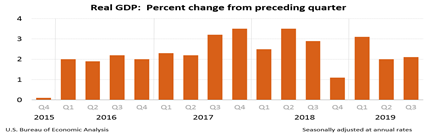
Last week’s revised Q3 GDP report was upped to 2.1 from 1.9 percent, with a slight increase in consumption and inventories. But it won’t help an even weaker Q4 GDP which is predicted to barely grow due to declining exports, as I said last week.

image

BEA.gov

Manufacturing and consumer spending are really the two main components of economic growth. Stock prices of the largest steel companies have declined as much as 50 percent, also according to the Inquirer. And with steel prices down, their earnings have begun to decline.

So trade wars seem to be wreaking as much havoc to economic growth as other geopolitical concerns, such as growing civil unrest in the Middle East and Asia (Hong Kong). Continuing to wage trade wars in the name of national security is really becoming a danger to our national security, as well as economic growth.

Harlan Green © 2019

Follow Harlan Green on Twitter: https://twitter.com/HarlanGreen
Posted in Consumers, Economy, Macro Economics, Weekly Financial News | Tagged , , , , | Leave a comment

Consumer Confidence Is Boosting Housing

The Mortgage Corner

image

StLouisFRED

New-home sales are now back to the long term average in the above graph that dates back to the 1960s, and consumers are still reasonably confident of their future.

“Sales of new singlefamily houses in October 2019 were at a seasonally adjusted annual rate of 733,000, according to estimates released jointly today by the U.S. Census Bureau and the Department of Housing and Urban Development. This is 0.7 percent below the revised September rate of 738,000, but is 31.6 percent above the October 2018 estimate of 557,000.”

This was the first time since 2007 that the annual pace of single-family home sales remained above 700,000 for three consecutive months, according to Calculated Risk. New-home sales were nearly 32 percent higher on an annual basis in October.

This means that residential construction is also increasing the supply of new homes, as I said last week; at the same time as there is a significant housing shortage and housing construction isn’t yet back to historical levels.

image

Conference Board

Whereas, “Consumer confidence declined for a fourth consecutive month, driven by a softening in consumers’ assessment of current business and employment conditions,” said Lynn Franco, Senior Director of Economic Indicators at The Conference Board. “The decline in the Present Situation Index suggests that economic growth in the final quarter of 2019 will remain weak. However, consumers’ short-term expectations improved modestly, and growth in early 2020 is likely to remain at around 2 percent. Overall, confidence levels are still high and should support solid spending during this holiday season.”

So, although consumer confidence is down a bit from last year, it is still enough to cheer consumers for the holidays.

I said I was also going to say something about interest rates trends last week. We only have to look to Japan and the EU to see that U.S. interest rates could continue downward; but only if our government doesn’t step in with public investments that are sorely needed—such as in our energy network, infrastructure, education, environmental protection and the like that we have been discussing ad nauseum.

As of now, the opposite is true. Republicans rammed through tax cuts that have run up a $1 trillion dollar annual deficit. But the windfall went into corporation profits rather than into public spending programs that would have produced more productive workers and sustained growth.

It meant that financial engineering has created a huge savings glut—both here and in Europe—that is driving down interest rates to zero or below. EU countries are so desperate to put their excess savings to work that they are willing to pay investors to use their savings with negative interest rates. The same could happen here if we don’t find a way to use those savings productively.

This came out of so-called austerity measures in an overreaction to the Great Recession. Conservative ‘austerians’ as they were called worried more about budget deficits than investments that would stimulate more spending by domestic consumers and businesses that would in turn boost future growth.

This is what happens with the savings glut we have now. Too many policymakers and investors are obsessed with saving—in fact, hoarding wealth—rather than putting it to productive use that would lower public debt over the long term.

Though it’s really rational financial behavior when individuals hold on to savings for a rainy day. But that’s not the case for governments that won’t spend what’s needed for the future. It will bring on the rainy days sooner. Lord John Maynard Keynes knew it in the 1930s. He was the creator of Keynesian economics and a government that gave us the New Deal.

Harlan Green © 2019

Follow Harlan Green on Twitter: https://twitter.com/HarlanGreen
Posted in Consumers, Economy, Housing, housing market, Keynesian economics, Weekly Financial News | Tagged , , | Leave a comment

Is It Start of a New Housing Boom?

The Mortgage Corner

image

Calculated Risk

We should be careful in announcing a new housing boom. It can be a two-edged pronouncement, since a housing bust followed the last housing boom and precipitated the Great Recession.

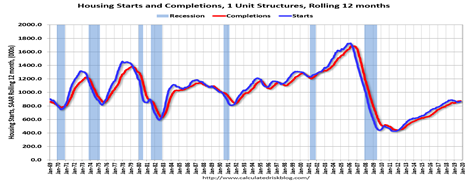
But it certainly looks like residential construction is one sector on a tear at present; at the same time as there is a significant housing shortage and housing construction isn’t yet back to historical levels, per the above single-family starts graph.

Housing construction is booming per the latest U.S. Census Bureau report on housing starts and permits, but is far below the peak of some 1.7 million units just prior to the Great Recession.

October starts are at a 1.314 million annual rate, the strongest showing since May last year. Permits are the big positive in today’s report, well above expectations at a 1.461 million rate which is the strongest since the subprime housing bubble bust in 2007.

The National Association of Home Builders (NAHB) Chairman Greg Ugalde said, “Home builders are seeing more building opportunities as market conditions remain solid. Builder sentiment remains strong, and we are seeing an uptick in buyer traffic.”

The October 1.31 million starts is the number of housing units builders would begin if they kept this pace for the next 12 months, explained the NAHB in their press release. Within this overall number, single-family starts increased 2.0 percent to 936,000 units. The multifamily sector, which includes apartment buildings and condos, increased 8.6 percent to a 378,000 pace.

“Led by lower mortgage rates, the pace of single-family permits has been increasing since April, and the rate of single-family starts has grown since May,” said NAHB Chief Economist Robert Dietz. “Solid wage growth, healthy employment gains and an increase in household formations are also contributing to the steady rise in home production.”

Three-month averages for the key single-family category confirm the construction and future permits strength. Starts are running at a 923,000 rate on the average which is another 12-year high and up sharply over the last two months. Single-family permits are at an 888,000 rate which is likewise pivoting higher and also the strongest in 12 years.

But longer term, single-family construction has consistently been at or above one million annualized units since the 1970s with a much smaller U.S. population. So there is a lot of catching up from the housing bust and Great Recession.

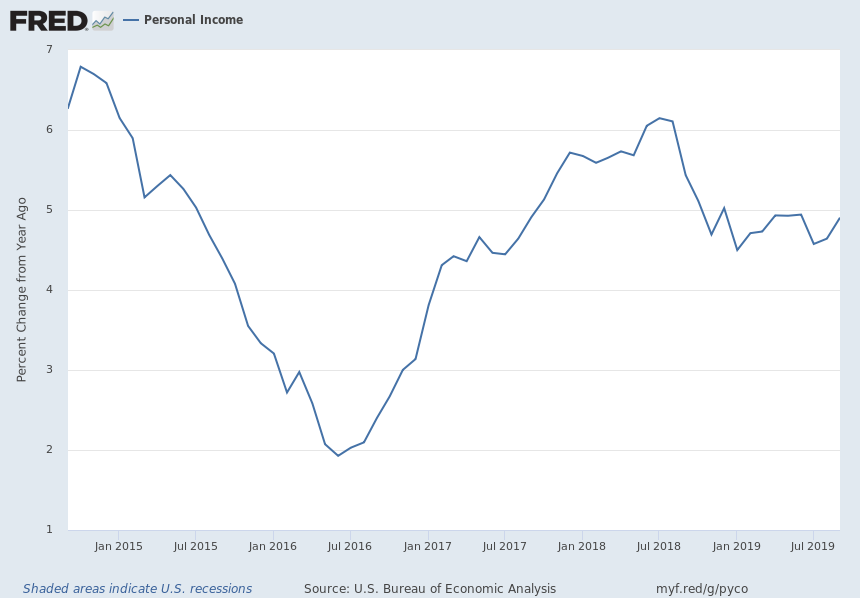
FRED’s Personal Income graph shows that most Americans are in fact still recovering from the Great Recession. And to even begin to approach the historical starts’ average it needs record-low interest rates to continue, given the depressed earnings picture for most Americans since the Great Recession.

personal

StLouisFed

Personal incomes have been consistently lower because most new jobs created today are in the lower-paying service sector, such as warehousing, health care, transportation, and the like, even in our fully-employed economy.

But the prognosis for interest rates is they could even go lower, which should continue the housing ‘boom’, or whatever we end up calling it. EU countries such as Denmark are already offering negative fixed interest rate mortgages, believe it or not. Can that happen here?

It will be the subject for a future column.

Harlan Green © 2019

Follow Harlan Green on Twitter: https://twitter.com/HarlanGreen

Posted in Consumers, Housing, housing market, Weekly Financial News | Tagged , , | Leave a comment

Q4 Economic Growth…Watch Out Below!

Popular Economics Weekly

We might have a problem with economic growth in the fourth quarter, thanks in part to Republicans’ 2017 tax cuts that were to stimulate longer term growth and jobs, believe it or not. The New York and Atlanta Federal Reserve estimate seasonally adjusted Q4 GDP growth to drop to just 0.3 to 0.4 percent, from Q3’s initial estimate of 1.9 percent growth, Merrill Lynch has a slightly more optimistic forecast of 1.5 percent.

This is a terrible number, if accurate. These are so-called early “nowcasts” based on very preliminary data, so much could change by Q4. But there has been a steady decline in growth from last year’s tax cut-fueled surge that is mirrored by the latest retail and industrial production figures.

Why were the tax cuts a bust? Fedex’s 2018 $1.6 billion tax “windfall” is a good example of what happened to that windfall, according to the New York Times. Fedex promised that the U.S. economy would see a “renaissance of capital investment” from the huge capital gains tax cut.

But it never happened. “If anything, the companies that received the biggest tax cuts increased their capital investments by less, on average,” said the Times article. The result was increased CEO salaries and massive stock buybacks, which benefited stockholders, but not their employees that received no salary boosts, or bonuses from the largesse.

“Fedex reaped big savings, bringing its effective tax rate to less than zero in fiscal year 2018 from 34 percent in fiscal year 2017,” continued the Times. The result was more financial engineering, rather than productive investments that would boost growth.

The Atlanta Fed nowcast said, “The GDPNow model estimate for real GDP growth (seasonally adjusted annual rate) in the fourth quarter of 2019 is 0.3 percent on November 15, down from 1.0 percent on November 8. After this morning’s retail trade releases from the U.S. Census Bureau, and this morning’s industrial production report from the Federal Reserve Board of Governors, the nowcasts of fourth-quarter real personal consumption expenditures growth and fourth-quarter real gross private domestic investment growth decreased from 2.1 percent and -2.3 percent, respectively, to 1.7 percent and -4.4 percent, respectively.”

image

Calculated Risk

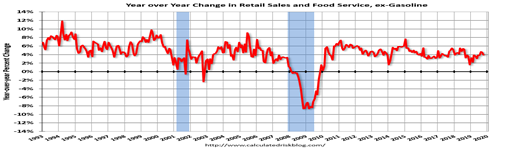
The steady decline in retail and food service sales ex-gasoline—a more reliable indicator of sales volume—is worrisome because it mirrors consumer behavior, which is the main driver of economic growth at present. Consumers have been saving more and spending less this year. Sales slowed to a 3.9 percent annual increase from what has historically been in the 5-6 percent range since 2011. This is even though consumers have remained optimistic about future prospects in the latest consumer sentiment surveys.

image

Calculated Risk

Industrial Production is also declining. Total industrial production was 1.1 percent lower in October than it was a year earlier. Capacity utilization for the industrial sector decreased 0.8 percentage point in October to 76.7 percent, a rate that is 3.1 percentage points below its long-run (1972–2018) average.

Small businesses that answer the National Federation of Small Business survey are still upbeat. “The small business optimism index showed modest but wide improvement in October, at 102.4 which is at the high end of expectations and up 6 tenths from what was an unexpectedly weak September. Eight of the index’s 10 components improved in October led by plans to increase inventories and including increased plans to make capital outlays. Earnings trends, however, fell sharply and current job openings edged lower. And continued earnings decline is a problem.

Industrial production and consumer spending are really the two main components of growth. Earnings have begun to decline, in a word, and who knows how much more with declining capital investment, which is the seed corn of future growth?

Harlan Green © 2019

Follow Harlan Green on Twitter: https://twitter.com/HarlanGreen

Posted in Consumers, Economy, Weekly Financial News | Tagged , , , | Leave a comment

Where are the Leaders?

Answering the Kennedys’ Call

image

surveymonkey.com

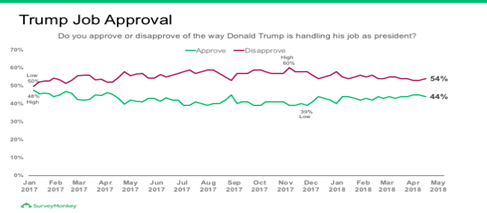
The congressional impeachment hearings illustrate one overwhelming fact; America has a leadership problem. President Trump is a very weak leader. He asked the newly-elected Ukrainian President Volodymyr Zelensky (extortion or bribery are the legal terms) to publicly announce that the Ukraine would investigate Joe and son Hunter Biden for potential conflicts of interest; in order to aid his reelection campaign.

Multiple sources reported he did so reportedly at the suggestion of former Campaign Manager and convicted felon Paul Manafort’s former business partner, Konstantin Kilimnik, a Russian operative.

Where is an American leader that will stand up to Russian oligarchs and Putin, instead of Trump’s open support of Putin’s foreign policy objectives; such as Trump’s reluctance to enforce sanctions first imposed under President Obama for Putin’s invasion of the Ukraine, or the weakening of our foreign alliances, including NATO that protect the peace?

This has further endangered a young democracy invaded by a Russian-backed army that has cost some 13,000 Ukrainian lives to date, and weakened their position in any negotiated peace settlement.

It is a perhaps disconcerting fact that America’s greatest leaders only came forward at the time of our greatest perils; whether it was George Washington winning the Revolutionary War, or Abraham Lincoln leading us through the Civil War, or Franklin D Roosevelt who led us through the Great Depression and World War II.

It is an even sadder thought to imagine what would have happened to the United States of America without these and other leaders that have grown American democracy? Our best leaders have always attempted to keep us united and the world at peace.

In a recent essay, Thomas Caruthers, Sr. Vice President for Studies at the Carnegie Endowment for International Peace write how the U.S. has kept the peace:

“In the late Cold War and early post–Cold War years, the United States took the lead in projecting a vision of global democracy and making it a core foreign policy priority. Successive U.S. administrations devoted significant diplomatic capital to supporting the spread of democracy, often building coalitions among governments and within multilateral organizations to help mobilize support for democratizing governments or pressure backsliding ones.

This is while our weakest leaders—from Lincoln’s successor Vice President Andrew Johnson to Donald Trump—have intentionally or inadvertently increased our divisions. Johnson was impeached by allowing cronyism and the corruption of his officials that prevented implementation of the post-civil war Reconstruction effort, or Trump’s outright appeal to the worst of our natures that has divided Americans.

It is therefore no coincidence that Johnson was impeached, and Trump is about to be impeached for the abuse of their Presidential powers. Whether Trump will be removed from office depends on a very partisan, Republican Senate that doesn’t see such weak leadership right in front of them that will weaken the Republican Party as well.

There is also a growing danger that democracy is in decline in many other parts of the world. Chess Grand Master Gary Kasparov and Thor Halvorssen of the Human Rights Foundation detailed the current sad state of participatory democracies in a recent Washington Post article:

“At present, the authoritarianism business is booming. According to the Human Rights Foundation’s research, the citizens of 94 countries suffer under non-democratic regimes, meaning that 3.97 billion people are currently controlled by tyrants, absolute monarchs, military juntas or competitive authoritarians. That’s 53 percent of the world’s population. Statistically, then, authoritarianism is one of the largest — if not the largest — challenges facing humanity.”

Are we now approaching another period of greater peril for America and participatory democracy in general? It has called forth great leaders in the past. What about today? We know the requirements of great leadership from our history—the requirement above all that to survive as a democracy and not become an autocracy ruled by the few, we are all in this together.

Harlan Green © 2019

Follow Harlan Green on Twitter: https://twitter.com/HarlanGreen
Posted in Politics, Uncategorized | Tagged , , , , , , | Leave a comment

What’s Happening To Interest Rates?

Popular Economics Weekly

image

StLouisFRED

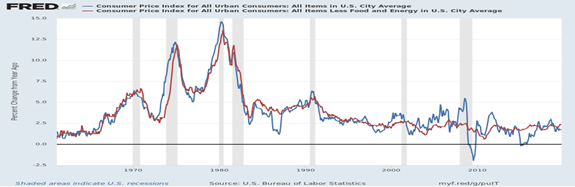
The Consumer Price Index for All Urban Consumers (CPI-U) rose 0.4 percent in October on a seasonally adjusted basis after being unchanged in September, the U.S. Bureau of Labor Statistics reported today. Over the last 12 months, the all items index increased 1.8 percent before seasonal adjustment.

The energy index increased 2.7 percent in October after recent monthly declines and accounted for more than half of the increase in the seasonally adjusted all items index. The gasoline index in particular rose 3.7 percent in October and the other major energy component indexes also increased.

There is still no inflation to worry about, in other words. This is why the Fed hasn’t succeeded in pushing inflation higher to combat deflationary expectations with its interest rate cuts. Prices are barely rising for everything but the daily fluctuations of energy prices—gasoline, in this case.

So don’t look for increasing interest rates anytime soon, even though the 10-year benchmark Treasury yield has topped 1.9 percent, up from its 1.55 percent recent bottom. It only happened because market investors are selling safe-haven bonds and buying stocks at present, in anticipation of a tariff agreement with China.

But Trump just announced that he hasn’t agreed to reducing or eliminating any tariffs just yet, though “talks were proceeding nicely.”

This tells you just how uncertain are predictions of a phase I tariff reduction agreement. It seems both sides are playing to the press rather than coming up with anything substantial. Why else would talks be dragging on with all the starts and stops along the way? It says to me that nothing substantial will be achieved until after the 2020 election, when China can be more certain which administration they will be dealing with.

There’s also more we can read into today’s inflation data. Fed Chairman Powell just announced no more Fed rate cuts are contemplated at present. This has to be because the Fed is now fearful that record low short term rates have pushed stock prices to record highs, thus causing a potential asset bubble.

And we just endured a Great Recession because of a busted housing asset bubble.

I mentioned last week that irrational exuberance seems to be creeping back into the stock market with price-to-earnings ratios above historical norms—usually a sign that stock buyers are counting on stocks continuing to rise; yet corporate profits are declining from their recent highs.

I quoted a Forbes Magazine article thusly: “On a cautionary note related to the earnings skid,” says Forbes, “the S&P 500’s price-to-earnings ratio has been on the rise and now stands near 18 times projected earnings over the next 12 months. That’s way above the 14 level where we started the year, and it exceeds the long-term average of around 16. Remember, it’s harder to grow the “P” side of that equation when the “E” side is on the decline.”

Although consumer spending is keeping economic growth from falling too far below 2 percent (Q3 GDP initially estimated up 1.9 percent), consumers are also saving more for a rainy day with a personal savings rate of +8 percent.

It is a sign that many consumers are also sitting on the fence, waiting to see which way the political winds will blow next year. Consumers will keep spending as long as interest rates remain this low.

Federal Reserve Chair Powell in his latest report to Congress worried about future growth:

“…However, noteworthy risks to this outlook remain. In particular, sluggish growth abroad and trade developments have weighed on the economy and pose ongoing risks. Moreover, inflation pressures remain muted, and indicators of longer-term inflation expectations are at the lower end of their historical ranges. Persistent below-target inflation could lead to an unwelcome downward slide in longer-term inflation expectations. We will continue to monitor these developments and assess their implications for U.S. economic activity and inflation.”

And the 30-year conforming fixed rate mortgage rate is still below 3.50 percent for the most credit-worthy borrowers, which is keeping residential construction and sales at their current highs. The Mortgage Bankers Association just reported November 8 week applications jumped 13.0 percent for refinancing and 5.0 percent for the purchases, with purchase applications up 15 percent in a year.

Low inflation and low interest rates are good news for housing, given the endemic undersupply of affordable housing, and growing homeless population. But it isn’t good news for overall economic growth, if it leads to disinflation and falling prices—i.e. actual deflation.

Harlan Green © 2019

Follow Harlan Green on Twitter: https://twitter.com/HarlanGreen
Posted in Consumers, Economy, Housing, housing market, Weekly Financial News | Tagged , , , , | Leave a comment

Why the Historical Decline in US Growth?

The Mortgage Corner

image

@GregDaco

Nonfarm business sector labor productivity decreased 0.3 percent in the third quarter of 2019, first decline in 5 years, the U.S. Bureau of Labor Statistics reported, as output increased 2.1 percent and hours worked increased 2.4 percent…From the third quarter of 2018 to the third quarter of 2019, productivity increased 1.4 percent, reflecting a 2.3-percent increase in output and a 0.9-percent increase in hours worked.

This almost arcane statistic followed by professional economists is one of two major reasons US economic growth has slowed to a crawl, as seen in the graphs. Individual workers are no longer producing as much per worker as they did through 2000, even with a fully employed economy and the introduction of modern technologies that boost production.

image

Another reason is declining population growth, as American mothers no longer produce enough replacement babies. A main contributor to the falling population growth rate is the decreasing fertility rate. The fertility rate has fallen from 3.7 in the 1960s to 1.9 today, when 2.1 births per mother is the natural replacement rate, leading to a lower increase in the US population (excess of births over deaths).

In fact, the national birth rate (12/1,000) still remains higher than the national death rate (8/1,000), which means more people are still being born in the U.S. each year than are passing away. Additionally, the arrival of immigrants with larger families, has kept the U.S. population steadily increasing, albeit slowly.

I suggest that lower fertility is just the tip of the melting economic iceberg, because populations also increase with new immigrants. So we shouldn’t be cutting back on immigration quotas as the current administration is doing—to some 700,000 last year from the 1.3-1.4 million per year in recent decades.

And combined policy missteps—such as spending less on capital investments that would increase labor productivity and not introducing policies that would enhance birth rates; also better health care, family leave, more liberal vacation and sick leave policies are a start—as European countries have been doing.

This has kept U.S. GDP growth averaging 2 percent since the Great Recession, but no higher. EU countries have declining birth rates, unfortunately, which has knocked down EU GDP growth rates to around one percent.

But they also have greater longevity and better healthcare outcomes than the U.S., which is ranked 37th in health outcomes by the World Health Organization. As in example, French residents now live an average 4 years longer than Americans, says Nobel economist Paul Krugman in a recent NYTimes Op-ed. “Why? Universal healthcare and policies that mitigate extreme inequality are the most likely explanations.”

There is much more that can be done to boost economic growth and income equality, in other words. Fixing schools would boost educational levels, switching to alternative energy sources would inject $trillions into new technologies and bring down pollution costs, fixing our infrastructure would boost productivity immediately by cutting down on commute times and lost work hours, and better enforcement of environmental regulations would decrease healthcare expenses as well as job losses.

The list goes on and on. Maybe we do need a Green New Deal to make all this happen?

Harlan Green © 2019

Follow Harlan Green on Twitter: https://twitter.com/HarlanGreen
Posted in Consumers, Economy, Keynesian economics, Weekly Financial News | Tagged , , , | Leave a comment

Do We Want to Save Planet Earth?

Answering the Kennedys’ Call

image

SF Chronicle

President Trump just announced the U.S. will withdraw in one year from the Paris Accord of almost 200 countries that have agreed to significantly limit Greenhouse Gas (GHG) Emissions.

This happened within a day of a report from the Alliance of World Scientists endorsed by more than 11,000 scientists that says the world is facing a climate emergency.

“Scientists have a moral obligation to clearly warn humanity of any catastrophic threat and to “tell it like it is.” On the basis of this obligation and the graphical indicators presented below, we declare, with more than 11,000 scientist signatories from around the world, clearly and unequivocally that planet Earth is facing a climate emergency.”

Is it a coincidence Trump announced the withdrawal from the Paris Accord on the same day satellite data shows that last month was the warmest October on record ?

I think not. Trump’s announcement took the headlines, thereby preempting the far more important climate news to the back pages. The withdrawal is to take effect one day after the 2020 Presidential election.

His administration is full of lobbyists and former executives of the fossil fuel industry in what will ultimately prove to be a vain attempt to further enrich themselves in the face of looming environmental disasters.

The total of 11,253 scientists from 153 countries affirm that” if we do not act or respond to the impacts of climate change by reducing our carbon emissions, reducing our livestock production, reducing our land clearing and fossil fuel consumption, the impacts will likely be more severe than we’ve experienced to date,” said lead author Dr Thomas Newsome, from the University of Sydney.

In fact, “That could mean there are areas on Earth that are not inhabitable by people,” said the report.

How so? Because it is already happening. We know great swaths of North Africa and the Middle East have experienced mass population exoduses from an increasing frequency of droughts that are causing outright civil wars (Syria), and anti-immigrant xenophobia in many countries.

BBC News summarized the report’s recommendations:

  • · Energy: Politicians should impose carbon fees high enough to discourage the use of fossil fuels, they should end subsidies to fossil fuel companies and implement massive conservation practices while also replacing oil and gas with renewables.
  • · Short-lived pollutants: These include methane, hydrofluorocarbons and soot – the researchers say that limiting these has the potential to cut the short-term warming trend by 50% over the next few decades.
  • · Nature: Stop land clearing, restore forests, grasslands and mangroves which would all help to sequester CO2.
  • · Food: A big dietary shift is needed say researchers so that people eat mostly plants and consumer fewer animal products. Reducing food waste is also seen as critical.
  • · Economy: Convert the economy’s reliance on carbon fuels – and change away from growing the world’s gross domestic product and pursuing affluence.
  • · Population: The world needs to stabilise the global population which is growing by around 200,000 a day.

But there’s more. It can cause irreparable economic damage that results in geopolitical unrest; even wars, as countries compete for limited resources. The U.S. Pentagon has been warning of this outcome for years, because it has labeled climate change a direct threat to our national security.

A summary of its latest January, 2018 report to congress showed that it was also harming military preparedness in future conflicts, so much so, that a US News & World Report in 2017 reported, “During his confirmation process for the post as secretary of defense this spring, Gen. James Mattis wrote in the question/response period: “Climate change can be a driver of instability and the Department of Defense must pay attention to potential adverse impacts generated by this phenomenon.”

From shifting temperatures to desertification, environmental changes have the potential to significantly affect the movement of populations, the availability of resources and the stability of governments. The results can be famine, drought, disease and a rise in global conflict.

Then the question must be asked: Why on earth is the Trump administration denying climate change and withdrawing from the Paris Accord when we now know it is causing  the suffering of millions, and is a threat to our national security?

Harlan Green © 2019

Follow Harlan Green on Twitter: https://twitter.com/HarlanGreen

Posted in Economy, Weekly Financial News | Tagged , , , , | Leave a comment