How Low Can Interest Rates Go?

Popular Economics Weekly

image

Calculatedriskblog

Why are interest rates so low—not just in the US? It’s been below 0 percent in the northern EU countries and Japan for years because there is little worldwide inflation, which means there’s not sufficient demand for the things people and businesses buy that would boost inflation and interest rates higher.

The housing market is usually an infallible indicator of inflation trends. The S&P Case-Shiller Home Price Index, for instance, shows housing prices rising 3.4 percent annually in May, when it was rising at 5 percent over the past several years. It’s a 3-month average of same-home sales that smooths out some of the bumps due to the difficulties in collecting national sales data that always qualify the price estimates with + or – double figure brackets.

The above Case-Shiller graph highlights the percentage changes. Its huge dip occurred during the Great Recession that busted the housing bubble. Its highest point since then was in 2014, and it began to dip below 5 percent in early 2018.

There’s not much the Central Banks can do about the falling interest rates, since they are already so low. They equivocate as much as the financial markets, which tells us things could get worse. The stock market is swinging wildly as more investors flee to save haven investments like bonds, which drives down interest rates further.

For one thing, JP Morgan says a recession could occur in 9 months if Trump can’t resolve the China trade war soon (Hong Kong unrest, for starters?). And economists are beginning to conjecture that if the inverted yield curve—with 1.65 percent 10-yr Treasury yield below the 2-2.5 percent fed funds rate and 2-year bond yields—remains inverted for too long, 1) banks could cut back their lending sharply, tightening credit markets, and 2) investor confidence will fall as more flee from stocks to bonds, while corporations cut back on capex spending due to future uncertainty.

It certainly looks like housing prices might continue to decline, in spite of still record-low mortgage rates, and even though mostly higher-priced homes are being built these days.

The conforming 30-year fixed mortgage rate has now fallen to 3.25 percent, the lowest I’ve seen it in my 30+ years as a Mortgage Banker, though the Prime rate on which most installment and credit card rates are based is at 5.25 percent. Prime dropped 0.25 percent in concert with the last week’s 0.25 percent Federal Reserve rate reduction, but stay tuned on further Prime rate drops, if consumers cut back on their spending.

Consumers might continue to spend for the rest of this year if consumer sentiment holds up, because the job market is still expanding. The latest JOLTS report (Job Openings and Labor Turnover Survey) says there were 1.65 million more job openings (7.35 million) than the 5.7 million new hires in July.

Why do I see interest rates, and inflation declining further? There’s a worldwide decline in foreign trade that totaled $17.7 trillion in 2017, on which most economies depend. And tariffs will become more reciprocal as other countries retaliate with their own import tariffs. It should be obvious to all by now that tariffs are really a tax on imports, and financial markets know this.

So the financial markets are telling us this isn’t the right time to raise taxes.

Harlan Green © 2019

Follow Harlan Green on Twitter: https://twitter.com/HarlanGreen
Posted in Consumers, Economy, Housing, housing market, Weekly Financial News | Tagged , , , , | Leave a comment

Trade Protectionism = Recession?

Popular Economics Weekly

image

FRED

BEIJING (AP) — China’s government has threatened unspecified “necessary countermeasures” if Trump’s planned tariff hike goes ahead said the AP. And it followed up the threat by devaluing their Yuan by more than 7 percent against the dollar, say news reports.

President Trump Thursday had suddenly tweeted that he would levy a 10 percent tariff on $300 million of Chinese imports last week, after what he perceived to be Chinese backtracking on their good faith efforts to negotiate. It completely unsettled financial markets, causing the DOW to plunge more than 600 points Friday and almost 1,000 points today from a rally spurred by the Federal Reserve rate cut on Wednesday, and today’s counterpunch by the Chinese—though some commentators remarked that investors should have seen it coming.

The beefed-up tariffs on Chinese imports add to an existing 25 percent tax Trump has already placed on Chinese goods. As the New York Times notes, the United States is now “taxing nearly everything China sends to the United States, from iPhones to New Balance sneakers to children’s books.”

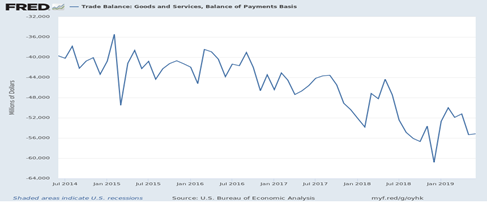
Republicans and Trump seem to have a bad case of historical amnesia. Historians generally agree it was the Smoot-Hawley Tariff Act of 1930 that helped to precipitate the Great Depression. The US lost some 50 percent of its foreign trade as a result. Other governments reciprocated with higher tariffs, just as the China is doing with Midwest farmers, and now their devaluation that makes their exports cheaper. They are also threatening to ban the export of rare earth minerals used in high-tech manufacturing components, of which China is the world’s major supplier.

China’s Commerce Ministry said Trump’s announcement is a violation of his agreement with President Xi Jinping in June to revive negotiations aimed at ending their fight over Beijing’s trade surplus and technology ambitions. The ministry had earlier said if the U.S. measures took effect, “China will have to take necessary countermeasures to resolutely defend its core interests.”

What is really happening between the lines? One Chinese minister posited that China had slowed negotiations for any meaningful trade agreement to a crawl until after the 2020 election, when it will know with more certainty who to deal with over the longer term.

Whereas President Trump sudden announcement must mean he is trying to divert media attention away from his other problems. To name a few: Trump hadn’t vetted Republican Congressman Daniel Radcliffe, who had to withdraw from consideration for the CIA Chief after it was obvious he wasn’t’ qualified for the job; Senate Majority Leader “Moscow Mitch” McConnell is drawing fire from all sides for refusing to allow a Senate bill to come to the floor that protects upcoming elections from foreign interference; and lastly, all signs are pointing to a gradually slowing economy precisely because of the ongoing trade war.

It is not a pretty picture, but empty bluster and posturing rarely is. We now have the makings of a currency devaluation war, says former Fed Vice Chair Alan Blinder, when other countries may now want to also devaluate their currencies. Such a result could lead to plummeting prices worldwide, and what else…?

The Chinese know the clock is ticking on the Trump administration and Republicans who continue to blindly support him, when congress is by law the real maker or breaker of trade agreements. Who will step up that actually knows the “Art of the Deal?”

Harlan Green © 2019

Follow Harlan Green on Twitter: https://twitter.com/HarlanGreen

Posted in Economy, Politics, Uncategorized, Weekly Financial News | Tagged , , | Leave a comment

Manufacturing, Foreign Trade Faltering

Financial FAQs

image

US manufacturers grew in July at the slowest pace in three years thanks to festering U.S. trade disputes that have hurt exports and undermined the global economy. It was the lowest number since August 2016, as the FRED graph shows.

“The July PMI registered 51.2 percent, a decrease of 0.5 percentage point from the June reading of 51.7 percent,” reported Timothy R. Fiore, CPSM, C.P.M., Chair of the Institute for Supply Management® (ISM®) Manufacturing Business Survey Committee.

“The manufacturing New Orders Index registered 50.8 percent, an increase of 0.8 percentage point from the June reading of 50 percent”, said Fiore: which means orders are stagnant; neither increasing or decreasing. “The Production Index registered 50.8 percent, a 3.3-percentage point decrease compared to the June reading of 54.1 percent. The Employment Index registered 51.7 percent, a decrease of 2.8 percentage points from the June reading of 54.5 percent.”

It’s possible the December 2017 tax cuts prolonged higher manufacturing growth through 2018, but the FRED graph shows that new orders had already begun to rise in the fall of 2016, when real Q3 GDP growth exceeded 4 percent, in part due to a roaring housing market, and consumer spending heartened by falling long term interest rates and strong job growth.

image

MarketWatch

MarketWatch gives a “gentleman’s C” for July’s unemployment report just out that showed a slowdown in payroll growth and downward revisions to past months. Nonfarm payroll rose 164,000, but much of the strength came for a second month from government payrolls which, reflecting the heavy government spending that’s underway, rose 16,000 to top June’s 14,000 rise.

Manufacturing also posted a strong gain of 16,000 which easily tops the consensus range even if the hours in the sector fell in the month, says Econoday. Payroll gainers include a second straight 38,000 rise for business services “which points to demand for contractors and temporary workers, as well as an 18,000 rise for financial activities.” On the downside is yet again retail which fell 4,000 in the month to extend its very severe contraction.

Trump and the Republicans are blaming the current growth slowdown on the overpriced US Dollar, because they believe an expensive Dollar in relation to foreign currencies is the culprit that is hurting manufacturing and exports, hence their push to lower the Federal Reserve overnight rate that could lower its value against other currencies.

The Fed did drop their rate on Wednesday one-quarter percent to a range of 2-2.25 percent, but it’s really trade wars that are reducing economic growth worldwide, which is now very dependent on the cross-border exchange of goods and services.

Dropping short term rates at or below the inflation rate will boost inflation, but it can’t be the cure-all for slower growth. It can’t be a substitute for making productive investments like infrastructure that should be a priority.

Fed Chair Greenspan and President Bush/Cheney kept interest rates too low in order to finance their wars on terror in early 2000 while cutting taxes. But it resulted in asset inflation and the housing bubble, as I said last week. Will that happen again, unless we begin to use our dollars in more productive ways, rather than to pay for tax cuts for the one percent?

Harlan Green © 2019

Follow Harlan Green on Twitter: https://twitter.com/HarlanGreen

Posted in Economy, Politics, Weekly Financial News | Tagged , , , | Leave a comment

What Happened to Main Street—Part II?

Popular Economics Weekly

image

FRED

Corporate responsibility is back in the air with a vengeance; not only from Senators Elizabeth Warren and Bernie Sanders who constantly remind us on the campaign trail that corporate misbehavior has tilted the “playing field” of economic benefits too much in corporations’ favor.

Now Jamie Gamble, a former corporate attorney, has touched the third rail of corporate behavior—business ethics. He has written an as yet unpublished essay that asserts corporate executives “are legally obligated to act like sociopaths,” according to Andrew Sorkin of the New York Times.

“The corporate entity is obligated to care only about itself and to define what is good as what makes it more money,” Gamble is quoted as saying in his essay. “Pretty close to a textbook case of antisocial personality disorder. And corporate persons are the most powerful people in our world.”

I call it the third rail because it’s a topic that comes up for discussion only when a crisis is brewing, or election, though economic futurists like Hazel Henderson have been writing about the need to train business executives on higher business ethics for decades; in books like, Building a Win-Win World, (Berrett-Koehler, 1996).

“When I published “Should Business Solve Societies’ Problems? In the Harvard Business Review in 1968,” said Henderson, “there were few MBA courses on business ethics. By 1995 such courses were standard and often compulsory.”

Ethical behavior leads to what she calls “win-win” corporate behavior, defined as cooperative outcomes that benefit not just corporate executives and their shareholders as happened with the recent Republican tax cuts.

Simply put, such sociopathic behavior benefits just the few with its pre-occupation with maximizing quarterly profits, rather than benefiting the employees and market customers it also services, while adding to the ‘hidden’ public costs of maintaining a clean environment and public infrastructure that it depends on.

These are what are termed the social costs of doing business that Senator Elizabeth Warren intoned in her first campaign to become a Massachusetts Senator:

“You built a factory out there? Good for you. But I want to be clear: you moved your goods to market on the roads the rest of us paid for; you hired workers the rest of us paid to educate; you were safe in your factory because of police forces and fire forces that the rest of us paid for. You didn’t have to worry that marauding bands would come and seize everything at your factory, and hire someone to protect against this, because of the work the rest of us did.

“Now look, you built a factory and it turned into something terrific, or a great idea? God bless. Keep a big hunk of it. But part of the underlying social contract is you take a hunk of that and pay forward for the next kid who comes along.”

In fact, Jamie Gamble has formulated a list of ethical rules he wants corporation executives and shareholders to adopt, and be liable for if they are not adhered to.  They should include:

· Their “relationship with their employees.”

· With “their communities in which they produce and sell.”

· Their “relationships with customers.”

· Their “effects on the environment.”

· And “effects on future generations.”

It is not surprising that Gamble’s ethical rules also meet the definition of sustainable economic growth, which is growth for the long term that benefits more than the few, because it is the “win-win” path that maintains strong and lasting economic growth without the frequent down cycles and economic crises that have wreaked so much economic and social damage in recent decades.

Harlan Green © 2019

Follow Harlan Green on Twitter: https://twitter.com/HarlanGreen

Posted in Consumers, Economy, Politics, Uncategorized | Tagged , , , , , | Leave a comment

Economic Growth Is Slowing

Financial FAQs

image

BEA.gov

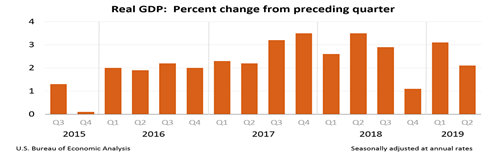
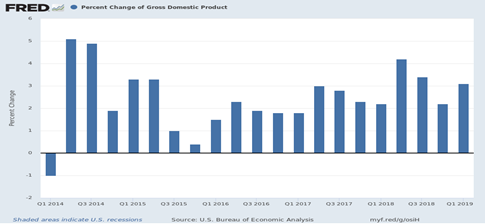
Gross domestic product, the official report card on the economy, grew at a 2.1 percent annual pace from the start of April to the end of June, the government said Friday. GDP slowed from a 3.1 percent gain in the first three months of the year.

American consumers don’t seem to care about signs of slowing growth in manufacturing and housing, as most can find good jobs and rising wages, and they are flush with cash. The BEA reports disposable personal income increased $193.4 billion, or 4.9 percent, in the second quarter, compared with an increase of $190.6 billion, or 4.8 percent, in the first quarter. Real disposable personal income (after inflation is factored in) increased 2.5 percent, compared with an increase of 4.4 percent in Q1.

But they are becoming more cautious about the future as the personal saving rate — personal saving as a percentage of disposable personal income – is at 8.1 percent in the second quarter, compared with 8.5 percent in the first quarter, which are highs for this recovery.

The increase in real GDP in the second quarter reflected positive contributions from personal consumption expenditures (PCE), federal government spending, and state and local government spending that were partly offset by negative contributions from private inventory investment, exports, nonresidential fixed investment and residential fixed investment, said the BEA. Imports, which are a subtraction in the calculation of GDP, increased.

(So)The deceleration in real GDP in the second quarter reflected downturns in inventory investment, exports, and nonresidential fixed investment. These downturns were partly offset by accelerations in PCE and federal government spending.

Economists had been predicting the slowdown for some time, as businesses are investing less this year. Manufacturing is the culprit, as no one wants to invest more in plant and equipment with the ongoing trade wars, as we have been saying. There is too much economic uncertainty in China and the EU, and growth in the rest of the world is slowing, according to the IMF.

The surge in consumer spending was also predicted by the jump in retail sales reported last week. Retail sales rose in June for the fourth month in a row, quieting concerns that the trade wars and weaker manufacturing output would also drag down consumer spending. The most surprising strength in the report was a 0.7 percent jump in auto sales, which the only component of manufacturing seeing steady growth. Nonretailers (Internet), which continue to feed off of traditional retailers such as department stores, was also surprising with a 1.7 percent for the second month in a row.

image

So any further decline in GDP growth will probably be due to a slower accumulation of inventories and capital investments (as seen in the above capital-goods orders graph) and a growing negative imbalance in exports vs. imports.

If the Trump administration and Republicans would realize the damage confrontational trade wars and other fear-mongering policies do to GDP growth, they would end such tactics. But it is obvious they only see an upside in their continuing confrontation with allies and adversaries alike, which should come back to haunt them next year when the inevitable worldwide growth slowdown impacts US, and the Presidential election.

And guess what?  The price index for gross domestic purchases increased 2.2 percent in the second quarter, compared with an increase of 0.8 percent in the first quarter, which is a sign of looming inflation, and makes it more likely the Fed will not want to lower their short term interest rates anytime soon.

Harlan Green © 2019

Follow Harlan Green on Twitter: https://twitter.com/HarlanGreen
Posted in Consumers, Economy, Macro Economics, Politics, Weekly Financial News | Tagged , , | Leave a comment

Why Are Home Sales Declining?

The Mortgage Corner Weekly

image

FRED

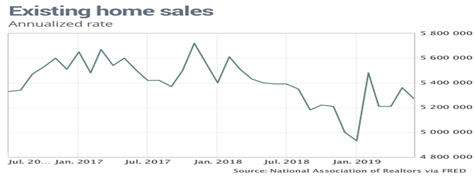
WASHINGTON (July 23, 2019) – Existing-home sales weakened in June, as total sales saw a small decline after a previous month of gains, said the National Association of Realtors®. While two of the four major U.S. regions recorded minor sales jumps, the other two – the South and the West – experienced greater declines last month.

The problem is still not enough affordable housing. The demand is there for mid-range housing, as 56 percent of homes sold in less than 30 days, and unsold inventory is at a 4.4-month supply at the current sales pace, up from the 4.3 month supply recorded in both May and in June 2018; when there is normally a 6-month supply if supply and demand are in balance.

Total existing-home sales, https://www.nar.realtor/existing-home-sales, completed transactions that include single-family homes, townhomes, condominiums and co-ops, dropped 1.7 percent from May to a seasonally adjusted annual rate of 5.27 million in June. Sales as a whole are down 2.2 percent from a year ago (5.39 million in June 2018).

“Home sales are running at a pace similar to 2015 levels – even with exceptionally low mortgage rates, a record number of jobs and a record high net worth in the country,” said Lawrence Yun, NAR’s chief economist. Yun says the nation is in the midst of a housing shortage and much more inventory is needed. “Imbalance persists for mid-to-lower priced homes with solid demand and insufficient supply, which is consequently pushing up home prices,” he said.

Yun said other factors could be contributing to the low number of sales, as well. “Either a strong pent-up demand will show in the upcoming months, or there is a lack of confidence that is keeping buyers from this major expenditure. It’s too soon to know how much of a pullback is related to the reduction in the homeowner tax incentive.”

What are consumers doing with their high net worth? Many are remodeling, instead of moving. Existing-home owners are remaining in their homes much longer. The recent average is 10 years, when 4 years has been the historical average years of duration in the same residence.

There are slightly more first-time buyers this season with record-low interest rates. First-time buyers were responsible for 35 percent of sales in June, up from 32 percent the prior month and up from the 31 percent recorded in June 2018.

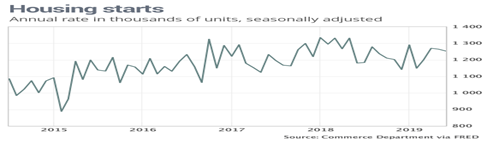
Construction of new houses also fell slightly in June and permits sank to the lowest level in two years, exacerbating the shortage and suggesting a sluggish U.S. housing market has failed to gain much momentum from lower mortgage rates.

image

FRED

Housing starts slipped 0.9 percent to an annual pace of 1.25 million last month, said the Commerce Department. That’s how many homes would be built in 2019 if construction took place at same rate over the entire year as it did in June.

Permits to build more homes, meanwhile, sank 6.1 percent to a 1.22 million pace, the government said Wednesday. That’s the lowest level since mid-2017.

And lastly, new-home sales also declined to a lower-than-expected 646,000 annual rate. The 3-month average is at 636,000 which compares unfavorably against a 673,000 peak in April.

This was still the highest sales for June since June 2007, and annual sales in 2019 should be the best year for new home sales since 2007, according to Calculated Risk, and suggests homebuyers haven’t let up on their enthusiasm to own a home.

Harlan Green © 2019

Follow Harlan Green on Twitter: https://twitter.com/HarlanGreen

Posted in Consumers, Housing, housing market, Weekly Financial News | Tagged , | Leave a comment

What Happened to Main Street?

Popular Economics Weekly

image

FRED

The main reason we have suffered from historically slow growth and stagnated wages since the Great Recession is in large part due to so-called trickle-down economics, the fallacy that concentrating most of the largess of economic growth on the private sector, and neglecting public sector growth in health care, environmental protection, education, R&D, and public infrastructure, for starters, means the US economy wasn’t paying forward its benefits for the next generations, as Senator Elizabeth Warren intoned at the beginning of her tenure.

It is the public sector that plants the seed corn for future, sustainable economic growth, which private businesses then utilize to create private sector jobs and profits. The US may have the greatest higher education and research facilities, but our elementary and high schools rank near the bottom in the developed countries.

We also rank much lower in health care and environmental protection, which lowers labor productivity and results in sicker workers. Isn’t it better for our country to improve the health and skills of workers (while paying them more) before we replace them with robots?

The Clinton administration made the most recent steps towards the goal of sustainable growth when it cut military spending and put a 2 percent overall limit on government expenditures that balanced the federal budget and actually created a surplus for four consecutive years—1996-2000.

But 9/11 and terrorism put the fear mongers back in charge and military spending surged, while public sector spending declined in those seed-corn sectors we spoke of. The result post-2000 was that Fed Chairman Greenspan kept interest rates below the existing rate of inflation, which grossly inflated the housing market and resulted in the housing bubble.

GW Bush and Fed Chair Greenspan chose the less sustainable growth path when they cut taxes, reducing government revenues at the same time they had to pay for the wars on terror. Once again, budget deficits surged because government revenues declined, and we embarked on a path that led to the Great Recession.

We have the same lesson today. Conservatives and the Trump administration are lobbying the Fed to lower interest rates to boost stock prices further, inflating stock values that are already at record levels in the hopes that it will continue economic growth in the 11th year of this record economic expansion.

There were 224,000 private payrolls jobs created in June, economic growth last year averaged 3.2 percent, and first quarter GDP was 3.1 percent this year already.

Unnecessarily low interest rates inflate deficits and asset bubbles if not invested wisely. We really need to grow the public sector and Main Street in whatever way it can be done. Gradually boosting the national minimum wage above the less-than-living-wage of $7.25 per hour would be a good start. Boosting Main Street benefits will do the most to create sustainable, enduring growth—by paying it forward to the next generations.

Harlan Green © 2019

Follow Harlan Green on Twitter: https://twitter.com/HarlanGreen
Posted in Consumers, Economy, Macro Economics, Politics, Weekly Financial News | Tagged , , , , , | Leave a comment

It’s Up To the Consumers!

Popular Economics Weekly

image

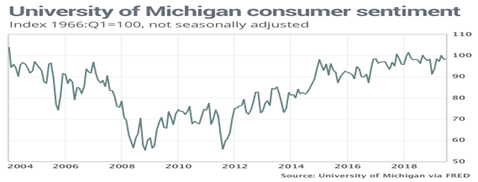
Consumers are feeling good enough to keep the US economy from sinking into recession at the moment. The consumer sentiment survey edged up to 98.4 this month from 98.2 in June, according to a preliminary reading from the University Michigan.

“Consumer sentiment remained largely unchanged in early July from June, remaining at quite favorable levels since the start of 2017,” said survey chief economist Richard Curtin. “Moreover, the variations in Sentiment Index have been remarkably small, ranging from 91.2 to 101.4 in the past 30 months. Perhaps the most interesting change in the July survey was in inflation expectations, with the year-ahead rate slightly lower and the longer term rate moving to the top of the narrow range it has traveled in the past few years.”

Actually, sentiment has been fluctuating in that range for several years, per the FRED graph, as economic growth and employment finally ramped up in 2015 after the Great Recession, boosting consumer confidence.

Curtin believes that inflation expectations affect consumer confidence, as the survey indicates consumer expectations for growth and jobs (hence confidence) rise the lower the inflation rate. Hence the Federal Reserve mandate to keep inflation low enough to enable stable growth.  So today’s ultra-low inflation (and interest rates) could be encouraging consumers to spend more.

“The Consumer Expectations Index falls as inflation expectations rise, signifying that consumers view higher inflation as a threat to economic growth,” he continued. “Higher inflation was related more frequently to rising interest rates and was associated with higher unemployment expectations.”

The Conference Board’s Index of Leading Economic indicators (LEI) that is a good predictor of economic activity over the next six months was not so optimistic.

“The US LEI fell in June, the first decline since last December, primarily driven by weaknesses in new orders for manufacturing, housing permits, and unemployment insurance claims,” said Ataman Ozyildirim, Senior Director of Economic Research at The Conference Board. “For the first time since late 2007, the yield spread made a small negative contribution. As the US economy enters its eleventh year of expansion, the longest in US history, the LEI suggests growth is likely to remain slow in the second half of the year.”

Why? Manufacturers’ new orders, building permits in the latest housing starts survey, and the yield curve were negative. The interest rate spread between the 10-year Treasury note and fed funds rate has sunk to negative -0.31 percent, from a positive +0.56 percent last December. Long term interest rates sinking below short term rates is a sign of slower growth, since investors rush to buy longer term Treasury bonds as a safe haven if there is too much economic uncertainty, as is happening at present.

A simple way to fix the inverted yield curve problem is if the Fed would lower the fed funds rate again. But is that the right thing to do when retail sales are soaring, and June payrolls totaled 224,000 new jobs? The economy is booming, in other words, so the Fed should allow higher interest rates unless other forces are at work—such as White House tweets that are artificially boost stock prices (and enrich stockholders and corporate CEOs), rather than policies that would help Main St. workers—like a higher minimum wage, and better worker protections, and strengthening health care policies, which would promote longer term economic growth.

So in fact other sectors of the economy have to be promoted, if we are to continue in this ‘goldilocks’ growth cycle (i.e., not too hot or too cold). Consumers can’t continue to party, otherwise.

Harlan Green © 2019

Follow Harlan Green on Twitter: https://twitter.com/HarlanGreen
Posted in Consumers, Economy, Weekly Financial News | Tagged , , , , , | Leave a comment

Great Retail Sales!

Financial FAQs

image

Econoday.com

Retail sales rose in June for the fourth month in a row, quieting concerns that the trade wars and weaker manufacturing output would also drag down consumer spending.

The most surprising strength in the report was a 0.7 percent jump in auto sales. Nonretailers (Internet), which continue to feed off of traditional retailers such as department stores, according to Econoday, was also surprising with a 1.7 percent for the second month in a row.

And discretionary spending, such as for restaurants, was up 0.9 percent following prior gains of 1.0 percent, 0.7 percent, and 0.8 percent. “This shows that consumers, flush with confidence and fully employed, are enjoying themselves,” said Econoday.

The list of strengths goes on with both furniture and building materials snapping back with 0.5 percent gains that point to strength for residential investment. Clothing stores saw sales also rise 0.5 percent as did health & personal care stores.

More good news was today’s Federal Reserve Industrial Production report that showed renewed strength in manufacturing—particularly in motor vehicle production. It’s still far below last year’s manufacturing output, however, that was mainly due to the 2017 tax breaks that raised profits.

image

Econoday

Manufacturing is by far the largest component in this report and June’s results are almost uniformly strong, led by a 2.9 percent monthly rise for motor vehicle production and a 0.7 percent rise for selected hi-tech. Business equipment production posted a second strong increase at 0.5 percent that follows May’s 0.4 percent rise in gains that should ease the Fed’s concerns over business investment.

Construction supplies also show strength, up 0.5 percent and 0.6 percent in the last two reports in what are positive signals for construction demand that reinforces the increased furniture and building materials gains in retail sales.

One month’s gain in manufacturing does not constitute a trend, however. But consumers are flush and confident, so economists may begin to raise their growth forecasts if this trend continues.

Harlan Green © 2019

Follow Harlan Green on Twitter: https://twitter.com/HarlanGreen
Posted in Consumers, Economy, Housing, Weekly Financial News | Tagged , , | Leave a comment

Why Are Worry About Low Inflation?

Popular Economics Weekly

image

Reuters.com

Almost everyone, including Fed Chair Powell, is worried about the low inflation rate.  It’s usually nearing 4 percent at this late stage of an economic recovery, not the current 2 percent if the US economy were running on all cylinders. Consumers should be spending more and businesses investing more to expand their markets—especially with the lowest unemployment rate in almost 50 years.

But the largest corporations don’t need to invest more. They have become fat and happy controlling their market share because they have been allowed to grow enough to buy up or stifle much of their competition. And with reduced competition they can spend most of their profits on stock buybacks and soaring CEO compensation packages.

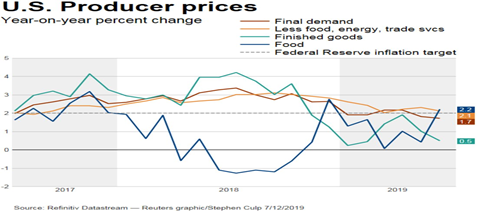
Last Friday’s wholesale Producer Price Index indicated as much, with raw materials for finished goods and services barely budging. There is very little wholesale inflation on raw materials, in spite of the increased tariffs being levied on Chinese goods and elsewhere. This is a very strange because fewer lowered foreign trade should mean imported goods are more expensive, not cheaper.

The Producer Price Index for final demand advanced 0.1 percent in June, seasonally adjusted, reported the U.S. Bureau of Labor Statistics. Final demand prices moved up 0.1 percent in May and 0.2 percent in April. On an unadjusted basis, the final demand index rose 1.7 percent for the 12 months ended in June, the lowest rate of increase since advancing 1.7 percent in January 2017.

This is with the strong dollar which cheapens imports, which should increase demand for wholesale goods and services. Gas prices fell 5 percent, even with the Middle East dangers that would ordinarily boost oil prices.

The real problem that Alexandria Ocasio Ortiz for one, highlighted in her questioning of Fed Chair Jerome Powell is why there is almost no inflation, even with a full employment rate of 3.7 percent? She wanted interest rates lowered sooner to boost higher growth, with some 6-7 million workers either not looking for work, or working part time, but would prefer working fulltime and earn a living wage.

Powell said the U.S. is suffering from a bout of uncertainty caused by trade tensions and weak global growth, but he pledged to do whatever it takes to shore up the economy in what Wall Street took as a sign the central bank will cut interest rates soon.

image

Econoday.com

The retail Consumer Price Index fared slightly better. Year-on-year the core is up 1 tenth to 2.1 percent. Housing and medical care which together make up about 1/2 the index — are also on the high side, said Econoday.

But outside the core, energy prices fell a sharp 2.3 percent on the month with the gasoline subcomponent down 3.6 percent. Energy prices, which are down 3.4 percent on the year, are not helping the Fed achieve its 2 percent inflation goal.

Trade wars are not really winnable anymore, as I’ve been saying; because we no longer live in a win-lose world where the strong are able to prey or even conquer the weak and vulnerable so easily. Our world has become too populous, and thanks to modern technologies too interlinked for it not to affect world trade upon which economic growth depends.

World trade is now in decline, which means US manufacturing and exports are in decline. So we hope US consumers keep spending, since they make up two-thirds of economic activity.

Harlan Green © 2019

Follow Harlan Green on Twitter: https://twitter.com/HarlanGreen
Posted in Consumers, Economy, Weekly Financial News | Tagged , , , , | Leave a comment