ANSWERING the KENNEDYS CALL FOR PEACE

image

The Rebuilding of Local Communities!

Where does the rebuilding of local communities that creates a sense of healthy community itself really happen? At the local level, whether it be in neighborhoods, towns, or cities. It is everywhere residents find a reason to band together.

And it is an answer to the fragmentation of local communities caused by the loss of so many blue collar jobs due to the Digital Revolution and Globalization of the workforce that has internationalized commerce so that corporations ignore national borders in their search for cheaper labor and new markets.

This has meant that towns, cities and states have had to look inward to heal their broken communities in order to provide citizens with the necessary means to grow and prosper.

Two Visions of Community

Harvard Sociologist Robert Putnam in an American Prospect sequel article to Bowling Alone wondered what made a viable community: “Some seemingly obvious answers turned out to be irrelevant. Party politics or ideology makes little difference. Affluence and prosperity have no direct effect. Social stability or political harmony or population movements are not the key. None of these factors is correlated with good government as we had anticipated. Instead, the best predictor is one that Alexis de Tocqueville might have expected. Strong traditions of civic engagement – voter turnout, newspaper readership, membership in choral societies and literary circles, Lions Clubs, and soccer clubs – are the hallmarks of a successful region.”

My hometown of Redwood City had much to do with why I chose community development as a focus and discipline, as a way to bring people of different backgrounds and concerns together, because it had many of those ingredients—strong civic groups such as an active Rotary club that gave out thousands of scholarship dollars every year to college students and a historical society that gave 150 year-old Redwood City a strong sense of identity. It was also a small-town where we could easily interact with each other in neighborhoods such as mine that had many immigrants.

I learned the basic tools of community development later from my Peace Corps training, which were first put into practice in a medium-size Turkish village of approximately 800, and then as a member of Cesar Chavez’s United Farmworkers Union that came to represent tens of thousands of farmworkers during its heyday. Foreign cultures were something I was familiar with because of the ethnic diversity of my own childhood neighborhood and background. I felt comfortable in different cultures because of the friendliness and hospitality shown by these communities of farmers and farmworkers, and my belief that we had a common humanity.

Redwood City is a San Francisco peninsula suburb full of history and diversity that was ahead of its time, in many ways. It is best known for the motto, “Climate Best by Government Test” on a sign that arches over El Camino Real, its major highway at that time. The sign was erected because the National Weather Service once had a Redwood City office, and christened its climate the best in the Bay Area and an ideal place to live. El Camino Real is Spanish for the King’s Highway originally built by Spanish explorers that first came to California in the 1700s. It connected California’s 21 missions built from 1769 to 1833 by Spain’s Catholic missionaries—more compelling history that gave Redwood City and the coastal region of California its unique identity.

It was this unifying identity that helped to make Redwood City a functioning community and the seat for San Mateo County, as well. I found keeping a historical record is one necessary ingredient that creates a common identity of a well-functioning community. Redwood City was founded in 1867, the oldest city on the San Francisco peninsula, because it had the only deep water port on San Francisco Bay south of San Francisco.

It was also a lumber town because the coastal mountains looming behind it were full of mature, first-growth Redwood trees that were brought down to its deep-water harbor and shipped to San Francisco and beyond.

Living in such a close-knit community as an eleven-year-old meant I could sell the San Francisco Call-Bulletin with its Sporting Green in the downtown bars on Main Street after school and make good tips as the Happy Hours became cheerier. I remember saving up the $36 needed to buy my first bike so I could graduate to an actual newspaper route. My Dad and I brought the money in a one-quart milk carton and dumped it on the counter of the bicycle shop, where it was counted out penny, by nickel, by dime, by quarter. I then owned a new Schwinn bicycle and became a Redwood City Tribune door-to-door newspaper boy.

I had attended Sequoia Union High School; one of just three high schools in our county at the time. That meant our annual Thanksgiving Day football Big Game with Palo Alto High was such an important community event that even today it is played in Stanford University’s football stadium, where it has attracted as many as 20,000 rabid fans.

My neighborhood was full of immigrants, including a Polish farmer across the street, Mr. Kolka, who raised pigeons, goats, and had a large fruit orchard on several acres. Next door was the Penna family, Sicilian immigrants with four boys who were my playmates. A recently arrived German family lived next to the Pennas, and a Chinese family nearby had a grandmother with tiny, shrunken feet. I knew this because she exercised on their front lawn in the mornings.

My mother was also an immigrant; a British Citizen born in Jamaica before coming to San Francisco. She was from a family of Sephardic Jews that left Portugal during the Catholic Inquisition—first to Amsterdam, then London, until they arrived in Jamaica sometime during the Eighteenth century and established The Army and Navy Stores, Ship Chandlers, to provision ships that anchored in Kingston Harbor.

We all have individual family histories that contribute to our sense of identity, for better or worse. My father loved our history because his mother was a member of the DAR, the Daughters of the American Revolution. Her family descended from minute men that fought in the Revolutionary War. So I grew up with a love of history; which was why I wanted to participate in history-making endeavors, such as the Peace Corps.

My education in community development was furthered when I became a member of the United Farmworkers Union, and learned how Cesar Chavez organized the UFW. Cesar’s early life shaped his vision of a community with greater justice and freedom for all.

His vision made him the consummate community organizer that could build the UFW. His family had lost their Arizona farm during the Great Depression and moved to Southern California to find work, just as John Steinbeck’s Joad Family did in the 1930’s Grapes of Wrath. That work was crop-picking as a child, so he came to intimately know the people he was to organize. His community was the mostly Filipino and Mexican farmworkers in the fields of California that later included Arizona, Florida and Texas farmworkers as his organizing efforts spread.

I was drawn to Cesar and the UFW Union in part cause because I had joined the Carpenter and Teamster unions while working my way through college. They were more responsive to local membership in those days when local members controlled the rules and regulations of their unions and had little contact with national leadership. Unfortunately, this doesn’t describe the later Teamsters Union the UFW clashed with during the 1970s period of United Farmworker strikes and boycotts that gave the Teamsters in particular a bad name.

The strongest unions are democratic and run by their members; including the AFL-CIO, United Mineworkers, and United Autoworkers unions that supported and gave financial aid to the United Farmworkers Union when growers and the Teamsters attempted to destroy it.

Cesar Chavez was successful because his was a vision of bottoms-up, ‘grass-roots’ organizing of the farmworkers, something he knew how to do because he had grown up in their community, as I said. That means the impetus to organize came from the farmworkers themselves who saw the important of community organizing and were willing to fight for the right to organize a union. His lacked certain administrative skills to some extent which hurt the UFW later. He was extremely charismatic and much better at motivating farmworkers than creating a long term, farmworkers union.

But he was able to unite religious leaders with social activists into a national movement for farmworker and immigrant rights. That is why he could enlist Dorothy Day of the Catholic Workers Movement, Reverend Chris Hartmire of the California Migrant Ministry, Walter Reuther, storied President of the United Auto Workers Union, the AFL-CIO, and International Brotherhood of Electrical Workers (IBEW), and the pro-labor Kennedy family to support the UFW’s cause. Cesar said many times the IBEW was his ideal of a democratically-run, grass roots labor union he wanted the UFW to emulate, because its members had a long history of active participation in their union.

I use these two visions of communities because they are an example of what successful community organizations or groups must contain—a compelling history or vision that unites them, and an adequate diversity of people and opinions so they can adapt to changing circumstances that can be difficult to control. Without such diversity, no community has remained functional and open to what will be unexpected changes, in my experience.

I graduated from Sequoia Union High School in 1958 and was accepted into the University of California Berkeley’s Engineering School that fall. The Korean War had ended in 1956. And there seemed to be no limit to future career possibilities. Jobs were plentiful; there were lots of opportunities for work and play on the San Francisco Peninsula.

California’s population was exploding in the 1950s; which was probably why the New York Giants moved to San Francisco in 1958 and became the storied San Francisco Giants, where I was able to watch Willie Mays and Willie McCovey play in Seals Stadium, former home of the Pacific Coast League’s San Francisco Seals.

Redwood City grew faster after I left for Berkeley in 1958, and I hardly recognize it today on return visits. It became a high tech center with some of the first computer company startups, and the home of Oracle, just as Silicon Valley was developing. Those memories of my neighborhood and Redwood City were the elements I thought all successful, well-functioning communities should contain.

Harlan Green © 2018

Follow Harlan Green on Twitter: https://twitter.com/HarlanGreen
Posted in Consumers, Uncategorized | Tagged , , , , , | Leave a comment

Even More Job Openings!

Financial FAQs

image

Calculated Risk

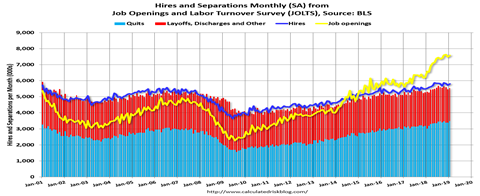
The consensus from the Labor Department’s latest JOLTS report is job openings (graph yellow line) keep rising and employers are scrambling to fill them. January’s number of job openings rose 1.4 percent to 7.581 million that also showed a sharp upward revision to December which is now at 7.479 million vs an initial 7.335 million.

The hires data (blue line) in the JOLTS report also rose 1.5 percent or nearly 100,000 to 5.801 million. And the spread with openings continues to widen to a new record of 1.780 million, which means 1.780 million jobs have yet to be filled, according to the survey.

Year-on-year, openings are up 21.7 percent which dwarfs the 4.2 percent rise in hires, says Calculated Risk. One indication of inflationary risk that Federal Reserve policy makers watch closely is the quits data in this report, rising nearly 100,000 in January to 3.490 million. It is workers seeking higher pay moving from one employer to another, which is usually a sign better jobs are available. 

Why is retail CPI inflation today just 2 percent, when it should normally be rising closer to the 3 percent average that prevailed through most of 2017, as I said in my last blog?

The University of Michigan sentiment survey gives some answers. The consumer sentiment index rose to 97.8 for the preliminary March reading which is above the consensus range. The expectations component, which sank sharply during the government shutdown in January, rose nearly 5 points to 89.2 for its best result since October. And current conditions look even better, up nearly 3 points at 111.2, their best level since before the December shutdown.

But inflation expectations, which the Federal Reserve watches very closely in this report, are still low. The year-ahead U of Michigan expectations reading is surprising, down 2 tenths to 2.4 percent though offset by a 2 tenths gain in the 5-year outlook to 2.5 percent.

This tells us consumers aren’t seeing many rising prices, and so continue to shop for discounts. Inflation expectations tend to be self-reinforcing, according to some recent research. It’s only when consumers see sharp price hikes that they begin to spend more, boosting prices further, as happened during the 1970s wage-price spiral that kicked inflation rates into double digits.

Yet inflation has been tame since the 1990s, and will probably continue as such, even with rising wages. The JOLTS report really tells us there just aren’t enough workers willing to work, qualified or unqualified. It’s a great place for working adults to be in.

image

CBPP.org

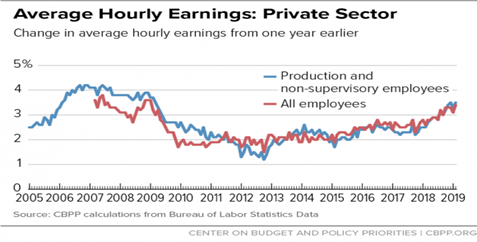
It also means there are many working-age adults sitting out the recovery that left the workforce during the Great Recession and see no reason to return until earnings return to pre-recession levels. Workers’ average hourly earnings are at a nine-year high, but the recovery is in its tenth year, so the incomes of many hourly workers have yet to catch up to present living conditions.

Harlan Green © 2019

Follow Harlan Green on Twitter: https://twitter.com/HarlanGreen
Posted in Economy, Macro Economics, Politics, Weekly Financial News | Tagged , , , , , | Leave a comment

Why No Inflation??

Financial FAQs

image

Econoday

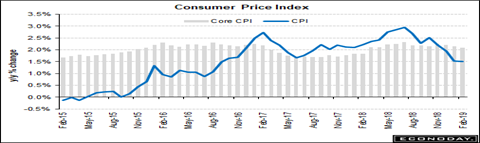
There is almost no inflation, and the markets love it, as both stocks and bonds are rallying on news. The Consumer Price Index rose just 1.5 percent in February, and its core without more volatile food and energy prices was up just 2.1 percent. The Fed has even stopped raising their short term rates, in an attempt to boost inflation higher, but no dice. It won’t move at all, but is falling.

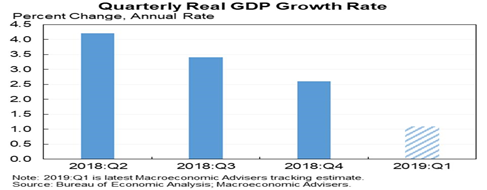
So where’s the inflation that should normally be rising close to 3 percent through most of 2017 as the graph shows? Then the Republican tax cuts gave artificial stimulus to economic growth, so much so that Q2 2017 GDP soared to a 4.2 percent growth rate.

But corporations and rich folk who benefited most from the cuts pocketed it, so growth slowed to 2.6 percent in Q4 and is predicted to be less than one percent in the first quarter of 2019. All that largesse wasn’t invested in much that was productive, in other words; what economists call capital expenditures; and corporations did not pass on its benefits to their employees in higher wages or benefits.

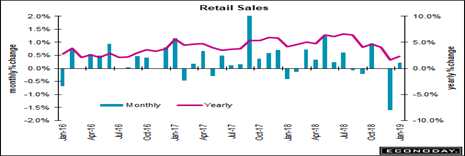
Growth fell because it didn’t affect the other 99 percent of income earners, whose incomes are slowly increasing, but not fast enough to push up their spending. In fact, retail sales are miserable at present, up just 0.2 percent in January, after declining a minus 1.6 percent in December, which puzzled many economists.

image

Econoday

Stocks plunged in December as well, until the Fed reversed course and decided to be “patient” before raising their short term rates further, which had pushed the Prime lending rate to 5.5 percent, on which credit card and installment debt base their rates. Consumers then apparently decided to park their shopping carts rather than splurge during the holidays.

“But when excluding autos, where sales were very weak in January, the latest month shows a very strong 0.9 percent gain that hits the top of Econoday’s consensus range,” said Econoday. “The report’s two core readings — less autos & gas and the control group — also show outstanding gains, of 1.2 and 1.1 percent respectively that reverse tremendous weakness in December at revised losses at 1.6 percent and 2.3 percent.”

So what do we make of what is  really disinflation, the economic term for falling inflation, that the Fed fears most of all because it signals consumers are buying less? It means consumers that make up two-thirds of economic activity are saving more with their personal savings more than double since the last recession. Could it mean consumers also fear another downturn; even another serious recession? Maybe the shock of the Great Recession hasn’t worn off, since most consumers have yet to benefit from the now 10-year recovery.

Harlan Green © 2019

Follow Harlan Green on Twitter: https://twitter.com/HarlanGreen
Posted in Consumers, Economy, Politics, Weekly Financial News | Tagged , , , | Leave a comment

Homeownership Expands Again

The Mortgage Corner

image

Washington Post

New data indicate that in 2016, in defiance of myriad prognostications, the decade-long decline in the homeownership rate abruptly reversed. Once-rapid growth in renter households stalled, and the long-stagnant number of owner-led households began rising,” says the Washington Post’s Andrew Van Dam.

The homeownership of American households peaked at the height of the housing bubble at 69 percent, and only now has returned to post-recession levels. This is confirmed by several other indicators, including the big jump in household formation by the millennial generation, children of the baby boomers, in particular who are now 22 to 38 years of age. It took them this long to buy because of the Great Recession that depressed incomes and huge amount of college debt.

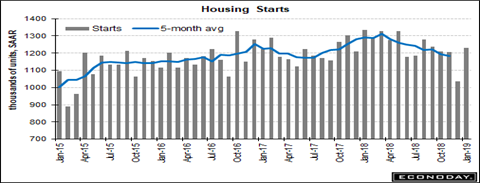
And builders are beginning to realize that fact, as housing starts jumped back to historical levels in January to a 1.230 million annual rate. After falling 28 percent in December, starts in the West jumped 29 percent in January, as California began to recover from the record number of wildfires. The biggest region for home builders is the South where January starts rose 14 percent to more than reverse December’s nearly 8 percent decline, which were also weather-related.

image

Econoday.com

Another reason for the rise in homeownership has to be steadily rising rents since they hit bottom in 2008, and mortgages rates still at almost record lows. “In the middle of 2015, rents nationally rose more than 6 percent from a year earlier — easily their fastest growth since the real estate data experts at Zillow began keeping track. It is one of the few times on record that rents rose faster than home prices,” said Van Dam.

The last piece of the housing puzzle is the moderation of housing prices that no longer rise at 5 percent per year. The Case-Shiller same-home index year-on-year prices were up only 4.2 percent in the month which missed expectations by a very sharp 6 tenths. This is the lowest growth rate since November 2014 and compares with FHFA’s 5.6 percent rate for December which was a 3-year low.

The surge in new households, as well as record low mortgage rates, have helped new-home sales as well. New home sales jumped 3.7 percent in December to a 621,000 annual rate that is on the high end of expectations, though December’s year-on-year rate is still minus 2.4 percent.

We therefore see a steady improvement for home sales in 2019, since I predict interest rates could stay this low for the foreseeable future. Why? Economic growth is slowing, while consumer incomes are rising above inflation rate, and there is still a housing shortage.

Harlan Green © 2019

Follow Harlan Green on Twitter: https://twitter.com/HarlanGreen
Posted in Consumers, Economy, Housing, housing market, Weekly Financial News | Tagged , , , , | Leave a comment

Why Smallest Jobs Increase in 17 months?

Popular Economics Weekly

image

MarketWatch.com

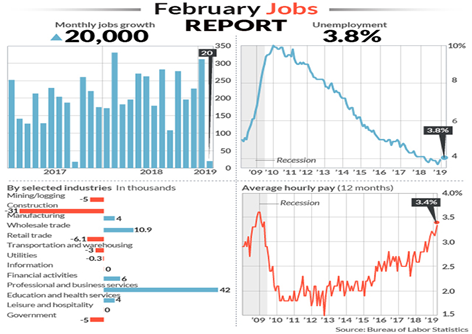
Is US economy running out of available workers? Just 20,000 nonfarm payroll jobs were created in February, per the Labor Department’s Bureau of Labor Statistics, the lowest total in 17 months. But it may have been because there aren’t enough workers that want to work. That has to be part of the reason for the sharp drop from January’s 311,000 new payroll jobs—that was also revised up from 304,000 jobs!

“The unemployment rate declined by 0.2 percentage point to 3.8 percent in February, said the BLS, and the number of unemployed persons decreased by 300,000 to 6.2 million. Among the unemployed, the number of job losers and persons who completed temporary jobs (including people on temporary layoff) declined by 225,000. This decline reflects, in part, the return of federal workers who were furloughed in January due to the partial government shutdown.”

Note that workers returning from the “partial government shutdown” accounted for some of the 300,000 decrease in unemployment, but that was in the Household Survey, a telephone survey of a smaller number of respondents that includes the self-employed.

The larger and generally more accurate Establishment survey of actual business payrolls showed a much larger decrease of 31,000 fewer construction workers (vs. 53,000 hired in January), with smaller drops in retail and government employment as well. So the two surveys don’t usually match.

That rate fell because of a sharp rise in the number of those employed (up 255,000) and a sharp fall in the number of unemployed, as I said, which makes for an unexpected 2 tenths dip in the unemployment rate to 3.8 percent.

The bottom line is there aren’t enough workers for hire. The number of job openings reached a series high of 7.3 million on the last business day of December due to the looming scarcity of hires. This means businesses must find more creative ways to hire and hold their employees—such as continue to raise salaries.

Wages in today’s report are another indication of the labor shortage, jumping 0.4 percent in the month which is outside expectations for a year-on-year rate of 3.4 percent that is at the high end of expectations.

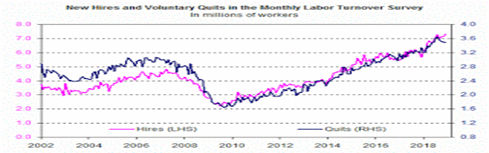
It should also mean more job creation this year, since many of those 6 million still out of work are simply waiting for wages to return to pre-recession levels, according to various sources. This is measured by the voluntary ‘Quits’ component of the Job Openings and Labor Survey that has been rising. Many of those having to work during and after the Great Recession had to take steep reductions in pay.

image

Wrightson-ICAP

So getting back to an equivalent breakeven for those workers holding out means taking into account the pay losses from the downturn even with a fully employed economy.  The gap between openings and hires is now 1.428 million, a new record and up from 1.304 million in November. It’s a very good number for growth prospects in 2019, as employers don’t look for this many new employees while continuing to raise wages, unless they see a better future. 

Harlan Green © 2019

Follow Harlan Green on Twitter: https://twitter.com/HarlanGreen

Posted in Economy, Macro Economics, Politics, Weekly Financial News | Tagged , , | Leave a comment

Why the Record 2018 Trade Deficit?

Financial FAQs

image

BEA.gov

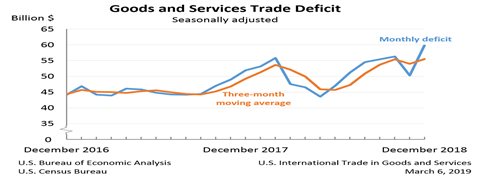
The U.S. Census Bureau and the U.S. Bureau of Economic Analysis announced today that the goods and services deficit was $59.8 billion in December, up $9.5 billion from $50.3 billion in November, revised.

This was not good news. The nation’s trade deficit shot to a 10-year high last year despite Trump White House attempts to reduce the gap, reflecting both the strength of the U.S. economy and other factors, including the Trump trade wars that have disrupted international trade flows.

The increase pushed total for the full year to $621 billion, the highest mark since the U.S. posted a $709 billion deficit in 2008 during the middle of the last recession.

For all of 2018, the goods and services deficit increased $68.8 billion, or 12.5 percent, from 2017. Exports increased $148.9 billion or 6.3 percent. Imports increased $217.7 billion or 7.5 percent.

Because the difference between imports and exports is negative, it subtracts from GDP growth, which economists have said is why full year GDP growth was slightly less than 3 percent (2.9 percent), as forecast.

The trade wars are a dumb way to attempt to correct the imbalance of manufactured products, as I said in my last post, because so many goods that Americans use are manufactured in cheaper climes, so the only way to protect American workers from cheaper foreign labor is to either invest heavily in new technologies or set up trade barriers.

The Trump team chose trade protections, which harks back to pre-Great Depression days; the era of mercantilism no longer viable in today’s closely knit world of commerce. Big Business over the past decade chose to buy back stock, rather than invest in new technologies that would enhance labor productivity.

Trade protections won’t work for several reasons. Chinese imports are at their highest level in years, and “…in a year in which Mr. Trump imposed tariffs on steel, aluminum, washing machines, solar panels and a variety of Chinese goods, the overall trade deficit grew 12.5 percent from 2017, or nearly $70 billion, to $621 billion, the Commerce Department said Wednesday,” reports the New York Times.

In fact, if the Trump administration and Republicans were really serious about rebalancing the budget and reducing the $1 trillion annual deficit predicted per the CBO by 2020, they wouldn’t have passed the 2017 corporate tax cut; or dropped out of trade alliances like the Trans-Pacific Partnership, which weakens their negotiating position.

The bottom line is no one seems to be interested in reducing either the trade or budget deficits, which is ok during good times, but will probably hasten the bad times.

We will have to watch for sharply rising interest rates, if we want to know when the next economic downturn happens. Interest rates are at record lows because foreign and domestic investors are still happy to invest their excess cash in US securities—including Treasury bonds at this time. It’s the safest haven for those that don’t have a more productive use for their accumulated wealth.

Harlan Green © 2019

Follow Harlan Green on Twitter: https://twitter.com/HarlanGreen
Posted in Economy, Keynesian economics, Macro Economics, Politics, Weekly Financial News | Tagged , , | Leave a comment

Can US Service Sector Boom Reduce Our Deficits?

Popular Economics Weekly

image

Econoday.com

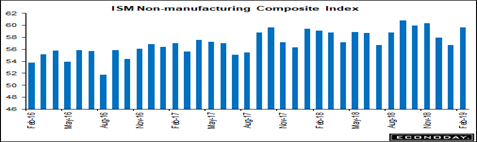
All 18 non-manufacturing industries reported growth in February, according to the ISM’s non-manufacturing index, which gives a monthly overview of service sector activity. This is huge and says the service sector that makes up two-thirds of US business activity will continue to power growth this year.

In fact, a growing US service sector is keeping the trade and budget deficits from worsening at a time when fiscal policy (the tax cuts) and trade policy (the tariffs) are slowing economic growth in 2019.

What is the service sector economy? It’s the financial services, trade, transportation, construction, education and health industries, for starters. It has become the dominant sector because most US consumers and businesses consume manufactured goods now made overseas. Hence the trade imbalance between imports and exports that Trump wants to ‘rebalance’ with his trade wars on allies and adversaries alike.

The trade wars are a dumb way to attempt to correct the imbalance of manufactured products, needless to say, because said ‘imbalance’ is offset by foreign investors eager to buy safe and secure US stocks and bonds. If the Trump administration and Republicans were really serious about rebalancing the trade imbalances, it would seek more trade alliances (such as the Trans-Pacific Partnership) and work to reduce the looming $1 trillion annual deficit, instead of passing the 2017 corporate tax cut.

The non-manufacturing sector’s growth rate rebounded after cooling off in January. Respondents said they are concerned about the uncertainty of tariffs, capacity constraints and employment resources; however, they remain mostly optimistic about overall business conditions and the economy.

“The NMI® registered 59.7 percent, which is 3 percentage points higher than the January reading of 56.7 percent,” said Anthony Nieves, Chair of the Institute for Supply Management Non-Manufacturing Business Survey Committee. “This represents continued growth in the non-manufacturing sector, at a faster rate. The Non-Manufacturing Business Activity Index increased to 64.7 percent, 5 percentage points higher than the January reading of 59.7 percent, reflecting growth for the 115th consecutive month, at a faster rate in February.”

Particularly robust was the New Orders Index that registered 65.2 percent, 7.5 percentage points higher than the reading of 57.7 percent in January. The Employment Index decreased 2.6 percentage points in February to 55.2 percent from the January reading of 57.8 percent.

What about the manufacturing sector that is made up of durable goods; like machinery, computers and transportation; and non-durable goods such as furniture, chemicals and petroleum products? The ISM’s February manufacturing survey reported a 2.4-point drop to 54.2 in February that was above low estimates. There was also a 2.7-point drop in new orders, a 3.2-point drop for employment, and a 5.7-point slide for production.

image

Council On Foreign Relations

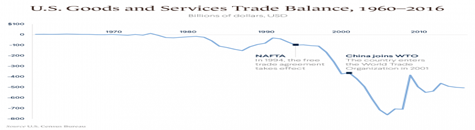
The trade wars have to be part of the problem, since Trump has focused on tariffs for manufactured products only, whereas China is also stealing information technology. Hence the Hauwei networking ban that the US fears might have implanted Chinese spyware.

“Demand remains healthy at the beginning of 2019,” said one respondent. “However, growing concerns for what could be another round of tariffs in March are further escalating price increases of already constrained electronic components.”

The total US trade imbalance was minus $550B last year, with service sector trade showing a net trade surplus of around $250B, since we export much of our information technologies, and approximately $800B net deficit in manufactured goods that are more cheaply made overseas.

“So we can’t “win” a trade war,’ says Nobel economist Paul Krugman. “What we can do is start a cycle of tit-for-tat, and when it comes to trade, America — which accounts for 9 percent of world exports and 14 percent of world imports — is by no means a dominant superpower. A cycle of retaliation would shrink overall world trade, making the world as a whole, America very much included, poorer.”

Therefore it’s not such a good idea to expend too much of our energy in attempting to correct the manufacturing imbalance, when there are better ways to cure deficits that are of our own making.

Harlan Green © 2019

Follow Harlan Green on Twitter: https://twitter.com/HarlanGreen
Posted in Consumers, Economy, Keynesian economics, Politics, Weekly Financial News | Tagged , , , , | Leave a comment

Q4 Real GDP Growth Still Good

Popular Economics Weekly

image

BEA.gov

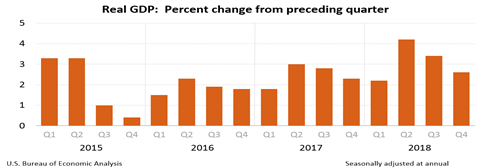
Real gross domestic product (GDP) increased at an annual rate of 2.6 percent in the fourth quarter of 2018 (table 1), according to the “initial” estimate released by the Bureau of Economic Analysis. In the third quarter, real GDP increased 3.4 percent. Due to the recent partial government shutdown, this initial report for the fourth quarter and annual GDP for 2018 replaces the release of the “advance” estimate originally scheduled for January 30th and the “second” estimate originally scheduled for February 28th. See the Technical Note for details.

The fourth-quarter GDP estimate surprised many analysts. Consumer spending rose 2.8 percent, despite the sharp drop in December retail sales, which is down from outsized rates of 3.5 and 3.8 percent in the prior two quarters but still good.

So why do jittery stock and bond investors keep waiting for the ‘other’ shoe to drop with growth so good? We know a major reason for the record low interest rates is the huge amount of excess liquidity not being invested in productive assets, but chasing inflated stock values, which makes buying long term sovereign debt in particular such a safe investment.

It’s called running for cover when the geopolitical situation worsening and a US administration that cannot live without drama, ballooning trade wars and massive federal debt now predicted to reach 100 percent of GDP per the Congressional Budget Office by 2023.

The flight to quality syndrome keeps investors buying up sovereign government debt in particular, thereby keeping interest rates in line with the very low inflation rate, which is a good time to invest in public education, infrastructure, and the general welfare.

In fact, the 10-year Treasury yield has not been this low since the 1950s, when money was plentiful and U.S. economic growth was phenomenal, reaching 6 and 7 percent GDP growth rates after WWII, as I said in my last blog.

This is the reverse of conditions that led to the housing bubble bust. Housing prices became inflated in the early 2000s because inflation was rising faster than interest rates that Fed Chair Alan Greenspan kept reducing to pay for GW’s wars on terror.

What more drama can happen this time? There was little damage to date from the record 35-day government shutdown and loss of business activity, though the BEA says it kept the annual growth rate at 2.9 percent rather than 3 percent. But we can’t see yet how much this will affect 2019 growth.

Let’s hope we find a better way to invest the excess liquidity, if we want to maintain full employment and rising wages in 2019. January’s 304,000 new payroll jobs is a good start. The US has to be investing much more in productive enterprises, as I’ve said.

Business investment rose 6.2 percent for nonresidential fixed investment in Q4, back near the high single-digit increases of the first half of last year when the corporate tax cut was driving spending. Residential investment, however, was weak, down 3.5 percent for the fourth straight quarterly decline that offers definitive evidence of how weak the housing sector has become.

image

However, former chief economic advisor Jason Furman isn’t so optimistic about 2019 growth. “I’m not seeing a sustained supply-side expansion in the wake of the (2017) tax cuts,” he says.

That means productive investments haven’t been increased enough, and probably won’t, unless there’s more agreement on Capitol Hill about what’s really needed to keep this virtuous business cycle, and the financial markets, from collapsing in 2019.

Harlan Green © 2019

Follow Harlan Green on Twitter: https://twitter.com/HarlanGreen
Posted in Consumers, Economy, Keynesian economics, Weekly Financial News | Tagged , , , | Leave a comment

Why the Record Low Interest Rates?

The Mortgage Corner

image

fred.stlouisfed.org

The 30-year fixed rate conforming mortgage rate fell to a 1-year low, according to Freddie Mac, the GSE still in government conservatorship, and major purchaser of conforming conventional mortgages. The 30-year fixed-rate averaged 4.35 percent in the February 21 week, mortgage giant Freddie Mac said last Thursday. That was down from 4.37 percent in the prior week and the lowest since early February 2018.

In fact, the 10-year Treasury yield on which mortgage rates depend has not been this low since the 1950s, when money was plentiful and U.S. economic growth was phenomenal, reaching 6 and 7 percent GDP growth rates after WWII.

What will this do for the housing market, which has shown signs of life after last year’s marked slowdown? It will depend on interest rates remaining at this record level over the longer term, which shouldn’t be happening at this late stage of the current recovery. I discussed its effect on the rise in construction and new-home sales last week.

“After two lackluster months, new home sales surged…in January to the fastest pace in our survey, dating back to 2013,” said Joel Kan, MBA Associate Vice President of Economic and Industry Forecasting. “Despite the jitters potential homebuyers felt in December from the volatility in the financial markets, the healthy job market and wage growth, moderating price gains and lower mortgage rates all helped home sales recover. Additionally, builders seem to be seeing improvement in their labor shortages, as recently released government survey data showed increases in construction hiring and openings in December.”

Not enough attention is being paid to why interest rates are at this level again at a time of full employment and last year’s growth spurt, which should put a strain on the available money supply, but hasn’t done so. It could be a sign of slowing growth.

There is almost no sign of incipient inflation, in other words, which has caused the Fed to back off on further rate increases. Or put another way, there is a disinflationary environment affecting many of the worlds’ developed economies today that have zero or negative sovereign debt yields. This has brought back memories of the Great Depression when so-called aggregate demand—the demand by consumers, government and foreigners for U.S. products—fell into negative territory, memories that caused recent Fed Chairman ‘helicopter’ Ben Bernanke to shower the U.S. economy with cash by buying up U.S. securities in various QE programs to mitigate the effects of the Great Recession.

This had the desired effect of keeping interest rates at post-WWII lows, aiding in the recovery from the Great Recession and housing bust. But why has it also kept inflation at multi-decade lows? Many conservative economists and deficit hawks predicted runaway inflation at the time.

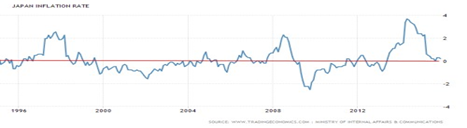
Japan experienced outright deflation during several lost decades under similar circumstances—of falling wages, as well as prices. This meant that Japanese consumers’ purchasing ability also shrank drastically, which caused economic growth to decline into several recessions in recent decades.

image

Tradingeconomics.com

Then, as now, the real culprit must be the lack of household income growth, which has remained static since the 1970s, after inflation. It should be a truism that if consumers’ incomes don’t rise faster than inflation, then there isn’t sufficient demand to boost inflation, which in small doses actually aids economic growth.

That brings up the other cause—a worldwide savings glut that isn’t being invested productively. What would be the best use for some of those savings? Repair and replace the $2.25 trillion in ageing U.S. infrastructure that hasn’t really been upgraded in 75 years, according to the American Society of Civil Engineers. It would boost incomes as well as the productivity of future generations.

What is its worst use? The Trump tax cuts, which haven’t increased either capital expenditures or wages, but went instead into the pockets of stockholders and corporate CEOs, where it does nothing except add to the savings glut, and overpriced stock values.

Nobelist Paul Krugman in a recent NYTimes Op-ed has perhaps best said why there has been no infrastructure spending over the past two years with Republicans controlling government. “The truth is that modern conservatives hate the idea of any kind of new public spending, even if it would make Americans better off — or perhaps it would be more accurate to say especially if it would make Americans better off, because a successful spending program might help legitimize a positive role for government in general. And while Trump may not fully share his party’s small-government ideology, all his limited energy is going into finding ways to punish people, not help them.”

So we see that the real reason for record low interest rates and inflation is the outright refusal of conservatives, in particular—both here and in the Eurozone—to make the investments that would bring more prosperity to those working households that need it the most.

Harlan Green © 2019

Follow Harlan Green on Twitter: https://twitter.com/HarlanGreen
Posted in Consumers, Economy, housing market, Keynesian economics, Politics, Weekly Financial News | Tagged , , , , | Leave a comment

Housing Market Still Alive and Well!

The Mortgage Corner

image

Calculated Risk

The Mortgage Bankers Association said last week its Builder Applications Survey data for January showed mortgage applications for new home purchases jumped by 43 percent from December, though was unchanged from a year ago.  This should silence the doomsayers who predict labor shortages and higher tariffs are sure to kill the housing market.

“After two lackluster months, new home sales surged…in January to the fastest pace in our survey, dating back to 2013,” said Joel Kan, MBA Associate Vice President of Economic and Industry Forecasting. “Despite the jitters potential homebuyers felt in December from the volatility in the financial markets, the healthy job market and wage growth, moderating price gains and lower mortgage rates all helped home sales recover. Additionally, builders seem to be seeing improvement in their labor shortages, as recently released government survey data showed increases in construction hiring and openings in December.”

Mortgage interest rates have indeed come down with a vengeance since December. The 30-year conventional fixed rate guaranteed by Fannie Mae and Freddie Mac is now 3.75 percent for a one-point origination fee, and the so-called high-balance conventional rate is 4.0 percent with one origination point for the most credit-worthy borrowers.

That’s why home builders’ confidence index jumped 4 points to 62 from 58 (percent of those surveyed), according to the latest National Association of Home Builders/Wells Fargo Housing Market Index (HMI), which is also good news.

So housing construction isn’t about to die, which is a sign economic growth isn’t gasping for air either in this full employment, low-interest rate environment. February marked the second consecutive month in which all the HMI indices posted gains. The index measuring current sales conditions rose three points to 67, the component gauging expectations in the next six months increased five points to 68 and the metric charting buyer traffic moved up four points to 48.

“Builder confidence levels moved up in tandem with growing consumer confidence and falling interest rates,” said NAHB Chief Economist Robert Dietz. “The five-point jump on the six-month sales expectation for the HMI is due to mortgage interest rates dropping from about 5 percent in November to 4.4 percent this week. However, affordability remains a critical issue. Rising costs stemming from excessive regulations, a dearth of buildable lots, a persistent labor shortage and tariffs on lumber and other key building materials continue to make it increasingly difficult to produce housing at affordable price points.”

There is more to the jump in builder confidence and new-home construction. The millennial generation is forming more new households this year, and at least 50 percent have historically wanted to buy a home. Researchers at the San Francisco Federal Reserve have been finding such an increase.

“The shares of young adults heading households now are similar to rates seen at the start of the housing boom,” said SF Fed researchers. “Moreover, while more young adults are living at home longer, data suggest they are continuing to transition to higher headship rates as they get older…Given current 12-month annual headship rates by age group, the Census Bureau projections imply household formations averaging on the order of 1.4 to 1.5 million per year through 2020. That is much better than an average of a little less than 900,000 annually over the past five years.”

MBA estimated new single-family home sales at a seasonally adjusted annual rate of 713,000 units in January, based on data from the BAS, an increase of 29.2 percent from the December pace of 552,000 units. On an unadjusted basis, MBA estimated 54,000 new home sales in January, an increase of 45.9 percent from 37,000 new home sales in December, a whopping increase.   

Conventional loans composed 68.7 percent of loan applications, FHA loans composed 18.6 percent, RHS/USDA loans composed 0.5 percent and VA loans composed 12.2 percent. The average loan size of new homes decreased from $334,944 in December to $334,532 in January.

The jump in finance applications and home building in January shouldn’t be surprising. The U.S. economy continues to perk along, seemingly ignoring any bad news, such as the just-released FOMC minutes of the December meeting that sees cloudier skies ahead for the U.S. and world economies this year.

Harlan Green © 2019

Follow Harlan Green on Twitter: https://twitter.com/HarlanGreen
Posted in Economy, Housing, housing market, Weekly Financial News | Tagged , , , , | Leave a comment