Laffernomics and Tomorrow’s GDP Estimate

Financial FAQs

The decline of so-called Laffernomics, an economic theory first proposed by conservative economist Arthur Laffer in 1974, posited in so many words that lower tax rates of the wealthiest, in particular, would increase overall tax revenues as well as economic growth. It has been Republicans’ economic doctrine since then.

Yet it hasn’t worked in numerous examples of what has also been called ‘trickle-down’ or Reaganomics since the 1980s, at least. And we will see further evidence of this in tomorrow’s initial estimate of first quarter GDP growth. First estimates were that it would be less than 1 percent.

image

FRED/Tradingeconomics.com

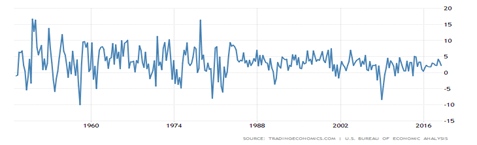
Considering full 2018, the economy advanced 2.9 percent, the most since 2015 and above 2.2 percent in 2017. In reality, growth has been trending down since the 1980s. However, GDP Growth Rate in the United States averaged 3.22 percent from 1947 until 2018, reaching an all-time high of 16.70 percent in the first quarter of 1950 and a record low of -10 percent in the first quarter of 1958,” which illustrates the uncertainty of predicting growth for any quarter, per the graph.

Tomorrow’s initial estimate of Q1 GDP growth will tell us just why Laffernomics in the guise of a one-time slashing of tax rates via the 2017 Republican Tax Cut and Jobs Act for the wealthiest and corporations doesn’t work for most Americans.

image 

BEA.gov

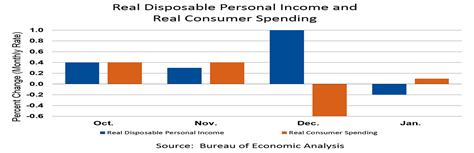
Consumer can’t spend what they don’t earn and the average household income (that means for most Americans) has barely risen since the 1980s, after inflation is factored in.

As economic blogger VOX put it last December, “The 2017 tax bill cut taxes for most Americans, including the middle class, but it heavily benefits the wealthy and corporations. It slashed the corporate tax rate from 35 percent to 21 percent, and its treatment of “pass-through” entities — companies organized as sole proprietorships, partnerships, LLCs, or S corporations — will translate to an estimated $17 billion in tax savings for millionaires this year. American corporations are showering their shareholders with stock buybacks, thanks in part to their tax savings.”

Some commentators are saying Q1 GDP growth might look better, due to higher consumer spending (retail sales just shot up), and One of Wall Street’s top forecasters, Macroeconomic Advisers, has lifted its GDP estimate to 2.8 percent from just a little over 1 percent a month ago. Other Wall Street firms have done the same, says MarketWatch.

But there are many caveats. “The increase in spending by consumers looks to have been the weakest in a year and business investment appears to have been flat,” contended Scott Anderson, chief economist at Bank of the West. “A festering U.S. trade dispute with China, a weak global economy and uncertainty stemming from the government shutdown all had a negative effect on investment. The U.S. economy isn’t out of the woods yet.”

There is one other leg to any economic recovery—government investment, yet what can the government spend when the Republican tax bill reduced almost $1.5 trillion of its revenues, and decided to pay for it with almost $1.5 trillion in cuts to Medicare and Medicaid benefits over the next 10 years?

The CBO estimates that implementing the Act would add an estimated $2.289 trillion to the national debt over ten years, or about $1.891 trillion after taking into account macroeconomic feedback effects, in addition to the $9.8 trillion increase forecast under the current policy baseline and existing $20 trillion national debt.

Harlan Green © 2019

Follow Harlan Green on Twitter: https://twitter.com/HarlanGreen

Posted in Consumers, Economy, Keynesian economics, Politics, Weekly Financial News | Tagged , , , | Leave a comment

Housing Supply Improving

The Mortgage Corner

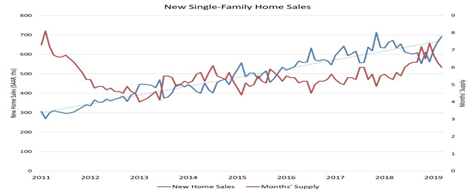
Our housing supply is finally improving. New-home sales ran at a seasonally adjusted annual rate of 692,000, the Commerce Department said Tuesday. That was 4.5 percent above February’s total and beat the consensus forecast of a 645,000 rate.

It has taken this long for the housing market to recover from the housing bubble, when one million more homes were built than were needed. It was part of the too easy credit conditions that brought in home buyers that wouldn’t have qualified under more normal circumstances.

image

NAHB.org

For some context on how severe the current spell of under-building has been, take a look at new-home sales in 2000 or 2001. During those two years, well before the housing bubble started to inflate, Americans purchased 877,000 and 900,000 newly-constructed homes. In 2018, Americans purchased just 622,000, said MarketWatch’s Andrea Riquier.

“Sales of newly-constructed homes finally gained momentum after months in the doldrums. March’s selling pace was the strongest since November 2017, the month before the recent tax law changes took effect,” continued Riquier.

Meanwhile, existing-home sales retreated in March, following February’s surge of sales, according to the National Association of Realtors®. Each of the four major U.S. regions saw a drop-off in sales, with the Midwest enduring the Existing-home sales retreated in March, following February’s surge of sales, according to the National Association of Realtors®. Each of the four major U.S. regions saw a drop-off in sales, with the Midwest enduring the largest decline last month.

Total existing-home sales1, https://www.nar.realtor/existing-home-sales, completed transactions that include single-family homes, townhomes, condominiums and co-ops, fell 4.9% from February to a seasonally adjusted annual rate of 5.21 million in March. Sales as a whole are down 5.4% from a year ago (5.51 million in March 2018), said the NAR.

Lawrence Yun, NAR’s chief economist, anticipated waning in the numbers for March. “It is not surprising to see a retreat after a powerful surge in sales in the prior month. Still, current sales activity is underperforming in relation to the strength in the jobs markets. The impact of lower mortgage rates has not yet been fully realized.”

Rob Dietz, chief economist for the National Association of Home Builders, acknowledges that comparing the current housing economy to the one from two decades ago has some downsides. For one, the population isn’t growing nearly as fast now as back then. Still, the gulf between then and now is stark – and 2018’s anemic pace of construction follows several years of similar underbuilding.

“We think that based on demographic demand, we should probably be building 1.1 million single family homes this year,” Dietz told MarketWatch. “Our forecast is for less than 880,000 starts.” The NAHB prefers to look at starts, or groundbreakings, rather than sales data, to gauge market activity.”

For the first quarter of 2019, new home sales are running 1.7 percent higher than the first quarter of 2018, said Dietz. However, while sales were up 9.6 percent for the quarter in the South (the largest region), sales were down 5.9 percent in the West, 8.1 percent in the Midwest and 17.6 percent in the Northeast.

The March data reveal the challenge of housing affordability however, per Dietz and the NAHB. March sales grew at lower price points. For example, 50 percent of March 2019 new home sales were priced under $300,000. In March of 2018, only 39 percent of sales were priced under $300,000.

Harlan Green © 2019

Follow Harlan Green on Twitter: https://twitter.com/HarlanGreen

Posted in Economy, Housing, housing market, Weekly Financial News | Tagged , , , , | Leave a comment

Retail Sales Rebound Sign of Higher Growth?

Popular Economics Weekly

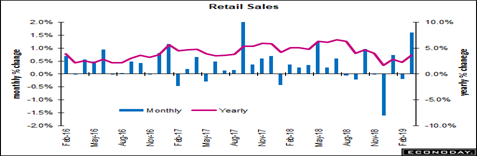
Sales at U.S. retailers surged in March by the most in a year and a half, the latest in a string of reports suggesting economic growth is picking up after a soft spell of growth earlier in the year. Retail sales soared 1.6 percent last month, the government said Thursday. This beat economists’ expectations.

image

Econoday.com

And the Conference Board reported its Index of Leading Economic Indicators rose 0.4 percent, which is another sign that economic growth is trending back to normal from the Q1 slowdown.

“The US LEI picked up in March with labor markets, consumers’ outlook, and financial conditions making the largest contributions,” said Ataman Ozyildirim, Director of Economic Research at The Conference Board. ”Despite the relatively large gain in March, the trend in the US LEI continues to moderate, suggesting that growth in the US economy is likely to decelerate toward its long term potential of about 2 percent by year end.”

A 2 percent growth rate is still enough to keep consumers happy and the unemployment rate low for the rest of this year.

New car sales and trucks rose 3.1 percent — the best performance this year, reports MarketWatch — to give the broader retail industry a boost. Auto receipts represent about one-fifth of all retail sales. Sales at auto dealers jumped 3.5 percent, as a result, the second big increase in a row.

But Americans also spent more to fill up their gas tanks. The average price of gas nationally rose almost 10 percent in March to $2.62 a gallon, government figures show. The last time prices were that high was in November.

Even if gas and autos are set aside, retail sales still rose a robust 0.9 percent. Among the big winners: Internet retailers, clothing stores, home-furnishing outlets and grocers. Sales rose between 1 and 2 percent in those segments.

Sales rose in every category except for stores that sell books, musical instruments and hobby items. Traditional brick-and-mortar department stores were also laggards: sales were flat.

But the 1.6 percent rise in March retail sales just recoups the -1.6 percent decline in December, while January and February showed miniscule growth, so we are back to 4 percent annual sales growth when 5 to 6 percent was the normal in 2017-18, in terms of overall sales—another sign of slowing growth this year.

The Conference Board’s leading indicators also showed strength in manufacturing and lower jobless claims, but the yield curve, or so-called interest rate spread between long and short term Treasury bonds, continues to narrow, pointing to a greater possibility of shrinking bank profits and credit availability later this year.

Yet both the Conference Board and U. of Michigan measures of consumer confidence also show consumers are happy at the moment, in part because the Fed says it won’t be raising their interest rates anytime soon and there are still more than 7 million job openings, according to the Labor Department’s latest JOLTS report.

All this means retail sales should continue to perk up on this Good Friday with the financial markets closed. We have to remember that as long as consumers are happy, the US economy will continue to grow, regardless of government missteps and geopolitical uncertainty.

Harlan Green © 2019

Follow Harlan Green on Twitter: https://twitter.com/HarlanGreen

Posted in Consumers, Economy, Weekly Financial News | Tagged , , , , | Leave a comment

First-Time Homebuyers Are Back

The Mortgage Corner

MarketWatch’s Andrea Riquier says first-time homebuyers aren’t doing so bad, if we look at more than the NARealtor’s existing-home sales data. First-timers’ sales data is important because they usually choose so-called “entry-level” homes that are affordable to moderate income households, which is important because moderately-priced housing for young adults is always in short supply.

Ms. Riquier reports the New York Fed might have a more accurate way to track first time homebuyers via their credit records, because the NYFed doesn’t rely on mortgage application data that is self-reported and hasn’t yet been confirmed during the formal application process.

image

MarketWatch.com

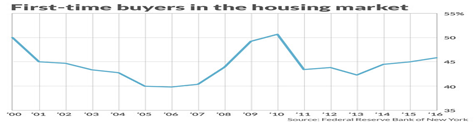
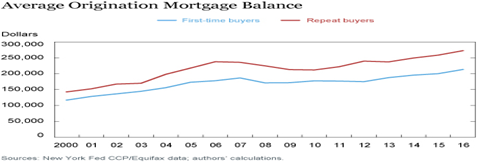
Their result shows that the first-time segment of buyers is back to 46 percent in 2016, from its low of 43 percent. The NAR has consistently reported first-timers’ percentage of sales at no more than 40 percent since the Great Recession.

The NYFed intones the importance of tracking borrowers on their website. “The large increases in consumer debt and defaults—of mortgage debt in particular—during the Great Recession highlighted the importance of understanding the liabilities reflected on household balance sheets.

“To that end, one of the CMD’s large data collection projects is the New York Fed Consumer Credit Panel, which is constructed from a nationally representative random sample of Equifax credit report data.”

image

LibertyStreet-NYFed

First-time homebuyers are younger and borrow less than repeat buyers, says the NYFed. And because they weren’t homeowners at the time, they didn’t suffer as much as repeat buyers in the ups and downs of the housing bubble. So the median age of first-time buyers actually declined from 35 in 2000 to 32 in 2016, while the median age of repeat buyers increased from 43 in 2000 to 46 in 2016, as housing prices recovered from the busted housing bubble. 

I reported in an earlier column that a major reason for the jump in first-time buyers was their increase in household formation. The millennial generation is forming more new households, and at least 50 percent have historically wanted to buy a home. Researchers at the San Francisco Federal Reserve have been finding such an increase. 

“The shares of young adults heading households now are similar to rates seen at the start of the housing boom,” said SF Fed researchers. “Moreover, while more young adults are living at home longer, data suggest they are continuing to transition to higher headship rates as they get older…Given current 12-month annual headship rates by age group, the Census Bureau projections imply household formations averaging on the order of 1.4 to 1.5 million per year through 2020. That is much better than an average of a little less than 900,000 annually over the past five years.”

First-timers’ ownership rate will no doubt continue to fluctuate, as many of them are still burdened by education debts, and a lower wage structure for those just entering the workforce. But home owning is the main wealth aggregator for middle class households and so will continue to incentivize young adults to buy rather than rent, but only if builders will construct more affordable housing, with loan programs and interest rates that make this possible.

Harlan Green © 2019

Follow Harlan Green on Twitter: https://twitter.com/HarlanGreen

Posted in Consumers, Housing, housing market, Weekly Financial News | Tagged , , , | Leave a comment

Part II—What’s Wrong With Capitalism?

Financial FAQs

Pete Buttigieg, Mayor of South Bend, Indiana and Presidential candidate, said to NBC’s Chuck Todd, “of course I’m a capitalist and America is a capitalist society, but it’s got to be democratic capitalism,” per the NYTimes’ Michael Tomasky.

But that hasn’t always been the case in America. Today we are approaching a very undemocratic form of capitalism—oligarchism, where a small percentage of Americans control most of the wealth and benefit from its laws—particularly since the end of the Great Recession.

Corporations and their stockholders have garnered 96 percent of the wealth generated since it ended in June 2009. Why? Because the busted housing bubble caused many in the middle class to either lose the equity in their homes, or their homes outright. The damage was so great that median household wealth has declined 30 percent since 2017, according to the Federal Reserve.

image

And taxes have been drastically cut that would fund public spending to restore some of that lost wealth—on badly deteriorated infrastructure, higher educational standards (US student test scores are now below that of other developed countries), research in new technologies, healthcare, and the environment.

These programs would help to restore some of the record income and wealth inequality that has resulted, and made America a world power in decline. A super majority of economists say public spending programs boost economic growth for the simple reason that it redistributes tax revenues where they will do the most good—to the 99 percent that have lost the most from the Great Recession.

Buttigieg has made some vague proposals to right the inequality that, after all, was the major cause of both the Great Depression and Great Recession. So why wouldn’t we want to bring back a democratic capitalism that works for all Americans?

But there is an even more important ingredient that nurtures democratic capitalism, besides public investments. It is healthy local community involvement in civic activities. Ball State, Indiana economist Michael J Hicks reports in an assessment of Mayor Pete’s accomplishments, a major component of his South Bend’s success has been local civic involvement in community organizations, such as their very active Rotary Club. “It was more like an interdisciplinary research colloquium, combined with an interfaith conference and millennial business forum,” said Hicks.

There are many studies that show positive results of what is a little known field of study—community development, also known as community organizing—that was first put into practice in the US by unions in the 1930s with New Deal legislation as a way to counteract effects of the Great Depression by boosting the formation of labor unions.

The National Industrial Recovery Act (1933) provided for collective bargaining. The 1935 National Labor Relations Act (also known as the Wagner Act) required businesses to bargain in good faith with any union supported by a majority of its employees. 

The United Nations defines community development broadly as “a process where community members come together to take collective action and generate solutions to common problems.”

One of its best-known practitioners was Saul Alinsky, based in Chicago, who is credited with originating the term community organizer during this time period. Alinsky wrote Reveille for Radicals, published in 1946, and Rules for Radicals, published in 1971. With these books, Alinsky was the first person in America to codify key strategies and aims of community organizing.

Wikipedia cites the International Association for Community Development (www.iacdglobal.org), the global network of community development practitioners and scholars, as “a practice-based profession and an academic discipline that promotes participative democracy, sustainable development, rights, economic opportunity, equality and social justice, through the organisation, education and empowerment of people within their communities, whether these be of locality, identity or interest, in urban and rural settings”.

Community development has today taken on a new popularity, as communities torn apart by globalization and loss of manufacturing jobs, particularly in the rust belt, seek to rebuild themselves.

Sociologists like Robert Putnam, author of Bowling Alone, the Collapse and Revival of American Community, have been vocal in calling for a revival of local civic participation in the rebuilding of American communities.

He says in Bowling Alone, “Financial capital – the wherewithal for mass marketing – has steadily replaced social capital – that is, grassroots citizen networks – as the coin of the realm.”

Then the problem becomes how to restore the social capital of civic engagement into its rightful place in the community? It has to begin with putting public capital back into the public sector as was done with the New Deal, in order to restore democratic capitalism, a capitalism that can work for all Americans.

Harlan Green © 2019

Follow Harlan Green on Twitter: https://twitter.com/HarlanGreen

Posted in Consumers, Economy, Keynesian economics, Macro Economics, Politics | Tagged , , , , , | 2 Comments

What’s Wrong With Capitalism (Revised)?

Financial FAQs

Winston Churchill once said, “No one pretends that democracy is perfect or all-wise. Indeed, it has been said that democracy is the worst form of government except all those other forms that have been tried from time to time.”

What about capitalism? Has it survived because it is the most imperfect economic system, except for all the others?

Hedge fund billionaire Ray Dalio has been sounding the alarm of late that the western, free market, American model of capitalism is no longer working for most Americans.

In a recent Linked In commentary he said, “I think that most capitalists don’t know how to divide the economic pie well and most socialists don’t know how to grow it well, yet we are now at a juncture in which either a) people of different ideological inclinations will work together to skillfully re-engineer the system so that the pie is both divided and grown well or b) we will have great conflict and some form of revolution that will hurt most everyone and will shrink the pie.”

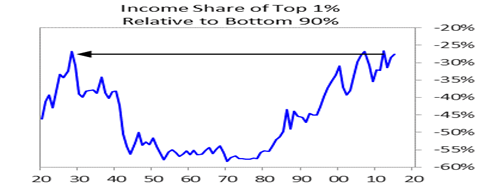
Dalio was talking about the 1930s collapse of markets and Great Depression—when Roosevelt’s New Deal came to the rescue, employed millions of the unemployed and helped US win WWII. It was the last time income inequality had increased to the level it is today as shown in this well-known graph, and the last time “people of different ideological inclinations” worked together.

image

In the words of Marriner Eccles, Roosevelt’s Federal Reserve Chairman during the Great Depression, “As mass production has to be accompanied by mass consumption, mass consumption, in turn, implies a distribution of wealth … to provide men with buying power. … Instead of achieving that kind of distribution, a giant suction pump had by 1929-30 drawn into a few hands an increasing portion of currently produced wealth. … The other fellows could stay in the game only by borrowing. When their credit ran out, the game stopped.”

We have the same situation today; partly as a result of the just-ended Great Recession, which was comparable to the Great Depression because of the $trillions in American households’ lost wealth yet to be recovered.

The Great Recession was a market failure caused by the housing bubble, but also by government policies that kept employees’ wages from rising with the increases in productivity—hence the return to record income inequality. For instance, collective bargaining labor laws were weakened in the 1980s. Today there are 26 so called ‘right-to-work’ states that restrict workers rights and union collective bargaining in some way.

This was accompanied by deregulation of whole industries in the name of globalization that loosened oversight and regulations controlling corporate behavior, unleashing the worst form of capitalism—cutthroat capitalism where the profit motive overrode all social obligations to take care of those less fortunate, which made it more difficult for ordinary Americans to climb the success ladder.

image

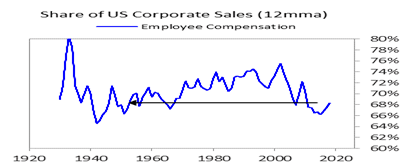
Dalio’s graph portrays who benefited from the 2001 and 2007 Great Recession. It wasn’t the employees, as employees’ share of US corporate sales plummeted from almost 76 percent of corporate revenues to 68 percent in 2017. Employees lost the most, in other words, and have yet to climb back above the 70 percent that prevailed from the 1970s to 2000.

And hence comes Ray Dalio’s dire threat: “The previously described income/wealth/opportunity gap and its manifestations pose existential threats to the US because these conditions weaken the US economically, threaten to bring about painful and counterproductive domestic conflict, and undermine the United States’ strength relative to that of its global competitors.”

So we need to find ways to escape repeating the history of the 1930’s and World War II that followed. Put another way, how do we rebalance the power structure that skewed incomes and wealth upward, and put the US at the bottom rankings of developed countries in services provided to its citizens—like educational opportunities, health outcomes, and chance for upward mobility?

Dalio’s answer is to identify leaders who believe greater equality of opportunity is the way to save capitalism, and who will in turn form public-private partnerships that include businesses, philanthropists (such as Dalio) and government to coordinate the planning of such partnerships via recommendations of a “bipartisan commission to bring together skilled people from different communities to come up with a plan to reengineer the system to simultaneously divide and increase the economic pie better.”

But who are those leaders? Philanthropists such as Bill Gates, Warren Buffett, and Dalio are already participating. And there are enlightened corporate leaders that don’t belong to ALEC, the right wing American Legislative Exchange Council lobby responsible for crafting the right-to-work laws that currently suppress both voter rights and worker salaries in many of the red states.

Princeton’s Nobelist Sir Angus Deacon says good luck in bringing together those different communities Dalio talks about in a Project Syndicate article: “I think that community is a casualty of an elite minority’s capture of both markets and the state…The genie of meritocracy cannot be put back in the bottle.”

And Nobel economist Paul Krugman once joked it may take another extremely dire event, maybe an alien invasion, before Americans will unite again in a common cause as they did with the New Deal and WWII.

Where will we find the political leaders? He doesn’t mention large ideas like the Green New Deal, which some of our younger leaders—and even Presidential candidates—are advancing. The bottom line is it will take very big ideas to tackle such  “existential threats”.  Let’s not forget global warming that the US Pentagon had said is already endangering our national security.

Harlan Green © 2019

Follow Harlan Green on Twitter: https://twitter.com/HarlanGreen

Posted in Uncategorized | Tagged , , , , , | Leave a comment

What’s Wrong With Capitalism?

Financial FAQs

Winston Churchill once said, “No one pretends that democracy is perfect or all-wise. Indeed, it has been said that democracy is the worst form of government except all those other forms that have been tried from time to time.”

What about capitalism? Has it survived because it is the most imperfect economic system, except for all the others?

Hedge fund billionaire Ray Dalio has been sounding the alarm of late that the western, free market, American model of capitalism is no longer working for most Americans.

In a recent Linked In commentary he said, “I think that most capitalists don’t know how to divide the economic pie well and most socialists don’t know how to grow it well, yet we are now at a juncture in which either a) people of different ideological inclinations will work together to skillfully re-engineer the system so that the pie is both divided and grown well or b) we will have great conflict and some form of revolution that will hurt most everyone and will shrink the pie.”

Dalio was talking about the 1930s collapse of markets and Great Depression—when Roosevelt’s New Deal came to the rescue, employed millions of the unemployed and helped US win WWII. It was the last time income inequality had increased to the level it is today as shown in this well-known graph, and the last time “people of different ideological inclinations” worked together.

image

In the words of Marriner Eccles, Roosevelt’s Federal Reserve Chairman during the Great Depression, “As mass production has to be accompanied by mass consumption, mass consumption, in turn, implies a distribution of wealth … to provide men with buying power. … Instead of achieving that kind of distribution, a giant suction pump had by 1929-30 drawn into a few hands an increasing portion of currently produced wealth. … The other fellows could stay in the game only by borrowing. When their credit ran out, the game stopped.”

We have the same situation today; partly as a result of the just-ended Great Recession, which was comparable to the Great Depression because of the $trillions in American households’ lost wealth yet to be recovered.

The Great Recession was a market failure caused by the housing bubble, but also by government policies that kept employees’ wages from rising with the increases in productivity—hence the return to record income inequality. For instance, collective bargaining labor laws were weakened in the 1980s. Today there are 26 so called ‘right-to-work’ states that restrict workers rights and union collective bargaining in some way.

This was accompanied by deregulation of whole industries in the name of globalization that loosened oversight and regulations controlling corporate behavior, unleashing the worst form of capitalism—cutthroat capitalism where the profit motive overrode all social obligations to take care of those less fortunate, which made it more difficult for ordinary Americans to climb the success ladder.

image

Dalio’s graph portrays who benefited from the 2001 and 2007 Great Recession. It wasn’t the employees, as employees’ share of US corporate sales plummeted from almost 76 percent of corporate revenues to 68 percent in 2017. Employees lost the most, in other words, and have yet to climb back above the 70 percent that prevailed from the 1970s to 2000.

And hence comes Ray Dalio’s dire threat: “The previously described income/wealth/opportunity gap and its manifestations pose existential threats to the US because these conditions weaken the US economically, threaten to bring about painful and counterproductive domestic conflict, and undermine the United States’ strength relative to that of its global competitors.”

So we need to find ways to escape repeating the history of the 1930’s and World War II that followed. Put another way, how do we rebalance the power structure that skewed incomes and wealth upward, and put the US at the bottom rankings of developed countries in services provided to its citizens—like educational opportunities, health outcomes, and chance for upward mobility?

Dalio’s answer is to identify leaders who believe greater equality of opportunity is the way to save capitalism, and who will in turn form public-private partnerships that include businesses, philanthropists (such as Dalio) and government to coordinate the planning of such partnerships via recommendations of a “bipartisan commission to bring together skilled people from different communities to come up with a plan to reengineer the system to simultaneously divide and increase the economic pie better.”

But who are those leaders? Philanthropists such as Bill Gates, Warren Buffett, and Dalio are already participating. And there are enlightened corporate leaders that don’t belong to ALEC, the right wing American Legislative Exchange Council lobby responsible for crafting the right-to-work laws that currently suppress both voter rights and worker salaries in many of the red states.

Princeton’s Nobelist Angus Deacon, author of Bowling Alone, the Collapse and Revival of American Community, doubts that American communities fragmented in the 1970s as a result of another ‘revolution’, the ICT revolution (in information and communications technologies), can be easily reconstituted. He says good luck in bringing together those ‘different communities’ Dalio talks about: “I think that community is a casualty of an elite minority’s capture of both markets and the state…The genie of meritocracy cannot be put back in the bottle.”

And Nobel economist Paul Krugman once joked it may take another extremely dire event, maybe an alien invasion, before Americans will unite again in a common cause as they did with the New Deal and WWII.

Where will we find the political leaders? He doesn’t mention large ideas like the Green New Deal, which some of our younger leaders—and even Presidential candidates—are advancing. The bottom line is it will take very big ideas to tackle such  “existential threats”.  Let’s not forget global warming that the US Pentagon had said is already endangering our national security.

Harlan Green © 2019

Follow Harlan Green on Twitter: https://twitter.com/HarlanGreen

Posted in Consumers, Economy, Keynesian economics, Macro Economics, Politics | Tagged , , , , , | Leave a comment

March Job Creation Exceeds Population Growth

Popular Economics Weekly

Stanford economist and Former Chief Economic Advisor Ed Lezear said this morning on CNBC that job creation still exceeds population growth, which is a sign the US economy continues to expand, but at a slower rate.

“Total nonfarm payroll employment increased by 196,000 in March, and the unemployment rate was unchanged at 3.8 percent, the U.S. Bureau of Labor Statistics reported today. Notable job gains occurred in health care and in professional and technical services.”

February was revised slightly up to 33,000 instead of the 20,000 initial nonfarm payroll total, also an encouraging gain that hints growth in the economy might be picking up again. Hiring increased in most major segments of the economy, most notably health care and white-collar firms. The flush of new jobs kept the unemployment rate near a 50-year low, the Labor Department said.

image

MarketWatch.com

Health-care and Educational Service providers led the way again, adding 70,000 jobs. Health-care has boosted hiring by almost 400,000 in the past year. Professional and technical firms hired 34,000 workers, restaurants increased staff by 27,000 and construction companies took on 16,000 new workers. A month earlier, builders cut employment by the most in a year and a half during a spell of severe cold and heavy snowfall.

But manufacturers trimmed 6,000 jobs after barely any gain in February. And retailers eliminated 12,000 jobs. The manufacturing losses seem to be coming from uncertainty over the prolonged trade negotiations with multiple countries. Manufacturers are complaining about the rising price of imported parts from the tariffs that make their finished products more expensive.

image

us.econoday.com

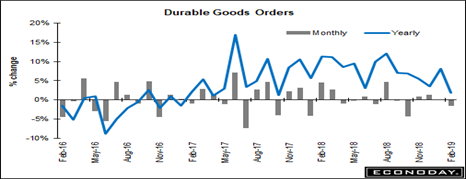
Another sign of a manufacturing activity slowdown was the decline in February Durable Goods Orders reported earlier this week. There was a cooling for aircraft orders, so that durable goods orders fell -1.6 percent with the ex-transportation reading very low at just a 0.1 percent gain.

Orders for core capital goods also fell -0.1 percent (ex-aircraft and autos), which are factory-produced tools, buildings, vehicles, machinery and equipment that increase future growth and productivity. The fact that orders have dropped below 5 percent annually when maintaining more than 6 percent annual growth the past 2 years is a definite sign of slowing activity.

But the 3-month 180,000 payroll hiring average is more than needed to employ the lower number of working-age adults entering the workforce. The workforce participation rate of 60.6 percent is also healthy, and governments have helped by adding 19,000 jobs since January.

MarketWatch reports another plus for economic growth. “Motor vehicle sales reached a seasonally adjusted annual rate of 17.45 million in March, up from 16.57 million in February, according to data from Autodata. That’s the highest reading in three months and represents a recovery from a downbeat start to the year. The MarketWatch-compiled consensus expectation was for a 16.8 million rate.”

What’s not to like about the unemployment report? Employers are paying more, and even willing to retrain workers to fill the skilled-worker void. The housing market has also picked up with record-low interest rates holding. The Mortgage Bankers Association reports refinance applications jumped 39 percent last week.

Harlan Green © 2019

Follow Harlan Green on Twitter: https://twitter.com/HarlanGreen

Posted in Consumers, Economy, Housing, Weekly Financial News | Tagged , , , , | Leave a comment

ANSWERING the KENNEDYS CALL: Birth of a “Livable” City

image

It is extremely difficult to form a new city in California, or any other US State for that matter. The studies required to justify taking jurisdiction away from a county government really means taking it away from what is in essence state control, since county governments were originally set up under state jurisdictions, and controlled by state laws and regulations.

This is evidenced by the financial strings state and county governments hold over cities; mainly in terms of its planning and zoning regulations, but also the share of tax revenues to various local services, such water and sanitary districts.

The birth of a new city in the Goleta valley was a vision that took years to realize, and huge amount of patience and persistence to bring together a unique admixture of its citizens—from Mexican immigrants to hi tech engineers, to university-educated environmentalists, and Defense Department employees; from supporters that wanted more municipal improvements such as flood and highway improvements, to those that wanted it to remain a sleepy bedroom community serving the adjacent City of Santa Barbara.

Forming a brand new city was the most challenging example of community building I experienced in my life because it meant bringing together enough of its residents in a common vision of their community. Seasonal farmworkers that harvested large lemon and avocado groves lived side-by-side with University of California Santa Barbara students and their professors in the unincorporated valley.

Because of this diversity there were an almost equal number for and against the formation of a new city. But it finally happened on the fourth try—February 1, 2002. The high crime rate in Goleta’s Old Town—the historical center of the Goleta Valley since it was settled more than 100 years earlier—was documented in the Redevelopment District Agency study commissioned by Santa Barbara County. There were more bars than restaurants and it was home to several gangs. There were also serious environmental concerns, as high traffic totals were causing air pollution, and successive floods during the 1990s following an earlier drought required greater flood controls.

Just the fact that it became a city enabled Goleta to contract with the County Sheriff to provide a neighborhood police service accountable solely to Goleta residents. This resulted in Goleta being listed as one of the 50 safest American cities in 2017, eleven years after its formation, according to a survey by Safewise, a security firm.

The re-design of Old Town Goleta also seemed an ideal location to practice some of those precepts of True Urbanism, or New Urban Design, all labels attached to what is now a worldwide movement that sought to make cities more citizen friendly.

How hard could that be, though we didn’t realize the state’s Environmental Quality Report (CEQA) would require flood improvements before anything else was done. We didn’t realize in a word what an effort it would take, and continuing struggle it still is, to bring together so much diversity of opinion and conviction into a well-functioning and sustainable community that epitomized what pro-city residents wanted in a new city.

The first step was to organize a design conference to provide design and planning alternatives for the future—something county planners supported after three failed Goleta cityhood elections. It was obvious that without a community effort to create a town center with a unique identity that contrasted with neighboring Big Sister city Santa Barbara, Goleta’s cityhood might never succeed.

The American Institute of Architects was co-sponsoring eight simultaneous design charrettes across the country and in Hawaii at the time, in an attempt to create design outcomes using these new urban planning techniques. All were retreats that brought design professionals such as architects, designers, and urban planners together to envision and help to re-design a project area—such as a district or town center.

The Goleta Old Town design charrette, a French term for a gathering of designers and interested parties to create an innovative atmosphere in which a diverse group of stakeholders can collaborate to “generate visions for the future” to use Wikipedia’s description, was also hooked via Internet to the seven other design charrettes so we could share ideas and outcomes. All were weekend-long marathon sessions that began early and went late into each evening of those two days, creating a feverish intensity that only an assembly of very creative individuals can foment.

The idea of a design charrette was exciting in itself. It is a well-known architectural concept first adopted by students of Paris’s Ecole des Beaux Arts, Frances’s major design school, in the 1800s. They were used to cramming for exams at the last minute while riding in a charrette, or horse cart to the exams. So this was an exciting chance for local students, environmentalists, and some developers that wanted to participate in what Goleta might become for future generations.

These retreats were co-sponsored by the American Institute of Architects, or AIA, and included Honolulu and Charlottesville, Virginia, home of the Jefferson designed University of Virginia and Jefferson’s nearby Monticello home, of course. I remember Charlottesville was surrounded by a rusting industrial belt needing resuscitation that could benefit from mixed-use design concepts of the new urban planning, just as Old Town was surrounded by auto-dependent suburban malls and shopping centers with few pedestrian conveniences.

We were able to assemble 100 design professionals and civic activists such as myself. It was a vehicle to begin the process of envisioning, or re-visioning a future for Old Town and the Goleta valley community.

We basically locked ourselves into a large industrial building and broke into eight committees, each tasked to come up with a different design concept for that weekend. The eight results covered the gamut of ideas for Old Town, an area of no more than 20 city blocks and population of ­­­­5,000. The designs ranged from a totally pedestrian environment only accessible to public transportation with room for pedestrian-oriented businesses and entertainment to draw them out of their autos, to one that permitted automobile access, (which local small businesses badly wanted to sustain their small businesses), but with more off street parking and lots of green landscaping.

Margaret Connell, a recent Goleta city council member who supported the Old Town revitalization plan and wanted Old Town to be part of a new city center, voiced some of her concerns because much of the work has remained undone since cityhood: “…So Goleta Old Town feels more embedded than the more recent housing and worksites, and it also suffers from some disadvantages of being “old.” It lacks sidewalks through much of the older residential areas, though the city is taking steps to remedy this. There are many children who live here, but there are very few parks — a pocket park on Nectarine, a larger one on Armitos Avenue, and a four-acre, active-recreation park on Kellogg Street, which is still being developed,” said former council woman Connell.

The major environmental concerns were a lack of alternative transportation (such as busses and bike lanes) to manage traffic flow during peak rush hour that could still service Old Town residents and businesses. Flooding was also a major concern, in spite of periodic droughts, since Santa Barbara and the south coast had suffered several devastating floods during the 1990’s that ended a prior eight-year drought.

The flood that broke the 1993 drought was called the March miracle because 11 inches of rain fell that month, even closing the Santa Barbara Municipal Airport for several days that had been formed from a saltwater estuary.

Old Town’s main street was flooded as well one night with at least a foot of water from a torrential rainfall that overflowed the two creeks bracketing Old Town’s boundaries. That is why flood control improvements, such as an enlarged and channelized creek bed, were required in the CEQA (California Environmental Quality Act) report as the first step in any redevelopment effort.

The droughts and consequential flooding also made everyone aware of the limited water supplies in California, even though some areas that year had experienced the greatest rainfall totals since the 1880s.

This is why the work of the new city of Goleta has just begun. The community plan balances environmental with livable concerns, but there was a casualty of the 2007-2009 Great Recession that caused an unexpected disruption of Goleta’s future infrastructure upgrades; especially in Old Town, which is adjacent to Santa Barbara’s municipal airport with its own accessibility problems.

California, to solve its budget problems from the Great Recession, dissolved all 404 Redevelopment District Agencies in 2011, which removed the tax financing that Old Town was counting on to fix some of those transportation problems and relieve the traffic congestion. That has put many of the planned improvements on hold until alternative financing is found.

So has Goleta become a more livable city? Its residents think so, though affordable housing will always be a problem. Local Historian Walker Thompkins’ description of the Goleta valley as a pastoral paradise is immortalized in his book, Goleta, the Good Land that is still available on Amazon’s website.

The livable cities movement, which is what it has become as cities now compete to attract the best and the brightest people and best jobs, has evolved into a ranking contest. The annual rankings of the most livable cities are published by several well-known lifestyle publications and organizations, including the AARP Livability Index, Monocle‘s “Most Liveable Cities Index”, the Economist Intelligence Unit‘s “Global Liveability Ranking”, and “Mercer Quality of Living Survey”. 

Unfortunately, not a single US city on the Economist’s list makes the top 10 in a study of the world’s 140 major cities. Melbourne, Australia topped it in 2016, with Perth and Adelaide Australia also in the top ten. Honolulu, Hawaii is the only American city mentioned at all. It makes the top ten list of most improved cities over the past 5 years.

Is their bias showing? A ranking released by the Economist Intelligence Unit, attempts to quantify the world’s most “livable” cities—that is, which locations around the world provide the best or the worst living conditions. The index, measured out of 100, considers 30 factors related to safety, health care, educational resources, infrastructure and the environment to calculate scores for 140 cities.

“Those that score best tend to be mid-sized cities in wealthier countries,” said the Economist survey. “Melbourne tops the list for the sixth year in a row, and six of the top ten cities are in Australia or Canada. But Sydney, Australia’s largest city, drops out of the top ten due to fears over terrorism.”

So the safety of its residents and the threat of violence and terrorism seems to have knocked American cities off the list, and put Australia at the top of most livable cities rankings. How do we solve the increasing dangers from violent extremism and domestic violence that make so many American and European cities unsafe?

Goleta Old Town’s revitalization is still a work in progress, in other words. Goleta became a city in 2002, but is still wrestling with the idea of putting a new City Hall in Old Town rather than continue to rent space in an industrial complex farther to the west in the midst of malls and office complexes. It remains to be seen just what the new city of Goleta will look like 15 years after its formation, and whether it is able to embody the livable planning principles we envisioned in the design charrette.

And what are other institutions that might bring us more peace and freedom in the world with its droughts, mass migrations, inequality and civil unrest in so many countries? How can we nurture more viable communities and neighborhoods? There are modern social movements and community development tools that can bring this about. We will describe some of them in the next chapters.

Harlan Green © 2019

Follow Harlan Green on Twitter: https://twitter.com/HarlanGreen

Posted in Politics, Uncategorized | Tagged , , , , | Leave a comment

Ignore the Bad News-Goldilocks Is Back!

Financial FAQs

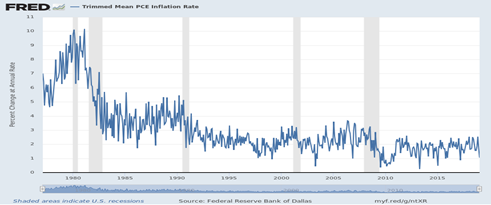
Why has the Fed stopped raising their interest rates? Because this is the lowest inflation rate for ‘core’ consumption expenditures in three decades, as this FRED graph from 1980 onward portrays.

image

fred stlouisfed.org.

“We are almost 10 years deep into this expansion and inflation is still not clearly meeting our target,” said Fed Chairman Jerome Powell in the press conference ending last Wednesday’s FOMC meeting. “That’s one of the reasons we are being patient.”

“Despite the lowest unemployment rate since the late 1960s and the fastest increase in wages in a decade,” he continued, “the rate of inflation actually fell slightly in the second half of 2018. Conventional wisdom says that’s not supposed to happen when the labor market is what economists describe as “tight.”

Right, that’s not supposed to habit but regardless, it has put consumers back into the sweet spot of a Goldilocks, not-too-hot, not-to-cold economy with unemployment at a 50-year low and incomes rising at the fastest rate in 10 years, according to MarketWatch. This is not supposed to happen, per conventional wisdom.

Rather than attempting to fathom what “conventional wisdom” means, it’s more productive to understand why the Goldilocks scenario is happening again. Consumers want to spend more with their rising incomes, but the incomes of a majority of consumers aren’t rising fast enough to keep up with production of those goods, which now largely come from other countries that can produce them more cheaply.

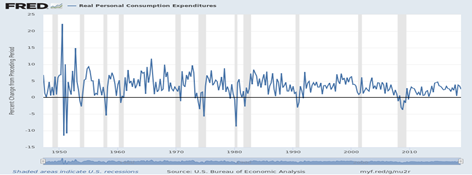
Hence Personal Consumption Expenditures (PCE) continue to fall, in line with more slowly rising personal incomes (for the 99 percent) and inflation. This FRED graph shows that PCE consistently grew at more than 5 percent until 2000, when it began to plunge to as low as -3.7 percent during the Great Recession, and finishing up +2.5 percent in Q4 2018.

image

FRED

This tells us several things. Firstly, most American workers have not yet recovered from the Greatest Recession since the Great Depression, which took WWII to get US out of that funk. So this hasn’t been enough consumption to boost inflation or interest rates, which is why we continue in the 2 percent GDP growth path, and retail sales were punk during the holidays and slow to recover.

image

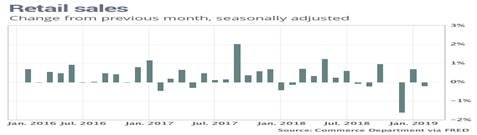
And, there was a 35-day government shutdown in December, which further depressed incomes and sales. Retail sales picked up slightly in January, but February isn’t looking so good with sales negative for the second time in 3 months, per the FRED graph.

And lastly, the final revision of Q4 GDP growth dropped to 2.2 percent from its 2.6 percent initial estimate, which has to be another casualty of the stupidest government shutdown ever.

So though inept government policies and the record income equality keep the economy from growing faster, it enables consumers to stay in the game; and keeps the US economy from overheating, which is a good thing, right?

Harlan Green © 2019

Follow Harlan Green on Twitter: https://twitter.com/HarlanGreen
Posted in Consumers, Economy, Keynesian economics, Politics, Weekly Financial News | Tagged , , , | Leave a comment