What If No Brexit Deal?

Popular Economics Weekly

image

Equalitytrust.org

We know why the UK voted to exit the EU—UK working class anger at not gaining many of the benefits from joining the EU, while experiencing its downside with the influx of eastern EU citizens that displaced domestic workers. But leaving the EU without a negotiated treaty will make it even worse for all Brits, rich and poor. It could spell another recession like the Great Recession, or even worse.

Both the Great Depression and Great Recession were caused by excessive speculation in the financial markets that created massive asset bubbles—whether in overpriced stock values or housing—which then burst. And middle and lower income- earners suffered the most.

But there was another reason. Record income inequality underlay both Great Downturns when these earners continued to borrow beyond their means to spend.

There are no asset bubbles at present, but a high level of debt exists because of the various QE programs that kept interest rates low to enable consumers to keep borrowing. So European and U.S. stock markets aren’t anywhere near Great Depression or Great Recession P/E ratio levels. And there’s no housing bubble caused by excessive overbuilding (Too few dwellings being built—so much so that California’s new governor, for instance, has pledged to add 3.5 million residences to California’s housing stock during his term).

However, the EU’s Great Recession was made worse by misplaced austerity policies that cut welfare spending and taxes when it should have increased public subsides as Ben Bernanke’s Federal Reserve did in 2009 that mitigated some of its effects, and enabled a quicker U.S. recovery.

Can you imagine what could happen if the UK doesn’t beat an orderly retreat from the EU? The UK chancellor, Philip Hammond, has warned of a “bad-tempered scenario” in which neither side acts in their own best economic interests, said the Guardian recently:

“Many Europeans regard the dispute over money not as an early round of bargaining but as a matter of good faith. If the Brits cannot be trusted to settle their past promises, why bother striking future deals? Walking out could therefore be treated as a legal default, with litigation in the international courts and even asset confiscation. Never mind free trade talks, such an atmosphere could make it impossible to agree a replacement for all manner of existing arrangements governing travel, immigration and customs.”

This is while the UK and EU economies are already slowing, and President Trump’s looming trade wars with allies and enemies alike will cut back growth even further.

So it’s vital that the UK and EU find an amicable divorce. What would that look like? The Guardian reports that Brexiters believe the UK can use WTO rules to trade perfectly successfully with Europe, as does Britain when trading with non-EU members. Though WTO tariffs are high for food and cars, most manufactured goods would see little change in export duties. “Over time, the hope is that Britain could return to the negotiating table to agree on rules that would facilitate EU trade in services and find other ways to compensate for lost agricultural markets by looking to faster-growing markets abroad,” says the Guardian

But there is so much more to cross-border agreements, such as custom unions, citizenship barriers, and the like. The real lesson is that U.S. and European economies are too fragile to allow anything but an amicable Brexit divorce; or better yet, no divorce at all.

image

Tradingeconomics.com

How do we judge the fragility of any economy? By its underlying growth factors. The EU and UK are both suffering serious slowdowns, with just 0.2 percent GDP growth rates in the latest quarters. The Euro area’s overall unemployment rate has declined to just 8 percent since the end of the Great Recession, with Italy’s unemployment stuck at 10 percent and Spain’s at 14 percent.

The question then is how much support would the US give to the UK, if the UK economy collapses, and the EU is unable or unwilling to come to their aid?

Harlan Green © 2019

Follow Harlan Green on Twitter: https://twitter.com/HarlanGreen
Posted in Consumers, Economy, Housing, Keynesian economics, Politics, Weekly Financial News | Tagged , , , , , | Leave a comment

Modern Infrastructure A Must for Climate Change

Answering the Kennedys Call

image

World Economic Forum

There is something we can do as a country to mitigate the catastrophic changes that global warming is already wreaking on whole populations. Accelerate development of a modern for-the-22nd Century infrastructure. It will create badly needed jobs, energy efficiencies that mitigate greenhouse gases, and better manage the international conflicts already arising from massive droughts and rising oceans.

That infrastructure must include new digital pathways, such as 5G networks, modern energy grids, modern transportation systems, and better planning for uncertain outcomes to changing climates. This is turn will assist resolutions to conflicts that are sure to pop up when populations are pressured to move, as they have in just the last decade.

There is actually no alternative. We are already seeing the rise of populist, anti-democratic governments in Europe, Africa, and the United States. Scared native populations are building walls and fences to protect themselves from the influx of darker-skinned strangers ousted by unlivable climates from the poorest regions.

The World Economic Forum has said, “A global focus on sustainable infrastructure can boost growth, reduce poverty, improve air quality and create jobs, while building low-carbon, climate-resilient economies. This transition could entail economic gains worth $26 trillion over the next 12 years compared to business-as-usual, according to a report by the New Climate Economy.”

The New Climate Economy was commissioned in 2013 by the governments of seven countries: Colombia, Ethiopia, Indonesia, Norway, South Korea, Sweden and the United Kingdom. “The Commission has operated as an independent body and has been given full freedom to reach its own conclusions. Lead by its global commission, it has disseminated its messages by engaging with heads of governments, finance ministers, business leaders and other key economic decision-makers in over 30 countries around the world,” said its website.

And what has been proposed by other countries is just now reaching our shores. The Green New Deal resolution by Massachusetts Sen. Ed Markey (D-MA) and Rep. Alexandria Ocasio-Cortez (D-NY) is already being denounced by so-called ‘moderate’ politicians and pundits as too draconian. Columnist David Brooks has characterized it as a massive government takeover of the private sector; socialism in its most extreme form that has been a failure in competition with modern capitalist-based economies.

Yet, why must it be an either/or proposition? The various reports on climate change mitigation maintain it will take centralized planning to create a necessary private/public partnership—yes, central planning in some form—to coordinate the incredible complexities that must be navigated in modeling multi-factor planning that takes into account many different outcomes. It’s playing three-dimensional chess with the survival of our planet at stake.

Then what kind of Central Planning? It has to resemble Roosevelt’s New Deal that brought us out of the Great Depression and enabled the U.S. to turn the tide in WWII. Global warming as a result of climate change is just such an emergency. And the longer governments wait to mitigate its affects, the more expensive it becomes—both in financial and geopolitical terms. The U.S. Pentagon has said it now poses a danger to our national security.

The critics of better coordination between the private and public sectors obviously miss the point. It is what is lacking from any suggested solutions to the climate crisis, because it entails massive improvement in the social structures as well, as is envisioned in the Green New Deal—such as some form of more universal health care, better labor laws, and a much improved social safety net that would mitigate much of the red-vs-blue states’ conflicts that have stymied bringing infrastructure improvements into this century, much less planning for the next.

“Even with these caveats in mind, a global climate action scenario prepared for this (New Climate) Report using the E3ME model that combines a range of opportunities including the wide scale use of appropriate carbon prices and phasing-out fossil fuel subsidies, seizing energy and industrial energy and resource efficiency gains, halting deforestation and restoring degraded lands, accelerating the penetration of electric vehicles, and integrating intermittent renewables into the power system—was found to deliver significant benefits. Transitioning to this low-carbon, sustainable growth path could deliver a direct economic gain of US$26 trillion through to 2030 compared to business-as-usual, according to analysis for this Report,” says the Guardian.

There is no reason that such complexities might overwhelm the planning process, in other words. Even AI will contribute in some form. If IBM’s Big Blue and newer iterations can win chess matches and defeat a top S. Korean champion in the ancient game of go, then we know Artificial Intelligence will be needed to help overcome those complexities.

Shouldn’t saving our planet take precedence over going to Mars, a barren planet and prime example of what could happen on earth? North America and all countries will suffer greatly from the looming climate crises, if we aren’t able to perfect our union in some way.

Harlan Green © 2019

Follow Harlan Green on Twitter: https://twitter.com/HarlanGreen
Posted in Economy, Keynesian economics, Politics | Tagged , , , | Leave a comment

More Job Creation Coming

Popular Economics Weekly

image

Wrightson-ICAP

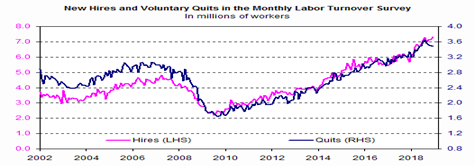
The number of job openings reached a series high of 7.3 million on the last business day of December, the U.S. Bureau of Labor Statistics reported yesterday. Over the month, hires and separations were little changed at 5.9 million and 5.5 million, respectively.

This means more job creation this year, even with January’s 304,000 new payroll jobs in the BLS unemployment report.  The gap between openings and hires is now 1.428 million, a new record and up from 1.304 million in November. It’s a very good number for growth prospects in 2019, as employers don’t look for this many new employees, unless they see a sunny future.

And the gap is likewise high between openings and those who were actively looking for work, at 1.041 million and next only in the record book to November’s 1.098 million.

Year-on-year comparisons further underscore the yawing gap with openings up 29.4 percent vs only a 7.1 percent gain for hires. Given how difficult it is for employees to fill openings, the number of layoffs & discharges in the month fell 3.2 percent to 1.697 million.

And the number of employees who quit rose 1.0 percent to 3.482 million in what hints at worker mobility and the pull from higher paying rivals. This is the reason workers’ pay is also rising faster—with real, after tax wages up 2 percent.

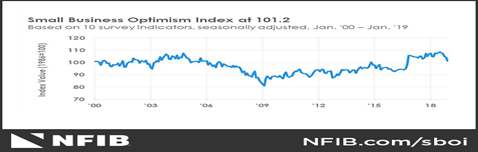
There was a slide in business optimism that is temporary, in my opinion, since the NFIB Small Business Optimism Index slipped 3.2 points in January, as owners continued hiring and investing, but expressed rising concern about future economic growth. The 101.2 reading, the lowest since the weeks leading up to the 2016 elections, however remains well above the historical average of 98, but indicates uncertainty among small business owners due to the 35-day government shutdown and financial market instability. The NFIB Uncertainty Index rose seven points to 86, the fifth highest reading in the survey’s 45-year history.

image

NFIB.com

“Business operations are still very strong, but small business owners’ expectations about the future are shaky,” said NFIB President and CEO Juanita D. Duggan. “One thing small businesses make clear to us is their dislike for uncertainty, and while they are continuing to create jobs and increase compensation at a frenetic pace, the political climate is affecting how they view the future.”

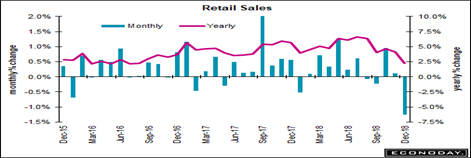
Another ‘blip’ that could be temporary was the fall in December retail sales, down 1.2 percent. But that may also be due to the December ‘uncertainties’—a lousy stock market, lousy weather, and the record government shutdown. Republicans got the message, which is why the “no wall” budget compromise just voted on will pass White House muster this time with no government shutdown.

image

Econoday.com

Another reason for optimism this year is less than 2 percent inflation in both the wholesale and retail sectors should keep consumers buying. Wholesale producer prices in the Producer Price Index were pulled down by a 3.8 percent drop in energy that follows 4.3 and 5.1 percent monthly declines in December in November, the latter the month when oil collapsed from $70 to $50.

And happy consumers amid lots of available jobs means they also see a sunny economic future and will act accordingly.

Harlan Green © 2019

Follow Harlan Green on Twitter: https://twitter.com/HarlanGreen
Posted in Consumers, Economy, Weekly Financial News | Tagged , , , , | Leave a comment

What Green New Deal?

Popular Economics Weekly

image

The Green New Deal resolution introduced in the House by Massachusetts Sen. Ed Markey (D-MA) and Rep. Alexandria Ocasio-Cortez (D-NY) as H. RES.____ is really the vision of what a fully-realized United States of America could look like, if its social and economic ills were remedied. But it will take at least a generation to accomplish what Markey and Ocasio-Cortez propose, and a majority of Americans say they support, in the best of circumstances.

That’s because much of the current voting public is older folk suspicious of change; and doubtful the dire predictions on climate change are true. So it will take the Octavio-Cortez’s in generations coming of age that want a better future for themselves than is currently the case.

Markey and Ocasio-Cortez want to change more than environmental laws and regulations in order to eliminate greenhouse gases. They want to make democracy work for everyone in H. RES.____:

“…to promote justice and equity by stopping current, preventing future, and repairing historic oppression of indigenous peoples, communities of color, migrant communities, deindustrialized communities, depopulated rural communities, the poor, low-income workers, women, the elderly, the unhoused, people with disabilities, and youth (referred to in this resolution as ‘‘frontline and vulnerable communities’’).

Much of the business community will also be alarmed by the reversals in pro-corporate policies implemented since the Reagan era that tilted the economic playing field towards Big Business by allowing near-monopolies in many business sectors and weakening labor laws.

The Green New Deal wants to strengthen labor laws by “(G) ensuring that the Green New Deal mobilization creates high-quality union jobs that pay prevailing wages, hires local workers, offers training and advancement opportunities, and guarantees wage and benefit parity for workers affected by the transition.”

First, let’s understand where the phrase “Green New Deal” comes from. NYTimes’ Thomas Friedman declared in a 2017 Op-ed that a Rooseveltian, big government New Deal was needed to revive the American economy from its doldrums since the Great Recession, and save Earth from the dire effects of climate change that even the U.S. Pentagon predicts could be catastrophic for world peace.

Friedman summarized its goals as: 1. Zero-net energy buildings: buildings that can produce as much energy as they consume. 2. Zero-waste manufacturing: stimulating manufacturers to design and build products that use fewer raw materials and that are easily disassembled and recycled. 3. A zero-carbon grid: If we can combine renewable power generation at a utility scale with some consumers putting up their own solar panels and windmills that are integrated with the grid, and with large-scale storage batteries, we really could, one day, electrify everything carbon-free. 4. Zero-emissions transportation: a result of combining electric vehicles and electric public transportation with a zero-carbon grid.

The Green New Deal uses Friedman’s suggestions as a blueprint. Their resolution says:

“The October 2018 report entitled ‘‘Special Report on Global Warming of 1.5 of Celsius’’ by the Intergovernmental Panel on Climate Change and the November 2018 Fourth National Climate Assessment report found that among other things—a changing climate is causing sea levels to rise and an increase in wildfires, severe storms, droughts, and other extreme weather events that threaten human life, healthy communities, and critical infrastructure”

Furthermore, “…global warming at or above 2 degrees Celsius beyond preindustrialized levels will cause— (A) mass migration from the regions most affected by climate change; (B) more than $500,000,000,000 in lost annual economic output in the United States by the year 2100; (C) wildfires that, by 2050, will annually burn at least twice as much forest area in the western United States than was typically burned by wildfires in the years preceding 2019.”

The U.S. Pentagon first raised similar alarms on global warming in a 2015 report to the Senate Appropriations Committee, because of the possibility of global conflicts caused by the struggle for depleted resources.

Climate change ‘should be elevated beyond a scientific debate to a US national security concern’, wrote the authors, Peter Schwartz, CIA consultant and former head of n-planning at Royal Dutch/Shell Group, and Doug Randall of the California-based Global Business Network.

“The document predicts that abrupt climate change could bring the planet to the edge of anarchy as countries develop a nuclear threat to defend and secure dwindling food, water and energy supplies. The threat to global stability vastly eclipses that of terrorism, say the few experts privy to its contents,” according to the Observer and Guardian newspapers that first broke the story.

The question should be how to achieve those goals, not whether it is desirable. The first step must be to eliminate our reliance on non-renewable, carbon-based fossil fuels that is endangering national and international security, as our planet warms while becoming ever more overcrowded.

The Green New Deal resolves to revive our democracy so that everyone has the opportunity to benefit from it.

Harlan Green © 2019

Follow Harlan Green on Twitter: https://twitter.com/HarlanGreen
Posted in Economy, Keynesian economics, Politics | Tagged , , , , , | Leave a comment

What is Driving Household Formation and Home Sales?

The Mortgage Corner

image

SF Federal Reserve

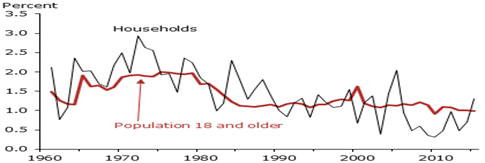
The growth in household formation, the major determinate of home ownership, is slowly returning to pre-housing bubble levels, according to a 2016 report by the San Francisco Fed’s economic research dept. This is a good sign for the future of new home construction as well, that has run a deep deficit since the end of the housing bubble.

The culprit in large part has been a millennial generation reaching adulthood—those born 1981 to 1996—that have been slow to leave home and form their own households, burdened with student debt and a slow to recover job market since the end of the Great Recession.

In 2014, the U.S. Federal Reserve released data about young households under the age of 35, (millennials), and perhaps one of the most striking data points was the low level of income. The median pre-tax income level for heads-of-household below the age of 35 was $35,300 per year. Comparable levels of income for previous years of the same demographic were $38,900 in 1995 and $43,900 in 2001 (all priced in 2013 dollars so we are looking at an apples-to-apples analysis). 

“The shares of young adults heading households now are similar to rates seen at the start of the housing boom,” said the SF Fed researchers. “Moreover, while more young adults are living at home longer, data suggest they are continuing to transition to higher headship rates as they get older…Given current 12-month annual headship rates by age group, the Census Bureau projections imply household formations averaging on the order of 1.4 to 1.5 million per year through 2020. That compares favorably to an average of a little less than 900,000 annually over the past five years.”

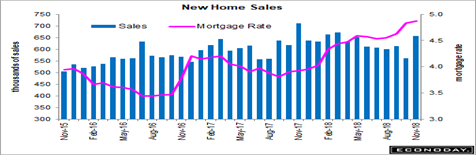
This could be boosting new-home sales, which eventually boosts housing construction. Sales of newly built, single-family homes jumped 16.9 percent to a seasonally adjusted annual rate of 657,000 units in November after an upwardly revised October report, reports the NAHB, and according to newly released data by the U.S. Department of Housing and Urban Development and the U.S. Census Bureau. This is the highest sales pace since March 2018. However, on a year-to-date basis, sales are down 7.7 percent from this time in 2017.

image

Econoday.com

Even builders recognize they are dependent on new household formation. “Solid job growth and growing household formations should support future demand for housing even as builders continue to address mounting affordability woes,” said NAHB Chief Economist Robert Dietz. “Builders are doing all they can to hold the line on costs to meet this demand, particularly at the entry-level market.”

Existing-home sales aren’t doing so well. Existing-home sales ran at a seasonally adjusted annual rate of 4.99 million in December, the National Association of Realtors said Tuesday. That was the lowest since November 2015. Sales were down 6.4 percent for the month, and 10.3 percent lower than the year-ago rate.

Lawrence Yun, NAR’s chief economist, says current housing numbers are partly a result of higher interest rates during much of 2018. “The housing market is obviously very sensitive to mortgage rates. Softer sales in December reflected consumer search processes and contract signing activity in previous months when mortgage rates were higher than today. Now, with mortgage rates lower, some revival in home sales is expected going into spring.”

But there is also the problem low inventory. There was just a 3.7 months of unsold inventory at the current sales rate. This is much too low to sustain sales anywhere near normal rates, especially in the affordable range. “…there is still a lack of adequate inventory on the lower-priced points and too many in upper-priced points,” said Yun.

We therefore maybe seeing the end of a not so virtuous circle. A fully-employed economy is drawing more millennials to form households and purchase homes. It’s about time, as the oldest cohort of millennials are approaching 38 years of age.

And reinforcing the good news on the household formation front is that more millennial women are marrying—some 1.2 million were newly-weds in 2016, according to PEW Research. That means even more households are being formed

Harlan Green © 2019

Follow Harlan Green on Twitter: https://twitter.com/HarlanGreen
Posted in Housing, housing market, Weekly Financial News | Tagged , , , , | Leave a comment

Can U.S. Economy Weather Trade Wars?

Financial FAQs

image

Econoday.com

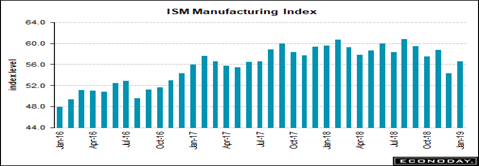
Why is manufacturing doing so well in the face of rising tariffs—in January when mid-winter business activity tends to slow? Consumers flush with cash from rising wages and full employment are powering higher domestic demand. Exports, on the other hand, have declined because of the rising costs of materials and parts, causing buyers to switch to exports from other countries that aren’t affected by the trade wars. Manufacturing exports had the slowest growth in two years.

The Institute of Supply Management reported that its January manufacturing index registered 56.6 percent, an increase of 2.3 percentage points from the December reading of 54.3 percent. The New Orders Index registered 58.2 percent, an increase of 6.9 percentage points from the December reading of 51.3 percent. The Production Index registered 60.5 percent, 6.4-percentage point increase compared to the December reading of 54.1 percent. The Employment Index registered 55.5 percent, a decrease of 0.5 percentage point from the December reading of 56 percent.”

Any number over 50 indicates that a majority of managers are reporting expanding business in the various sectors that the ISM Indexes measure. The question then is how long can consumers keep this up, while foreign demand for U.S. goods continues to decline? There is very little optimism that the tariff wars will subside soon, given that the revamped NAFTA Treaty has yet to pass Congress, and Democrats in particular not happy with Trump’s cosmetic tweaks that do little to change it.

Brookings’ analysis was that “After a year and a half of negotiations, the three parties are going to end up with a new trade deal that looks remarkably similar to the old NAFTA.”

The ISM’s Non-manufacturing Index for the service sector is also growing robustly, which means that most of the U.S. economy will continue steady growth; at least for the first half of this year and maybe longer if interest rates remain at their current lows.

image

Econoday.com

“The NMI® registered 56.7 percent, which is 1.3 percentage points lower than the December reading of 58 percent. This represents continued growth in the non-manufacturing sector, at a slower rate. The Non-Manufacturing Business Activity Index decreased to 59.7 percent, 1.5 percentage points lower than the December reading of 61.2 percent, reflecting growth for the 114th consecutive month, at a slower rate in January. The New Orders Index registered 57.7 percent, 5 percentage points lower than the reading of 62.7 percent in December. The Employment Index increased 1.2 percentage points in January to 57.8 percent from the December reading of 56.6 percent.”

The problem with the Trump administration’s bargaining style in levying punitive tariffs on exports from friend and foe, on top of the fact that appearances seem to be more important than substance, is that such bully tactics turn off foreign countries who have lots of choices doing business elsewhere than with the U.S.

This is already showing signs of affecting U.S. growth, since consumers cannot maintain their higher consumption (largely fueled by borrowing) forever. The BEA’s Q3 2018 GDP final growth estimate was 3.4 percent, down from Q2’s 4.2 percent. Fourth quarter’s initial GDP estimate has been held up by the government shutdown.

Why the slowdown? “The deceleration in real GDP growth in the third quarter primarily reflected a downturn in exports and decelerations in nonresidential fixed investment and in Personal Consumption Expenditures (i.e., consumer spending),” said the BEA. “Imports increased in the third quarter after decreasing in the second.”

A continuation of this picture could be a sign of further growth problems, if the trade wars aren’t resolved soon.

Harlan Green © 2019

Follow Harlan Green on Twitter: https://twitter.com/HarlanGreen
Posted in Consumers, Economy, Politics, Weekly Financial News | Tagged , , , , | Leave a comment

Very Strong January Employment

Popular Economics Weekly

image

MarketWatch.com

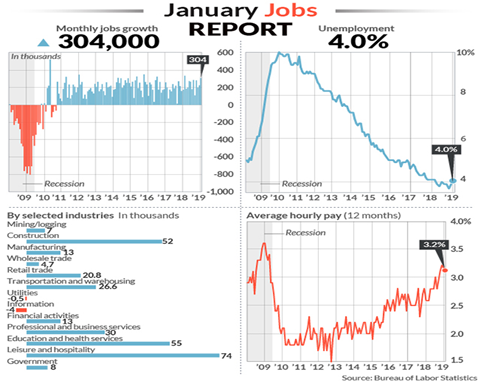
Total nonfarm payroll employment increased by 304,000 in January, and the unemployment rate edged up to 4.0 percent, the Bureau of Labor Statistics reported today. Job gains occurred in several industries, including leisure and hospitality, construction, health care, and transportation and warehousing.

This is an unusually high jobs number for January, especially after the robust December payroll numbers, which were downgraded to 222,000 private payroll jobs from the original 312,000 jobs total.

The big mystery is with average hourly wages rising at 3.2 percent, there are still no signs of inflation. And that is keeping both short and long term interest rates extremely low. The 10-year Treasury yield has now sunk to 2.65 percent; very unusual for this late in a recovery cycle. It means mortgage rates for a 30-year conforming fixed rate are now 3.75 percent with a one point origination fee for the most credit-worthy borrowers, which is a rate last seen during the Fed’s Quantitative Easing cycles that pushed down long term rates to near post-WWII lows.

And it is keeping the Fed from raising short term rates further, as well, which is boosting consumers’ spending, who are fully-employed and flush with cash from the best wage and benefit increases in 11 years.

The Labor Department said the impact of the partial federal government shutdown contributed to the uptick in both the unemployment rate, at 4.0 percent, and the number of unemployed persons, at 6.5 million. Among the unemployed, the number who reported being on temporary layoff increased by 175,000. This figure includes furloughed federal employees who were classified as unemployed on temporary layoff under the definitions used in the household survey.

Companies that provide leisure and hospitality — hotels, restaurants, gambling, recreation — added 74,000 jobs in a surprisingly strong gain, reports the BLS. Construction firms took on 52,000 new workers, particularly in fields geared toward commercial building. Health-care providers hired 42,000 workers. Transportation and delivery companies beefed up payrolls by 27,000. And retailers increased staffing by 21,000.

Why such low inflation and interest rate numbers? Macro-economists are saying there is a huge amount of liquid assets sloshing around the world from extremely high savings rates by individuals and central banks. Central banks have not really begun to tighten their purse strings, even 10 years into the recovery from the Great Recession. The EU is worried about slowing economic growth, for one, while China is also showing signs of lower growth.

So the American Fed cannot afford to be in a crediting tightening mode either, which would put a damper on U.S. growth. Multi-national U.S. corporations aren’t repatriating much of the $2.4 trillion in overseas profits, either, which means most of their profits aren’t being put to work to improve either American productivity or future growth.

In fact, even the 2017 Republicans’ Tax Cut and Jobs Act hasn’t helped, as I said yesterday, which MarketWatch’s Howard Gold has labeled the “Shareholder and CEO Enrichment Act of 2017.”

The bottom line seems to be the U.S. is back in the goldilocks growth mode; growth is neither too hot (because of low inflation), nor too cold (with full employment), which is a conundrum of sorts, as former Fed Chair Alan Greenspan was wont to say. It doesn’t fit some economic models, in other words.

But many major economists—such as Harvard economist Larry Summers, IMF’s Olivier Blanchard, Nobelists Paul Krugman and Joe Stiglitz—believe it’s a perfect time to put some of that excess cash to better use than boosting stockholder and CEO incomes. Why not use it to begin to build for future growth in all the sectors that would secure a better future—education, infrastructure, R&D, healthcare? All that’s lacking is the political will.

Harlan Green © 2019

Follow Harlan Green on Twitter: https://twitter.com/HarlanGreen
Posted in Consumers, Economy, Keynesian economics, Politics, Weekly Financial News | Tagged , , , , | Leave a comment

Best Wage and Benefit Rise in 11 Years

Financial FAQs

image

MarketWatch.com

Workers’ wages and benefits are finally rising at a decent clip from being fully employed, said the Labor Department. Total compensation, including health and pension benefits, rose in 2018 2.9 percent, up from 2.8 percent in 2017. That’s the biggest 12-month increase since the fall of 2008, reports MarketWatch.

The BLS just reported that Compensation costs for civilian workers increased 0.7 percent, seasonally adjusted, for the 3-month period ending in December 2018. Wages and salaries (which make up about 70 percent of compensation costs) increased 0.6 percent and benefit costs (which make up the remaining 30 percent of compensation) increased 0.7 percent from September 2018.

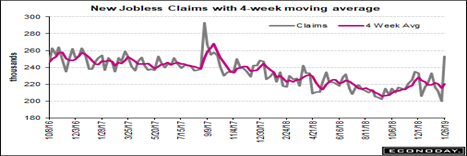
And as a prelude to tomorrow’s unemployment report, the weekly initial jobless claims reported by states rose abruptly in the January 26 week, up 53,000 to a 253,000 level that leaves the forecasters, at a consensus 220,000 and a high estimate of 225,000, scratching their heads. This is the highest total in more than a year-and-a-half.

image

Econoday.com

Was this an anomaly? Furloughed Federal employees from the government shutdown may be some of the answer but not all of it. They did add nearly 15,000 to the headline drop which is down more than 10,000 from the prior week, said Econoday. Contractors tied to the government (who don’t get any back pay) also likely added to the total though there are no specifics available in the data.

This leaves guesses about tomorrow’s January unemployment report up in the air. It’s likely to be much less than the gangbuster’s December report of 317,000 payroll jobs rise. It’s more likely to be around 180,000, which isn’t bad after all the geopolitical problems, such as Trump’s trade wars. Other countries are beginning to retaliate with their own higher tariffs. This doesn’t make for optimistic prognostications about future growth.

The International Monetary Fund is also downgrading worldwide growth due to the growing uncertainties such as whether Brexit will happen and the EU’s slowing growth, along with declining world trade projections.

The 2017 Republicans’ Tax Cut and Jobs Act hasn’t helped, either, which MarketWatch’s Howard Gold has labeled the Shareholder and CEO Enrichment Act of 2017.

“Corporations, big shareholders and top corporate executives reap the lion’s share of the gains from the 2017 tax cut. It didn’t boost economic growth that much, didn’t start a capital spending boom or U.S. manufacturing renaissance, didn’t bring overseas profits back home, and might have led to modest job growth but little discernible wage increases. And we’ll all be stuck with the bill for a long, long time.”

But why focus on the negatives, when American workers are finally benefiting from being fully employed? Job growth has picked up, having risen by 2.6 million in 2018, vs. a gain of 2.2 million in 2017. It’s unclear how much of that can be attributed to the tax cut, as I said, since health care and professional and business services jobs set set the pace, as they have for the past 30 years.

Let us see what tomorrow’s unemployment report looks like before we make any rash growth projections for 2019.

Harlan Green © 2019

Follow Harlan Green on Twitter: https://twitter.com/HarlanGreen
Posted in Consumers, Economy, Keynesian economics, Macro Economics, Weekly Financial News | Tagged , , , | Leave a comment

It’s the Consumer, Stupid

Answering the Kennedys Call—Part II

New York Times’ economic writer Neil Irwin in a recent Op-ed is not seeing a very robust future for global economic growth. “…what the last few months have made clear is that the forces that have held back the global economy for the last 11 years are not temporary, and have not gone away…The low-growth world was not just a phase. It’s the new reality beneath every macroeconomic question and debate for the foreseeable future.”

Really? Much of such pessimistic forecasting is based on a faulty understanding of economic history. I am paraphrasing the title of a controversial and little noticed 2011 New York Times Op-ed by Rutger’s history professor James Livingston, at a time when recovery from the Great Recession was still in doubt.

In it, he said, “As an economic historian who has been studying American capitalism for 35 years, I’m going to let you in on the best-kept secret of the last century: private investment — that is, using business profits to increase productivity and output — doesn’t actually drive economic growth. Consumer debt and government spending do. Private investment isn’t even necessary to promote growth.”

And yet most Americans still apparently buy the conservatives’ line that lower corporate and personal income taxes generate more jobs and growth, which hasn’t panned out for the latest Republican reduction in personal and corporate tax rates, either.

“Between 1900 and 2000,” wrote Professor Livingston, “real gross domestic product per capita (the output of goods and services per person) grew more than 600 percent. Meanwhile, net business investment declined 70 percent as a share of G.D.P. What’s more, in 1900 almost all investment came from the private sector — from companies, not from government — whereas in 2000, most investment was either from government spending (out of tax revenues) or “residential investment,” which means consumer spending on housing, rather than business expenditure on plants, equipment and labor.”

And that is why we have congresswoman Alexandria Octavio-Cortez’s call for a 70 percent maximum income tax rate and Presidential candidate Senator Elizabeth Warren’s just announced proposal for a wealth tax on the richest Americans with accumulated net wealth of more than $50 million.

“Warren herself hasn’t issued many details of her plan,” said the LA Times on her announcement, “But according to UC Berkeley economists Emmanuel Saez and Gabriel Zucman, who advised her on the proposal, the tax would be 2 percent on net worth above $50 million and another 1 percent on net worth above $1 billion. They say it would affect about 75,000 U.S. households, or less than 0.1 percent of the total, and raise $2.75 trillion over 10 years. That’s about 0.1 percent of gross domestic product per year.”

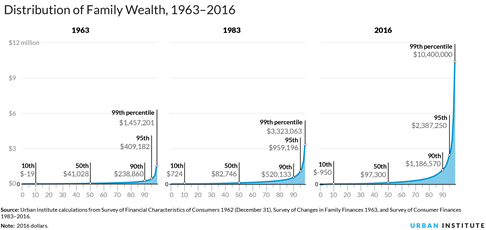
American conservatives have worked to lower taxes on the wealthiest, while enhancing the monopoly powers of corporations since at least 1980. It has resulted in the greatest income and wealth inequality in U.S. modern history, as illustrated by this Urban Institute graph.

image

Urban Institute

The result has not been good for a participatory democracy, as I said last week. But returning $2.75 trillion to federal government coffers over 10 years would be good for democracy, whether it can be put to use to implement more social programs like paid family leave, some form of private/public universal health care program, at least $1 trillion in repairs and upgrades of our ageing infrastructure, more education spending on preschoolers, and paying down some of the outstanding $1 trillion in student debt.

All of these items would vastly improve economic growth, both today and for future generations. So there is no need to believe Neil Irwin’s lament that the world can’t escape its “low growth, low inflation rut.”

We have not been paying attention to economic history, but condemned to repeat what hasn’t worked, says Professor Livingston.

“So corporate profits do not drive economic growth — they’re just restless sums of surplus capital, ready to flood speculative markets at home and abroad. In the 1920s, they inflated the stock market bubble, and then caused the Great Crash. Since the Reagan revolution, these superfluous profits have fed corporate mergers and takeovers, driven the dot-com craze, financed the “shadow banking” system of hedge funds and securitized investment vehicles, fueled monetary meltdowns in every hemisphere and inflated the housing bubble.”

That’s why it’s time to begin to put some of America’s accumulated wealth to better use than has been the case in recent decades.

Harlan Green © 2019

Follow Harlan Green on Twitter: https://twitter.com/HarlanGreen

Posted in Economy, Keynesian economics, Macro Economics, Politics, Weekly Financial News | Tagged , , , , | Leave a comment

What is a Living Wage?

Answering the Kennedys Call

The Washington Post published a recent interview with new Democratic House Member Alexandria Octavia-Cortez in which she said, “I think it’s wrong that a vast majority of the country doesn’t make a living wage, I think it’s wrong that you can work 100 hours and not feed your kids. I think it’s wrong that corporations like Walmart and Amazon can get paid by the government, essentially experience a wealth transfer from the public, for paying people less than a minimum wage.”

Is it true that most Americans don’t make a living wage? Actually, that is not the right question we should be asking, which has been the subject of endless debate, anyway. What constitutes a living wage has to be different for each individual. Wouldn’t someone born and raised amid extreme wealth, say, have what they consider a far different living wage than a religious ascetic?

Why not concentrate on what I believe Congresswoman Cortez is really talking about—the principle of fair play as applied to the majority of Americans? There are maybe 25 percent who live at or below the poverty line that have to work more than 40 hours per week to have a living income, depriving them of family, or enough leisure time to enjoy themselves. Europeans seem to have conquered the problem in countries like Denmark and the Netherlands, where the average workweek is 34 hours, with four weeks paid vacations and universal health care for their citizens.

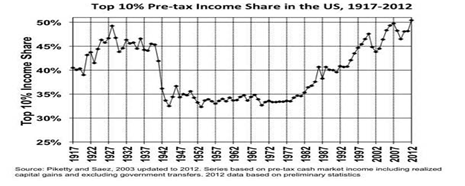
Meanwhile, American conservatives have worked to lower taxes on the wealthiest, while enhancing the monopoly powers of corporations since at least 1980. It has resulted in the greatest income inequality in the U.S. since 1928, in the wealthiest country in the world, as illustrated by this well-known Piketty-Saez graph.

image

WashingtonPost-Piketty-Saez

The result has not been good for a participatory democracy. The American electorate has become polarized, which has brought out the worst in human nature—including anti-immigrant racism, white nationalism, and the tearing down of government regulations that safeguard health and the environment. The consequence is a much reduced middle class that once maintained civility in political discourse.

Even conservative Barron’s Magazine editor Randall Forsythe mentions a 2017 Federal Reserve Consumer Finance study that showed the huge wealth disparities during the recent federal government shutdown—four in 10 Americans would have difficulty in meeting a $400 emergency expense—while the top 1 percent of income earners now own 50 percent of stockholdings.

image

www.pewresearch.org.

PEW Research in a 2018 report, reports that year-over-year average hourly earnings have been rising at 2 to 3 percent. “After adjusting for inflation, however, today’s average hourly wage has just about the same purchasing power it did in 1978, following a long slide in the 1980s and early 1990s and bumpy, inconsistent growth since then. In fact, in real terms average hourly earnings peaked more than 45 years ago: The $4.03-an-hour rate recorded in January 1973 had the same purchasing power that $23.68 would today.”

We are seeing the results of the singular focus on private profits rather than public welfare spending that includes adequate healthcare, improved infrastructure, and educational facilities that would elevate America back into the pantheon of western countries, instead of becoming an outlier that is withdrawing from the developed world.

Maybe we are also seeing how the word socialism is beginning to scare the wealthy to return some of their newly-begotten wealth to bring back a democracy that benefits the majority of Americans.

Harlan Green © 2019

Follow Harlan Green on Twitter: https://twitter.com/HarlanGreen
Posted in Consumers, Economy, Politics, Weekly Financial News | Tagged , , , , , | Leave a comment