What Happened to Consumers’ Confidence?

Financial FAQs

image

http://www.sca.isr.umich.edu/

Consumer sentiment declined in early January to its lowest level since Trump was elected, reported the December U. of Michigan sentiment survey. It’s down for a number of reasons—too many reasons, and economists are consequently beginning to predict GDP growth will be reduced to the 2 percent annual growth average that has prevailed since the end of the Great Recession.

“The decline was primarily focused on prospects for the domestic economy, with the year-ahead outlook for the national economy judged the worst since mid-2014. The loss was due to a host of issues including the partial government shutdown, the impact of tariffs, instabilities in financial markets, the global slowdown, and the lack of clarity about monetary policies. Aside from the direct economic impact from these various issues on the economy, the indirect effect meant that half of all consumers believed that these events would have a negative impact on Trump’s ability to focus on economic growth.”

How serious are the present crises? It depends on their duration. The shutdown is easiest to solve, if the parties can unite in agreement on what exactly constitutes a border ‘wall’—would a digital wall suffice, along with better-funded courts and more Border agents?

“While the January falloff in optimism is certainly consistent with a slowdown in the pace of growth,” said U of Michigan chief economist Richard Curtin, “it does not yet indicate the start of a sustained downturn in economic activity. It is the strength in personal finances that will continue to support consumption expenditures at favorable levels in 2019. Nonetheless, consumers now sense a need to buttress their precautionary savings, which is typically done by reducing their discretionary spending. Evolving job and wage prospects, which were slightly weaker in early January, are critical to extending the current expansion.”

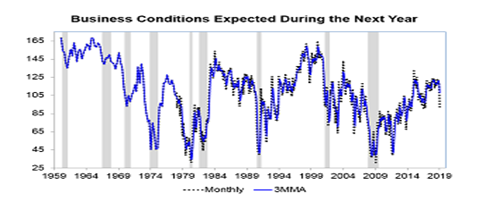
Consumer confidence is based on other factors, as well, such as the job market. The other confidence index, the Conference Board’s Consumer Confidence Index showed lower future job expectations.

“Consumer Confidence decreased in December, following a moderate decline in November,” said Lynn Franco, Senior Director of Economic Indicators at The Conference Board. “Expectations regarding job prospects and business conditions weakened, but still suggest that the economy will continue expanding at a solid pace in the short-term. While consumers are ending 2018 on a strong note, back-to-back declines in Expectations are reflective of an increasing concern that the pace of economic growth will begin moderating in the first half of 2019.”

As has been mentioned by many commentators and economists, the Trump administration isn’t equipped or staffed to handle multiple crises, much less a serious single one. Michael Lewis’ The Fifth Risk was the latest warning of what might happen with an administration that didn’t want the federal government to function well, and appointed administration officials—mainly lobbyists of industries that it regulated—whose mandate was to make sure it increased the profits of their industries rather than the welfare of the American public. That meant it would have a difficult time handling any major crisis, such as the ongoing government shutdown.

So it’s easy to see why consumers are feeling queasy and want to save more of their rising incomes, rather than spend them. Other factors that might be scaring consumers are the ongoing tariff wars, and the IMF prediction of slower worldwide growth.

Maybe doing nothing, other than re-opening the federal government for business, is the better choice for maintaining healthy growth. A revised NAFTA agreement has yet to be ratified by the Senate to take effect. And a “lack of clarity about monetary policies” probably means the Federal Reserve will stop raising short term rates for a while, which will hearten the financial markets, as well.

Harlan Green © 2019

Follow Harlan Green on Twitter: https://twitter.com/HarlanGreen
Posted in Consumers, Economy, Politics, Weekly Financial News | Tagged , , , , , | Leave a comment

What’s Behind Brexit and the Politics of Fiscal Austerity?

Popular Economics Weekly

image

https://www.washingtonpost.com

The case can now be made that Briton’s vote to leave the EU was because of wrong-headed fiscal policies in the aftermath of the Great Recession. The housing bubble affected Europeans almost as much as Americans after 2008, busting their asset bubbles with stock market crashes and large job losses. And the UK’s response was draconian; raise taxes while cutting back on social welfare programs that benefited the not so wealthy.

This was to be achieved by a combination of UK public spending reductions and tax increases amounting to £110 billion, which made their downturn worse than that of the U.S., because Fed Chair Ben Bernanke and the Democratic congress advocated easing credit and spending some $787B to boost infrastructure repairs and depleted state budgets in the American Recovery and Reinvestment Act of 2009 (ARRA).

The Tory government of John Cameron did the opposite with a vengeance; beginning in 2010 to brutally slash £21 billion from its welfare budget that took away essential benefits from a large number of UK citizens; who then voted for the Brexit referendum in 2016. Tories used the standard conservative trope that public spending took away from private sector investments that could revive the economy by creating new jobs.

That is not a proven economic theory, however, as conservatives have never wanted to admit that corporations and other private businesses tend to hold back a large part of their profits to buy back stock and thus boost the incomes of stockholders and CEOs, rather than invest it into further growth and more jobs. Instead, austerity became the conservatives’ excuse for shrinking government services at the wrong time.

This is documented by the results of research from a University of Warwick economist, Themo Fetzer: “These reforms activated existing economic grievances,” said Fetzer. “Further, auxiliary results suggest that the underlying economic grievances have broader origins than what the current literature on Brexit suggests. Up until 2010, the UK’s welfare state evened out growing income differences across the skill divide through transfer payments. This pattern markedly stops from 2010 onwards as austerity started to bite.”

This has also been the case with U.S. programs that were put into place when the Tea Party took over Republican politics and began the series of austerity measures in 2011 that included a prior government shutdown and caps on public spending.

The result in both countries was that it increased income inequality, which enraged the newly disenfranchised, non-college educated males, in particular, that were most affected by the Great Recession. Brexit advocates blamed the EU for it budget woes, claiming that withdrawal would bring home all those revenues that went to support less prosperous members of the EU, as a huge influx of Poles and other Eastern European citizens flocked into the UK and took away less-skilled jobs that many Brits believed they depended on.

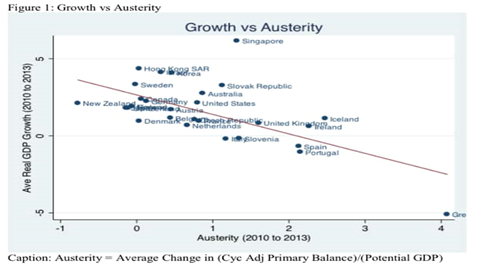
Nobel Economist Paul Krugman in a 2015 Guardian article wrote perhaps the best known critique of austerity programs that were enacted throughout much of the developed world as a result of the Great Recession: “Since the global turn to austerity in 2010, every country that introduced significant austerity has seen its economy suffer, with the depth of the suffering closely related to the harshness of the austerity. In late 2012, the IMF’s chief economist, Olivier Blanchard, went so far as to issue what amounted to a mea culpa: although his organisation never bought into the notion that austerity would actually boost economic growth, the IMF now believes that it massively understated the damage that spending cuts inflict on a weak economy.”

Republicans, blaming the Great Recession on a bloated federal budget and too many regulations, attempted to cut almost all welfare spending, and even  abolish Obamacare when they controlled the House and Senate.

But now that Repubs have all the political power? They are creating record budget deficits and national debt with their tax and regulation cutting policies. That tells us austerity was just an excuse to redistribute even more wealth to the corporations and Wall Street; rather than Main Street.

But also, that Brexit is the result of misplaced ideologies, rather than tried and true economic policies.

Harlan Green © 2019

Follow Harlan Green on Twitter: https://twitter.com/HarlanGreen
Posted in Economy, Keynesian economics, Macro Economics, Politics, Weekly Financial News | Tagged , , , , , , , | Leave a comment

Why Falling Home Sales?

The Mortgage Corner

image

Econoday.com

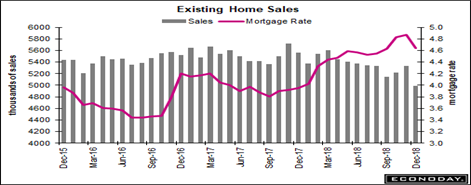
Total existing-home sales, https://www.nar.realtor/existing-home-completed transactions that include single-family homes, townhomes, condominiums and co-ops, decreased 6.4 percent from November to a seasonally adjusted rate of 4.99 million in December. Sales are now down 10.3 percent from a year ago (5.56 million in December 2017), said the National Association of Realtors.

Why is this happening, at a time when interest rates are plunging almost back to recession levels? The anti-regulation crowd says it’s due to the 2015 TRID regulations that gave borrowers three extra days to go over their loan documents before closing—thanks to Dodd-Franks, and the Consumer Finance Protection Bureau legislation enacted during the Obama administration.

Banks never liked the new regulations since it cost money to make the changes to borrower and closing documents. It protected borrowers who were sometimes confronted with changed loan terms at the closing, and had to either accept or possibly lose their new purchase.

But there’s a much more convincing reason for the sales drop off. Not enough housing inventory. New homes are not built fast enough to satisfy new adults of the millennial generation now forming families. These children of the baby boomers are the largest population segment ever, born approximately between 1980 and 1996. And most of the new homes are not being built in the affordable range.

Lawrence Yun, NAR’s chief economist, says current housing numbers are also partly a result of higher interest rates during much of 2018. “The housing market is obviously very sensitive to mortgage rates. Softer sales in December reflected consumer search processes and contract signing activity in previous months when mortgage rates were higher than today. Now, with mortgage rates lower, some revival in home sales is expected going into spring.”

In fact, interest rates have declined substantially since last fall, and are almost back to recession lows. The 30-year conforming fixed rate has dropped to 4.0 percent with one origination point, for the most credit-worthy borrowers.

And what about inventories? “Several consecutive months of rising inventory is a positive development for consumers and could lead to slower home price appreciation,” says Yun. “But there is still a lack of adequate inventory on the lower-priced points and too many in upper-priced points.”

And total housing inventory is much lower. It decreased at the end of December to 1.55 million, down from 1.74 million existing homes available for sale in November, but represents an increase from 1.46 million a year ago. Unsold inventory is at a 3.7-month supply at the current sales pace, down from 3.9 last month and up from 3.2 months a year ago.

Not enough new homes are being constructed, as I said. This is an incredibly low inventory level and a major reason for the lower sales’ numbers.

The median existing-home price for all housing types in December was $253,600, up 2.9 percent from December 2017 ($246,500). December’s price increase marks the 82nd straight month of year-over-year gains.

There are several reasons for the lower construction totals, but it can’t be higher interest rates, which have really only risen on the short term end—i.e., on the Prime Rate that controls installment loans, which is up more than 1.5 points to 5.50 percent.

So this should affect credit card and auto loan debt, but that debt hasn’t fallen, as consumers are flush with cash due to the low unemployment rate.

It’s really because many communities don’t want to build more affordable housing—the Not In My Backyard (NIMBY) crowd. The housing situation has deteriorated so badly at the lower and middle earner price range in states like California that new Governor Gavin Newsom is pledging to somehow finance—or create legislation that encourages the building of—3.5 million new units by 2025.

Harlan Green © 2019

Follow Harlan Green on Twitter: https://twitter.com/HarlanGreen
Posted in Consumers, Housing, housing market, Weekly Financial News | Tagged , , , , | Leave a comment

A Week of Conflicting Growth Signals

Popular Economics Weekly

image

Econoday

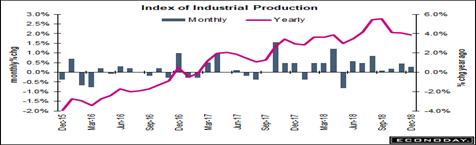
How do we reconcile the fact that industrial production in 2018 was very good, probably due to producers stocking up before more new tariffs are announced, and consumer sentiment has plunged to a 2-year low because of the government shutdown?

A surge in motor vehicle production together with construction supplies along with a strong gain for business equipment caused a 1.1 percent December increase in manufacturing production that far surpasses Econoday’s consensus range where the top estimate was only 0.4 percent.

Consumers power most economic activity with their spending, so when they grow worried about future prospects, spending and economic growth slow down. Hence the reduced growth expectations in 2019, as there is a growing consensus that a prolonged government shutdown will begin to harm large and small businesses.

Trump’s chief economic advisor Kevin Hasselt reports the shutdown has cost $1.2 billion in economic activity per week in just the first three weeks of 2019, and could cost much more if the shutdown continues.

image

U.Michigan

In what is the first major economic indication of trouble tied to the government shutdown, the consumer sentiment index plunged to a 90.7 reading that is far below consensus estimates of 95.5. The expectations component fell nearly 9 points to 78.3 with current conditions also taking a hit, down more than 6 points to 110.0.

Richard Curtin, chief economist of the U. of Michigan sentiment survey, reported “Consumer sentiment declined in early January to its lowest level since Trump was elected. The decline was primarily focused on prospects for the domestic economy, with the year-ahead outlook for the national economy judged the worst since mid-2014. The loss was due to a host of issues including the partial government shutdown, the impact of tariffs, instabilities in financial markets, the global slowdown, and the lack of clarity about monetary policies. Aside from the direct economic impact from these various issues on the economy, the indirect effect meant that half of all consumers believed that these events would have a negative impact on Trump’s ability to focus on economic growth.

Another casualty of the shutdown was that some government statistics, such as retail sales, haven’t reported for December. December sales are expected to be healthy, but then we have the usual January letdown as consumers retrench while waiting for their tax refunds that may also be delayed because of the shutdown.

So consumers are beginning to recognize the record shutdown length is affecting this year’s economic prospects,. And we shouldn’t forget what happened the last time higher tariffs were enacted. It was just prior to the 1929 stock market plunge. The Smoot-Hawley Tariff Act of 1930 raised import tariffs by an average 20 percent, which helped to turn it into the Great Depression.

Are we about to repeat that history?

Harlan Green © 2019

Follow Harlan Green on Twitter: https://twitter.com/HarlanGreen

Posted in Consumers, Economy, Politics, Weekly Financial News | Tagged , , , , | Leave a comment

Is There Too Little Inflation?

Financial FAQs

image

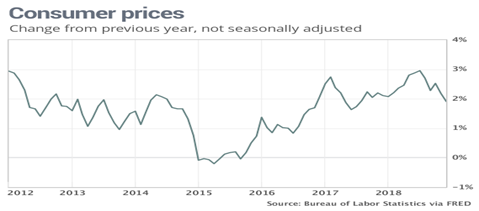
The Consumer Price Index for All Urban Consumers (CPI-U) declined 0.1 percent in December on a seasonally adjusted basis after being unchanged in November, the U.S. Bureau of Labor Statistics reported Friday. Over the last 12 months, the all items index increased 1.9 percent before seasonal adjustment.

The major reason has been falling gas prices. Energy fell 3.5 percent in December as gasoline prices dropped for a second straight month, down 7.5 percent. Transportation costs in general slipped as airfares continued their decline, down 1.5 percent on the month following a 2.4 percent drop in November, according to Econoday.

It’s also why we have abnormally low interest rates at this late stage of the recovery, which actually mirror the amount of excess savings. No matter how much individuals and businesses have borrowed since the Great Recession, interest rates have stayed low. It’s as if there’s a bottomless supply of liquidity that holders of said currencies—including most of the world’s central banks—are eager to put to work in some way.

This could also be a worrisome indicator of what economists call slack demand. Consumers and businesses are spending less and saving more, in spite of the U.S. economy being fully employed with a 3.9 percent unemployment rate. The overall demand for goods and services has fallen from historical levels since the Great Recession as consumers and businesses have become more cautious than in other recoveries, and when consumer economic activity now determines some 70 percent of economic growth.

This is while household incomes have barely kept up with inflation for decades from the progressive weakening of employee bargaining rights since the 1980s, and may only now be increasing with the fully-employment economy.

Former Fed Chair Janet Yellen has entered the discussion with her prediction that the U.S. is stuck in a low-inflationary environment. “All evidence suggests we’re going to be in an environment of low interest rates for a long time,” she said at a recent tech conference.

Such slack overall demand could also be a problem because the Trump trade wars are pushing up the cost of materials. This is hurting U.S. sales overseas, because U.S. export firms have had to raise their prices due to the rising costs of imported materials, such as aluminum and steel that have 10 and 25 percent tariffs, respectively.

Such low inflation is therefore a two-edged sword in many ways. Lower inflation means products are more affordable to larger segments of the population, but it is also a sign that without rising prices producers cannot boost profits, hindering their growth prospects.

All-in-all, this means such stubbornly low inflation can also mean lower prospects for future job growth, hence lower overall economic growth, as well.

Harlan Green © 2019

Follow Harlan Green on Twitter: https://twitter.com/HarlanGreen
Posted in Consumers, Economy, Weekly Financial News | Tagged , , , , | Leave a comment

America’s Immigration Problem

Popular Economics Weekly

image

CalculatedRiskBlog

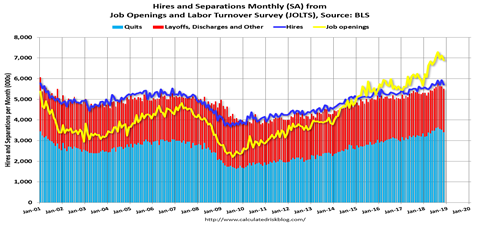
The Calculated Risk graph says it best in the Labor Department’s latest Job Openings and Labor Turnover Survey (JOLTS). There are still about one million more job openings (yellow line) than hires (blue line). There have been more openings than hires since January 2015, according to Calculated Risk.

This tells us several things about the U.S. economy. Firstly, America has a skilled labor shortage because technological innovation exceeds the existing labor force—in fact throughout its history.

America is still a young country in many ways, and our birthrate is declining. This is in contrast to older developed and developing countries in Europe and Asia that have had labor surpluses existing before the various technological revolutions.

Secondly, it is why we so badly need new immigrants to fill those vacancies. Therefore restricting immigration is counter-productive in so many ways. It restricts the growth of our labor force, which directly affects economic growth, and denies America’s history as the land of opportunity. America was founded by immigrants, and it is immigrants that contribute new ideas as well as new blood to our creative mix.

Lastly, the huge gap between job hires and openings tells us there shouldn’t be a fear of recession, or even a significant slowdown, for maybe years to come. Why? Job openings continue to far exceed the six million looking for work, according to the (BLS).

The number of job openings fell to 6.9 million on the last business day of November, the U.S. Bureau of Labor Statistics (BLS) reported today. Over the month, hires edged down to 5.7 million, quits edged down to 3.4 million, and total separations were little changed at 5.5 million. Within separations, the quits rate and the layoffs and discharges rate were unchanged at 2.3 percent and 1.2 percent, respectively. This release includes estimates of the number and rate of job openings, hires, and separations for the nonfarm sector by industry and by four geographic regions.

The BLS said large numbers of hires and separations occur every month throughout the business cycle. When the number of hires exceeds the number of separations, employment rises, even if the hires level is steady or declining. Conversely, when the number of hires is less than the number of separations, employment declines, even if the hires level is steady or rising.

And over the 12 months ending in November, hires totaled 68.0 million and separations totaled 65.6 million, yielding a net annual employment gain of 2.4 million. (These totals include workers who may have been hired and separated more than once during the year.)

So U.S. economic growth should continue to perk along, even if it slows to the historical rate of 2 percent that has prevailed since the end of the Great Recession. It may never climb above that rate without more workers joining the workforce, and there is more public sector investment. We know what those investments should be—infrastructure modernization, improving educational opportunities, combating global warming, etc.—that would give a big boost to labor productivity as well.

The ideal would be to spend more in public investments, but if congress can’t agree on more spending, either American households increase their number of offspring (which is highly unlikely) and/or we reverse the current administration’s anti-immigration policies.

Harlan Green © 2019

Follow Harlan Green on Twitter: https://twitter.com/HarlanGreen
Posted in Consumers, Economy, Macro Economics, Weekly Financial News | Tagged , , , | Leave a comment

A Gangbusters December Employment Report

Popular Economics Weekly

image

MarketWatch.com

Total nonfarm payroll employment increased by 312,000 in December, and the unemployment rate rose to 3.9 percent, the U.S. Bureau of Labor Statistics reported today. Job gains occurred in health care, food services and drinking places, construction, manufacturing, and retail trade.

It looks like the U.S. economy isn’t slowing as much as feared, contrary to the pessimists that have been driving down stock prices, while driving up bond prices, so that the 10-year Treasury bond yield is now 2.65 percent, and conforming 30-year fixed mortgage rates are at 3.875 percent with a 1 point origination fee for the best credit holders.

Health-care providers hired 50,000 people, professional firms filled 43,000 positions, manufacturers added 32,000 jobs, construction firms’ payrolls rose by 32,000 and restaurants hired 41,000 additional workers.

The unemployment rate, meanwhile, rose to 3.9 percent from a 49-year low of 3.7 percent. The percentage of working-age Americans in the labor force climbed to a one-and-a-half-year high as more people looked for jobs. That is a good sign since it means people think more jobs are available.

Strong hiring has also given workers more bargaining power. The amount of money the average worker earns climbed 11 cents or 0.4 percent to $27.48 an hour last month.

Who says the housing market is dead, as well? These low interest rates will stimulate more borrowing and home buying. And Fed Chairman Jerome Powell said the Fed would be flexible about raising interest rates this year at a recent conference. “We will be patient as we watch to see how the economy evolves,” given the low inflation outlook, he said.

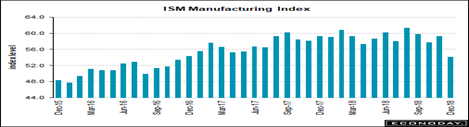
The employment report contradicted yesterday’s December ISM Manufacturing Index that showed a slowdown in manufacturing hiring, falling more than 5 points to a 54.1 level. This is the lowest showing for this index since November 2016. Especially new orders slowed by 10 points to a 51.1 level that is suddenly very close to breakeven 50. It means approximately half of the supply managers surveyed saw an order slowdown.

This is the lowest showing for new orders since August 2016. Weakness is entirely on the domestic side, says Econoday, as one of the few positives in December’s data is a 6 tenth rise in new export orders to 52.8 which is respectable for this particular reading.

image

Econoday.com

The real question is what will economic growth look like in 2019. It will depend largely on a favorable outcome of the trade talks, which means a lowering of the Trump tariffs that do little for American interests, or American consumers.

That’s because higher tariff fees get passed on to consumers, ultimately, which pushes up inflation, then Federal Reserve interest rates; which cuts into consumer spending. And then we have to worry about the soaring federal deficits, which means new taxes will be enacted sometime down the road.

However, this doesn’t worry Nobelist Paul Krugman at the moment in a recent NYTimes Op-ed: “…there are things government should be spending money on even when jobs are plentiful—things like fixing our deteriorating infrastructure and helping children get education, healthcare and adequate nutrition. Such spending has big long-run payoff, even in purely monetary terms.”

The bottom line is money is cheap at the moment with the very low interest rates, so this isn’t the time to worry about budget deficits. It’s much more important to be investing public monies into future growth and productivity that could even prolong this business cycle, now in its tenth year of continuous growth.

Harlan Green © 2018

Follow Harlan Green on Twitter: https://twitter.com/HarlanGreen

Posted in Consumers, Economy, housing market, Weekly Financial News | Tagged , , , , | Leave a comment

In Search of a Moral Economy

Financial FAQs

image

vox.com

Vermont Senator Bernie Sanders defined a moral economy in a recent Duke University dialogue with the Reverend William Barber II: ““A moral economy is one that says, ‘In the wealthiest country in the history of the world, all our people should be able to live with dignity and security.’”

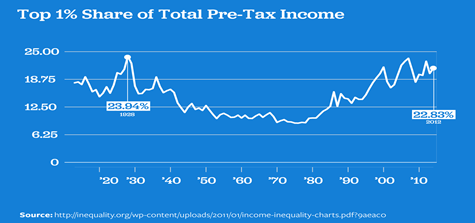
We don’t have to quote the very progressive U.S. Senator to know what a moral economy should look like. One has only to study the history of income and wealth redistribution since 1980 when demand-side economic theory—the Keynesian economics of English Lord John Maynard Keynes that guided Roosevelt’s New Deal—was replaced by so-called supply-side policies—under the conservative but never validated premise that enhancing the wealth of holders of capital with lower taxes and regulations would maximize production, while suppressing the rights and wages of their workers.

History since then has borne out the immorality of what came to be called trickle-down economics—record income inequality in the American workforce. Its rationale came from a diagram on a napkin that then White House Chief of Staff Dick Cheney took to heart as the mantra that guides conservative Republicans even today.

It’s an absurd equation. President Reagan at the time believed that lower taxes would motivate workers to work harder and produce more. The problem was reducing everyone’s taxes would stymie government programs that helped to level the opportunity table. It was the wealthiest that benefited most with reduced personal tax rates that were as high at 92 percent in the Eisenhower administration, which financed the federal highway system, sent us to the moon, and instigated many of the public programs that have made America so productive.

It’s hard to know where this thought process came from. History shows that people work just as hard—sometimes even harder—when they receive a smaller share of their paycheck; especially when a portion goes to insure future benefits like workman’s compensation insurance, social security, Medicare and Medicaid.

But conservatives latched onto several Austrian economists who hated any form of authority; so much so that they advocated limiting the powers of democratically elected governments to care for their own citizens. Such was the fear of centralized authority by economists like Fredrick Hayek in his book, whose book, The Road to Serfdom, called any regulations to tame capitalism a form of enslavement without recognizing that raw, unregulated capitalism meant serfdom and exploitation of those workers.

image

Graph: metroscan.com

We do now have a better understanding of how capitalism—the worst economic system, except for all of the others (to paraphrase Churchill)—works for Main Street as well as Wall Street.

It means in part returning to the much more progressive tax rates of earlier U.S. administrations—before President Reagan made the immoral tax cuts that even underfunded the military at the time, and initiated the massive federal debt burden we carry today.

All the public programs funded by governments today enhance prosperity and productivity in some way—whether it’s to upgrade our infrastructure, fund new health discoveries, strengthen the public insurance and pension programs; as well as protect the environment, without which no Americans can prosper over the long term.

Then we can afford to protect those most in need. That is what a moral economy looks like.

Harlan Green © 2018

Follow Harlan Green on Twitter: https://twitter.com/HarlanGreen
Posted in Economy, Keynesian economics, Macro Economics, Politics | Tagged , , , , , , | Leave a comment

Will 2019 Be Year U.S. Begins to Reunite?

Popular Economics Weekly

image

vox.com

Wonder of wonders, is New York Times conservative columnist David Brooks becoming a neo-Keynesian, New Deal economist? This is the term coined for those younger economists, such as Nobel economists Paul Krugman, Joe Stiglitz and George Akerlof, who have updated John Maynard Keynes’ New Deal theories that helped to bring us out of the Great Depression and created today’s developed economies.

Brooks isn’t a trained economist, but he has been looking for a new political center in his more recent columns—mostly in reaction to the Trump administrations betrayal of free trade and limited debt, mainstay ideas of the former Republican Party, but also its takeover by the Trump administration.

Brooks said in a recent NYTimes Op-ed, “The nations that have the freest markets also generally have the most generous welfare states. The two are not in opposition. In the real world they go together.”

“What generous welfare states?” Western national governments have stepped in wherever the private sector has proved unable or unwilling to support economic growth and general prosperity since World War II. And it was Roosevelt’s New Deal programs that created social security, unemployment insurance, enshrined workers’ rights, and the modern industrial economy that enabled us to win World War II.

So 2019 may be the year that the political parties and American electorate begin to come together, to show a willingness to compromise their ideals and their convictions in reaction to the “Make America First” doctrine of the Tea Party and white nationalist supporters of the Trump administration.

The newly elected Democratic House of Representatives may be the first concrete result of this trend towards more centrist policies in January 2019 with more than 200 women now in the 435 member House. Who better than women to make compromises in the name of getting things done, as they have done in their households since the beginning of time?

Another sign is the more centrist views of conservative writers that Brooks has cited, beginning with the Niskanen Center, an offshoot of the conservative Cato Institute, which released a comprehensive report called, “The Center Can Hold: Public Policy for an Age of Extremes,” written by Brink Lindsey, Steven Teles, Wilkinson and Hammond. The report is a manifesto for a new centrism based on what the authors call a “free-market welfare state model, says Brooks.

“They want government to protect citizens against the disruptions of global capitalism: “Without strong income supports that put a floor beneath displaced workers and systems that smooth the transition to new employment, political actors and the public tend to turn against the process of creative destruction itself.”

By creative destruction, Brooks means the tendency of capitalist economies to throw out the old to make room for new innovations and industries, regardless of the consequences to workers in the old industries—like manufacturing in the Midwestern rustbelt. The economic consequences have been devastating for those regions, needless to say.

What Brooks and his fellow conservative centrists don’t say, however, is that modern capitalists have become monopolists is almost every sense of the world. Just a few major corporations dominate the old manufacturing and energy sectors. And the new digital economy is dominated by the so-called Silicon Valley Big Five—Google, Microsoft, Facebook, Apple and Amazon—that have almost totally escaped oversight; until now.

This tendency towards ‘monopsony’ in under-regulated capitalist economies—the economic term for employers having excessive control over their labor market—is what led to “global capitalism” and too big to fail multinational corporations.

This is in fact earth shaking news emerging from the past of a Republican Party that created the U.S. Environmental Protection Agency and first proposed expanding government-subsidized health care in the 1970s. Let us hope America can return to the two-party system that enabled compromise, a more generous welfare state, and less destructive form of capitalism.

It would be a new beginning for the Re-United States of America.

Harlan Green © 2018

Follow Harlan Green on Twitter: https://twitter.com/HarlanGreen
Posted in Uncategorized | Tagged , , , , , | Leave a comment

Will 2019 Be Year U.S. Begins to Reunite?

Popular Economics Weekly

image

vox.com

Wonder of wonders, is New York Times conservative columnist David Brooks becoming a neo-Keynesian, New Deal economist? This is the term coined for those younger economists, such as Nobel economists Paul Krugman, Joe Stiglitz and George Akerlof, who have updated John Maynard Keynes’ New Deal theories that helped to bring us out of the Great Depression and created today’s developed economies.

Brooks isn’t a trained economist, but he has been looking for a new political center in his more recent columns—mostly in reaction to the Trump administrations betrayal of free trade and limited debt, mainstay ideas of the former Republican Party, but also its takeover by the Trump administration.

Brooks said in a recent NYTimes Op-ed, “The nations that have the freest markets also generally have the most generous welfare states. The two are not in opposition. In the real world they go together.”

“What generous welfare states?” Western national governments have stepped in wherever the private sector has proved unable or unwilling to support economic growth and general prosperity since World War II. And it was Roosevelt’s New Deal programs that created social security, unemployment insurance, enshrined workers’ rights, and the modern industrial economy that enabled us to win World War II.

So 2019 may be the year that the political parties and American electorate begin to come together, to show a willingness to compromise their ideals and their convictions in reaction to the “Make America First” doctrine of the Tea Party and white nationalist supporters of the Trump administration.

The newly elected Democratic House of Representatives may be the first concrete result of this trend towards more centrist policies in January 2019 with more than 200 women now in the 500 member House. Who better than women to make compromises in the name of getting things done, as they have done in their households since the beginning of time?

Another sign is the more centrist views of conservative writers that Brooks has cited, beginning with the Niskanen Center, an offshoot of the conservative Cato Institute, which released a comprehensive report called, “The Center Can Hold: Public Policy for an Age of Extremes,” written by Brink Lindsey, Steven Teles, Wilkinson and Hammond. The report is a manifesto for a new centrism based on what the authors call a “free-market welfare state model, says Brooks.

“They want government to protect citizens against the disruptions of global capitalism: “Without strong income supports that put a floor beneath displaced workers and systems that smooth the transition to new employment, political actors and the public tend to turn against the process of creative destruction itself.”

By creative destruction, Brooks means the tendency of capitalist economies to throw out the old to make room for new innovations and industries, regardless of the consequences to workers in the old industries—like manufacturing in the Midwestern rustbelt. The economic consequences have been devastating for those regions, needless to say.

What Brooks and his fellow conservative centrists don’t say, however, is that modern capitalists have become monopolists is almost every sense of the world. Just a few major corporations dominate the old manufacturing and energy sectors. And the new digital economy is dominated by the so-called Silicon Valley Big Five—Google, Microsoft, Facebook, Apple and Amazon—that have almost totally escaped oversight; until now.

This tendency towards ‘monopsony’ in under-regulated capitalist economies—the economic term for employers having excessive control over their labor market—is what led to “global capitalism” and too big to fail multinational corporations.

This is in fact earth shaking news emerging from the past of a Republican Party that created the U.S. Environmental Protection Agency and first proposed expanding government-subsidized health care in the 1970s. Let us hope America can return to the two-party system that enabled compromise and a more generous welfare state, and less destructive form of capitalism.

It would be a new beginning for a Re-United States of America.

Harlan Green © 2018

Follow Harlan Green on Twitter: https://twitter.com/HarlanGreen

Posted in Consumers, Economy, Keynesian economics, Politics | Tagged , , , , , | Leave a comment