Very Strong January Employment

Popular Economics Weekly
image

MarketWatch.com

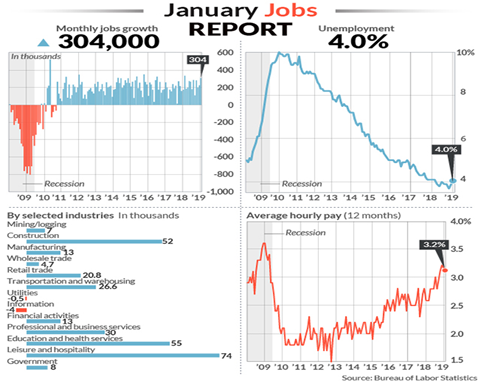
Total nonfarm payroll employment increased by 304,000 in January, and the unemployment rate edged up to 4.0 percent, the Bureau of Labor Statistics reported today. Job gains occurred in several industries, including leisure and hospitality, construction, health care, and transportation and warehousing.

This is an unusually high jobs number for January, especially after the robust December payroll numbers, which were downgraded to 222,000 private payroll jobs from the original 312,000 jobs total.

The big mystery is with average hourly wages rising at 3.2 percent, there are still no signs of inflation. And that is keeping both short and long term interest rates extremely low. The 10-year Treasury yield has now sunk to 2.65 percent; very unusual for this late in a recovery cycle. It means mortgage rates for a 30-year conforming fixed rate are now 3.75 percent with a one point origination fee for the most credit-worthy borrowers, which is a rate last seen during the Fed’s Quantitative Easing cycles that pushed down long term rates to near post-WWII lows.

And it is keeping the Fed from raising short term rates further, as well, which is boosting consumers’ spending, who are fully-employed and flush with cash from the best wage and benefit increases in 11 years.

The Labor Department said the impact of the partial federal government shutdown contributed to the uptick in both the unemployment rate, at 4.0 percent, and the number of unemployed persons, at 6.5 million. Among the unemployed, the number who reported being on temporary layoff increased by 175,000. This figure includes furloughed federal employees who were classified as unemployed on temporary layoff under the definitions used in the household survey.

Companies that provide leisure and hospitality — hotels, restaurants, gambling, recreation — added 74,000 jobs in a surprisingly strong gain, reports the BLS. Construction firms took on 52,000 new workers, particularly in fields geared toward commercial building. Health-care providers hired 42,000 workers. Transportation and delivery companies beefed up payrolls by 27,000. And retailers increased staffing by 21,000.

Why such low inflation and interest rate numbers? Macro-economists are saying there is a huge amount of liquid assets sloshing around the world from extremely high savings rates by individuals and central banks. Central banks have not really begun to tighten their purse strings, even 10 years into the recovery from the Great Recession. The EU is worried about slowing economic growth, for one, while China is also showing signs of lower growth.

So the American Fed cannot afford to be in a crediting tightening mode either, which would put a damper on U.S. growth. Multi-national U.S. corporations aren’t repatriating much of the $2.4 trillion in overseas profits, either, which means most of their profits aren’t being put to work to improve either American productivity or future growth.

In fact, even the 2017 Republicans’ Tax Cut and Jobs Act hasn’t helped, as I said yesterday, which MarketWatch’s Howard Gold has labeled the “Shareholder and CEO Enrichment Act of 2017.”

The bottom line seems to be the U.S. is back in the goldilocks growth mode; growth is neither too hot (because of low inflation), nor too cold (with full employment), which is a conundrum of sorts, as former Fed Chair Alan Greenspan was wont to say. It doesn’t fit some economic models, in other words.

But many major economists—such as Harvard economist Larry Summers, IMF’s Olivier Blanchard, Nobelists Paul Krugman and Joe Stiglitz—believe it’s a perfect time to put some of that excess cash to better use than boosting stockholder and CEO incomes. Why not use it to begin to build for future growth in all the sectors that would secure a better future—education, infrastructure, R&D, healthcare? All that’s lacking is the political will.

Harlan Green © 2019

Follow Harlan Green on Twitter: https://twitter.com/HarlanGreen

Posted in Consumers, Economy, Keynesian economics, Politics, Weekly Financial News | Tagged , , , , | Leave a comment

Best Wage and Benefit Rise in 11 Years

Financial FAQs

image

MarketWatch.com

Workers’ wages and benefits are finally rising at a decent clip from being fully employed, said the Labor Department. Total compensation, including health and pension benefits, rose in 2018 2.9 percent, up from 2.8 percent in 2017. That’s the biggest 12-month increase since the fall of 2008, reports MarketWatch.

The BLS just reported that Compensation costs for civilian workers increased 0.7 percent, seasonally adjusted, for the 3-month period ending in December 2018. Wages and salaries (which make up about 70 percent of compensation costs) increased 0.6 percent and benefit costs (which make up the remaining 30 percent of compensation) increased 0.7 percent from September 2018.

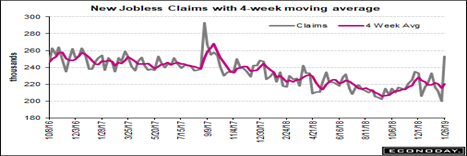
And as a prelude to tomorrow’s unemployment report, the weekly initial jobless claims reported by states rose abruptly in the January 26 week, up 53,000 to a 253,000 level that leaves the forecasters, at a consensus 220,000 and a high estimate of 225,000, scratching their heads. This is the highest total in more than a year-and-a-half.

image

Econoday.com

Was this an anomaly? Furloughed Federal employees from the government shutdown may be some of the answer but not all of it. They did add nearly 15,000 to the headline drop which is down more than 10,000 from the prior week, said Econoday. Contractors tied to the government (who don’t get any back pay) also likely added to the total though there are no specifics available in the data.

This leaves guesses about tomorrow’s January unemployment report up in the air. It’s likely to be much less than the gangbuster’s December report of 317,000 payroll jobs rise. It’s more likely to be around 180,000, which isn’t bad after all the geopolitical problems, such as Trump’s trade wars. Other countries are beginning to retaliate with their own higher tariffs. This doesn’t make for optimistic prognostications about future growth.

The International Monetary Fund is also downgrading worldwide growth due to the growing uncertainties such as whether Brexit will happen and the EU’s slowing growth, along with declining world trade projections.

The 2017 Republicans’ Tax Cut and Jobs Act hasn’t helped, either, which MarketWatch’s Howard Gold has labeled the Shareholder and CEO Enrichment Act of 2017.

“Corporations, big shareholders and top corporate executives reap the lion’s share of the gains from the 2017 tax cut. It didn’t boost economic growth that much, didn’t start a capital spending boom or U.S. manufacturing renaissance, didn’t bring overseas profits back home, and might have led to modest job growth but little discernible wage increases. And we’ll all be stuck with the bill for a long, long time.”

But why focus on the negatives, when American workers are finally benefiting from being fully employed? Job growth has picked up, having risen by 2.6 million in 2018, vs. a gain of 2.2 million in 2017. It’s unclear how much of that can be attributed to the tax cut, as I said, since health care and professional and business services jobs set set the pace, as they have for the past 30 years.

Let us see what tomorrow’s unemployment report looks like before we make any rash growth projections for 2019.

Harlan Green © 2019

Follow Harlan Green on Twitter: https://twitter.com/HarlanGreen
Posted in Consumers, Economy, Keynesian economics, Macro Economics, Weekly Financial News | Tagged , , , | Leave a comment

It’s the Consumer, Stupid

Answering the Kennedys Call—Part II

New York Times’ economic writer Neil Irwin in a recent Op-ed is not seeing a very robust future for global economic growth. “…what the last few months have made clear is that the forces that have held back the global economy for the last 11 years are not temporary, and have not gone away…The low-growth world was not just a phase. It’s the new reality beneath every macroeconomic question and debate for the foreseeable future.”

Really? Much of such pessimistic forecasting is based on a faulty understanding of economic history. I am paraphrasing the title of a controversial and little noticed 2011 New York Times Op-ed by Rutger’s history professor James Livingston, at a time when recovery from the Great Recession was still in doubt.

In it, he said, “As an economic historian who has been studying American capitalism for 35 years, I’m going to let you in on the best-kept secret of the last century: private investment — that is, using business profits to increase productivity and output — doesn’t actually drive economic growth. Consumer debt and government spending do. Private investment isn’t even necessary to promote growth.”

And yet most Americans still apparently buy the conservatives’ line that lower corporate and personal income taxes generate more jobs and growth, which hasn’t panned out for the latest Republican reduction in personal and corporate tax rates, either.

“Between 1900 and 2000,” wrote Professor Livingston, “real gross domestic product per capita (the output of goods and services per person) grew more than 600 percent. Meanwhile, net business investment declined 70 percent as a share of G.D.P. What’s more, in 1900 almost all investment came from the private sector — from companies, not from government — whereas in 2000, most investment was either from government spending (out of tax revenues) or “residential investment,” which means consumer spending on housing, rather than business expenditure on plants, equipment and labor.”

And that is why we have congresswoman Alexandria Octavio-Cortez’s call for a 70 percent maximum income tax rate and Presidential candidate Senator Elizabeth Warren’s just announced proposal for a wealth tax on the richest Americans with accumulated net wealth of more than $50 million.

“Warren herself hasn’t issued many details of her plan,” said the LA Times on her announcement, “But according to UC Berkeley economists Emmanuel Saez and Gabriel Zucman, who advised her on the proposal, the tax would be 2 percent on net worth above $50 million and another 1 percent on net worth above $1 billion. They say it would affect about 75,000 U.S. households, or less than 0.1 percent of the total, and raise $2.75 trillion over 10 years. That’s about 0.1 percent of gross domestic product per year.”

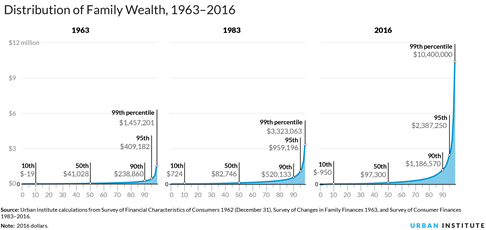
American conservatives have worked to lower taxes on the wealthiest, while enhancing the monopoly powers of corporations since at least 1980. It has resulted in the greatest income and wealth inequality in U.S. modern history, as illustrated by this Urban Institute graph.

image

Urban Institute

The result has not been good for a participatory democracy, as I said last week. But returning $2.75 trillion to federal government coffers over 10 years would be good for democracy, whether it can be put to use to implement more social programs like paid family leave, some form of private/public universal health care program, at least $1 trillion in repairs and upgrades of our ageing infrastructure, more education spending on preschoolers, and paying down some of the outstanding $1 trillion in student debt.

All of these items would vastly improve economic growth, both today and for future generations. So there is no need to believe Neil Irwin’s lament that the world can’t escape its “low growth, low inflation rut.”

We have not been paying attention to economic history, but condemned to repeat what hasn’t worked, says Professor Livingston.

“So corporate profits do not drive economic growth — they’re just restless sums of surplus capital, ready to flood speculative markets at home and abroad. In the 1920s, they inflated the stock market bubble, and then caused the Great Crash. Since the Reagan revolution, these superfluous profits have fed corporate mergers and takeovers, driven the dot-com craze, financed the “shadow banking” system of hedge funds and securitized investment vehicles, fueled monetary meltdowns in every hemisphere and inflated the housing bubble.”

That’s why it’s time to begin to put some of America’s accumulated wealth to better use than has been the case in recent decades.

Harlan Green © 2019

Follow Harlan Green on Twitter: https://twitter.com/HarlanGreen
Posted in Economy, Keynesian economics, Macro Economics, Politics, Weekly Financial News | Tagged , , , , | Leave a comment

What is a Living Wage?

Answering the Kennedys Call

The Washington Post published a recent interview with new Democratic House Member Alexandria Octavia-Cortez in which she said, “I think it’s wrong that a vast majority of the country doesn’t make a living wage, I think it’s wrong that you can work 100 hours and not feed your kids. I think it’s wrong that corporations like Walmart and Amazon can get paid by the government, essentially experience a wealth transfer from the public, for paying people less than a minimum wage.”

Is it true that most Americans don’t make a living wage? Actually, that is not the right question we should be asking, which has been the subject of endless debate, anyway. What constitutes a living wage has to be different for each individual. Wouldn’t someone born and raised amid extreme wealth, say, have what they consider a far different living wage than a religious ascetic?

Why not concentrate on what I believe Congresswoman Cortez is really talking about—the principle of fair play as applied to the majority of Americans? There are maybe 25 percent who live at or below the poverty line that have to work more than 40 hours per week to have a living income, depriving them of family, or enough leisure time to enjoy themselves. Europeans seem to have conquered the problem in countries like Denmark and the Netherlands, where the average workweek is 34 hours, with four weeks paid vacations and universal health care for their citizens.

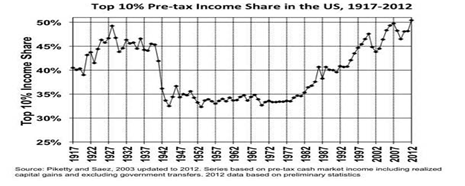
Meanwhile, American conservatives have worked to lower taxes on the wealthiest, while enhancing the monopoly powers of corporations since at least 1980. It has resulted in the greatest income inequality in the U.S. since 1928, in the wealthiest country in the world, as illustrated by this well-known Piketty-Saez graph.

image

WashingtonPost-Piketty-Saez

The result has not been good for a participatory democracy. The American electorate has become polarized, which has brought out the worst in human nature—including anti-immigrant racism, white nationalism, and the tearing down of government regulations that safeguard health and the environment. The consequence is a much reduced middle class that once maintained civility in political discourse.

Even conservative Barron’s Magazine editor Randall Forsythe mentions a 2017 Federal Reserve Consumer Finance study that showed the huge wealth disparities during the recent federal government shutdown—four in 10 Americans would have difficulty in meeting a $400 emergency expense—while the top 1 percent of income earners now own 50 percent of stockholdings.

image

www.pewresearch.org.

PEW Research in a 2018 report, reports that year-over-year average hourly earnings have been rising at 2 to 3 percent. “After adjusting for inflation, however, today’s average hourly wage has just about the same purchasing power it did in 1978, following a long slide in the 1980s and early 1990s and bumpy, inconsistent growth since then. In fact, in real terms average hourly earnings peaked more than 45 years ago: The $4.03-an-hour rate recorded in January 1973 had the same purchasing power that $23.68 would today.”

We are seeing the results of the singular focus on private profits rather than public welfare spending that includes adequate healthcare, improved infrastructure, and educational facilities that would elevate America back into the pantheon of western countries, instead of becoming an outlier that is withdrawing from the developed world.

Maybe we are also seeing how the word socialism is beginning to scare the wealthy to return some of their newly-begotten wealth to bring back a democracy that benefits the majority of Americans.

Harlan Green © 2019

Follow Harlan Green on Twitter: https://twitter.com/HarlanGreen
Posted in Consumers, Economy, Politics, Weekly Financial News | Tagged , , , , , | Leave a comment

What Happened to Consumers’ Confidence?

Financial FAQs

image

http://www.sca.isr.umich.edu/

Consumer sentiment declined in early January to its lowest level since Trump was elected, reported the December U. of Michigan sentiment survey. It’s down for a number of reasons—too many reasons, and economists are consequently beginning to predict GDP growth will be reduced to the 2 percent annual growth average that has prevailed since the end of the Great Recession.

“The decline was primarily focused on prospects for the domestic economy, with the year-ahead outlook for the national economy judged the worst since mid-2014. The loss was due to a host of issues including the partial government shutdown, the impact of tariffs, instabilities in financial markets, the global slowdown, and the lack of clarity about monetary policies. Aside from the direct economic impact from these various issues on the economy, the indirect effect meant that half of all consumers believed that these events would have a negative impact on Trump’s ability to focus on economic growth.”

How serious are the present crises? It depends on their duration. The shutdown is easiest to solve, if the parties can unite in agreement on what exactly constitutes a border ‘wall’—would a digital wall suffice, along with better-funded courts and more Border agents?

“While the January falloff in optimism is certainly consistent with a slowdown in the pace of growth,” said U of Michigan chief economist Richard Curtin, “it does not yet indicate the start of a sustained downturn in economic activity. It is the strength in personal finances that will continue to support consumption expenditures at favorable levels in 2019. Nonetheless, consumers now sense a need to buttress their precautionary savings, which is typically done by reducing their discretionary spending. Evolving job and wage prospects, which were slightly weaker in early January, are critical to extending the current expansion.”

Consumer confidence is based on other factors, as well, such as the job market. The other confidence index, the Conference Board’s Consumer Confidence Index showed lower future job expectations.

“Consumer Confidence decreased in December, following a moderate decline in November,” said Lynn Franco, Senior Director of Economic Indicators at The Conference Board. “Expectations regarding job prospects and business conditions weakened, but still suggest that the economy will continue expanding at a solid pace in the short-term. While consumers are ending 2018 on a strong note, back-to-back declines in Expectations are reflective of an increasing concern that the pace of economic growth will begin moderating in the first half of 2019.”

As has been mentioned by many commentators and economists, the Trump administration isn’t equipped or staffed to handle multiple crises, much less a serious single one. Michael Lewis’ The Fifth Risk was the latest warning of what might happen with an administration that didn’t want the federal government to function well, and appointed administration officials—mainly lobbyists of industries that it regulated—whose mandate was to make sure it increased the profits of their industries rather than the welfare of the American public. That meant it would have a difficult time handling any major crisis, such as the ongoing government shutdown.

So it’s easy to see why consumers are feeling queasy and want to save more of their rising incomes, rather than spend them. Other factors that might be scaring consumers are the ongoing tariff wars, and the IMF prediction of slower worldwide growth.

Maybe doing nothing, other than re-opening the federal government for business, is the better choice for maintaining healthy growth. A revised NAFTA agreement has yet to be ratified by the Senate to take effect. And a “lack of clarity about monetary policies” probably means the Federal Reserve will stop raising short term rates for a while, which will hearten the financial markets, as well.

Harlan Green © 2019

Follow Harlan Green on Twitter: https://twitter.com/HarlanGreen

Posted in Consumers, Economy, Politics, Weekly Financial News | Tagged , , , , , | Leave a comment

What’s Behind Brexit and the Politics of Fiscal Austerity?

Popular Economics Weekly

image

https://www.washingtonpost.com

The case can now be made that Briton’s vote to leave the EU was because of wrong-headed fiscal policies in the aftermath of the Great Recession. The housing bubble affected Europeans almost as much as Americans after 2008, busting their asset bubbles with stock market crashes and large job losses. And the UK’s response was draconian; raise taxes while cutting back on social welfare programs that benefited the not so wealthy.

This was to be achieved by a combination of UK public spending reductions and tax increases amounting to £110 billion, which made their downturn worse than that of the U.S., because Fed Chair Ben Bernanke and the Democratic congress advocated easing credit and spending some $787B to boost infrastructure repairs and depleted state budgets in the American Recovery and Reinvestment Act of 2009 (ARRA).

The Tory government of John Cameron did the opposite with a vengeance; beginning in 2010 to brutally slash £21 billion from its welfare budget that took away essential benefits from a large number of UK citizens; who then voted for the Brexit referendum in 2016. Tories used the standard conservative trope that public spending took away from private sector investments that could revive the economy by creating new jobs.

That is not a proven economic theory, however, as conservatives have never wanted to admit that corporations and other private businesses tend to hold back a large part of their profits to buy back stock and thus boost the incomes of stockholders and CEOs, rather than invest it into further growth and more jobs. Instead, austerity became the conservatives’ excuse for shrinking government services at the wrong time.

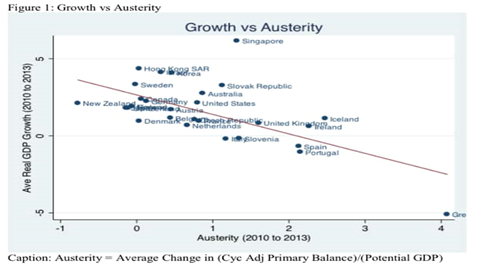
This is documented by the results of research from a University of Warwick economist, Themo Fetzer: “These reforms activated existing economic grievances,” said Fetzer. “Further, auxiliary results suggest that the underlying economic grievances have broader origins than what the current literature on Brexit suggests. Up until 2010, the UK’s welfare state evened out growing income differences across the skill divide through transfer payments. This pattern markedly stops from 2010 onwards as austerity started to bite.”

This has also been the case with U.S. programs that were put into place when the Tea Party took over Republican politics and began the series of austerity measures in 2011 that included a prior government shutdown and caps on public spending.

The result in both countries was that it increased income inequality, which enraged the newly disenfranchised, non-college educated males, in particular, that were most affected by the Great Recession. Brexit advocates blamed the EU for it budget woes, claiming that withdrawal would bring home all those revenues that went to support less prosperous members of the EU, as a huge influx of Poles and other Eastern European citizens flocked into the UK and took away less-skilled jobs that many Brits believed they depended on.

Nobel Economist Paul Krugman in a 2015 Guardian article wrote perhaps the best known critique of austerity programs that were enacted throughout much of the developed world as a result of the Great Recession: “Since the global turn to austerity in 2010, every country that introduced significant austerity has seen its economy suffer, with the depth of the suffering closely related to the harshness of the austerity. In late 2012, the IMF’s chief economist, Olivier Blanchard, went so far as to issue what amounted to a mea culpa: although his organisation never bought into the notion that austerity would actually boost economic growth, the IMF now believes that it massively understated the damage that spending cuts inflict on a weak economy.”

Republicans, blaming the Great Recession on a bloated federal budget and too many regulations, attempted to cut almost all welfare spending, and even  abolish Obamacare when they controlled the House and Senate.

But now that Repubs have all the political power? They are creating record budget deficits and national debt with their tax and regulation cutting policies. That tells us austerity was just an excuse to redistribute even more wealth to the corporations and Wall Street; rather than Main Street.

But also, that Brexit is the result of misplaced ideologies, rather than tried and true economic policies.

Harlan Green © 2019

Follow Harlan Green on Twitter: https://twitter.com/HarlanGreen
Posted in Economy, Keynesian economics, Macro Economics, Politics, Weekly Financial News | Tagged , , , , , , , | Leave a comment

Why Falling Home Sales?

The Mortgage Corner

image

Econoday.com

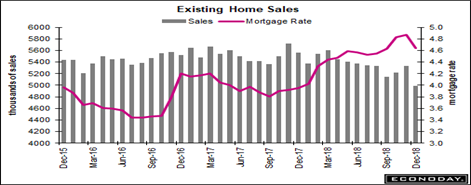
Total existing-home sales, https://www.nar.realtor/existing-home-completed transactions that include single-family homes, townhomes, condominiums and co-ops, decreased 6.4 percent from November to a seasonally adjusted rate of 4.99 million in December. Sales are now down 10.3 percent from a year ago (5.56 million in December 2017), said the National Association of Realtors.

Why is this happening, at a time when interest rates are plunging almost back to recession levels? The anti-regulation crowd says it’s due to the 2015 TRID regulations that gave borrowers three extra days to go over their loan documents before closing—thanks to Dodd-Franks, and the Consumer Finance Protection Bureau legislation enacted during the Obama administration.

Banks never liked the new regulations since it cost money to make the changes to borrower and closing documents. It protected borrowers who were sometimes confronted with changed loan terms at the closing, and had to either accept or possibly lose their new purchase.

But there’s a much more convincing reason for the sales drop off. Not enough housing inventory. New homes are not built fast enough to satisfy new adults of the millennial generation now forming families. These children of the baby boomers are the largest population segment ever, born approximately between 1980 and 1996. And most of the new homes are not being built in the affordable range.

Lawrence Yun, NAR’s chief economist, says current housing numbers are also partly a result of higher interest rates during much of 2018. “The housing market is obviously very sensitive to mortgage rates. Softer sales in December reflected consumer search processes and contract signing activity in previous months when mortgage rates were higher than today. Now, with mortgage rates lower, some revival in home sales is expected going into spring.”

In fact, interest rates have declined substantially since last fall, and are almost back to recession lows. The 30-year conforming fixed rate has dropped to 4.0 percent with one origination point, for the most credit-worthy borrowers.

And what about inventories? “Several consecutive months of rising inventory is a positive development for consumers and could lead to slower home price appreciation,” says Yun. “But there is still a lack of adequate inventory on the lower-priced points and too many in upper-priced points.”

And total housing inventory is much lower. It decreased at the end of December to 1.55 million, down from 1.74 million existing homes available for sale in November, but represents an increase from 1.46 million a year ago. Unsold inventory is at a 3.7-month supply at the current sales pace, down from 3.9 last month and up from 3.2 months a year ago.

Not enough new homes are being constructed, as I said. This is an incredibly low inventory level and a major reason for the lower sales’ numbers.

The median existing-home price for all housing types in December was $253,600, up 2.9 percent from December 2017 ($246,500). December’s price increase marks the 82nd straight month of year-over-year gains.

There are several reasons for the lower construction totals, but it can’t be higher interest rates, which have really only risen on the short term end—i.e., on the Prime Rate that controls installment loans, which is up more than 1.5 points to 5.50 percent.

So this should affect credit card and auto loan debt, but that debt hasn’t fallen, as consumers are flush with cash due to the low unemployment rate.

It’s really because many communities don’t want to build more affordable housing—the Not In My Backyard (NIMBY) crowd. The housing situation has deteriorated so badly at the lower and middle earner price range in states like California that new Governor Gavin Newsom is pledging to somehow finance—or create legislation that encourages the building of—3.5 million new units by 2025.

Harlan Green © 2019

Follow Harlan Green on Twitter: https://twitter.com/HarlanGreen
Posted in Consumers, Housing, housing market, Weekly Financial News | Tagged , , , , | Leave a comment

A Week of Conflicting Growth Signals

Popular Economics Weekly

image

Econoday

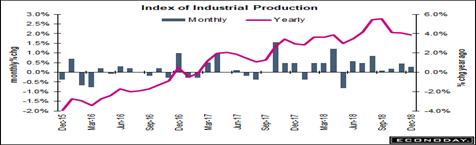
How do we reconcile the fact that industrial production in 2018 was very good, probably due to producers stocking up before more new tariffs are announced, and consumer sentiment has plunged to a 2-year low because of the government shutdown?

A surge in motor vehicle production together with construction supplies along with a strong gain for business equipment caused a 1.1 percent December increase in manufacturing production that far surpasses Econoday’s consensus range where the top estimate was only 0.4 percent.

Consumers power most economic activity with their spending, so when they grow worried about future prospects, spending and economic growth slow down. Hence the reduced growth expectations in 2019, as there is a growing consensus that a prolonged government shutdown will begin to harm large and small businesses.

Trump’s chief economic advisor Kevin Hasselt reports the shutdown has cost $1.2 billion in economic activity per week in just the first three weeks of 2019, and could cost much more if the shutdown continues.

image

U.Michigan

In what is the first major economic indication of trouble tied to the government shutdown, the consumer sentiment index plunged to a 90.7 reading that is far below consensus estimates of 95.5. The expectations component fell nearly 9 points to 78.3 with current conditions also taking a hit, down more than 6 points to 110.0.

Richard Curtin, chief economist of the U. of Michigan sentiment survey, reported “Consumer sentiment declined in early January to its lowest level since Trump was elected. The decline was primarily focused on prospects for the domestic economy, with the year-ahead outlook for the national economy judged the worst since mid-2014. The loss was due to a host of issues including the partial government shutdown, the impact of tariffs, instabilities in financial markets, the global slowdown, and the lack of clarity about monetary policies. Aside from the direct economic impact from these various issues on the economy, the indirect effect meant that half of all consumers believed that these events would have a negative impact on Trump’s ability to focus on economic growth.

Another casualty of the shutdown was that some government statistics, such as retail sales, haven’t reported for December. December sales are expected to be healthy, but then we have the usual January letdown as consumers retrench while waiting for their tax refunds that may also be delayed because of the shutdown.

So consumers are beginning to recognize the record shutdown length is affecting this year’s economic prospects,. And we shouldn’t forget what happened the last time higher tariffs were enacted. It was just prior to the 1929 stock market plunge. The Smoot-Hawley Tariff Act of 1930 raised import tariffs by an average 20 percent, which helped to turn it into the Great Depression.

Are we about to repeat that history?

Harlan Green © 2019

Follow Harlan Green on Twitter: https://twitter.com/HarlanGreen
Posted in Consumers, Economy, Politics, Weekly Financial News | Tagged , , , , | Leave a comment

Is There Too Little Inflation?

Financial FAQs

image

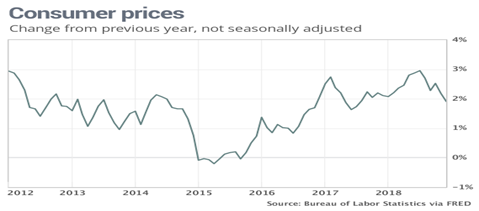
The Consumer Price Index for All Urban Consumers (CPI-U) declined 0.1 percent in December on a seasonally adjusted basis after being unchanged in November, the U.S. Bureau of Labor Statistics reported Friday. Over the last 12 months, the all items index increased 1.9 percent before seasonal adjustment.

The major reason has been falling gas prices. Energy fell 3.5 percent in December as gasoline prices dropped for a second straight month, down 7.5 percent. Transportation costs in general slipped as airfares continued their decline, down 1.5 percent on the month following a 2.4 percent drop in November, according to Econoday.

It’s also why we have abnormally low interest rates at this late stage of the recovery, which actually mirror the amount of excess savings. No matter how much individuals and businesses have borrowed since the Great Recession, interest rates have stayed low. It’s as if there’s a bottomless supply of liquidity that holders of said currencies—including most of the world’s central banks—are eager to put to work in some way.

This could also be a worrisome indicator of what economists call slack demand. Consumers and businesses are spending less and saving more, in spite of the U.S. economy being fully employed with a 3.9 percent unemployment rate. The overall demand for goods and services has fallen from historical levels since the Great Recession as consumers and businesses have become more cautious than in other recoveries, and when consumer economic activity now determines some 70 percent of economic growth.

This is while household incomes have barely kept up with inflation for decades from the progressive weakening of employee bargaining rights since the 1980s, and may only now be increasing with the fully-employment economy.

Former Fed Chair Janet Yellen has entered the discussion with her prediction that the U.S. is stuck in a low-inflationary environment. “All evidence suggests we’re going to be in an environment of low interest rates for a long time,” she said at a recent tech conference.

Such slack overall demand could also be a problem because the Trump trade wars are pushing up the cost of materials. This is hurting U.S. sales overseas, because U.S. export firms have had to raise their prices due to the rising costs of imported materials, such as aluminum and steel that have 10 and 25 percent tariffs, respectively.

Such low inflation is therefore a two-edged sword in many ways. Lower inflation means products are more affordable to larger segments of the population, but it is also a sign that without rising prices producers cannot boost profits, hindering their growth prospects.

All-in-all, this means such stubbornly low inflation can also mean lower prospects for future job growth, hence lower overall economic growth, as well.

Harlan Green © 2019

Follow Harlan Green on Twitter: https://twitter.com/HarlanGreen
Posted in Consumers, Economy, Weekly Financial News | Tagged , , , , | Leave a comment

America’s Immigration Problem

Popular Economics Weekly

image

CalculatedRiskBlog

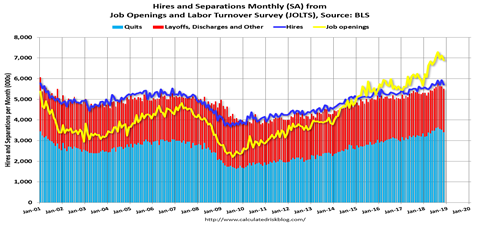
The Calculated Risk graph says it best in the Labor Department’s latest Job Openings and Labor Turnover Survey (JOLTS). There are still about one million more job openings (yellow line) than hires (blue line). There have been more openings than hires since January 2015, according to Calculated Risk.

This tells us several things about the U.S. economy. Firstly, America has a skilled labor shortage because technological innovation exceeds the existing labor force—in fact throughout its history.

America is still a young country in many ways, and our birthrate is declining. This is in contrast to older developed and developing countries in Europe and Asia that have had labor surpluses existing before the various technological revolutions.

Secondly, it is why we so badly need new immigrants to fill those vacancies. Therefore restricting immigration is counter-productive in so many ways. It restricts the growth of our labor force, which directly affects economic growth, and denies America’s history as the land of opportunity. America was founded by immigrants, and it is immigrants that contribute new ideas as well as new blood to our creative mix.

Lastly, the huge gap between job hires and openings tells us there shouldn’t be a fear of recession, or even a significant slowdown, for maybe years to come. Why? Job openings continue to far exceed the six million looking for work, according to the (BLS).

The number of job openings fell to 6.9 million on the last business day of November, the U.S. Bureau of Labor Statistics (BLS) reported today. Over the month, hires edged down to 5.7 million, quits edged down to 3.4 million, and total separations were little changed at 5.5 million. Within separations, the quits rate and the layoffs and discharges rate were unchanged at 2.3 percent and 1.2 percent, respectively. This release includes estimates of the number and rate of job openings, hires, and separations for the nonfarm sector by industry and by four geographic regions.

The BLS said large numbers of hires and separations occur every month throughout the business cycle. When the number of hires exceeds the number of separations, employment rises, even if the hires level is steady or declining. Conversely, when the number of hires is less than the number of separations, employment declines, even if the hires level is steady or rising.

And over the 12 months ending in November, hires totaled 68.0 million and separations totaled 65.6 million, yielding a net annual employment gain of 2.4 million. (These totals include workers who may have been hired and separated more than once during the year.)

So U.S. economic growth should continue to perk along, even if it slows to the historical rate of 2 percent that has prevailed since the end of the Great Recession. It may never climb above that rate without more workers joining the workforce, and there is more public sector investment. We know what those investments should be—infrastructure modernization, improving educational opportunities, combating global warming, etc.—that would give a big boost to labor productivity as well.

The ideal would be to spend more in public investments, but if congress can’t agree on more spending, either American households increase their number of offspring (which is highly unlikely) and/or we reverse the current administration’s anti-immigration policies.

Harlan Green © 2019

Follow Harlan Green on Twitter: https://twitter.com/HarlanGreen

Posted in Consumers, Economy, Macro Economics, Weekly Financial News | Tagged , , , | Leave a comment