A Gangbusters December Employment Report

Popular Economics Weekly

image

MarketWatch.com

Total nonfarm payroll employment increased by 312,000 in December, and the unemployment rate rose to 3.9 percent, the U.S. Bureau of Labor Statistics reported today. Job gains occurred in health care, food services and drinking places, construction, manufacturing, and retail trade.

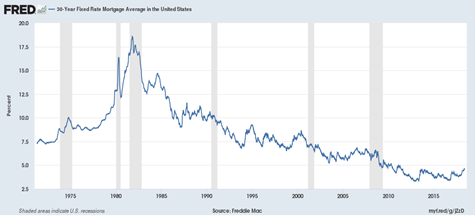
It looks like the U.S. economy isn’t slowing as much as feared, contrary to the pessimists that have been driving down stock prices, while driving up bond prices, so that the 10-year Treasury bond yield is now 2.65 percent, and conforming 30-year fixed mortgage rates are at 3.875 percent with a 1 point origination fee for the best credit holders.

Health-care providers hired 50,000 people, professional firms filled 43,000 positions, manufacturers added 32,000 jobs, construction firms’ payrolls rose by 32,000 and restaurants hired 41,000 additional workers.

The unemployment rate, meanwhile, rose to 3.9 percent from a 49-year low of 3.7 percent. The percentage of working-age Americans in the labor force climbed to a one-and-a-half-year high as more people looked for jobs. That is a good sign since it means people think more jobs are available.

Strong hiring has also given workers more bargaining power. The amount of money the average worker earns climbed 11 cents or 0.4 percent to $27.48 an hour last month.

Who says the housing market is dead, as well? These low interest rates will stimulate more borrowing and home buying. And Fed Chairman Jerome Powell said the Fed would be flexible about raising interest rates this year at a recent conference. “We will be patient as we watch to see how the economy evolves,” given the low inflation outlook, he said.

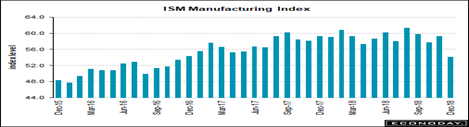
The employment report contradicted yesterday’s December ISM Manufacturing Index that showed a slowdown in manufacturing hiring, falling more than 5 points to a 54.1 level. This is the lowest showing for this index since November 2016. Especially new orders slowed by 10 points to a 51.1 level that is suddenly very close to breakeven 50. It means approximately half of the supply managers surveyed saw an order slowdown.

This is the lowest showing for new orders since August 2016. Weakness is entirely on the domestic side, says Econoday, as one of the few positives in December’s data is a 6 tenth rise in new export orders to 52.8 which is respectable for this particular reading.
image

Econoday.com

The real question is what will economic growth look like in 2019. It will depend largely on a favorable outcome of the trade talks, which means a lowering of the Trump tariffs that do little for American interests, or American consumers.

That’s because higher tariff fees get passed on to consumers, ultimately, which pushes up inflation, then Federal Reserve interest rates; which cuts into consumer spending. And then we have to worry about the soaring federal deficits, which means new taxes will be enacted sometime down the road.

However, this doesn’t worry Nobelist Paul Krugman at the moment in a recent NYTimes Op-ed: “…there are things government should be spending money on even when jobs are plentiful—things like fixing our deteriorating infrastructure and helping children get education, healthcare and adequate nutrition. Such spending has big long-run payoff, even in purely monetary terms.”

The bottom line is money is cheap at the moment with the very low interest rates, so this isn’t the time to worry about budget deficits. It’s much more important to be investing public monies into future growth and productivity that could even prolong this business cycle, now in its tenth year of continuous growth.

Harlan Green © 2018

Follow Harlan Green on Twitter: https://twitter.com/HarlanGreen
Posted in Consumers, Economy, housing market, Weekly Financial News | Tagged , , , , | Leave a comment

In Search of a Moral Economy

Financial FAQs

image

vox.com

Vermont Senator Bernie Sanders defined a moral economy in a recent Duke University dialogue with the Reverend William Barber II: ““A moral economy is one that says, ‘In the wealthiest country in the history of the world, all our people should be able to live with dignity and security.’”

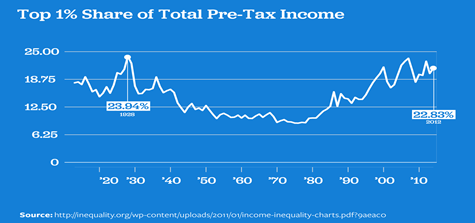
We don’t have to quote the very progressive U.S. Senator to know what a moral economy should look like. One has only to study the history of income and wealth redistribution since 1980 when demand-side economic theory—the Keynesian economics of English Lord John Maynard Keynes that guided Roosevelt’s New Deal—was replaced by so-called supply-side policies—under the conservative but never validated premise that enhancing the wealth of holders of capital with lower taxes and regulations would maximize production, while suppressing the rights and wages of their workers.

History since then has borne out the immorality of what came to be called trickle-down economics—record income inequality in the American workforce. Its rationale came from a diagram on a napkin that then White House Chief of Staff Dick Cheney took to heart as the mantra that guides conservative Republicans even today.

It’s an absurd equation. President Reagan at the time believed that lower taxes would motivate workers to work harder and produce more. The problem was reducing everyone’s taxes would stymie government programs that helped to level the opportunity table. It was the wealthiest that benefited most with reduced personal tax rates that were as high at 92 percent in the Eisenhower administration, which financed the federal highway system, sent us to the moon, and instigated many of the public programs that have made America so productive.

It’s hard to know where this thought process came from. History shows that people work just as hard—sometimes even harder—when they receive a smaller share of their paycheck; especially when a portion goes to insure future benefits like workman’s compensation insurance, social security, Medicare and Medicaid.

But conservatives latched onto several Austrian economists who hated any form of authority; so much so that they advocated limiting the powers of democratically elected governments to care for their own citizens. Such was the fear of centralized authority by economists like Fredrick Hayek in his book, whose book, The Road to Serfdom, called any regulations to tame capitalism a form of enslavement without recognizing that raw, unregulated capitalism meant serfdom and exploitation of those workers.

image

Graph: metroscan.com

We do now have a better understanding of how capitalism—the worst economic system, except for all of the others (to paraphrase Churchill)—works for Main Street as well as Wall Street.

It means in part returning to the much more progressive tax rates of earlier U.S. administrations—before President Reagan made the immoral tax cuts that even underfunded the military at the time, and initiated the massive federal debt burden we carry today.

All the public programs funded by governments today enhance prosperity and productivity in some way—whether it’s to upgrade our infrastructure, fund new health discoveries, strengthen the public insurance and pension programs; as well as protect the environment, without which no Americans can prosper over the long term.

Then we can afford to protect those most in need. That is what a moral economy looks like.

Harlan Green © 2018

Follow Harlan Green on Twitter: https://twitter.com/HarlanGreen

Posted in Economy, Keynesian economics, Macro Economics, Politics | Tagged , , , , , , | Leave a comment

Will 2019 Be Year U.S. Begins to Reunite?

Popular Economics Weekly

image

vox.com

Wonder of wonders, is New York Times conservative columnist David Brooks becoming a neo-Keynesian, New Deal economist? This is the term coined for those younger economists, such as Nobel economists Paul Krugman, Joe Stiglitz and George Akerlof, who have updated John Maynard Keynes’ New Deal theories that helped to bring us out of the Great Depression and created today’s developed economies.

Brooks isn’t a trained economist, but he has been looking for a new political center in his more recent columns—mostly in reaction to the Trump administrations betrayal of free trade and limited debt, mainstay ideas of the former Republican Party, but also its takeover by the Trump administration.

Brooks said in a recent NYTimes Op-ed, “The nations that have the freest markets also generally have the most generous welfare states. The two are not in opposition. In the real world they go together.”

“What generous welfare states?” Western national governments have stepped in wherever the private sector has proved unable or unwilling to support economic growth and general prosperity since World War II. And it was Roosevelt’s New Deal programs that created social security, unemployment insurance, enshrined workers’ rights, and the modern industrial economy that enabled us to win World War II.

So 2019 may be the year that the political parties and American electorate begin to come together, to show a willingness to compromise their ideals and their convictions in reaction to the “Make America First” doctrine of the Tea Party and white nationalist supporters of the Trump administration.

The newly elected Democratic House of Representatives may be the first concrete result of this trend towards more centrist policies in January 2019 with more than 200 women now in the 435 member House. Who better than women to make compromises in the name of getting things done, as they have done in their households since the beginning of time?

Another sign is the more centrist views of conservative writers that Brooks has cited, beginning with the Niskanen Center, an offshoot of the conservative Cato Institute, which released a comprehensive report called, “The Center Can Hold: Public Policy for an Age of Extremes,” written by Brink Lindsey, Steven Teles, Wilkinson and Hammond. The report is a manifesto for a new centrism based on what the authors call a “free-market welfare state model, says Brooks.

“They want government to protect citizens against the disruptions of global capitalism: “Without strong income supports that put a floor beneath displaced workers and systems that smooth the transition to new employment, political actors and the public tend to turn against the process of creative destruction itself.”

By creative destruction, Brooks means the tendency of capitalist economies to throw out the old to make room for new innovations and industries, regardless of the consequences to workers in the old industries—like manufacturing in the Midwestern rustbelt. The economic consequences have been devastating for those regions, needless to say.

What Brooks and his fellow conservative centrists don’t say, however, is that modern capitalists have become monopolists is almost every sense of the world. Just a few major corporations dominate the old manufacturing and energy sectors. And the new digital economy is dominated by the so-called Silicon Valley Big Five—Google, Microsoft, Facebook, Apple and Amazon—that have almost totally escaped oversight; until now.

This tendency towards ‘monopsony’ in under-regulated capitalist economies—the economic term for employers having excessive control over their labor market—is what led to “global capitalism” and too big to fail multinational corporations.

This is in fact earth shaking news emerging from the past of a Republican Party that created the U.S. Environmental Protection Agency and first proposed expanding government-subsidized health care in the 1970s. Let us hope America can return to the two-party system that enabled compromise, a more generous welfare state, and less destructive form of capitalism.

It would be a new beginning for the Re-United States of America.

Harlan Green © 2018

Follow Harlan Green on Twitter: https://twitter.com/HarlanGreen
Posted in Uncategorized | Tagged , , , , , | Leave a comment

Will 2019 Be Year U.S. Begins to Reunite?

Popular Economics Weekly

image

vox.com

Wonder of wonders, is New York Times conservative columnist David Brooks becoming a neo-Keynesian, New Deal economist? This is the term coined for those younger economists, such as Nobel economists Paul Krugman, Joe Stiglitz and George Akerlof, who have updated John Maynard Keynes’ New Deal theories that helped to bring us out of the Great Depression and created today’s developed economies.

Brooks isn’t a trained economist, but he has been looking for a new political center in his more recent columns—mostly in reaction to the Trump administrations betrayal of free trade and limited debt, mainstay ideas of the former Republican Party, but also its takeover by the Trump administration.

Brooks said in a recent NYTimes Op-ed, “The nations that have the freest markets also generally have the most generous welfare states. The two are not in opposition. In the real world they go together.”

“What generous welfare states?” Western national governments have stepped in wherever the private sector has proved unable or unwilling to support economic growth and general prosperity since World War II. And it was Roosevelt’s New Deal programs that created social security, unemployment insurance, enshrined workers’ rights, and the modern industrial economy that enabled us to win World War II.

So 2019 may be the year that the political parties and American electorate begin to come together, to show a willingness to compromise their ideals and their convictions in reaction to the “Make America First” doctrine of the Tea Party and white nationalist supporters of the Trump administration.

The newly elected Democratic House of Representatives may be the first concrete result of this trend towards more centrist policies in January 2019 with more than 200 women now in the 500 member House. Who better than women to make compromises in the name of getting things done, as they have done in their households since the beginning of time?

Another sign is the more centrist views of conservative writers that Brooks has cited, beginning with the Niskanen Center, an offshoot of the conservative Cato Institute, which released a comprehensive report called, “The Center Can Hold: Public Policy for an Age of Extremes,” written by Brink Lindsey, Steven Teles, Wilkinson and Hammond. The report is a manifesto for a new centrism based on what the authors call a “free-market welfare state model, says Brooks.

“They want government to protect citizens against the disruptions of global capitalism: “Without strong income supports that put a floor beneath displaced workers and systems that smooth the transition to new employment, political actors and the public tend to turn against the process of creative destruction itself.”

By creative destruction, Brooks means the tendency of capitalist economies to throw out the old to make room for new innovations and industries, regardless of the consequences to workers in the old industries—like manufacturing in the Midwestern rustbelt. The economic consequences have been devastating for those regions, needless to say.

What Brooks and his fellow conservative centrists don’t say, however, is that modern capitalists have become monopolists is almost every sense of the world. Just a few major corporations dominate the old manufacturing and energy sectors. And the new digital economy is dominated by the so-called Silicon Valley Big Five—Google, Microsoft, Facebook, Apple and Amazon—that have almost totally escaped oversight; until now.

This tendency towards ‘monopsony’ in under-regulated capitalist economies—the economic term for employers having excessive control over their labor market—is what led to “global capitalism” and too big to fail multinational corporations.

This is in fact earth shaking news emerging from the past of a Republican Party that created the U.S. Environmental Protection Agency and first proposed expanding government-subsidized health care in the 1970s. Let us hope America can return to the two-party system that enabled compromise and a more generous welfare state, and less destructive form of capitalism.

It would be a new beginning for a Re-United States of America.

Harlan Green © 2018

Follow Harlan Green on Twitter: https://twitter.com/HarlanGreen
Posted in Consumers, Economy, Keynesian economics, Politics | Tagged , , , , , | Leave a comment

Why the Fed’s Obsession With Inflation?

Popular Economics Weekly

image

tradingeconomics.com/FRED

The Federal Reserve’s December FOMC statement, said, after increasing their overnight rate another one-quarter percent: “Consistent with its statutory mandate, the Committee seeks to foster maximum employment and price stability. The Committee judges that some further gradual increases in the target range for the federal funds rate will be consistent with sustained expansion of economic activity, strong labor market conditions, and inflation near the Committee’s symmetric 2 percent objective over the medium term.”

Why is there still worry over inflation, 40 years after the 1970’s wage-price spiral that caused so much pain, and initiated the Fed’s obsession with keeping a low inflation target in the first place?

One has only to look at the decline of real wages and salaries since the 1980s, to realize the Fed puts most of the inflation blame on real wages, the incomes of the working and middle classes. They use the outmoded formula that labor costs make up two-thirds of product costs; ergo, every time wages begin to rise the Fed must raise rates to keep wages from rising higher to prevent more inflation.

But the history of the Consumer Price Index gauge of retail inflation from 1929 portrayed in the above graph proves that inflation has been almost non-existent above 2 percent, with occasional bumps to 4 percent during boom times; except for the sharp spike in 1980 due to the wage-price spiral caused by the jump in oil prices of the 1970’s Arab oil embargos.

Then what are said “strong labor conditions” the Fed seems to be worried about that merit the quarter-point raise this week? The unemployment rate is 3.7 percent, but wages are barely rising above today’s 2 percent inflation rate these days, even in a fully-employed economy. And the Fed predicts 2 percent inflation through 2021 in its just-released predictions with full employment also continuing through 2021.

image

They must not really believe wage costs determine inflation, if they predict low inflation will persist with full employment in the 3 percent range, per their above matrix. That can’t happen. The “strong labor market conditions” haven’t pushed up production costs, with so-called unit-labor costs rising just 0.9 percent Q-to-Q.

So what is the Fed to do? It should not tie their inflation predictions to wage increases, for starters. Inflation is caused by much more than rising wages. In today’s low inflation environment where robots are replacing many workers, the costs of production are tied more to the costs of robots, rather than labor personnel.

Tesla’s new Fremont, CA fully-automated Model 3 electric vehicle factory that was set up in just 3 weeks is evidence robots now control the cost and pace of production more than the personnel.

Harlan Green © 2018

Follow Harlan Green on Twitter: https://twitter.com/HarlanGreen

Posted in Consumers, Macro Economics, Politics, Weekly Financial News | Tagged , , , , | Leave a comment

Where Goes the Housing Market?

The Mortgage Corner

image

Calculated Risk

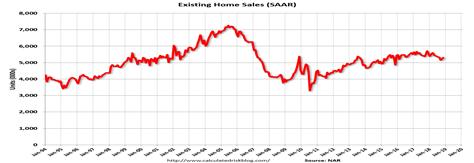
WASHINGTON (December 19, 2018) – Existing-home sales increased in November, said the National Association of Realtors®, marking two consecutive months of increases. Three of four major U.S. regions saw gains in sales activity last month.

Total existing-home sales, https://www.nar.realtor/existing-home-sales, completed transactions that include single-family homes, townhomes, condominiums and co-ops, increased 1.9 percent from October to a seasonally adjusted rate of 5.32 million in November. Sales are now down 7.0 percent from a year ago (5.72 million in November 2017).

Why the return to increased sales after the market downturn? The 30-year fixed conforming mortgage rate has dropped back to 4 percent with a 1 point origination fee, 4.25 percent with 0 points in origination fees for the most qualified borrowers. Rates are lower because there is almost no inflation and investors are fleeing back to bonds as a safe haven in an unsafe world at present.

Lawrence Yun, NAR’s chief economist, said two consecutive months of increases is a welcomed sign for the market. “The market conditions in November were mixed, with good signs of stabilizing home sales compared to recent months, though down significantly from one year ago. Rising inventory is clearly taming home price appreciation.”

image

Calculated Risk

The housing market is cooling, in other words. Inventories of unsold homes have been rising year-over-year; housing prices and inventories in the west, particularly, have soared. Las Vegas inventory is the rising red line on the Calculated Risk graph, the black line is the NAR’s national inventory level.

“A marked shift is occurring in the West region, with much lower sales and very soft price growth,” said Yun. “It is also the West region where consumers have expressed the weakest sentiment about home buying, largely due to lack of affordable housing inventory.”

The median existing-home price for all housing types in November was $257,700, up 4.2 percent from November 2017 ($247,200). November’s price increase marks the 81st straight month of year-over-year gains.

Total housing inventory at the end of November decreased to 1.74 million, down from 1.85 million existing homes available for sale in October. This represents an increase from 1.67 million a year ago, however. Unsold inventory is at a 3.9-month supply at the current sales pace, down from 4.3 last month and up from 3.5 months a year ago.

Properties typically stayed on the market for 42 days in November, up from 36 days in October and 40 days a year ago. Forty-three percent of homes sold in November were on the market for less than a month, which is still a good number.

“It is not surprising to see homes remain on the market a little longer,” said NAR President John Smaby. “Buyers can often negotiate a more favorable price in those circumstances, especially when paired with a motivated seller and the aid of a Realtor familiar with their local market.”

The result is more apartment units are being built to accommodate the rising number of new households—mainly in the millennial generation, say home builders. So it does look like the housing market has topped and is in a slow decline. But with interest rates continuing to fall, and home purchases more affordable again, the decline in single-family construction may reverse.

Harlan Green © 2018

Follow Harlan Green on Twitter: https://twitter.com/HarlanGreen

Posted in Consumers, Housing, housing market, Weekly Financial News | Tagged , , , | Leave a comment

Why Isn’t Inflation a Problem?

Popular Economics Weekly

image

us.econoday.com

It looks like inflation will no longer be a problem holding back consumer spending for the forseeable future; or in any other economy in the developed world as well.

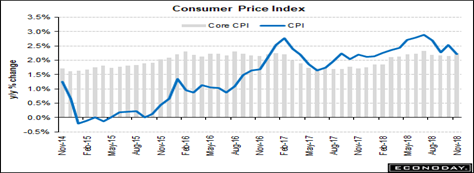
It’s not a problem because economies today can quickly ramp up production and sell into multiple international markets due to the new technologies and labor-saving devices that keep popping up. It’s why the Consumer Price Index (CPI) is increasing just 2.2 percent annually, when energy and food price fluctuations are taken out.

This is both good and bad for a number of reasons. Firstly, it means interest rates won’t rise very fast, lowering borrowing costs for consumers and businesses, the boost to consumers.

The increased use of robotics in the service and manufacturing sectors is just one example that makes this possible. Labor productivity has surged. The U.S. Bureau of Labor Statistics just reported nonfarm business sector labor productivity increased 2.3 percent during the third quarter of 2018, I reported last week, as output increased 4.1 percent and hours worked increased just 1.8 percent. Declining unit labor costs over the past 12 months are the reason productivity has increased at the same time as output.

That means labor costs aren’t rising either, which boosts labor productivity, and higher productivity boosts everyone’s standard of living. The average labor productivity rate of 2 percent since World War II has doubled the standard of living every 25 years for workers.

It means personal incomes are rising faster than inflation, at the moment, which boosts consumer buying power. But the prolonged low inflation since the end of the Great Recession also means aggregate demand (the overall demand by consumers, investors and government for ‘things’) has not been strong enough to boost GDP grown above 2 percent.

But we could also be returning to a period of disinflation—falling inflation—or outright deflation that lasted for two decades in Japan, and that Federal Reserve officials worried about in the past—hence Ben Bernanke’s ‘Helicopter Ben’ moniker when he said in early 2000s somewhat facetiously that dropping money from helicopters is one way to combat deflation.

Should we worry about continued low inflation that worried the Fed for so long and resulted in the QE security purchases that have kept interest rate at rock bottom for so long? Yes, because wages and salaries are not rising as fast as they should to boost aggregate demand and therefore maintain economic growth in the longer term 3 percent average range. This due to a number of reasons, including labor-unfriendly administrations that took away labor protections.

And that’s why there isn’t the money for badly needed infrastructure, healthcare, education, and just about everything in the public sector that only governments can do. Slow growth also means many lack a decent living wage or standard of living.

Harlan Green © 2018

Follow Harlan Green on Twitter: https://twitter.com/HarlanGreen
Posted in Consumers, Economy, Weekly Financial News | Tagged , , , , , | Leave a comment

Our Loneliest Generation?

Answering the Kennedys Call

image

theatlantic.com

Much of my forthcoming book, Answering the Kennedys Call; Solutions in Public Service and Community-Building for the Future documents how we can rebuild the broken communities and sense of isolation that is afflicting so many Americans today.

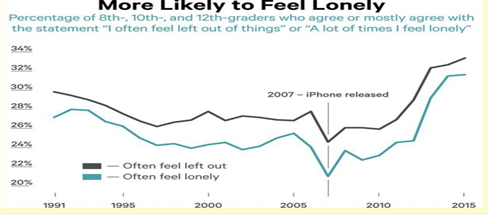
One facet of broken communities is the growing sense of loneliness and unhappiness in newer generations, due in part to the dominance of social networking with smartphones, Facebook, Instagram, and Snapchat.

Child Psychologist Jean Twenge says the iphone generation, those born between 1995 and 2012, are now the loneliest generation in a 2017 Atlantic Magazine article, and book, iGen: Why Today’s Super-Connected Kids Are Growing Up Less Rebellious, More Tolerant, Less Happy—and Completely Unprepared for Adulthood—and What That Means for the Rest of Us..

“Psychologically, they are more vulnerable than Millennials were: Rates of teen depression and suicide have skyrocketed since 2011. It’s not an exaggeration to describe iGen as being on the brink of the worst mental-health crisis in decades. Much of this deterioration can be traced to their phones.”

Social Scientists first saw an increase in Americans’ feelings of loneliness in the 1970s—at the same time as the advent of the World Wide Web (the Internet), and the personal computer first introduced by Apple in 1976. But then it was the millennials who were the most affected, and unhappy—the children of the baby boomers.

The University of Chicago’s annual General Social Survey has also found that the number of Americans with no close friends has tripled since 1985. “Zero” is the most common number of confidants, reported by almost a quarter of those surveyed. Likewise, the average number of people Americans feel they can talk to about “important matters” has fallen from three to two.

And the results of rising loneliness have been mixed, as the title of Twenge’s book highlights—they are somewhat slower to mature and acquire social skills to successfully negotiate adult life. There is greater social isolation as teens focus on their phones—even sleeping with them under the pillow—rather than acknowledging their physical surroundings. This especially affects their physical health; they spend less hours sleeping (averaging 7 hours vs. 9 hours needed by most teens).

“It’s not only a matter of fewer kids partying; fewer kids are spending time simply hanging out,” says Twenge. “That’s something most teens used to do: nerds and jocks, poor kids and rich kids, C students and A students. The roller rink, the basketball court, the town pool, the local necking spot—they’ve all been replaced by virtual spaces accessed through apps and the web.“

Rising levels of depression and suicides are the most alarming results from such social isolation, isolation that runs counter to our evolutionary development—when social skills were necessary for survival in that it enabled them to recognize friend from foe.

Girls have also borne the brunt of the rise in depressive symptoms among today’s teens. Boys’ depressive symptoms increased by 21 percent from 2012 to 2015, while girls’ increased by 50 percent—more than twice as much. The rise in suicide, too, is more pronounced among girls. Although the rate increased for both sexes, three times as many 12-to-14-year-old girls killed themselves in 2015 as in 2007, compared with twice as many boys. The suicide rate is still higher for boys, in part because they use more-lethal methods, but girls are beginning to close the gap.

The Kaiser Family Foundation in conjunction with The Economist has been measuring loneliness among U.S., U.K., and Japanese citizens. More than a fifth of adults in the United States (22 percent) and the United Kingdom (23 percent) as well as one in ten adults (nine percent) in Japan say they often or always feel lonely, feel that they lack companionship, feel left out, or feel isolated from others, and many of them say their loneliness has had a negative impact on various aspects of their life.

“People experiencing loneliness disproportionately report lower incomes and having a debilitating health condition or mental health conditions,” said the @KaiserFamFound/@Economist survey. “About six in ten say there is a specific cause of their loneliness, and, compared to those who are not lonely, they more often report being dissatisfied with their personal financial situation. They are also more likely to report experiencing negative life events in the past two years, such as a negative change in financial status or a serious illness or injury. Three in ten say their loneliness has led them to think about harming themselves.”

It is part of the larger breakdown of American communities studied by Robert Putnam in his ground-breaking book, Bowling Alone, the Collapse and Revival of American Community. Putnam warns that our stock of social capital – the very fabric of our connections with each other, has plummeted, impoverishing our lives and communities.

This means communities must be strengthened, with more focus put on bringing neighborhoods together. One aid is with national social networks like Next Door that seeks to bring neighbors out of their homes, computers and iphones to connect and help each other with day-to-day concerns, like cleaning the streets, advertising lost and found items, or just knowing who are their neighbors.

Nextdoor’s virtual communities—that now cover more than 180,000 U.S. neighborhoods, including more than 90 percent of those in the 25 largest cities—are becoming representative of the country’s actual populations, say its San Francisco founders.

This is social networking at its best—building community again by humanizing the tech tools that have been dividing us.

Harlan Green © 2018

Follow Harlan Green on Twitter: https://twitter.com/HarlanGreen

Posted in Consumers, Uncategorized | Tagged , , | Leave a comment

It’s the Third Largest Housing Boom Ever!

The Mortgage Corner

image

fred.stlouisfed.org

The 10-year Treasury bond yield has fallen back to 2.86 percent, which is usually recession territory. And the 30-year conforming fixed rate is 4.125 percent again with a 1-point origination fee. This is unheard of in a fully employed economy currently growing at 3 percent. Longer term rates should be rising at such a time, not falling, as I said last week.

Then are we approaching recession territory? Nobel laureate Robert Shiller, perhaps the most informed behavioral economist following the housing market, has just opined that we are in the third largest housing boom, ever. He won last year’s Nobel Prize in the Economic Sciences because he has taken the trouble to understand Americans’ financial behavior in the housing market.

Only two other housing booms—the housing bubble preceding the Great Recession and that in post WWII 1940’s—lasted longer. Existing-home prices have risen 53 percent since 2012, 40 percent after inflation is factored in, said Professor Shiller.

“Since February 2012, when the price declines associated with the last financial crisis ended, prices for existing homes in the United States have been rising steadily and enormously. According to the S&P/CoreLogic/Case-Shiller National Home Price Index (which I helped to create) as of September, the prices were 53 percent higher than they were at the bottom of the market in 2012.”

It’s possible we are at the top of this housing boom, which means at the top of this business cycle, as well, since the financial markets usually follow where housing goes. Housing prices and housing demand are forward-looking indicators, in other words, because home buyers are sensitive to inflation and interest rate trends.

Actually, Professor Shiller maintains most investors are fairly lazy in their research of investments, including housing purchases, which is why we have housing bubbles. That’s because investors tend to listen to good stories or word-of-mouth opinions by others they may or may not trust, rather than do their own research that might tell them the innate value of an investment in greater depth.

Such ‘irrational exuberance’ caused the last housing bubble because homebuyers believed the conventional story that home prices would never decline; and they hadn’t since World War Two. That’s why homebuyers pushed up housing prices as much as 20 percent per year before the bubble burst in 2018, and housing prices declined for the first time since World War Two!

Shiller goes through all the possibilities for the current housing boom, including good economic times and the low jobless rate, but I vote for the simplest explanation— low interest rates.

It’s true 30-year conforming fixed mortgage rates were even lower last year at this time; as low as 3.50 percent; but the Fed is no longer buying mortgage-backed securities with their QE program. They are now selling a portion of their $4 trillion portfolio. This should boost mortgages and other longer term fixed yields; but that isn’t happening as investors prefer to snap up more secure sovereign debt insured by the ‘faith and credit’ of the U.S. government.

Then do we have a housing bubble today? Not yet, as there are far too few homes being built at present. Builders are playing catchup to the lingering results of the Great Recession—too many low-paying jobs, too strict qualification standards by conforming lenders that sell to Fannie Mae and Freddie Mac (those entities still owned by the federal government), and cities that don’t want more homes built in their own backyard.

Harlan Green © 2018

Follow Harlan Green on Twitter: https://twitter.com/HarlanGreen
Posted in Consumers, Economy, Housing, housing market, Weekly Financial News | Tagged , , , , | Leave a comment

Weaker Employment Report Due to Trade Wars?

Financial FAQs

image

MarketWatch.com

Total nonfarm payroll employment increased by 155,000 in November, and the unemployment rate remained unchanged at 3.7 percent, the U.S. Bureau of Labor Statistics reported today. Job gains occurred in health care, in manufacturing, and in transportation and warehousing.

The slightly weaker report showed little inflation that might keep the Fed from raising interest rates further in their December FOMC meeting. The Federal Reserve may also want to hesitate in raising rates further because of the ongoing trade wars that threaten jobs and growth next year. This was brought out in the wild stock market gyrations of late. The DOW down plunged more than 1,000 points this week, erasing all its gains for the year, in part due to fears of upcoming layoffs due to the rising tariff costs.

Average hourly earnings increased just 0.2 percent, which was on the low side of expectations. The year-on-year rate for earnings held unchanged at 3.1 percent, again on the low side of expectations, which should keep the retail (CPI) inflation rate in the 2 percent range.

Another sign of moderation comes from average weekly hours which, at 34.4, are at the low end of expectations. Manufacturing hours and overtime are steady, which with the 27,000 jobs created show moderate results for the upcoming industrial production report.

But overall manufacturing activity as detailed in the October ISM Manufacturing Index was extremely strong with new orders, at 62.1, up 4.7 points, back over 60 in one of the longest runs in the long history of this report that it had held for a year-and-half.

The number of long-term unemployed (those jobless for 27 weeks or more) declined to 62.9 percent, and the employment-population by 120,000 to 1.3 million in November. These individuals accounted for 20.8 percent of the unemployed.

Both the labor force participation rate, at 62.9 percent, and the employment-population ratio, at 60.6 percent, were unchanged in November. The number of persons employed part time for economic reasons (sometimes referred to as involuntary part-time workers), at 4.8 million, changed little in November. These individuals, who would have preferred full-time employment, were working part time because their hours had been reduced or they were unable to find full-time jobs.

The report wasn’t strong enough to prevent expectations of further economic uncertainty amid the ongoing trade war with China, in particular, that has been given a 90-day reprieve at the G20 economic summit. The so-called reprieve did nothing for the existing tariffs in steel and aluminum initiated by Trump and agricultural tariffs enacted by China in response, which are boosting costs for both manufacturers and consumers.

Are we about to enter another recession, the sixth recession in two decades? Five have occurred since 1981, including the Great Recession. Two were during Ronald Reagan’s Presidency (1981, 1983), one under GHW Bush (1991), and two under GW Bush (2001, 2007). All have occurred under Republican administrations, in other words, administrations noted for cutting taxes, but not spending. Are we seeing a pattern?

The Trump administration is trying the opposite tack. It has cut taxes, but erected higher trade barriers. The results are already clear. General Motors just announced it is poised to end production at five plants in the U.S. and Canada, kill off several passenger cars – including the Chevrolet Impala – and slash 15 percent of its salaried workforce in a sweeping cost-cutting plan designed to boost profits and adjust to America’s changing tastes in vehicles, as I mentioned last week.

The move — part of a sweeping cost-cutting plan unveiled Monday — comes as Americans are abandoning passenger cars in favor of crossovers, SUVs and pickups, said USA Today. But the underlying reason is that GM and Ford announced the 25 percent boost in steel tariffs, and 10 percent boost in aluminum tariffs enacted by the Trump administration will cost each an extra $1 billion in production costs next year.

Higher tariffs will not bring more jobs home—especially those higher-paying manufacturing jobs we were promised.

Harlan Green © 2018

Follow Harlan Green on Twitter: https://twitter.com/HarlanGreen
Posted in Consumers, Economy, Politics, Weekly Financial News | Tagged , , , | Leave a comment