America’s Concentration Camps for Children

ANSWERING THE KENNEDYS CALL

image

NYTimes.com

There should no longer be any doubt that the Trump administration is pursuing policies last used in Nazi Germany—concentration camps that now house up to 13,000 young Hispanic refugees—mostly unaccompanied minors who are seeking asylum in America.

To deal with the surging shelter populations, which have hovered near 90 percent of capacity since May, according to the New York Times, mass reshuffling is underway and shows no signs of slowing. Hundreds of children are being shipped from shelters to Tornillo in West Texas each week—mostly in the middle of the night to escape publicity–totaling more than 1,600 so far.

“Roughly 100 shelters that have, until now, been the main location for housing detained migrant children are licensed and monitored by state child welfare authorities, who impose requirements on safety and education as well as staff hiring and training,” said the NYTimes.

“The tent city in Tornillo, on the other hand, is unregulated, except for guidelines created by the Department of Health and Human Services. For example, schooling is not required there, as it is in regular migrant children shelters.

“The number of detained migrant children has spiked even though monthly border crossings have remained relatively unchanged, in part because harsh rhetoric and policies introduced by the Trump administration have made it harder to place children with sponsors.”

Does the Trump administration have no shame? What made America great is the fact that we are a land of immigrants, yet President Trump and his white-nationalist supporters want to restrict immigration to 50 percent of what it was historically—“to more like those from Norway,” he has said.

“Traditionally, most sponsors have been undocumented immigrants themselves, and have feared jeopardizing their own ability to remain in the country by stepping forward to claim a child. The risk increased in June, when federal authorities announced that potential sponsors and other adult members of their households would have to submit fingerprints, and that the data would be shared with immigration authorities.”

There is a reason America and Americans have always welcomed immigrants. America has been a nation whose innovation and new industries have outdistanced its labor workforce, historically, hence been always been in need of a new influx of workers.

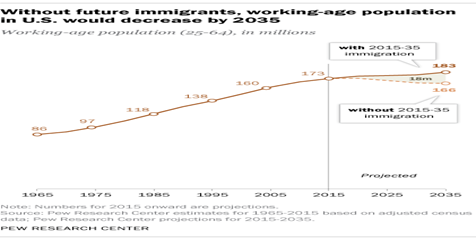
For most of the past half-century, baby boomers — those born after World War Two and before 1965 — have been the main driver of the nation’s expanding workforce, but now that they’re heading into retirement only two groups of workers are projected to grow over the next two decades: immigrants and those whose parents are first-generation immigrants, a new report by the Pew Research Center, a nonprofit think tank in Washington, D.C., concluded. “The most important component of the growth in the working-age population over the next two decades will be the arrival of future immigrants,” it said.
image

Graph: PEW

Which is why it is so important to find a path to citizenship for the 11 million undocumented workers that fulfill jobs very few America citizens will take. And there have been several bills to give a path to those undocumented workers employed in agriculture, construction, and the hospitality industries. But, alas, congress has not been able to pass any of them.

Roughly 36 percent of plasterers and stucco masons were undocumented workers in 2014, the highest share of any occupation, according to a report released recently by the Pew Center. Some 30 percent of miscellaneous agricultural workers, 31 percent of drywall and ceiling tile installers and 28 percent of graders and sorters of agricultural products and 23 percent of sewing machine operators were also undocumented. Also 12 percent of miscellaneous personal appearance workers — manicurists and pedicurists and makeup artists — were undocumented.

image

Chart: PEW

More than 43.7 million immigrants resided in the United States in 2016, accounting for 13.5 percent of the total U.S. population of 323.1 million, according to American Community Survey (ACS) data.

And a recent CNBC report mentioned America’s chronic labor shortages, as the ongoing recovery from the Great Recession is now highlighting. “A report Thursday from ADP and Moody’s Analytics cast an even sharper light on what is becoming one of the most important economic stories of 2018: the difficulty employers are having in finding qualified employees to fill a record 6.7 million job openings,” said CNBC.

But chronic labor shortages have always been the case, and are part of our history. Trump’s, racist, anti-immigration policies are only making matters worse, not to speak of what can only be called his de-facto ethnic cleansing of non-Eurocentric populations.

Harlan Green © 2018

Follow Harlan Green on Twitter: https://twitter.com/HarlanGreen
Posted in Politics, Uncategorized | Tagged , , , | Leave a comment

Housing Supply Still Too Low

The Mortgage Corner

image

Graph: Econoday

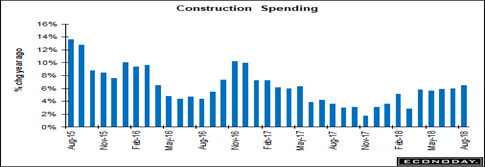
Most of the construction activity is in the commercial sector, at the moment, though sales of newly-constructed homes rose 3.5 percent compared to July. The pace of new-home sales in August was 12.7 percent higher than a year ago. But large revisions to prior months were all downward, a reminder that the housing recovery still can’t satisfy the demand for single-family housing, in particular.

Economists at Freddie Mac that analyzed the pace of new housing construction found that years of underbuilding has left the U.S. with a cumulative shortfall — that is, supply compared to historical averages — of 4.6 million housing units in the years since 2000. That number is especially stark considering that builders constructed a 1 million unit surplus of homes in the bubble years of the last decade.

The median selling price in August was $320,200, 1.9 percent higher than year-ago prices. Year to date, sales were 6.9 percent higher than the same period last year. The year-to-date comparison has declined over the course of the year, a sign of flagging momentum, as higher mortgage rates and home prices are discouraging some buyers and pushing up the supply of available homes to 6.1 months at the current sales rate.

Commercial construction held most of the action. “In August, the estimated seasonally adjusted annual rate of public construction spending was $316.7 billion,” said the Census Bureau, “2.0 percent (±2.8 percent) above the revised July estimate of $310.5 billion, with much of it in education, a good sign that states are spending on their public infrastructure.”

Strongest in the report was highways & streets, up 1.7 percent in the month. Educational spending was also strong with a 1.0 percent gain. Government spending was also very active in August, up 5.9 percent at the Federal level and up 1.7 percent for state & local, reported the Census Bureau.

The Fed made good on its promise to raise their overnight rate one-quarter percent to 2.25 percent, boosting the Prime Rate used in most revolving credit to 5.25 percent. This hasn’t dampened consumer enthusiasm yet, as consumer spending is rising at 3.8 percent in the latest revision to Q2 GDP growth, which held at 4.2 percent. Maybe it’s one last holiday fling before reality and higher inflation set in from the tariff wars?

Fed Chair Powell said in his announcement after the latest FOMC meeting: “I see the current path of gradually raising interest rates as the FOMC’s approach to taking seriously both of these risks. While the unemployment rate is below the Committee’s estimate of the longer-run natural rate, estimates of this rate are quite uncertain. The same is true of estimates of the neutral interest rate. We therefore refer to many indicators (my bold) when judging the degree of slack in the economy or the degree of accommodation in the current policy stance. We are also aware that, over time, inflation has become much less responsive to changes in resource utilization.”

It’s good to see commercial construction making a comeback, even with congress seemingly unable to pay its fair share of infrastructure spending that will be needed just to upgrade the federal highway system, as well as our energy grid that is being seriously threatened by Russian cyberattacks, according to our spy agencies.

Housing starts are attempting to catch up, as starts ran at a 1.282 million seasonally adjusted annual rate in August, the Commerce Department said Wednesday. That was 9.2 percent higher than July’s pace, and 9.4 percent higher than a year ago. But that still won’t be enough to satisfy demand.

Stephen Stanley, chief economist at Amherst Pierpont, Securities interviewed by MarketWatch’s Andria Riquier, was more blunt: “To be clear, there is fundamental softness in housing. Industry sources suggest that the relentless torrid home price appreciation in recent years has finally reached a point that numerous prospective buyers are balking. In addition, high-end homes in high-tax states are starting to see some effect from tax law changes implemented in December. On top of that, new home construction has been impacted by a run-up in materials costs this year, squeezing builders in a vice between rising costs and a diminishing appetite of prospective buyers to pay up.”

Add to that we will be soon entering the tenth year of this boom cycle, which would put it on a par with the 1991 to 2001 boom years that paid down our national debt. If only that were the case today, instead of the surging federal deficit and debt that is squeezing future public sector investments and growth.

Harlan Green © 2018

Follow Harlan Green on Twitter: https://twitter.com/HarlanGreen
Posted in Consumers, Economy, Housing, housing market, Weekly Financial News | Tagged , , , , , | Leave a comment

How Severe Will Be The Next Recession?

Financial FAQs

image

Graph: TradingEconomics.com

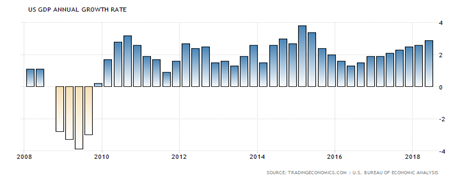
Why are we discussing the possibility of a severe recession when GDP growth is expected to average 3 percent this year, the highest annual average growth rate in several years? Because there is too much federal debt, to put it bluntly.

The very unpopular, all-Republican tax cuts of December, 2017 will add $1.5 trillion to the national debt over 10 years, while cutting approximately $1 trillion in Medicaid, food stamp (SNAP) and other aid to lower-income citizens.

“By 2028, America’s government debt burden could explode from this year’s $15.5 trillion to a staggering $33 trillion—more than 20 percent bigger than it would have been had Trump’s agenda not passed,” said a recent Forbes article. “At that point, interest payments would absorb more than $1 in $5 of federal revenue, crippling the government’s capacity to bolster the economy, and constraining the private sector too.”

Contrary to the claims of the President and his supporters, the U.S. can’t grow fast enough to shed this burden. Trump’s agenda on immigration and trade is more likely to stunt that growth, said Forbes. “This is almost like climate change,” remarked Mark Zandi, chief economist at Moody’s Analytics. “It doesn’t do you in this year, or next year, but you’ll see the ill effects in a day of reckoning.”

In addition, Republicans in control of congress left no funds for spending on badly needed infrastructure repairs and upgrades, the spending that would actually increase overall productivity and future economic growth. Economists calculate such spending would add $1.25 to $1.50 to the GDP for every dollar spent on improving our roads, bridges, electrical grid, airports; not to speak of better water and sewer treatment facilities.

And the Federal Reserve announced today at the end of their FOMC meeting that they are raising interest rates one quarter percent for the third time this year and signaled it will raise the cost of borrowing again in December, ending the long period of accommodative credit policies enacted since the end of the Great Recession. This will constrict credit and reduce consumer demand by raising the cost of everyday borrowing on credit cards and installment loans that are based on short-term rates.

They are doing this at the wrong time with inflation still low, personal incomes barely increasing, and no discernable benefits for most consumers from the tax cuts. The Fed on Wednesday increased its target for its benchmark lending rate to a range of 2 percent to 2.25 percent. Rates are now at their highest level since shortly after the bankruptcy of Lehman Brothers in the fall of 2008.

It will probably be those latest tax cuts and rising debt load that sinks the current 9-year recovery, just as the GW Bush tax cuts erased four years of budget surpluses at the end of the longest growth cycle ever—from 1991-2001—contributing to the Great Recession and record federal debt of today.

This is while a larger federal budget is about to be signed by President Trump with no new taxes enacted to pay for it. It is not how to run a successful business, or country.

Harlan Green © 2018

Follow Harlan Green on Twitter: https://twitter.com/HarlanGreen
Posted in Economy, Politics, Weekly Financial News | Tagged , , , , | Leave a comment

Was There Ever A Soft Landing?

Popular Economics Weekly

image

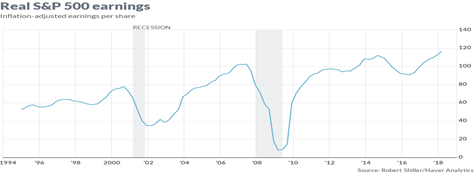
Graph: MarketWatch/R Shiller

“The Federal Reserve has a chance to do something no U.S. central bank has done before, if it can slow the economy and raise the unemployment rate without pushing the economy into recession,” said Peter Hooper, chief economist at Deutsche Bank Securities in a MarketWatch interview.

“The Powell Fed can make history by engineering a soft landing from below,” Hooper said in the interview.

Good luck, is my response, as no Fed has engineered a soft landing in the past. A soft landing is when US economic growth gradually slows rather than crashes at the start of a recession, as evidenced by the five recessions experienced just since 1981 in which homeowners and financial markets suffered great losses.

Fed Chairman Jerome Powell was stating his so-called “Powell Doctrine” at the annual Jackson Hole symposium of leading economists. He said the Fed should respond to actual market conditions—for instance, whether inflation is too high or too low—rather than macroeconomic formulas that attempt to predict future downturns, such as formulas economists use to determine a “neutral rate of inflation.”

He said in his speech: “I see the current path of gradually raising interest rates as the FOMC’s approach to taking seriously both of these risks. While the unemployment rate is below the Committee’s estimate of the longer-run natural rate, estimates of this rate are quite uncertain. The same is true of estimates of the neutral interest rate. We therefore refer to many indicators (my bold) when judging the degree of slack in the economy or the degree of accommodation in the current policy stance. We are also aware that, over time, inflation has become much less responsive to changes in resource utilization.”

Nobel economist Robert Shiller, who won his Nobel Prize studying individual and group behavior in financial markets, is already warning about an irrational exuberance being fed by record corporate profits which could lead to a so-called “hard landing” of the economy. Excessive profits are just one of the indicators Chairman Powell says the Fed should focus on.

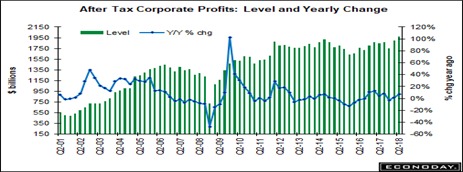
Corporations have actually been reporting record profits for years—in 2014 it was the highest as a percentage of GDP, historically—and corporate profits are being further supercharged by the huge reduction in the corporate capital gains tax enacted in December 2017.

image

Graph: Econoday

“Apparently, investors believe that this boom is going to last, or at least that other investors think it should last, which is why they are bidding up stock prices in a dramatic response to the earnings increase,” said Professor Shiller.

“The reason for this confidence is hard to pin down,” continued Shiller, “but it must be rooted in the public’s loss of healthy skepticism about corporate earnings, together with an absence of popular narratives that tie the increase in earnings to transient factors. Talk of an expanding trade war and other possible actions by a volatile U.S. president just does not seem strongly linked to talk of earnings forecasts — at least not yet.”

Irrational over-exuberance has been a problem in the past for investors, and was highlighted by then Fed Chairman Greenspan in his famous 1996 speech. He was right, but the actual downturn happened four years later with the dot-com, high tech recession of 2000.

So even with the best of information and intentions, the Fed will find it hard to predict when and if a soft landing is possible.

Harlan Green © 2018

Follow Harlan Green on Twitter: https://twitter.com/HarlanGreen
Posted in Economy, Keynesian economics, Macro Economics, Weekly Financial News | Tagged , , , , | Leave a comment

Corporate Governance Reform—Women Make A Difference

ANSWERING THE KENNEDYS CALL

image

NYTimes.com

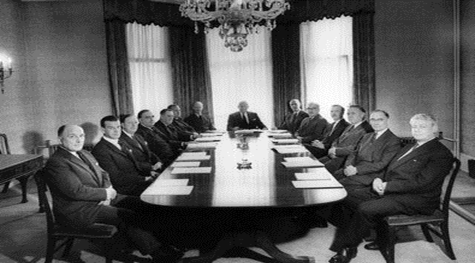
California State Senator Hannah-Beth Jackson’s upcoming Senate Bill SB826 on reforming corporate governance will make corporations more responsive to the needs of the societies in which they operate by requiring more women to serve on their boards.

This is heady stuff, as research has shown that women on a corporate board are more likely to “create a sustainable future” by, among other things, instituting strong governance structures with a high level of transparency.

A 2012 UC Berkeley Hass School of Business study entitled, Women Create a Sustainable Future, to list just a few of the benefits of adding more women to corporate boards, are more likely to be:

· Companies that proactively invest in renewable power generation and related services.

· Companies that proactively address the environmental risks embedded in their financing decisions.

· Companies that provide strong employment benefits and performance incentives and offer employee engagement and professional development programs.

· Companies that offer products with an improved nutritional or healthier profile and have sought credible verification for its healthier status.

“Women and sustainability are two sides of the same coin …. Corporations build better societies if they have balanced boards,” said Halla Tomadottir, executive chair and co-founder of Audur Capital in Iceland, interviewed in the study. Ms. Tomadottir was on the all-female board of the only Icelandic bank that didn’t go into bankruptcy in 2008 during the Great Recession.

Perhaps her most famous quote, made in the Michael Moore documentary, Where to Invade Next? was “One woman on a board is a token, two women a minority. It takes three women to make a difference.” (sic)

“Take for example, a company like Nestlé,” says the Hass study, “which has recently turned its focus toward creating shared value with its product offerings in three areas: nutrition, water, and rural development. Nestlé uses science-based solutions to improve the quality of life through food and diet. “This type of social initiative is well aligned with corporate sustainability for Nestlé. Our research findings to date suggest that having more women corporate directors is correlated with these types of strategies and outcomes. Nestlé’s Board of Directors has three women.”

Senator Jackson’s bill, “no later than the close of the 2019 calendar year, would require a domestic general corporation or foreign corporation that is a publicly held corporation, as defined, whose principal executive offices, according to the corporation’s SEC 10-K form, are located in California to have a minimum of one female, as defined, on its board of directors, as specified. No later than the close of the 2021 calendar year, the bill would increase that required minimum number to 2 female directors if the corporation has 5 directors or to 3 female directors if the corporation has 6 or more directors.”

The behavior of corporations and corporate boards has come under scrutiny particularly since the December 2017 massive corporate tax cuts that its supporters touted would repatriate some of the $3 trillion in overseas assets, as well as raise the incomes of its employees.

But that hasn’t happened to date, as the focus of corporations’ increased profits since then have been to return the windfall to investors and corporate CEOs—either by buying back more shares, going private, or indulging in Wall Street’s merger and acquisitions’ game, rather than creating sustainable programs that would profit society at large as well as themselves.

In a 1970 Times magazine article, the free market economist Milton Friedman argued that businesses’ sole purpose is to generate profit for shareholders. Moreover, he maintained, companies that did adopt “responsible” attitudes would be faced with more binding constraints than companies that did not, rendering them less competitive.

“There is one and only one social responsibility of business — to use it resources and engage in activities designed to increase its profits so long as it stays within the rules of the game, which is to say, engages in open and free competition without deception or fraud.” -Milton Friedman, New York Times Magazine, September 1970.

How the world has changed since then! We now know that ignoring environmental and social issues can be bad for business. Companies that pollute their local communities risk poisoning their customers. Ignoring the state of the local school system can mean depleting the pool of qualified workers. Exploiting workers risks higher turnover and training costs, not to mention greater difficultly in attracting the most qualified candidates.

As part of its findings, SB826 provides some impressive supportive data about the benefits of board gender diversity, including the following:

“(1) A 2017 study by MSCI found that United States’ companies that began the five-year period from 2011 to 2016 with three or more female directors reported earnings per share that were 45 percent higher than those companies with no female directors at the beginning of the period.

(2) In 2014, Credit Suisse found that companies with at least one woman on the board had an average return on equity (ROE) of 12.2 percent, compared to 10.1 percent for companies with no female directors. Additionally, the price-to-book value of these firms was greater for those with women on their boards: 2.4 times the value in comparison to 1.8 times the value for zero-women boards.

(3) Credit Suisse conducted a six-year global research study from 2006 to 2012, with more than 2,000 companies worldwide, showing that women on boards improve business performance for key metrics, including stock performance. For companies with a market capitalization of more than $10 billion, those with women directors on boards outperformed shares of comparable businesses with all-male boards by 26 percent.”

The business world can no longer afford to ignore what it takes to create a sustainable future, a future in which our children can enjoy the fruits of our labor. How can we otherwise enjoy a world growing more populous with limited resources and a warming planet?

Harlan Green © 2018

Follow Harlan Green on Twitter: https://twitter.com/HarlanGreen
Posted in Uncategorized, Weekly Financial News | Tagged , , , , | Leave a comment

Homeowners Preserve Rising Home Equity

The Mortgage Corner

image

Graph: MarketWatch/Black Knight

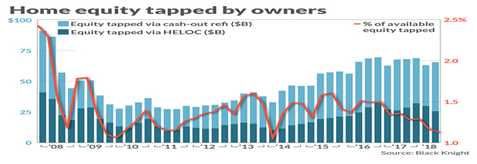
American homeowners have amassed a record $6 trillion in equity in their properties, according to a study by real estate data firm Black Knight, a figure boosted by surging home prices and a trend of owners staying put longer. But rising interest rates and caution resulting from the housing troubles of a decade ago are limiting how much of that equity is getting tapped.

“As the second quarter came to a close, the total amount of tappable equity available to homeowners with mortgages surpassed the $6 trillion mark for the first time in history,” said Ben Graboske, executive vice president of Black Knight’s Data & Analytics division. “There is now $636 billion more tappable equity available than at the start of 2018, and nearly three times as much compared to the bottom of the market in 2012.”

Homeowners are staying in their homes longer in part because of fears of another housing bust that was part of the Great Recession, in other words. In 2016 and 2017 sellers had stayed in their homes a median 10 years, up from a median of six years all the way back to 1985. This is also because there are fewer homes to buy as housing inventories have shrunk drastically.

Inventory of starter and tradeup homes were down 12-13 percent compared to a year ago, one of the biggest drops in years, Trulia chief economist Ralph McLaughlin said. McLaughlin is hoping that rising home prices will entice more owners to sell, even though mortgage rates have risen from their low of 3.5 percent to 4.25 percent for a 30-year fixed conforming loan with a 1 point origination fee. But that is still historically low, when fixed mortgage rates were in the 6 percent range just a few years ago, and even as high as 16 percent in the mid-1980s.

Existing-home sales are still strong, however, according to the National Association of Realtors. Total existing-home sales, https://www.nar.realtor/existing-home-sales, which are completed transactions that include single-family homes, townhomes, condominiums and co-ops, did not change from July and remained at a seasonally adjusted rate of 5.34 million in August. Sales are now down 1.5 percent from a year ago (5.42 million in August 2017).  

Lawrence Yun, NAR chief economist, says the decline in existing home sales appears to have hit a plateau with robust regional sales. “Strong gains in the Northeast and a moderate uptick in the Midwest helped to balance out any losses in the South and West, halting months of downward momentum,” he said. “With inventory stabilizing and modestly rising, buyers appear ready to step back into the market.”

image

Graph: Calculated Risk

Higher interest rates aren’t stopping new homes from being built, either. August Housing starts jumped 9.2 percent to a 1.282 million annualized rate which is well above July’s upwardly revised 1.174 million rate, according to the U.S. Census Bureau. But permits, which are the forward looking component of the report, fell 5.7 percent to a 1.229 million rate.

Looking at starts, multi-family construction that has slowed 29 percent to a 406,000 rate for year-on-year growth, which had been in the negative column, was up 38 percent. Single-family homes, which are the more important of the readings, rose 1.9 percent to an 876,000 rate that, however, is fractionally lower than a year ago, down 0.2 percent.

Where do interest rates go from here? The Conference Board has predicted economic growth could average 3 percent or higher for the rest of this year, which will continue to boost interest rates somewhat. Their leading economic index rose 0.4 percent in August following even stronger gains in the prior two months, the Conference Board said Thursday. The LEI is a gauge of 10 economic indicators meant to signal peaks and valleys in the business cycle and the broader economy.

But our take is there just isn’t enough consumer demand to push rates much higher. Consumers have been paying down their overall debt as a percentage of household income, as well as borrowing less. It is corporations that loaded up on easy money the past several years and now have to worry about paying it back if there is a downturn.

Harlan Green © 2018

Follow Harlan Green on Twitter: https://twitter.com/HarlanGreen
Posted in Consumers, Economy, Housing, housing market, Weekly Financial News | Tagged , , , | Leave a comment

What Do Slowing Retail Sales Mean?

Popular Economics Weekly

image

Graph: Econoday

Retail sales are slowing this fall, yet consumers’ confidence is at an all-time high. Why are consumers buying less and saving more this season? It could be higher interest rates, as the Fed has raised short term rates 5 times, already, so that the Prime rate that determines credit card debt is now 5 percent when it was 4.25 percent one year ago.

Or, they see this recovery from the Greatest Recession since the Great Depression as not that impressive. August retail sales barely managed a 0.1 percent monthly gain as tracked in the blue column of Econoday’s graph. Retail sales are only about 1/3 of total consumer spending which are mostly services. Nevertheless, August’s results are pointing to slowing for total consumer spending as tracked in the green bars and which will be posted at month end, when third-quarter GDP numbers are first released.

Wages are rising mostly for just the top one percent of income earners, according to Thomas Piketty, who should win the Nobel Prize in economics this year for his research on the real and growing income disparities in western countries. The U.S. is at the bottom of developed countries, because other developed countries offer far more in benefits; such as universal health care, paid maternity leave, and higher minimum wages that offset the income disparities.

image

His best-seller, Capital in the Twenty-First Century, published in 2014, raised the curtain on the rising wealth of the one percent since 1980 due to their ownership of capital, the means of production, as described by Nobelist Paul Krugman in the New York Review of Books.

“Capital still matters; at the very highest reaches of society, income from capital still exceeds income from wages, salaries, and bonuses. Piketty estimates that the increased inequality of capital income accounts for about a third of the overall rise in US inequality. But wage income at the top has also surged. Real wages for most US workers have increased little if at all since the early 1970s, but wages for the top one percent of earners have risen 165 percent, and wages for the top 0.1 percent have risen 362 percent.”

Then why are consumers so optimistic? The University of Michigan sentiment survey rose to 100.8 from 96.2 in July for the strongest showing since March this year, as well as since 2004. It has to be the ‘goldilocks’ growth consumers and employers are experiencing at present.

Economic growth is neither too hot nor too cold, as I said last week. Both retail CPI and wholesale PPI inflation indexes have been falling (i.e., prices not too hot), while it has become easier to find jobs with higher salaries (i.e., job market not too cold).

It does look like American consumers feel we are in a sweet spot, even though costs are now rising due to the new tariffs. Maybe it’s one last fling before the inevitable downturn, when interest rates continue to rise and consumers can buy no more. But who knows when that will happen?

Harlan Green © 2018

Follow Harlan Green on Twitter: https://twitter.com/HarlanGreen

Posted in Consumers, Economy, Weekly Financial News | Tagged , , , | Leave a comment

Does Lower Inflation Mean a Goldilocks Economy?

Popular Economics Weekly

image

Graph: Calculated Risk

Consumers are being helped by consumer prices that are barely rising. The Consumer Price Index is up just 2.7 percent, and core CPI without food and energy prices up 2.2 percent in 12 months. This has kept interest rates at historic lows since the Great Recession and is the reason for an economy that is neither too hot nor too cold.

Just how long it will last is an enduring question for economists. One infallible feature of an incoming recession is sharply rising interest rates. But historically low interest rates over an extended period can also mean most consumers aren’t earning enough to boost their buying power, which in turn ‘powers’ higher prices and inflation—a sign of intractable income inequality.

The Great Recession was largely caused by Alan Greenspan’s Fed raising interest rates 16 consecutive times—a total of 4 percent—that caused all the ‘liar’ loans with negative amortization and no real income or asset verification to become unaffordable to lower-income borrowers and homeowners.

That isn’t the case today—yet. The wealthiest 10 percent—what is basically left of the middle class that has profited since the Great Recession—has a very high savings rate. But not the ‘other’ 90 percent, so that average annual incomes are rising at 2.7 percent; also the consumer inflation rate today.

Households carried a record $13.3 trillion in debt at the end of June, Federal Reserve records show. That tops the prior peak of $12.7 trillion in 2008 during the middle of the Great Recession. High debt levels, especially in mortgages, contributed to the 2008 financial panic and the severity of the recession, as I said.

But low interest rates and inflation are keeping delinquencies very low at the moment, and lending standards remain quite stringent in the post-crisis era, according to a recent Moody’s study reported by MarketWatch. As such, there’s less danger of another housing market collapse.

image

But that is the catch. Interest rates and inflation must remain very low for delinquencies to remain ‘very low’, and that won’t last much longer with wage pressures growing, fewer workers available for hire, and the Federal Reserve saying it will continue to raise short-term rates.

Business confidence is soaring as well, thanks to the economic ‘porridge’ being neither too hot nor too cold. The NFIB Small Business Optimism Index soared to 108.8 in August, a new record in the survey’s 45-year history, topping the July 1983 high-water mark of 108. The record-breaking figure is driven by small business owners executing on the plans they’ve put in place due to dramatic changes in the nation’s economic policy.

And small businesses create most of the jobs. “Today’s groundbreaking numbers are demonstrative of what I’m hearing every day from small business owners – that business is booming. As the tax and regulatory landscape changed, so did small business expectations and plans,” said NFIB President and CEO Juanita D. Duggan. “We’re now seeing the tangible results of those plans as small businesses report historically high, some record breaking, levels of increased sales, investment, earnings, and hiring.”

So how long can such goldilocks growth last? It is the ideal condition economic planners work for, but lasts only very briefly until debt levels rise to unsustainable levels, given the inherent fluctuations and dynamism in any economy. Vigilance in looking for signs of higher interest rates and slower growth is therefore a major requirement to stay ahead of those fluctuations.

Harlan Green © 2018

Follow Harlan Green on Twitter: https://twitter.com/HarlanGreen

Posted in Consumers, Economy, Macro Economics, Weekly Financial News | Tagged , , , , | Leave a comment

The Red Tide in Education

ANSWERING THE KENNEDYS CALL

image

The Guardian

Red tide algal blooms have been threatening coastal beaches for decades, killing sea life and sickening bathers; a sign of rising ocean temperatures due to global warming as well as human pollution.

But another red tide is benefitting Americans by threatening the wealth of oligarchs like the Koch Brothers and U.S. Education Secretary Betsy DeVos, who have diverted funds so desperately needed by America’s public schools where most of our children are educated to not only preserve their wealth, but increase it.

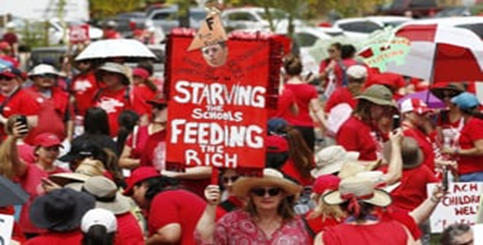
It is the red state Teacher’s movement for better salaries and benefits in public schools in the conservative red states that have either cut education spending in public schools, or diverted funds to Charter Schools and private school vouchers that have benefited the largely conservative wealth-holders of this world and their supporters who own and operate for-profit schools that can receive up to 90 percent of their revenues from federal taxpayers, typically in the form of student loans and Pell Grants.

The Teacher’s movement is another example of powerful ‘grass-roots’ movements generated in local communities to solve grievances that have worsened their citizens’ quality of life.

A 2016 report by the NYU Brennan Center for Justice entitled Secret Spending in the States stated in its introduction: “Six years after Citizens United enabled unfettered spending in our elections, the use of so-called dark money has become disturbingly common. Contrary to the Supreme Court’s assumption that this unlimited spending would be transparent to voters, at the federal level powerful groups have since 2010 poured hundreds of millions of dollars into influencing elections while obscuring the sources of their funding.”

In the six states the Brennan Center report detailed—Alaska, California, Arizona, Colorado, Massachusetts and Maine—1) At these levels, dark money sources often harbor a narrow, direct economic interest in the contest’s outcome;  money sources often harbor a narrow, direct economic interest in the contest’s outcome; (2) relatedly, contentious ballot measures that carry major economic consequences frequently attract dark money; and (3) in the relatively low-cost elections at these levels, it is easy for dark money to dominate with unaccountable messages that voters cannot meaningfully evaluate.

Who were the recipients of this largesse in PAC money that ballooned after Citizens United? It has to be no secret that the supporters of vouchers and/or Charter schools that favored higher-income constituencies won out in the funding struggle.

This is what started the “Red for Ed” teachers’ movement fighting for better school funding who had suffered for years, in underpaid and underfunded public schools. “Red shirts and blouses had emerged as the official uniform of teacher uprisings against low pay that were spreading from West Virginia to Oklahoma and Kentucky under the rallying cry “Red for Ed,” said an excellent NYTimes Magazine article, about the Arizona teachers’ uprising.

Public education is a $650 billion national enterprise,” said the NYTimes, “comparable to the U.S. defense budget, except that the federal government pays only 8.5 percent of the cost. States and local school districts split the rest in varying proportions, but each state finances it differently. Texas and Louisiana tap plentiful oil and gas revenues; Northeastern states like Massachusetts and New Jersey rely on high income and property taxes.”

Arizona hasn’t raised income taxes in more than 25 years, and counts more on sales taxes and other revenues generated by a growing economy. However they pay for it, K-12 schooling is the biggest single expenditure for all states, accounting for 36 percent of general-fund budgets on average.

“A half-dozen Arizona teachers — and more than 25 others, current and retired, with education backgrounds — declared their candidacy for the State House and Senate with a promise to increase funding for public schools, said the NYTimes. “They’re part of a sudden wave of educators on ballots as first-time candidates in every walkout state.”

The ultimate solution has to be political action, especially political action by women who make up 80 percent of the teaching profession. In fact, the red wave is turning into a blue wave, as this has energized even the less liberal voter base. Data from the Center for American Women and Politics at Rutgers University shows that more women have filed to run for Congress than at any point since at least 1992 — and by a wide margin. That year, 298 women ran for the House of Representatives. This year, 476 have — most of them Democrats.

Harlan Green © 2018

Follow Harlan Green on Twitter: https://twitter.com/HarlanGreen

Posted in Consumers, Politics, Uncategorized | Tagged , , , , , | Leave a comment

What To do About America’s Homeless Problem?

ANSWERING THE KENNEDYS CALL

image

Los Angeles Times

A study released in December 2017 by the U.S. Department of Housing and Urban Development (HUD) reported America’s homeless population has risen this year for the first time since the Great Recession, propelled by the housing crisis afflicting the west coast, according to a new federal study.

The study has found that 553,742 people were homeless on a single night this year, a 0.7 percent increase over last year. It suggests that despite a booming economy, the poorest Americans are still struggling to meet their most basic needs.

Most affected are the western states of California, Oregon and Washington, where soaring housing prices have made even rental housing expensive and out of range for many low-income citizens that live and work in their largest cities.

The state of California estimates that 180,000 new housing units are needed each year in order to keep up with population growth. Over the last decade, however, there was an annual average of less than 80,000 units, because developers often face a long review process and local opposition.

Government investment in low-income homes has lagged since it was slashed during the Reagan administration, and today most people on the cusp of homelessness do not receive government rental assistance. In fact, the government spends twice as much on a housing tax break for the wealthiest Americans, and the tax reforms just enacted by Congress could deal a further blow to affordable-housing.

Localities are left to improvise solutions. Los Angelenos voted to tax themselves to provide billions in funding. Tiny-home villages have taken root in Oregon and Washington state (though a plan to erect them in Silicon Valley was met recently by angry residents chanting “build a wall” to keep homeless residents out). Hawaii is pursuing the idea of authorized tent encampments, according to The Guardian.

“The improved economy is a good thing, but it does put pressure on the rental market, which does put pressure on the poorest Angelenos,” said Peter Lynn, head of the Los Angeles homelessness agency, in an LA Times interview. The most dramatic spike in the nation was in his region, where a record 55,000 people were counted. “Clearly we have an outsize effect on the national homelessness picture.”

LA Mayor Eric Garcetti has pushed through a record budget to build and house homeless denizens of Los Angeles. A recently passed Measure H initiative is generating $355 million each year to provide a wide range of services to help people in desperate need. Proposition HHH is giving the City $1.2 billion to build thousands units of supportive housing over the next decade — units that will be paired with those same services, so that unsheltered Angelenos can go home for good.

Because it will take years to build permanent housing, Mayor Garcetti has launched a new plan called A Bridge Home — to give homeless Angelenos in every neighborhood a refuge in the community they already know and love by housing them in “trailers, tents, and other temporary shelters across the city,” until they can be connected with a permanent home.

image

It’s one remarkable solution to the homeless crisis that a major city like Los Angeles can afford. The mayor, who has set a goal of ending street homelessness by 2028, has said at least 6,000 people a year could be served by the shelters, which are planned for each of the city’s 15 council districts. New state funds may boost available funds, but the mayor’s budget set aside $1.3 million for each of the 15 shelters.

We are saying, in other words, that part of the solution to the housing and homeless crisis has to be the responsibility of governments. The private housing industry is booming for the most fortunate, but local, state and the federal governments must acknowledge that homelessness should be the concern of all Americans.

Harlan Green © 2018

Follow Harlan Green on Twitter: https://twitter.com/HarlanGreen

Posted in Housing, housing market, Politics, Uncategorized | Tagged , , , , | Leave a comment