Trade Wars Hurt U.S. the Most!

Popular Economics Weekly
image

Econoday.com

Is the trade war hurting U.S. jobs? Yes, says Mauldin Economics’ Patrick Watson, among others. Watson uses US automakers as an example. Ford and GM estimate that the 25 percent steel and 10 percent aluminum tariffs will add $1 billion to their production costs just next year. What happens when they sell more vehicles overseas with such rising production costs?

“For GM and other auto manufacturers, the customers are increasingly foreign. In this year’s third quarter, GM sold 835,934 cars in China and 694,638 in the U.S. It built many of those directly in China and has every reason to make more there, with tariffs or not,” said Watson

Is globalization reversing itself? The recent rise in US Labor Productivity highlights the growing use of robots and other productivity-enhancing technologies American companies are investing in due, in part, to the 3.7 percent unemployment rate and resultant dearth of skilled workers. But there are other reasons

Robots level product costs, since they cost as much in China as in the US, which means China will produce more domestically to avoid rising tariffs, and so needs to import less from others, including the U.S.

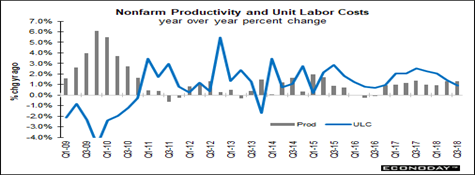
The U.S. Bureau of Labor Statistics just reported nonfarm business sector labor productivity increased 2.3 percent during the third quarter of 2018, as output increased 4.1 percent and hours worked increased 1.8 percent. Declining unit labor costs over the past 12 months are the reason productivity has increased at the same time as output. It is down to 0.9 percent for a 3 tenths decline from the first estimate. This reflects a 4 tenths downgrade in compensation to a growth rate of 3.1 percent.

This should also mean U.S. workers’ wages are rising, but the trade wars are in fact driving many of the better paying manufacturing jobs overseas. Robots are shortening the supply chain, in other words, which will only hasten the decline in the need for foreign products.
image

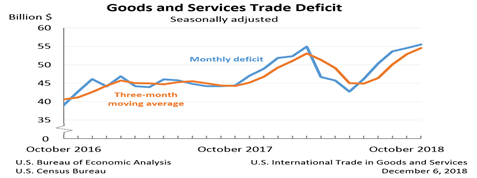
And we are already seeing the result of the tariff increases on Chinese goods; a surging trade deficit. The trade deficit rose in October to a 10-year high amid a record shortfall with China (due to drop in soybean purchases), keeping the U.S. on pace to record the largest annual gap in a decade, reports the U.S. Bureau of Economic Analysis.

The deficit edged up 1.7 percent to $55.5 billion from a revised $54.6 billion in September. That’s the biggest shortfall since October 2008, and ironically, it stems in part from tariffs imposed by President Trump in an effort to reduce the deficit.

We know part of the recent surge in imports reflects American companies stocking up on Chinese goods ahead of the holidays to get ahead of another increase in U.S. tariffs that were supposed to kick in on Jan. 1. But the U.S. tariff increase has been temporarily been postponed until March, per agreement with China at the recent G20 summit in Argentina.

Even the 90-day postponement is not helping the stock market, since nothing concrete was agreed on at the G20 meeting.  But it is pushing interest rates lower, to levels not seen since the Great Recession.  This will help consumer spending, but only if the Fed doesn’t raise their short-term rates further.

Harlan Green © 2018

Follow Harlan Green on Twitter: https://twitter.com/HarlanGreen
Posted in Consumers, Economy, Politics, Weekly Financial News | Tagged , , , | Leave a comment

Credit Alert—Interest Rates about to Invert

The Mortgage Corner

image

MarketWatch.com

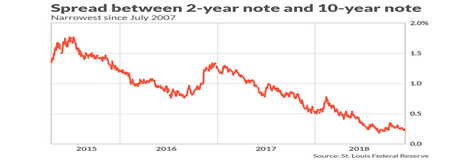
The spread between the 2-year note and the 10-year narrowed 4 basis points to 0.16 percentage point on Monday, its flattest levels since July 2007, according to MarketWatch. The 10-year Treasury yield dropped back below 3 percent, to 2.93 percent for the first time in one year, lowering mortgage rates as well.

This is unheard of in a fully employed economy currently growing at 3 percent when longer term rates should be rising, if there was a rising demand for longer term credit transactions, such a mortgages. So it’s a danger signal that all may not be well in the financial markets. There is the perception, at least, that worldwide growth is slowing. The stock market has become increasingly jittery with huge moves daily, trade wars are in full bloom, and Russia (Ukraine) and North Korea (new missile sites) are acting up again.

Hence investors would rather hold US bonds than stocks at the moment.

A major reason for worldwide slower growth could also be the shrinking volume of US dollars in circulation. The Federal Reserve has been selling off its $4 trillion hoard of securities back into the private sector that was part of its Quantitative Easing program, thus reducing the amount of US dollars in circulation. This is while it is still the world’s reserve currency that is used in a majority of cross-border transactions.

The current Federal Reserve is another culprit in the inversion curve because it is pushing short term rates higher. Its benchmark overnight rate has risen to 2.25 percent, its eighth raise since 2015, and now 2 percent above its post-recession lows, thus increasing the cost of consumer borrowing. Yet inflation is barely rising, which should be reason not to raise rates, since it is another indication that a majority of consumers aren’t aren’t flush with cash. Not when the median income of households has barely budged since the 1980s, after inflation.

There is just not enough demand for goods and services, in other words, which is why inflation is tame. Then what’s causing the economic growth? Corporate profits are at record levels, and automation is speeding up labor productivity. So more is produced, but the income stream doesn’t trickle down to the majority of consumers in what has become a lower-paying service economy of mainly warehouse, restaurant (part of leisure and hospitality sector), healthcare, and retail workers that don’t earn enough money to warrant the Fed’s push for higher short term rates in anticipation that inflation may someday loom on the horizon.

But it ain’t happening, and doesn’t look like it will happen soon, unless what trickles down becomes a real income stream for the middle and lower income earners. There has to be greater access to jobs with fair pay, decent shelter, effective schools, and reliable health care, for starters.

Harlan Green © 2018

Follow Harlan Green on Twitter: https://twitter.com/HarlanGreen

Posted in Consumers, Economy, Politics, Weekly Financial News | Tagged , , , , | Leave a comment

Climate Becoming Too Hot to Ignore

Answering the Kennedys Call to Action

image

www.economist.com

The impacts of climate change are already being felt in communities across the country. More frequent and intense extreme weather and climate-related events, as well as changes in average climate conditions, are expected to continue to damage infrastructure, ecosystems, and social systems that provide essential benefits to communities, according to the just released U.S. Fourth National Climate Assessment..

Future climate change is expected to further disrupt many areas of life, exacerbating existing challenges to prosperity posed by aging and deteriorating infrastructure, stressed ecosystems, and economic inequality, said the study.

“Impacts within and across regions will not be distributed equally. People who are already vulnerable, including lower-income and other marginalized communities, have lower capacity to prepare for and cope with extreme weather and climate-related events and are expected to experience greater impacts.”

It is people that are most affected by climate change—global warming in particular that can result in massive population shifts away from rising waters, drought-affected areas with lack of water and the increased danger of wildfires—and so its effect on communities leads off the study results, especially in the western states with their prolonged droughts.

image

NationalClimateAssessment

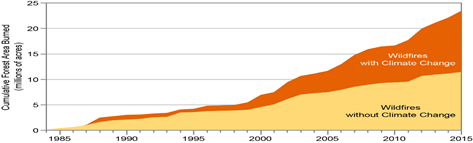
“Climate change has led to an increase in the area burned by wildfire in the western United States,” said an Atlantic Monthly summary of the report. “Analyses estimate that the area burned by wildfire from 1984 to 2015 was twice what would have burned had climate change not occurred. Furthermore, the area burned from 1916 to 2003 was more closely related to climate factors than to fire suppression, local fire management, or other non-climate factors.”

image

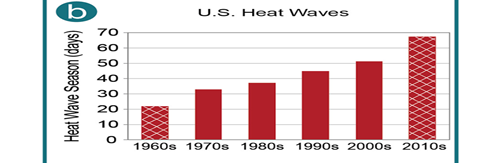
California in particular has been affected by heat waves this year and the prolonged six-year drought leading to the worst wildfires in California history. The just extinguished Paradise Camp Fire destroyed 18,793 structures and 85 lives lost to date, with several hundred residents still missing.

The last prolonged U.S. dry spell was the 1930’s Dustbowl during the Great Depression. It only compounded the economic damage with the loss of farmland and mass migration of dustbowl families immortalized in John Steinbeck’s Grapes of Wrath.

And economic damage will be horrendous if nothing is done to mitigate the damage from a hotter planet and coastal areas subject to greater flooding.

The report says shoreline counties hold 49.4 million housing units, while homes and businesses worth at least $1.4 trillion sit within about 1/8th mile of the coast. Flooding from rising sea levels and storms is likely to destroy, or make unsuitable for use, billions of dollars of property by the middle of this century, with the Atlantic and Gulf coasts facing greater-than-average risk compared to other regions of the country …

Damage could be as much as $3.6 trillion in properties and value loss of no mitigation measures are taken, but $820 billion “where cost-effective adaptation measures are implemented.”

Climate change is becoming a topic too hot to ignore; even by the science-deniers who prefer to protect their pocketbooks rather than America’s communities and country.

Harlan Green © 2018

Follow Harlan Green on Twitter: https://twitter.com/HarlanGreen
Posted in Uncategorized | Tagged , , , , | Leave a comment

Climate Becoming Too Hot to Ignore

Answering the Kennedys Call to Action

image

www.economist.com

The impacts of climate change are already being felt in communities across the country. More frequent and intense extreme weather and climate-related events, as well as changes in average climate conditions, are expected to continue to damage infrastructure, ecosystems, and social systems that provide essential benefits to communities, according to the just released U.S. Fourth National Climate Assessment..

Future climate change is expected to further disrupt many areas of life, exacerbating existing challenges to prosperity posed by aging and deteriorating infrastructure, stressed ecosystems, and economic inequality, said the study.

“Impacts within and across regions will not be distributed equally. People who are already vulnerable, including lower-income and other marginalized communities, have lower capacity to prepare for and cope with extreme weather and climate-related events and are expected to experience greater impacts.”

It is people that are most affected by climate change—global warming in particular that can result in massive population shifts away from rising waters, drought-affected areas with lack of water and the increased danger of wildfires—and so its effect on communities leads off the study results, especially in the western states with their prolonged droughts.

image

NationalClimateAssessment

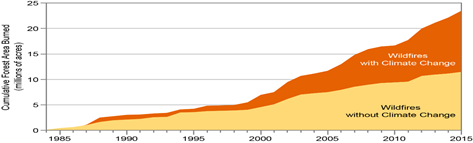
“Climate change has led to an increase in the area burned by wildfire in the western United States,” said an Atlantic Monthly summary of the report. “Analyses estimate that the area burned by wildfire from 1984 to 2015 was twice what would have burned had climate change not occurred. Furthermore, the area burned from 1916 to 2003 was more closely related to climate factors than to fire suppression, local fire management, or other non-climate factors.”

image

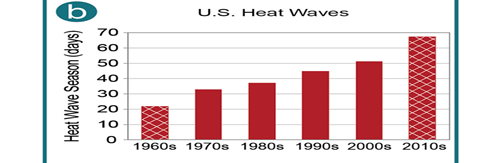
California in particular has been affected by heat waves this year and the prolonged six-year drought leading to the worst wildfires in California history. The just extinguished Paradise Camp Fire destroyed 18,793 structures and 85 lives lost to date, with several hundred residents still missing.

The last prolonged U.S. dry spell was the 1930’s Dustbowl during the Great Depression. It only compounded the economic damage with the loss of farmland and mass migration of dustbowl families immortalized in John Steinbeck’s Grapes of Wrath.

And economic damage will be horrendous if nothing is done to mitigate the damage from a hotter planet and coastal areas subject to greater flooding.

The report says shoreline counties hold 49.4 million housing units, while homes and businesses worth at least $1.4 trillion sit within about 1/8th mile of the coast. Flooding from rising sea levels and storms is likely to destroy, or make unsuitable for use, billions of dollars of property by the middle of this century, with the Atlantic and Gulf coasts facing greater-than-average risk compared to other regions of the country …

Damage could be as much as $3.6 trillion in properties and value loss of no mitigation measures are taken, but $820 billion “where cost-effective adaptation measures are implemented.”

Climate change is becoming a topic too hot to ignore; even by the science-deniers who prefer to protect their pocketbooks rather than America’s communities and country.

Harlan Green © 2018

Posted in Economy, Politics, Uncategorized, Weekly Financial News | Tagged , , , , | Leave a comment

Q3 Economic Growth Still Strong

Financial FAQs

image

Econoday.com

Q3 real GDP growth was up 3.5 percent, according to the U.S. government Bureau of Economic Analysis. “With this second estimate for the third quarter, the general picture of economic growth remains the same; upward revisions to nonresidential fixed investment and private inventory investment were offset by downward revisions to personal consumption expenditures (PCE) and state and local government spending,” said the BEA.

Consumer spending is up 3.6 percent, and there is virtually no inflation. Prices are rising 1.7 percent annually per the GDP price deflator that measures the prices of all final goods and services produced domestically.

image

Econoday

Soaring corporate profits weren’t a big help to growth, however, as most of the profits are being spent on stock buybacks, though there was a slight increase of capital expenditures. Investment in equipment climbed 3.5 percent vs. virtually no increase in the preliminary estimate.

And spending on structures such as office buildings and drilling rigs fell 1.7 percent instead of -8 percent in the first estimate. Profits were up 19.4 percent after taxes, and tax payments fell 32.9 percent from last year. Corporates profits are therefore up 10.3 percent in a year, the best showing since 2012.

We also now have the Fourth National Climate Assessment, which is much more accurate than the previous reports from 13 federal agencies in pinning down the damage to economic growth. If nothing is done to mitigate its effects on coastal cities’ flooding from rising sea levels, increasing wildfires in drought-stricken regions, and the increasing frequency and ferocity of hurricanes and tornadoes, economic growth will suffer substantially.

“In the absence of significant global mitigation action and regional adaptation efforts, rising temperatures, sea level rise, and changes in extreme events are expected to increasingly disrupt and damage critical infrastructure and property, labor productivity, and the vitality of our communities.”

Need we say more about ignoring physical reality in all its forms? Profits must be invested where they will do the most good. If corporations won’t heed the looming threats to not only the environment but livelihoods as well, then government will find a more beneficial use for the $trillions being hoarded in the private sector.

Harlan Green © 2018

Follow Harlan Green on Twitter: https://twitter.com/HarlanGreen
Posted in Economy, Macro Economics, Weekly Financial News | Tagged , , , | Leave a comment

Beware the Shrinking US Dollar!

Popular Economics Weekly

image

Econoday.com

Barron’s Magazine reported that the Fed is shrinking credit too quickly, and it will slow not only U.S. economic growth, but growth in the rest of the world as well. Why? Because the U.S. Dollar is the world’s main reserve currency that covers more than 60 percent of world trade.

And since the Fed is taking circulating $$ out of the economy by selling some of those $4 trillion in securities it has been holding since Fed Chair Ben Bernanke’s term–$50 billion per month—it is reducing the amount of dollars in circulation, leaving fewer dollars to pay for transactions via the world’s banks and clearing houses.

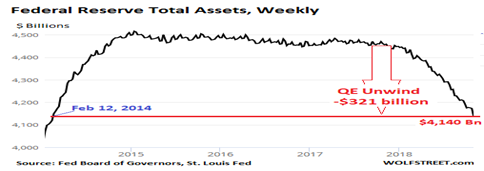
Over the four-week period from October 3 through October 31, reports Wolf Street, the Federal Reserve shed $35 billion in assets, according to the Fed’s weekly balance sheet released last Thursday afternoon. This brought the balance sheet to $4,140 billion, the lowest since February 12, 2014. Since October 2017, when the Fed began its QE unwind, or “balance sheet normalization,” it has now shed $321 billion:

image

wolfstreet.com

And that could mean that China’s Yuan (Renminbi) and the euro would begin to replace it as reserve currencies, meaning that fewer transactions would flow through US banks and economy. It also means that the US then has less control over trade rules, and yes, sanctions it wants to impose on other countries, like Iran. This is because other countries don’t like economic bullying that isn’t in their interests, and will seek to use other currencies, such as the euro in place of the dollar.

The dollar leads all other currencies in supplying the functions of money for international transactions. It is still the most important unit of account (or unit of invoicing) for international trade. It is the main medium of exchange for settling international transactions. It is also the principal store of value for the world’s central banks, said a recent Bank of England Quarterly Bulletin.

But what can happen next, as worldwide growth slows, which is sure to happen as dollar reserves and credit shrink?? Trump’s trade war is happening at a very bad time, in other words. Economist and Project Syndicate columnist Jeffery Sachs has outlined the possibilities of trade policies that harm, rather than help economic growth.

“The most consequential and ill-conceived of Trump’s international economic policies are the growing trade war with China and the re-imposition of sanctions vis-à-vis Iran. The trade war is a ham-fisted and nearly incoherent attempt by the Trump administration to stall China’s economic ascent by trying to stifle the country’s exports and access to Western technology. But while U.S. tariffs and non-tariff trade barriers may dent China’s growth in the short term, they will not decisively change its long-term upward trajectory.

“More likely, they will bolster China’s determination to escape from its continued partial dependency on U.S. finances and trade, and lead the Chinese authorities to double down on a military build-up, heavy investments in cutting-edge technologies, and the creation of a yuan-based global payments system as an alternative to the dollar system.”

This is hardly making US safer, in a world that has outgrown dependence on US economic and geopolitical power. The U.S. currently produces around 22 percent of world output measured at market prices, and around 15 percent in purchasing-power-parity terms (i.e., actual volume). Yet the dollar accounts for half or more of cross-border invoicing, reserves, settlements, liquidity, and funding.

We could be punching above our weight, as the saying goes, if we continue to bully our economic allies, as well as our adversaries. There are now other Heavyweights in the ring.  

Harlan Green © 2018

Follow Harlan Green on Twitter: https://twitter.com/HarlanGreen

Posted in Economy, Macro Economics, Politics, Weekly Financial News | Tagged , , , | Leave a comment

Home Sales Rise for the Holidays

The Mortgage Corner

image

Econoday.com

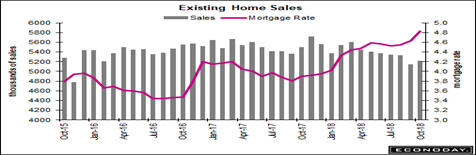
Existing-home sales increased in October after six straight months of decreases, according to the National Association of Realtors. Three of four major U.S. regions saw gains in sales activity last month.

Lawrence Yun, NAR’s chief economist, says increasing housing inventory has brought more buyers to the market. “After six consecutive months of decline, buyers are finally stepping back into the housing market,” he said. “Gains in the Northeast, South and West – a reversal from last month’s steep decline or plateau in all regions – helped overall sales activity rise for the first time since March 2018.”

It’s really been almost a year (November 2017) since sales last peaked. And that was when interest rates had dipped to 4.0 percent for 30-year conforming fixed rates. So it is further evidence that sales are interest-rate sensitive, and homebuyers will wait for a dip in mortgage rates.

Today’s benchmark 10-year T Bond has fallen back to 3.06 percent, for instance, and the 30-year conforming fixed rate to 4.375 percent for those with the best credit scores.

It’s another manifestation of the flight to quality from a very unstable stock market worried about trade wars and outright wars, as the Trump administration stirs up the domestic and geopolitical temperatures again. Unilateral withdrawals from trade and Intermediate Nuclear Missile treaties do not hearten confidence this administration is interested in keeping the peace.

“Total existing-home sales, https://www.nar.realtor/existing-home-sales, which are completed transactions that include single-family homes, townhomes, condominiums and co-ops, increased 1.4 percent from September to a seasonally adjusted rate of 5.22 million in October. Sales are now down 5.1 percent from a year ago (5.5 million in October 2017), said the NAR.

This may be due to increased inventories of homes for sale, as Yun said. Buying has slowed, but new-home building has increased. Total housing inventory at the end of October decreased from 1.88 million in September to 1.85 million existing homes available for sale, but that represents an increase from 1.80 million a year ago. Unsold inventory is at a 4.3-month supply at the current sales pace, down from 4.4 last month and up from 3.9 months a year ago.

image

Econoday.com

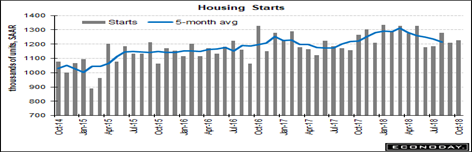
Meanwhile nationwide housing starts rose 13.7 percent in October to a seasonally adjusted annual rate of 1.29 million units after a slight upward revision to the September reading, according to newly released data from the U.S. Department of Housing and Urban Development and the Commerce Department. This is the highest housing production reading since October 2016, when total starts hit a post-recession high of 1.33 million.

“We are seeing solid, steady production growth that is consistent with the National Association of Homebuilders forecast for continued strengthening of the single-family sector,” said NAHB Chief Economist Robert Dietz. “As the job market and overall economy continue to firm, we should see demand for housing increase as we head into 2018.”

Single-family production rose 5.3 percent in October to a seasonally adjusted annual rate of 877,000. Year-to-date, single-family starts are 8.4 percent above their level over the same period last year. Multifamily starts jumped 36.8 percent to 413,000 units after a weak September report.

Hurricane Michael hit Florida and Georgia in October though existing-home sales in the South nevertheless managed a 1.9 percent monthly rise. Sales in the West were strongest at plus 2.8 percent with the Northeast at plus 1.5 percent but the Midwest at minus 0.8 percent.

“Sales may have gotten a boost from discounting as the median price fell 0.6 percent to $255,400, said Econoday. “Year-on-year, the median is up 3.8 percent which is sizably above the decline in sales which points to further discounting ahead.”

More price discounting and lower (not higher) interest rates and inflation may lie ahead, as real estate becomes the more dependable asset in such times of uncertainty.

Harlan Green © 2018

Follow Harlan Green on Twitter: https://twitter.com/HarlanGreen
Posted in Consumers, Housing, housing market, Weekly Financial News | Tagged , , , | Leave a comment

Retail Sales Surge While Consumers Pay Down Debt

Popular Economics Weekly

image

Econoday.com

U.S. retail sales rebounded sharply in October as purchases of motor vehicles and building materials surged, likely driven by rebuilding efforts in areas devastated by Hurricane Florence.

CBS News reports an economic consulting firm says Hurricane Florence may result in between $17 billion and $22 billion in lost economic output and property damage. That would put Florence in the Top 10 of costliest hurricanes to hit the U.S.

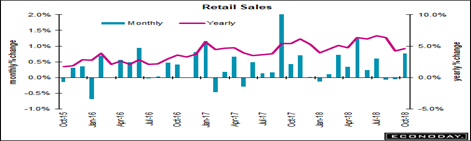
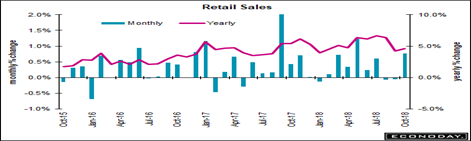
The Commerce Department said last Thursday retail sales increased 0.8 percent as households also bought more electronics and appliances. September sales were revised down, sales slipping 0.1 percent instead of nudging up 0.1 percent as previously reported; the month Hurricane Florence made landfall.

Autos were very strong in October, rising 1.1 percent following several months of weakness. Building materials were up nearly as much as autos, up 1.0 percent in what is a good indication for residential investment, said Econoday. Gasoline sales jumped 3.5 percent in the month though this reading for November due very likely fluctuating oil prices, which have been declining of late.

image

Econoday

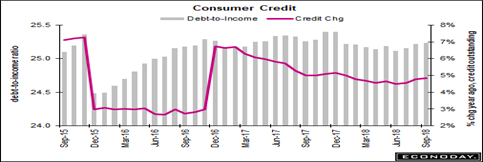
But consumers are spending less overall, as consumer credit slowed more than expected to just $10.9 billion in September, below Econoday’s consensus range and less than half of the upwardly revised $22.9 billion August increase. Growth slowed in nonrevolving credit, which rose $11.2 billion in September versus $18.3 billion previously, while growth in revolving credit stalled completely and posted a marginal decline of $0.3 billion. Gains in nonrevolving credit reflect vehicle financing and student loans while gains in revolving credit reflect credit-card debt. 

image

St Louis FRED

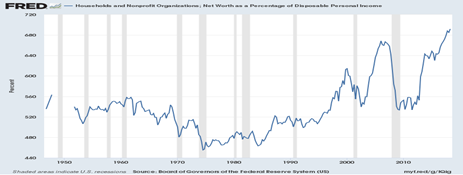
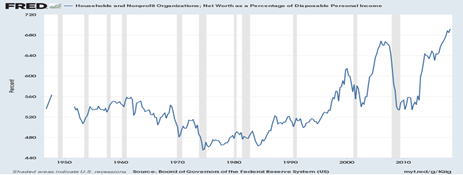
Consumers are paying down their overall debt, in other words. “Household net worth just hit $107 trillion and in relative terms it is at an all-time high of 5.23x nominal GDP. What is significant about this is it is coming during a cycle that has been characterized by household de-leveraging,” said economists from RBC Capital Markets in a MarketWatch interview.

“It took bubbles of epic proportions in the past to boost net worth/GDP significantly (tech, housing). This time around we have a household balance sheet where liabilities relative to net worth are sitting at a 33-year low. Pristine balance sheets coupled with significant momentum from tight labor markets (firming wage growth) and tax reform (firming after-tax income) puts the consumer in a position to continue carrying this cycle for a while,” said RBC.

So how long does the second-longest business cycle, now in its 10th year, last? That’s the question on everyone’s mind. The 10-yr Treasury bond yield just plunged to 3.05 percent, flattening the so-called yield curve once again.

So if the Fed keeps raising short term rates as promised, it could seriously compromise growth next year by restricting credit and so consumer spending that makes up two-thirds of economic activity.

Harlan Green © 2018

Follow Harlan Green on Twitter: https://twitter.com/HarlanGreen
Posted in Uncategorized | Tagged , , , | Leave a comment

Retail Sales Surge While Consumers Pay Down Debt

Popular Economics Weekly

image

Econoday.com

U.S. retail sales rebounded sharply in October as purchases of motor vehicles and building materials surged, likely driven by rebuilding efforts in areas devastated by Hurricane Florence.

CBS News reports an economic consulting firm says Hurricane Florence may result in between $17 billion and $22 billion in lost economic output and property damage. That would put Florence in the Top 10 of costliest hurricanes to hit the U.S.

The Commerce Department said last Thursday retail sales increased 0.8 percent as households also bought more electronics and appliances. September sales were revised down, sales slipping 0.1 percent instead of nudging up 0.1 percent as previously reported; the month Hurricane Florence made landfall.

Autos were very strong in October, rising 1.1 percent following several months of weakness. Building materials were up nearly as much as autos, up 1.0 percent in what is a good indication for residential investment, said Econoday. Gasoline sales jumped 3.5 percent in the month though this reading for November due very likely fluctuating oil prices, which have been declining of late.

image

Econoday

But consumers are spending less overall, as consumer credit slowed more than expected to just $10.9 billion in September, below Econoday’s consensus range and less than half of the upwardly revised $22.9 billion August increase. Growth slowed in nonrevolving credit, which rose $11.2 billion in September versus $18.3 billion previously, while growth in revolving credit stalled completely and posted a marginal decline of $0.3 billion. Gains in nonrevolving credit reflect vehicle financing and student loans while gains in revolving credit reflect credit-card debt. 

image

St Louis FRED

Consumers are paying down their overall debt, in other words. “Household net worth just hit $107 trillion and in relative terms it is at an all-time high of 5.23x nominal GDP. What is significant about this is it is coming during a cycle that has been characterized by household de-leveraging,” said economists from RBC Capital Markets in a MarketWatch interview.

“It took bubbles of epic proportions in the past to boost net worth/GDP significantly (tech, housing). This time around we have a household balance sheet where liabilities relative to net worth are sitting at a 33-year low. Pristine balance sheets coupled with significant momentum from tight labor markets (firming wage growth) and tax reform (firming after-tax income) puts the consumer in a position to continue carrying this cycle for a while,” said RBC.

So how long does the second-longest business cycle, now in its 10th year, last? That’s the question on everyone’s mind. The 10-yr Treasury bond yield just plunged to 3.05 percent, flattening the so-called yield curve once again.

So if the Fed keeps raising short term rates as promised, it could seriously compromise growth next year by restricting credit and so consumer spending that makes up two-thirds of economic activity.

Harlan Green © 2018

Follow Harlan Green on Twitter: https://twitter.com/HarlanGreen

Posted in Consumers, Economy, Weekly Financial News | Tagged , , , | Leave a comment

Higher Interest Rates Ahead?

Popular Economics Weekly

image

Econoday.com

The benchmark 10-year Treasury Bond Yield that determines mortgage and other long term rates ended at 3.13 percent today from 3.11 percent last week with the continued stock market selloff. It was as high as 3.22 percent at times. The Fed is on track to raise short term interest rates another one-quarter percent in December, which will boost the Prime Rate used for credit card and installment debts to 5.50 percent. What does that mean for continued job and economic growth?

The jury is out on the answer. Consumer confidence is booming, but stocks are fluctuating madly because investors are fretting over what happens next year, which is what investors always attempt to predict—i.e., how much to discount future corporate earnings. A majority of S&P 500 companies reported higher earnings than predicted in Q3, so there should be a minimal discount. And corporations are using most of their extra profits from the December tax cut to buy back stock. But that is one-time booster shot that investors worry will soon end the stimulus.

If interest rates continue to rise, it will cut into consumer spending, while bond traders worry about incoming inflation. But the Producer Price Index and Consumer Price Index show inflation are remaining below 3 percent—hardly levels that could diminish asset valuations. Both indexes continue to hover around 2.5 percent before seasonal adjustment and inflation are factored in.

image

Econoday

The U.S. economy isn’t overheating, in other words. The US Bureau of Economic Analysis reported that the Personal Consumption Expenditure Index of inflation has been basically flat for months; at 2.0 percent, right on the Fed’s inflation target. Robust growth with little inflation is the Goldilocks economy we all yearn for, and the stock market should be applauding, not fearing.

And consumers’ holiday spirits are high, with the U. of Michigan sentiment survey close to its 12-month high. “Inflation expectations are mixed with the year-ahead reading down 1 tenth to 2.8 percent, said Econoday, “but the 5-year outlook up 2 tenths to 2.6 percent. These levels have been steady all year and, for the Federal Reserve, confirm that inflation expectations remain fully anchored.”

What about jobs? The economy looks to be fully employed for another year, at least. The Labor Department’s most recent JOLTS report indicates the gap between openings and hires, which had been widening in previous months and reached a record high of 1.386 million in August, shrank in September—to a still wide 1.265 million. 

That means 1.265 million jobs lack applicants, which could put a brake on future growth. Employers aren’t finding enough qualified workers to expand production, and wages are finally rising above inflation.

What’s not to like about this economy? Even the National Federation of Independent Businesses (NFIB); made up mainly of the small business owners that create most new jobs; reported record-high optimism in its October survey.

“Small business optimism continued its two-year streak of record highs, according to the NFIB Small Business Optimism Index October reading of 107.4,” per its press release. “Overall, small businesses continue to support the three percent-plus growth of the economy and add significant numbers of new workers to the employment pool. Owners believe the current period is a good time to expand substantially, are planning to invest in more inventory, and are reporting high sales figures.”

It seems U.S. consumers aren’t yet reacting to the higher tariffs on imported wash machines and stoves hit by rising aluminum and steel prices. But higher vehicle prices are sure to follow. Total vehicle sales are booming at the moment, topping 18 million units in October, according to the St. Louis Fed.

What can go wrong, you ask??

Harlan Green © 2018

Follow Harlan Green on Twitter: https://twitter.com/HarlanGreen

Posted in Consumers, Economy, Weekly Financial News | Tagged , , , , , , , | Leave a comment