Slower July Jobs Growth

Popular Economics Weekly

image

Graph: MarketWatch

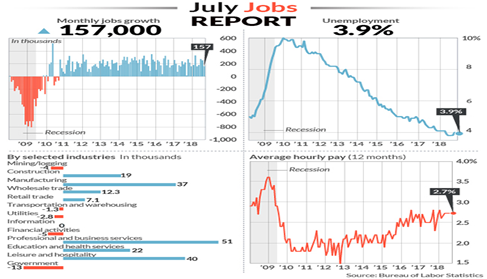
Total nonfarm payroll employment rose by 157,000 in July, and the unemployment rate edged down to 3.9 percent, the U.S. Bureau of Labor Statistics reported today. Employment increased in professional and business services, in manufacturing, and in health care and social assistance.

A 157,000 rise in nonfarm payrolls for July is at the low end of Econoday’s consensus range but is still healthy growth that is strong enough to absorb new entrants into the labor market. And revisions showed a net 59,000 gain with June revised up to 248,000 and May higher at 268,000 in what were two very strong months for job growth.

So the jury is out on when this fully employed economy will begin to slow down. The stock and bond markets are predicting another six months of growth, even with the trade war uncertainties. Trump seems to be holding off on bringing down the hammer of additional Chinese tariffs of $200B, and says he will work in concert with the EU on bringing China to the fair trade table.

The payroll increases were led by temporary help services which rose 28,000 in a very strong gain that indicates employers, stacked up with orders and backlogs, “are scrambling to meet demand,” says Econoday. “Construction payrolls also standout with a strong 19,000 gain in the latest indication of strength in this sector. Manufacturing payrolls rose 37,000 to more than double Econoday’s consensus with trade & transportation, reflecting strong activity in the supply chain, up 15,000. Weakness in payrolls comes from mining, down 4,000 after a long series of gains, and also government payrolls which fell 13,000 to nearly reverse the prior month’s 14,000 jump.”

image

Graph: Econoday

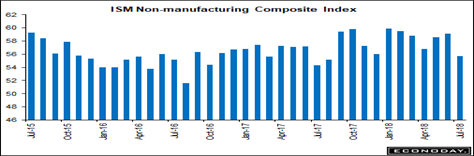
Another caveat to continued growth is a slowing of activity in the service industries, at the lowest level in 11 months. ISM’s Non-manufacturing Composite Index reported both new orders, down more than 5 points to 57.0, and backlog orders, down 5 points to 51.5, show softening. Export orders in this report, at 58.0, remain very strong but are down 2.5 points.

Overall business activity also slowed, down nearly 7.5 points to 56.5 with delivery times showing less stress. Input prices remain highly elevated at 63.4, up nearly 3 points in the month, said the ISM.

There is still the threat of higher auto tariffs, and Midwest farmers are being hurt by higher agricultural prices aimed at Trump country, so we can see that a sharp acceleration in inflation might unsettle both the job and financial markets.

Higher inflation and interest rates, in other words, should tell us whether the rising import and export prices will hurt jobs and company earnings in coming months.

Harlan Green © 2018

Follow Harlan Green on Twitter: https://twitter.com/HarlanGreen

Posted in Consumers, Economy, Weekly Financial News | Tagged , , , | Leave a comment

Americans More Educated Than Ever!

ANSWERING THE KENNEDYS CALL

 image

Education is the linchpin for continued growth in American and worldwide Democracies. To that end, Popular Economics wants to share this inspiring new report from the US Census Bureau’s America Counts series.

Stay tuned, as Popular Economics and ANSWERING THE KENNEDYS CALL will report on what this means for all of US.

America Counts: Stories Behind the Numbers

U.S. Population More Educated Than Ever Before

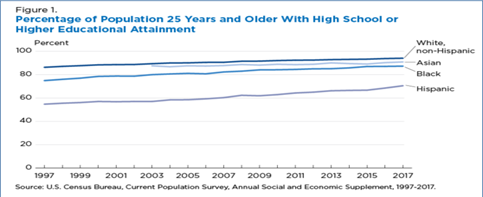
For the first time, the percentage of the American population age 25 and older that completed high school or higher levels of education reached 90 percent in 2017.

The nation has made giant strides in education since 1940, when only 24 percent of people age 25 and older had finished four years of high school or more, according to recently released educational attainment data from the U.S. Census Bureau’s Current Population Survey.

Read More

In contrast, 77 years later a high school education is viewed as a prerequisite for many jobs in the modern economy, which helps explain the record 90 percent high school completion rate today.

image

Learn More About Educational Attainment in the United States

As the educational attainment of the population as a whole increased, so did the high school completion of all race and Hispanic origin groups.

Get the Data

If you like this story, use the hashtag #AmericaCounts to share it on social media.

About America Counts

America Counts tells the stories behind the numbers in a new inviting way. It features stories on various topics such as families, housing, employment, business, education, the economy, emergency preparedness, and population. Contact our Public Information Office for media inquiries or interviews. 

Share this message or view it as a web page.

Harlan Green © 2018

Follow Harlan Green on Twitter: https://twitter.com/HarlanGreen

Posted in Economy, Politics, Uncategorized | Tagged , , | Leave a comment

The Rebuilding of Local Communities

ANSWERING the KENNEDYS CALL

image

Where does the rebuilding of local communities that creates a sense of healthy community itself really happen? At the local level, whether it be in neighborhoods, towns, or cities. It is everywhere residents find a reason to band together.

And it is an answer to the fragmentation of local communities caused by the loss of so many blue collar jobs due to the Digital Revolution and Globalization of the workforce that has internationalized commerce so that corporations ignore national borders in their search for cheaper labor and new markets.

This has meant that towns, cities and states have had to look inward to heal their broken communities in order to provide citizens with the necessary means to grow and prosper.

National Night Out is one such community-building effort that has become a nation-wide movement. It is an annual community-building campaign that promotes public safety-community partnerships and neighborhood camaraderie. National Night Out enhances the relationship between neighbors and public safety and fosters that sense of community.

It is“… a chance to bring neighborhoods together with the men and women who protect them. The safety of our communities depends on both law enforcement and the neighbors they serve. National Night Out enhances that cooperation,” says Vice President Joe Biden.

Millions of neighbors take part in National Night Out across thousands of communities for one night each year.

What is its history? National Night Out has been celebrated since 1984 and is sponsored by the National Association of Town Watch in the United States and Canada. NATW introduced National Night Out in August of 1984 through an already established network of law enforcement agencies, neighborhood watch groups, civic groups, state and regional crime prevention associations and volunteers across the nation. The first annual National Night Out involved 2.5 million neighbors across 400 communities in 23 states. However, the event soon grew to a celebration beyond just front porch vigils.

Neighborhoods across the nation began to host block parties, festivals, parades, cookouts and various other community events with safety demonstrations, seminars, youth events, visits from emergency personnel, exhibits and much, much more. Today, 38 million neighbors in 16 thousand communities across the nation take part in National Night Out.

My home town of Redwood City, California is one such city participating in National Night Out. Here are some of the programs designed to foster a sense of belonging to a viable community and city:

“National Night Out is an annual community-building campaign that promotes public safety-community partnerships and neighborhood camaraderie. National Night Out enhances the relationship between neighbors and public safety and fosters Redwood City’s sense of community.

Join your Redwood City neighborhood this year on August 7 to celebrate National Night Out!

Centennial – Mezes Park, 6-8 p.m.

Eagle Hill – Block Party at Quartz and St. Francis St., 5-8 p.m.

Friendly Acres – Barbeque at Andrew Spinas Park, 6-8 p.m. Fun and games for children and families.

Redwood Shores/Sandpiper Lagoon HOA – Block Party at Avocet Dr. and Waterside Circle from 5:30 – 7:30 p.m. Redwood City Police and Fire departments will attend. Light food and drinks will be provided. Please park in guest parking only or walk to the area.

Redwood Village – Join your neighbors for food, ice cream, classic cars, and a jumper on Flynn St. (off Greenwood), from 6-8 p.m.

Roosevelt – Gather at the Sheltered BBQ Area at Red Morton Park (by the Bocce Ball Court, behind the Community Activities Building) from 6 – 8 p.m. Come tie-dye t-shirts and participate in a dessert contest. 

Woodside Plaza – Gather at Maddux Park from 5 – 8 p.m. for corn hole, ladder golf, and a bake-off competition. Redwood City Police and Fire departments will attend with cars and trucks. RCPD will provide fingerprinting kits. Kona Hawaiian Ice Truck will stop by from 6 – 7 p.m. At 8 p.m. Maddux movie night will follow with a showing of The Princess Bride.

Go here to learn more.

What could be more enjoyable on a summer evening that coming together with others to celebrate your own community’s well-being!

Harlan Green © 2018

Follow Harlan Green on Twitter: https://twitter.com/HarlanGreen

Posted in Economy, Politics, Uncategorized | Tagged , | Leave a comment

Better Economic Growth Ahead?

Popular Economics Weekly

Real gross domestic product increased at an annual rate of 4.1 percent in the second quarter of 2018, according to the “advance” estimate released by the Bureau of Economic Analysis. In the first quarter, real GDP increased 2.2 percent (revised).

All economic cylinders were firing, including a huge 4 percent jump in consumer spending and net 1.1 percent jump in exports. But costs are soaring as well, up 3 percent in the GDP Price Index that measures inflation. Costs are rising because of the tariff wars.  Still, it’s good to see growth approaching the 2014 high mark of 5 percent quarterly economic growth—before the budget wars when Republicans limited government spending across the board (the sequester) and new investment.

image

Graph: BEA

We can only maintain such growth if employment continues to grow; which might happen this year. But it means we can’t have trade wars that cause sharp price rises and interrupt international supply chains. President Trump now says we “love each other” after the latest meeting with European Commission President Jean-Claude Juncker, but they made vague promises. The EU will now buy some of the excess in US soybeans due to China’s cutbacks, and work towards gradually eliminating tariffs on all non-auto industrial goods..

This is a big deal for several reasons, as spelled out in their joint press release: “The United States and the European Union together count more than 830 million citizens and more than 50 percent of global GDP. If we team up, we can make our planet a better, more secure, and more prosperous place.

“Already today, the United States and the European Union have a $1 trillion bilateral trade relationship – the largest economic relationship in the world. We want to further strengthen this trade relationship to the benefit of all American and European citizens.”

They agreed to work together toward zero tariffs, zero non-tariff barriers, and zero subsidies on non-auto industrial goods. They will also work to reduce barriers and increase trade in services, chemicals, pharmaceuticals, medical products, as well as soybeans.

But they have to also agree to unite against China’s trade barriers and technology thefts, instead of negotiating bilaterally with China, Russia, and even Iran, where National Security Advisor and pro-Iran war hawk John Bolton seems to want regime change.

What could derail higher growth ahead is the inflation problem. Prices rose sharply in the GDP Price Index, as the US depends heavily on tariff-affected imports to supply its manufacturing sector in particular.

image

Graph: Econoday

And now we have the problem of declining government revenues that have cut corporate tax revenues by one-third due to the recent tax cuts . This happened last during the Great Recession. Shrinking government spending won’t fix airports, highways, bridges, not to speak of the aged energy grid that Russia has been hacking into of late.

Let us hope the next Congress has the sense to stop cutting taxes (and health care benefits) when corporations use the tax savings to buy back their stock and increase stockholder dividends, rather than invest in new plants and equipment. The only way to increase productivity and our standard of living when the private sector won’t is to use tax dollars that serve the public good, rather than the private good of the wealthiest among US.

Harlan Green © 2018

Follow Harlan Green on Twitter: https://twitter.com/HarlanGreen

Posted in Consumers, Economy, Politics, Weekly Financial News | Tagged , , , | Leave a comment

Housing Sales Are Slowing

The Mortgage Corner

Existing-home sales decreased for the third straight month in June, as declines in the South and West exceeded sales gains in the Northeast and Midwest, reports the National Association of Realtors. The ongoing supply and demand imbalance helped push June’s median sales price to an existing-home new all-time high.

“Total existing-home sales, https://www.nar.realtor/existing-home-sales, said the NAR, “which are completed transactions that include single-family homes, townhomes, condominiums and co-ops, decreased 0.6 percent to a seasonally adjusted annual rate of 5.38 million in June from a downwardly revised 5.41 million in May. With last month’s decline, sales are now 2.2 percent below a year ago.

image

Graph: Econoday

Pending home sales that measure future sales also decreased modestly in May and have fallen on an annualized basis for the fifth straight month, according to the NAR. This seems to show a slowing of demand for housing, though the Realtor’s economist Yun believes it’s more due to lack of supply, and fewer entry-level homes available.

Lawrence Yun, NAR chief economist, said closings inched backwards in June and fell on an annual basis for the fourth straight month. “There continues to be a mismatch since the spring between the growing levels of homebuyer demand in most of the country in relation to the actual pace of home sales, which are declining,” he said.

“The root cause is without a doubt the severe housing shortage that is not releasing its grip on the nation’s housing market. What is for sale in most areas is going under contract very fast and in many cases, has multiple offers. This dynamic is keeping home price growth elevated, pricing out would-be buyers and ultimately slowing sales.”

Why do we still have a housing shortage 9 years after the Great Recession? For the first half of 2018, a steady job market and a shortage of existing homes for sale has bolstered housing starts, said the Commerce Department. New home construction has climbed 7.8 per cent year-to-date.

And homebuilders are also relatively confident that the expansion will continue. The National Association of Home Builders/Wells Fargo builder sentiment index declined slightly to a reading of 68 in June, but any reading above 50 signals growth.

So another ‘root cause’ has to be affordability, as prices continue to climb. The report was mixed good news, as prices continue to rise, up 4.5 percent for the median to $276,900, while buyers saw a 4.3 percent rise in the number of homes on the market, at 1.950 million relative to sales, a gain to 4.3 months from 4.1 months.

image

Graph: Calculated Risk

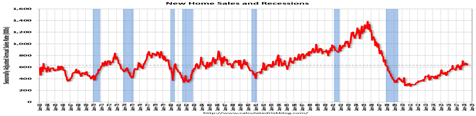
It was thought new-home sales would give a boost to housing, but even new- homes sales are slower in June. The Calculated Risk graph shows new-home sales lagging historically from other recoveries, when sales reached 800,000 units annually.

“Sales of new single-family houses in June 2018 were at a seasonally adjusted annual rate of 631,000, according to estimates released jointly today by the U.S. Census Bureau and the Department of Housing and Urban Development. This is 5.3 percent below the revised May rate of 666,000, but is 2.4 percent above the June 2017 estimate of 616,000.”

The sales slowdown has to be from after-effects of the Great Recession, what was also the Great Housing Bust when so many homeowners lost their home and life-savings. It’s a combination of lenders being much more cautious and consumers earning much less these days. For instance, first-time buyers totaled just 31 percent of existing homebuyers, vs. the 40 percent long term average.

Household incomes have been stagnant since the 1980s after inflation, and both incomes and net worth have actually declined since the Great Recession, so we are seeing the results in the housing market, as the costs of home-building continue to climb with inflation.

For example, the just enacted Canadian lumber tariffs are adding $9,000 on average to building costs, according to the National Association of Home Builders. “Not only are consumers and builders concerned about the current lumber tariffs, but also the next round of proposed tariffs on a number of goods and services,” said NAHB Chair Randy Noel.

In fact, there has not been a concerted effort to boost consumers’ incomes at all since the Great Recession. Rather, the effort has been to suppress wages, with more states restricting collective bargaining rights of both union and non-union employees. There are now 28 right-to-work states that restrict the amount of dues unions can collect, and even the Supreme Court has just rescinded a 40-year old precedent that allowed public employee unions to collect dues from non-union members that enjoy the same benefits.

Do we need any more reasons to understand the slowdown in home buying?

Harlan Green © 2018

Follow Harlan Green on Twitter: https://twitter.com/HarlanGreen

Posted in Consumers, Economy, Housing, housing market, Weekly Financial News | Tagged , , , , | Leave a comment

The Dire Consequences of Record Income Inequality

ANSWERING the KENNEDYS CALL

image

In a new Economic Policy Institute report entitled The New Gilded Age, income inequality has risen in every state since the 1970s, and in most states it has continued to grow in the post–Great Recession era.

Why should we care? The most dire economic consequences of income inequality are recessions, including the Great Depression when inequality was as high as it is now. And since 1980, inequality soared which has resulted in 5 recessions, including the Great Recession.

Are there more on the horizon in this ninth year of this long-in-the-tooth recovery from the Great Recession? The Economic Policy Institute map shows the income disparities in the U.S. today. In Alaska the top 1 percent earns 12.7 times the 99 percent, whereas New York has the highest multiple, at 44.4 percent.

From 2009 to 2015, the incomes of the top 1 percent grew faster than the incomes of the bottom 99 percent in 43 states and the District of Columbia. The top 1 percent captured half or more of all income growth in nine states. In 2015, a family in the top 1 percent nationally received, on average, 26.3 times as much income as a family in the bottom 99 percent.

Today, the top 1 percent has garnered 24 percent of national income once again, as happened in 1928 just prior to the Great Depression, and which today is $1.3m. The 99 percent rest of us have an average annual income of $50,000 per year. And now we have to worry that the current geopolitical uncertainties—a Trump trade war, breaking up of western treaties (TPP, NAFTA, NATO), global warming that is causing mass migrations, the threats of more terrorism, or ongoing regional military conflicts—could plunge us into another recession or worse.

There is a way out of this mess, other than another recession or war. We could shift the balance of power to those that want to rebalance the income equation by rescinding those tax cuts that only benefit the 1 percent longer term.

Or, we could shift more spending away from the military’s $600B budget that just increases the likelihood of war, to badly needed infrastructure improvements, boosting educational opportunities of the disenfranchised blue collar workers, or more R&D to create the next generation of innovators and entrepreneurs.

There are countless ways we can use those revenues, in other words, that would benefit 99 percent of Americans, instead of the 1 percent.

Harlan Green © 2018

Follow Harlan Green on Twitter: https://twitter.com/HarlanGreen

Posted in Consumers, Economy, Keynesian economics, Politics, Weekly Financial News | Tagged , , , | Leave a comment

US Economic Self-Destruction Imminent?

Financial FAQs

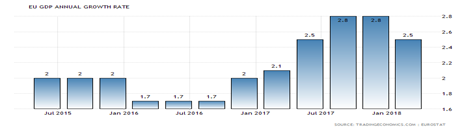
The International Monetary Fund has just warned that President Trump’s trade wars could cost the world’s economies some $430B in lost growth. The Washington-based organisation said the current threats made by the US and its trading partners risked lowering global growth by as much as 0.5 percent by 2020 in worldwide Gross National Product.

And NYU economist Nouriel Roubini has now jumped on the critics’ bandwagon contra the Trump tariffs with his contention that trade wars will cause rising inflation and economic uncertainty at the wrong time.

Last year was a time of ideal growth conditions, but this year? “The combination of strong growth, low inflation, and easy money implied that market volatility was low,” said Professor Roubini about 2017. “And with the yields on government bonds also very low, investors’ animal spirits were running high, boosting the price of many risky assets…Many commentators even argued that the decade of the “new mediocre” and “secular stagnation” was giving way to a new “goldilocks” phase of steady, stronger growth.”

image

Graph: Trading Economics

But this year, says Roubini, for the first time in a decade the biggest risks are now stagflationary (slower growth and higher inflation). “These risks include the negative supply shock that could come from a trade war; higher oil prices, owing to politically motivated supply constraints; and inflationary domestic policies in the U.S.”

This is while President Trump has abandoned the Trans Pacific Partnership with 11 other Asian countries and Australia (who are forming their own trade partnership), and is attempting to bust up our trade alliances with the EU, Canada, and Mexico.

Although all economies would suffer from further tariff escalations, the US would find itself “as the focus of global retaliation” with a relatively higher share of its exports taxed in global markets. “It is therefore especially vulnerable,” says the IMF.

Trump’s trade wars have escalated from $3.6 million in tariffs first imposed in January against 18 types of Chinese solar panels and washing machines to more than 10,000 products worth some $362 billion, as China, Canada and the European Union has retaliated with their own tariffs, according to the New York Times.

And the Guardian says the European commission, the EU’s executive arm, warned the White House recently it would be prepared to use tariffs against as much as $300bn(£228bn) of US products should Donald Trump slap higher taxes on European automotive imports to America. The president had threatened last month to impose tariffs of 20% on imports of cars from the EU after Brussels carried through plans to tax American consumer goods – such as whiskey, cigars and Harley-Davidson motorcycles – in retaliation against US tariffs on European steel and aluminum.

This is not how to practice “The Art of the Deal”, if President Trump ever did know how. His past record of lawsuits, bankruptcies, and links to Mafia figures and Russian Oligarchs belies this. Conflating friends with enemies now pits the whole world against the US in trade matters.

Harlan Green © 2018

Follow Harlan Green on Twitter: https://twitter.com/HarlanGreen

Posted in Economy, Keynesian economics, Politics, Weekly Financial News | Tagged , , , | Leave a comment

Is 4% GDP Growth Real?

Popular Economics Weekly

image

Graph: Econoday

Many economists, including Trump economic advisor Larry Kudlow, are predicting up to 4 percent economic growth over the next few quarters. Why? Full employment is enticing consumers to buy more, with booming retail sales and consumer confidence.

“Sales at health & personal care stores were unusually strong in June, up 2.2 percent following a series of very strong gains in the 1 percent range,” reports Econoday. “Nonstore retailers, in a sign of e-commerce strength, rose 1.3 percent in June and continue to make ground compared to other components. Gasoline stations, boosted by high gas prices, saw a 1.0 percent rise in June sales following a 3.0 percent spike in May. Building materials, at plus 0.8 percent in June, and furniture store sales, up 0.6 percent, are both positive indications for residential investment.”

The problem with understanding the significance of retail sales is that they aren’t corrected for inflation, and consumer (CPI) inflation is approaching 3 percent, so 6 percent nominal annual retail sales is closer to 3 percent in real sales. And that is probably the high end, as consumers’ real average paychecks are increasing 2.7 percent, so any increase in buying is limited by the amount consumers can borrow with rising interest rates, as I’ve been saying.

Is 4 percent GDP growth possible for the next several quarters, as Kudlow, et. al. are predicting? It depends on how long can this business expansion continues, says Brookings economist Robert Shapiro.

“Trump’s middling record on GDP and investment raises the question of how much longer the current expansion, now just two months shy of entering its tenth year, can last,” says Shapiro. “Developed economies move in business cycles, and so they weaken eventually as a matter of course. That’s where the United States is today. This late in any economic expansion, the pool of available workers for new jobs is modest, most attractive investment opportunities have been taken, and any pent-up consumer demand for large durable purchases has been exhausted.”

image

Graph: MarketWatch

In fact, wages are falling after inflation by another measure. According to the Labor Department, median weekly earnings fell 0.6 percent in inflation-adjusted dollars in the second quarter, compared to the same time period of 2017. That’s the third straight quarter where inflation has outpaced wage growth, according to MarketWatch’s Steve Goldstein.

This is an important statistic because real personal income growth is one of the four pillars that measure the onset of a recession. Nonfarm employment, industrial production and real retail sales are the other three pillars. All four indicators must peak for a recession to begin. So far, median weekly earnings show weakness, but the other three still show growth.

A more public sign of recession is when there are two consecutive quarters of GDP decline. So to be clear, weakness is showing in just one of the four legs, and there are predictions of at least two more quarters of positive GDP growth.

But then there is the looming trade war. The International Monetary Fund has just warned that President Trump’s trade wars with everyone could cost the world’s economies some $430B in lost growth. The Washington-based organisation said the current threats made by the US and its trading partners risked lowering global growth by as much as 0.5 percent by 2020, or about $430bn in lost GDP worldwide.

It has escalated from $3.6 million in tariffs first imposed in January against 18 types of Chinese solar panels and washing machines to more than 10,000 products worth some $362 billion, as China, Canada and the European Union have retaliated with their own tariffs, according to the latest New York Times estimate.

And 2020 is the year of our next presidential election. So investors can gamble that President Trump won’t continue to double down on his trade wars, if he wants to be re-elected. But it is a very high-stakes gamble.

Harlan Green © 2018

Follow Harlan Green on Twitter: https://twitter.com/HarlanGreen

Posted in Consumers, Economy, Keynesian economics, Uncategorized, Weekly Financial News | Tagged , , , , , | Leave a comment

Inflation On the Rise

The Mortgage Corner

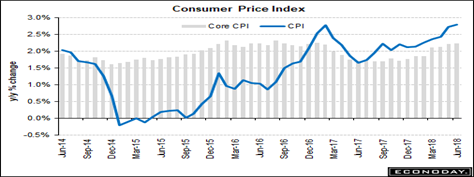
Inflation is finally rising enough to bite into consumers’ paychecks. It is also a sign that economic growth is increasing at least temporarily, as consumers borrow more to buy more. But the bottom 50 percent of income earners have seen no real average annual income growth since 1980, which means at least one-half of all consumers have to eventually stop buying and start paying back those loans when inflation and interest rates increase further.

image

Graph: Econoday

Retail inflation is up 2.9 percent annually, which has to begin to hurt the heavily indebted consumer, as I said. But enthusiasm over the full employment numbers and job availability are keeping consumers buying for the moment. It is because there are more available job openings than jobs being created at the moment—almost 1 million, a huge gap —which is why more workers are quitting their current jobs, reports the Labor Department’s JOLTS survey.

The rising so-called Quits rate is big news because it means workers are moving to better job opportunities; a sign of rising incomes as well. Americans quit their jobs in May at the fastest rate since 2001, showing that employees feel so good about the economy they are willing to leave one company for another.

image

Graph: Econoday

Job openings slipped back but still remain very abundant, at 6.638 million in May vs. an upward revised and record 6.840 million in April. Openings are up 16.7 percent compared to May last year and are far above hiring, at 5.754 million in May for comparatively distant 4.9 percent year-on-year gain.

But watch out, the University of Michigan consumer sentiment index fell in July to a reading of 97.1, below June’s level of 98.2, which is an indication that the trade war bombast is beginning to worry consumers. That’s the lowest level since January. Prices are on the rise, yet interest rates haven’t yet followed.

Why? Part of the reason is that longer-term interest rates are stuck at a very low level, so that there is little difference between the 2 and 10-year Treasury yield, a sign that many bond investors don’t trust the predictions for higher growth. It’s a flight-to-quality syndrome when investors flock to a safe haven from future uncertainty with lower, but safer yielding investments, such as government-guaranteed sovereign bonds.

So we are seeing a growing unease in investors and consumers about the future, with consumers’ personal savings rate barely above zero (2.8 percent), with no cushion to fall back on should there be either a market crash, or full-blown trade war that lifts prices for everyone, or an actual war.

Harlan Green © 2018

Follow Harlan Green on Twitter: https://twitter.com/HarlanGreen

Posted in Consumers, Economy, Weekly Financial News | Tagged , , , , | Leave a comment

ANSWERING the KENNEDYS CALL

image

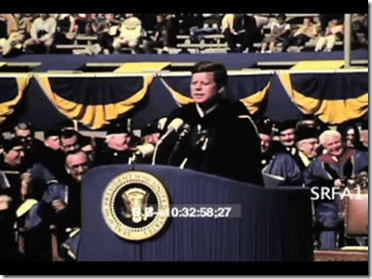
We are announcing a new blog series—ANSWERING THE KENNEDYS CALL. It will report on what is being done today to address the problems that deal with record income inequality, immigration and civil rights, environment protection, and the rebuilding of local communities both at home and abroad that we cover in a forthcoming book, ANSWERING the KENNEDYS CALL: Inspiring Lessons in Public Service and Community Building from the Sixties for the Future.

It is a book about the cultural and social revolution of the Sixties carried forward by newer generations that is healing our broken communities and a dysfunctional government.  The Sixties created many of the benefits we enjoy today—environmental protection, civil rights for minorities, scientific research that brought us moon landings, the Internet, modern commerce, and a greater openness to other peoples and countries. 

By portraying the history of community development via the experiences of the Sixties’ generations, and practices of M. Scott Peck, Cesar Chavez and sociologist Robert Putnam in community organizing, we will show we have never really left that hopeful spirit that is creating new forms of a healthy, functioning, participatory democracy.

The efforts of those generations in making the world a better place is finding a response among younger generations today in countering the rampant pessimism and sense of limited possibilities prevalent in much of our society, due in large part to the economic uncertainty and successive recessions that have impoverished a majority of Americans since the 1980s.

President Obama is now mounting a campaign with a similar goal to inspire our youth to a life of service; and the youth he talks about are my target audience:  http://thehill.com/blogs/pundits-blog/the-administration/330269-full-remarks-obama-at-chicago-event-discusses-future.

“The only folks who are going to be able to solve that problem are going to be young people, the next generation,” said President Obama. “And I have been encouraged everywhere I go in the United States, but also everywhere around the world to see how sharp and astute and tolerant and thoughtful and entrepreneurial our young people are. A lot more sophisticated than I was at their age. And so the question then becomes what are the ways in which we can create pathways for them to take leadership, for them to get involved?”

We begin with this recent headline from the United Farmworkers Union: Salinas, Calif.-based D’Arrigo Bros. of California has just signed a new contract with the United Farm Workers union that will cover more than 1,500 farm workers, according to this press release from The Packer, “the fresh fruit and vegetable industry’s leading source for news, information and analysis.”

The agreement provides family medical, dental and vision benefits for the farm workers that will be paid for by D’Arrigo. Health insurance will be provided by the Robert F. Kennedy Medical Plan, a plan established in 1968 specifically for farm workers and their families.

“Both parties have come to a new era of a working relationship and realize the agricultural workers need to be taken care of,” President John D’Arrigo said in the release. “That investment will hopefully translate into people wanting to work here the whole season,”

Employees also receive hourly and productivity pay increases. The incentive and box pay rate will increase by 3 percent in the first year, 3 percent in the second year and 2.5 percent in the third year. Workers will also receive six paid holidays a year, and loaders and machine operators who use their personal vehicles will be paid 50 cents per mile for travel time.

“To be willing to put that much investment in their employees really demonstrates the value that John D’Arrigo is placing on his employees,” UFW president Arturo Rodriguez said in the release.

Why the realization from a major Salinas, California grower that union workers are important to his business? There is a growing scarcity of seasonal farmworkers due to the ICE sweeps and “zero tolerance policy” of the Trump administration that is decimating America’s agricultural industry. Growers are beginning to look to the UFW to supply those seasonal workers that labor contractors formally provided, but were mainly undocumented workers.

It took the first-term election of California’s Democratic Governor Jerry Brown in 1975 to give farmworkers bargaining rights with his enactment of the California Agricultural Labor Relations Act that legalized the union organization of farmworkers.

Today’s suppression of employee bargaining rights is little different, even though there is a National Labor Relations Board to enforce union collective bargaining rights. The problem is 28 so-called right-to-work states under Republican control allow private sector nonunion employees off the dues hook who work in a job that benefits from union bargaining.

And just recently the Supreme Court overturned a 40-year precedent in Janus v. AFSCME that nonunion government workers cannot be forced to pay fees to public sector unions if they chose not to belong to them. Those fees, approved by the court in the 1977 case Abood v. Detroit Board of Education, cover collective bargaining costs such as contract negotiations, but are meant to exclude political advocacy.

SCOTUS’s Chief Justice Alito stated in his majority opinion that taking the side of governments in such labor disputes saves governments money. Really? Justice Alito is admitting that weakening government unions’ ability to collect dues will also weaken employees’ ability to bargain for their pay and benefits.

We don’t buy his argument that he wants to help governments with their finances. He as a good conservative is only interested in downsizing government in any way he (and probably his 4 fellow SCOTUS conservatives) can, which includes downsizing the standard of living of both union and nonunion government employees.

Harlan Green © 2018

Follow Harlan Green on Twitter: https://twitter.com/HarlanGreen

Posted in Economy, Politics, Uncategorized | Tagged , , , , | Leave a comment