Where Goes the Housing Market?

The Mortgage Corner

image

Graph: Econoday

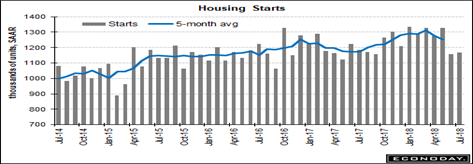
We definitely have a housing shortage. Housing construction is unable to keep up with the demand for single-family homes, in particular. Year-on-year, starts are down 1.4 percent with completions, at a 1.188 million rate, down 0.8 percent and homes not started, at 175,000, up 23.2 percent, nationally. The lack of available construction labor and high costs for lumber, which are tied in part to tariffs, are negative factors, say Realtors and home builders.

“Given the chronic lack of affordable housing and rapidly escalating home prices, it is worrisome that on a per capita basis, the country is producing new single-family housing stock at a rate that is similar to the trough of a typical recession,” Sam Khater, chief economist at Freddie Mac, told Reuters.

This is not good news for entry-level homebuyers looking to buy affordable homes, needless to say. Even though mortgage rates are still at post-recession (historic) lows, with the 30-year conforming mortgage rate stuck at 4.0 percent for a one point origination fee among the most competitive California lenders.

Some new-home projects are seeing construction delays due to those cost concerns, according to the National Association of Home Builders. The NAHB also notes the number of single-family units that are authorized but have not started is up 25 percent since July 2017.

And we have the aforementioned tariff wars raising the price of building materials—Canadian lumber in particular. “Supply-side challenges, including increases in material prices and chronic labor shortages, are affecting affordability in many markets,” says Robert Dietz, the NAHB’s chief economist. “However, consumer demand remains strong, due to a growing economy and job market and favorable demographics.”

Showing much less weakness are permits, up 1.5 percent in the month to 1.311 million. Year-on-year, permits are up 4.2 percent with strength centered where it should be and that’s single-family homes where permits are up a very solid 6.4 percent. Multi-family permits are up 0.2 percent year-on-year, reflecting the rise in renters that can’t afford to buy.

What can be done to ease what is fast becoming a housing crisis? The tariff wars with Canada and the EU are definitely not in our national security interest, as housing inflation is already a problem. But there is also a construction workers shortage in this fully employed economy. Many of those workers are recently-arrived immigrants being deported by the Trump administration, rather than offered a path to citizenship; which is also harming agriculture.

The national median existing-home value is now $217,300, an increase of 8.3 percent on the year and 8.4 percent above the bubble-era peak. In 21 of the nation’s 35 largest markets, the median home value is now at an all-time high reports Zillow, the housing information specialist.

And continuing a years-long trend, says Zillow, the number of U.S. homes for sale in June fell 4.8 percent to 1.2 million, the 41st month in a row of annual inventory declines. Inventory of homes in the top value tier dropped 5.4 percent, while the number of homes for sale in the bottom value tier fell 3.6 percent.

Even though homeownership is rising from its Great Recession trough, the share of people renting their home, rather than owning it, has also increased in all 50 of the largest cities in the country between 2006 and 2016, reports Zillow.   Renter households now represent the majority in 29 of those 50 cities — back in 2006 at the start of the housing crisis, only 16 had renter-household majorities.

So we are seeing the inevitable result of the busted housing bubble, when as many as one million excess homes were built. But even more damage was done during the succeeding recovery, when policies were not instigated to cure the loss of incomes that resulted from the loss of jobs and homes.

It will require many more public-funded programs to cure the housing shortage, including affordable housing tax breaks, remedy of the massive infrastructure deficit, and tax cuts and spending programs (such as on health care and education) that benefit the middle and working classes, rather than Wall Street and the corporations.

Harlan Green © 2018

Follow Harlan Green on Twitter: https://twitter.com/HarlanGreen
Posted in Consumers, Economy, Housing, housing market, Weekly Financial News | Tagged , , , , , , , | Leave a comment

Interest Rates Dangerously Low?

Popular Economics Weekly

image

Graph: FRED

Why should historically low interest rates be a problem, you say?  Doesn’t that help consumer demand by enabling consumers to buy more by borrowing more cheaply, and economic growth by encouraging companies to create more jobs?  Not when rates have remained this low for so long.

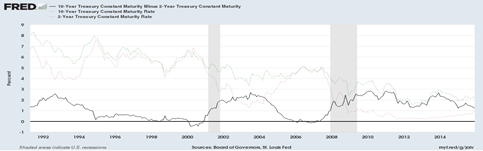
Interest rates are far too low this late in the recovery from the Great Recession. It isn’t only because the Treasury Yield Curve slope has been steadily declining since 2014 that measures the difference between the 10-year and 2-year Treasury bond yields.

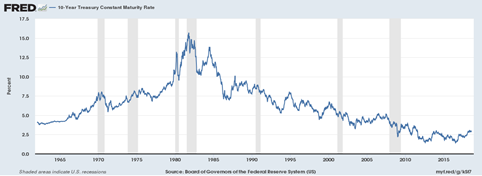
The Benchmark 10-year Treasury yield itself hasn’t risen above 3 percent in at least one year. It was this low for sustained periods during the Great Recession, when it dipped below 2 percent. But it shouldn’t be as low today (2.85 percent at this writing). In fact, interest rates haven’t recovered from the Great Recession. It normally ranges from 4 to 5 percent during prosperous times when there is a greater demand for money—e.g., from 2000 to 2008—as the FRED graph shows.

It signals a significant weakness in aggregate demand for goods and services; which is the sum of demand by consumers, investors, government spending and net exports, (and somewhat mirrors the weak 2 percent GDP growth since then). This could means we are dangerously close to another recession, if economic shocks such as the Turkish Lira plunge, or a full-fledged trade war occurs.

Consumer spending is perking along above 3 percent only because of excessive borrowing due to the low interest rates, rather than rising incomes, so it won’t be sustainable. And capital spending is half of what it should be with the stimulus from the Republican tax cuts and $1.3 trillion in additional federal spending.

Exports—another component of aggregate demand—is momentarily rising, but it could be a one-time surge in orders to escape rising costs from the trade war. And there is always the threat of cuts to government entitlement programs like food stamps, Medicare and Medicaid, which increases costs of many low and middle-income consumers.

So we could be teetering on the edge of an economic slowdown, no matter what the pundits are saying about full employment and the latest 4.1 percent GDP 2nd quarter growth, with excessive government and private debt providing little cushion for support should geopolitical and financial problems worsen.

However, there is a caveat to this dismal scenario. It may not be a recession for all Americans. Household debt — including mortgages, credit cards, auto loans, student loans and other credit — grew for the 16th consecutive quarter in the April-to-June period, rising by 0.6%, or $82 billion, to $13.29 trillion, the New York Fed reported Tuesday.

image

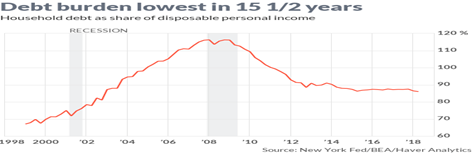
That’s because the recovery has really benefited just the top 10 percent income-earners, who have been able to pay down their debts. With personal disposable incomes at a $15.46 trillion annual rate in the quarter, the debt-to-income ratio dipped to 86 percent. That’s the lowest, by a tiny amount, since the fourth quarter of 2002. At the height of the credit bubble in 2008, debts topped at 116 percent of disposable income.

And we have government debt approaching 100 percent of GDP by 2020, according to the watchdog Congressional Budget Office. The sad denouement of this scenario could be that another downturn will hurt those most dependent on the federal government for protection, as has happened in the past.

Harlan Green © 2018

Follow Harlan Green on Twitter: https://twitter.com/HarlanGreen
Posted in Consumers, Economy, Politics, Weekly Financial News | Tagged , , , | Leave a comment

Loneliness in America is a Public Health Problem

ANSWERING THE KENNEDYS CALL

image

As part of our series on community-building I am reporting on what happens to Americans as a result of the breakdown of community, which Robert Putnam first documented in his best-seller, “Bowling Alone: the Collapse and Revival of American Community.”

This MarketWatch article forwards a report by Cigna Health on the damage done to individuals by living in a society that encourages little face-to-face human contacts in our high-stress, and very unequal society:

“ A recent Cigna survey of 20,000 U.S. adults found that nearly half of people suffer from feelings of loneliness. The evaluation of loneliness was measured by an often-used score of 43 or higher on the University of California, Los Angeles “Loneliness Scale,” a 20-item questionnaire developed to measure feelings of loneliness and social isolation. Loneliness is both a health issue and a social issue and, often, subjective.

“We view a person’s physical, mental and social health as being entirely connected,” David Cordani, president and chief executive officer of Cigna, said in a statement. “We’re seeing a lack of human connection, which ultimately leads to a lack of vitality,” he said, “or a disconnect between mind and body.”

Why such a disconnect of Americans? “Mandatory overtime and involuntary long hours are a growing problem particularly for some segments of the labor force,” according to “Overworked America,” a 2016 report from the Washington Center for Equitable Growth, a left-leaning research center. Workers who are not paid overtime are more than twice as likely to report working more than 40 hours a week,” it said.

image

European Union members, such as The Netherlands and Denmark, have lower workweek hours with universal healthcare, tuition-free colleges and report much fewer health problems.

The toll of loneliness has even affected our youngest generation—the Gen X’ers. “Generation X-ers are struggling to keep up with a loss of wealth and income since the Great Recession,” says the study, “and have less time to spend with family. As wages play catchup with inflation, many people work overtime or two jobs to make ends meet.”” The U.S. is one of the few countries in the industrialized world that does not require employers to offer paid parental leave.”

“More people live (and eat) alone. More than half of all meals (57 percent) are eaten alone, a 2014 study by market researcher NPD Group concluded. And 34 percent of Americans spend dinner time alone. Nearly 30 percent of households in the U.S. are comprised of one person. It’s the second most common household type after married couples without children.”

How can we decrease our loneliness (and health) problem? Exercise and good sleep habits are a start. But much more is needed, given the fact that America is the only developed country without universal health care, paid parental leave to raise healthier children, and an educational system that heavily in debts college students. It requires a society and government willing to care for all citizens.

The current state of loneliness is not sustainable. It is why Americans’ health outcomes are measurably worse than in other developed countries; with higher infant mortality, less longevity, an intractable Opioid/drug epidemic, and rampant gun violence, for starters.

There is no reason why Americans can’t create better functioning communities, create a sense that we are all in this together and care more for each other, rather than remain divided among races and political ideologies.

We do know how to combat loneliness. Be willing to reach out to others when it’s an inconvenience, even with a smile.

Harlan Green © 2018

Follow Harlan Green on Twitter: https://twitter.com/HarlanGreen

Posted in Consumers, Economy, Uncategorized | Tagged , , , , | Leave a comment

Why aren’t Wages Growing Faster?

Popular Economics Weekly

image

Graph: FRED

Interest rates are far too low for this late in the recovery from the Great Recession. We know this because the Treasury Yield Curve has been falling that measures the difference between the 10-year and 2-year Treasury bond yields. The difference is just 1 percent, when it has been around 2 percent during other prosperous times, as the FRED graph shows. It last was this low just before the last 2 recessions (gray columns in graph).

Why are interest rates still low? The simplest answer is there isn’t sufficient demand for what is being produced that would cause more borrowing, thus causing interest rates to rise. And though the Republican tax cuts have juiced profits of corporations and their stock holders, it hasn’t boosted the wages of ordinary consumers that power two-thirds of economic activity.

Consumers’ personal incomes are rising at the inflation rate on average, which means they don’t have sufficient income or savings that would cause them to increase their spending habits. It’s a difficult and maybe counter-intuitive concept. If prices are rising as fast as incomes, then consumers are also playing catchup in what they need to maintain their standard of living.

That is why economists worry that such low long term interest rates in particular could be a sign of another incipient recession. Banks cannot lend as much when their profit on loans is the difference between their cost of money and what they can lend at longer-term loan rates (such as mortgages and installment loans). So it means a shrinkage in the available credit.

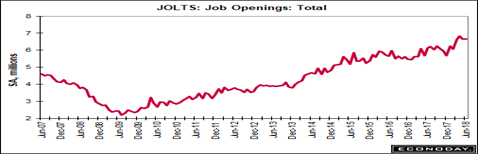
The good news is that job openings are still soaring in the Labor Department’s JOLTS Report, which should boost wages. It is a survey of available jobs, vs. how many jobs have been created in June.

There were 6.662 million in June vs. an upwardly revised 6.659 million in May, reports the BLS. Year-on-year, the number of job openings was up 8.8 percent. The number of hires remained well below job openings at 5.651 million in June, down from May’s 5.747 million, while separations, which includes quits, layoffs and discharges, rose to 5.502 million from 5.419 million.

 image

Graph: Econoday

That means there were more than 1 million jobs that remained unfilled, which has to put more pressure on employers to boost wages. So will inflation behave enough to allow an increase in real wages, which should be rising above the rate of inflation this late in the recovery from the Great Recession?

That has been the problem since the 1970s, really. The Fed wants to keep inflation low, so it raises interest rates whenever there is a sign that workers’ wages are rising faster than inflation. But this puts a damper on consumer spending, which in turn keeps economic growth in the 2-3 percent range, which isn’t enough to either pay down personal or government debts.

And social security trustees calculate the $3 trillion social security trust fund will be depleted by 1934, which would mean taxes must be raised to maintain current benefits before then. Does anything believe Congress will allow said benefits to shrink, with voting seniors just daring them to cut their benefits?

It’s much easier for the Fed to allow inflation to rise above its 2 percent target range before raising their interest rates to allow faster wage growth, which in turn boosts tax revenues. The social security trustees use a mid-range GDP growth rate of approximately 2.6 percent to calculate longevity of the SS trust fund.

But GDP growth has averaged 3.5 percent since the 1930s, including the Great Depression. Why have inflation hawks at the Federal Reserve so slowed growth since the 1970s by boosting interest rates at the slightest hint of higher inflation, which in turn has kept GDP growth below its long-range potential?

The real answer is that pro-business, pro-corporate administrations since 1980 have severely limited collective bargaining and other pro-labor laws in the name of globalization, thus limiting wage growth.

That’s why such policies are called trickle-down economics. Very little of the national wealth created since then has trickled down to the 80 percent that are the real wage earners.

Harlan Green © 2018

Follow Harlan Green on Twitter: https://twitter.com/HarlanGreen

Posted in Consumers, Economy, Politics, Weekly Financial News | Tagged , , , , , | Leave a comment

Slower July Jobs Growth

Popular Economics Weekly

image

Graph: MarketWatch

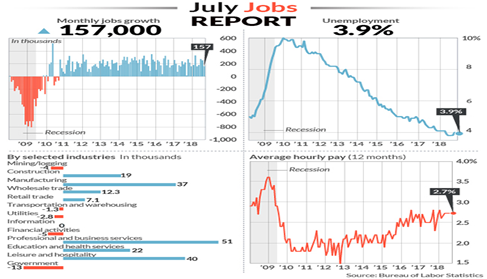
Total nonfarm payroll employment rose by 157,000 in July, and the unemployment rate edged down to 3.9 percent, the U.S. Bureau of Labor Statistics reported today. Employment increased in professional and business services, in manufacturing, and in health care and social assistance.

A 157,000 rise in nonfarm payrolls for July is at the low end of Econoday’s consensus range but is still healthy growth that is strong enough to absorb new entrants into the labor market. And revisions showed a net 59,000 gain with June revised up to 248,000 and May higher at 268,000 in what were two very strong months for job growth.

So the jury is out on when this fully employed economy will begin to slow down. The stock and bond markets are predicting another six months of growth, even with the trade war uncertainties. Trump seems to be holding off on bringing down the hammer of additional Chinese tariffs of $200B, and says he will work in concert with the EU on bringing China to the fair trade table.

The payroll increases were led by temporary help services which rose 28,000 in a very strong gain that indicates employers, stacked up with orders and backlogs, “are scrambling to meet demand,” says Econoday. “Construction payrolls also standout with a strong 19,000 gain in the latest indication of strength in this sector. Manufacturing payrolls rose 37,000 to more than double Econoday’s consensus with trade & transportation, reflecting strong activity in the supply chain, up 15,000. Weakness in payrolls comes from mining, down 4,000 after a long series of gains, and also government payrolls which fell 13,000 to nearly reverse the prior month’s 14,000 jump.”

image

Graph: Econoday

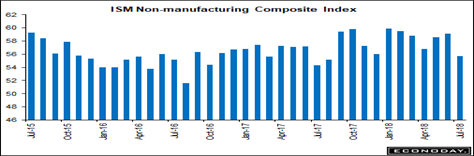
Another caveat to continued growth is a slowing of activity in the service industries, at the lowest level in 11 months. ISM’s Non-manufacturing Composite Index reported both new orders, down more than 5 points to 57.0, and backlog orders, down 5 points to 51.5, show softening. Export orders in this report, at 58.0, remain very strong but are down 2.5 points.

Overall business activity also slowed, down nearly 7.5 points to 56.5 with delivery times showing less stress. Input prices remain highly elevated at 63.4, up nearly 3 points in the month, said the ISM.

There is still the threat of higher auto tariffs, and Midwest farmers are being hurt by higher agricultural prices aimed at Trump country, so we can see that a sharp acceleration in inflation might unsettle both the job and financial markets.

Higher inflation and interest rates, in other words, should tell us whether the rising import and export prices will hurt jobs and company earnings in coming months.

Harlan Green © 2018

Follow Harlan Green on Twitter: https://twitter.com/HarlanGreen
Posted in Consumers, Economy, Weekly Financial News | Tagged , , , | Leave a comment

Americans More Educated Than Ever!

ANSWERING THE KENNEDYS CALL

 image

Education is the linchpin for continued growth in American and worldwide Democracies. To that end, Popular Economics wants to share this inspiring new report from the US Census Bureau’s America Counts series.

Stay tuned, as Popular Economics and ANSWERING THE KENNEDYS CALL will report on what this means for all of US.

America Counts: Stories Behind the Numbers

U.S. Population More Educated Than Ever Before

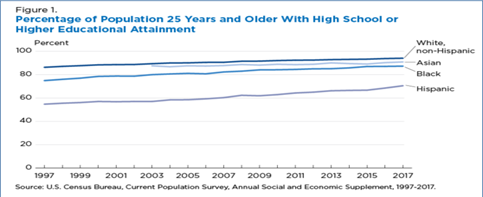
For the first time, the percentage of the American population age 25 and older that completed high school or higher levels of education reached 90 percent in 2017.

The nation has made giant strides in education since 1940, when only 24 percent of people age 25 and older had finished four years of high school or more, according to recently released educational attainment data from the U.S. Census Bureau’s Current Population Survey.

Read More

In contrast, 77 years later a high school education is viewed as a prerequisite for many jobs in the modern economy, which helps explain the record 90 percent high school completion rate today.

image

Learn More About Educational Attainment in the United States

As the educational attainment of the population as a whole increased, so did the high school completion of all race and Hispanic origin groups.

Get the Data

If you like this story, use the hashtag #AmericaCounts to share it on social media.

About America Counts

America Counts tells the stories behind the numbers in a new inviting way. It features stories on various topics such as families, housing, employment, business, education, the economy, emergency preparedness, and population. Contact our Public Information Office for media inquiries or interviews. 

Share this message or view it as a web page.

Harlan Green © 2018

Follow Harlan Green on Twitter: https://twitter.com/HarlanGreen
Posted in Economy, Politics, Uncategorized | Tagged , , | Leave a comment

The Rebuilding of Local Communities

ANSWERING the KENNEDYS CALL

image

Where does the rebuilding of local communities that creates a sense of healthy community itself really happen? At the local level, whether it be in neighborhoods, towns, or cities. It is everywhere residents find a reason to band together.

And it is an answer to the fragmentation of local communities caused by the loss of so many blue collar jobs due to the Digital Revolution and Globalization of the workforce that has internationalized commerce so that corporations ignore national borders in their search for cheaper labor and new markets.

This has meant that towns, cities and states have had to look inward to heal their broken communities in order to provide citizens with the necessary means to grow and prosper.

National Night Out is one such community-building effort that has become a nation-wide movement. It is an annual community-building campaign that promotes public safety-community partnerships and neighborhood camaraderie. National Night Out enhances the relationship between neighbors and public safety and fosters that sense of community.

It is“… a chance to bring neighborhoods together with the men and women who protect them. The safety of our communities depends on both law enforcement and the neighbors they serve. National Night Out enhances that cooperation,” says Vice President Joe Biden.

Millions of neighbors take part in National Night Out across thousands of communities for one night each year.

What is its history? National Night Out has been celebrated since 1984 and is sponsored by the National Association of Town Watch in the United States and Canada. NATW introduced National Night Out in August of 1984 through an already established network of law enforcement agencies, neighborhood watch groups, civic groups, state and regional crime prevention associations and volunteers across the nation. The first annual National Night Out involved 2.5 million neighbors across 400 communities in 23 states. However, the event soon grew to a celebration beyond just front porch vigils.

Neighborhoods across the nation began to host block parties, festivals, parades, cookouts and various other community events with safety demonstrations, seminars, youth events, visits from emergency personnel, exhibits and much, much more. Today, 38 million neighbors in 16 thousand communities across the nation take part in National Night Out.

My home town of Redwood City, California is one such city participating in National Night Out. Here are some of the programs designed to foster a sense of belonging to a viable community and city:

“National Night Out is an annual community-building campaign that promotes public safety-community partnerships and neighborhood camaraderie. National Night Out enhances the relationship between neighbors and public safety and fosters Redwood City’s sense of community.

Join your Redwood City neighborhood this year on August 7 to celebrate National Night Out!

Centennial – Mezes Park, 6-8 p.m.

Eagle Hill – Block Party at Quartz and St. Francis St., 5-8 p.m.

Friendly Acres – Barbeque at Andrew Spinas Park, 6-8 p.m. Fun and games for children and families.

Redwood Shores/Sandpiper Lagoon HOA – Block Party at Avocet Dr. and Waterside Circle from 5:30 – 7:30 p.m. Redwood City Police and Fire departments will attend. Light food and drinks will be provided. Please park in guest parking only or walk to the area.

Redwood Village – Join your neighbors for food, ice cream, classic cars, and a jumper on Flynn St. (off Greenwood), from 6-8 p.m.

Roosevelt – Gather at the Sheltered BBQ Area at Red Morton Park (by the Bocce Ball Court, behind the Community Activities Building) from 6 – 8 p.m. Come tie-dye t-shirts and participate in a dessert contest. 

Woodside Plaza – Gather at Maddux Park from 5 – 8 p.m. for corn hole, ladder golf, and a bake-off competition. Redwood City Police and Fire departments will attend with cars and trucks. RCPD will provide fingerprinting kits. Kona Hawaiian Ice Truck will stop by from 6 – 7 p.m. At 8 p.m. Maddux movie night will follow with a showing of The Princess Bride.

Go here to learn more.

What could be more enjoyable on a summer evening that coming together with others to celebrate your own community’s well-being!

Harlan Green © 2018

Follow Harlan Green on Twitter: https://twitter.com/HarlanGreen
Posted in Economy, Politics, Uncategorized | Tagged , | Leave a comment

Better Economic Growth Ahead?

Popular Economics Weekly

Real gross domestic product increased at an annual rate of 4.1 percent in the second quarter of 2018, according to the “advance” estimate released by the Bureau of Economic Analysis. In the first quarter, real GDP increased 2.2 percent (revised).

All economic cylinders were firing, including a huge 4 percent jump in consumer spending and net 1.1 percent jump in exports. But costs are soaring as well, up 3 percent in the GDP Price Index that measures inflation. Costs are rising because of the tariff wars.  Still, it’s good to see growth approaching the 2014 high mark of 5 percent quarterly economic growth—before the budget wars when Republicans limited government spending across the board (the sequester) and new investment.

image

Graph: BEA

We can only maintain such growth if employment continues to grow; which might happen this year. But it means we can’t have trade wars that cause sharp price rises and interrupt international supply chains. President Trump now says we “love each other” after the latest meeting with European Commission President Jean-Claude Juncker, but they made vague promises. The EU will now buy some of the excess in US soybeans due to China’s cutbacks, and work towards gradually eliminating tariffs on all non-auto industrial goods..

This is a big deal for several reasons, as spelled out in their joint press release: “The United States and the European Union together count more than 830 million citizens and more than 50 percent of global GDP. If we team up, we can make our planet a better, more secure, and more prosperous place.

“Already today, the United States and the European Union have a $1 trillion bilateral trade relationship – the largest economic relationship in the world. We want to further strengthen this trade relationship to the benefit of all American and European citizens.”

They agreed to work together toward zero tariffs, zero non-tariff barriers, and zero subsidies on non-auto industrial goods. They will also work to reduce barriers and increase trade in services, chemicals, pharmaceuticals, medical products, as well as soybeans.

But they have to also agree to unite against China’s trade barriers and technology thefts, instead of negotiating bilaterally with China, Russia, and even Iran, where National Security Advisor and pro-Iran war hawk John Bolton seems to want regime change.

What could derail higher growth ahead is the inflation problem. Prices rose sharply in the GDP Price Index, as the US depends heavily on tariff-affected imports to supply its manufacturing sector in particular.

image

Graph: Econoday

And now we have the problem of declining government revenues that have cut corporate tax revenues by one-third due to the recent tax cuts . This happened last during the Great Recession. Shrinking government spending won’t fix airports, highways, bridges, not to speak of the aged energy grid that Russia has been hacking into of late.

Let us hope the next Congress has the sense to stop cutting taxes (and health care benefits) when corporations use the tax savings to buy back their stock and increase stockholder dividends, rather than invest in new plants and equipment. The only way to increase productivity and our standard of living when the private sector won’t is to use tax dollars that serve the public good, rather than the private good of the wealthiest among US.

Harlan Green © 2018

Follow Harlan Green on Twitter: https://twitter.com/HarlanGreen
Posted in Consumers, Economy, Politics, Weekly Financial News | Tagged , , , | Leave a comment

Housing Sales Are Slowing

The Mortgage Corner

Existing-home sales decreased for the third straight month in June, as declines in the South and West exceeded sales gains in the Northeast and Midwest, reports the National Association of Realtors. The ongoing supply and demand imbalance helped push June’s median sales price to an existing-home new all-time high.

“Total existing-home sales, https://www.nar.realtor/existing-home-sales, said the NAR, “which are completed transactions that include single-family homes, townhomes, condominiums and co-ops, decreased 0.6 percent to a seasonally adjusted annual rate of 5.38 million in June from a downwardly revised 5.41 million in May. With last month’s decline, sales are now 2.2 percent below a year ago.

image

Graph: Econoday

Pending home sales that measure future sales also decreased modestly in May and have fallen on an annualized basis for the fifth straight month, according to the NAR. This seems to show a slowing of demand for housing, though the Realtor’s economist Yun believes it’s more due to lack of supply, and fewer entry-level homes available.

Lawrence Yun, NAR chief economist, said closings inched backwards in June and fell on an annual basis for the fourth straight month. “There continues to be a mismatch since the spring between the growing levels of homebuyer demand in most of the country in relation to the actual pace of home sales, which are declining,” he said.

“The root cause is without a doubt the severe housing shortage that is not releasing its grip on the nation’s housing market. What is for sale in most areas is going under contract very fast and in many cases, has multiple offers. This dynamic is keeping home price growth elevated, pricing out would-be buyers and ultimately slowing sales.”

Why do we still have a housing shortage 9 years after the Great Recession? For the first half of 2018, a steady job market and a shortage of existing homes for sale has bolstered housing starts, said the Commerce Department. New home construction has climbed 7.8 per cent year-to-date.

And homebuilders are also relatively confident that the expansion will continue. The National Association of Home Builders/Wells Fargo builder sentiment index declined slightly to a reading of 68 in June, but any reading above 50 signals growth.

So another ‘root cause’ has to be affordability, as prices continue to climb. The report was mixed good news, as prices continue to rise, up 4.5 percent for the median to $276,900, while buyers saw a 4.3 percent rise in the number of homes on the market, at 1.950 million relative to sales, a gain to 4.3 months from 4.1 months.

image

Graph: Calculated Risk

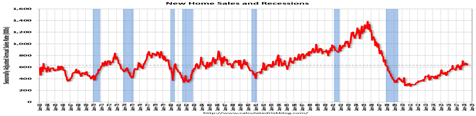
It was thought new-home sales would give a boost to housing, but even new- homes sales are slower in June. The Calculated Risk graph shows new-home sales lagging historically from other recoveries, when sales reached 800,000 units annually.

“Sales of new single-family houses in June 2018 were at a seasonally adjusted annual rate of 631,000, according to estimates released jointly today by the U.S. Census Bureau and the Department of Housing and Urban Development. This is 5.3 percent below the revised May rate of 666,000, but is 2.4 percent above the June 2017 estimate of 616,000.”

The sales slowdown has to be from after-effects of the Great Recession, what was also the Great Housing Bust when so many homeowners lost their home and life-savings. It’s a combination of lenders being much more cautious and consumers earning much less these days. For instance, first-time buyers totaled just 31 percent of existing homebuyers, vs. the 40 percent long term average.

Household incomes have been stagnant since the 1980s after inflation, and both incomes and net worth have actually declined since the Great Recession, so we are seeing the results in the housing market, as the costs of home-building continue to climb with inflation.

For example, the just enacted Canadian lumber tariffs are adding $9,000 on average to building costs, according to the National Association of Home Builders. “Not only are consumers and builders concerned about the current lumber tariffs, but also the next round of proposed tariffs on a number of goods and services,” said NAHB Chair Randy Noel.

In fact, there has not been a concerted effort to boost consumers’ incomes at all since the Great Recession. Rather, the effort has been to suppress wages, with more states restricting collective bargaining rights of both union and non-union employees. There are now 28 right-to-work states that restrict the amount of dues unions can collect, and even the Supreme Court has just rescinded a 40-year old precedent that allowed public employee unions to collect dues from non-union members that enjoy the same benefits.

Do we need any more reasons to understand the slowdown in home buying?

Harlan Green © 2018

Follow Harlan Green on Twitter: https://twitter.com/HarlanGreen

Posted in Consumers, Economy, Housing, housing market, Weekly Financial News | Tagged , , , , | Leave a comment

The Dire Consequences of Record Income Inequality

ANSWERING the KENNEDYS CALL

image

In a new Economic Policy Institute report entitled The New Gilded Age, income inequality has risen in every state since the 1970s, and in most states it has continued to grow in the post–Great Recession era.

Why should we care? The most dire economic consequences of income inequality are recessions, including the Great Depression when inequality was as high as it is now. And since 1980, inequality soared which has resulted in 5 recessions, including the Great Recession.

Are there more on the horizon in this ninth year of this long-in-the-tooth recovery from the Great Recession? The Economic Policy Institute map shows the income disparities in the U.S. today. In Alaska the top 1 percent earns 12.7 times the 99 percent, whereas New York has the highest multiple, at 44.4 percent.

From 2009 to 2015, the incomes of the top 1 percent grew faster than the incomes of the bottom 99 percent in 43 states and the District of Columbia. The top 1 percent captured half or more of all income growth in nine states. In 2015, a family in the top 1 percent nationally received, on average, 26.3 times as much income as a family in the bottom 99 percent.

Today, the top 1 percent has garnered 24 percent of national income once again, as happened in 1928 just prior to the Great Depression, and which today is $1.3m. The 99 percent rest of us have an average annual income of $50,000 per year. And now we have to worry that the current geopolitical uncertainties—a Trump trade war, breaking up of western treaties (TPP, NAFTA, NATO), global warming that is causing mass migrations, the threats of more terrorism, or ongoing regional military conflicts—could plunge us into another recession or worse.

There is a way out of this mess, other than another recession or war. We could shift the balance of power to those that want to rebalance the income equation by rescinding those tax cuts that only benefit the 1 percent longer term.

Or, we could shift more spending away from the military’s $600B budget that just increases the likelihood of war, to badly needed infrastructure improvements, boosting educational opportunities of the disenfranchised blue collar workers, or more R&D to create the next generation of innovators and entrepreneurs.

There are countless ways we can use those revenues, in other words, that would benefit 99 percent of Americans, instead of the 1 percent.

Harlan Green © 2018

Follow Harlan Green on Twitter: https://twitter.com/HarlanGreen
Posted in Consumers, Economy, Keynesian economics, Politics, Weekly Financial News | Tagged , , , | Leave a comment