What Do Slowing Retail Sales Mean?

Popular Economics Weekly

image

Graph: Econoday

Retail sales are slowing this fall, yet consumers’ confidence is at an all-time high. Why are consumers buying less and saving more this season? It could be higher interest rates, as the Fed has raised short term rates 5 times, already, so that the Prime rate that determines credit card debt is now 5 percent when it was 4.25 percent one year ago.

Or, they see this recovery from the Greatest Recession since the Great Depression as not that impressive. August retail sales barely managed a 0.1 percent monthly gain as tracked in the blue column of Econoday’s graph. Retail sales are only about 1/3 of total consumer spending which are mostly services. Nevertheless, August’s results are pointing to slowing for total consumer spending as tracked in the green bars and which will be posted at month end, when third-quarter GDP numbers are first released.

Wages are rising mostly for just the top one percent of income earners, according to Thomas Piketty, who should win the Nobel Prize in economics this year for his research on the real and growing income disparities in western countries. The U.S. is at the bottom of developed countries, because other developed countries offer far more in benefits; such as universal health care, paid maternity leave, and higher minimum wages that offset the income disparities.

image

His best-seller, Capital in the Twenty-First Century, published in 2014, raised the curtain on the rising wealth of the one percent since 1980 due to their ownership of capital, the means of production, as described by Nobelist Paul Krugman in the New York Review of Books.

“Capital still matters; at the very highest reaches of society, income from capital still exceeds income from wages, salaries, and bonuses. Piketty estimates that the increased inequality of capital income accounts for about a third of the overall rise in US inequality. But wage income at the top has also surged. Real wages for most US workers have increased little if at all since the early 1970s, but wages for the top one percent of earners have risen 165 percent, and wages for the top 0.1 percent have risen 362 percent.”

Then why are consumers so optimistic? The University of Michigan sentiment survey rose to 100.8 from 96.2 in July for the strongest showing since March this year, as well as since 2004. It has to be the ‘goldilocks’ growth consumers and employers are experiencing at present.

Economic growth is neither too hot nor too cold, as I said last week. Both retail CPI and wholesale PPI inflation indexes have been falling (i.e., prices not too hot), while it has become easier to find jobs with higher salaries (i.e., job market not too cold).

It does look like American consumers feel we are in a sweet spot, even though costs are now rising due to the new tariffs. Maybe it’s one last fling before the inevitable downturn, when interest rates continue to rise and consumers can buy no more. But who knows when that will happen?

Harlan Green © 2018

Follow Harlan Green on Twitter: https://twitter.com/HarlanGreen

Posted in Consumers, Economy, Weekly Financial News | Tagged , , , | Leave a comment

Does Lower Inflation Mean a Goldilocks Economy?

Popular Economics Weekly

image

Graph: Calculated Risk

Consumers are being helped by consumer prices that are barely rising. The Consumer Price Index is up just 2.7 percent, and core CPI without food and energy prices up 2.2 percent in 12 months. This has kept interest rates at historic lows since the Great Recession and is the reason for an economy that is neither too hot nor too cold.

Just how long it will last is an enduring question for economists. One infallible feature of an incoming recession is sharply rising interest rates. But historically low interest rates over an extended period can also mean most consumers aren’t earning enough to boost their buying power, which in turn ‘powers’ higher prices and inflation—a sign of intractable income inequality.

The Great Recession was largely caused by Alan Greenspan’s Fed raising interest rates 16 consecutive times—a total of 4 percent—that caused all the ‘liar’ loans with negative amortization and no real income or asset verification to become unaffordable to lower-income borrowers and homeowners.

That isn’t the case today—yet. The wealthiest 10 percent—what is basically left of the middle class that has profited since the Great Recession—has a very high savings rate. But not the ‘other’ 90 percent, so that average annual incomes are rising at 2.7 percent; also the consumer inflation rate today.

Households carried a record $13.3 trillion in debt at the end of June, Federal Reserve records show. That tops the prior peak of $12.7 trillion in 2008 during the middle of the Great Recession. High debt levels, especially in mortgages, contributed to the 2008 financial panic and the severity of the recession, as I said.

But low interest rates and inflation are keeping delinquencies very low at the moment, and lending standards remain quite stringent in the post-crisis era, according to a recent Moody’s study reported by MarketWatch. As such, there’s less danger of another housing market collapse.

image

But that is the catch. Interest rates and inflation must remain very low for delinquencies to remain ‘very low’, and that won’t last much longer with wage pressures growing, fewer workers available for hire, and the Federal Reserve saying it will continue to raise short-term rates.

Business confidence is soaring as well, thanks to the economic ‘porridge’ being neither too hot nor too cold. The NFIB Small Business Optimism Index soared to 108.8 in August, a new record in the survey’s 45-year history, topping the July 1983 high-water mark of 108. The record-breaking figure is driven by small business owners executing on the plans they’ve put in place due to dramatic changes in the nation’s economic policy.

And small businesses create most of the jobs. “Today’s groundbreaking numbers are demonstrative of what I’m hearing every day from small business owners – that business is booming. As the tax and regulatory landscape changed, so did small business expectations and plans,” said NFIB President and CEO Juanita D. Duggan. “We’re now seeing the tangible results of those plans as small businesses report historically high, some record breaking, levels of increased sales, investment, earnings, and hiring.”

So how long can such goldilocks growth last? It is the ideal condition economic planners work for, but lasts only very briefly until debt levels rise to unsustainable levels, given the inherent fluctuations and dynamism in any economy. Vigilance in looking for signs of higher interest rates and slower growth is therefore a major requirement to stay ahead of those fluctuations.

Harlan Green © 2018

Follow Harlan Green on Twitter: https://twitter.com/HarlanGreen

Posted in Consumers, Economy, Macro Economics, Weekly Financial News | Tagged , , , , | Leave a comment

The Red Tide in Education

ANSWERING THE KENNEDYS CALL

image

The Guardian

Red tide algal blooms have been threatening coastal beaches for decades, killing sea life and sickening bathers; a sign of rising ocean temperatures due to global warming as well as human pollution.

But another red tide is benefitting Americans by threatening the wealth of oligarchs like the Koch Brothers and U.S. Education Secretary Betsy DeVos, who have diverted funds so desperately needed by America’s public schools where most of our children are educated to not only preserve their wealth, but increase it.

It is the red state Teacher’s movement for better salaries and benefits in public schools in the conservative red states that have either cut education spending in public schools, or diverted funds to Charter Schools and private school vouchers that have benefited the largely conservative wealth-holders of this world and their supporters who own and operate for-profit schools that can receive up to 90 percent of their revenues from federal taxpayers, typically in the form of student loans and Pell Grants.

The Teacher’s movement is another example of powerful ‘grass-roots’ movements generated in local communities to solve grievances that have worsened their citizens’ quality of life.

A 2016 report by the NYU Brennan Center for Justice entitled Secret Spending in the States stated in its introduction: “Six years after Citizens United enabled unfettered spending in our elections, the use of so-called dark money has become disturbingly common. Contrary to the Supreme Court’s assumption that this unlimited spending would be transparent to voters, at the federal level powerful groups have since 2010 poured hundreds of millions of dollars into influencing elections while obscuring the sources of their funding.”

In the six states the Brennan Center report detailed—Alaska, California, Arizona, Colorado, Massachusetts and Maine—1) At these levels, dark money sources often harbor a narrow, direct economic interest in the contest’s outcome;  money sources often harbor a narrow, direct economic interest in the contest’s outcome; (2) relatedly, contentious ballot measures that carry major economic consequences frequently attract dark money; and (3) in the relatively low-cost elections at these levels, it is easy for dark money to dominate with unaccountable messages that voters cannot meaningfully evaluate.

Who were the recipients of this largesse in PAC money that ballooned after Citizens United? It has to be no secret that the supporters of vouchers and/or Charter schools that favored higher-income constituencies won out in the funding struggle.

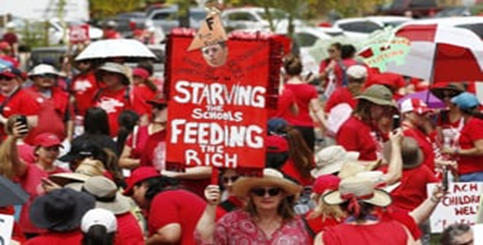
This is what started the “Red for Ed” teachers’ movement fighting for better school funding who had suffered for years, in underpaid and underfunded public schools. “Red shirts and blouses had emerged as the official uniform of teacher uprisings against low pay that were spreading from West Virginia to Oklahoma and Kentucky under the rallying cry “Red for Ed,” said an excellent NYTimes Magazine article, about the Arizona teachers’ uprising.

Public education is a $650 billion national enterprise,” said the NYTimes, “comparable to the U.S. defense budget, except that the federal government pays only 8.5 percent of the cost. States and local school districts split the rest in varying proportions, but each state finances it differently. Texas and Louisiana tap plentiful oil and gas revenues; Northeastern states like Massachusetts and New Jersey rely on high income and property taxes.”

Arizona hasn’t raised income taxes in more than 25 years, and counts more on sales taxes and other revenues generated by a growing economy. However they pay for it, K-12 schooling is the biggest single expenditure for all states, accounting for 36 percent of general-fund budgets on average.

“A half-dozen Arizona teachers — and more than 25 others, current and retired, with education backgrounds — declared their candidacy for the State House and Senate with a promise to increase funding for public schools, said the NYTimes. “They’re part of a sudden wave of educators on ballots as first-time candidates in every walkout state.”

The ultimate solution has to be political action, especially political action by women who make up 80 percent of the teaching profession. In fact, the red wave is turning into a blue wave, as this has energized even the less liberal voter base. Data from the Center for American Women and Politics at Rutgers University shows that more women have filed to run for Congress than at any point since at least 1992 — and by a wide margin. That year, 298 women ran for the House of Representatives. This year, 476 have — most of them Democrats.

Harlan Green © 2018

Follow Harlan Green on Twitter: https://twitter.com/HarlanGreen
Posted in Consumers, Politics, Uncategorized | Tagged , , , , , | Leave a comment

What To do About America’s Homeless Problem?

ANSWERING THE KENNEDYS CALL

image

Los Angeles Times

A study released in December 2017 by the U.S. Department of Housing and Urban Development (HUD) reported America’s homeless population has risen this year for the first time since the Great Recession, propelled by the housing crisis afflicting the west coast, according to a new federal study.

The study has found that 553,742 people were homeless on a single night this year, a 0.7 percent increase over last year. It suggests that despite a booming economy, the poorest Americans are still struggling to meet their most basic needs.

Most affected are the western states of California, Oregon and Washington, where soaring housing prices have made even rental housing expensive and out of range for many low-income citizens that live and work in their largest cities.

The state of California estimates that 180,000 new housing units are needed each year in order to keep up with population growth. Over the last decade, however, there was an annual average of less than 80,000 units, because developers often face a long review process and local opposition.

Government investment in low-income homes has lagged since it was slashed during the Reagan administration, and today most people on the cusp of homelessness do not receive government rental assistance. In fact, the government spends twice as much on a housing tax break for the wealthiest Americans, and the tax reforms just enacted by Congress could deal a further blow to affordable-housing.

Localities are left to improvise solutions. Los Angelenos voted to tax themselves to provide billions in funding. Tiny-home villages have taken root in Oregon and Washington state (though a plan to erect them in Silicon Valley was met recently by angry residents chanting “build a wall” to keep homeless residents out). Hawaii is pursuing the idea of authorized tent encampments, according to The Guardian.

“The improved economy is a good thing, but it does put pressure on the rental market, which does put pressure on the poorest Angelenos,” said Peter Lynn, head of the Los Angeles homelessness agency, in an LA Times interview. The most dramatic spike in the nation was in his region, where a record 55,000 people were counted. “Clearly we have an outsize effect on the national homelessness picture.”

LA Mayor Eric Garcetti has pushed through a record budget to build and house homeless denizens of Los Angeles. A recently passed Measure H initiative is generating $355 million each year to provide a wide range of services to help people in desperate need. Proposition HHH is giving the City $1.2 billion to build thousands units of supportive housing over the next decade — units that will be paired with those same services, so that unsheltered Angelenos can go home for good.

Because it will take years to build permanent housing, Mayor Garcetti has launched a new plan called A Bridge Home — to give homeless Angelenos in every neighborhood a refuge in the community they already know and love by housing them in “trailers, tents, and other temporary shelters across the city,” until they can be connected with a permanent home.

image

It’s one remarkable solution to the homeless crisis that a major city like Los Angeles can afford. The mayor, who has set a goal of ending street homelessness by 2028, has said at least 6,000 people a year could be served by the shelters, which are planned for each of the city’s 15 council districts. New state funds may boost available funds, but the mayor’s budget set aside $1.3 million for each of the 15 shelters.

We are saying, in other words, that part of the solution to the housing and homeless crisis has to be the responsibility of governments. The private housing industry is booming for the most fortunate, but local, state and the federal governments must acknowledge that homelessness should be the concern of all Americans.

Harlan Green © 2018

Follow Harlan Green on Twitter: https://twitter.com/HarlanGreen

Posted in Housing, housing market, Politics, Uncategorized | Tagged , , , , | Leave a comment

August Jobs Report No Big Deal

Popular Economics Weekly

image

Graph: MarketWatch

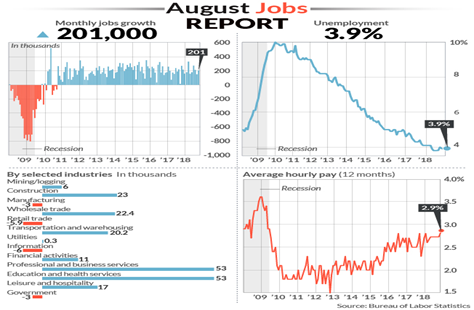
Total nonfarm payroll employment increased by 201,000 in August, and the unemployment rate was unchanged at 3.9 percent, the U.S. Bureau of Labor Statistics reported today. Job gains occurred in professional and business services, health care, wholesale trade, transportation and warehousing, and mining.

Very little happened with the August Unemployment report. Average hourly wages rose slightly, and more service sector jobs were created, but fewer new jobs were in the more highly-skilled manufacturing and high tech sectors.

White-collar professional firms filled 53,000 positions, bringing the total created over the past 12 months to more than half a million, which includes both the professional and business services, and health care. These are the fastest growing jobs in the country. Health-care providers hired 33,000 people, transport firms added 20,000 jobs and construction companies hired 23,000 workers.

Employment fell by 3,000 in manufacturing, the first decline in 13 months. U.S. tariffs and a scarcity of (higher paid) skilled laborers may finally being felt by employers. And gains for July and June were revised down by a combined 50,000, the Labor Department said Friday.

This could be a sign that economic activity is peaking, although wholesale trade, transportation and warehousing job growth was robust.

The (other) Household Survey that actually measures the unemployment rate—a smaller telephone survey of households that is slightly less accurate—held steady at 3.9 percent though the labor participation rate slipped 2 tenths to 62.7 percent.

This was because the number of people in the labor force went down by a half of million, to 161.8 million from 162.3 million reflecting a decrease in the number of employed which in this survey, in contrast to the BLS Establishment survey, includes the self-employed.

The big news was the 2.9 percent rise in average hourly earnings, the highest since December 2007 and the beginning of the Great Recession, according to Econoday.

The Labor Department also reported the number of persons employed part time for economic reasons (sometimes referred to as involuntary part-time workers), at 4.4 million, changed little over the month but down by 830,000 over the year. “These individuals, who would have preferred full-time employment, were working part time because their hours had been reduced or they were unable to find full-time jobs,” said Labor.

The fall in part-time employment tells us why wages are finally rising above the inflation rate—most have found full-time work. This may cause the inflation rate to rise, since workers’ salaries are about two-thirds of product costs. Inflation is still tame, however, with the Fed’s preferred ‘core’ PCE inflation index holding at 2 percent. We believe the Fed will raise short term interest rates by another 1/8 percent at its next FOMC meeting, anyway, in spite of President Trump’s tendency to berate Fed Governors to hold interest rates down; because higher interest rates make imported goods more expensive for consumers.

In other words, inflation is only this low because of the slow rise in hourly wages. It means a majority of new jobs being created are either in those warehousing and transportation sectors, or leisure services that still pay barely subsistence wages.

There was nothing else of note in the August jobs report. Consumers seem to be happy, with consumer confidence and retail spending at their highest levels in years, which should mean continued high GDP growth for the rest of this year.

That’s because neither consumers nor investors seem to be taking rising import and export prices very seriously, yet.

Harlan Green © 2018

Follow Harlan Green on Twitter: https://twitter.com/HarlanGreen

Posted in Consumers, Economy, Weekly Financial News | Tagged , , , , | Leave a comment

Important Unemployment Report Tomorrow?

Financial FAQs

image

Graph: Econoday

Tomorrow’s U.S. unemployment report is predicted to drop the unemployment rate to 3.8 percent, according to MarketWatch. But that may be misleading, as almost one million job openings remain unfilled, which could boost the payroll jobs total much higher. Even though just 157,000 payroll jobs were created in July, it may have been because so many work seekers were in vacation, and didn’t choose to take up a new job.

Tomorrow is important because it could foretell whether economic growth is slowing due to the trade war uncertainties. The just revised Q2 GDP growth estimate was left unchanged at 4.2 percent, a good showing.

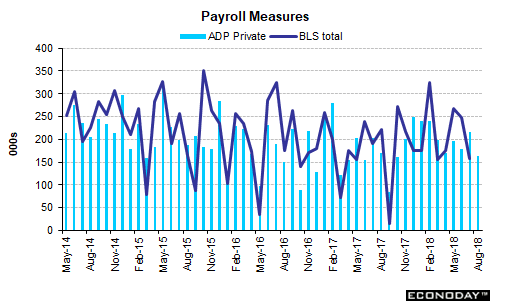
Meanwhile, initial weekly jobless claims have fallen to 203,000, the lowest since 1969, which is another sign fewer workers are being laid off. Today’s August ADP private payrolls survey reported 163,000 jobs created. It is sometimes a predictor of the U.S. jobs report, as the above graph shows, but usually underestimates the U.S. Labor Department report.

image

Graph: Econoday

Another sign of economic strength is the just released August ISM non-manufacturing survey of Supply Managers. ISM’s non-manufacturing sample reports sharp acceleration in overall growth during August, at an index of 58.5 vs July’s 55. Strength is centered in orders with both new orders, at 60.4, and backlog orders, at 56.5, posting strong monthly gains. And new export orders are up 2.5 points to 60.5, a special plus and one that underscores the importance of service exports for the U.S. economy, says Econoday.

“Export orders expanded at stable levels,” commented Timothy R. Fiore, Chair of the Institute for Supply Management® (ISM®) Manufacturing Business Survey Committee. “Prices pressure continues, but the index softened for the third straight month and remains above 70. Demand is still robust, but the nation’s employment resources and supply chains continue to struggle. Respondents are again overwhelmingly concerned about tariff-related activity, including how reciprocal tariffs will impact company revenue and current manufacturing locations. Panelists are actively evaluating how to respond to these business changes, given the uncertainty.”

Prices are rising for parts as well as finished products, in other words. But companies are not yet passing said costs on to consumers; maybe because of the recent tax cuts. That is, except for the two industries reporting contraction in August: Wood Products and Primary Metals, which are already subject to higher tariffs.

Corporate profits are surging almost 8 percent at present because of the tax cuts. But corporations are not yet boosting employees’ wages and salaries above the inflation rate. How is that possible in such a tight labor market? This may be clearer with tomorrow’s unemployment report.

A recent National Bureau of Economic Research Working Paper that surveyed union historical records showed during maximum membership years from 1940-70 unions offered a larger wage premium to less-skilled workers, so that unions have had an important equalizing effect on income distribution to the extent that they are successful in organizing the less-skilled.

But that effect has diminished as union membership shrank and lower numbers of low-skilled workers have joined union since then, which is also keeping wages from rising faster. Still, union membership has historically offered greater benefits to union workers than non-union workers.

Harlan Green © 2018

Follow Harlan Green on Twitter: https://twitter.com/HarlanGreen
Posted in Consumers, Economy, Uncategorized, Weekly Financial News | Tagged , , , , , | Leave a comment

What Happens When Poverty Exists In the Valley of Plenty?

ANSWERING THE KENNEDYS CALL TO ACTION

image

Poverty in the Valley of Plenty is a documentary film that then California Congressman Richard Nixon and growers in the San Joaquin successfully sued to have banned for defamation. It was about the working conditions that early post-WWII farmworkers still suffered under. I was able to show a banned copy of the film to the United Farmworkers of America that had been produced by the Hollywood trade unions when I was a member of the UFW

In 1948, the National Farm Labor Union and Hollywood filmmakers who hated the virulently anti-union big farm grower DiGiorgio Fruit, the largest grape, plum, and pear grower in the world, made the film titled Poverty in the Valley of Plenty to expose the terrible conditions of the farmers. In 1947, DiGiorgio responded to a strike by firing all the strikers and replacing them with a combination of Filipinos, undocumented workers, and migrants coming to the U.S. through the Bracero Program. The last of these was an illegal move against the agreement between the U.S. and Mexico that explicitly stated braceros were not to be used as strikebreakers. The unions hated DiGiorgio so much that they waived all their wage and hour contracts to get the film made.

The conditions of farmworkers in the 1950s were such as portrayed in John Steinbeck’s The Grapes of Wrath during the Great Depression The film portrayed poor farmers from the Dustbowl that could only find work in California’s crop-filled valleys—under conditions that aren’t much different from many of today’s lower income workers.

We have today as much of a problem for at least 25 percent of working Americans that earn no more than the poverty rate for a family of four–$25,100/year in 2018, according to the U.S. Department of Health and Human Services.

Who are they? Many are single-adult families with children—mostly mothers barely making ends meet in menial jobs. The Oxford economist Robert Allen recently estimated needs-based absolute poverty lines for rich countries that are designed to match more accurately the $1.90 line for poor countries, and $4 a day is around the middle of his estimates. When we compare absolute poverty in the United States with absolute poverty in India, or other poor countries, we should be using $4 in the United States and $1.90 in India.

“Once we do this, there are 5.3 million Americans who are absolutely poor by global standards. This is a small number compared with the one for India, for example, but it is more than in Sierra Leone (3.2 million) or Nepal (2.5 million), about the same as in Senegal (5.3 million) and only one-third less than in Angola (7.4 million). Pakistan (12.7 million) has twice as many poor people as the United States, and Ethiopia about four times as many.”

Author Robert Putnam (Bowling Alone), in his book “Our Kids: The American Dream In Crisis,” looks at another angle: the way income inequality is trickling down to our public education system.

Putnam points out that Americans of different classes and educational backgrounds are increasingly living apart from each other: either in educated, wealthy enclaves or the inverse—poverty again in the valley of plenty. That has a negative and stratifying effect on schools, particularly on schools in poor areas.

“What we know very well is that when rich kids go to school, in their backpack they bring their parents’ aspirations, their parents’ resources, their parents’ trips to France, their allusions to Proust or whatever, and that benefits all the kids in town,” Putnam said..”

“When poor kids go to school, they’re bringing in their backpack gang violence—even if they’re not personally involved—they’re coming from very poor neighborhoods, they bring disarray from home, hunger at home, and those factors affect everyone else,” he continued in a PBS interview on TV interview.

The Nation Magazine cites a recent Education Law Center and Rutgers Graduate School of Education report that exposes the tremendous inequality in educational opportunities of elementary school students within wealthy and poor school districts and states. It highlights Professor Putnam’s central thesis; by worsening the the chances of success of lower-income children; already hindered living in poor neighborhoods within dysfunctional family structures; it hurts all Americans.

Putnam cites the findings of Clive Belfield, an associate professor of economics at Queens College, City University of New York: “The aggregate lifetime burden of failure to face the woes of poor youth is $1.59 trillion for taxpayers and $4.75 trillion for the larger society in lost earnings, lower economic growth and lower tax revenue beyond direct costs in welfare.”

An inadequately educated public diminishes the chances democracy itself will survive, as well .

Harlan Green © 2018

Follow Harlan Green on Twitter: https://twitter.com/HarlanGreen
Posted in Politics, Uncategorized | Tagged , , , , | Leave a comment

What Really Is Fair Trade?

Popular Economics Weekly

image

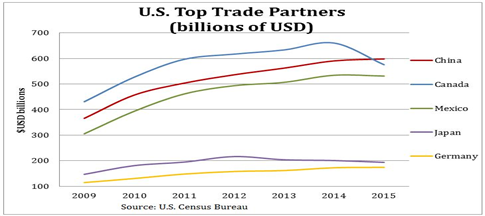
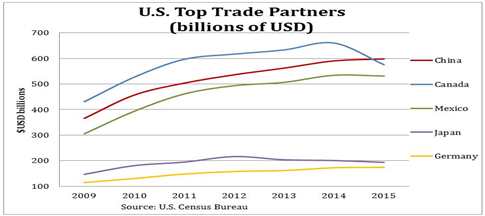
China is our trading partner with the largest deficit; $506 billion in exports to the US vs. $130 billion in imports from US for a -$376 billion trade deficit in 2017. Canada is the 2nd largest partner with American consumers buying $300 billion in imports from Canada vs. $282 billion in exports for a -$18 billion trade deficit, according to the latest U.S. Census Bureau data.

Mexico is the third largest partner, with a -$71 billion trade deficit in exports vs. imports. The only partners with which the US has a trade surplus of exports over imports are Brazil and The Netherlands, ranked 12th and 13th, respectively, of the top 15 US trading partners.

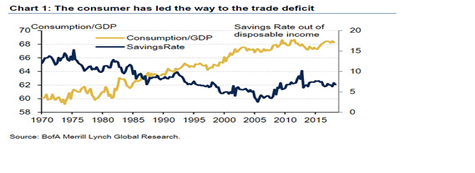
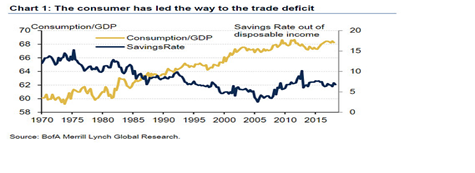
The culprit is American consumers that now account for almost 70 percent of economic activity, versus 60 percent in the early 1980s, according to Bank of America’s Merrill Lynch analysts.

image

Consumers spend almost as much as they save, thanks in part to historically low interest rates that make it easy to borrow. The personal savings rate is now 6.7 percent and inflation is ticking above 2 percent, the Fed’s preferred inflation rate, so look for more interest rate hikes in coming months.

Why is President Trump picking a trade war with two of our top three trading partners that accounted for 29 percent of our trading volume in 2017? Is there a better way than a trade war to cure the deficit problem that doesn’t threaten to elevate prices further to an already escalating inflation rate?

Attempting to correct those imbalances is the major reason President Trump launched tariff wars with our largest trading partners. But he crippled himself at the same time by withdrawing from the 12-member Trans-Pacific Partnership—called TPP—at the beginning of his administration. Though it wasn’t perfect (didn’t boost US job formation), the trade alliance lowered tariffs on thousands of goods and gave US the power to oppose China’s unfair trade practices.

Obama economic advisor Austun Goolsbee tweeted recently:

“E.g. TPP cut tariffs on 18,000 us products—to zero for $90b of US autos & $35b of IT, big cuts for US beef, pork, dairy, poultry, forced fairness for US service exports, established free intl movement of data, killed regulatory barriers to us export, limited state owned enterprises.

“TPP had strongest labor rules of any agreement ever (ban forced labor, child labor, discrimination, required freedom to unionize, minimum wage, hour limits, wkr safety) & the strongest enviro (ship pollution, ozone chem, illegal fishing, illegal logging, wildlife trafficking)movement of data, killed regulatory barriers to US export, limited state owned enterprises.”

“And Mexico and Canada signed TPP so Trump’s nafta “deal” is demonstrably worse for the US than what Canada and Mexico already agreed to,” said Professor Goolsbee.”

The trade deficit has been with US since the 1970s, when roaring inflation and several recessions meant consumers wanted cheaper-foreign-made goods over those made in the USA, due in part to several Arab oil embargos that drove up oil prices and caused long lines at gas stations due to gasoline shortages.

On the macro (national) economic level, the US made it easy for American multi-national corporations to build their factories overseas with anti-labor policies that suppressed union collective bargaining and US wages, in their quest to expand international trade by opening US borders via lower import tariffs.

So a greater fair trade world would require major policy changes to correct the trade imbalances, needless to say. American consumers would pay more for Made in USA products and not always seek discounted foreign goods, for starters, if their incomes improved. They would then pay more taxes, increasing government revenues, which would lessen demand for massive federal government borrowing to cover the huge annual federal budget deficit that is projected to reach $1.5 trillion in 10 years.

Really fair trade is just basic economics 101 that would require fairer labor policies.

Harlan Green © 2018

Follow Harlan Green on Twitter: https://twitter.com/HarlanGreen

Posted in Uncategorized | Tagged , , , , | Leave a comment

What Really Is Fair Trade?

Popular Economics Weekly

image

China is our trading partner with the largest deficit; $506 billion in exports to the US vs. $130 billion in imports from US for a -$376 billion trade deficit in 2017. Canada is the 2nd largest partner with American consumers buying $300 billion in imports from Canada vs. $282 billion in exports for a -$18 billion trade deficit, according to the latest U.S. Census Bureau data.

Mexico is the third largest partner, with a -$71 billion trade deficit in exports vs. imports. The only partners with which the US has a trade surplus of exports over imports are Brazil and The Netherlands, ranked 12th and 13th, respectively, of the top 15 US trading partners.

The culprit is American consumers that now account for almost 70 percent of economic activity, versus 60 percent in the early 1980s, according to Bank of America’s Merrill Lynch analysts.

image

Consumers spend almost as much as they save, thanks in part to historically low interest rates that make it easy to borrow. The personal savings rate is now 6.7 percent and inflation is ticking above 2 percent, the Fed’s preferred inflation rate, so look for more interest rate hikes in coming months.

Why is President Trump picking a trade war with two of our top three trading partners that accounted for 29 percent of our trading volume in 2017? Is there a better way than a trade war to cure the deficit problem that doesn’t threaten to elevate prices further to an already escalating inflation rate?

Attempting to correct those imbalances is the major reason President Trump launched tariff wars with our largest trading partners. But he crippled himself at the same time by withdrawing from the 12-member Trans-Pacific Partnership—called TPP—at the beginning of his administration. Though it wasn’t perfect (didn’t boost US job formation), the trade alliance lowered tariffs on thousands of goods and gave US the power to oppose China’s unfair trade practices.

Obama economic advisor Austun Goolsbee tweeted recently:

“E.g. TPP cut tariffs on 18,000 us products—to zero for $90b of US autos & $35b of IT, big cuts for US beef, pork, dairy, poultry, forced fairness for US service exports, established free intl movement of data, killed regulatory barriers to us export, limited state owned enterprises.

“TPP had strongest labor rules of any agreement ever (ban forced labor, child labor, discrimination, required freedom to unionize, minimum wage, hour limits, wkr safety) & the strongest enviro (ship pollution, ozone chem, illegal fishing, illegal logging, wildlife trafficking)movement of data, killed regulatory barriers to US export, limited state owned enterprises.”

“And Mexico and Canada signed TPP so Trump’s nafta “deal” is demonstrably worse for the US than what Canada and Mexico already agreed to,” said Professor Goolsbee.”

The trade deficit has been with US since the 1970s, when roaring inflation and several recessions meant consumers wanted cheaper-foreign-made goods over those made in the USA, due in part to several Arab oil embargos that drove up oil prices and caused long lines at gas stations due to gasoline shortages.

On the macro (national) economic level, the US made it easy for American multi-national corporations to build their factories overseas with anti-labor policies that suppressed union collective bargaining and US wages, in their quest to expand international trade by opening US borders via lower import tariffs.

So a greater fair trade world would require major policy changes to correct the trade imbalances, needless to say. American consumers would pay more for Made in USA products and not always seek discounted foreign goods, for starters, if their incomes improved. They would then pay more taxes, increasing government revenues, which would lessen demand for massive federal government borrowing to cover the huge annual federal budget deficit that is projected to reach $1.5 trillion in 10 years.

Harlan Green © 2018

Follow Harlan Green on Twitter: https://twitter.com/HarlanGreen

Posted in Consumers, Economy, Macro Economics, Weekly Financial News | Tagged , , , , | Leave a comment

Labor Productivity is the Golden Fleece

Financial FAQs

image

Graph: Econoday

Rising labor productivity is the golden fleece of economic growth, the pot of gold at the end of the rainbow, because major economists maintain it is really the only way workers can raise their standard of living. This means raising incomes above the inflation rate, which is where average household incomes have been stuck since the end of the Great Recession.

The sheep’s fleece was an ancient Greek method of extracting placer gold from flowing streams.  The heavier gold flakes would stick to the fleece, hence the Greek myth of Jason bringing home the Golden Fleece came to signify the accumulation of wealth and power.

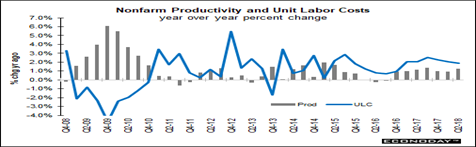
For that reason it’s good news that labor productivity seems finally to be recovering. Workers’ output rose at a very hot 4.8 percent rate in the second quarter, up from an already solid 2.6 percent rate in the first quarter. Hours worked rose at a 1.9 percent rate vs. the first quarter’s 2.6 percent.

But we don’t see its benefits being passed on to wage and salary earners. Wages have stagnated and income inequality increased because workers’ productivity hadn’t risen substantially since 2010, as the graph shows; when benefits from ARRA, the $831 billion American Recovery and Reinvestment Act enacted during the first year of President Obama’s administration, petered out. It was much too inadequate to help restore states’ and consumers’ personal wealth from the worst recession since the Great Depression.

“Obama officials and Congress clearly made a big mistake early in the recession by focusing more intently on saving banks — and, thus, bankers and investors — and much less on directly helping families facing foreclosures and layoffs,” says a recent NY Times Op-ed. “Later in the recovery, the decision by Republican leaders in Congress to oppose every Obama proposal prevented the government from doing much to help people regain what they had lost or to heat up the tepid recovery with infrastructure spending and other stimulus measures.”

More government public sector aid was necessary, in other words, because the private sector was recovering from their losses and had little money to invest.

And “Government puts a lot of money into basic research, whereas businesses tend to fund late-stage development that can be quickly commercialized,” says MarketWatch’s Rex Nutting. “However, federal funding for research hasn’t kept pace with the growth in the economy; in the past 10 years, federal R&D investments have risen just 0.3 percent per year after adjusting for inflation.”

A major reason for the rise in productivity at the moment has to be that companies are investing more in new plants and equipment; in part because of the Republican tax cut in corporations’ nominal tax rate, but also because there is a huge deficit in skilled workers that has required businesses to invest more heavily in technologies that replace those missing workers. There are now about one million more job openings than jobs being created each month.

So workers aren’t really benefiting from the productivity increase, as nominal compensation fell to a 2.0 percent rate from 3.7 percent in the first quarter, according to Econoday. When adjusting for inflation, real compensation rose 0.3 percent and was little changed from the first quarter’s 0.2 percent rate.

image

Why?? Firstly, many more low-paying service sector jobs are being created than manufacturing jobs; which have been shipped overseas by corporations where wage and benefit costs are a fraction of Americans’. It is a major reason President Trump has initiated tariff increases in the hope foreign manufactures become less competitive in a bid to bring home some of those manufacturing jobs.

But that may or may not succeed, as a burgeoning trade war with higher tariffs would probably raise prices and inflation to a level that would nullify any benefits from more domestic jobs. Nobel economist Paul Krugman has said that it could eliminate 8 to 9 million jobs from companies that would shrink as a result of the increased tariffs, due to foreign businesses looking elsewhere for cheaper products not affected by the tariffs.

Increasing the national minimum wage from $7.25/hour last set in the 2009 would definitely help the lower wage sector, which Big Business has been resisting. Workers are producing more than ever, at present. But that doesn’t mean their standard of living will rise because of it, unless employers pass on more of the productivity increase to their employees

Harlan Green © 2018

Follow Harlan Green on Twitter: https://twitter.com/HarlanGreen
Posted in Consumers, Economy, Keynesian economics, Weekly Financial News | Tagged , , , , , | Leave a comment