
Popular Economics Weekly
“Total nonfarm payroll employment increased by 172,000 in May, and the unemployment rate was unchanged at 4.3 percent, the U.S. Bureau of Labor Statistics reported today. Job gains occurred in leisure and hospitality, local government, and health care. Employment in financial activities declined.” BLS
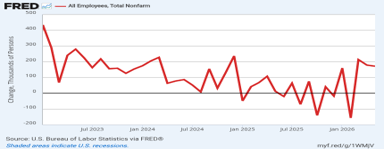
The job market is finally recovering after almost no job growth last year. The recovery is brutal, per the head spinning FRED payroll graph above; -149,000 jobs were lost in October 2025 and -156,000 jobs were lost as recently as February 2026 before recovering in March (+214,000 jobs), April (+179,000 jobs), and now May (+172,000 jobs).
The sudden hiring surge is because manufacturing has rebounded; both from the Biden administration’s $5 trillion raised in legislation to modernize U.S. infrastructure and the $1.5-2 trillion suddenly pouring into the A.I. construction of data centers.
Corporations are investing as much as possible of their record profits in A.I. that is being touted as the next industrial revolution able to produce more of everything, thus freeing us from the jobs that produce everything.
Fed Governors are already talking about raising interest rates later this year, instead of lowering them to combat the inflation surge. Bond yields have been rising as markets are now expecting higher inflation ahead.
Consumers will be hit the hardest, as surveys now show that just 20 percent can continue to shop as they have been with the rest now living from paycheck-to-paycheck.
This is happening at the same time as retail (CPI) inflation has topped 4 percent, the first time in three years. Its energy index has now risen 23.5 percent in a year, thanks to the Strait of Hormuz closure.
So, 20 percent of consumers can travel, boosting the leisure and hospitality sector, which added 70,000 jobs in May, well above the average monthly gain of 14,000 over the prior 12 months. But food and gas are another matter for the 80 percent.
Manufacturing payrolls added 7,000 jobs, and construction added 17,000 jobs in May but most of the job growth was in the lower-wage service sector. Employment in government also rose by 55,000, largely a gain in local government, and education (+44,000). Healthcare added 35,000 jobs, in line with the average monthly gain of 38,000 over the prior 12 months.
Former Labor Secretary Robert Reich has predicted what will happen with wealth now concentrated in the hands of so few:
“When so much of our economy is in relatively few hands, we will inevitably get to the point where consumers cannot buy all the goods and services the economy is capable of producing (with A.I.). This puts the entire economy at risk.”
In a sign of the times, sales of existing homes accelerated to their fastest pace of the year in May, led by sales of homes priced at over $1 million, according to research released by the National Association of Realtors. The only categories where home sales declined last month were those homes that are most affordable priced below $250,000.
This second industrial revolution will create fewer high-wage jobs, in other words, because A.I. can already do much of the thinking, problem-solving work as well. Who will take care of the fallout? It will be jobs that improve the human element, particularly in healthcare, which A.I can certainly be helpful in modernizing.
But what about protecting the environment? A.I.’s huge computers use lots of electricity, and water to cool the super computers. But so do ordinary Americans.
Harlan Green © 2026
Follow Harlan Green on Twitter: https://twitter.com/HarlanGreen


