
Popular Economics Weekly
“Consumer confidence inched up in June as falling oil prices in recent weeks provided some relief to consumer inflation fears,” said Dana M Peterson, Chief Economist, The Conference Board. “Consumer appraisals of current business conditions were slightly more positive compared to last month. However, perceptions of the current labor market softened measurably as the percentage of consumers saying jobs were ‘hard to get’ rose to 22.5%, the highest level since January 2021 (22.8%). Conference Board
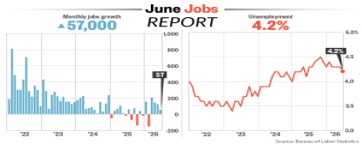
The Conference Board’s Consumer Confidence Survey highlighted what was behind the meager total of 57,000 new jobs in June – the fewest in four months. The job market may not recover from the damage the Trump administration has done to the U.S. economy anytime soon.
Some 755,000 worker dropped out of the labor force in June because “jobs are hard to get,” said the Conference Board’s survey.
What’s more, job gains in May and April were revised down to a combined 277,000 from a previous 351,000 – 74,000 fewer than previously reported.
Trump’s Iran War disaster is probably the main reason for the job losses because higher energy prices from the Middle East are elevating inflation and slowing down hiring for years to come. Wall Street is hoping the A.I. revolution will boost labor productivity to such an extent that it will tame inflation, but without creating many new jobs.
The other culprit for fewer new jobs? Federal immigration officials have detained more than 10,000 people in the last five days, reports the NYTimes, a major surge that has stemmed from a push within Immigration and Customs Enforcement to increase arrest rates. Immigrants won in the latest SCOTUS rulings that ICE cannot hold them without due process, which might slow down the roundups because it requires a bond hearing for the undocumented.
The shrinking labor force will shrink economic growth as well since fewer workers means less will be produced; unless the A.I. delivers on it promises of higher productivity. And that will take years. But that means fewer workers, anyway. There will be more robots, Claude, ChatGPT, Open AI, etc., etc. and a shrinking workforce that pays less taxes to support public policies, social security, Medicare and the public debt let’s not forget, which almost out of control.
Well, many of the new jobs will be in the lower paying healthcare industry — hospitals, doctor’s offices, dentists, nursing homes and so forth — that created 47,000 of the 57,000 new U.S. jobs in June.
The big question will be how to support our public policies that serve all Americans in the future (and preserve jobs), rather than more Republican policies that continue to favor the concentration of wealth via A.I., driving the U.S. government ever closer to insolvency.
Harlan Green © 2026
Follow Harlan Green on Twitter: https://twitter.com/HarlanGreen


