
Popular Economics Weekly
“Advance estimates of U.S. retail and food services sales for May 2026, adjusted for seasonal variation and holiday and trading-day differences, but not for price changes, were $763.7 billion, up 0.9 percent (±0.4 percent) from the previous month, and up 6.9 percent (±0.5 percent) from May 2025.” Census Bureau
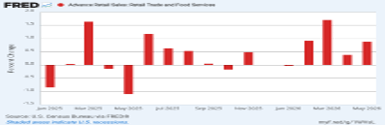
Retail sales are recovering, even though consumers are paying more for automobiles and gas because of the higher inflation. But it’s emptying their pocketbooks, to no one’s surprise.
So why do consumers keep shopping? They may have some of the irrational exuberance prevailing at the moment in financial markets because of optimism over the SpaceX IPO that is breaking sales records. It’s called herd behavior in economic parlance, because its investors seem to believe SpaceX is the next big thing without too much forethought.
Nobel Laureate Robert Shiller calls it lazy thinking, listening to little more than word of mouth or hearsay, or scanning the headlines but not what is between the lines, instead of researching it.
SpaceX is making a tiny profit, yet Elon Musk’s hyper sales pitch has investors believe the sky’s the limit with future earnings from…what, a trip to the moon or Mars? Its IPO has capitalized it as much as established corporations such as Microsoft that have a track record of real profits.
The stock market indexes are still breaking records in part because the major corporations have record profits. And the job market is finally recovering, after almost no job growth last year. The sudden hiring surge is because manufacturing has rebounded; both from the Biden administration’s $5 trillion raised in legislation to modernize U.S. infrastructure and the $1.5-2 trillion suddenly pouring into the A.I. construction of data centers.
In fact, there’s so much irrational exuberance that this so-called A.I. revolution is now being compared to the Dotcom (in 2000) and housing bubbles (2008).
Too much fiber optic cable was laid in the years leading up to 2000 that is only now turning a profit, and too many homes were built during the bubble that weren’t being absorbed by the housing market, resulting in declining home sales.
This is even though the U.S. population has increased by 60 million since 2000, according to the Census Bureau. The result is the lack of affordable housing and record homelessness, which could result in a more profitable investment than A.I.
But despite the market optimism, most consumers have become more cautious. It hasn’t convinced ordinary consumers who can barely afford to keep up with rising prices. The Conference Board’s Index of Leading Economic Indicators that attempts to predict business cycles, shows too many headwinds for much improvement.
“Consumers are feeling squeezed because everyday costs—especially gas and energy—are rising faster than their incomes, leaving many households with less money available for things like travel, restaurants, entertainment, and shopping. The good news is that businesses are spending heavily on AI, data centers, and new technology, helping to keep the economy growing, while consumers pull back spending,” said Justyna Zabinska-La Monica, Senior Manager, Business Cycle Indicators for the Conference Board.
Growing retail sales are a positive sign that the economy is improving for consumers as well as market investors but it can’t last unless inflation declines. Will artificial intelligence be the ticket to greater prosperity for all?
Let’s hope so, otherwise the A.I. bubble will also burst.
Harlan Green © 2026
Follow Harlan Green on Twitter: https://twitter.com/HarlanGreen


 Populareconomicsblog