
Popular Economics Weekly
“From the same month one year ago, the PCE price index for May increased 4.1 percent. Excluding food and energy, the PCE price index increased 3.4 percent from one year ago.”
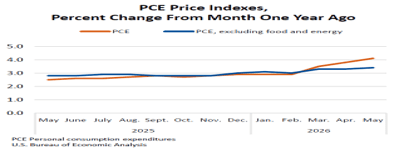
The Personal Consumption Expenditure Index (PCE), the Federal Reserve’s preferred inflation gauge that covers the widest spectrum of price changes, gave no relief in May. In fact, the PCE graph above showed inflation’s steady climb since Trump’s April 2025 Liberation Day (illegal) tariff hikes levied on the rest of the world that must now be repaid.
Refunding the tariffs to importers won’t reduce inflation because the higher import costs were passed on to consumers and producers. It becomes a chain reaction as those costs work through the economy. There are also the distributers, for instance, as well as the retailers and manufacturers’ profits that go into the chain.
The 4.1% annual inflation rate means inflation is now out of control for wholesale prices that go into the finished products as well. This is while Kevin Warsh, the new Fed Chairman, has said he is committed to bringing inflation back down to 2%.
When and how can it be done? We will be living with the likelihood the Fed may have to raise interest rates sometime this year. The Ukraine and Iran wars are creating more product shortages on top of the supply chain shortages caused by the tariffs.
The Ukraine war could be over if Trump had taken Ukraine’s side in the conflict instead of Putin’s. And how will he handle the Iranians who have the U.S. over a barrel (of more than oil) because he must bring down the price of oil-based products as well?
The U.S. economy is growing at 2% in the latest first quarter revision because consumers have kept shopping, but with a terrific toll on their personal savings rate (down to just 3%).
The financial markets have added to the frenzy because of the A.I. spending to expand data centers. There’s more than a little irrational exuberance prevailing, I said last week.
Their actions have raised consumer prices to such a level that they may not come down for years. We know this because the wholesale Producer Price Index (PPI), that measures the price of raw materials going into the finished products rose a whopping 1.1% in May, seasonally adjusted, also the largest rise in more than three years that must work its way through the product chain.
No, inflation is here to stay for a while, producing an immense asset bubble as the U.S. economy advances into the next stage of our industrial revolution. Economists have another term to describe it—creative destruction—that economist John Kenneth Galbraith said was,
“the cyclical process by which the system eliminates the people and institutions which are mentally too vulnerable for useful economic service. Unfortunately the process has larger and less benign effects, including the possibility of painful recession or depression.”
We are in this inflationary mess because of executive actions made on impulse rather than research by a President and advisors who are completely ignorant of basic economic theory, who has said he likes the inflation and no longer cares about the economy.
Who will be the winners and losers in the A.I. economy to come at a speed that will upend the lives and jobs of the next generations?
Harlan Green © 2026
Follow Harlan Green on Twitter: https://twitter.com/HarlanGreen


