Popular Economics
“The US LEI receded slightly in August, the first monthly decline since March of this year,” said Justyna Zabinska-La Monica, Senior Manager, Business Cycle Indicators, at The Conference Board. “Four out of ten components fell compared to the previous month, with consumer expectations remaining a significant strain on the Index.”
Does the new Fed chairman want to be another Paul Volcker, whose Board of Governors raised the Fed Funds rate to 20 percent to cure the stagflation surge of the 1970s? We don’t need another ‘hard landing’, the economic term for an engineered recession.
New Fed Chair Kevin Warsh said at the most recent FOMC meeting that the Fed would do what it takes to restore confidence in the Federal Reserve to fulfill its mandate of low inflation with maximum employment.
And to make its point the 12 Fed Governors voted unanimously to raise their Fed Funds rate +0.25 percent, thus raising the Prime Rate from 6.75 to 7.00 percent that governs most installment loan and credit card rates.
So the surge in August retail sales might not be a good thing, as much as consumers would like to celebrate another good holiday, since how is the Fed to bring down inflation otherwise when consumers are a major cause of it?
The core personal consumption expenditure index—the version of the Fed’s preferred inflation measure for consumers that excludes food and energy prices—has exceeded the Fed’s 2% target for over 60 months.
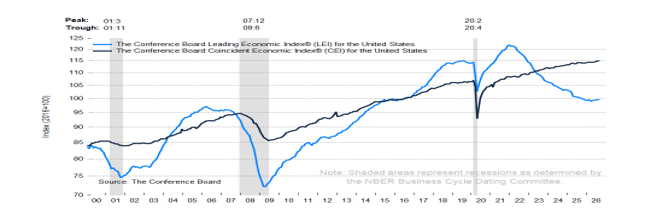
The Conference Board’s Index of Economic Indicators (LEI) that attempts to predict future growth has been flashing signals of a slowdown for months per its graph above (downward slope of blue line).
But even the tariffs and Mideast wars haven’t slowed down consumer spending enough. The Fed is saying that it has waited too long to act to bring down inflation, which is endangering economic growth and the U.S. currency.
Chairman Warsh also said five years was too long to wait for the inflation rate to return its 2 percent target rate because of the tariffs and Middle East unrest. It was last this low during the COVID-19 pandemic.
Of course, “The odds of a serious Fed policy mistake are uncomfortably high and rising,” warned Mark Zandi, chief economist at Moody’s Analytics, in a post on X, I quoted last week.
Barron’s Randall Forsythe cites David Rosenberg of Rosenberg Research on what can be the most dangerous mistake, “Unless oil prices come down quickly. The only way by which interest rates bring inflation back to the 2% target is “by destroying enough demand to offset the supply loss. That is a recession by design,” he concludes.
Economists call it a ‘hard landing’. And that has always been the dilemma; how can the Fed boost interest rates just enough to engineer a ‘soft landing’, which means bring inflation back down to its long-term average without causing a recession?
This is the rock and a hard place I’ve been talking about. It can’t be done without some pain.
Harlan Green © 2026
Follow Harlan Green on Twitter: https://twitter.com/HarlanGreen


 Populareconomicsblog