Popular Economics
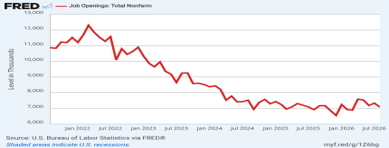
“The number of job openings was little changed at 7.1 million in August, the U.S. Bureau of Labor Statistics reported today. Hires changed little at 5.2 million, while total separations were unchanged at 5.1 million. Within separations, quits (3.1 million) were unchanged, while layoffs and discharges (1.6 million) were essentially unchanged.” BLS.gov
Will the federal Reserve engineer a hard or soft landing in this new rate hike cycle just beginning? A soft-landing is possible, but something has to be done about the rapid rise in interest rates.
The last time the Fed acted to tame inflation was during the post-COVID-19 pandemic recovery when CPI inflation had reached 9 percent.
But it worked. There wasn’t another recession and the economy has had five years of continuous growth since then, in large part because of the bipartisan recovery aid, including personal checks paid to almost all Americans.
More than $5Billion was invested in the recovery from the worst recession since the Great Depression.
Can the Fed do a repeat performance under new Fed Chair Kevin Warsh, an actual economist?
The just released JOLTS report shows that better economic growth is ahead, even with the Fed’s first rate hike since 2024. The actual unemployment report is due and will give more clues—such as whether hires pick up.
So the hard landing scenario—which is an engineered recession, when the Fed holds interest rates too high for too long, I believe is less likely even though bond interest rates are the highest in 20 years; a danger single that credit conditions are tight for both businesses and consumers.
The Jobs Openings and Labor Turnover survey shows the number of job openings has been gradually increasing from its low of 6.55 million openings last December and is now 7.1 million.
There were 5.2 million hires and 5.1 million separations (i.e., quits), thus approximately 100,000 net new jobs were possibly created in August. This should be positive news for the upcoming August unemployment report.
If higher job formation continues, consumers will spend more despite the Fed’s actions to raise their higher borrowing costs. Consumers aren’t feeling good about the cost of anything since the Iran war.
They will need a confidence boost. They aren’t very happy per the latest Conference Board survey.
“The Consumer Confidence Index deteriorated notably in September, following two prior months of softening,” said Dana M Peterson, Chief Economist, The Conference Board. “The Present Situation Index fell sharply, while the Expectations Index slipped further into negative territory.”
But higher job creation numbers might do the trick and allow a soft landing, especially if the A.I. build- out will create the good jobs that are needed to run the new economy.
Harlan Green © 2026
Follow Harlan Green on Twitter: https://twitter.com/HarlanGreen


