
Popular Economics Weekly
“Both nonfarm payroll employment (+29,000) and the unemployment rate (4.2 percent) changed little in September, the U.S. Bureau of Labor Statistics reported today. Employment in all major industries changed little over the month.” BLS.gov
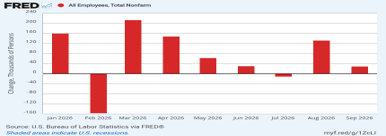
September’s U.S. official unemployment report was a disappointment—just 29,000 jobs were added vs. +133,000 jobs in August (see graph). But that may not be a sign of a weakening labor market.
It should be obvious that the labor market is at the beginning os another recovery with the massive acceleration in government and A.I. spending that eclipses any prior era by $Billions.
The new chip factories and data centers are being built over time. It may be another decade before we will see definitive results in job formation and GDP growth, as happened in prior technological revolutions, such as for computer and the Internet use to spread.
So it’s difficult to see the changes, contrary to the Bureau of Labor Statistics report, or even the final employment numbers. For instance, after losing -10,000 jobs in July, mainly because of supply disruptions from Trump’s Iran blockade, payroll formation was originally reported to be 162,000 jobs in August then reduced to 133,000 hires in its latest revision.
And I’m guessing that September new jobs will probably be revised upward from 29,000 jobs, given that it’s hard to estimate September because totals include seasonal back to school and government hires that aren’t known immediately.
So, all that investment must eventually grow the job market as well. Steve Ratner, Morning Joe’s resident economist, said in a NYTimes opinion piece that we could already be seeing its impact; the labor markets are beginning to hire more technical professionals because of it.
“To date, A.I. has killed a number of jobs but boosted employment for plumbers, electricians, data scientists and market research analysts”.
Manufacturing may be the biggest story. Manufacturing employment was little changed in September (+9,000) but is up by 72,000 since a recent low in December 2025.
And the Institute of Supply Management’s manufacturing index of new orders climbed 1.6 points last month to a robust 55.3%. It means a majority (55.3%) of supply managers report more new orders. Some manufacturers are even hiring for the first time in a few years. Job creation was positive for the third straight month, following a 33-month streak of declines.
So the low September payroll total may be a temporary glitch.
And GDP growth has already been revised upward in the past two quarters. Q1 2026 GDP was bumped up from 2.0 to 2.2 percent and Q2 from 1.5 to 2.5 percent. And there are +3 percent predictions for Q3 growth.
But all that activity is blowing up inflation. The price index for gross domestic purchases increased 5.6 percent in the second quarter GDP number, revised down 0.2 percentage point from the previous estimate.
This means there will be another Fed rate hike, but maybe after the November election, which is the tradition so as not to be seen as influencing voters.
“Total nonfarm payroll employment changed little in September
(+29,000), following an average monthly gain of 45,000 over the prior 12 months.
Health care employment continued its upward trend in September (+17,000), but at a slower pace than the average monthly gain over the prior 12 months (+33,000).
Will the employment picture improve with literally $Trillions going into the economy? More importantly, will it improve consumers’ confidence in their own future, which has been in the dumps? They must believe so for it to happen. A.I. robots won’t do it.
That is the conundrum, as former Fed Chair Greenspan would say.
Harlan Green © 2026
Follow Harlan Green on Twitter: https://twitter.com/HarlanGreen


