
Popular Economics Weekly
“Many participants emphasized that a higher path for the target range would be prudent on risk-management grounds, providing insurance against inflation remaining persistently above target due to stronger-than-expected demand or further adverse supply shocks,” FOMC
Must Americans endure more endless wars, as we did with Vietnam, Iraq, and Afghanistan? And was the cost worth it with the mountain of debt left behind?
The FOMC minutes quoted above say, if we cannot bring down inflation from “stronger than expected demand for funds” (debt), or “adverse supply shocks” (tariffs and ongoing wars), a “higher path” (more rate hikes) would be prudent.
And we now have two more wars—Ukraine, Iran—and the Gaza war, or genocide; whatever we want to call it costing even more, which will push inflation rates even higher, thus the Fed’s response.
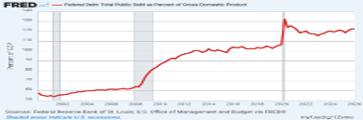
The climb in debt portrayed in the above FRED (Federal Reserve Bank of St. Louis) graph to today’s unmanageable height began after 9/11 and the GW Bush wars on terror against Iraq and Afghanistan. But we lost the Vietnam and Afghanistan wars; and Iraq is a loss in the $dollars spent, with the last U.S. troops having finally left after 23 years.
A Brown University study estimates the U.S. financial cost of the Iraq War alone is estimated at $1.79 trillion to $2.2 trillion in direct budgetary spending, with long-term projections (including veteran care, disability, and interest on borrowing through 2050) pushing the total past $2.89 trillion to over $6 trillion. [1, 2, 3]
How will the mountain of debt left behind ever be paid as portrayed in the above FRED graph of public debt as a percentage of GDP in such an environment?
The Federal Reserve’s FOMC minutes quote hinted at the cost of so much debt; multiple interest rates hikes are needed to tame inflation back down to its 2 percent target rate to maintain it credibility to control inflation.
And that means prolonged high interest rates that will damage economic growth. Or, it might take another major recession like the Great Recession (thick vertical gray bar in graph) to happen.
Our public debt must eventually be paid for, one way or another. It should be with higher taxes on corporations and the wealthiest. But Republicans have chosen to cut taxes while spending more on the military (i.e., our wars), while reducing spending on most social program sand even threatening social security and Medicare.
Too much is at stake if we ever defaulted on our public debt. now $41Trillion still and growing with our credit rating downgraded to AA from two of the credit agencies.
The good news is that we have the power to settle ongoing wars. The bad news is that President Trump and his Republicans have taken the wrong side on the Ukraine and Iran wars (Russia’s) and maybe Israel’s as well by supporting Netanyahu and his hard liners that don’t want a two-state solution.
But the EU won’t allow the Ukrainians to lose, and Trump doesn’t have a way out of a war that has cost US $44B to date, per Wikipedia.
The Fed has gone into such rate hike cycles times before. The last concerted effort happened because Alan Greenspan’s Fed held interest rates too low for too long to aid in paying for the wars on terror (sound familiar?).
And it busted the housing bubble, resulting in the 2008-09 Great Recession.
There are much more dire outcomes if we can’t find a way to end these ongoing wars. It will take greater fiscal discipline to bring down $41Trillion in debt; now 122 percent of our Gross Domestic Product.
It’s been done before; the Clinton Administration’s four years of budget surpluses. Then what happened? The 9/11 Al Queda attack and more wars.
There are cheaper ways to settle conflicts. President Obama’s nuclear arms treaty with Iran, for instance, in which Iran agreed to use nuclear energy only for peaceful purposes.
Harlan Green © 2026
Follow Harlan Green on Twitter: https://x.com/HGreen97180/


