
Surging Construction Sector Aids Home Sales

image

The Mortgage Corner

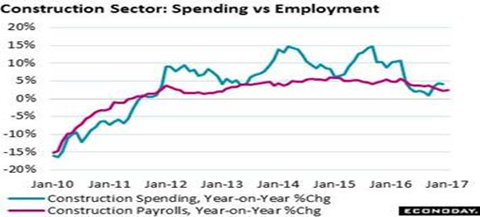
Construction payrolls were a positive surprise of the January employment report, rising 36,000 for the best gain since March. Construction was soft through most of last year though it did pick up at year end.

And this is why Pending and New-home sales are doing so well. Overall construction spending fell 0.2 percent in December but spending on new single-family homes rose 0.5 percent in the month with multi-family spending up 2.8 percent.
image

Graph: Econoday

This is why sales of newly built, single-family homes rose 12.2 percent in 2016 to 563,000 units, the highest annual rate since 2007, according to newly released data by the U.S. Department of Housing and Urban Development and the U.S. Census Bureau.

Only public construction spending fell a sharp 1.7 percent in the month. Educational spending fell 2.2 percent with highways & streets down 0.6 percent. Private nonresidential categories (ie, commercial) are mixed with total spending for this component unchanged in the month.

“We are encouraged by the growth in the housing sector last year, and by the fact that builders increased inventory by 10 percent in anticipation of future business,” said Robert Dietz, chief economist of the National Association of Home Builders (NAHB). “NAHB’s forecast calls for continued upward momentum this year, with housing starts expected to rise 10 percent over the course of 2017.”

The inventory of new home sales for sale was 259,000 in December, which is a 5.8-month supply at the current sales pace, an improvement from the 5 percent range most of last year. The median sales price of new houses sold was $322,500, up from.

image

Graph: Trading Economics

That is why housing starts, or construction, is so important in building up inventories depleted by the Great Recession. Starts jumped 11.3 percent from the previous month to a seasonally adjusted annualized rate of 1226 thousand in December of 2016, beating market expectations of 1200 thousand. Multi-segment starts rebounded while single-family declined for the second month. Considering full 2016, housing starts rose 4.9 percent to 1166.4 thousand.

“This report represents firm growth for housing in 2016, as single-family starts rose 9 percent and multifamily production was down slightly,” said NAHB Chief Economist Robert Dietz. “We expect that 2017 will be another year of gradual, steady improvement in the housing market. Multifamily starts have been volatile in recent months, but should level off as supply meets demand. Meanwhile, single-family production continues to gain momentum but is limited by supply-side headwinds.”

So housing construction is returning to normal times. Starts in the United States averaged 1438.64 thousand from 1959 until 2016, reaching an all-time high of 2494 Thousand in January of 1972 and a record low of 478 Thousand in April of 2009.

Harlan Green © 2017

Follow Harlan Green on Twitter: https://twitter.com/HarlanGreen

Posted in Consumers, Economy, Housing, housing market, Weekly Financial News | Tagged , , , , | Leave a comment

Homeland Security Obeys Court Order to lift Trump Travel Ban

image

Popular Economics Weekly

It is a well-known fact that the US has had a history of labor shortages, dating from the Revolutionary War. Colonial America was defined by a severe labor shortage that employed forms of unfree labor such as slavery and indentured servitude and by a British policy of benign neglect (salutary neglect). Over half of all European immigrants to Colonial America arrived as indentured servants, says Wikipedia.

Then why would the Trump administration enact an immigration ban on seven primarily Moslem countries, when we need all the immigrants we can import to fill the 5.5 million job openings that remain unfilled, as well as find the workers for his promised $1 trillion in infrastructure projects?

Hence the need and tradition of immigrants adding new blood and man (and women) power to our workforce. The colonies were also characterized by religious diversity, with many Congregationalists in New England, German and Dutch Reformed in the Middle Colonies, Catholics in Maryland, and Scots-Irish Presbyterians on the frontier. Sephardic Jews were among early settlers in cities of New England and the South. Many immigrants arrived as religious refugees: French Huguenots settled in New York, Virginia and the Carolinas. Many royal officials and merchants were Anglicans.

They need to come from all religions, in other words, particularly Islam, which is the third most populous religion with 1.6 billion practitioners

So when will the Trump team get that message, especially after contempt citations are already being filed as he defies the latest court injunctions against his temporary travel ban?

At least one contempt of court citation has been filed against President Donald Trump and another is likely to be submitted on Friday, charging that the administration has defied court orders by denying entry to the United States by an untold number of immigrants from seven predominantly Muslim countries.

The Commonwealth of Virginia filed its contempt motion late Wednesday night in Alexandria federal court. Meanwhile, an attorney who is trying to assist more than 200 Yemenis in gaining entry into this country said Thursday that her office will file a contempt motion of its own on Friday in U.S. District Court in Los Angeles.

“The Trump administration is acting as if he is running a dictatorship,” attorney Julie Ann Goldberg said in a telephone interview from Djibouti, where her clients are being held in transit. “It’s as if he has forgotten there are three branches of government in this country and has totally disregarded any judicial order. He is ignoring them across the country.”

Judges in Brooklyn, Boston, Alexandria, Va., and Seattle, as well as two more in Los Angeles have issued orders to stop the government from carrying out the executive order Trump signed last Friday that suspended for 90 days the issuance of visas to people from seven countries deemed by the U.S. government to present a terrorist threat. They are Syria, Libya, Sudan, Iran, Somalia, Iraq and Yemen. The president’s executive order also suspended refugee admissions from all countries for 120 days.

Federal officials have issued statements saying that they are taking steps to “immediately” comply with the court orders. As of Thursday, the government had recommended denials of boardings to 1,136 immigrants with visas or other documents who sought entry into the United States, while they had granted waivers to 87 immigrants. Restrictions appear to have been lifted nationwide on lawful permanent residents of the United States, some of whom had difficulty gaining entry into the country in the earliest stages of the order’s rollout.

And now we have the revelation that more than 100,000 entry visas were revoked in the middle of the night, without notifying the courts or agencies that are involved. But because a Washington State Federal Judge has granted a nationwide injunction to lift the travel ban, the Department of Homeland Security has just announced it has suspended all actions to implement the immigration order and will resume standard inspections of travelers as it did prior to the signing of the travel ban.

Also, a State Department official tells CNN the department has reversed the cancellation of visas that were provisionally revoked following the President’s executive order last week — so long as those visas were not stamped or marked as canceled.

Harlan Green © 2017

Follow Harlan Green on Twitter: https://twitter.com/HarlanGreen

Posted in Consumers, Economy, Politics | Tagged , , | Leave a comment

A Yuge Jobs Gain Today

Popular Economics Weekly

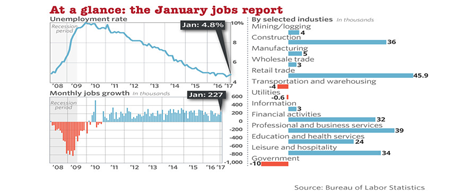
The U.S. created 227,000 new jobs in January to mark the largest gain in four months, revealing an economy that has plenty of stamina nearly eight years into a recovery that shows little sign of ending. Retailers, construction firms, financial companies and restaurants led the way in hiring in January, the government said Friday.

image

Graph: Marketwatch

The unemployment rate rose slightly to 4.8 percent last month, mostly because more people were looking for work, but there is a skills gap with most of the unemployed blue collar workers needing job retraining, rather than additional coal and manufacturing jobs the Trump team is hoping to generate. Job openings are near their record high and that’s drawing a larger share of Americans back into the labor force.

This is while a tighter labor market is also forcing firms to pay more to workers, an emerging trend that’s likely to further underpin the recovery. In January, hourly wages rose 0.1 percent to $26 an hour. Over the past 12 months wages have climbed 2.5 percent—faster than the less than 2 percent annual gains that prevailed through most of the recovery.

What does this mean? Maybe some of those unfilled 5.55 million job openings will be filled. But only if the courts lift the immigration ban that will discourage the influx of skilled workers to fill those jobs, as the Trump administration seems caught in the grips of white nationalist wall-builders, at the moment, such as Steven Bannon, who are very unskilled at writing Executive Orders, it seems.

Chaos is reigning over the immigration ban, at the moment. The global confusion that has since erupted is the story of a White House that rushed to enact, with little regard for basic governing, a core campaign promise that Mr. Trump made to his most fervent supporters, reports the New York Times. In his first week in office, Mr. Trump signed other executive actions with little or no legal review, but his order barring refugees has had the most explosive implications.

Passengers were barred from flights to the United States, customs and border control officials got instructions at 3 a.m. Saturday and some arrived at their posts later that morning still not knowing how to carry out the president’s orders.

Back to the jobs report, there was a huge surge in retail payrolls (46,000), professional services (39,000), and construction jobs (36,000), signaling real estate is still strong, with interest rates still near their record lows.

image

Graph: Econoday

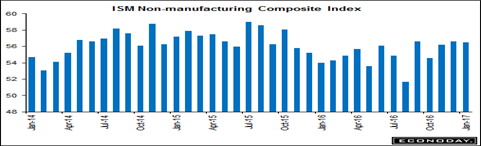
More big news was that the service sector is still booming, though it dropped slightly in January. The ISM non-manufacturing, or service sector index “The NMI® registered 56.5 percent which is 0.1 percentage point lower than the seasonally adjusted December reading of 56.6.

Both prices and employment jumped 2.9 and 2.0 percent, respectively, again signaling a tighter labor market. The sector that includes Health Care & Social Assistance; Finance & Insurance; Public Administration; Accommodation & Food Services; Retail Trade; Construction; still reflects strong growth.

“This represents continued growth in the non-manufacturing sector at a slightly slower rate,” said Anthony Nieves, chair of the Institute for Supply Management® (ISM®) Non-Manufacturing Business Survey Committee. “Respondents’ comments are mixed indicating both optimism and a degree of uncertainty in the business outlook as a result of the change in government administration.”

So this uncertainty is another reason to cancel or modify Trump’s immigration ban, as it hurts more than the seven Muslim countries. Scientists worldwide are now cancelling their participation in US scientific conferences in protest.

Harlan Green © 2017

Follow Harlan Green on Twitter: https://twitter.com/HarlanGreen
Posted in Uncategorized | Tagged , , , , , | Leave a comment

A Yuge Jobs Gain Today

Popular Economics Weekly

The U.S. created 227,000 new jobs in January to mark the largest gain in four months, revealing an economy that has plenty of stamina nearly eight years into a recovery that shows little sign of ending. Retailers, construction firms, financial companies and restaurants led the way in hiring in January, the government said Friday.

image

Graph: Marketwatch

The unemployment rate rose slightly to 4.8 percent last month, mostly because more people were looking for work, but there is a skills gap with most of the unemployed blue collar workers needing job retraining, rather than additional coal and manufacturing jobs the Trump team is hoping to generate. Job openings are near their record high and that’s drawing a larger share of Americans back into the labor force.

This is while a tighter labor market is also forcing firms to pay more to workers, an emerging trend that’s likely to further underpin the recovery. In January, hourly wages rose 0.1 percent to $26 an hour. Over the past 12 months wages have climbed 2.5 percent—faster than the less than 2 percent annual gains that prevailed through most of the recovery.

What does this mean? Maybe some of those unfilled 5.55 million job openings will be filled. But only if the courts lift the immigration ban that will discourage the influx of skilled workers to fill those jobs, as the Trump administration seems caught in the grips of white nationalist wall-builders, at the moment, such as Steven Bannon, who are very unskilled at writing Executive Orders, it seems.

Chaos is reigning over the immigration ban, at the moment. The global confusion that has since erupted is the story of a White House that rushed to enact, with little regard for basic governing, a core campaign promise that Mr. Trump made to his most fervent supporters, reports the New York Times. In his first week in office, Mr. Trump signed other executive actions with little or no legal review, but his order barring refugees has had the most explosive implications.

Passengers were barred from flights to the United States, customs and border control officials got instructions at 3 a.m. Saturday and some arrived at their posts later that morning still not knowing how to carry out the president’s orders.

Back to the jobs report, there was a huge surge in retail payrolls (46,000), professional services (39,000), and construction jobs (36,000), signaling real estate is still strong, with interest rates still near their record lows.

image

Graph: Econoday

More big news was that the service sector is still booming, though it dropped slightly in January. The ISM non-manufacturing, or service sector index “The NMI® registered 56.5 percent which is 0.1 percentage point lower than the seasonally adjusted December reading of 56.6.

Both prices and employment jumped 2.9 and 2.0 percent, respectively, again signaling a tighter labor market. The sector that includes Health Care & Social Assistance; Finance & Insurance; Public Administration; Accommodation & Food Services; Retail Trade; Construction; still reflects strong growth.

“This represents continued growth in the non-manufacturing sector at a slightly slower rate,” said Anthony Nieves, chair of the Institute for Supply Management® (ISM®) Non-Manufacturing Business Survey Committee. “Respondents’ comments are mixed indicating both optimism and a degree of uncertainty in the business outlook as a result of the change in government administration.”

So this uncertainty is another reason to cancel or modify Trump’s immigration ban, as it hurts more than the seven Muslim countries. Scientists worldwide are now cancelling scientific conferences in the US in protest.

Harlan Green © 2017

Follow Harlan Green on Twitter: https://twitter.com/HarlanGreen
Posted in Consumers, Economy, Macro Economics, Politics, Weekly Financial News | Tagged , , , , , | Leave a comment

Private Payrolls, Consumer Confidence Signal Strong January

Popular Economics Weekly

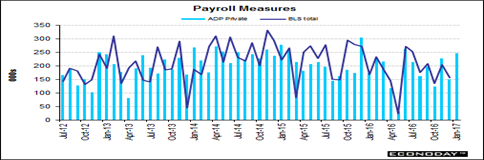
ADP is calling for substantial strength in Friday’s employment report, showing yesterday 246,000 for private payrolls, not including government jobs. This is far beyond expectations and would compare with December private payroll growth in the government’s report of 144,000 (ADP’s count for December is revised slightly lower to 151,000).

Yesterday’s data follow positive employment indications in Tuesday’s consumer confidence report and may very well pull expectations higher for Friday’s employment report, says Econoday.

image

Graph: Econoday

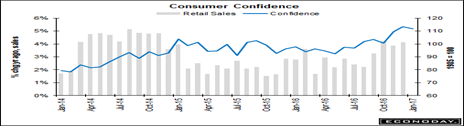
And the Conference Board’s consumer confidence survey showed further consumer strength. Consumer confidence held strong and steady in January, at 111.8 for only a slight decrease from December’s 15-year high of 113.3 (revised), said the Conference Board. Details are positive including a noticeable decline in those saying jobs are hard to get right now, at 21.5 percent vs December’s 22.7 percent, combined with a solid rise in those who say jobs are plentiful, at 27.4 vs 26.0 percent.

image

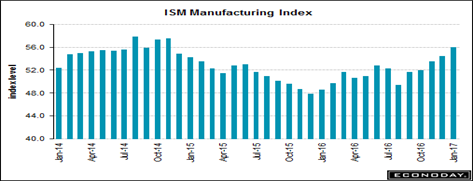
Then we also have the ISM manufacturing index back to post-recession highs. The ISM manufacturing report out Wednesday, in line with a run of regional reports, is signaling the strongest conditions in the factory sector since the oil-price collapse of 2014. The composite index for January is 56.0 for a sizable 1.5 point gain and the highest reading since November 2014.

New orders at 60.4 vs 60.3 in December is also a high since November 2014 and is the first back-to-back 60 showing since December 2013. Employment is also strong, up a sharp 3.3 points to 56.1 for the highest reading since August 2014. Inventories are steady as are delivery times which have been slowing in line with rising activity. Input costs are showing increasing pressure, in line with rising costs in other anecdotal reports.

 image

Graph ISM

So what have we for economic prospects in the Trump era? A lot will depend on the markets confidence that the Trump team can follow through on its promises. But limiting immigration when the economy is basically fully employed is not a recipe for further growth, because where will the workers come from to build all those infrastructure projects, for instance?

Probably from overseas. Or maybe from some of the unemployed blue-collar workers that don’t have the skills in today’s high tech economy. Though housing construction is rising, public construction spending fell a sharp 1.7 percent in the month. Educational spending fell 2.2 percent with highways & streets down 0.6 percent. Private nonresidential categories are mixed with total spending for this component unchanged in the month.

Also, where will the additional monies come from to finance those Trump projects?

Harlan Green © 2017

Follow Harlan Green on Twitter: https://twitter.com/HarlanGreen

Posted in Consumers, Economy, housing market, Weekly Financial News | Tagged , , , , , | Leave a comment

Pending Home Sales—Case-Shiller Prices Higher

image

The Mortgage Corner

Pending home sales picked up in December as solid increases in the South and West offset weakening activity in the Northeast and Midwest, according to the National Association of Realtors®. And the S&P Case-Shiller Home Price Index of same existing-home prices continued to rise more than inflation, signaling a housing shortage still exists.

The Pending Home Sales Index, a forward-looking indicator based on contract signings, increased 1.6 percent to 109.0 in December from 107.3 in November. With last month’s uptick in activity, the index is now 0.3 percent above last December (108.7). Pending sales have been this active since 2015, really, which in turn has stimulated housing construction, mostly on the high end.

image

Graph: NAR

Lawrence Yun, NAR chief economist, says contract activity was mixed throughout the country in December but ultimately ended on a high note to close out 2016. “Pending sales rebounded last month as enough buyers fended off rising mortgage rates and alarmingly low inventory levels to sign a contract,” he said. “The main storyline in the early months of 2017 will be if supply can meaningfully increase to keep price growth at a moderate enough level for households to absorb higher borrowing costs. Sales will struggle to build on last year’s strong pace if inventory conditions don’t improve.”

And national home price gains maintained momentum in November, two months after retaking the high last seen at the height of the housing bubble, according to Case-Shiller.

The S&P/CoreLogic Case-Shiller 20-city index rose 5.3 percent compared to a year ago for the three month period ending in November, an acceleration from the 5.1 percent increase notched in October. The national price index rose 5.6 percent for the year, up from 5.5 percent in October, and a yuge seasonally adjusted 0.8 percent for the month. Among the 20 cities, Seattle, Portland and Denver continued to see the strongest price gains.

According to Yun, a large portion of overall supply right now is at the upper end of the market, as we said. This is evident by looking at December data on the year-over-year change in single-family sales by price range. Last month, sales were up around 10 percent compared to December 2015 for homes sold at or above $250,000, while homes sold between $100,000 and $250,000 only increased 2.3 percent. Meanwhile, sales of homes under $100,000 were down 11.6 percent compared to a year ago.

image

Graph: NAR

This could be because mortgage rates have risen, though a 30-year fixed conforming rate is still 4.0 percent for one origination point in California. This is approximately 0.75 percent higher that the record lows of last yar.

“The dismal number of listings in the affordable price range is squeezing prospective first-time buyers the most,” said Yun. “As a result, young households are missing out on the wealth gains most homeowners have accrued from the 41 percent cumulative rise in existing home prices since 2011.”

Metro

Monthly Case-Shiller

12-Month Change

Atlanta

0.0%

6.1%

Boston

0.4%

5.5%

Charlotte

0.3%

5.9%

Chicago

-0.8%

4.0%

Cleveland

0.0%

3.8%

Dallas

0.2%

8.1%

Denver

0.6%

8.7%

Detroit

-0.1%

6.6%

Las Vegas

0.3%

6.0%

Los Angeles

0.2%

5.5%

Miami

0.5%

6.1%

Minneapolis

0.1%

5.5%

New York

0.4%

2.4%

Phoenix

0.3%

5.2%

Portland

0.2%

10.1%

San Diego

0.3%

5.8%

San Francisco

-0.1%

5.3%

Seattle

0.2%

10.4%

Tampa

0.8%

8.1%

Washington

0.2%

3.7%

Harlan Green © 2017

Follow Harlan Green on Twitter: https://twitter.com/HarlanGreen
Posted in Housing, housing market, Weekly Financial News | Tagged , , , | Leave a comment

Q4 GDP Slightly Lower—How About 2017?

Financial FAQs

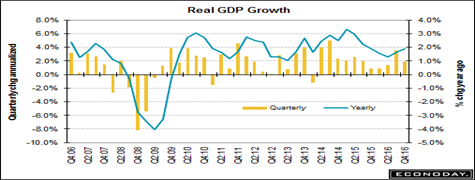
Fourth quarter Gross Domestic Product growth slowed, mostly because of the strong dollar and weak foreign demand. But consumers held up their end with higher consumer sentiments, and businesses also began to invest in new plants and equipment again.

One reason for the weakness is surging domestic demand for imported goods, because consumers are buying lots of goods and services. So all-in-all, the U.S. economy is doing very well, with interest rates still low and domestic demand still strong.

image

Graph: Econoday

Gross domestic product, the official score card for the economy, expanded at a 1.9 percent annual clip from October to December, the Commerce Department said. That’s a marked drop from a 3.5 percent growth rate in the third quarter and below the 2.2 percent consensus of Bloomberg. The drop was mainly because of lower exports (strong dollar) and higher imports, which are a subtraction in the calculation of GDP, increased.

Still, the increase in real GDP in the fourth quarter reflected positive contributions from personal consumption expenditures (PCE), private inventory investment, residential fixed investment, nonresidential fixed investment, and state and local government spending.

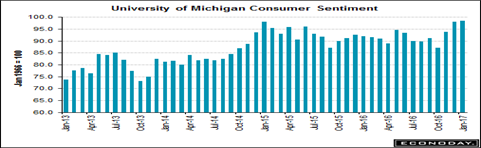
And we have soaring consumer sentiment, as the University of Michigan Consumer Sentiment survey is now at 98.5 in January, at the cycle highs where it’s been since the November election. Prospects for future income are the highest in a decade, though the sample is split between optimism among Republicans offsetting pessimism among Democrats. One fifth of the sample says it’s a good idea to borrow in advance of possible rate increases, a 20-year high for this reading.

image

Graph: Econoday

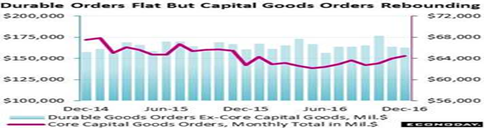
But the real hero of the week was durable goods orders for goods lasting more than 3 years, such as auto, appliances and aircraft. Even though December orders, pulled down by a swing lower in defense aircraft, slipped 0.4 percent, core capital goods orders rose 0.8 percent which is on top of an upward revised 1.5 percent gain in November.

image

Graph: Econoday

This is the sign of the increase in business investment in plants and equipment that will be sorely needed to increase productivity and so economic growth in 2017. Year-on-year core capital goods orders (nondefense ex-aircraft) moved into the plus column for the first time since October 2015, at 2.8 percent to exceed total orders at 1.2 percent. The graph tracks monthly dollar levels of core capital goods (at $64.5 billion in December) against all other durable goods (at $162.5 billion). This swing higher for capital goods has contributed to three straight quarters of gains, though small ones, for nonresidential investment in the GDP report. But progess is progess, says Econoday.

So we can only hope that President Trump doesn’t start too many trade wars, such as with Mexico, our third largest trading partner, if GDP growth is to improve from the past decade. For most of our exports and core capital goods depend on parts made elsewhere. We have a worldwide interconnected economy, in other words, which a trade war could harm greatly.

Harlan Green © 2017

Follow Harlan Green on Twitter: https://twitter.com/HarlanGreen
Posted in Consumers, Politics, Weekly Financial News | Tagged , , , , | Leave a comment

President Trump’s Bully Mentality

image

Popular Economics Weekly

President Trump’s first days in office were alarming for several reasons. He immediately began attacking the press, while intentionally stating falsehoods such as he would have won the popular vote, but for “3 to 5 million” fraudulent votes. Or, maybe they weren’t intentional falsehoods? Since most of those falsehoods are easily debunked, such as the size of the crowds at Friday’s Inauguration and Saturday women’s march.

Then you have the CIA meeting, where he stated that it was the lying media that made up his dispute with the intelligence community, whereas it is easy to check Trump’s speeches and Twitter messages for all to see he was the one that criticized the intelligence community for their findings that Vladimir Putin’s intelligence services wanted him elected.

So could it be that he is delusional, the words of Mother Jones’ David Corn? Or is it possible that he only listens to news from the likes of Breitbart, The National Inquirer, Fox, and Russ Limbaugh that cater to his voters, not the mass media that reports to the rest of US?

No, it is far more likely that he believes his success in business, such as it is, was due to his bullying tactics, tactics that browbeat investors and lenders to such an extent that he can no longer rely on U.S. investors and banks to finance his projects. So he doesn’t care—and may even have contempt for—facts or truths or any kind that don’t further his agenda.

A New York Times reporter on Lawrence O-Donnell’s MSNBC Last Word said it reminded her of the behavior of dictators, such as the current Russian and Chinese autocrats who considered all news as grist for their propaganda mills.

I have written about the bully mentality several times that has led to increased bullying in school, and even gun violence. It is a mentality that attempts to impose a bully’s version of reality on the real world for the sole purpose of domination. President Trump has always acted the bully, which is the reason for his history of lawsuits and bankruptcies, so that facts are only useful in so much as they support his positions.

Evidence of Trump’s bullying tactics also comes from his words on Twitter and elsewhere, reports Groff Beattle, a professor of Psychology at Edge Hill University who specializes in gestures, has discussed how Trump uses the body language and mannerisms of a bully, such as the exaggerated use of his hands.

Also comments such as “mentally sick”, “dummy”, “looser” or “looked disgusting” are all examples of bullying language on Trump’s Twitter. Trump’s bullying tactics include calling President Obama the founder of a terrorist organisation and insinuating that Clinton took drugs prior to a debate. Furthermore, he has mocked the disability of reporter Serge Kovaleski, portrayed immigrants and foreigners as dangerous people, rapists or “criminal aliens”, and demonstrated a significant lack of respect for women generally.

How does one oppose such destructive behavior? First, remember that bullies have to prey on the weakest, and avoid confrontation with those stronger because of their own insecurities. Trump preyed on naïve students and the elderly in his Trump University scam. And he stiffed workers and employees when building his Trump Casinos either by paying them less than was contractually agreed to, or not at all.

Combine it with his case-study narcissism that requires he be constantly in the limelight. So standing up to such a bully means the news media should ignore his tantrums, rather than commenting on them. Remember that he makes such outrageous lies to gain even more attention.

Psychology Today has posted a list of bullying behavior, a list that fits President Trump like a glove:

– Uncontrolled anger and unpredictable irritability, frequently directed at the weakest people (‘safe targets’) or those perceived as a future threat

– A sociopathic ability to control their own image – the selective ability to look like a different person to different audiences – for example, being aggressive to ‘subordinates’, while being charming and helpful to others

– Having little status outside of work, bullies wield the power that their job gives them with vicious zeal

– Running ‘witch-hunts’

– Gratuitous domineering behaviour – sometimes physical

– The ability to make the unreasonable seem reasonable, even to the victims

–Projecting their own inadequacies onto others

– Making irrational accusations

– Publicly putting people down

– Sadistic enjoyment in humiliating others

The list is endless of President Trump’s bullying tactics, and the responses are well known. There is even a government website, https://www.stopbullying.gov/ to help understand what the bully mentality is all about.

How sad it is that this US President, now the most powerful person on earth, is setting such an example of his own weakness and insecurity.

Harlan Green © 2017

Follow Harlan Green on Twitter: https://twitter.com/HarlanGreen
Posted in Politics, Uncategorized | Tagged , , , | Leave a comment

Has Inflation Returned?

Financial FAQs

Inflation is here! says Econoday, per last week’s CPI report; at 2.1 percent for total consumer prices (columns in graph) and 2.2 percent for the core rate (red line). Two percent is generally considered the target rate for inflation, the rate consistent with stable and sustainable economic growth.

The last time both the CPI and the core were actually together at the 2 percent line was way back in February 2013. And then it plunged into negative territory, as the federal government shut down in 2013 for two weeks over Republican’s refusal to raise the debt ceiling. The U.S. had already lost its S&P AAA rating on sovereign Treasury debt in 2011, and instituted the sequester agreement putting an across the board cap on government spending.

Then oil prices plunged along with worldwide commodity prices in 2014 due to slowing growth in the so-called BRIC emerging economies (Brazil, Russia, India, and China), so that U.S. industries cut back their investment spending, as well.

image

Graph: Econoday

The current rise in the CPI is mostly due to higher energy prices as economic activity (and oil prices) have picked up with U.S. final Q3 GDP growth at 3.5 percent. Energy prices are up 1.5 percent in the month, their fourth straight strong monthly gain with the yearly rate now well above the inflation rate at 5.4 percent.

But inflation may not be here to stay, as there is massive uncertainty over what exactly the Trump economic policies will be. Tax cuts and fewer government regulations will certainly stimulate additional growth, and so higher inflation, which is necessary to put more people back to work.

Medical care has also been a consistent source of strength though recent readings have been fading, up only 0.2 percent in December for a yearly 4.1 percent. Housing is another area of strength, up a tangible 0.3 percent in the month and at 3.0 percent year-on-year. Owners’ equivalent rent, which is a closely watched subcomponent of housing, also rose 0.3 percent.

image

Graph: Econoday

Where will the growth come from? From the manufacturing sector, if Trump succeeds in implementing that massive $1 trillion infrastructure spending he has promised. The manufacturing component of the industrial production could manage only a 0.2 percent gain in December, said Econoday, one that followed a 0.1 percent decline in November.

Factory output during 2016 (red line) proved dead flat once again, not getting any help from exports (columns). Exports were on the rise several years back and were helping production as seen on the left side of the graph, but the progress has since fizzled, as the BRIC economies are still in a recession mode.

So there may not be much inflation this year. And the Fed would counteract any inflation increase with higher interest rates, anyway, which they said they would do maybe two or three times in 2017, if necessary.

Harlan Green © 2016

Follow Harlan Green on Twitter: https://twitter.com/HarlanGreen

Posted in Consumers, Economy, Politics, Weekly Financial News | Tagged , , , | Leave a comment

Housing Starts Surge With Builder Optimism

The Mortgage Corner

A surge in multifamily production resulted in overall nationwide housing starts rising 11.3 percent to a seasonally adjusted annual rate of 1.23 million units, according to newly released data from the U.S. Department of Housing and Urban Development and the U.S. Census Bureau. This is Yuge, and will help to ease the shortage of rental units that has been driving up rental rates, squeezing low and moderate-income renters out of some housing markets.

Single-family construction dropped 4 percent to a seasonally adjusted annual rate of 795,000 units, but that was still 3.9 percent higher in a year. Multifamily production jumped 57 percent to 431,000 units in December. However, the monthly data for apartment production has exhibited strong volatility since August, sand the National Association of Home Builders. Still this may stop the average rent increase of 7 percent annually in high growth regions.

image

Graph: Calculated Risk

“This report represents firm growth for housing in 2016, as single-family starts rose 9 percent and multifamily production was down slightly,” said NAHB Chief Economist Robert Dietz. “We expect that 2017 will be another year of gradual, steady improvement in the housing market. Multifamily starts have been volatile in recent months, but should level off as supply meets demand. Meanwhile, single-family production continues to gain momentum but is limited by supply-side headwinds.”

Regionally in December, combined single- and multifamily housing production rose 31.2 percent in the Midwest, 23.5 percent in the West and 18.5 percent in the Northeast. The South posted a loss of 1.4 percent. That is an incredible increase in mid-winter, and reflects the rush to build before the predicted rise in interest rates this year.

The National Association of Home Builders (NAHB) also reported that though the housing market index (HMI) of builder optimism in future housing construction dropped slightly to 67 in January, down from 69 in December, any number above 50 indicates that more builders view sales conditions as good than poor. And this is easily the highest confidence rating since the end of the Great Recession.

image

Graph: NAHB

The slight drop in confidence may also be because of uncertainty over future building regulations, which are set state by state, rather than nationally, and interest rates, of course, which many predict will rise, as I said.

So despite the January drop, some builders say there are still reasons to be bullish. “Builders begin the year optimistic that a new Congress and administration will help create a better climate for small businesses, particularly as it relates to streamlining and reforming the regulatory process,” said NAHB Chairman Granger MacDonald.

Such optimism will evaporate, however, if interest rate rise sharply. But with the conforming 30-year fixed rate falling back to 3.75 percent in California of late, that may not happen. Could it be that optimism over future growth could also mean higher inflation, which means higher interest rates, as well?

This writer is optimistic that with Janet Yellen and her Fed Governors still cautious about forecasting higher growth and inflation—where will all those workers come from that will be needed for any new infrastructure projects when there is already a shortage of construction workers—remains to be seen.

Harlan Green © 2017

Follow Harlan Green on Twitter: https://twitter.com/HarlanGreen

Posted in Consumers, housing market, Weekly Financial News | Tagged , , , , | Leave a comment