Consumer Spending Down, Recession Looms?

Popular Economics Weekly

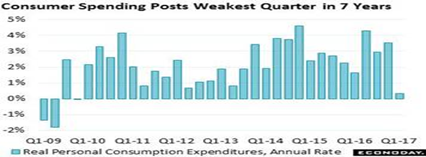
Wow! First-quarter GDP was paltry enough at 0.7 percent but consumer spending was even more paltry, at only 0.3 percent for the most embarrassing annualized pace since 2009. Unemployment is unusually low and consumer confidence unusually high making the results difficult to explain.
image

Graph: Econoday

Could it be that nothing is happening in Congress and the White House on all those promised initiatives? The 5-month budget agreement left all spending priorities in place for the rest of this fiscal year (i..e., until September). That meant no money for a border wall, no defunding of Obamacare (as promised), or Planned Parenthood, or cuts in the EPA budget that protects our environment.

All the post-election euphoria for change hasn’t translated into actions, in other words. So, consumers may be keeping their powder dry, as their savings rate rose 0.2 percent to 5.6 percent.

Another worrisome indicator is almost no inflation, as core Personal Consumption Expenditure prices had the weakest showing in 16-1/2 years, according to Econoday. Core PCE prices fell 0.1 percent to take down the year-on-year rate by a sizable 2 tenths to 1.6 percent.

And if there’s no inflation, or falling inflation, it means there’s falling demand, which means falling profits. And that’s when a business cycle ends. So unless Congress and the Trump White House decide to stop playing with people’s minds on repealing Obamacare, or trying to pass a budget that cuts taxes for the wealthiest, while cutting benefits to seniors and the sickest, we could see a looming recession.

The ineptitude of government is at the moment startling. The budget agreement leaves everything in place, which includes, thanks to the Washington Post’s Daily 202:

1. There are explicit restrictions to block the border wall, but final agreement goes further, putting strict limitations on how Trump can use new money for border security (e.g. to invest in new technology and repair existing fencing). Administration officials have insisted they already have the statutory authority to start building the wall under a 2006 law. This prevents such an end run.

2. Non-defense domestic spending will go up, despite the Trump team’s insistence he wouldn’t let that happen. The president called for $18 billion in cuts. Instead, he’s going to sign a budget with lots of sweeteners that grow the size of government. Mitch McConnell made sure $4.6 billion got put aside to permanently extend health benefits to 22,000 retired Appalachian coal miners and their families.

Nancy Pelosi made sure $295 million was included to shore up Medicaid in Puerto Rico. Chuck Schumer got $61 million to reimburse local law enforcement agencies for the cost of protecting Trump when he travels to his residences in Florida and New York. There is also another $2 billion in disaster relief money for states, which bought a couple votes. (Kelsey Snell, our lead budget reporter, has more examples.)

3. The administration asked to slash spending at the National Institutes of Health by $1.2 billion for the rest of this fiscal year. Instead, the NIH will get a $2 billion boost – on top of the huge increase it got last year. Republican appropriators who care about biomedical research, including Rep. Tom Cole (R-Okla.) and Sen. Roy Blunt (R-Mo.), delivered.Trump also failed in his efforts to cut money for other kinds of scientific inquiry. For example, he proposed defunding the Advanced Research Projects Agency–Energy. Instead, it is getting a $15 million increase.

4. Trump fought to cut the Environmental Protection Agency by a third. The final deal trims its budget by just 1 percent, with no staff cuts. As part of a compromise, the EPA gets $80 million less than last year, but the budget is $8 billion.

5. He didn’t defund Planned Parenthood. Despite the best efforts of social conservatives, the group will continue to receive funding at current levels.

6. The president got less than half as much for the military as he said was necessary. Trump repeatedly prodded Congress to increase military spending by $30 billion. He’s getting $12.5 billion, with an additional $2.5 billion if/when he delivers a detailed plan on how to defeat the Islamic State.

7. Democrats say they forced Republicans to withdraw more than 160 riders. These unrelated policy measures, which each could have been a poison pill, would have done things like get rid of the fiduciary rule and water down environmental regulations. On the other side of the ledger, this budget blocks the Justice Department from restricting the dispensing of medical marijuana in states where it has been legalized.

8. To keep negotiations moving, the White House already agreed last week to continue paying Obamacare subsidies. This money, which goes to insurance companies, reduces out-of-pocket expenses for low income people who get coverage under the Affordable Care Act. The Trump administration justifies giving up on this because of the potential to resolve the bigger issue by repealing Obamacare.

Need we say more?  If ideology trumps common sense; such as the promised $1 trillion infrastructure bill, we can see the confidence balloon also lose its air. Then watch out below, as I’ve said.

Harlan Green © 2017

Follow Harlan Green on Twitter: https://twitter.com/HarlanGreen

Posted in Consumers, Economy, Politics, Weekly Financial News | Tagged , , , , , | Leave a comment

Slow Q1 GDP Growth Means What?

Financial FAQs

Real gross domestic product (GDP) increased at an annual rate of 0.7 percent in the first quarter of 2017, according to the “advance” estimate released by the Bureau of Economic Analysis. In the fourth quarter of 2016, real GDP increased 2.1 percent.

image

Graph: BEA

The first estimate of first quarter economic growth usually means little. Consumer weren’t spending, and they never seem to spend much in Q1, as in past years, as the BEA graph show. But with consumer confidence still sky high because of optimism that President Trump and Congress might still agree on some stimulus, spending may pick up.

There were signs of higher growth in Q1 outside of the consumers, particularly in real estate. “The deceleration in real GDP in the first quarter reflected a deceleration in PCE and downturns in private inventory investment and in state and local government spending that were partly offset by an upturn in exports and accelerations in both nonresidential and residential fixed investment,” said the BEA.

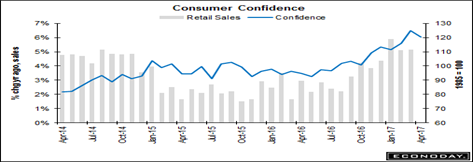
So consumer sentiments can be deceptive, even misleading, given the lack of higher consumer spending in Q1. The Conference Board reported the consumer confidence index eased back to 120.3 in April vs a revised 124.9 in March with these two months the best of the 8-year expansion. “Readings remain strongly favorable including jobs-hard-to-get which is steady at a very low 19.1 percent and points to strength for the April employment report,” said Econoday.

Weak vehicle sales are a major negative in the quarter’s consumer breakdown, pulling durable sales down at a 2.5 percent rate and offsetting a 1.5 percent rise in non-durables and a slow 0.4 percent showing for services. Weakness in consumer spending is worrisome but not other data in the GDP report. Residential investment posted a second straight very strong quarter, up 13.7 percent. And in a rare show of strength, nonresidential investment, which has been subdued, jumped at a 9.4 percent rate with both structures and equipment showing unusual strength. A surge in mining investment is a standout of the report, said the BEA.

image

Graph: Econoday

There are more signs that growth could pick up in coming quarters. The Institute for Supply Management’s Chicago Business Barometer, a proxy for Midwest growth, ticked up 0.6 Points in April to 58.3 in April from 57.7 in March, the highest level since January 2015. New orders are the highest since May 2014, and in a sign of ongoing strength deliveries continue to slow. 

Optimism among firms about business conditions rose for the third month in a row. Three of the five Barometer components led April’s increase, with Production and Order Backlogs receding, said the report. Third Consecutive Rise in Business Confidence, New Orders Highest Since May 2014, Inflationary Pressures Ease Slightly, Prices Paid fall, as the MNI Chicago Business Barometer increased to 58.3 in April from 57.7 in March, the highest level since January 2015.

“The April Chicago report showcased another impressive month, with firms reporting solid growth. Rising demand and firm production led to a pick-up in hiring by firms. Although the employment indicator has been bumpy, in and out of contraction, if the current month’s rise is sustained, it could provide a boost to the labor market,” said Shaily Mittal, senior economist at MNI Indicators, compiler of the report.

But optimism doesn’t always translate to spending, as we know from past reports. Consumers’ incomes keep rising and were very solid in the fourth quarter at a 3.5 percent pace, but rose at only 0.3 percent in first-quarter 2017 on weak vehicle sales and lower heating bills. This is by far the worst showing since no change in fourth-quarter 2009, and would be the lowest showing for consumer spending in 5 years. What will it take for consumers to spend again?

Harlan Green © 2017

Follow Harlan Green on Twitter: https://twitter.com/HarlanGreen
Posted in Consumers, Economy, Weekly Financial News | Tagged , , , , , | Leave a comment

No “Art of the Deal” in 100 Days

trump art

Popular Economics Weekly

It’s 100 days into the Trump Presidency and looking more and more like President Trump is no more effective at running the country than his business interests. His book, The Art of the Deal was meant to tout his negotiating skills, but the results were never very successful.

And neither are his legislative efforts; with no repeal of Obamacare, tax reform, an immigration ban, new trade policy, and sanctuary city victories in the offing anytime soon because of poorly thought out strategies. Instead, he threatens judges, sanctuary cities, Congress, and even other countries when they don’t support his various executive orders.

His multiple bankruptcies of the Trump Casinos when other Atlantic City Casinos were successful, Trump University charged as a criminal enterprise (under RICO), and the fact that he had to rely on Russian Oligarchs to finance his real estate empire when U.S. banks would no longer lend to him, are just the tip of the iceberg of business incompetence.

These are the acts of a bully, rather than leader, which is why he seems to have so much in common with V Putin, Marine Le Pen, and other demagogues. Acting tough can be a plus when dealing with North Korea, or even Russia, but not when dealing with Americans who don’t like him or his very anti-American policies.

It’s sad, really, that he doesn’t have the skills to really shake up the Washington establishment, which needs it badly, as the election showed. But being a successful negotiator requires more than bully tactics, even in business. He so badly stiffed his own employees, as well as states such as New York (back taxes), charities, and well as U.S. banks that they want nothing more to do with him, except in court.

This is why he is involved in more than 4,000 lawsuits at last count, according to USA Today, and more are yet to come with mounting Federal court rulings against his executive orders.

Fortune Magazine reported last June on candidate Trump’s negotiating tactics: “The legal actions provide clues to the leadership style the billionaire businessman would bring to bear as commander in chief. He sometimes responds to even small disputes with overwhelming legal force. He doesn’t hesitate to deploy his wealth and legal firepower against adversaries with limited resources, such as homeowners. He sometimes refuses to pay real estate brokers, lawyers and other vendors.”

And, “As he campaigns, Trump often touts his skills as a negotiator,” says Fortune. “The analysis shows that lawsuits are one of his primary negotiating tools. He turns to litigation to distance himself from failing projects that relied on the Trump brand to secure investments. As USA TODAY previously reported, he also uses the legal system to haggle over his property tax bills. His companies have been involved in more than 100 tax disputes, and the New York State Department of Finance has obtained liens on Trump properties for unpaid tax bills at least three dozen times.”

There may be even be more troubles ahead for President Trump, now that he is also stiffing a Republican-run House Oversight Committee investigation into General Flynn’s activities as an unreported lobbyist, which wasn’t apparently disclosed in his application for renewal of his Top Secret security clearance.

So, could this lead to his impeachment?

Harlan Green © 2017

Follow Harlan Green on Twitter: https://twitter.com/HarlanGreen
Posted in Economy, Politics, Uncategorized | Tagged , , , , , , | Leave a comment

Why Is Mortgage Lending Still Restricted?

The Mortgage Corner

We can thank the Great Recession for most of it. Banks have become much more conservative, and builders are building approximately 50 percent fewer residences vs. the 2 million housing units at the height of the housing bubble.

And the very Great Recession was in some ways worse than the Great Depression, when FDR’s New Deal created jobs for those that couldn’t find work. Whereas conservative economic ideologies have triumphed since President Reagan under austerity policies (such as the 2011 government shutdown over raising the budget cap), which have restricted government spending at a time when the private sector has refused to reinvest in productive growth, even though corporate profits have soared to record levels as a percentage of GDP.

The Urban Institute has dug even deeper into the causes of tight credit. Since private sector lending dried up after the Great Recession, government GSEs, such as Fannie Mae, Freddie Mac, FHA and VA; all with some form of government guarantee, have had to step in to revive the housing market. So they account for more than 80 percent of all residential lending.

And because the US Treasury completely appropriated all the assets and profits of Fannie and Freddie in 2012, which account for 60 percent of all residential loans, they have imposed additional fees on any but the best credit risks to protect taxpayers. This in effect raised the cost of qualifying, which in turn reduces the pool of eligible homebuyers and borrowers.

How much, asks the Urban Institute? “According to our estimates, an additional 1.25 million loans would have been made in 2013 if the cautious standards of 2001, rather than the severe standards of 2013, had been in place. Between 2009 and 2013, the number of “missing” loans grew from 0.50 million to 1.25 million annually, for a total of more than 4 million missing loans over the five years.”

Behind all this data lies another, more sobering fact—the record income inequality that occurred since the 1970s and was the major cause of the Great Recession. Incomes have flowed so fast to the upper income tiers since its end in 2009 that 96 percent of all income gained since then has gone to the top 1 percent.

This is in part because of the stock market rebound and loss of all those homes from the housing bust. It resulted in some $4 trillion in lost housing assets for middle-class homeowners in the main, the main source of their wealth.

It’s a phenomenon named Monopsony by economists, or the increasing monopoly power of Big Business in particular to control labor costs due to marked lack of competition. This is explained in lucid detail by Kate Bahn, an economist at the Center For American Progress, a progressive think tank.

“While overall the labor market looks fairly solid, it’s still lacking on measures of competitiveness that are giving employers outsized ability to set low wages,” says Prof Hahn. “They can reap higher profits by exploiting their workers who don’t feel confident enough to leave their current job in search of a better one. (It’s evidenced) by the historically low rates of people moving across geographies.”

image

Graph: BLS/Econoday

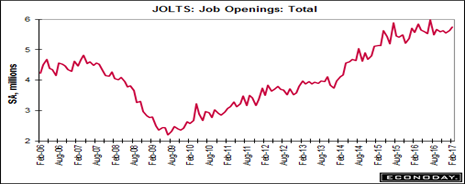
The Labor Department measures it as the quits rate in their JOLTS report (Job Openings and Labor Turnover Survey) that tabulates the number of Hires and Separations each month. There was a 1 tenth downtick in the quits rate to 2.1 percent, “a subdued reading that points to lack of movement between jobs and lack of wage pull for employees,” said Econoday. The separations rate also fell, down 1 tenth to 3.5 percent.

The gap between openings and hiring first opened up about 2 years ago signaling that employers are having a hard time finding people with the right skills, said Econoday. The current spread between openings and hirings is 429,000, the widest since September. But remember, the US economy is so large that more than 5 million jobs are created and lost per month.

One would think the high number of available jobs means higher wages for all, as employers bid up salaries to attract them, but not so; just for the highly skilled. Those blue collar and service jobs that require less skill don’t have the competitive advantage of higher education and training that would boost their salaries.

And that is why the credit and housing markets have skewed towards the highest income earners, and will remain so, unless more New Deal-type programs (such as promised infrastructure spending, universal health care, stronger labor laws) help to bring back the middle class.

Harlan Green © 2017

Follow Harlan Green on Twitter: https://twitter.com/HarlanGreen
Posted in Consumers, Economy, Housing, housing market, Weekly Financial News | Tagged , , , , , , , , | Leave a comment

Low Inflation Boosts Housing Sales

Financial FAQs

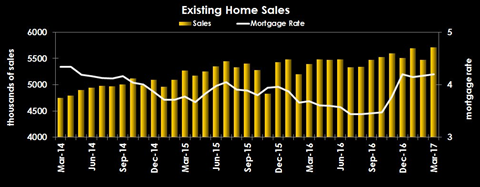
Existing-home sales are now accelerating to new expansion highs, says the NAR. Sales rose a very sharp 4.4 percent to a higher-than-expected annualized rate of 5.710 million. This is the best rate since February 2007. Both components show strength with single-family sales up 4.3 percent to a 5.080 million rate and condo sales up 5.0 percent to a 630,000 rate. And year-on-year sales are moving higher, up 5.9 percent divided between 6.1 percent for single-family homes and 5.0 percent for condos.

image

Graph: Econoday

Lawrence Yun, NAR chief economist, says existing sales roared back in March and were led by hefty gains in the Northeast and Midwest. “The early returns so far this spring buying season look very promising as a rising number of households dipped their toes into the market and were successfully able to close on a home last month,” he said.

“Although finding available properties to buy continues to be a strenuous task for many buyers, there was enough of a monthly increase in listings in March for sales to muster a strong gain. Sales will go up as long as inventory does.”

Why the great interest rates? It’s mainly because there is still very little inflation, and the bond market that determines mortgage rates likes low inflation. A March contraction of the CPI led to sizable slowing in year-on-year rates. The total rate is 2.4 percent, down 3 tenths from February and sliding back to the Fed’s 2 percent target. The core rate, which excludes food & energy, is down 2 tenths and is right at the target line. Energy comparisons are very easy right now given low prices this time last year. This makes the decline in the core a special concern.

image

Graph: Econoday

The median existing-home price for all housing types in March was $236,400, up 6.8 percent from March 2016 ($221,400). March’s price increase marks the 61st consecutive month of year-over-year gains.

And total housing inventory at the end of March increased 5.8 percent to 1.83 million existing homes available for sale, but is still 6.6 percent lower than a year ago (1.96 million) and has fallen year-over-year for 22 straight months. Unsold inventory is at a 3.8-month supply at the current sales pace (unchanged from February), signaling a very high demand that is outstripping new-home construction, stuck at 1.22 million annual units.

The conforming 30-year fixed rate mortgage is now 3.50 percent and the so-called Hi-Balance conforming 30-year fixed rate is 3.75 percent these days for a 1 percent origination fee. This is what has kept the demand for housing on a tear, in spite of low inventories and tepid economic growth, as I said yesterday.

Harlan Green © 2017

Follow Harlan Green on Twitter: https://twitter.com/HarlanGreen
Posted in Housing, housing market, Politics, Weekly Financial News | Tagged , , | Leave a comment

Return To Low Interest Rates Boosts Housing

The Mortgage Corner

The conforming 30-year fixed rate mortgage is now 3.50 percent and the so-called Hi-Balance conforming 30-year fixed rate is 3.75 percent these days for a 1 percent origination fee. And this is what has kept the demand for housing on a tear, in spite of tepid economic growth, with GDP still stuck at 2 percent per the Philly Fed Index seen below.

Why? It’s mainly because there is still very little inflation, and the bond market that determines mortgage rates likes low inflation. The low inflation rate may be because there’s still doubt on what growth-inducing legislation may ever get through a weak President and Congress stuck in ideological warfare. So we could see builders’ record profits continue for the rest of this year, and maybe more affordable housing.

Both new-home construction and builder optimism are at post-recession highs, but with normal seasonal fluctuations (such as mid-March Northeast blizzard), says the National Association of Home Builders (NAHB).

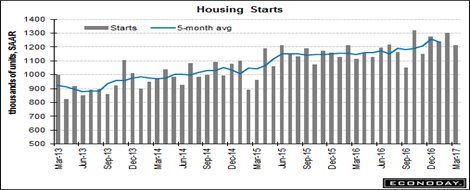
Following an elevated February reading, nationwide housing starts fell 6.8 percent in March to a seasonally adjusted annual rate of 1.22 million units, according to the U.S. HUD and the Commerce Department. Still, new housing production in the first quarter of this year is running 8.1 percent above the pace in 2016, reports the NAHB.

image

Graph: Econoday

This is why builder confidence in the market for newly-built single-family homes remained solid in April, falling three points to a level of 68 on the National Association of Home Builders/Wells Fargo Housing Market Index (HMI) after an unusually high March reading, said the NAHB.

”The fact that current sales conditions has been over 70 for five consecutive months shows that there is continued demand for new construction,” said NAHB Chief Economist Robert Dietz. “However, builders are facing several challenges, such as hefty regulatory costs and ongoing increases in building material prices.”

The building industry is doing its share to boost growth as it continues to add jobs, with monthly employment data for February showing that home builder and remodeler employment increased by 18,900. Over the last 12 months, home builders and remodelers have added 136,000 jobs on a net basis and residential construction employment now stands at 2.707 million.

image

Graph: Calculated Risk

Where is US manufacturing activity these days? It’s still increasing in most states. The Philadelphia Federal Reserve has released the coincident indexes for the 50 states for February 2017. Over the past three months, the indexes increased in 47 states (green states), decreased in two, and remained stable in one (Michigan), for a three-month diffusion index of 90. In the past month, the indexes increased in 44 states, decreased in four, and remained stable in two, for a one-month diffusion index of 80.

“Here is a map of the three month change in the Philly Fed state coincident indicators. This map was all red during the worst of the recession, and almost all green now,” says Calculated Risk’s Bill McBride.

So, economic growth continues into the eighth year of this business cycle. And housing is usually a leading indicator of future growth, but that will depend on what looks like lower interest rates, future (lower) inflation trends, actions of the Federal Reserve, and Congress, of course.

Harlan Green © 2017

Follow Harlan Green on Twitter: https://twitter.com/HarlanGreen

Posted in Consumers, Housing, housing market, Politics, Weekly Financial News | Tagged , , , , | Leave a comment

Which Trump Economic Proposals Should Fail?

Popular Economics Weekly

It doesn’t look good for two Trump and Republican campaign promises currently working their way through Congress: i.e., to repeal and replace Obamacare, and reform the tax code. They should really be working on what is possible; a $1 Trillion infrastructure spending bill. So the euphoria and expectations generated by the Trump victory might dissipate, and that is what’s needed to generate future growth at the end of an already long business cycle.

Why? There is massive opposition from both Republicans and Democrats to both an Obamacare replacement vehicle and tax reform proposals to date. Whereas the one campaign promise that could succeed is the upgrade and replacement of our aging public infrastructure. Both Republicans and Democrats want it for their home states and districts.

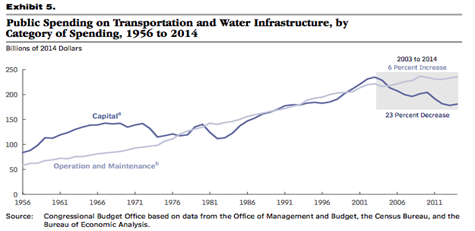
For instance, out of the 614,387 bridges in the US, more than 200,000 are more than 50 years old. The Associated Society of Civil Engineers 2016 report estimates it would cost some $123 billion just to fix the bridges in the US, and many of the one million drinking water pipes have been in use for almost 100 years. The aging system makes water breaks more prevalent, which means there are about two trillion gallons of treated water lost each year.

In fact, most of our highways and bridges were built more than 70 years ago, which is why the ASCE says public infrastructure is now behind more the $4.5 trillion in maintenance alone, such as highways, harbors, wastewater facilities and bridges.

image

Graph: CBO

Even more important to our security and economic well-being, is the majority of the transmission and distribution lines were built in the mid-20th century and have a life expectancy of about 50 years, meaning that they are already outdated. So between 2016 to 2025, there’s an investment gap of about $177 billion for infrastructure that supports electricity, like power plants and power lines, reports the ASCE. 

There is another Republican obsession, however that may block even that possibility. It’s Trump’s preoccupation with the Wall, or pseudo Wall, and deportation of millions of undocumented workers—the majority of which have lived in the U.S. for more than 10 years. They have raised families, paid taxes, and held jobs that white and other ethnic groups are either incapable of doing (such as farm work), or refuse the low wages and benefits on this bottom rung of the labor ladder.

image

Graph: Business Insider

Any increase in their deportation could cause severe damage to growth, and maybe even end the 8 years of this growth cycle. The Center for American Progress, a liberal policy institute in Washington, is even more blunt. It estimates that a policy of mass deportation would “immediately reduce the nation’s GDP by 1.4% and ultimately by 2.6%.” This is when current GDP growth is just 2 percent.

None other than Fed Chairman Janet Yellen also voiced her concern in a recent speech. “Labor-force growth has been slowing in the United States,” Yellen said. “It’s one of several reasons, along with slow productivity growth, for the fact that our economy has been growing at a slow pace. Immigration has been an important source of labor-force growth. So slowing the pace of immigration probably would slow the growth rate of the economy.”

Her comments are striking because Yellen is usually careful not to discuss topics outside her monetary policy and regulation mandate, lest her remarks be construed as political.

And, “Because capital will adjust downward to a reduction in labor — for example, farmers will scrap or sell excess equipment per remaining worker — the long-run effects are larger and amount to two-thirds of the decline experienced during the Great Recession,” the CAP report says. “Removing 7 million unauthorized workers would reduce national employment by an amount like that experienced during the Great Recession.”

Over 10 years, US output will have fallen $4.7 trillion short of what it might otherwise have been, CAP says. For comparison, US gross domestic product, the nation’s total spending on goods and services, stood at $18.6 trillion at the end of 2016.

Those are very large numbers, which means Republicans and Democrats will have to learn to work together on what is practical and attainable to avoid this next recession.

Harlan Green © 2017

Follow Harlan Green on Twitter: https://twitter.com/HarlanGreen
Posted in Consumers, Economy, Politics, Weekly Financial News | Tagged , , , , | Leave a comment

Is Happiness That Important to Americans?

Popular Economics Weekly

What a strange question to ask Americans! We are the wealthiest country in the world, right? But a recent survey claims to show that wealth accumulation is not the first priority for most of the world. In fact, the 2017 United Nation’s World Happiness Report compiled by Gallup says that Americans’ pre-occupation with wealth gets in the way of being happy.

This conclusion results from a survey of 155 countries, and shows USA is now ranked 19th in being happy, due to our national preoccupation with what money buys now, rather than in the future. Norway is ranked number one; no surprise with its oil wealth. But, “by choosing to produce its oil slowly,” says the survey, “and investing the proceeds for the future rather than spending them in the present, Norway has insulated itself from the boom and bust cycle of many other resource-rich economies. To do this successfully requires high levels of mutual trust, shared purpose, generosity and good governance, all factors that help to keep Norway and other top countries where they are in the happiness rankings.

The USA, however, hasn’t shielded itself from boom and bust cycles. The Great Recession is just the latest in a string of recessions since 1980—two under R Reagan, one during Bush I, and two under son GW Bush. And that has led to the greatest income equality since 1929 that was the beginning of the Great Depression, and also the cause of just-ended Great Recession.

We have not been good at investing in our future, and that has led to a very low savings rate and very little put aside for retirement. This is in part because our social safety net is profoundly inadequate. We have no universal healthcare, for starters, and Republicans are threatening to repeal Obamacare, and maybe even Medicare.

This is while we have a huge public debt because Congress has refused to raise enough taxes to pay for all the spending that has supported the ongoing wars as well as tax loopholes afforded corporations, and high net-worth individuals.

Why has such record income inequality led to recessions? As Marriner Eccles, FDR’s renown Federal Reserve Chairman once said about the Great Depression: “…a giant suction pump had by 1929-30 drawn into a few hands an increasing portion of currently produced wealth. … The other fellows could stay in the game only by borrowing. When their credit ran out, the game stopped.”

Credit had again run out for most Americans in 2007 due to a failed financial system and busted housing bubble. And it is just that uncertainty that is in the way of happiness. For how can anyone be happy, unless they can count on a predictable future?

“The USA is a story of reduced happiness,” said the Gallup study. “In 2007 the USA ranked 3rd among the OECD countries; in 2016 it became 19th. The reasons are declining social support and increased corruption and it is these same factors that explain why the Nordic countries do so much better.”

And the lack of such social support has resulted in poorer health outcomes for all Americans—such as declining longevities, significantly higher disease rates, and higher infant mortality. The study lists the main factors that support happiness: caring, freedom, generosity, honesty, health, income and good governance.”

In sum, the United States offers a vivid portrait of a country that is looking for happiness “in all the wrong places,” says the study. “The country is mired in a roiling social crisis that is getting worse. Yet the dominant political discourse is all about raising the rate of economic growth. And the prescriptions for faster growth—mainly deregulation and tax cuts—are likely to exacerbate, not reduce social tensions. Almost surely, further tax cuts will increase inequality, social tensions, and the social and economic divide between those with a college degree and those without.”

America has become a less caring and generous country because of its single-minded pursuit of wealth, in other words. How to re-develop those traits that Americans have historically been noted for?

Creating a quality educational system available to all, would be a start. The share of Americans receiving a college Bachelor’s Degree or better is stuck at 36 percent when a more technically savvy workforce is needed more than ever. And the educational divide between Haves and Have-nots has been increasing, which increases the political polarization.

“Clinton won 17 of the top 18 states, while Trump won 29 of the bottom 32 states,” said Gallup. And, “The deep social and economic divisions according to educational attainment seem to be similar to the dynamics of the Brexit vote and other anti-migrant parties in Europe, which find their base among voters with lower educational attainment.”

Why is greater equality, and the concept of a safety net for all Americans taking so long to achieve when it has already been achieved in all other advanced countries and economies?

One hint: Why haven’t we elected a female president when every other major western economy has? And women, because they are used to nurturing and caring for children, are much better at planning for the future

Harlan Green © 2017

Follow Harlan Green on Twitter: https://twitter.com/HarlanGreen

Posted in Economy, Politics, Weekly Financial News | Tagged , , , , , | Leave a comment

Why the Weak March Employment Report?

The Mortgage Corner

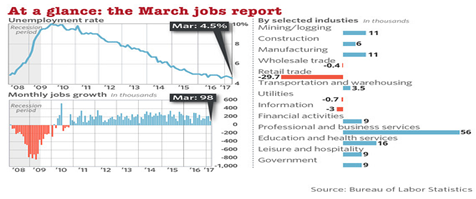
The good news is the unemployment rate fell to 4.5 percent, and number of unemployed persons (i.e., available for work) declined by 326,000 to 7.2 million. Both measures were improved numbers over the year. But just 98,000 payroll jobs were created in March from the Establishment survey that tracks actual payrolls, lower than gains of 219,000 in February and 216,000 in January, reported the Bureau of Labor Statistics on Friday.

image 

Graph: Marketwatch

The smaller telephone Household survey that measures the actual unemployment rate and included the self-employed found 472,000 more with jobs and 145,000 added to the workforce, which is why the unemployment rate dropped 0.2 percent to 4.5 percent.

The predictions were for much stronger payroll creation in March, as the ADP (a payroll service) private payrolls estimate on Wednesday was 263,000 payroll jobs, and the Labor Department’s estimates usually follow closely. It’s probably because the surveys were taken at different times of the month and the east coast had some serious weather, as I said.

The consensus before ADP’s result was calling for a 170,000 rise in March private payrolls which would follow gains of 227,000 and 221,000 in the two prior months. Details in the ADP report include a strong 49,000 gain for construction and a 30,000 increase for manufacturing.

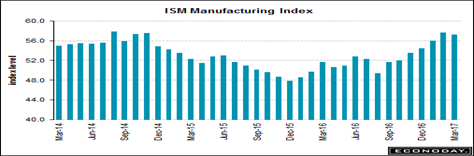
This was predicted by a very strong ISM manufacturing index of manufacturing activity earlier in the week, with its employment index at 58.9—which means 58.9 percent of respondents to the survey increased hiring for a 4.7 point gain, the best rate since June 2011. Yet there might be a sign of a weather effect in deliveries as delivery times did slow by a moderate 1.1 points to 55.9, says Econoday.

image

Graph: Econoday

So, it could be the weather as the Northeast experienced a Category 3 blizzard in March after two very warm months. In any event this is the lowest unemployment rate since the height of the last expansion in April 2007 though there is still very little wage growth. Average hourly earnings rose only 0.2 percent in the month for a year-on-year rate that is down 1 tenth in the month and further away from the 3 percent line, which historically has meant full employment.

Why the fewer payroll jobs, is a good question. Many businesses are probably waiting to see if the Trump tax and infrastructure campaign promises will become realty. The Labor Department said retail trade is down 30,000 in March following February’s 31,000 decline. Trade & transportation payrolls decreased 27,000 following a 16,000 decline. But both manufacturing and mining show gains, at 11,000 each with construction, despite the weather, still rising 6,000.

And number of long-term unemployed has dropped 526,000 over the past year, while the number of part-time workers who want a full-time jobs is down 567,000 in a year. Also the government hiring freeze put in place in late January didn’t hurt March payrolls as government payrolls rose 9,000.

But the huge drop in retail jobs could mean online buying is cutting into storefront businesses. Macy’s is closing many of its stores and Sears and Roebuck could soon declare bankruptcy or breakup with its $1billion annual negative cashflow.

So was March an aberration? Long term rates are falling at the moment, with the 10-year Treasury yield back to 2.30 percent, while the Fed just raised their short term, overnight fed funds rate to 0.75 to 1.0 percent. Hence there is now a smaller difference between short and long term rates that I’ve mentioned before. This will squeeze bank profits and so the availability of credit at a time when we still have an economy growing just enough at 2 percent.

That’s not enough growth to put the 5.6 million back to full-time work who keep searching.

Harlan Green © 2017

Follow Harlan Green on Twitter: https://twitter.com/HarlanGreen
Posted in Consumers, Economy, Politics, Weekly Financial News | Tagged , , , , | Leave a comment

Consumers Too Optimistic?….Then Watch Out Below!

Popular Economics Weekly

Consumer confidence has risen to what might be unsustainable levels—the highest in 16 years. That was in 2000, which was at the end of a 10-year economic recovery, the longest recovery since WWII. The Conference Board’s index is now at its strongest level since those dotcom boom days of December 2000 before that market crashed and the 9/11 attack occurred, says Econoday.

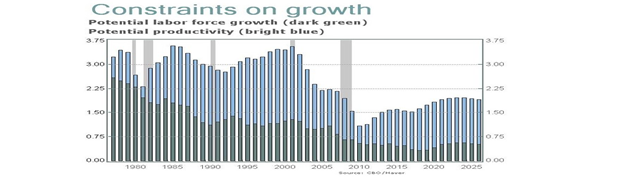
Stronger savings and rising wages are the main reason for the 9.5 point surge in the consumer confidence index to 125.6. Much of the optimism is after Donald Trump’s campaign promises, which, if enacted could mean higher growth, though such growth depends more on factors outside of such campaign promises as higher import taxes and any change in tax policies It actually depends much more on a faster growing workforce, and higher labor productivity—goals that will be difficult to achieve in today’s polarized political climate.

image

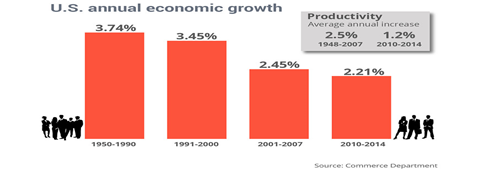
Studies have shown that to even reach a 3 percent annual GDP growth, 2.8 million workers must be added to the US workforce every year, and just 600,000 native born workers currently reach working age because of a shrinking US birth rate. That and a very poor average productivity rate of 1.2 percent from 2010-2014 have constrained growth.

image

Consequently, the Trump administration’s draconian attempts to cut back on immigration will only damage growth. The Trump administration is proposing as much as a 50 percent reduction in immigration.

Boosting job creation can be a two-edged sword, in that two-thirds of the jobs are in the service sector. Manufacturing has been making a comeback of late, but that has more to do with a recovery in the rest of the world, and lower dollar exchange rates, rather than the imposition of tariffs that are subject to retaliation.

Mexico, for instance, has threatened to either ban or raise taxes on the importation of US corn, a staple in Mexico that has driven many Mexican corn-growers out of business.

Econoday reports in the latest ISM Manufacturing Survey that “the new orders index is still, outside of February, the second strongest reading since December 2013. And new export orders are very strong, up 4.0 points to 59.0 for the best showing since November 2013. Backlog orders are understandably piling up, 1/2 point higher to a 57.5 rate of monthly growth that was last matched in March 2014 and last exceeded in April 2011.”

So confidence is a good thing, if it encourages businesses and the economy to grow and create more jobs. But businesses act on hard facts, such as increased demand for their goods and services, rather than hope.

Harlan Green © 2017

Follow Harlan Green on Twitter: https://twitter.com/HarlanGreen

Posted in Consumers, Economy, Politics, Weekly Financial News | Tagged , , , , , , , | Leave a comment