
How Much Do We Care?

ANSWERING KENNEDY’S CALL

“Robert F. Kennedy, Jr., the proposed secretary of the Department of Health and Human Services, would undo all of this.  On his watch, were his ideas implemented, millions of us would die.  Knowing that our lives will be shorter, we become nasty and brutish.”

NPR.org

This is a question I asked in 2017. What country had the second-highest mortality from noncommunicable conditions — like diabetes, heart disease or violence — and the fourth highest from infectious disease? Also, from adolescence to adulthood to old age, what country has the highest chance of dying an early death?

The answer is the United States of America. Where else, since the U.S. is the only developed country in the world without universal health care? Then why would Donald Trump nominate RFK, Jr., an anti-vaxxer and conspiracy follower with no medical background who is the least qualified person for guarding the health of Americans as Secretary of Health and Human Services?

Timothy Snyder said it best in looking at Trump’s cabinet picks to date:

“Taken together, Trump’s candidates constitute an attempt to wreck the American government.

“The foundation of modern democratic state is a healthy, long-lived population.  We lived longer in the twentieth century because of hygiene and vaccinations, pioneered by scientists and physicians and then institutionalized by governments.  We treat one another better when we know we have longer lives to lose.  Health is not only the central human good; it enables the peaceful interactions we associate with the rule of law and democracy. 

“Robert F. Kennedy, Jr., the proposed secretary of the Department of Health and Human Services, would undo all of this.  On his watch, were his ideas implemented, millions of us would die.  Knowing that our lives will be shorter, we become nasty and brutish.”

The Republican Partyitself has been on the same path with their efforts to dismantle healthcare legislation such as Obamacare in the name of downsizing government.

A recent New York Times Business Insider article by Eduardo Porter highlighted a recent study by the Institute of Medicine and the National Research Council of 16 of the richest countries in the world that set out to assess our nation’s health.

The results are devastating and show how far America has fallen behind in caring for its citizens.

This problem should have nothing to do with ideology, and whether access to affordable health care should be a privilege or a right. Too many Americans are dying of drug overdose and violence. Too many Americans suffer from depression, a major cause of drug abuse.

And too many Americans are obese, making them less productive and more prone to accidents in the workplace. “The United States ranks in the bottom fourth among the 30 industrialized nations in the Organization for Economic Cooperation and Development in terms of days lost to disability,” says Porter. “Women will lose 362 days between birth and their 60th birthday: men about 336. Mental health problems like depression will account for most.”

But these statistics hide the real problem—rampant income inequality that has caused many of these unhealthy ouitcomes.

The U.S. ranks 106th of the 149 countries in income inequality as ranked by the CIA’s World Factbook; with a Gini inequality index of developing countries like Peru and Cameroon. Finland and the Scandinavian countries are at the top of equality, Germany and France are 12th and 20th, respectively. The higher the index, the greater the gap between wealthy and poorer citizens of a country’s population.

And the poorer the person, family, or community, the more prone to illness and drug use is that person, or family, or community. This is where the just defeated Senate version of repeal and replace Obamacare bill would have hurt the most—in the poorer red states that voted for President Trump.

“What’s more, the United States’ higher tolerance of poverty undoubtedly contributes to higher rates of sickness and death,” says Porter. “Americans at all socioeconomic levels are less healthy than people in some other rich countries. But the disparity is greatest among low-income groups.”

Finally contributing to our health crisis is the incredible amount of violence—both due to guns (33,000 per year killed by guns), workplace accidents, and drug abuse, that a universal health care system would treat via mental health coverages as well.

In other words, there are much higher costs because we don’t have a healthy healthcare system and we the citizens are paying those costs.

Harlan Green © 2024

Follow Harlan Green on Twitter: https://twitter.com/HarlanGreen

Posted in COVID-19, Economy, gun violence, Politics, Weekly Financial News | Tagged , , , , , , , , | Leave a comment

Holiday Sales Booming

Popular Economics Weekly

FREDretailsales

The Commerce Department reported Retail trade sales were up 0.4 percent (±0.5 percent)* from September 2024, and up 2.6 percent (±0.5 percent) from last year. Nonstore retailers were up 7.0 percent (±1.4 percent) from last year, while food services and drinking places were up 4.3 percent (±2.1 percent) from October 2023

Sales of new cars and trucks jumped 1.6% in October to lead the charge among retailers. Auto sales account for one-fifth of all retail sales. Restaurant sales are also booming, so maybe consumers are breathing a great sigh of relief that the election is over.

Holiday sales are strong even though it will be two weeks before we know if the 12,000 new payroll jobs is a fluke in the October unemployment report because of the hurricane damage and 30,000 striking Boeing machinists, which is now settled.

Even the east coast docks’ strike was settled. Was it because the strikers wanted to enjoy the upcoming holidays with more money in their pockets? We won’t know if the September jobs report was a fluke, as I said, until October’s numbers come out, but Fed Chair Powell is now saying the Fed is not in a hurry to lower interest rates further if retail sales stay strong, especially with stronger inflation news.

Both wholesale inflation and retail inflation rates were higher than forecast in October, which is another sign that consumer spending hasn’t slowed, and will continue to push up prices.

So, was too high inflation the main reason Republicans won a landslide, as exit polls have said? Then why do consumers keep shopping, and pushing up prices even higher, if a majority was so unhappy with their costs?

Maybe there were other, more cultural factors that kept consumers from realizing how lucky we are to have the fastest growing economy in the western world with no worries about energy shortages.

I find it hard to believe that most consumers were unhappy with their own circumstances, since they have spent so much for leisure activities.

Americans continue to signal that travel is splurge-worthy and are again setting new records for vacation spending in 2024, according to Allianz Partners USA, a travel insurance company. Americans have more than doubled their projected summer vacation spending since the inception of the pandemic. The 2024 figure represents an approximately 3.5% increase over last year, but a whopping 118% jump compared to 2019.

Maybe consumers want to forget about the results of the presidential race that has left the country still split in two. But the majority was mad enough to bring in Donald Trump once again in a big way, after voting him out four years ago for doing so little.

Harlan Green © 2024

Follow Harlan Green on Twitter: https://twitter.com/HarlanGreen

Posted in Consumers, COVID-19, Politics, Weekly Financial News | Tagged , , , , , , , , , | Leave a comment

Inflation Is Not the Problem

Financial FAQs

Inflation is close to its long-term 2 percent range, so the Federal Reserve has accomplished its goal of stabilizing prices. Yet the election results show that rising prices since the COVID-19 pandemic most panicked voters; even more than the border crossings, or abortion restrictions, and jobs.

Reuters

So it’s difficult to say whether voters ignored basic economic principles, or ideologies triumphed common sense, so that many voters needed to blame someone for their anxieties and “throw out the bums” they believed caused it.

It is how democracies work. This reaction happened in most of the developed world where ruling majorities were blamed for the effects of the pandemic that damaged their economies.

But in the U.S. it was too much prosperity, not too little. The Bidenomics’ bills pumped an enormous amount of investments into our economy to build a larger industrial base, modernize our infrastructure and moderate the global warming.

And many voters didn’t seem to understand how it affected the most basic law of economics: the Law of Supply and Demand. It postulates that prices rise when there isn’t enough of something consumers want, and they fall when there is a surplus.

Only now has the supply of goods and services caught up with demand, which is why consumers continued to buy as prices rose, because the U.S. economy is fully employed and consumers weren’t worried about losing their jobs. The historically low number of workers applying for jobless benefits confirms this.

Yet voters were still unhappy. Everyone had a job that wanted one, yet wages for many weren’t rising as fast as the cost of everything since the pandemic.

Why? Because it took several years for the supply chains to recover, which meant the Federal Reserve had to raise interest rates to stabilize prices, making things even more expensive.

What can’t happen, however is for most prices to return to levels before the pandemic unless there is another recession—except for energy prices (gas, natural gas, electricity) because they can fluctuate wildly even in normal times. So energy prices have returned to more normal levels. Average gas prices, for instance, have returned to pre-pandemic levels.

Consumer prices rose enough in October to keep the rate of inflation slightly above the Federal Reserve’s 2 percent goal, The consumer price index (CPI) climbed 0.2 percent for the fourth month in a row, the government said Wednesday, matching economists’ forecast. It rose 2.6 percent in a year from September’s 2.4 percent inflation rate, marking the first upturn in seven months.

This could be problem, especially if some Republican priorities are enacted, such a more tax cuts, which might cause the Fed to hold off cutting interest rates further. It would probably hurt both stock and bond prices, for starters, and slow growth further in what is already a slowing economy.

On a more cheerful note, now that prices stabilized, the natural rise of wages will catch up with those newly stabilized prices and most of us will feel reassured—unless there’s another economic shock.

That could be a larger war, or a climate disaster. Americans are already experiencing a greater frequency of such shocks with more tornadoes, hurricanes, wildfires and floods. So newly elected congress men and women, please, please, don’t cut the funding of the Environmental Protection Agency, or FEMA!

Harlan Green © 2024

Follow Harlan Green on Twitter: https://twitter.com/HarlanGreen
Posted in Consumers, COVID-19, Economy, Politics, Weekly Financial News | Tagged , , , , , , , | Leave a comment

Who Will Drain the Swamp?

ANSWERING KENNEDY’S CALL

“This is so bad. We have just gotten list of amendments to be included in bill NOT from our R colleagues, but from lobbyists downtown,” said Missouri Dem Senator Claire McCaskill. “None of us have seen this list, but lobbyists have it. Need I say more? Disgusting. And we probably will not even be given time to read them.”

NICHOLAS KAMM/AFP/Getty Images

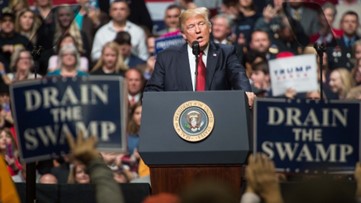
Donald Trump will be President and could have control of both the House and Senate again. The same happened in 2017 when he last won on the campaign promise to Drain the Swamp of corruption in Washington.

He didn’t succeed in his first term, actually creating a deeper swamp with rampant corruption at almost all levels of government. Will he do better this time; might he and his Republicans learn from their past mistakes?

Republicans will want more tax cuts, for starters, as well as extend the tax cuts his administration engineered in 2017, The Tax Cuts and Jobs Act, that they passed with House and Senate majorities.

I wrote at the time, “The Republicans tax bill has passed, and it is the greatest theft of taxpayer monies in history; even greater than that of Presidents’ Reagan and Bush I and II that began the immense transfer of wealth to the wealthiest in 1980 with their tax cuts starving the government of much needed revenues that would keep the federal deficits under control.”

Why? It was written by the very lobbyists Republicans and the Trump administration had cultivated during his 2017 election.

More than 130 lobbyists were hired to work in his first administration, and 36 of them have blatant conflicts of interest, working on the same issues they were lobbying on, in violation of Trump’s ethics rules, according to MarketWatch economist Jeff Nutting.

“This is so bad. We have just gotten list of amendments to be included in bill NOT from our R colleagues, but from lobbyists downtown,” said Missouri Dem Senator Claire McCaskill. “None of us have seen this list, but lobbyists have it. Need I say more? Disgusting. And we probably will not even be given time to read them.”

The bill cut Medicare and Medicaid benefits by $1.5 trillion and could add $1.5 trillion to the federal deficit in 10 years according to the CBO. That’s a $3 trillion outright theft from U.S. taxpayers for the biggest heist in history.

We know what happened when Republicans tried this taxpayer heist before. President Reagan and congress had to raise taxes 11 times to make up the deficits created by the first ‘trickle-down’ tax cuts in 1981. Two consecutive recessions in 1981 and 1982 followed as Fed Chairman Paul Volcker raised interest rates to record levels to choke off inflation at the same time.

Then GW Bush did the same in 2001-03, when he cut taxes again while paying for the wars on terror, resulting in the largest federal deficit in history at the time, as well as the Great Recession.

This did not generate enough tax revenue to pay for the additional debt, so foreign governments and individuals will become more reluctant to invest in U.S. debt, as the deficit continues to grow and interest rates rise.

It can happen again. It is suicidal economics. The U.S. won’t declare bankruptcy. But it will saddle future generations with an impossible debt load and prevent much needed public and private investment that would increase productivity and boost growth.

This happened in 2017, and the stench of lobbyists filling the swamp became so overwhelming in Donald Trump’s first term that it was the reason his Republican majority were voted out of office, as I said.

Is there any reason to doubt it will happen again?

Harlan Green © 2024

Follow Harlan Green on Twitter: https://twitter.com/HarlanGreen
Posted in Uncategorized | Tagged , , , , , , , , , , , , | Leave a comment

No Art of the Deal

ANSWERING KENNEDY’S CALL

After all, it is mathematically impossible to cut taxes for corporations and billionaires, sustain basic programs like defense and Social Security, and lower the deficit simultaneously:” Nobel Laureate Joseph Stiglitz.

Huffington Post

Historians will puzzle over the results of our latest presidential election for decades. A majority of Americans have just voted in a con artist and sexual predator for the second time who has failed in most of his business ventures and left investors holding the tab.

One conclusion will be that identity politics won, after all. Enough white women chose Donald Trump over the East-Asian/Black Kamala Harris who advocated more rights for women, while enough Hispanic and Black males put their faith in a misogynist who has sexually assaulted women.

Identity politics has moved much of the Democratic Party to the left with the Black Lives Matter and LBDGQ movements. But most exit polls said it was the economy that decided the vote—everything became too expensive after COVID-19.

My conclusion is that it has taken very special presidents to lead such a diverse populace that will defend the constitution. In modern times it was Roosevelt creating the New Deal to bring America out of the Great Depression and win World War 2.

But post-WWII generations eventually forgot what the New Deal had accomplished and voted in a Republican Party that by 1980 had begun to drain the federal budget by continually cutting taxes for their wealthy supporters creating massive federal deficits; Reagan (-$400 billion), GW Bush (-$1 trillion), and Donald Trump (-$5 trillion).

Democratic presidents wanted government programs that benefited more Americans, so President Clinton created actual budget surpluses in his last four years, President Obama brought America out of the Great Recession spawned by the GW Bush administration’s fiscal mismanagement and created Obamacare.

President Biden created a second New, New Deal to bail us out of the COVID-19 pandemic and begin to pay down Trump’s massive deficits, thereby creating the fastest economic recovery from the pandemic among developed countries. It is designed to protect Americans from climate change and modernize the economy for decades to come.

And now a peculiar American form of amnesia has set in once again; a majority of Americans have voted in Donald Trump for a repeat performance with the hope he will cure their economic malaise, even with his record of multiple bankruptcies. And Republicans will surely run up massive deficits in their quest to siphon even more of the federal budget as they did in Trump’s first term.

His stated policies will also endanger us because Trump not only wants to weaken America militarily by weakening military alliances such as NATO, but weaken environment protections as well by gutting the U.S. Environmental Protection Agency once again for the fossil fuel industry in the face of more frequent and greater hurricanes, tornadoes, and wildfires.

We know this because one of Trump’s first actions when elected in 2017 was to leave the Paris Accord. He has called climate change a hoax.

We currently have the second highest carbon emissions per capita after China, but would become the highest emitter among developed countries if Republicans succeed in rolling back 30 years of environmental regulation.

Why did he leave the Paris Accord I in 2017 when it is a voluntary accord to reduce carbon emissions? It was to help the coal industry, where Commerce Secretary Wilbur Ross is heavily invested in coal and has already made $millions with the 50 percent bump up in coal stocks since Trump took office.

And the Koch Brothers $millions that were spent to elect Tea Party candidates paid off as Trump initiated an immediate review of President Obama/s Clean Power Plan, which restricts greenhouse gas emissions at coal-fired power plants.

Surrounded by coal miners at the time, the president described the Paris Accord as a “crushing attack” on workers and vowed to nix “job-killing regulations. “We’re going to have safety, we’re going to have clean water, we’re going to have clean air, but so many [regulations] are unnecessary, so many are job-killing,” he said.

And Trump now says he wants Elon Musk to become the efficiency czar, which will cause even more economic damage, since Musk has promised to cut as much as $2 trillion “of waste”—the amount of the current budget deficit—from the next federal budget, at the same time that Trump and Republicans have promised more tax cuts for their wealthy supporters.

But in the words of Nobel Laureate Joseph Stiglitz in Project-Syndicate, “After all, it is mathematically impossible to cut taxes for corporations and billionaires, sustain basic programs like defense and Social Security, and lower the deficit simultaneously.”

The next four years of Republican rule will be a measure of how much many Americans have fooled themselves once again, as they did in 2017. For a second time Americans will have the chance to learn from that experience, especially the young who may not have been of voting age, to see how Trump and the Republicans mishandled the economy that mostly profited themselves.

And it will be another bitter lesson for our women, minorities, the poor and even many in the middle class, as well as those that will suffer from the effects of a warming atmosphere.

Harlan Green © 2024

Follow Harlan Green on Twitter: https://twitter.com/HarlanGreen
Posted in Consumers, COVID-19, Economy, Politics, Weekly Financial News | Tagged , , , , , , , , , , , , , | Leave a comment

What’s Next, Trump Republicans?

Financial FAQs

What if conservatives succeeded in repealing Obamacare? “Republicans’ Obamacare repeal bill would leave 17 million more people uninsured next year, and 32 million more in 2026, the Congressional Budget Office said in an estimate Wednesday. It also said premiums would double by 2026. …By 2026, three quarters of the population would live in areas with no insurers participating in the non-group market, due to upward pressure on premiums and downward pressure on enrollment, the report found.”

I wrote a Huffington Post piece in July 2017 during President Trump’s first term that could predict what we might look forward to with Republicans, and Donald Trump’s healthcare policy in his second go-around as president.

Huffington Post

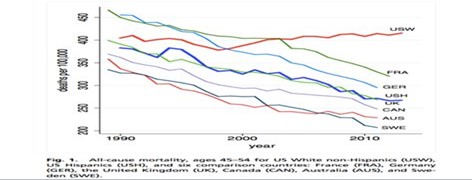
The result for working Americans of Republicans’ repeated attempts to repeal Obama that I wrote about then is shown in the above graph. It compares the soaring death rates of 45-54 white American males with other developed countries (red USW line). Obamacare is the only American universal healthcare plan that covers workers with pre-existing conditions if no employer healthcare, and yet Republicans can be expected to again attempt to replace it with a “concept” in Trump’s words.

Americans had just avoided another health care disaster in voting down the Senate’s ‘skinny’ Obamacare Repeal and Replace bill in 2017. Even though maintaining most of the taxes to pay for the Medicaid portion, it would have made insurance coverage prohibitively expensive for those older and sicker users with the removal of the private and employer mandate requirements that would cause younger and healthier people to leave the insurance markets.

This is just the latest precipice that’s been avoided. Americans already have the worst health outcomes in the developed world, precisely because America is the only developed country—in fact, even of undeveloped countries—that doesn’t have universal coverage.

The result is one of the highest birth death rates, as well as diabetes, heart and other infectious disease rates—which are diseases usually associated with poorer, undeveloped countries.

The last time Republicans swept the presidential election in 2017, it was the very white, male Tea Party reacting to our first Black President. But they didn’t replace it with something new. They went back to their base of wealthy Oligarchs formed during the Reagan era, still fighting labor unions and resisting more social programs to help the less fortunate, as Trump’s MAGA nation has promised to do.

Trump’s electorate has been good at wanting to tear down the old institutions, but not good at replacing them with a newer, better system. And if Elon Musk becomes the efficiency czar in Trump’s new administration, and he continues to brag he can cut $2 trillion in waste from the federal budget, we know social programs and maybe much more will suffer in the name of reducing the national debt.

There is another, better way to replace what hasn’t worked for working Americans; but that must be based on science and new technologies that can come from our educated elite (rather than our political and wealthy elite).

If Republicans want to be part of that future, they can’t follow a con artist who doesn’t’ believe in the future, only the past.

Harlan Green © 2024

Follow Harlan Green on Twitter: https://twitter.com/HarlanGreen
Posted in Consumers, COVID-19, Economy, Politics | Tagged , , , , , , , , , , , , | Leave a comment

Bidenomics Works–Part II

Popular Economics Weekly

Calculated Risk

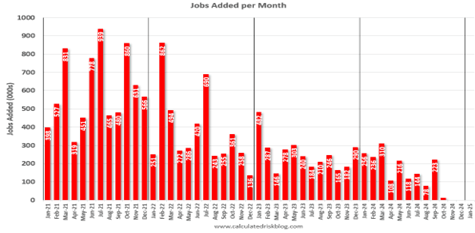
September’s unemployment rate remained at 4.1 percent but reported just 12,000 new payroll jobs due to the hurricanes and Boeing aircraft strike of 30,000 machinists.

Total nonfarm payroll employment was essentially unchanged in October (+12,000), following an average monthly gain of 194,000 over the prior 12 months, said the BLS. In October, employment continued to trend up in health care and government. Temporary help services lost jobs. Employment declined in manufacturing due to strike activity.

That makes it a sure thing the Fed will continue to lower short-term rates at their November FOMC meeting. Also that economic growth will continue into the new year.

Health care added 52,000 jobs in October, in line with the average monthly gain of 58,000 over the prior 12 months. Governments added 40,000 jobs but manufacturing lost 46,000 jobs, which is probably because of the Boeing strike.

Calculated Risk’s graph shows us just how good President Biden’s Bidenomics policies have been. More than 16 million jobs have been created since January 2021 as we returned to work from the brief COVID-19 pandemic shutdown.

But with the Presidential election upon us, our future prosperity is still in doubt. We should take Elon Musk at his word when he said at the Madison Garden rally that he would cut at least $2 trillion from the federal budget if Trump wins, and he is appointed efficiency czar. It would lead to economic disaster, even for his Billionaire supporters.

After all, it is mathematically impossible to cut taxes for corporations and billionaires, sustain basic programs like defense and Social Security, and lower the deficit simultaneously,” said Nobel Laureate Joseph Stiglitz in Project-Syndicate.

And we should believe what Trump says, according to Mary Trump, his niece, as Trump becomes more irrational, threatening anyone he now perceives as his enemy, including Taylor Swift, so that her boyfriend Kansas City footballer Travis Kelce has told him not to mess with his girl!

“Donald Trump is offering a vision of crony rentier capitalism that has enticed many captains of industry and finance. In catering to their wishes for more tax cuts and less regulation, he would make most Americans’ lives poorer, harder, and shorter,” said Stiglitz.

Timothy Snyder in the introduction of On Freedom, the sequel to his best-selling On Tyranny, tells us why we have a sociopath bordering on psychopathy as the Republican Party candidate for President of the United States of America.

“Deep into a century that was the stuff of dreams in the 1970s, and the subject of confident predictions in the 1990s, we find ourselves at a turning point. Whether we will be free will depend on us—not just on what we do, but on why we do it: our ideals.”

It’s a sad commentary that one of our political parties chose a leader that wants to tear down those institutions that have preserved our democracy; even attack the Capital on January 6 to overturn the 2020 election.

Harlan Green © 2024

Follow Harlan Green on Twitter: https://twitter.com/HarlanGreen
Posted in Consumers, COVID-19, Economy, Keynesian economics, Politics, Weekly Financial News | Tagged , , , , , , , , , , | Leave a comment

The Harris Presidency

ANSWERING KENNEDY’S CALL

What would it mean for Kamala Harris to be our first female President? It’s a historical turning point that will affirm women have finally attained equal political rights to men, and American citizens confirm they want greater personal rights—to expanded health care, abortion, and environment protection that has been held back by a dominant male culture until now.

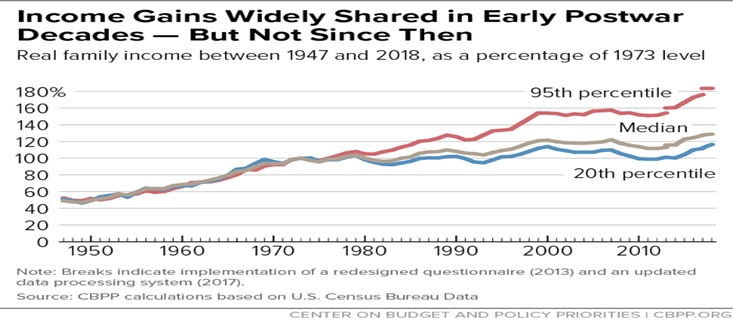
Should Harris and the Democrats win it would also signal the end of the Second Gilded Age, an age characterized by record income inequality that began in earnest when President Ronald Reagan’s supply-side economic policies began to transfer massive amounts of wealth from working adults (small business and salaried) to the owners of wealth (capital assets) in the 1980s.

cbpp.org

It would give President-Elect Harris a mandate to begin to reverse the tax structures that were the major cause of the record inequality by raising corporate and personal tax rates back to Reagan-era levels, and thus begin to reduce the massive budget deficits that resulted.

President Reagan and Republicans cut the maximum personal tax rate for the wealthiest from 50 percent to 28 percent and reduced corporate taxes from 34 to 28 percent to initiate what economists call the Second Gilded Age, which resulted in our first massive deficit–$400 billion—by the end of his administration.

The massive deficits continued to grow under successive Republican administration tax cuts that resulted in curtailing our social safety net. GW Bush’s deficit grew to $1 trillion, and the Trump administration’s to more than $5 trillion.

A Harris Presidency could also mean an end to our ongoing civil war, a war originally between the industrial North vs. slave-holding South that never really ended with General Lee’s surrender at the Appomattox Courthouse in 1865.

Though slave-owning was banned with the Emancipation Proclamation and Abraham Lincoln’s north winning the civil war, southern states found ways to continue to impoverish former slaves by terrorizing them under Jim Crow laws that even the civil rights acts of the 1960s couldn’t completely eradicate.

Today’s manifestation of our civil war has morphed into a battle between red states controlled by Republicans with a white male/Oligarchic culture continuing to impoverish their own citizens vs. more prosperous blue states with a dominant female/minority majority.

Kamala Harris has promised in her platform and speeches that she would be a President for all Americans. That would mean policies benefiting red state citizens as well, such as raising the federal minimum wage from $7.25 that was last raised in 2009.

Currently 14 states haven’t raised their minimum wage since then, or at all. Five red states have not even adopted a state minimum wage: Alabama, Louisiana, Mississippi, South Carolina and Tennessee. Two states, Georgia and Wyoming, have a minimum wage below $7.25 per hour, so that in all seven of these states, the federal minimum wage guarantees at least a $7.25 per hour wage. New Hampshire and Pennsylvania are the only blue states still with the federal minimum wage.

There are other ways the red states have kept workers’ salaries lower that Harris should remedy: lobby to repeal so-called right-to-work laws in 26 states that say members of a union aren’t required to pay union dues even though they enjoy the benefits. The result is that membership in unions has declined, along with workers’ rights to bargain collectively. And those 26 states now have a Supreme Court majority to enforce those state laws.

Democratic majorities have always found ways to benefit more Americans since the New Deal. President Obama was able to pass Obamacare, or the Affordable Care Act, the first universal health insurance that meant insurance companies couldn’t ban clients with existing conditions.

Climate change has become a clear and present danger causing more hurricanes, floods, wildfires threatening Americans that Donald Trump has called a hoax, and would rather “Drill baby drill” for more fossil fuels.

The Biden administration has already begun work on reducing global warming with the Inflation Reduction Act subsidizing alternative energy sources that don’t increase global warming but that the Republican Party vociferously opposes to protect its fossil fuel constituents.

We have lived through a Gilded Age before. The first Gilded Age came in the late 1800s, when the Industrial Revolution made Robber Barons such as railroad titan Cornelius Vanderbilt, banking titan JP Morgan, and Standard Oil’s John D Rockefeller the richest men in their time.

It ended with the death of President William McKinley in 1901, and revelations of rampant corruption followed by Teddy Roosevelt’s Progressive Party and Franklin Roosevelt’s New Deal that created government institutions such as the Federal Reserve to regulate banking and social security, as well as empowering labor unions to level the playing field for workers.

If elected, Kamala Harris and Democrats should be able to continue the new New Deal legislation that President Biden’s Bidenomics’ policies have initiated with more than $5 trillion invested in keeping America great and creating 16 million jobs that have benefited all of our citizens, not just Oligarchs such an Elon Musk.

Musk warned, after all, what would happen if he became the efficiency czar Trump says he wants him to be and cuts $2 trillion from the $6.75 trillion federal budget. There would be no money left for social programs, the military, and drastic cuts in social security and Medicare benefits, say economists such as Nobel Laureate Paul Krugman.

It would also mean Husband Doug Emhoff would become the first, First Gentleman, which wouldn’t diminish the historical record of great First Ladies. Men should take heart that women have equaled men in all ways, not just in intelligence and courage, but have shown a heart large enough to create a United States, not a Divided States of America, when Kamala Harris becomes our new President.

Harlan Green © 2024

Follow Harlan Green on Twitter: https://twitter.com/HarlanGreen
Posted in Politics | Tagged , , , , , , , , , , , | Leave a comment

Another ‘Roaring Twenties’?

Financial FAQs

BEA.gov

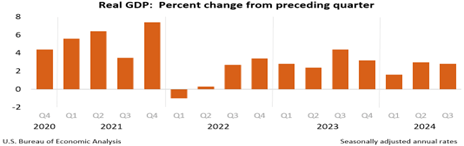
The advance estimate of BEA third quarter U.S. economic growth was 2.8 percent, slightly less than the 3 percent growth in Q2 but is showing few signs the post-pandemic recovery has slowed. It has defied the odds of a Federal Reserve engineered slowdown that made the cost of borrowing higher, jacking up the Prime Rate to an 8.5 percent high.

The manufacturing sector slowed down, but not overall economic growth because consumers kept spending on consumer goods, dining out, travel and other leisure activities.

This has all the signs of another Roaring ‘20s that occurred after the Spanish Flu pandemic in the 1920s. I don’t mean it literally, of course, because the first Roaring Twenties of jazz and the Flapper era for women occurred after World War I. Yet the recovery from WWI and the Spanish Flu pandemic that killed an estimated 650,000 Americans also unleashed a spending and investment spree that is also happening after the COVID-19 pandemic.

I’m using the analogy because this Roaring 2020s could also last a decade due to the pent-up demand from government spending that is seeding so much private investment, with the U.S. economy still fully employed and infrastructure and technology investments just beginning to kick in

Consumer spending surged 3.7 percent, and domestic investment grew 11 percent in the Bureau of Economic Analysis (BEA) report. This was mainly because consumer spending was holding up for the holidays and they were still saving. The personal savings rate is holding at 4.8 percent.

Inflation also continues to decline. The price index for gross domestic purchases increased 1.8 percent in the third quarter, compared with an increase of 2.4 percent in the second quarter (table 4). The personal consumption expenditures (PCE) price index increased 1.5 percent, compared with an increase of 2.5 percent. Excluding food and energy prices, the PCE price index increased 2.2 percent, compared with an increase of 2.8 percent.

Now that inflation is back to the Fed’s target rate of 2 percent range, Fed officials can concentrate on continuing to bring down their short-term Fed Funds rate, which will bring down the Prime Rate further, causing consumers to be even more confident about their future.

That is why, “Consumer confidence recorded the strongest monthly gain since March 2021, but still did not break free of the narrow range that has prevailed over the past two years,” said Dana M. Peterson, Chief Economist at The Conference Board.

“In October’s reading, all five components of the Index improved. Consumers’ assessments of current business conditions turned positive. Views on the current availability of jobs rebounded after several months of weakness, potentially reflecting better labor market data. Compared to last month, consumers were substantially more optimistic about future business conditions and remained positive about future income,” said Peterson.

ConferenceBoard

Much will depend on Friday’s official U.S. unemployment report but the independent ADP’s private-sector jobs report showed businesses added 233,000 new jobs in October, the biggest gain in 15 months. The report is not as accurate as the government’s nonfarm payrolls report, which comes out on Friday.

The Trade/Transportation, Education/Health sectors added 104,000 jobs, construction added 37,000 jobs (infrastructure), while manufacturing lost 19,000 jobs in the ADP report.

One historian wrote that after the devastation of World War I and the Spanish Flu pandemic, “Incredibly, the dire post-war economic predictions didn’t come true. At least not immediately. American consumers, who had patriotically scrimped and saved during wartime, began to live it up. Europeans also joined in, purchasing $8 billion in exports from America. Inflation ticked upward, and so did prices, but consumers were willing to pay anything for a taste of freedom.”

Sound familiar? Only this time the Fed’s inflation fight didn’t cause a recession, on the contrary—at least not yet. It’s a good place to be, just in case there might be other surprises in the future.

Harlan Green © 2024

Follow Harlan Green on Twitter: https://twitter.com/HarlanGreen

Posted in Consumers, COVID-19, Economy, Weekly Financial News | Tagged , , , , , , , , , , , | Leave a comment

Why Does Bidenomics Work?

Financial FAQs

FREDrealgdp

Elon Musk told a cheering crowd at Sunday’s MAGA rally in New York that if Donald Trump puts him in charge of government efficiency, as planned, he can cut “at least $2 trillion” from the current federal budget.

This would cause an almost immediate recession. Such is the blindness of the world’s richest Oligarch, who has made no bones about his dislike of government regulations and taxes in the way of his dream of reaching Mars.

MarketWatch’s Brent Arends tells us what would happen. “Either Donald Trump and Elon Musk are planning to cut 85% of all spending on highways, disaster relief, federal bank-deposit insurance and the departments of Agriculture, Homeland Security and Justice; close all U.S. embassies; and abolish the Environmental Protection Agency, the Small Business Administration, NASA and nearly all welfare, income-support, food-stamp and childhood-nutrition programs.”

“Or, they are planning on cutting Social Security and Medicare — despite Donald Trump’s protests to the contrary,” said Arends

That is what is behind Republicans’ dislike of Democrats economic policies since President Biden’s election that has created more than 15 million jobs and 3 percent economic growth as we recovered from the COVID-19 pandemic.

It takes government investments to spur private investments; not just in new technologies (the CHIPS Act) but healthcare and the environment (Inflation Reduction Act), and in modernizing our infrastructure (Infrastructure Act) so that Americans will feel more secure from hurricanes and illness and therefore produce more.

That is the real definition of efficiency, not cutting benefits so that Billionaires can keep more of their wealth.

President Obama was the first to turn the tide on President Reagan’s 40- years of trickle-down economic policies that had transferred $50 trillion in wealth from working Americans to the owners of capital living off their corporate profits, according to a RAND Corporation working paper.

He did it by creating Obamacare (the Affordable Care Act) and making government the protector of people, not of profits, as Republicans had done. This resulted in economic growth accelerating to 4 percent during the Obama years continuing into Trump’s years, even with a Republican-engineered shutdown. It was the longest economic recovery since World War Two, and the reason Trump could brag that growth has been so good just prior to COVID-19.

The economy unfortunately shrank -7.5 percent in 2020 as businesses shut down due to the pandemic. It roared back to life in the second quarter of 2021 as congress acted quickly to put money back into Americans’ pockets.

In fact, the U.S. economy will continue to provide most of the thrust for global growth through the balance of this year and in 2025, led by robust consumer spending “that has held up through a wrenching bout of inflation and the high interest rates used to tame it,” the International Monetary Fund said on Tuesday.

Such economic policies requiring government investments have worked before. It was Roosevelt’s New Deal that employed more than 8 million people, built 650,00 miles of roads, 120,000 bridges, created the minimum age, 8-hour workdays and started up social security.

Now more than half of the living US recipients of the Nobel Prize for economics signed a letter that called Vice President Kamala Harris’ economic agenda “vastly superior” to the plans laid out by former President Donald Trump.

“While each of us has different views on the particulars of various economic policies, we believe that, overall, Harris’ economic agenda will improve our nation’s health, investment, sustainability, resilience, employment opportunities, and fairness and be vastly superior to the counterproductive economic agenda of Donald Trump,” the economists write in the letter obtained by CNN.

Top this off consumers are now joining the Harris economic bandwagon. The Conference Board’s latest consumer confidence survey surged to 108.7 in October from a revised 99.2 reading in the prior month, the Conference Board said Tuesday.  This is highest level of confidence since January.

“Consumer confidence recorded the strongest monthly gain since March 2021, but still did not break free of the narrow range that has prevailed over the past two years,” said Dana M. Peterson, Chief Economist at The Conference Board. “In October’s reading, all five components of the Index improved. Consumers’ assessments of current business conditions turned positive. Views on the current availability of jobs rebounded after several months of weakness, potentially reflecting better labor market data.” 

Is Bidenomics finally catching on with ordinary Americans, not just economists?

Harlan Green © 2024

Follow Harlan Green on Twitter: https://twitter.com/HarlanGreen

Posted in Consumers, COVID-19, Economy, Politics, Weekly Financial News | Tagged , , , , , , , , | Leave a comment