Why Another Gilded Age?

Financial FAQs

“I remember ’29 very well … the drugged and happy faces of people who built paper fortunes on stocks they couldn’t possibly have paid for. … In our little town bank presidents and track workers rushed to pay phones to call brokers. Everyone was a broker, more or less. At lunch hour, store clerks and stenographers munched sandwiches while they watched stock boards and calculated their pyramiding fortunes. Their eyes had the look you see around a roulette wheel …but despondency, not prosperity was just around the corner.”—John Steinbeck

Graph: Last Tech Age

This is what happened in the 1920s that led to the Great Depression and Roosevelt’s New Deal.

Marriner Eccles, Rooselvelt’s New Deal Federal Reserve Chairman was one of the first to characterize the cause of the Great Depression, when he said in testimony before congress that it was the record income inequality of that time:

The United States economy is like a poker game where the chips have become concentrated in fewer and fewer hands, and where the other fellows can stay in the game only by borrowing. When their credit runs out the game will stop—Mariner Eccles, Federal Reserve Chairman during the Great Depression.”

The current Gilded Age began in earnest with the election of President Ronald Reagan and his credo that “government is the problem.” It has resulted in the huge transfer of wealth from workers to the owners of capital—as much as $1trillion, according to some economists—by cutting their taxes and deregulation of whole industries.

Laws were also enacted to weaken labor unions and monoply laws were not enforced so that corporations could transfer their factories overseas where labor was cheaper, basically gutting America’s middle class industrial base that has been the cause of so much anger and despair of America’s workers.

The U.S. is in 106th place of the 149 countries in income inequality as ranked by the CIA’s World Factbook; with a Gini inequality index of developing countries like Peru and Cameroon. Whereas Finland and the Scandinavian countries are at the top of equality rankings, Germany and France are 12th and 20th, respectively, as I’ve highlighted in past columns. The higher the index, the greater the gap between wealthy and poorer citizens of a country’s population.

It’s had to believe that we have reached that point once again, a time when today’s wealthiest exceed the wealth of the Vanderbilt’s, Rockefeller’s and Morgan’s tenfold that built those massive 5th Avenue mansions at the turn of the 20th Century to show off their wealth, before there was an income tax or Federal Reserve.

It was spawned by an economy fueled by oil, railroads, and a banking system that enabled so many consumers to go into debt, until the stock market crashed on Black Friday of 1929.

History is repeating itself with $Trillioners instead of the $Billionaires (and $Millionaires) of that era because of Sillicon Valley and the Internet that have made an Elon Musk, now the richest person in the world.

But it is at the cost of a greater concentration of wealth than ever. Today’s moguls duplicate the 20th Century robber barons in wanting to share as little of their wealth as possible—instead, they use their wealth to elect conservative policies that lower tax rates and cut government benefits that protect the other 99 percent of Americans.

Is President Biden’s Bidenomics’s spending of $trillions to modernize America’s industrial base, infrastructure, and mitigate disasters caused by a changing climate the last gasp of Roosevelt’s New Deal programs that protect ordinary Americans?

The incoming Trump administration has tasked the richest man in the world to set up a “Department of Government Efficiency”, they say, to downsize or eliminate some of those programs to eliminate waste, but really to shrink or eliminate the health and safety programs; such as the US Environmental Protection Agency, Health and Education department, and even shrink the IRS once again to enable the $Trillionaires to better evade taxes.

Trump is clear about his intentions. He intends to pick a cabinet based on their loyalty to him as he did in his first term. Many have no qualifications; most were lobbyists with blatant conflicts of interest which resulted in many having to resign when their corruption was uncovered.

Such dysfunctional behavoir was a reason President Trump lost the House of Represetatives to Nancy Pelosi and the Democrats in 2018, and Trump lost to President Biden in 2020.

Sadly, the incoming all-Republican congress will probably give him the tax cuts, inflationary tariffs and the mass deportation of undocumented immigrants that will also be a repeat of Trump’s first term.

And many in the working class who voted for him will suffer again, and as they have throughout Trump’s working life; thanks in large part to the Elon Musk’s of the world that don’t believe in sharing their wealth.

Harlan Green © 2024

Follow Harlan Green on Twitter: https://twitter.com/HarlanGreen

Posted in Consumers, COVID-19, Economy, Keynesian economics, Politics, Weekly Financial News | Tagged , , , , , , , , , , , , , | Leave a comment

Job Market Still Booming

Popular Economics Weekly

Total nonfarm payroll employment rose by 227,000 in November, and the unemployment rate changed little at 4.2 percent, the U.S. Bureau of Labor Statisticsreported today. Employment trended up in health care, leisure and hospitality, government, and social assistance. Retail trade lost jobs.

FREDunemploymentrate

It looks like the American economy that so many voters thought was not working for them has now brought the unemployment rate down to 4.2 percent from its 14.8 percent high in April 2020 (peak of red line in graph) during the COVID-19 pandemic.

This is despite the labor strikes by Boeing employees, East Coast dockworkers, railroad workers and several hurricanes that devastated parts of the south.

President Biden touted the results in the next to last unemployment report of his administration. It took much longer to get there after the Great Recession (large gray bar) in the FRED graph dating from 2010 that included the Obama and first Trump administrations.

“America’s comeback continues,” he said in a statement. “Today’s report shows that the economy created 227,000 jobs in November, as Boeing machinists returned to work with record wage gains and hurricane recovery continued. Unemployment of 4.2% is in the same low range of the past seven months. This has been a hard-fought recovery, but we are making progress for working families.”

Hurricanes Milton and Helene prevented more than a half million people from going to work in October, said MarketWatch’s Jeffry Bartash, but most of them were back on the job last month. The number of people who said they could not work because of bad weather in November fell to just 62,000 from 512,000 in the prior month.

Almost all sectors showed job increases: Education/Health +79,000, Leisure/hospitality +53,000, Government +33,000, and manufacturing + 22,000 in payroll jobs.

This could not have happened without the various policies enacted over the past four years of the Biden Administration when more than 15 million jobs were created that brought the American economy out of the COVID-19 pandemic, the worst natural disaster in more than 100 years.

The truth is that it could have been much worse if the pandemic recovery hadn’t been a public/private collaboration. The $5 trillion in the various Bidenomics’ legislation enacted by a bipartisan congress put those investments into productive enterprises, such as modernizing our infrastructure and manufacturing base, as well as mitigating the results of global warming by investing in alternative energies like solar, EVs and wind generation.

Many Americans have suffered horrendously from the hurricanes and record number of tornadoes that have devastated parts of the south and Midwest. Climate change has not proven to be a ‘hoax’, so I am hopeful that the upcoming Republican administration in their drive for more efficiency will not eliminate those programs that have helped these regions to recover. Many of the worst-hit areas are in Republican-run red states.

All eyes are now riveted on whether the Federal Reserve will drop interest rates another 0.25 percent in its December FOMC meeting, which will boost growth further.

Prominent economist Mohamed El-Erian has described today’s jobs release as “a somewhat strong report, but not consistently strong,” adding that it should pave the way for an interest-rate cut by the Federal Reserve later this month.

“It is strong on the earnings side. It is strong on the labor participation coming down side — less supply — and is also strong on a small beat,” he told Bloomberg TV. “But the fact that the unemployment rate went up means that the Fed will be comfortable cutting by 25 basis points, means that the market will increase the probability of this happening. So on the policy front, this did not complicate what would have been a messy situation.”

I am also hopeful after COVID-19 that the next administration will know enough not to cut too much meat off the government’s bone that’s managing our healthcare system when another natural disaster might loom, such as a bird-flu pandemic that scientists are now saying is a possibility.

Harlan Green © 2024

Follow Harlan Green on Twitter: https://twitter.com/HarlanGreen
Posted in Consumers, COVID-19, Economy, Politics, Weekly Financial News | Tagged , , , , , , , , | Leave a comment

Will Job Market Recover?

The Mortgage Corner

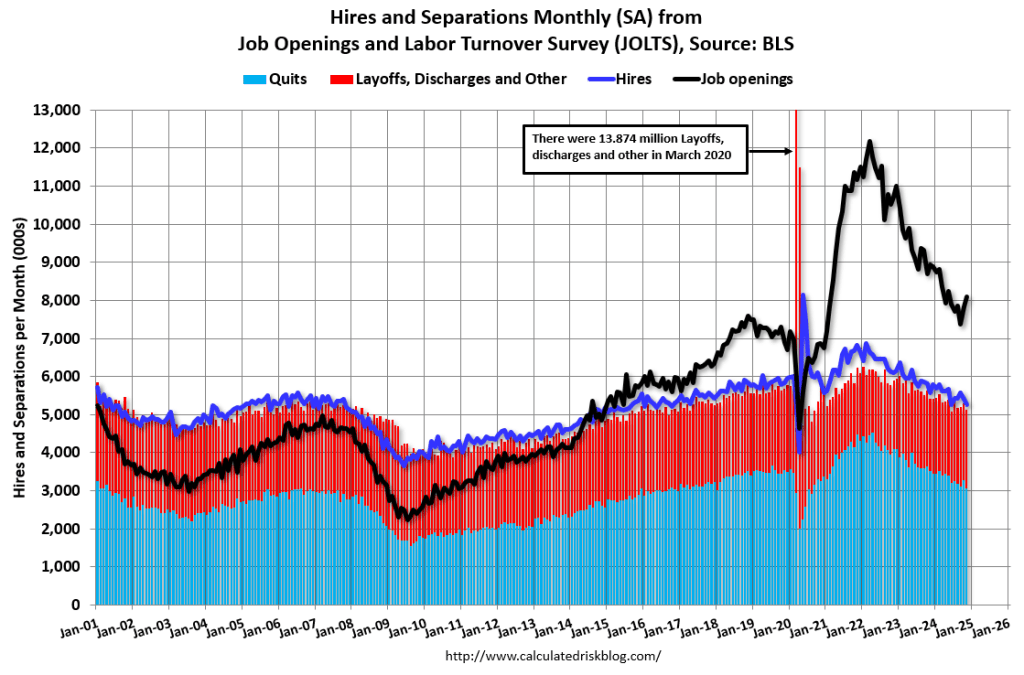
The number of job openings was little changed at 7.7 million on the last business day of October, the U.S. Bureau of Labor Statistics reported today. Over the month, hires changed little at 5.3 million. The number of total separations was little changed at 5.3 million. Within separations, quits (3.3 million) increased, but layoffs and discharges (1.6 million) changed little.

Calculated Risk

The above graph of job openings (black line), hires (dark blue), Layoff, Discharges and other (red column), and Quits (light blue column) from the JOLTS report show normal job growth, according to the Bureau of Labor Statistics. But will it recover from the Boeing and east coast strikes that laid off so many workers?

The JOLTS report doesn’t give much encouragement to Friday’s unemployment report for November, as the number of hires equaled the number of separations. The difference usually tells us the total number of job creations.

It’s hard to know what this means for the Trump administration’s next four years. Chairman Powell is still sounding dovish about another -0.25 percent rate cut in December, which will be helpful. But credit card rates are still as high as 30 percent, which is an insane borrowing rate for those using credit cards.

“The Fed’s goal all along has been to bring down inflation without a “painful rise in unemployment,” Powell said in remarks at the annual meeting of the National Association for Business Economics in Nashville,” per MarketWatch. “While the task is not complete, we have made a good deal of progress toward that outcome,” he said.

The Institute for Supply Management (ISM) surveys of both the service and manufacturing sectors were also static, with manufacturing not expanding at all and the service sector barely above its 50-point breakeven level.

Demand remains weak, said Timothy R. Fiore, CPSM, C.P.M., Chair of the Institute for Supply Management® (ISM®),as companies prepare plans for 2025 with the benefit of the election cycle ending. Production execution eased in November, consistent with demand sluggishness and weak backlogs. Suppliers continue to have capacity, with lead times improving but some product shortages reappearing. Sixty-six percent of manufacturing gross domestic product (GDP) contracted in November, up from 63 percent in October.”

This is what happens between election cycles. Will the Trump administration carry out on its threats of giant tariffs, or deporting millions of undocumented immigrants who are employed in the service sector that includes professional services and construction? Construction is booming as the CHIPS and Infrastructure Acts pour $Trillions into mostly red state projects such as new computer chip manufacturing factories.

The service sector that also includes leisure activities such as dining and travel will wind down after the holidays. But the financial markets are still rallying on the hopes that further tax cuts will boost both bond and stock prices.

It’s a difficult time to predict what comes next. Further Fed rate cuts are desperately needed to revive the housing market, for instance.

Pending home sales ascended in October – the third consecutive month of increases – according to the National Association of REALTORS®. All four major U.S. regions experienced month-over-month gains in transactions, with the Northeast leading the way. Year-over-year, contract signings increased in all four U.S. regions, led by the West.

“Homebuying momentum is building after nearly two years of suppressed home sales.” said NAR Chief Economist Lawrence Yun. “Even with mortgage rates modestly rising despite the Federal Reserve’s decision to cut the short-term interbank lending rate in September, continuous job additions and more housing inventory are bringing more consumers to the market.”

That gives homebuyers a ray of hope that interest rates will continue to decline, as well as for credit card users.

Harlan Green © 2024

Follow Harlan Green on Twitter: https://twitter.com/HarlanGreen

Posted in Consumers, COVID-19, Economy, Housing, housing market, Weekly Financial News | Tagged , , , , | 1 Comment

Trumponomics 2.0–What To Expect?

Financial FAQs

George Will, the conservative pundit, gave the best description of Trump’s incoherence in a Washington Post Op-ed: “It is urgent for Americans to think and speak clearly about President Trump’s inability to do either. This seems to be not a mere disinclination but a disability. It is not merely result of intellectual sloth but of an untrained mind bereft of information and married to stratospheric self-confidence.”

This was a leading conservative writer’s prediction of what did happen in President Trump’s first term as President—chaos. Trump’s second term should be a rerun if he succeeds in getting most of his initial cabinet picks confirmed by (or rammed through) the U.S. Senate.

Huffington Post

Many have no qualifications for those jobs, just as in Trump’s first term when most were lobbyists with blatant conflicts of interest, which resulted in many having to resign when their corruption was uncovered. Such dysfunctional behavior was a reason President Trump lost the House of Representatives to Nancy Pelosi and the Democrats in 2018, and Trump lost to President Biden in 2020.

Sadly, the incoming all-Republican congress will probably give him the tax cuts, inflationary tariffs and the mass deportation of undocumented immigrants that will be a repeat of Trump’s first term. And many in the working class who voted for him will suffer again, and as they have throughout Trump’s working life.

A 2016 USA TODAY article catalogued more than 3,500 lawsuits filed by or against Donald Trump over his business career. Many were filed by small businesspeople and firms that Trump refused to pay for work done on his various real estate holdings.

“Donald Trump often portrays himself as a savior of the working class who will “protect your job.” But the USA TODAY NETWORK analysis found he has been involved in more than 3,500 lawsuits over the past three decades — and a large number of those involve ordinary Americans, like the Friels, who say Trump, or his companies have refused to pay them.”

The Friel’s family cabinetry business, founded in the 1940s by Edward’s father, finished its work in 1984 and submitted its final bill to the general contractor for the Trump Organization, the resort’s builder, said USA TODAY.

Edward’s son, Paul, who was the firm’s accountant, still remembers the amount of that bill more than 30 years later: $83,600. The reason: the money never came. “That began the demise of the Edward J. Friel Company… which has been around since my grandfather,” he said.

I wrote then, “The greatest nightmare of 2017 may be the record income inequity that was exemplified in the just-passed tax cuts that are to be paid for with up to $3 trillion in added federal debt plus spending cuts to Medicare and Medicaid over the next ten years, which will impoverish the poorest among us.

Professors Thomas Piketty and Emmanuel Saez were the first to examine 100 years of income tax returns that highlighted the wide swings in income inequality. They found that income inequality rose substantially between 1979 and 2002 because the top 10 percent of the income distribution took 91 percent of the income growth during that period. As the real incomes of the top 10 percent soared, the incomes of the bottom 90 percent stagnated..

With nothing to replace the economic destruction that will follow Trump’s policies, other than the “Drill baby Drill” for more fossil fuels, we will be poorer with predictions for an additional $5 trillion added to the national debt. As in his first term, I do not foresee a happy two years ahead, at the least.

It turns out very few of us need a tax cut. MarketWatch economist Rex Nutting calculated that those in the 60 percent middle-income brackets—from $32,000 to $140,000 per year—pay just an average 2.5 percent in income taxes. It’s only the richest 0.1 to 1 percent income earners that pay more, and so want the huge tax cuts congress and the Trump administration are proposing.

“A bill that cuts federal income taxes for middle-class families makes absolutely no sense, except as a sad way of camouflaging the real intent of the bill: Giving millions of dollars to the very wealthy, who happen to be the only people who are really benefiting from our uneven economic growth,” said Nutting.

It was Trump and his family that profited most from his first term in retaining ownership of his assets rather than either divesting or putting them in a blind trust, blatantly ignoring the emoluments clause of the constitution that forbid profiting from foreign governments seeking his favor.

Donald Trump suffered no consequences for his lawless behavior as has former Brazilian President Jair Bolsonaro, who is banned from running again until 2030 for casting doubt on Brazil’s 2022 election outcome that voted him out of office.

The greatest chaos may come from his pick of Pam Bondi for Attorney General, who is replacing Matt Gaetz. She has sworn revenge for perceived weaponization of the Justice Department by weaponizing it even more to persecute his perceived enemies.

“When will the 2017 nightmare end?” I wrote in 2017. “Maybe in 2018, if most Americans realize the fantasy world the current administration and congress has created is not theirs. Americans desire a world in which life, liberty and the pursuit of happiness is available to all, not just the few.”

That is what happened in Trump’s first term. Must it get even worse before it gets better?

Harlan Green © 2024

Follow Harlan Green on Twitter: https://twitter.com/HarlanGreen
Posted in Consumers, COVID-19, Economy, Politics, Weekly Financial News | Tagged , , , , , , , , | Leave a comment

How Do We Fix Inflation?

Financial FAQs

I said last week that: “Many of us remember when a gallon of gas was less the $2, or a quart of milk less than $1, or housing was last affordable in the 1970s. I remember the inflation surges in housing. What happened?”

So, shouldn’t we as voters be able understand how to fix inflation surges such as we just experienced with the COVID-19 pandemic? That didn’t happened on November 5. Trump was able to convince most of his voters to blame someone rather than learn what needed to be done, and had already been done, to cure the problem.

It is now doubly important because if Trump raises tariffs and begins to deport undocumented workers on ‘Day One’ of his presidency as promised, inflation will soar again and the U.S. economy will quickly go into a tail spin.

Why couldn’t Trump voters see this? Their anger was fostered by an out of control social media catering to their own interest groups by elevating conspiracy theories and denigating scientific facts to keep their audience rather than what is good for most Americans and the American economy.

It has always been difficult to pierce the fog of propaganda and obfuscation that has dogged anything related to our economy because the U.S. economy is the most complex in the world with its competing mix of private and public enterprise needed to to make it work.

FREDcpi

The retail Consumer Price Index (CPI) in the FRED graph above dating from 1980 is the eaiest way to understand why we had high inflation spikes and how long it took for it to return to normal.

Simply put, the spikes that hurt most Americans were due to supply shortages mostly out of our control. The 1980 spike was mainly because of an oil shortage that took a decade to reverse. In 2022 the other high spike was the COVID-19 pandemic that shut down supply chains and took approximately three years to recover.

It didn’t matter which political party was in charge—Republicans in 1980 and Democrats in 2022. Both parties had the tools to mitigate the inflation surges that took some time, as I said.

How were they solved? Both political parties used their financial institutions, mainly the Federal Reserve and Treasury Department, and did not disparage them as Trump’s MAGA supporters do as a matter of policy. Because they control the flow of money—regulating whether there is too much (inflationary) or too little (deflationary) money is in circulation to counter the supply disruptions.

But playing the blame game that has enraged so many working class voters doesn’t solve the inflation problem, though it did win enough workers to the Republican side. They now must prove they actually know something about its causes.

What will hinter any good faith effort to tame inflation is the maldistribution of the money supply. Too much of it is in too few hands, a hallmark of what has been called the second Gilded Age that has favored the wealthiest since the 1970s, and not ordinary workers dmaged most by higher inflation whose household incomes have stagnated since then.

We have working solutions to the inflation that has plagued the American economy for decades. But deporting undocumented workers and raising tariffs will raise inflation, since tariffs are a tax on imports, and fewer immigrants form the backbone of the supply sector (restaurants, transportation, retail, construction) that has been the backbone of this recovery. It will cause a labor shortage, which means fewer goods and services will be produced, thus raising the price of things, as well.

This is the most basic of Econ 101 priinciples, but Trump was able to fool his voters because there is a general ignorance of economic principles.

And our capitalist system hasn’t been helping the working class since the 1970s, as I’ve said in past columns. The increasing income inequality created an almost unstoppable anger that grew after decades of income loss for working class voters as more and more wealth was shunted upward creating ever larger budget deficits.

If we are able to reverse the income inequality with more progressive taxation policies that pay for a better social benefits, for instance, we might convince more voters to realize government isn’t the problem and inflation is really governed by the common sense rule of supply and demand.

They might then not choose someone who only knows how to blame but rather vote for real economic solutions to mitigate inflation.

Once Roosevelt created the New Deal in response to the Great Depression, governments began to work for ordinary Americans—from social security to a federal minimum wage, to workers rights. Only such a private-public partnership will help to cure our inflation problem.

Harlan Green © 2024

Follow Harlan Green on Twitter: https://twitter.com/HarlanGreen
Posted in Consumers, COVID-19, Economy, Keynesian economics, Politics, Weekly Financial News | Tagged , , , , , , | Leave a comment

Why the Inflation Problem?

Financial FAQs

Most of us remember when a gallon of gas was less the $2, or a quart of milk less than $1, or housing was last affordable in the 1970s. I remember the inflation surges in housing. What happened?

Shouldn’t we as voters understand inflation if a majority of voters were so angry about the soaring price of everything that the majority would find somebody to blame (President Biden), and elect somebody else (Donald Trump) who said he will make everything better, even though that didn’t happen during his first term?

It is a peculiar form of American amnesia that caused so many to vote against their own interests—in this case a majority of white women to vote for a sexual predator and abortion opponent, young working class males to support a con-artist who had stiffed or defrauded his own workers and filed bankruptcy multiple times to avoid paying them.

It could be because everything is happening too fast in our high-Tech driven economy and social media culture that has left so many people still wanting to live in a world they remember or imagine.

This happened at least once before and signaled how difficult it is for Americans to face forward rather than look backward to a time that never was, even though they crave change. It was first noticed in Thomas Frank’s 2005 best-seller:What’s the Matter With Kansas; How Conservatives Won the Heart of American?

Such nostalgia enabled GW Bush to win a second term, although he started his wars on terror by lying about weapons of mass destruction after failing to anticipate 9/11.

To understand what happened because of Trump’s false economic narrative—that Americans were better off financially in his first term—we should understand the complexity of our own economy.

The main priority of Republicans—tax cuts that Bush and Trump Republicans enacted were a giant scam that actually transferred more wealth to their supporters and imp0verished more working Americans, while adding $trillions to the national debt.

But enough Americans remembered an earlier, whiter America that had experienced a victorious, post-World War Two prosperity—until the 1970s and school integration, minorities wanting more rights (including women), the killings of the Kennedy brothers and Martin Luther King, Jr., and a Vietnam War tore our country apart.

It’s hard to imagine such a tumultuous history today several generations later.

Republicans have always favored tax cuts that enriched themselves, but not better healthcare for Americans—especially women and children.

CBPP.org

So how should voters understand the American economy? Firstly, we have been living in what has been called the second Gilded Age that has favored the wealthiest since the 1970s, and not ordinary workers whose household incomes have stagnated since then.

But most Americans probably understand it’s most basic tenet: The Law of Supply and Demand. It’s an economic term, but based on commone sense. The price of things depends on the supply of things. And when there is an abrupt shortage, such as oil and gas because of the Arab oil embargo that cut off OPEC (The Organization of Oil Exporting Countries) oil imports in the 1970s, gas prices soared. And that began the upward cycle of price fluctuations.

Meanwhile, more than 80 million baby boomers became consumers at the same time who wanted more of everything. And the housing industry couldn’t build enough dwellings to satisfy the increased demand.

This is as good a common sense explanation as any to understand inflation. Prices go up or down when they aren’t in equilibrium—i.e., too much supply lowers prices, while too much demand from consumers and businesses raises them.

The same thing happened with the COVID-19 pandemic that killed one million Americans. The worldwide shutdowns and shelter-in-place requirements to keep it from spreading caused massive shortages of everything, which caused the price hikes that infuriated so many.

Consumers couldn’t very well blame COVID-19, a virus like the flu though much more virulent, but they could blame who was supposed to protect Americans from it.

What is most remarkable is that prices had been rising rapidly since the 1970s, but Americans hadn’t reacted as angrily as they did after the COVID-19 pandemic—maybe because of the trauma from so many lives lost—whole families in some cases.

Inflation is like the frog in water that has been slowly coming to a boil. For whatever reason, we have only noticed it since the water (meaning our economy) has come to a boil from the pandemic’s aftereffects that have most hurt our working class, many of whom had lost jobs as globalization moved good paying manufacturing jobs overseas in the name of making everything cheaper.

Most of us remember when a gallon of gas was less the $2, or a quart of milk less than $1, or housing prices were last affordable in the 1970s, as I said. But there was no quick cure. The OPEC oil embargo jump-started the decade-long inflation surge in the 1970s, for instance.

What can be done to cure the current inflation surge? Republicans and Trump’s “Drill Baby Drill” promise can’t do much to lower oil prices because the U.S. already produces more oil than it uses, while adding more CO2 to the atmosphere that is accelerating global warming, that endangers whole parts of the country.

And higher proposed tariffs won’t increase the supply of anything and might lower demand, since it makes imports more expensive because it is a tax on imported goods.

There are two solutions that the Biden administration have implemented, but Republicans don’t like—federal funds to make construction of affordable housing cheaper, and the elimination of loopholes that encourage the profit-taking by cartel-size pharmaceutical corporations that took advantage of the pandemic shortages and continue to raise their prices.

And lastly, we need more comprehensive healthcare legislation that would increase productivity of our workforce because they become healthier. But Republicans have historically opposed that as well, having attempted to repeal Obamacare, the Affordable Care Act, more than 30 times. It is the only private health insurance that insures more than 30 million Americans against preexisting conditions.

Republicans are even talking about downsizing Medicaid and Medicare in the name of increasing efficiency. That will also increase inflation, because M & M keep overall costs of healthcare lower with their power to control treatment and drug prices.

So it’s difficult to know if it was ideology and conspiracy theories triumphing common sense economics that enabled Republicans to win this election.

Inflation has returned to its historic norm, and the American economy is fully employed so everyone’s job should be safe. Many voters want someone to blame for their myriad anxieties, as Kansans had done two decades earlier.

We will now have to worry if this Gilded Age will end as did the last one. So much wealth had been accumulated in too few hands that it caused the Great Depression and led to World War Two.

Harlan Green © 2024

Follow Harlan Green on Twitter: https://twitter.com/HarlanGreen

Posted in Consumers, COVID-19, Economy, Housing, Politics | Tagged , , , , , , , , , , , , | Leave a comment

Donald Trump’s Bully Mentality

ANSWERING KENNEDY’S CALL

President Trump’s first days in office were alarming for several reasons. He immediately began attacking the press, while intentionally stating falsehoods such as he would have won the popular vote, but for “3 to 5 million” fraudulent votes…Since most of those falsehoods are easily debunked, such as the size of the crowds at Friday’s Inauguration and Saturday women’s march.

Simon & Schuster

This was in 2017. Will we see a repeat of Donald Trump’s last term? It might be instructive to those 6 million Democratic voters that stayed home this election cycle to remind them why the rampant corruption of his first term and chaos at the border in 2017 when he attempted to deport 11 million undocumented immigrants, separating babies from their mothers, was why he wasn’t reelected for a second term then.

It looks like a repeat performance as he is again nominating those most loyal and most incompetent for some of his cabinet picks, such as Matt Gaetz for Attorney General, Tulsi Gabbard for Department of National Intelligence, and Robert Kennedy, Jr. for Health and Human Services.

And he will again use the same bullying tactics to attempt to get them through the Senate without background checks or security clearances. How easily Americans have forgotten that a man who has used bullying tactics his whole life to get what he wants, has highlighted his own incompetence to be POTUS again.

I have written about the bully mentality in our culture before. In times of uncertainty as we have today, it has led to increased bullying in school, and even gun violence. It is a mentality that attempts to impose a bully’s version of reality on the real world for the sole purpose of domination. President Trump has always acted the bully, which is the reason for his history of lawsuits and bankruptcies, so that facts are only useful in so much as they support his needs.

Evidence of Trump’s bullying tactics also comes from his words on social media. Groff Beattle, a professor of Psychology at Edge Hill University has reported Trump uses the body language and mannerisms of a bully, such as the exaggerated use of his hands.

Comments such as “mentally sick”, “dummy”, “looser” or “looked disgusting” are all examples of bullying language Trump uses to attempt to normalize such behavior. Trump’s bullying tactics include calling President Obama the founder of a terrorist organization and insinuating that Clinton took drugs prior to a debate. He also mocked the disability of reporter Serge Kovaleski, portrayed immigrants and foreigners as dangerous people, rapists or “criminal aliens”, and demonstrated a significant lack of respect for women or military veterans, calling wounded veterans “losers”.

How does one oppose such destructive behavior? First, we should know that bullies prey on those they can intimidate, and avoid confrontation with those stronger because of their own insecurities. Trump preyed on naïve students and the elderly in his Trump University scam. And he stiffed workers and employees when building his Trump Casinos either by paying them less than was contractually agreed to, or not at all.

Combine it with his narcissism that requires he be constantly in the limelight. So, the news media should ignore his tantrums, rather than always commenting on them. Remember that he makes such outrageous lies to gain even more attention.

Psychology Today posted a list of bullying behavior, a list that fits President Trump like a glove:

– Uncontrolled anger and unpredictable irritability, frequently directed at the weakest people (‘safe targets’) or those perceived as a future threat
– A sociopathic ability to control their own image – the selective ability to look like a different person to different audiences – for example, being aggressive to ‘subordinates’, while being charming and helpful to others
– Having little status outside of work, bullies wield the power that their job gives them with vicious zeal
– Running ‘witch-hunts’
– Gratuitous domineering behaviour – sometimes physical
– The ability to make the unreasonable seem reasonable, even to the victims
–Projecting their own inadequacies onto others
– Making irrational accusations
– Publicly putting people down
– Sadistic enjoyment in humiliating others

The list of Trump’s bullying tactics is endless, and how to counter them are well known. There is even a government website, https://www.stopbullying.gov/ to help understand what the bully mentality is all about. How sad it is that this U.S President-Elect, about to become the most powerful person on earth once again, is setting such an example of his own weakness and insecurity.

How easily Americans have forgotten his most recent past and what it could mean as he again seeks to limit our freedoms and turn our Democracy into an Autocracy.

Harlan Green © 2024

Follow Harlan Green on Twitter: https://twitter.com/HarlanGreen
Posted in Consumers, COVID-19, Economy, Politics | Tagged , , , , , , , | Leave a comment

How Much Do We Care?

ANSWERING KENNEDY’S CALL

“Robert F. Kennedy, Jr., the proposed secretary of the Department of Health and Human Services, would undo all of this.  On his watch, were his ideas implemented, millions of us would die.  Knowing that our lives will be shorter, we become nasty and brutish.”

NPR.org

This is a question I asked in 2017. What country had the second-highest mortality from noncommunicable conditions — like diabetes, heart disease or violence — and the fourth highest from infectious disease? Also, from adolescence to adulthood to old age, what country has the highest chance of dying an early death?

The answer is the United States of America. Where else, since the U.S. is the only developed country in the world without universal health care? Then why would Donald Trump nominate RFK, Jr., an anti-vaxxer and conspiracy follower with no medical background who is the least qualified person for guarding the health of Americans as Secretary of Health and Human Services?

Timothy Snyder said it best in looking at Trump’s cabinet picks to date:

“Taken together, Trump’s candidates constitute an attempt to wreck the American government.

“The foundation of modern democratic state is a healthy, long-lived population.  We lived longer in the twentieth century because of hygiene and vaccinations, pioneered by scientists and physicians and then institutionalized by governments.  We treat one another better when we know we have longer lives to lose.  Health is not only the central human good; it enables the peaceful interactions we associate with the rule of law and democracy. 

“Robert F. Kennedy, Jr., the proposed secretary of the Department of Health and Human Services, would undo all of this.  On his watch, were his ideas implemented, millions of us would die.  Knowing that our lives will be shorter, we become nasty and brutish.”

The Republican Partyitself has been on the same path with their efforts to dismantle healthcare legislation such as Obamacare in the name of downsizing government.

A recent New York Times Business Insider article by Eduardo Porter highlighted a recent study by the Institute of Medicine and the National Research Council of 16 of the richest countries in the world that set out to assess our nation’s health.

The results are devastating and show how far America has fallen behind in caring for its citizens.

This problem should have nothing to do with ideology, and whether access to affordable health care should be a privilege or a right. Too many Americans are dying of drug overdose and violence. Too many Americans suffer from depression, a major cause of drug abuse.

And too many Americans are obese, making them less productive and more prone to accidents in the workplace. “The United States ranks in the bottom fourth among the 30 industrialized nations in the Organization for Economic Cooperation and Development in terms of days lost to disability,” says Porter. “Women will lose 362 days between birth and their 60th birthday: men about 336. Mental health problems like depression will account for most.”

But these statistics hide the real problem—rampant income inequality that has caused many of these unhealthy ouitcomes.

The U.S. ranks 106th of the 149 countries in income inequality as ranked by the CIA’s World Factbook; with a Gini inequality index of developing countries like Peru and Cameroon. Finland and the Scandinavian countries are at the top of equality, Germany and France are 12th and 20th, respectively. The higher the index, the greater the gap between wealthy and poorer citizens of a country’s population.

And the poorer the person, family, or community, the more prone to illness and drug use is that person, or family, or community. This is where the just defeated Senate version of repeal and replace Obamacare bill would have hurt the most—in the poorer red states that voted for President Trump.

“What’s more, the United States’ higher tolerance of poverty undoubtedly contributes to higher rates of sickness and death,” says Porter. “Americans at all socioeconomic levels are less healthy than people in some other rich countries. But the disparity is greatest among low-income groups.”

Finally contributing to our health crisis is the incredible amount of violence—both due to guns (33,000 per year killed by guns), workplace accidents, and drug abuse, that a universal health care system would treat via mental health coverages as well.

In other words, there are much higher costs because we don’t have a healthy healthcare system and we the citizens are paying those costs.

Harlan Green © 2024

Follow Harlan Green on Twitter: https://twitter.com/HarlanGreen

Posted in COVID-19, Economy, gun violence, Politics, Weekly Financial News | Tagged , , , , , , , , | Leave a comment

Holiday Sales Booming

Popular Economics Weekly

FREDretailsales

The Commerce Department reported Retail trade sales were up 0.4 percent (±0.5 percent)* from September 2024, and up 2.6 percent (±0.5 percent) from last year. Nonstore retailers were up 7.0 percent (±1.4 percent) from last year, while food services and drinking places were up 4.3 percent (±2.1 percent) from October 2023

Sales of new cars and trucks jumped 1.6% in October to lead the charge among retailers. Auto sales account for one-fifth of all retail sales. Restaurant sales are also booming, so maybe consumers are breathing a great sigh of relief that the election is over.

Holiday sales are strong even though it will be two weeks before we know if the 12,000 new payroll jobs is a fluke in the October unemployment report because of the hurricane damage and 30,000 striking Boeing machinists, which is now settled.

Even the east coast docks’ strike was settled. Was it because the strikers wanted to enjoy the upcoming holidays with more money in their pockets? We won’t know if the September jobs report was a fluke, as I said, until October’s numbers come out, but Fed Chair Powell is now saying the Fed is not in a hurry to lower interest rates further if retail sales stay strong, especially with stronger inflation news.

Both wholesale inflation and retail inflation rates were higher than forecast in October, which is another sign that consumer spending hasn’t slowed, and will continue to push up prices.

So, was too high inflation the main reason Republicans won a landslide, as exit polls have said? Then why do consumers keep shopping, and pushing up prices even higher, if a majority was so unhappy with their costs?

Maybe there were other, more cultural factors that kept consumers from realizing how lucky we are to have the fastest growing economy in the western world with no worries about energy shortages.

I find it hard to believe that most consumers were unhappy with their own circumstances, since they have spent so much for leisure activities.

Americans continue to signal that travel is splurge-worthy and are again setting new records for vacation spending in 2024, according to Allianz Partners USA, a travel insurance company. Americans have more than doubled their projected summer vacation spending since the inception of the pandemic. The 2024 figure represents an approximately 3.5% increase over last year, but a whopping 118% jump compared to 2019.

Maybe consumers want to forget about the results of the presidential race that has left the country still split in two. But the majority was mad enough to bring in Donald Trump once again in a big way, after voting him out four years ago for doing so little.

Harlan Green © 2024

Follow Harlan Green on Twitter: https://twitter.com/HarlanGreen

Posted in Consumers, COVID-19, Politics, Weekly Financial News | Tagged , , , , , , , , , | Leave a comment

Inflation Is Not the Problem

Financial FAQs

Inflation is close to its long-term 2 percent range, so the Federal Reserve has accomplished its goal of stabilizing prices. Yet the election results show that rising prices since the COVID-19 pandemic most panicked voters; even more than the border crossings, or abortion restrictions, and jobs.

Reuters

So it’s difficult to say whether voters ignored basic economic principles, or ideologies triumphed common sense, so that many voters needed to blame someone for their anxieties and “throw out the bums” they believed caused it.

It is how democracies work. This reaction happened in most of the developed world where ruling majorities were blamed for the effects of the pandemic that damaged their economies.

But in the U.S. it was too much prosperity, not too little. The Bidenomics’ bills pumped an enormous amount of investments into our economy to build a larger industrial base, modernize our infrastructure and moderate the global warming.

And many voters didn’t seem to understand how it affected the most basic law of economics: the Law of Supply and Demand. It postulates that prices rise when there isn’t enough of something consumers want, and they fall when there is a surplus.

Only now has the supply of goods and services caught up with demand, which is why consumers continued to buy as prices rose, because the U.S. economy is fully employed and consumers weren’t worried about losing their jobs. The historically low number of workers applying for jobless benefits confirms this.

Yet voters were still unhappy. Everyone had a job that wanted one, yet wages for many weren’t rising as fast as the cost of everything since the pandemic.

Why? Because it took several years for the supply chains to recover, which meant the Federal Reserve had to raise interest rates to stabilize prices, making things even more expensive.

What can’t happen, however is for most prices to return to levels before the pandemic unless there is another recession—except for energy prices (gas, natural gas, electricity) because they can fluctuate wildly even in normal times. So energy prices have returned to more normal levels. Average gas prices, for instance, have returned to pre-pandemic levels.

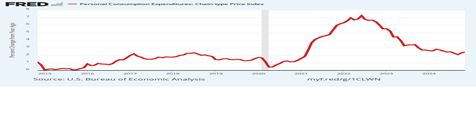
Consumer prices rose enough in October to keep the rate of inflation slightly above the Federal Reserve’s 2 percent goal, The consumer price index (CPI) climbed 0.2 percent for the fourth month in a row, the government said Wednesday, matching economists’ forecast. It rose 2.6 percent in a year from September’s 2.4 percent inflation rate, marking the first upturn in seven months.

This could be problem, especially if some Republican priorities are enacted, such a more tax cuts, which might cause the Fed to hold off cutting interest rates further. It would probably hurt both stock and bond prices, for starters, and slow growth further in what is already a slowing economy.

On a more cheerful note, now that prices stabilized, the natural rise of wages will catch up with those newly stabilized prices and most of us will feel reassured—unless there’s another economic shock.

That could be a larger war, or a climate disaster. Americans are already experiencing a greater frequency of such shocks with more tornadoes, hurricanes, wildfires and floods. So newly elected congress men and women, please, please, don’t cut the funding of the Environmental Protection Agency, or FEMA!

Harlan Green © 2024

Follow Harlan Green on Twitter: https://twitter.com/HarlanGreen
Posted in Consumers, COVID-19, Economy, Politics, Weekly Financial News | Tagged , , , , , , , | Leave a comment