More Greater Lawlessness–Republicans’ Climate Denial

Answering Kennedy’s Call

NYTimes

One year ago, on August 16, 2022, President Biden signed the Inflation Reduction Act into law – the largest investment in clean energy and climate action ever.

“The Inflation Reduction Act is a transformative law that is helping the United States meet its climate goals and strengthen energy security, investing in America to create good-paying jobs, reducing energy and health care costs for families, and making the tax code fairer,” the White House said in its latest update.

Whereas at the top of the Republican’s MAGA list in its 2024 platform is weaken as many environmental laws as possible in order to return fossil fuels and the non-renewable, most pollution intensive industries to dominance.

Trump’s acceptance speech said as much: “…And next we will add the actual and incredible waste of taxpayer dollars that is fueling the inflation crisis. They spent trillions of dollars on things doing with the green new scam. It’s a scam…We will not allow it to be spent on meaningless green new scam ideas.”

“And I will end the electric vehicle mandate on day one, thereby saving the US auto industry from complete obliteration, which is happening right now. And remember we have liquid gold under our feet, more than any other country by far. We are a nation that has the opportunity to make an absolute fortune with its energy. We have it and China doesn’t.”

This is after the last Trump administration spent four years dismantling major climate policies and rolling back many more rules governing clean air, water, wildlife and toxic chemicals.

In all, a New York Times analysis, based on research from Harvard Law SchoolColumbia Law School and other sources, counts nearly 100 environmental rules officially reversed, revoked or otherwise rolled back under Mr. Trump. More than a dozen other potential rollbacks remained in progress by the end but were not finalized by the end of the administration’s term.

President Biden’s four years have reversed such climate change denial. Just twelve months after the law was signed, the Inflation Reduction Act is already having a significant impact on American workers and families and “is delivering for underserved communities and those that have been too often left behind,” said the White House.

“Outside groups estimate the Inflation Reduction Act’s clean energy and climate provisions have created more than 170,000 clean energy jobs already, companies have announced over $110 billion in clean energy manufacturing investments in the last year alone, the law is delivering billions of dollars to protect communities from the impacts of climate change, and millions of seniors are saving money because their insulin is capped at $35 per month,” said the White House in its update.

The Republican Party’s attack on environmental regulations has been unrelenting in its support of the fossil fuel industry.

But in the early 1970s when I joined the U.S. Environmental Protection Agency, the Clean Air Act, the Clean Water Act, and the Endangered Species Act were all passed with broad bipartisan support and signed by Republican President Richard Nixon.

What happened? The 1973 Arab oil embargo shut off OPEC supplies and led to long car lines waiting at gas stations to fill their tanks, for those that remember.

It was a very traumatic decade of soaring inflation that caused Big Business to bankroll lobbyists to support Big Oil producers, which set the environmental movement back. Oil production became a national security priority; fracking was developed to make the US the largest oil producer in the world.

The result of that decade was the beginning of what became Reaganomics, or trickle-down economics. It wasn’t even an economic theory—just make the one precent wealthier and enough will trickle down to the other 99 percent to lift all boats.

Worldwide temperatures have been increasing ever since; tornadoes and hurricanes more frequent and damaging, wildfires and floods as well. Even the Pentagon has jumped on the environmental bandwagon with its reports that have said global warming now endangers our national security.

Even the Big Oil industry has admitted the danger in many studies. But not the Republican Party, apparently, which makes its climate denial platform a national security threat as well.

Harlan Green © 2024

Follow Harlan Green on Twitter: https://twitter.com/HarlanGreen

Posted in Consumers, COVID-19, Economy, Politics | Tagged , , , , | Leave a comment

The Greater Lawlessness–Republicans War on America

Answering Kennedy’s Call

Trump’s selection of J.D. Vance as Vice-President means the chaos of Trump’s first administration will continue on steroids, as Trump will have a VP who will assist him in continuing to tear down one institution after another that protects ordinary Americans.

JD Vance looked down on working class whites he grew up among when he wrote his memoir, “Hillbilly Elegy”. “You can walk through a town where 30 percent of the young men work fewer than 20 hours a week and find not a single person aware of his own laziness,” as cited by Paul Krugman in a recent NYTimes Op-ed.

“We don’t study as children, and we don’t make our kids study when we’re parents,” he said. But now that he’s the Republican Vice President candidate, those lazy males have suddenly become victims of the surge of illegal immigrants that are “poisoning the blood of Americans”, in Trump’s words, and taking their jobs Vance has said in numerous speeches and interviews.

But that’s not the case. The unemployment rate of adult white males is just 4 percent, below the current national unemployment rate, said Krugman, a Nobel prize winner in economics.

As an example of the chaos during his first administration when Trump was taking babies away from immigrant mothers and attempting to build a wall, I wrote this 2017 Huffington Post piece on how his immigration policies will damage the US economy.

“For most of the past half-century, adults in the U.S. Baby Boom generation – those born after World War II and before 1965 – have been the main driver of the nation’s expanding workforce, reports the PEW Research Center. But as this large generation heads into retirement, the increase in the potential labor force will slow markedly, and immigrants will play the primary role in the future growth of the working-age population (though they will remain a minority of it).

Huffington Post

“The stakes are enormous if Republicans succeed in removing most of the estimated 11 million undocumented worker (only half of which are from Mexico and the Latin countries), and cut legal immigration in half, as they have promised to do. Economic growth will plummet, since it is mainly based on growth of the working age population, as well as labor productivity, which has also fallen since 2000,” I wrote then.

It is one more example of the Bully Mentality I’ve been writing about ad nauseum that is particular to the Republican Party—the bullying behavior of the strongest preying on the weakest that has made citizens of the red states they control the poorest.

How much of a bully is JD Vance? He is now mimicking Donald Trump’s behavior. In an interview with ABC News “This Week” anchor George Stephanopoulos, Vance doubled down on his views of the 2020 election, saying the results shouldn’t have been immediately certified, and he went on to suggest Trump should ignore “illegitimate” U.S. Supreme Court rulings.

“If I had been vice president, I would have told the states, like Pennsylvania, Georgia and so many others, that we needed to have multiple slates of electors and I think the U.S. Congress should have fought over it from there,” he continued. “That is the legitimate way to deal with an election that a lot of folks, including me, think had a lot of problems in 2020. I think that’s what we should have done.”

This is returning US to the Law of the Jungle, the Darwinian struggle where the fittest survive and prosper, now with the assistance of his Vice Presidential candidate.

It is monumental hypocrisy of a man from Kentucky who grew up among the very people he has made into victims, a red state that has suffered so much from what is now the official policy of Donald Trump’s party.

Harlan Green © 2024

Follow Harlan Green on Twitter: https://twitter.com/HarlanGreen
Posted in Consumers, COVID-19, Economy, Politics | Tagged , , , , | Leave a comment

Retail Sales Falter

The Mortgage Corner

Fed Chair Powell has said it again. Second-quarter economic data including last week’s consumer price report “do add somewhat” to confidence that inflation is heading down to the central bank’s 2 percent goal at an Economic Club of Washington interview— a condition for rate cuts, report various media. He repeated that labor markets are now in a “better balance,” and an unexpected weakening in labor markets would also be a reason to adjust rates.

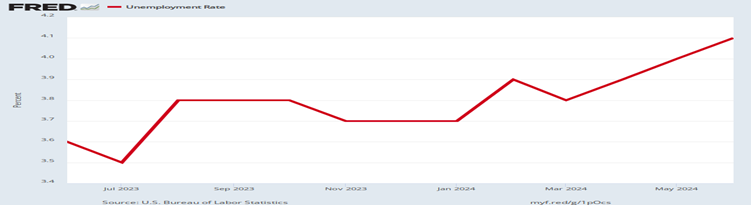
That is already happening with the latest revisions to unemployment data and the unemployment rate now up to 4.1 percent. It ticked up to 4.1 percent in June from 3.8 percent in March. The sudden rise in the unemployment rate in the middle of the work year should alarm Fed officials.

Further evidence of slowing job growth is that average hourly wage growth fell to 3.9 percent. It makes up to two-thirds of production costs for most businesses and is now the main driver of inflation.

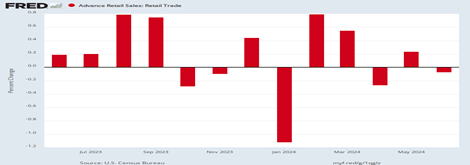
1another reason a rate cut seems more likely is that retail sales were unchanged in June once again. It actually fell when inflation is factored. It’s now been flat for three consecutive months.

FREDretail

Advance of U.S. retail and food services sales for June 2024, adjusted for seasonal variation and holiday and trading-day differences, but not for price changes, were $704.3 billion, virtually unchanged (±0.5 percent)* from the previous month, but up 2.3 percent (±0.5 percent) above June 2023. Total sales for the April 2024 through June 2024 period were up 2.5 percent (±0.5 percent) from the same period a year ago.

Housing is another reason a rate cut is needed sooner. Though for sale inventories are up to a 3.7-month supply, according to Realtors, builders have been slashing prices because of the sky-high mortgage rates.

Nearly one third of home sellers in Sun Belt cities are slashing their asking prices as the number of properties for sale in those markets surges.

The share of home listings with a price cut was the highest in metropolitan areas across the South as homeowners competed to entice buyers, according to June monthly data from real-estate company Realtor.com. The report includes data for home listings in the 50 largest U.S. metropolitan areas going back to 2016, said the NAR.

Total existing-home sales1 – completed transactions that include single-family homes, townhomes, condominiums and co-ops – retreated 0.7% from April to a seasonally adjusted annual rate of 4.11 million in May. Year-over-year, sales were down from 4.23 million in May 2023.

“Eventually, more inventory will help boost home sales and tame home price gains in the upcoming months,” said NAR Chief Economist Lawrence Yun. “Increased housing supply spells good news for consumers who want to see more properties before making purchasing decisions.”

It is also putting more affordable housing on the market. In the NAR’s June report, as in the previous four months, the growth in homes particularly priced in the $200,000 to $350,000 range outpaced all other price categories, as home inventory in this range grew by 50.0 percent compared with last year, surpassing even last month’s high 45.1 percent growth rate. This increase is again primarily fueled by a greater availability of smaller and more affordable homes in the South.

Total housing inventory2 registered at the end of May was 1.28 million units, up 6.7 percent from April and 18.5 percent from one year ago (1.08 million). The 3.7-month supply at the current sales pace is up from 3.5 months in April and 3.1 months in May 2023.

All the discounting won’t cure the housing shortage but it will create more affordable housing.

Consumer spending itself has now slowed for three consecutive months because of too high interest rates, as has the job market, which has now taken a dangerous downturn.

So why wait for a September rate cut, as many are predicting? The Fed’s FOMC meets next in July.

Harlan Green © 2024

Follow Harlan Green on Twitter: https://twitter.com/HarlanGreen

.

Posted in Consumers, COVID-19, Economy, Housing, housing market, Weekly Financial News | Tagged , , , , | Leave a comment

Prices Are Falling!

Popular Economics Weekly

Today could be historic for inflation watchers. It’s the first time since July 2022 that retail prices as measured by the U.S. Consumer Price Index (CPI) have declined.

It will be history making and effect the financial markets, housing, and maybe the presidential election where inflation has seemed to be Americans’ major worry—at least according to the polls.

The easiest signs of actual deflation for consumers are seeing the decline in gas prices to pre-pandemic levels. Gas prices dropped 3.8% in June, the BLS said. And the cost of used cars and trucks fell 1.5%.

I said last month that it will probably be hard to believe for many scarred by the post-pandemic inflation scare that still believe inflation is too high, but there was no inflation increase in May for both wholesale (PPI) and retail (CPI) inflation indexes.

FREDcpi

The FRED graph illustrates that we now have had two months of no price increases. It could have been predicted because consumers have known for months that stores were discounting, and been frequenting big box retailers like Target, Walmart and Costco.

It also tells us that housing (rents) have been declining after an initial uptick in the first quarter due to various shortages. Housing inventories have increased some 40 percent year over year, per the National Association of Realtors.

This will cause bonds in particular to rally because interest rates, including mortgages, will finally begin to decline from their two-year highs.

San Francisco Fed Chairman Mary Daly was the first to jump on the rate cutting bandwagon this morning. She said she now supports lowering interest rates.

“With the information we have received today, which includes data on employment, inflation, GDP growth and the outlook for the economy, I see it as likely that some policy adjustments will be warranted,” Daly said in a roundtable with reporters cited my MarketWatch’s Greg Robb.

The increase in rents in the past 12 months slowed to 5.1% in June from 5.3% in the prior month and touched the lowest level since April 2022. Rents are expected to slow even further, but just how much is unclear. Before the pandemic, they were rising about 3.5% to 3.9% a year.

The cost of “imputed” housing, meanwhile, rose a scant 0.3% in June. That’s the smallest increase since July 2021. This category, known to economists as OER, is a indirect proxy for how much the cost of housing is rising.

The Biden administration’s Treasury Department is doing its part with funds to support building more affordable housing.

“Executive agencies have the power to act quickly to promote homeownership. We applaud the Biden Administration’s comprehensive, multi-agency response targeting solutions at every level of government. It will take an all-of-government approach to yield results in this fight,” said NAR’s Chief Advocacy Officer Shannon McGahn.

So, Fed Chair Powell was correct in saying at his latest congressional testimony that the Fed will not have to wait for inflation to decline to its 2 percent target rate before cutting interest rates

He was making a brave statement, because the inflation hawks will now say easing credit could stimulate another inflation surge, because consumers will therefore be able to borrow more, thus increasing the demand side of the supply-demand equation.

But lower interest rates will also stimulate more home building, increasing the supply side of the housing shortage that has kept most housing unaffordable for entry-level and first-time homebuyers.

The rather sudden drop in prices could mean more, maybe economic growth itself slowing further? Let’s wait and see.

Harlan Green © 2024

Follow Harlan Green on Twitter: https://twitter.com/HarlanGreen

Posted in Consumers, COVID-19, Economy, Housing, housing market, Weekly Financial News | Tagged , , , , | Leave a comment

Q2 Economic Growth Is…?

Financial FAQs

Estimates of 2024 second quarter economic growth have been all over the map, but I will attempt to separate the wheat from the chaff, so to speak.

Firstly, GDP growth is mostly dependent on consumer spending, which makes up some two-thirds of it. And right now, consumers continue to spend after hesitating in Q1 led to just 1.4 percent Q1 GDP growth. But I believe Q2 will be better, which will keep the budget deficit within an acceptable range. More on that later.

The Federal Reserve’s consumer credit measure for May—the 2nd month of the second quarter—just showed a big jump in consumer spending. Total consumer credit rose $11.3 billion in May, up from a $6.5 billion gain in the prior month, the Federal Reserve said Monday. 

The rise in May translates into a 2.7% annual rate says MarketWatch’s Jeffry Bartash, stronger than the 1.5% rise in the prior month. Revolving credit, like credit cards, jumped by a 6.3% annual rate in May after a rare 0.8 % fall in the prior month. Nonrevolving credit, typically auto and student loans, rose by a 1.4% rate after a 2.4% rise in the prior month.

Why is this important? Revolving credit (i.e., cards) is spent on everyday items as well as travel and leisure, and we are in the summer season of most travel. This jump is spending should mean a boost in consumer confidence going into the fall.

The Atlanta Fed GDPNow estimate of Q2 growth jumped today, which I believe is the best indicator of what the BEA’s Q2 initial estimate of growth might look like will be out in two weeks.

AtlfedGDPNow

“The GDPNow model estimate for real GDP growth (seasonally adjusted annual rate) in the second quarter of 2024 is 2.0 percent on July 10, up from 1.5 percent on July 3…after last Friday’s employment report from the Bureau of Labor Statistics and this morning’s wholesale trade report from the US Census Bureau…”

Real Domestic Private Investment, a major component of GDP growth, has also been surging. It is now growing at 5 percent in Q1 and is up a total 11 percent from Q1 2023 when it was shrinking. This is huge, because, remember I mentioned in a recent blog that more private investment in infrastructure as well as CHIPS and other manufacturing incentives built into Bidenomics lessens the need for taxpayer funding and hence lowers the budget deficit.

And in more good news, Fed Chair Powell remarked at today’s house congressional hearing that the Fed will not wait to reach its 2 percent target rate before beginning to cut rates.

This is the best of news, though it will now have investors worrying about some unseen dangers that may lie ahead that the Fed might be worrying about. What are they? Watch the news!

Harlan Green © 2024

Harlan Green on Twitter: https://twitter.com/HarlanGreen

Posted in Consumers, COVID-19, Economy, Keynesian economics, Weekly Financial News | Tagged , , , , | Leave a comment

The Irrelevance of MAGA Republicans

Answering Kennedy’s Call

This is another Huffington Post column I wrote in 2017 at the beginning of the Trump presidency. It’s about the irrelevance of his policies for most Americans that another Trump presidency would repeat, as well as further damaging our health and the environment, while making the world less safe.

“It’s sad that the President of the United States has become irrelevant to most of the problems facing Americans and the world. In choosing to return to a 1950’s that never was—the brief emergence of a white middle class—MAGA Trump is choosing to isolate himself and his constituency from the real world. Do we need a better definition of President Trump’s irrelevance?

Let’s start with his fiasco of an Asian trip, where he fawned over foreign leaders who gave him massive pageants, but no trade concessions, while abandoning the Trans- Pacific Partnership.

The remaining 11 countries, including Japan, Australia, Mexico and Malaysia, said they had revived the Trans-Pacific Partnership (TPP) deal, a multilateral agreement championed under the Obama administration.

The Guardian reported Ministers meeting in Danang, Vietnam agreed on the “core elements” of what was now called the comprehensive and progressive agreement for Trans-Pacific Partnership, a joint statement read.

And “American leaders from state capitals, city halls and businesses across the country have shown up in force” in Bonn, Germany, to discuss carrying out the 2015 Paris climate agreement,” said California Governor Jerry Brown and Michael Bloomberg in the New York Times.

This is when President Trump announced at the beginning of his Presidency that he was abandoning the Paris Accord in favor of supporting a return to coal and oil energy. But that isn’t happening for the rest of America, as some 50 percent of U.S. states and cities are represented in Bonn.

“California just extended its cap-and-trade emission program through 2030 and has adopted incentives that will help put 1.5 million electric vehicles on the road by 2025,’ said Jerry Brown, Governor of the sixth largest economy in the world.

Huffington Post

And the U.S. just released its latest congressionally mandated Climate Science Special Report that says 2017 wreaked the most catastrophic destruction in 90 years with an estimated $175 billion in property damage. Only the San Francisco Earthquake (1906), Chicago Fire (1871), and Great Flood (1927) caused more destruction.

What is Trump afraid of that he fawns over Chinese and Russian leaders, while extracting no concessions from them? He was seen to spend more time with Vladimir Putin at the Asia-Pacific Economic Cooperation summit in Vietnam than any other leader.

Even his support of Republicans’ so-call tax reform bills is irrelevant, as he wants Republicans once again to attempt to repeal the Obamacare mandate, when more than 50 percent of Americans now support Obamacare, according to the latest Kaiser Family Foundations Health Tracking Poll.

That is irrelevance of the highest order, and as many pundits have noted, it is also the definition of insanity: Republicans attempting to repeal Obamacare more than 30 times and expecting a different result.

Another feature of the tax reform bill is that it requires taking away approximately $1.5 trillion in Medicare and Medicaid benefits to give the wealthiest an unnecessary tax cut. Therefore, it won’t help the shrinking middle class, or any income class, except the top 1 percent.

Harold Myerson voiced recently in The American Prospect, “The United States now has the highest percentage of low-wage workers – that is workers who make less than two-thirds of the median wage- of any developed nation. Fully 25 percent of all American workers make no more than $17, 576 a year.”

The irrelevance of this President’s policies is therefore a real danger to our future health and standard of living in so many ways.

Harlan Green © 2024

Follow Harlan Green on Twitter: https://twitter.com/HarlanGreen
Posted in Consumers, COVID-19, Economy, Keynesian economics, Politics, Uncategorized | Tagged , , , , | Leave a comment

Fewer Jobs, Lower Rates?

Popular Economics Weekly

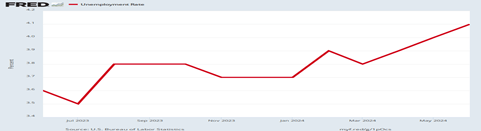
June’s unemployment report was weaker than expected. It looks like the labor market is slowing enough to convince the Fed that interest rates should come down. Not only fewer nonfarm payroll jobs were added to payrolls, but past months were revised downward because the Labor Department makes what are called seasonal adjustments, which are comparisons to past years’ job creation totals to create a more accurate picture of job growth.

The FRED graph below gives the best picture of those adjustments. The unemployment rate ticked up to 4.1 percent in June from 3.8 percent in March. The sudden rise in the unemployment rate in the middle of the work year should alarm Fed officials.

Further evidence of slowing economic growth is that average hourly wage growth fell to 3.9 percent. It makes up to two-thirds of production costs for most businesses, and is now the main driver of inflation.

FREDunemployment 

Of the 206,000 jobs created, a 70,000 increase in new government jobs accounted for one-third of the total. Most were in state and local government, which is where most of the infrastructure modernization is happening.

Government hiring has surged over the past year as private-sector hiring has faltered. The private sector added just 136,000 in June. Health care, another fast-growing industry, created 49,000 new jobs. The construction industry increased payrolls by 27,000.

Yet leisure and hospitality, another industry that had been hiring lots of workers, only added 7,000 jobs. Such leisure activity employment has barely risen in the past three months. Employment also fell in professional and business services, retail, manufacturing and temporary work.

The slowdown in leisure and hospitality is the best sign that consumer spending has slowed, which will bring down Q2 economic growth. So, things are not looking so rosy for economic growth going forward.

It’s why many economists are calling for the Fed to now become proactive and mitigate any future slowdown. Cutting interest rates will first aid the severely constricted housing market with 30-year fixed rates now back above 7 percent. Manufacturing is barely staying afloat because investors are also waiting for lower borrowing costs.

This means the private-public projects in infrastructure and other parts of Bidenomics’ projects that are revitalizing the U.S. economy are mainly being paid for with taxpayer money. But the private sector will jump back in once the much-anticipated rate cuts begin.

And once a better private-public investment balance is restored, not as much taxpayer money will be needed to improve economic growth, and that is really the only way to bring down the federal debt. The annual increase in public federal debt to GDP ratio is just 4.1 percent in the first quarter 2024. It plunged -10 percent during the pandemic, per the FRED graph and returned to positive territory in Q2 2023, as spending on infrastructure projects picked up.

FREDpublicdebttoGDP

This truth will confound the budget hawks who want to cut spending to pay for the tax cuts Republican will keep proposing. But without such taxpayer investment in the future; (paying it forward, to quote Senator Elizabeth Warren), there is very little future growth. Nor is there a prosperous future in store for most Americans.

Harlan Green © 2024

Follow Harlan Green on Twitter: https://twitter.com/HarlanGreen
Posted in Consumers, COVID-19, Economy, Housing, housing market, Keynesian economics, Politics, Weekly Financial News | Tagged , , , , | 1 Comment

U.S. Economy Still Too Hot?

Financial FAQs

The battle is intensifying between the Fed Governors’ inflation doves and hawks as we approach November. Chairman Powell says inflation is getting closer to the Fed’s 2 percent target when we enter the 3rd quarter 2024, but he’s still not confident enough to advocate cutting interest rates.

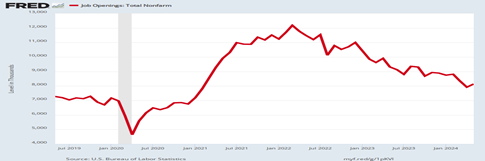
This is while the Labor Department’s JOLTS report showed the number of job openings in the U.S. rebounded in May after falling to a more than three-year low, showing the demand for labor is still high.

It will only make the Fed’s decisions more difficult, since there is a lot of disagreement over how much the US economy will continue to grow (which the Fed worries might keep the inflation numbers too high).

Job postings rose to 8.1 million in May from 7.9 million in April, the Labor Department said Tuesday in its Job Opening and Labor Turnover Survey (JOLTS). Most of the increased hiring was in government. New openings have fallen from a record 12 million in 2022, but they are still higher than they were before the pandemic.

FREDjobopenings

An economic conference in Sintra, Portugal highlighted both sides of the inflation argument, with Chicago Fed President Goolsby saying Fed policy is now becoming too restrictive as the economy slows. It’s therefore time to consider cutting interest rates, though he didn’t want to “tie the Fed’s hand” by predicting when.

The best news was last week’s very weak Personal Consumption Expenditure (PCE) inflation index, which was flat. The Fed’s preferred inflation measure didn’t increase at all in June and annual inflation is now down to 2.6 percent.

And NYTimes Paul Krugman remarked in his latest Op-ed, “there’s a good case for arguing that inflation has been defeated, and that the Fed should start cutting interest rates.”

Friday will tell us another statistic the Fed looks at, the ‘official” US unemployment report, which will show how accurate are the job numbers.

Total nonfarm payroll employment increased by 272,000 in May, I wrote last month,, higher than the average monthly gain of 232,000 over the prior 12 months. The unemployment rate rose to 4.0 percent from 3.9 percent, slightly higher than the pre-pandemic levels of 3.5 percent when the average inflation rate was under 2 percent, as portrayed in the truncated FRED graph (gray line is 2020 pandemic recession), that many seem to remember so fondly.

The real argument is over who benefits from lower interest rates. Lower borrowing costs obviously benefit consumers in general; most in the middle and lower income brackets. But the Fed’s fear is that consumers will then spend more and thus drive up prices again, hence their hesitation in cutting interest rates just yet.

That in turn affects economic growth, which everyone wants, but not too much, if you can believe that. It stimulates more hires, which boosts wages, which the Fed believes is now the main inflation culprit.

The best predictor of economic growth has been the Atlanta Fed’s GDPNow estimate that gets revised at least twice a month. It has just been adjusted downward again in July1 to 1.7 percent, from as high in 3 percent one month ago.

It is now in line with the Blue Chip economists’ consensus of 2nd quarter growth, which should begin to worry Powell’s Federal Reserve. Real personal consumption and domestic investment have been falling, in line with last week’s PCE report I mentioned above.

Retail sales last month were also flat, another concern as consumers look for more bargains and retailers such as Target and Walmart announce ever more discounts. The slowdown is now becoming a definite trend and better the Fed becomes proactive by nipping any downturn in the bud before the November election.

Harlan Green © 2024

Harlan Green on Twitter: https://twitter.com/HarlanGreen
Posted in Consumers, COVID-19, Economy, Weekly Financial News | Tagged , , , , | Leave a comment

The Bully Mentality–III

Answering Kennedy’s Call

JONATHAN ERNST / REUTERS

“Fostering a culture of fear and ignorance is not the way to run a political party, or country, if it would ever come to that.”

I wrote this in 2014 about what I have called the Bully Mentality pervading the Republican Party that has enabled it to coerce its own supporters to vote against their own self-interests, making Republican red states the poorest states in our country.

These are states that in the main have opposed a higher minimum wage, union organizing that would enable workers to bargain collectively, and rely on the richest states via transfer payments to fund much of their governments. (Red states such as Mississippi, W. Virginia, Montana and Kentucky receive more than 30 percent of their revenues from other states).

Why does the USA have such a problem with bullies? Whether in the schools, in politics, or on Internet social media? The result has been teenage suicides, horrendous school shootings by students who felt bullied or belittled, and now a whole political party that opposes anything that smacks of aiding the poorest, seniors, and less educated.

That possibility of becoming the Republican Party taking back the White House has come closer with former President Trump seeking a second term without ever conceding that he lost the last election.

The Bully Mentality is a state of mind that pervades those who are only good at one thing, preying on the weakest to empower themselves.

It is something Nobel Laureate Paul Krugman wrote about during the Obama administration when it created Obamacare.

“But nobody expects to see a lot of prominent Republicans declaring that rejecting Medicaid expansion is wrong, that caring for Americans in need is more important than scoring political points against the Obama administration. As I said, there’s an extraordinary ugliness of spirit abroad in today’s America, which health reform has brought out into the open.”

I said then the “ugliness” is really a textbook definition of bullying behavior

  • Derogatory name-calling and nicknaming
  • Spreading rumors or lying about someone
  • Threatening someone
  • Yelling at or talking to someone in a rude or unkind tone of voice, especially without justifiable cause
  • Mocking someone’s voice or style of speaking
  • Laughing at someone
  • Use of body language (i.e., the middle finger) to torment someone
  • Making insults or otherwise making fun of someone

The textbook definition fits former President Trump.

If the Republican Party can’t keep its constituents poor and less educated, then the Republican Party, now Trump’s party, would lose its hold over them. Conservatives oppose expanding educational opportunities such as Head Start and pre-school aid because it would encourage rational thinking, and an appreciation of science. Their constituents would then begin to understand global warming, and maybe evolution instead of creationist theories that the world was created by a God just 7,000 years ago!

The danger of such behavior is even greater today. We have a Republican presidential candidate who has no compunction about endangering our national security by wanting to weaken NATO and other alliances, been indicted and awaiting trial under the Espionage Act for his carelessness with Top Secret documents, and endangered our economic security with his tax cuts that have created record deficits.

How then have Republicans been given the edge in various polls on the economy and foreign policy? It is another attribute of bully behavior—the total disregard for truth and facts that is at the heart of their propaganda machine.

There are many ways to counter the bully mentality. Firstly, by recognizing that bullies are cowards at heart, which is why they avoid confronting those showing strength. It creates a pervasive culture of victimization, a feeling of powerlessness in which those so afflicted transfer their allegiance to a con artist such as Donald Trump.

That is how dictators all over the world have taken and maintained power. Can that happen to the world’s oldest democracy? It’s up to ordinary citizens to stand tall in opposing such behavior. It’s surprising how quickly bullies will disappear when citizens take back their own strength.

Harlan Green © 2024

Follow Harlan Green on Twitter: https://twitter.com/HarlanGreen

Posted in Economy, gun violence, Politics | Tagged , , , , | 1 Comment

Consumers Not So Confident?

The Mortgage Corner

What are we to make of the Conference Board’s latest confidence survey?

“The decline in confidence between May and June was centered on consumers aged 35-54. By contrast, those under 35 and those 55 and older saw confidence improve this month,” said Dana M. Peterson, Chief Economist at The Conference Board.

Conference Board

We are in the midst of one of the greatest economic recoveries in history—from the worst pandemic in more than 100 years. Yet most consumers lack confidence because they don’t know where to look for information on the real economy, as opposed to what is on social media or in mass media headlines.

“Confidence pulled back in June but remained within the same narrow range that’s held throughout the past two years, as strength in current labor market views continued to outweigh concerns about the future. However, if material weaknesses in the labor market appear, confidence could weaken as the year progresses,” said Peterson

I believe this reflects the fact that most consumers like their current circumstances, but not outside events that may forecast the future. Why isn’t the rest of the world doing as well as Americans, say the headlines?

A lot of the confusion unfortunately comes from social media which doesn’t differentiate fact from fiction. A recent poll maintained that 50 percent of those surveyed believe we are in a recession, when real GDP growth has averaged 2 percent since the pandemic, and we are at full employment.

It reflects what I have called irrational pessimism. The other side of the coin is irrational exuberance, when excessive optimism that prices will almost always rise can cause asset bubbles.

Nobel laureate economist Robert Shiller has written about it. That’s because most market investors rely on hearsay and word of mouth, rather than research that would paint a more accurate view of market conditions.

Much of Main Street, ordinary working adults in the main, have become irrationally pessimistic for that reason. Surveys such as a recent poll by PEW Research show this.

“About three-in-ten Americans (28%) currently rate national economic conditions as excellent or good, while a similar share (31%) say they are poor and about four-in-ten (41%) view them as “only fair.”

I also believe most Americans are emotionally exhausted and still recovering from the pandemic, so they are now spending less which is slowing economic growth.

BEA.gov/CRFB

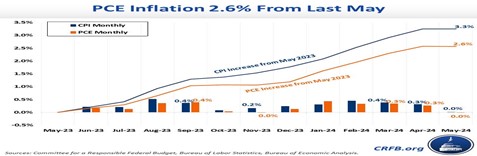
That is reflected in the major inflation indexes which were all flat in May. The Fed’s preferred Personal Consumption Expenditures (PCE) monthly inflation index didn’t rise at all on Friday in line with retail CPI prices (in blue line) reported earlier this month as seen in above graph.

When will consumers begin to realize this? Maybe in September when the Fed is now predicted to begin to lower their interest rates. That should make all of US happier!

Harlan Green © 2024

Follow Harlan Green on Twitter: https://twitter.com/HarlanGreen

Posted in Consumers, COVID-19, Economy, Uncategorized, Weekly Financial News | Tagged , , , , | Leave a comment