Still Fully Employed!

Popular Economics Weekly

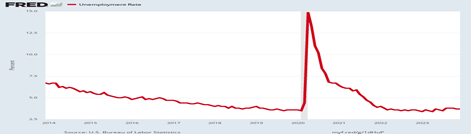
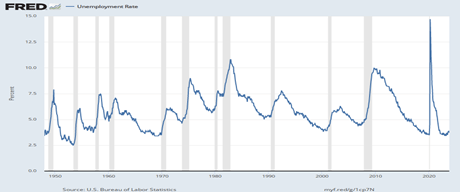
Ho hum. The U.S. economy was still fully employed in December. How boring! The St. Louis Fed (FRED) graph below shows the American economy has been at full employment since December 2021 when the unemployment rate first sank below 4 percent (to 3.9 percent).

And much of the hiring has been at state and local government levels because local governments are finally recovering from the COVID pandemic. That is the surest indicator of the beginning of a new uptick in the business cycle.
FREDunemployment

“Total nonfarm payroll employment increased by 216,000 in December, and the unemployment rate was unchanged at 3.7 percent, the U.S. Bureau of Labor Statistics reported today. Employment continued to trend up in government, health care, social assistance, and construction, while transportation and warehousing lost jobs.”

Average hourly wages of nonfarm private employees rose from 4.0 to 4.1 percent annually.

More good news is that factory orders have picked up, according to the Commerce Department, with new orders for U.S.-made goods increasing more than expected in November amid a surge in demand for civilian aircraft, government data showed on Friday.

Factory orders rose 2.6 percent after declining by 3.4 percent in October, the Commerce Department’s Census Bureau said. Orders climbed 0.7 percent on a year-on-year basis in November. And manufacturing, which accounts for 10.3 percent of the economy, is still being constrained by high interest rates. It should therefore pick up even more this year as interest rates decline further.

This is what is called a ‘soft landing’, I said when the unemployment rate dropped back to 3.7 percent in November. Government agencies at all levels added 52,000 new jobs in December – the biggest of any industry – to cap off a record year of hiring (i.e., total of 2.7 million new jobs in 2023), says MarketWatch’s Jeffry Bartash. “Altogether, government employment rose by 672,000 in 2023 and accounted for one-quarter of all new U.S. jobs created.”

So, what’s not to like about this jobs report? Maybe the Fed may now change its mind and not bring down interest rates so quickly, which could happen beginning this March? The evidence is becoming overwhelming that inflation is continuing to rapidly fall. Maybe Powell, et. al., may begin to worry that prices could plunge even more, which isn’t a good sign, since profits then begin to decline, a precursor to a recession.

I believe all the government hiring shows something else—a full blown recovery leading to a new business cycle and maybe what I’ve been calling a ‘Roaring Twenty-Twenties’. Such a ‘roaring’ recovery happened once before, a century ago at the end of the last pandemic that was caused by the Spanish Flu.

Then again, maybe a more boring economic recovery is in the works, with steady employment, wages continuing to rise more than inflation, and a majority of consumers admitting they are happy. Maybe a boring economy is good!

Harlan Green © 2024

Follow Harlan Green on Twitter: https://twitter.com/HarlanGreen

Posted in Consumers, COVID-19, Economy, Macro Economics, Weekly Financial News | Tagged , , , , | Leave a comment

Q4 Growth Prospects Improve

The Mortgage Corner

Prospects for better fourth quarter economic growth are improving. Why? Interest rates are declining along with inflation rates.

The Atlanta Fed’s GDPNow Q4 estimate of economic growth that I like just picked up steam after several downward revisions.

AtlantaFed

“The GDPNow model estimate for real GDP growth (seasonally adjusted annual rate) in the fourth quarter of 2023 is 2.5 percent on January 3, up from 2.0 percent on January 2. After this morning’s release of the ISM Manufacturing Index from the Institute for Supply Management, the nowcasts of fourth-quarter gross personal consumption expenditures growth and fourth-quarter gross private domestic investment growth increased from 2.4 percent and -0.4 percent, respectively, to 2.9 percent and 0.5 percent,” said its report.”

In fact, I mentioned last week that the rate of U.S. inflation based on the Federal Reserve’s preferred PCE index became negative in November for the first time since 2020 indicating that price pressures continue to subside. The PCE index actually dipped – 0.1 percent last month, the government said Friday, and was unchanged in October.

Boosting growth is consumer spending that has held up with robust holiday shopping, and soaring construction spending, up 11.3 percent annually.

FREDconstruction

Why? It’s mostly the Infrastructure and Inflation Reduction Acts pairing with private industry in modernizing the American economy that is creating high-paying jobs and producing more things, which also brings down inflation.

There’s more spending on highways and bridges, while private residential construction rose 1.1 percent in November, with single-family construction up 2.9 percent and multi-family construction rising 0.1 percent. These are longer term investments which should mean longer term growth prospects.

On the inflation front stocks and bonds have been rallying because Chairman Powell sounded dovish for the first time at his December press conference following their last FOMC meeting of the year.

“The question of when it will be appropriate to begin dialing back the policy restraint” was clearly “a discussion for us at our meeting today,” Powell said. The Fed is “likely at or near the peak rate for this cycle.”

Plunging interest rates are best illustrated by the 10-year benchmark fixed rate Treasury note yield that sets mortgage rates. It had dropped below 4 percent for the first time since the pandemic.

And the 30-year fixed-rate mortgage fell for the seventh week in a row, averaging 6.61 percent as of Dec. 28, according to data released by Freddie Mac on Thursday. A year ago, the 30-year fixed-rate mortgage was averaging at 6.31 percent.

What’s not to like about prospects for growth in the New Year? Would congress be so foolish as to close down government because so much is on the line? I don’t think so.

Harlan Green © 2024

Follow Harlan Green on Twitter: https://twitter.com/HarlanGreen

Posted in Consumers, COVID-19, Economy, Housing, housing market, Keynesian economics, Weekly Financial News | Tagged , , , , | Leave a comment

Why the Irrational Pessimism?

Financial FAQs

Public polls seem to be saying one thing, economic facts another. Real Clear Politics compendium of 11 opinion polls on whether participants approve or disapprove of President Biden’s handling of the economy show a negative -22.5 percent spread.

Yet we have had the unemployment rate below 4 percent for two years, current inflation is hovering at 2.5 percent and still declining, and consumers continue in record numbers to travel and enjoy leisure activities.

FREDunemployment

Household wealth has also increased 37 percent since 2019, per the New York Fed, the minimum wage has risen to the mid-teens in most states (except a few red states), and there is a labor shortage with nine million job vacancies that has resulted in record wage increases in multiple industries.

Why the disconnect between economic reality and public opinions? Could it be poll takers are asking the wrong questions, like are you better off today than during the pandemic?

Most of the respondents say they are personally better off, but the economy isn’t improving. How can that be?

I maintain it is what I call the Irrational Pessimism of investors, which are most Americans that respond to said polls. It is the opposite of what Nobelist Robert Shiller has called Irrational Exuberance, but for the same reasons.

Yale Professor Shiller is one of the founders of behavioral finance and author of many books that won him the Nobel Prize in 2013. His research has said that most people act irrationally when making financial decisions. Such decisions are mainly based on hearsay, rumors, and plain old irrational exuberance.

For example, the housing bubble was caused by the public’s belief that housing prices only rose but never fell since they hadn’t fallen for decades, said Shiller.

Professor Shiller has written about it in successive editions of his book, Irrational Exuberance. And former Fed Chair Greenspan first brought such behavior to the world’s attention before the 2000 Dot-com recession, as I said recently.

So why would not the public behave irrationally having just weathered the worst pandemic in 100 years—that is, being irrationally pessimistic in the face of so much financial trauma?

His research and that of other Neo-Keynesian (those who essentially believe that government is needed to maintain a healthy economy, as happened with FDR’s New Deal) show that most financial decisions aren’t based on the careful search of facts, but mental laziness, even in the housing market.

It has essentially refuted those economists who believed since the 1970s that financial markets behaved rationally—i.e., that investors carefully thought through their financial decisions, hence unregulated, free markets were the surest way to prosperity.

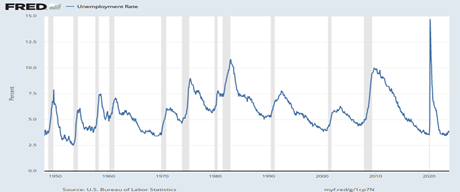
That didn’t prove the case, of course, as the six recessions since 1980, including the Great Recession, have proven.

So, in fact, poll respondents may not be thinking of their own personal well-being in these polls. They tend to act more rationally when the personal stakes are highest.

But understanding complex markets is another matter, and one that takes more time and effort. Perhaps by November and presidential election time rolls around, the American public will take the economic consequences of their decisions more seriously, and not leave it to hearsay, word-of-mouth and irrational pessimism. Let us hope so.

Harlan Green © 2024

Harlan Green on Twitter: https://twitter.com/HarlanGreen
Posted in Consumers, COVID-19, Economy, Housing, housing market, Keynesian economics, Weekly Financial News | Tagged , , , | Leave a comment

No Recession Next Year?

Financial FAQs

Fortune Magazine has come up with the most interesting reasons for a looming recession in a recent edition.

“Here are six reasons why a recession remains Bloomberg Economics’ base case. They range from the wiring of the human brain and the mechanics of monetary policy, to strikes, higher oil prices and a looming credit squeeze — not to mention the end of Taylor Swift’s concert tour.”

I’m not sure just what the wiring of the human brain has to do with recessions, other than Nobelist Robert Shiller research about human behavior; that most financial decisions are based on hearsay, rumors, and plain old irrational exuberance.

The housing bubble was caused by such behavior. Professor Shiller has written about it in successive editions of his book, Irrational Exuberance. And former Fed Chair Greenspan first brought such behavior to the world’s attention before the 2000 Dot-com recession.

Fortune Magazine should add blockbuster movies like Barbie and Oppenheimer, if they want to attribute our current economic health to happy consumers enjoying leisure activities; but their current temperament could change with bad news.

Oil prices are falling, the strikes have been settled with employees winning bigtime with better benefits, and the current credit squeeze hasn’t hurt current record employment and consumer spending to date per below graph (gray bars are recessions).

FREDunemployment

Federal Reserve Governors have also been sounding more dovish on interest rate policy of late.

“The question of when it will be appropriate to begin dialing back the policy restraint” was clearly “a discussion for us at our meeting today,” Powell said at his last press conference of this year. The Fed is “likely at or near the peak rate for this cycle.”

That leaves what Bloomberg believes is the major determinant of a possible recession; the “looming credit squeeze” due to the continuation of higher inflation and interest rates. So, we don’t yet know the full effect of the sudden hike in interest rates engineered by the Fed since March 2022, some 18 months ago that has made borrowing more expensive.

But consumers seem to act rationally when it affects their pocketbooks, especially from too high prices and interest rates. Their record spending on leisure activities could change if the Fed doesn’t begin to lower interest rates in the spring, as I said.

The so-called Fed Funds rate has been at its high point of 5.25 to 5.50 percent from August 2023, just five months, whereas Greenspan’s Fed held rates at their maximum for eight months, from August 2006 to June 2007. The Great Recession was determined to have begun in December 2007.

So there isn’t much room left to avoid a recession, is there? Watch the actual behavior of interest rates to know what consumers will do next!

Harlan Green © 2023

Harlan Green on Twitter: https://twitter.com/HarlanGreen
Posted in Consumers, COVID-19, Economy, Weekly Financial News | Tagged , , , , | Leave a comment

It Wasn’t the Fed

Popular Economics Weekly

What more does Chairman Powell and the Federal Reserve Governors need to know to announce the inflation battle has been won? Its preferred inflation indicator has shown zero monthly increases for two months.

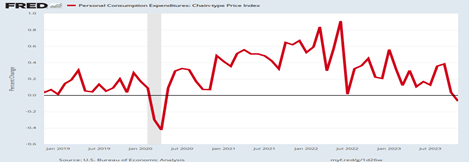
The rate of U.S. inflation based on the Federal Reserve’s preferred PCE index actually fell in November for the first time since 2020 and indicated that price pressures continue to subside. The PCE index dipped – 0.1 percent last month, the government said Friday. Inflation was unchanged in October.

FREDpce

This is what is called a ‘soft landing’, I said last week when the unemployment rate dropped back to 3.7 percent. More jobs are being created in November’s unemployment report, though some 50,000 of the 199,000 new nonfarm payroll jobs are strikers returning to work in Hollywood productions and auto factories.

So the Fed’s actions in raising interest rates to multi-decade highs wasn’t the proximate cause of bringing down inflation in what was an overaction to the effects of the COVID pandemic.

High inflation wasn’t the fault of rising wages, either, when job openings are still at record highs so that everyone who wants a job can find one.

Workers are getting terrific raises now that the strikes have been settled, yet inflation keeps declining. No, broken supply chains were the major culprit. It’s taken almost three years to ramp up enough production to bring down prices.

We are now seeing the results as shoppers have shown in the latest retail sales figures that they are finding more bargains during this record holiday shopping season.

Even industrial production is ramping up; so much so that Q4 projections of growth are rising again.

Orders for durable goods for products that last more than three years (cars, appliances, etc.) rose 5.4 percent in November, the U.S. government said Friday. This is the largest gain since July 2020. It is the second gain in the past three months. Transportation orders had the largest increase, rising 15.3 percent in November. This was in part because orders for motor vehicles and parts jumped 2.8 percent after the end of the UAW strike. Orders for commercial aircraft also soared but tend to fluctuate wildly month-to-month.

The Atlanta Fed raised its estimate of fourth quarter GDP growth as high as 3.0 percent and it could go higher with today’s robust durable orders release by the Commerce Department.

The U.S. Federal Reserve Board suggested that interest rates would be cut by 75 basis points in 2024 after it last FOMC meeting of 2023 in December. Can we now be in what is called a Goldilocks economy?

That is when the Fed’s interest rate isn’t so low that it ushers in inflation, yet not so high that it tips the economy into a recession. Maybe we’ve reached that point.

Once again, consumers will decide on the direction of economic growth. And holiday travel shows they haven’t slowed down much.

Auto club AAA forecasts that 115 million people in the U.S. will go 50 miles or more from home between Saturday and New Year’s Day. That’s up 2% over last year. The busiest days on the road will be Saturday and next Thursday, Dec. 28, according to transportation data provider INRIX.

And MarketWatch reports the Transportation Security Administration screened more than 2.6 million passengers on Thursday, which had been projected to be one of the busiest travel days, along with Friday and New Year’s Day. That’s short of the record 2.9 million that agents screened on the Sunday after Thanksgiving, since travel tends to be more spread over Christmas and New Year’s.

The Chorus is growing on the need to begin dropping interest rates. That’s all we need to sustain this recovery.

Harlan Green © 2023

Follow Harlan Green on Twitter: https://twitter.com/HarlanGreen
Posted in Consumers, COVID-19, Economy, Weekly Financial News | Tagged , , , | Leave a comment

Consumers Much Happier This Season

Financial FAQs

Consumer confidence in December as measured by the Conference Board’s Consumer Confidence Index is rising again; it jumped 10 points to 110.7 from 101. Why should that be, with all the doom and gloom and geopolitical uncertainty bombarding us daily?

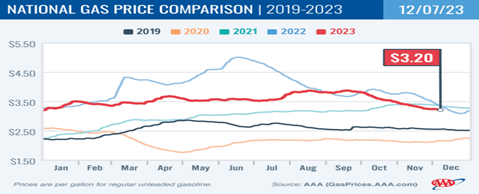
I think it’s because consumers are seeing falling prices and lower inflation, especially gasoline prices with average gas prices approaching $3 per gallon for the first time in years. And consumers continue to shop both online and in stores because they are finding more bargains, with retail sales surging.

“December’s increase in consumer confidence reflected more positive ratings of current business conditions and job availability, as well as less pessimistic views of business, labor market, and personal income prospects over the next six months,” said Dana Peterson, Chief Economist at The Conference Board.

And the unemployment rate has fallen back to 3.7 percent with more workers than ever joining the workforce. Why shouldn’t consumers’ temperaments improve?

Conference Board

While December’s renewed optimism was seen across all ages and household income levels, the gains were largest among householders aged 35-54 and households with income levels of $125,000 and above, said the Conference Board.

This is also understandable as they comprise the largest percentage of the adult-age workforce with average hourly waging rising 4.0 percent—at least 1 percent above a falling inflation rate.

More good news is a recovery in the housing market. Single-family construction is soaring. Why? These adult-age consumers believe it’s time to own a home.

Overall housing starts increased 14.8 percent in November to a seasonally adjusted annual rate of 1.56 million units, according to a report from the U.S. Department of Housing and Urban Development and the U.S. Census Bureau.

“The single-family starts figure is remarkably strong, and we would not be surprised to see this figure revised lower or fall back slightly in the next month, given the nearly 20 % rise in November,” said NAHB Chief Economist Robert Dietz. “NAHB is forecasting an approximate 4 % gain for single-family starts in 2024, as mortgage rates settle lower, economic growth slows and inflation moves lower.”

If I were the Fed Governors, I wouldn’t wait for inflation to drop further to begin to lower interest rates, I said last week. The inflation rate has been falling steadily for more than a year and we could be in a deflationary spiral. Sound impossible? It might happen if the Fed doesn’t see the writing on the wall.

Nobel Laureate Paul Krugman has been scolding certain economists of late in a NYTimes Op-ed who don’t believe what is happening.

“From an economic point of view, 2023 will go down in the record books as one of the best years ever—a year in which inflation came down amazingly fast at no visible cost, defying the predictions of many economists that disinflation would require years of high unemployment.”

The cost of living measured by the Consumer Price Index rose just 0.1 percent in November thanks to lower oil prices. Without food and gas prices, so-called core consumer prices rose a somewhat sharper 0.3 percent last month and matched the Wall Street forecast. And the annual rate of inflation slowed to 3.1 percent in November from 3.2 percent in the prior month, matching the lowest level since early 2021.

Consumers are starting to believe what they are experiencing, in other words. Gas prices are at the top of the list, but how about dining out?

There was a 11 percent increase in dining out sales, and Christmas may equal Thanksgiving as the highest travel month ever. Don’t consumers carry the most weight on which direction this economy is heading?

Harlan Green © 2023

Follow Harlan Green on Twitter: https://twitter.com/HarlanGreen

Posted in Consumers, COVID-19, Economy, Housing, housing market, Weekly Financial News | Tagged , , , , | Leave a comment

How Low Can Interest Rates Go?

The Mortgage Corner

Stocks and bonds are rallying after Chairman Powell sounded dovish for the first time at his December press conference following their last FOMC meeting of the year.

“The question of when it will be appropriate to begin dialing back the policy restraint” was clearly “a discussion for us at our meeting today,” Powell said. The Fed is “likely at or near the peak rate for this cycle.”

Plunging interest rates are best illustrated by the 10-year benchmark fixed rate Treasury note yield that sets mortgage rates. It has plunged below 4 percent for the first time since the pandemic.

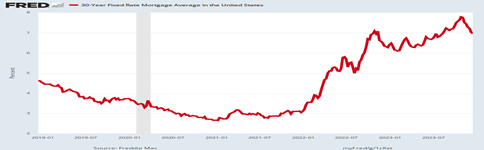
And the 30-year fixed-rate mortgage fell for the seventh week in a row, averaging 6.95 percent as of Dec. 14, according to data released by Freddie Mac on Thursday. A year ago, the 30-year fixed-rate mortgage was averaging at 6.31 percent.

It remained below 5 percent from the end of the Great Recession until May 2022 when the Fed began to raise interest rates. I predict it should drop below 5 percent sometime next year as inflation continues to decline and the Fed begins its rate dropping schedule.

FRED30yrfixed

We are already seeing the results—holiday sales are booming. Retail sales are surging now, up 4.1 percent annually both online and in stores. Dining out is up 11 percent annually.

Advance estimates of U.S. retail and food services sales for November 2023, adjusted for seasonal variation and holiday and trading-day differences, but not for price changes, were $705.7 billion, up 0.3 percent (±0.5 percent)* from the previous month, and up 4.1 percent (±0.7 percent) above November 2022.”

The housing market is on hold until mortgage rates fall more.

NAR Chief Economist Lawrence Yun forecasts that 4.71 million existing homes will be sold, the housing market is expected to grow, and Austin, Texas will be the top real estate market to watch in 2024 and beyond.

Yun predicts home sales will begin to rise next year – by 13.5 percent compared to 2023, and the median home price will reach $389,500 – an increase of 0.9 percent from this year.

Builder confidence in the market for newly built single-family homes is improving slightly. It rose three points to 37 in December, according to the National Association of Home Builders (NAHB)/Wells Fargo Housing Market Index (HMI) released today.

“With mortgage rates down roughly 50 basis points over the past month, builders are reporting an uptick in traffic as some prospective buyers who previously felt priced out of the market are taking a second look,” said NAHB Chairman Alicia Huey. “With the nation facing a considerable housing shortage, boosting new home production is the best way to ease the affordability crisis, expand housing inventory and lower inflation.”

AtlantaFed

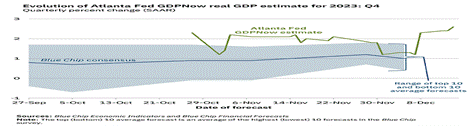
The Fed’s abrupt change in course has also boosted Q4 economic growth prospects. The Atlanta Fed’s GDPNow growth estimate just leaped from 1.2 percent to 2.6 percent, due to “…fourth quarter real personal consumption expenditures growth, fourth-quarter real gross private domestic investment growth, and fourth-quarter real government spending growth.”

So I don’t believe it’s too early to predict a better New Year for investors and homeowners!

Harlan Green © 2023

Follow Harlan Green on Twitter: https://twitter.com/HarlanGreen
Posted in Consumers, COVID-19, Economy, Housing, housing market, Weekly Financial News | Tagged , , , , | 1 Comment

Please Drop Interest Rates Sooner!

Financial FAQs

If I were the Fed Governors, I wouldn’t wait for inflation to drop further to begin lowering interest rates. The inflation rate has been falling steadily for more than a year and we might be in the midst of a deflationary spiral. Sound impossible? It could be if the Fed doesn’t see the writing on the wall.

The cost of living measured by the Consumer Price Index rose just 0.1 percent in November thanks to lower oil prices. Without food and gas prices, so-called core consumer prices rose a somewhat sharper 0.3 percent last month and matched the Wall Street forecast. And the annual rate of inflation slowed to 3.1 percent in November from 3.2 percent in the prior month, matching the lowest level since early 2021.

The next stage could be outright deflation, which nobody wants because it has spelled recession in the past. Why? Because the steep decline in inflation over a short period means a looming oversupply of things at the same time as sky-high interest rates, and that was the cause of past recessions.

The first indication of oversupply is gas prices, which are falling fast. As of Monday, the average national price for regular unleaded gasoline stood at $3.153 a gallon, down from $3.242 a week ago, and down from $3.376 a month ago, according to AAA.

AAA.com

The main reason is a weaker cost for oil, which is struggling to stay above $70 per barrel.  The falling price comes just a week after OPEC+ announced voluntary production cuts of about 2 million barrels daily. 

“Historically, crude oil tends to drop nearly 30 percent from late September into early winter with gasoline prices trailing the play,” said Andrew Gross, AAA spokesperson. “More than half of all US fuel locations have gasoline below $3 per gallon. By the end of the year, the national average may dip that low as well.”

Inflation is falling fast with the 6-month CPI already down to 2.5 percent, yet unit wages are rising 4.0 percent annually in November’s unemployment report. So inflation today is being caused by higher rents and used cars, not oil prices as happened in the 1970s or rising wages.

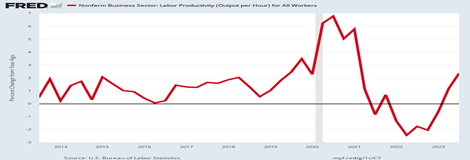
We now know why inflation is falling. Nonfarm labor productivity is soaring, up 5.2 percent in the third quarter of 2023 as output increased 6.1 percent and hours worked increased 0.9 percent.

The increase in labor productivity is the highest rate since the third quarter of 2020, when productivity increased 5.7 percent. From the same quarter a year ago, nonfarm business sector labor productivity increased 2.4 percent.

The last time we approached bubble territory was an oversupply of housing in early 2000 that led to the housing bubble and Great Recession. Labor productivity was as high in Q1 2002 at 5.8 percent annually.

Under Fed Chairman Alan Greenspan, the Fed didn’t recognize the housing bubble until it was too late (In part due to lax supervision by the GW Bush administration Treasury and Greenspan’s Fed). In fact, he even encouraged homebuyers to take out adjustable-rate mortgages to prolong the housing market rally.

He then held the same 5.25 percent Fed Funds rate too long—10 months from August 2006 to June 2007—before the fed began to drop rates.

But by then it was too late. The Great Recession began in December 2007. Housing values had already begun to plunge due to a one-million-unit oversupply and the mortgages tied to them became worthless because they could no longer be serviced due to soaring mortgage rates that followed the Fed’s rate hikes.

Can this happen again? There is a pronounced undersupply of housing today with builders racing to catch up, so there is little danger of a housing bubble. Instead of looking backwards to the 1970s when oil shortages led to the inflationary spiral, the Fed should be focusing on possible oversupply today and falling prices as the production of things continues to ramp up.

There could be an oversupply in the industrial sector, for instance—of computer chips in particular as new factories begin to produce, and ordinary commodities as labor productivity stays high with AI and supply-chains continue to improve.

And let’s not forget the four bank failures to date due to the Fed’s rate hikes. The Fed should not forget the failure of Lehman Brothers and many other financial institutions that was also part of the Great Recession.

Harlan Green © 2023

Follow Harlan Green on Twitter: https://twitter.com/HarlanGreen
Posted in Consumers, COVID-19, Economy, Housing, housing market, Politics, Weekly Financial News | Tagged , , , , , , | 1 Comment

More Jobs Than Ever!

Popular Economics Weekly

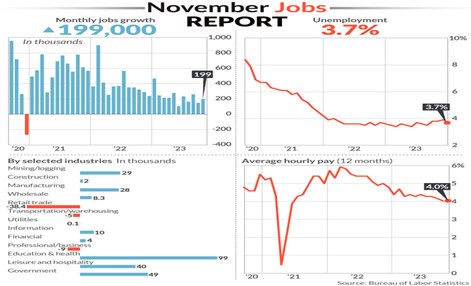
This is what is called a ‘soft landing’. More jobs are being created in November’s unemployment report, though some 50,000 of the 199,000 new nonfarm payroll jobs are strikers returning to work in Hollywood productions and auto factories

And they got terrific raises. Yet average hourly pay fell to 4.0 percent, which should please the Fed. How can that be? Because workers are producing more in less time with labor productivity now soaring.

Unit labor costs (i.e., wages) fell at a 1.2 percent annualized rate in the third quarter, I reported recently. Unit labor costs rose at a 1.6 percent rate from a year ago, the smallest year-on-year increase since the second quarter of 2021.

MarketWatch.com

“Total nonfarm payroll employment increased by 199,000 in November, and the unemployment rate edged down to 3.7 percent, the U.S. Bureau of Labor Statistics reported today. Job gains occurred in health care and government. Employment also increased in manufacturing, reflecting the return of workers from a strike. Employment in retail trade declined.”

The unemployment rate fell from 3.9 percent to 3.7 percent because half a million new workers entered the workforce. Education, Leisure/Hospitality, and Government added 188,000 of those new hires. The mining and manufacturing sectors added an additional 57,000 jobs.

This is the best of all worlds for the American economy. The share of the population working or looking for work even matched a post pandemic high of 62.8 percent.

Another sign of a soft landing was that consumer spending has slowed, which puts less pressure on prices, and so a reason that the inflation rate continues to decline.

Total consumer credit rose $5.2 billion in October, down from a $12.2 billion gain in the prior month, the Federal Reserve said Thursday. That translates into credit growth in both credit cards and installment loans at a 1.2 percent annual rate, down from a 3 percent rate in the prior month. Revolving credit (cards) increased at an annual rate of 2.7 percent, while nonrevolving credit (installment loans) increased at an annual rate of 0.7 percent.

I reported last week that Paul Krugman in a recent NYTimes Op-ed said the personal consumption expenditure deflator (PCE) excluding food and energy—the Fed’s preferred inflation indicator—has risen at an annual rate of just 2.5 percent over the past six months, down from 5.7 percent in March 2022. When food and energy prices are added it still rose just 2.5 percent.

More Americans want to work because of higher pay and it’s easy to find a job, so miracle of miracles, and congratulations to Fed officials, we have achieved a soft landing in time for the holidays and a more hopeful New Year.

Harlan Green © 2023

Follow Harlan Green on Twitter: https://twitter.com/HarlanGreen
Posted in Consumers, COVID-19, Economy, Politics, Weekly Financial News | Tagged , | Leave a comment

Higher Productivity Lowers Inflation

Financial FAQs

Why has the Fed got it so wrong with inflation, even though the inflation rate has been falling steadily for more than a year?

Paul Krugman in a recent NYTimes Op-ed said the personal consumption expenditure deflator (PCE) excluding food and energy—the Fed’s preferred inflation indicator—has risen at an annual rate of just 2.5 percent over the past six months, down from 5.7 percent in March 2022. When food and energy prices are added it still rose just 2.5 percent.

Even U.S. unit labor costs were much weaker than initially thought in the third quarter amid surging labor productivity, which meant unit labor costs (i.e., wages) weren’t pushing inflation higher. So-called ‘sticky wages’ were the main reason the Fed kept saying inflation would remain high, hence their refusal to say when they would begin to drop interest rates.

The markets now believe they could begin as early as in March next year.

FREDproductivity

“Unit labor costs fell at a 1.2% annualized rate in the third quarter, the Labor Department’s Bureau of Labor Statistics said, revised down from the previously reported 0.8% pace of decline. Unit labor costs rose at a 1.6% rate from a year ago, the smallest year-on-year increase since the second quarter of 2021.”

Slowing wage pressures were underscored by the ADP National Employment Report, which showed that private payrolls increased by just 103,000 jobs in November after rising 106,000 in October. ADP said almost all the new jobs were created in transportation, education, and health care.

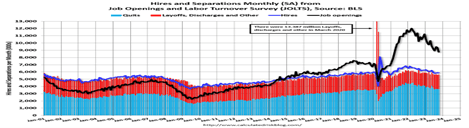
There is another obscure economic statistic that can show a better next year. It’s the Labor Department’s JOLTS report that counts the number of job openings each month. The number of openings was sky-high after the COVID pandemic as evidenced by the black line in Calculated Risk’s graph because employers wanted to re-hire workers as the economy recovered so quickly.

Calculated Risk/BLS.gov

It has been steadily declining since then, as has the number of hires (blue line).

But the unemployment rate is still below 4 percent (currently 3.9%) and has been since December 2021. Americans are fully employed, and companies are wanting to hire more despite inflation and soaring interest rates.

“The number of job openings decreased to 8.7 million on the last business day of October, the U.S. Bureau of Labor Statistics reported today. Over the month, the number of hires and total separations changed little at 5.9 million and 5.6 million, respectively. Within separations, quits (3.6 million) and layoffs and discharges (1.6 million) changed little.”

The difference between hires (5.9 million) and separations (5.6 million) in the JOLTS report means approximately 300,000 new jobs were created in November, changing little in the employment picture.

That should tell us there will be a strong November unemployment report on Friday, though slower GDP growth is forecast for the fourth quarter. Americans are experiencing an incredible recovery, fastest in the developed world, including China.

Harlan Green © 2023

Follow Harlan Green on Twitter: https://twitter.com/HarlanGreen
Posted in Consumers, COVID-19, Economy, Weekly Financial News | Tagged , , , , , | 1 Comment