Our Budget Deficit Isn’t the Problem

Financial FAQs

Harvard Economics Professor and former Treasury Secretary Larry Summers said Tuesday during an event staged by the Center for American Progress, a Democratic Party-aligned think tank, that the U.S. budget deficit, which came in at $1.7 trillion in 2023, “is probably a more serious problem than it ever has before.”

Really? We have the fastest growing economy in the developed world—up 4.9 percent annually in the third quarter. But the new Republican House Speaker wants to slash spending in the name of cutting the deficit, which is an attempt to cut back on President Biden’s New, New Deal programs that will modernize the American economy by “paying it forward” in the words of Senator Elizabeth Warren for future generations.

So, this is not the time to worry about the budget deficit, though it’s the highest since World War Two.

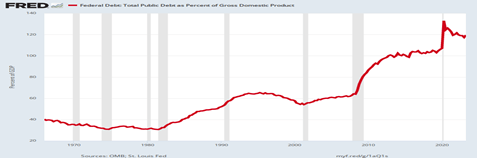
Professor Summers had been very good at convincing Presidents Clinton and Obama at reducing budget deficits. So much so that President Clinton had four consecutive years of budget surpluses from 1996-2000. That worked when the Soviet Union broke up ending the Cold War and the US was able to make huge cuts in military spending.

But it’s not good advice today as it wasn’t a good idea to limit FDR’s New Deal spending when our government had to re-arm to win World War II. There are two regional wars today, and we’ve had to spend $trillions just to win the COVID world war.

The massive debt accumulated during WWII was paid down quickly when the technological advances spurred by those wartime investments brought soaring economic growth and post-war prosperity.
FREDdebt/GDP

The same will happen today because the $trillions in debt that is modernizing the US economy, the educational system, and our social safety net is investing in future growth.

We are already seeing the results with soaring Q3 GDP growth and a historically low unemployment rate, but only if the debt is paid down with growth rather than slashing spending prematurely at the time it is most needed.

The current budget battle is over what to spend. Republicans want to raise the retirement age for Social Security and Medicare and cut benefits, as well as slash spending on money already approved to expand IRS operations, which is meant to collect long overdue taxes, thus improving the deficit.

It’s the Repubs backdoor way of cutting federal spending by reducing tax revenues, thus protecting their wealthy donors who have thrived with all manner of tax shelters.

Their initial proposal is to pay for Biden’s war funding by taking $14 billion away from the IRS budget, which budget analysts say will actually cost $40 billion because of lost tax revenues from the reduction of tax collections.

And what about aiding the democracies fighting two wars and winning the climate change battle, just as we needed to win WWII to survive as a democracy?

Our government must also worry about the Fed. The debate is still when the Fed will begin to lower their short-term rates in time to prevent a recession.

Harlan Green © 2023

Follow Harlan Green on Twitter: https://twitter.com/HarlanGreen

Posted in Consumers, COVID-19, Economy, Keynesian economics, Politics, Weekly Financial News | Leave a comment

Where’s the Recession?

Popular Economics Weekly

Is waiting for the next recession becoming a useless guessing game? Maybe even the event itself has less meaning these days when conditions can change so quickly.

We have declining existing home sales yet surging new-home sales in September. And the first ‘advance’ estimate of third quarter economic growth made a huge jump to 4.9 percent, up from 2.1 percent in Q2.

BEA.gov

Economists and pundits have been calling for a recession since the beginning of this year. Yet the Fed’s rate hikes haven’t dampened consumer spending, which grew 4 percent in Q3. It highlights the fact that American consumers power more than 60 percent of economic activity.

And inflation continued to decline, contrary to the Fed’s expectations, which is a growth booster. The personal consumption expenditures (PCE) price index increased 2.9 percent, compared with an increase of 2.5 percent in Q2, per the GDP report. Yet excluding more volatile food and energy prices, the PCE price index increased 2.4 percent, compared with an increase of 3.7 percent.

So where is the recession? It doesn’t have to be two consecutive quarters of negative GDP growth. The US economy began to expand again in the third quarter of 2022 after two quarters of negative growth per the above BEA graph.

The technical definition of a recession is when basic growth indicators such as nonfarm payrolls, retail sales, and industrial production have peaked and begin a prolonged decline.

That could still happen next year if long-term interest rates remain high. Yet who does that really affect? Companies like to plan ahead so corporations can cut back investing in future growth. but our federal government is spending $trillions on modernizing the economy as well as fighting both hot and cold wars.

And retail sales keep expanding. Seasonally adjusted sales came off ground zero (+0.4 percent) in June 2023 and expanded 3.0 percent in September.

Now is a good time for Fed Chairman Powell to announce that inflation has been conquered, as so many economists are doing. For instance, Nobel Laureate Paul Krugman said recently:

“Growth, both in gross domestic product and in jobs, has remained solid. But standard measures of underlying inflation are now under 3 percent and falling. Fancier statistical models maintained by the New York Fed tell the same story, and say that underlying inflation has fallen by half since its peak last year.”

The reason? The Fed’s anti-inflation policies are working. But there is a time lag for higher interest rates to fully affect consumers and investors. Household wealth as well as incomes continue to stay ahead of inflation.

The Federal Reserve recently announced that the average family’s net worth jumped 37 percent between 2019 and 2022. That’s the largest three-year increase since the Fed began conducting the survey more than three decades ago, according to its latest Survey of Consumer Finances.

It’s not only due to consumers being fully employed but a massive increase in housing values during the pandemic when mortgage rates bottomed.

Both the Great Depression and Great Recession were catastrophic times but how often do such events happen? It doesn’t look like we have as much to fear given the current economic recovery.

Harlan Green © 2023

Follow Harlan Green on Twitter: https://twitter.com/HarlanGreen
Posted in Consumers, COVID-19, Economy, Housing, housing market, Weekly Financial News | Leave a comment

Housing Must Be Saved

The Mortgage Corner

Realtors are loudly crying that holding interest rates at the current high level for a prolonged period is destroying the housing market., I said recently. Existing-home sales are now at the lowest level since the Great Recession, and the danger is a serious housing downturn could lead to another recession.

It has prompted NAR chief economist Lawrence Yun to say, “As has been the case throughout this year, limited inventory and low housing affordability continue to hamper home sales. The Federal Reserve simply cannot keep raising interest rates in light of softening inflation and weakening job gains.”

Why is he so concerned? The 10-year benchmark Treasury yield that determines fixed mortgage rates has just breached 5 percent for the first time since July 2007, causing mortgage rates to soar.

This last happened in the lead up to the busted housing bubble and Great Recession of 2007-2009.

Alan Greenspan’s Federal Reserve at the time had raised their Fed Funds rate to 5.25 percent on August 2006 and held it to June 2007 before easing credit conditions. The Great Recession was determined to have begun in December 2007. There is not as much danger of it happening today because bank reforms have made financial markets more wary, yet past housing market downturns have been predictive of past recessions.

The same confluence of high mortgage rates with the Fed Funds rate is in danger of happening again today, only much more quickly as the real estate market has shrunk drastically during the Fed’s current tightening cycle.

FRED30yr

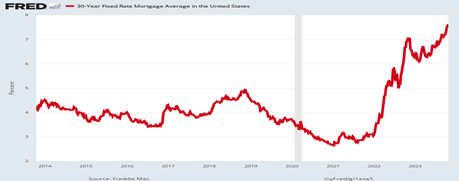
According to Freddie Mac, the 30-year fixed rate mortgage averaged 7.57 percent as of October 12 (see above FRED graph). That’s up from 7.49 percent the previous week and 6.92 percent one year ago.

Existing-home sales fell even lower in September, according to the National Association of REALTORS®. Among the four major U.S. regions, sales rose in the Northeast but receded in the Midwest, South and West. All four regions registered year-over-year sales declines.

Total existing-home sales1 – completed transactions that include single-family homes, townhomes, condominiums and co-ops – waned 2.0% from August to a seasonally adjusted annual rate of 3.96 million in September. Year-over-year, sales dropped 15.4% (down from 4.68 million in September 2022), said the NAR.

Single-family home sales slipped to a seasonally adjusted annual rate of 3.53 million in September, down 1.9% from 3.6 million in August and 15.8% from the prior year. The median existing single-family home price was $399,200 in September, up 2.5% from September 2022, said the National Association of Realtors (NAR).

Such  a mortgage rate has made housing even less affordable for first-time home buyers. First-time buyers were responsible for 27% of sales in September, down from 29% in August 2023 and September 2022, and pre-pandemic levels closer to 40 percent.

NAR’s 2022 Profile of Home Buyers and Sellers – released in November 2022 – found that the annual share of first-time buyers was 26%, the lowest since NAR began tracking the data.

A record number of multi-family units (apartments) are under construction, as there are now a record number of Americans needing some kind of housing, and more apartments might create more affordable rents.

But it won’t satisfy those still holding the American dream of owning their own home, I said last week. “For the third straight month, home prices are up from a year ago, confirming the pressing need for more housing supply,” Yun said.

Have the Fed Governors learned from their actions leading to the Great Recession? They again reached the 5.25 percent rate recently after raising their interest rate for more than one year. The question will be how long they dare to keep it so high without causing another recession.

Long-term interest rates may stay high because of the unusual flood of Treasury securities on the market that is financing a new industrial resurgence and the need for higher military spending.

But there’s no need for the Fed to continue to restrict credit with inflation in decline. We need higher economic growth more than ever with so much geopolitical uncertainty, and a poor housing market.

Harlan Green © 2023

Follow Harlan Green on Twitter: https://twitter.com/HarlanGreen

Posted in Consumers, COVID-19, Economy, Housing, housing market, Weekly Financial News | Leave a comment

Too Little Growth a Danger

Popular Economics Weekly

Rather than worry about too much inflation still in the pipeline, we should worry about too little economic growth going forward, if we take Chairman Powell at his word in his latest speech at a recent economic forum that the Fed should keep their rates high enough that economic growth will be in the 2 percent range to achieve the Fed’s target inflation rate of 2 percent inflation.

But Realtors are loudly crying that holding interest rates at the current high level is destroying the housing market.

Remarking on the fact that existing-home sales are now at the lowest level since the Great Recession, NAR chief economist Lawrence Yun said ,

“As has been the case throughout this year, limited inventory and low housing affordability continue to hamper home sales. The Federal Reserve simply cannot keep raising interest rates in light of softening inflation and weakening job gains.”

Chairmen Powell’s truism wasn’t always the case. A look at the below FRED graph dating from 1950, shows economic growth was ‘held’ in the 2 percent range only after 1980 and former Fed Chairman Paul Volcker’s era of setting sky high interest rates until the sky high inflation originating in the 1970s was tamed (gray bars are recessions).

But to accomplish it, Volcker’s Federal Reserve believed a massive transfer of wealth from salaried workers to owners of capital (shareholders and corporate CEOs in the main) was necessary. Why? Volcker’s Federal Reserve believed that the economy couldn’t tolerate an inflation rate with average hourly wages rising much more than 2 percent per year.

FREDgdp

This was obviously an overreaction to the 1970s wage-price spiral. Yet prior to 1980 quarterly GDP growth averaged closer to 5 percent, and there was a much more equal distribution of income between employees and employers.

The Fed under Volcker’s successor, Alan Greenspan, had done such a good job of tamping down wage increases that too low inflation was the worry in 2009 after the busted housing bubble and Great Recession. It was the reason his successor, Ben Bernanke, instituted the Quantitative Easing (QE) policies that injected enough money into the system to bring the inflation rate back to its 2 percent target.

Existing-home sales faded in September, according to the National Association of REALTORS®. Among the four major U.S. regions, sales rose in the Northeast but receded in the Midwest, South and West. All four regions registered year-over-year sales declines.

A record number of multi-family units (apartments) are under construction, as there are now a record number of Americans needing some kind of housing, and more apartments might create more affordable rents.

But it won’t satisfy those still holding the American dream of owning their own home. “For the third straight month, home prices are up from a year ago, confirming the pressing need for more housing supply,” Yun said.

Now is not a good time for the Fed to continue to restrict credit. We need higher economic growth now more than ever with so much geopolitical uncertainty, and a poor housing market.

Harlan Green © 2023

Follow Harlan Green on Twitter: https://twitter.com/HarlanGreen
Posted in Consumers, COVID-19, Economy, Housing, housing market, Politics, Weekly Financial News | Leave a comment

Retail Sales Will Save Us

Financial FAQs

The debate is raging on when the Fed will begin to lower their short-term rates in time to prevent a recession. A number of pundits and economists, such as Nobel Laureate Paul Krugman, have said the inflation battle has been won. And most Fed Governors are now saying they should not raise interest rates any higher.

The problem is the bond market doesn’t’ believe so, even believes the latest robust economic data show growth not slowing enough to pacify the Fed, hence 10-year and 30-year bond yields are soaring above 4 percent and fixed mortgage rates above 7 percent in the expectation that the Fed will cause a recession.

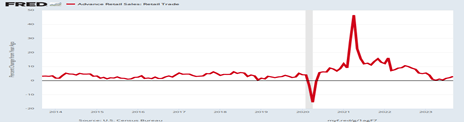
Well, retail sales might save us from a recesssion. Sales are surging, far above consensus estimates, recovering from negative sales growth in February and March 2023. Consumers are supposed to slow spending when the Fed raises the cost of borrowing, aren’t they? What is going on?

FREDretail

“Advance estimates of U.S. retail and food services sales for September 2023, adjusted for seasonal variation and holiday and trading-day differences, but not for price changes, were $704.9 billion, up 0.7 percent (±0.5 percent) from the previous month, and up 3.8 percent (±0.7 percent) above September 2022,” said the Census Bureau’s press release.

I said last week economic growth is increasing because there has been a huge surge in job formation—336,000 new jobs in September alone with higher revisions in the past two months. And wages are now rising faster than inflation for the first time in years, so why wouldn’t consumers want to spend with the upcoming holidays?

And we have the Atlanta Fed in its latest forecast saying, “The GDPNow model estimate for real GDP growth (seasonally adjusted annual rate) in the third quarter of 2023 is 5.1 percent on October 10, up from 4.9 percent on October 5. The consensus for Q3 economic GDP growth is a bit lower, probably in the 3-4 percent range.

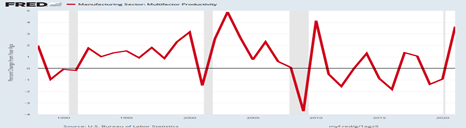
I maintain there’s also another reason, a rise in what is called multifactor productivity, which measures capital inputs (machines, new technologies) as well as labor productivity, and it is soaring per the below FRED graph. It rose to 3.6 percent in 2021 from zero in 2020. This will create a greater supply of things, which puts downward pressure on prices, as do more workers producing more.

FREDproductivity

Is it because of the increased use of AI, which is a capital input? That’s too soon to know, but Doctors are already reporting more accurate diagnoses using AI to quickly find bad genes to determine what should be done with a cancer tumor.

“Over the last decade, the supply chain landscape has witnessed a transformative evolution, largely propelled by technological advancements. Such innovations as AI, the Internet of Things (IoT), blockchain and sophisticated data analytics have automated and optimized various aspects of supply management,” said an Institute for Supply Management article on automation.

The real key to staying fully employed while taming inflationary surges is also to avoid too much geopolitical uncertainty (wars), and preparing better for future pandemics that disrupt said supply chains.

Harlan Green © 2023

Follow Harlan Green on Twitter: https://twitter.com/HarlanGreen
Posted in Consumers, COVID-19, Economy, Politics, Weekly Financial News | Leave a comment

Too Low Inflation a Danger

Popular Economics Weekly

Rather than worry about too much inflation still in the pipeline, we should worry about too little inflation going forward. The Producer Price Index of wholesale goods and services in September was 2.2 percent. It hit the Fed’s 2 percent target rate sometime between April-May this year. It then plunged to a zero inflation rate in June 2023 before rising to the current 2.2 percent inflation rate.

FREDppi

Too low inflation was the worry in 2009 after the Great Recession and the reason former Fed Chair Ben Bernanke instituted the Quantitative Easing (QE) policies that injected enough money into the system to bring the inflation rate back to its 2 percent target.

Today’s 2.2 percent PPI tells us the cost of wholesale goods and services has reached the Fed’s target rate and is a reason the Fed may have gone too far in suppressing wholesale prices. It means the supply chains have recovered and could even be over producing, which would continue to depress prices.

Why be worried when prices have risen so much in just two years? Final Demand Producer prices peaked in March 2022 at 12 percent. Consumers want prices to come down, after all.

But it’s a very dangerous monetary policy to suppress demand with such high interest rates for a prolonged period as Fed officials are saying they want to do.

Companies and consumers can quickly change course should there be more unforeseen consequences, such as a wider Middle East war creating scarcities that push prices up again. The 3.3 percent rise in final demand energy prices was the major culprit of the September PPI report.

The retail Consumer Price Index for September was a bit higher because of rising shelter costs and gas prices. But the headline all items annual inflation rate remained at 3.7 percent as in August.

“The index for shelter was the largest contributor to the monthly all items increase, accounting for over half of the increase. An increase in the gasoline index was also a major contributor to the all items monthly rise,” said the BLS.

So which index is more accurate?

The other Personal Consumption Expenditure Index (PCE) is rising at 3.5 percent over 12 months, right in the middle, and is probably the best picture of overall inflation. It shows the same bell curve and has also flattened of late.

“It’s the latest encouraging sign for Fed policymakers, who have been raising interest rates since March 2022 in a campaign to slow the economy and cool price increases,’ said NYTimes Jeanna Smialek. “While economic momentum has held up better than expected, a less ebullient housing market and a grinding return to normalcy in the car market have helped key prices — like automobile and rents — to fade.”

Unfortunately, the release of the Fed’s September FOMC minutes showed Fed officials aren’t yet getting the message that their credit policy may be too restrictive.

MarketWatch reporter Greg Robb summed it up: “The 12 voting Fed officials were unanimous in their decision to keep interest rates at a 22-year high, between 5.25% and 5.5 while penciling an additional rate hike before the end of the year to bring down inflation. “Almost all” of the 19 Fed officials supported holding rates steady, the minutes said.”

I’m hoping circumstances will convince them a more dovish stance on inflation is warranted.

Harlan Green © 2023

Follow Harlan Green on Twitter: https://twitter.com/HarlanGreen

Posted in Consumers, COVID-19, Economy, Macro Economics, Weekly Financial News | 1 Comment

Higher Growth Ahead!

Financial FAQs

Why have stocks and bonds been gyrating so much this year? It’s partly because a confused Federal Reserve doubts inflation is approaching their 2 percent target, and so won’t signal when they might begin to reduce their sky high interest rates.

Financial markets are confused as well because they still don’t know if we will have higher growth, or a recession. That’s difficult to understand since we have been at historically low unemployment for more than one year, which is hardly a sign of looming inflation.

At least one GDP growth optimist, the Atlanta Federal Reserve, has been putting what it calls its GDPNow estimate of future economic growth very high, predicting a 5.1 percent growth rate in the third quarter, more than double the first two quarters.

AtlantaFed

Why? It’s mainly because there has been a huge surge in job formation—336,000 new jobs in September alone and higher revisions in the past two months.

The Atlanta Fed in its latest forecast said, “The GDPNow model estimate for real GDP growth (seasonally adjusted annual rate) in the third quarter of 2023 is 5.1 percent on October 10, up from 4.9 percent on October 5. After last week’s employment situation release from the US Bureau of Labor Statistics and this morning’s wholesale trade report from the US Census Bureau, the nowcasts of third-quarter real gross private domestic investment growth and third-quarter real government spending growth increased from 5.9 percent and 2.2 percent, respectively, to 6.7 percent and 3.0 percent.”

That’s a mouthful to comprehend but other forecasters are also revising their Q3 GDP growth estimates as high as 4 percent.

Another indicator of robust job growth is the JOLTS report on job openings, a measure of labor demand. The number of job openings rose 690,000 to 9.610 million job vacancies on the last day of August. That was the biggest jump in two years. And data for July was also revised higher to show 8.920 million job openings instead of the 8.827 million previously reported, as I reported last week.

Meanwhile, the number of so-called dovish Fed Governors that want to halt further rate increases is growing. Atlanta Fed President Raphael Bostic said the Fed can afford to be patient if inflation continues to slow, speaking at an event in Atlanta.

The goal of the Fed is to reduce inflation to 2 percent a year, Bostic said, but the central bank doesn’t have to get there “tomorrow,” reported MarketWatch.

“I think our policy is sufficiently restrictive at this point to get us to the 2% target,” Bostic said later in a call with reporters.

Another dove is the Minneapolis Fed President Neil Kashkari. Kashkari, who is a voting member of the Fed’s interest-rate committee this year, said the job market has remained resilient even with all the Fed’s rate hikes over the past year and a half.

“We feel like we’re on track for a soft landing,” Kashkari said, with inflation coming down and avoiding a deep recession. “So far, things are looking hopeful, but it’s too soon to declare victory.”

Whereas many Fed officials are being coy about future inflation trends because they fear the economy could overheat once again, leading the Fed to raise interest rates even higher, hance the recession fears.

But what could cause another recession unless we have another pandemic—wars and soaring energy prices? It is not happening at present. But this uncertainty will keep Wall Street in a tither for months, and the Fed from reducing their interest rates anytime soon, unfortunately.

Harlan Green © 2023

Follow Harlan Green on Twitter: https://twitter.com/HarlanGreen

Posted in Consumers, COVID-19, Economy, Politics, Weekly Financial News | Leave a comment

Hot Labor Market and Lower Inflation Possible?

 Popular Economics Weekly

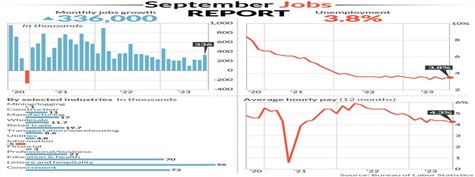
Total nonfarm payrolls rose by 336,000 in September, and the unemployment rate was unchanged at 3.8 percent, the U.S. Bureau of Labor Statistics reported today. Job gains occurred in leisure and hospitality; government; health care; professional, scientific, and technical services; and social assistance. Whereas wage growth continued to decline.

MarketWatch

The real truth from this very strong unemployment report is that consumers in a full-employment economy will keep spending. Why? Because their wages are increasing faster than the inflation rate, which is now nearing the Fed’s 2 percent target.

Every sector except Information services added jobs, beginning with Leisure and Hospitality (96,000), Government (73,000), Education & Health (70,000), which is a sure sign that economic growth is picking up. The government also raised its estimate of job gains in August to 227,000 from 187,000, and July was revised up to 236,000 from 157,000.

This should indicate third quarter GDP growth estimates as high as 4 percent are accurate, double the first two quarters, yet average hourly wage growth is slowing, probably because most new jobs are in the lower-paying service sector.

conferenceboard.org

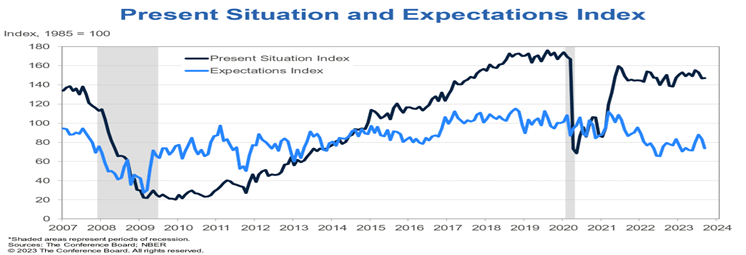
We can understand why consumers are a bit confused. They still feel good about the present but worry about higher prices and yet continue to worry about a possible upcoming recession, which is reflected in the Conference Board’s Consumer Confidence survey.

“September’s disappointing headline number reflected another decline in the Expectations Index, as the Present Situation Index was little changed,” said Dana Peterson, Chief Economist at The Conference Board. “Write-in responses showed that consumers continued to be preoccupied with rising prices in general, and for groceries and gasoline in particular.”

So why then the recession fears? I believe this is largely the fault of Federal Reserve officials who continue to confuse both the public and financial markets about their intentions when signs are now indicating that we can have higher economic growth and lower inflation.

Why is lower inflation possible? More job creation means more is being produced, giving consumers more choices with some help from newer technologies (such as AI?) that should boost labor productivity.

Harlan Green © 2023

Follow Harlan Green on Twitter: https://twitter.com/HarlanGreen
Posted in Consumers, COVID-19, Economy, Weekly Financial News | Leave a comment

Why the Labor Shortage?

Financial FAQs

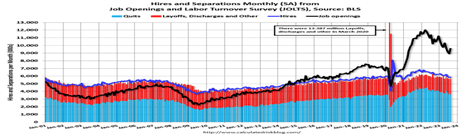
Once again, we begin the countdown to the unemployment report by parsing the Job Openings and Labor Turnover Survey (JOLTS) report on the number of job vacancies in the U.S. economy. The August report shows an extremely tight labor market.

Firstly, the JOLTS report tells us there is a definite worker shortage at a time of record employment. This has given labor unions the upper hand in negotiating new labor contracts.

CalculatedRisk/BLS

Job openings, a measure of labor demand, were up 690,000 to 9.610 million on the last day of August. That was the biggest jump in two years, reported Reuters. Data for July was revised higher to show 8.920 million job openings instead of the 8.827 million previously reported.

“Over the month, the number of hires (blue line in graph) and total separations (light blue bar) changed little at 5.9 million and 5.7 million, respectively,” said the Bureau of Labor Statistics (BLS). “Within separations, quits (3.6 million) and layoffs and discharges (1.7 million) changed little.”

This means the unemployment rate and nonfarm payroll count due out Friday may change little as well. The difference in the JOLTS report between hires and separations was 200,000 (5.9m-5.7m). The consensus for Friday’s unemployment report is an increase of 150,000 to 170,000 nonfarm payroll jobs with the unemployment rate holding at 3.8 percent.

FREDunemployment

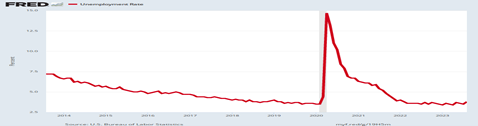
To give us an idea of its significance, the unemployment rate has been below 4 percent since January 2022, and just five times since the 1950s. Why so low currently? Because all the post-pandemic government recovery and development aid is priming economic activity. Never since World War Two has government spent so much on modernizing our economy.

Another jobs report by payroll processor ADP said U.S. private-sector employment rose by a tepid 89,000 in September, perhaps a sign the labor market is catching a chill in the early fall, said one commentator. That’s the smallest increase in two and a half years.

The ADP payroll estimate can offer clues on the strength of the labor market, but it’s not an accurate predictor of the government’s official employment report that follows. The two reports often vary widely from month to month, as was the case during the summer, even if they move in the same direction over time.

There is a solution to the labor shortage and such a tight labor market. More workers are entering the workforce, which is the best solution to the worker shortage. An additional 736,000 entered the workforce in July, including an influx of immigrants.

That is another reason the Fed might want to pause any further rate hikes.

Harlan Green © 2023

Follow Harlan Green on Twitter: https://twitter.com/HarlanGreen
Posted in Consumers, COVID-19, Economy, Macro Economics, Weekly Financial News | Leave a comment

It’s the Pandemic Stupid!

Popular Economics Weekly

Economists are beginning to say enough is enough. The Fed might continue to pause from another rate hike in their November FOMC meeting because the latest inflation data show a continued decline, but not in December.

“Although inflation has come down from the peak reached last year, it is still too high,” New York Fed President John Williams said in a prepared speech. “We still have a ways to go to fully restore price stability.”

To borrow from some economists who fear the Fed is getting the causes of inflation wrong and thereby keeping interest rates too high, the current inflation surge was caused by the COVID pandemic, stupid!

Yet listening to Fed Chair Powell, you would think most of the Fed Governors believe it was caused by higher wages, since Econ 101 postulates that wages comprise some two-thirds of product costs, therefore costs will rise or fall in line with wages.

That has been an economic truism since the 1970s, even though there was an Arab oil embargo in 1973 that brought shortages and sky-high gas prices leading to the so-called wage-price spiral that has traumatized the Fed since then.

Major economists such as former White House Chief Economist Jason Furman and Nobel laureate Paul Krugman have spoken about the dangers of prolonging higher interest rates, despite the rapid inflation decline.

“The question now is whether we’ll get a recession anyway — basically, whether Fed tightening will produce an unnecessary recession,” says Krugman. “And the picture there is very muddy. Milton Friedman’s famous line about “long and variable lags” has come in for a lot of questioning lately, with some suggestions that the lags may have gotten a lot shorter. If the lags are long, we may stumble into a recession; if not, not.”

@JasonFurman

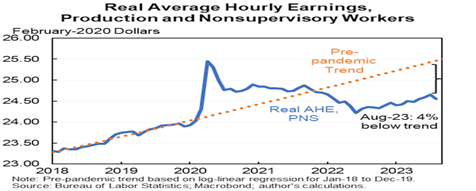
Furman’s assertion is that wage growth can’t be a major determinate of inflation as it was in the 1970s, since it is still below the longer-term trend line.

“How are real wages doing? Most measures show they are up since prior to the pandemic but are still 3-5% below their immediate pre-pandemic trajectory.”

The real question should be why are so many meetings necessary to make the point that inflation should come down further?

The Federal Reserve Governors convene eight official vote-taking meetings per year after which they broadcast their intentions for policy—whether to raise, lower rates, or stand pat. This is really interfering with Wall Street’s own internal processes and the actual time lag needed for policy actions to take effect that determine the direction of inflation, causing the wild price fluctuations we see today.

Would the markets behave differently with fewer Fed pronouncements? Fed officials have been acting preemptively before seeing the results of their policies for decades, which let us not forget includes maximizing employment as well as price stability.

Today we have the COVID pandemic causing the product shortages that led to the current inflation spike, followed by the Ukraine-Russian war causing further shortages. But inflation has been declining anyway, much quicker than in the 1970s.

FREDpce

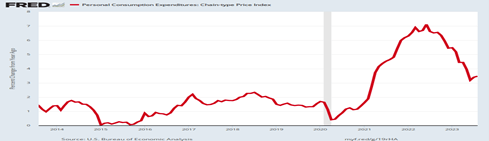
The favored measure of inflation, the Personal Consumption Expenditure Index (PCE) that measures a broad spectrum of products and services, has been declining fast. From the same month one year ago, the latest PCE price index for August increased 3.5 percent, per the FRED (St. Lous Fed) graph, down from its 7.1 percent peak in June 2022.

The danger with comparing it to the only analogy the Fed seems to come up with, the 1970s and the Arab oil embargo, is the damage it causes to wage and salary earners which comprise almost 80 percent of the adult work force.

Could the fear of not being taken seriously be the reason for so much Federal Reserve jawboning and unnecessarily high interest rates? Raising interest rates too high for too long has precipitated at least eight of the ten recessions since 1960, harming economic growth as well as household incomes.

Harlan Green © 2023

Follow Harlan Green on Twitter: https://twitter.com/HarlanGreen
Posted in Consumers, COVID-19, Economy, Politics, Weekly Financial News | Leave a comment