Housing Starts Up, Recession Worries Over?

Financial FAQs

The best indicator of a looming recession is to watch how consumers behave. And this will be a record year for travel on the ground and in the air. So, would consumers continue travelling if they saw financial trouble ahead? Of course not.

Gas Buddy, for one, says gas prices are down. For the ninth consecutive week, the nation’s average price of gasoline has declined, falling 6.2 cents from a week ago to $3.27 per gallon according to GasBuddy data compiled from more than 12 million individual price reports covering over 150,000 gas stations across the country.

And AAA is predicting a record number of cars on the road. the third highest since 2000. AAA projects 55.4 million travelers will head 50 miles or more from home over the Thanksgiving holiday travel period.

Housing construction and Pending Home sales numbers were also up in October. This may be an indication that the housing market slowdown may have bottomed, another sign of a resurgence.

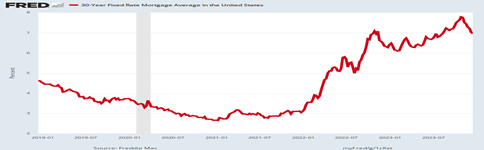
That’s in part because mortgage rates have dropped suddenly to the low 7 percent range, 15-year fixed to mid-6 percent, and homebuyers will know this. The bond market has been rallying of late, in line with optimism that the Fed may be done with its rate hikes and even begin to ease rates early next year.

The National Association of Realtors Pending Home Sales Index (PHSI)* – a forward-looking indicator of home sales based on contract signings – rose 1.1 percent to 72.6 in September. Pending transactions had declined 11% in a year.

The NAR forecasts that the 30-year fixed mortgage rate will average 6.9 percent for 2023 and decrease to an average of 6.3 percent in 2024, as markets unwind from the Fed’s rate hikes.

I can see blue skies ahead for housing as interest rates continue to decline. More existing homes for sale are needed, which are at historic lows because of the interest rate disparities from the COVID pandemic (see red line in below Calculated Risk graph).

Calculated Risk

Overall housing starts (new construction) increased 1.9 percent in October as well to a seasonally adjusted annual rate of 1.37 million units, according to a report from the U.S. Department of Housing and Urban Development and the U.S. Census Bureau.

The October reading of 1.37 million starts is the number of housing units builders would begin if development kept this pace for the next 12 months. Within this overall number, single-family starts increased 0.2 percent to a 970,000 seasonally adjusted annual rate.

However, single-family starts are down 10.6 percent year-to-date. The multifamily sector, where demand is greatest and includes apartment buildings and condos, increased 6.3 percent to an annualized 402,000 pace.

“The construction data in October continue to reflect that despite multidecade lows for housing affordability, the market continues to lack attainable inventory that only the home building industry can provide,” said NAHB Chief Economist Robert Dietz. “And with the 10-year Treasury rate now back in the 4.5% range, we are forecasting gains for single-family home building in the months ahead and an outright gain for construction in 2024.”

What are consumers thinking at the moment? Many have been discouraged from even looking for homes because of such high interest rates.

Overall, lower-income consumers and younger consumers exhibited the strongest declines in sentiment, said Joanne Hsu, Director of the University of Michigan sentiment survey. In contrast, sentiment of the top tercile of property owners improved 10 percent, reflecting the recent strengthening in equity markets.

It’s a reflection of the 37 percent increase in wealth of mostly homeowners from 2019 to 2022, according to a new survey from the Federal Reserve. The average family’s net worth jumped 37 percent between 2019 and 2022. That’s the largest three-year increase since the Fed began conducting the survey more than three decades ago.

The bottom line is with so much pent up demand brought on by the Fed’s inflation fight, consumers still want to spend, especially with interest rates on the decline.

Harlan Green © 2023

Follow Harlan Green on Twitter: https://twitter.com/HarlanGreen
Posted in Consumers, COVID-19, Economy, Housing, housing market, Weekly Financial News | Leave a comment

Building Community at Home

Answering Kennedy’s Call

Fulfilling the third goal of my Peace Corps service, “to help promote a better understanding of other peoples on the part of Americans,” wasn’t as easy to do. My PCV service was implementing a rural community development program in a Turkish village for two years in the 1960s. I partially fulfilled it on my return home by organizing tours of Turkey that was full of Greek and Roman tourist sites for Americans.

But I also found ways to bring back the knowledge I had learned in rural community development to my home community, an unincorporated area of Santa Barbara County that ultimately resulted in the formation of a new city.

What could be more community developing than that? This is an excerpt from my memoir published by peacecorpsworldwide.org › 2023-winner-of-the-peace2023 Winner of the Peace Corps Writers’ Publisher’s Award.

As a bedroom community to Santa Barbara, the Goleta Valley had no real community organization of its own other than the Goleta Valley Chamber of Commerce. It needed an established entity to ask for what was needed to improve the valley’s aging and dilapidated infrastructure, and to reduce chaotic development. More public transportation, water resources, and just smart community planning were needed to mitigate the effects of a growing population.

There was much opposition to any organizing effort that would create more than a bedroom community in the Goleta Valley. There were those who wanted to “belong” to the City of Santa Barbara so their property values would be the beneficiary of Santa Barbara property values. They wanted no part of a new, more rural city. Then there were the environmentalists that tended to cluster around UC Santa Barbara with its strong environmental studies program. They were afraid a new city would encourage more development.

But in fact, being unincorporated didn’t prevent development: property owners and developers had only to convince one County Supervisor that represented a larger area, rather than a city council responsible for the entire community.

Goletans couldn’t agree on what was unique about their own community. Was it a farming culture, bedroom community, or just funky adjunct to UC Santa Barbara? Many thought that, with prosperous Santa Barbara next door, what was the need for another city on the already crowded South Coast? Hence the impasse that had defeated earlier cityhood attempts.

The first step in building a livable community, in my view, had to be creating a town center that could focus planning efforts, and Old Town Goleta seemed just the place to do it. Old Town had been the historical center of the Goleta Valley with stores, a saloon, and a blacksmith for farmers in the early days.

It took two years’ of planning to accomplish just the first step that was formally approved by County Supervisors—The Goleta Old Town Revitalization Plan.

Follow Harlan Green on Twitter: https://twitter.com/HarlanGreen

Posted in Macro Economics, Politics, Uncategorized | 1 Comment

Where’s the Inflation–Part II?

Popular Economics Weekly

We can also look at the behavior of wholesale prices to see if inflation has been conquered. The Producer Price Index has been at or below the Fed’s target 2 percent since May 2023. It’s the cost of raw materials that go into finished products, so it should have told Fed officials that retail inflation will soon follow that is now rising at 3.2 percent.

What is holding up retail CPI prices? Market scarcities that have enabled producers to temporarily boost their profit margins. But the PPI tells us that scarcities are quickly disappearing; in autos and gas, for instance, where prices had the largest drop in the PPI.

FREDppifinaldemand

“The Producer Price Index for final demand fell 0.5 percent in October, seasonally adjusted, after advancing 0.4 percent in September, the U.S. Bureau of Labor Statistics reported today. The October decline is the largest decrease in final demand prices since a 1.2-percent drop in April 2020.”

What more proof does the Fed need to begin thinking about dropping interest rates? Corporations are reporting record profits in the third quarter due to those pandemic-induced scarcities and 98 percent reporting in the third quarter say they are increasing their dividends, a sure sign of increased profits.

The PPI is slightly higher without volatile foods, energy, and trade services, advancing +0.1 percent in October, the fifth consecutive rise. For the 12 months ended in October, prices for final demand less foods, energy, and trade services moved up 2.9 percent.

This may be the ‘head fake’ that Chairman Powell was talking about at a recent conference. What if food and energy scarcities surface again with all the geopolitical uncertainty?

If it wasn’t for the huge 4.9 percent Q3 GDP growth, economists will begin to worry that falling inflation shows a drop in the demand for goods and services, which does signal a slowdown.

Slowing retain sales can be the first sign of any slowdown in activity. Are shoppers already shopped out for the holidays? Retail sales have declined, falling 0.1 percent in October for the first time in seven months, but the decline is unlikely to last as Americans enter the holiday-shopping season, especially if prices are no longer rising.

There was better news with housing. The 30-year fixed-rate mortgage dropped a quarter of a percent to 7.50%, the largest one-week decrease since last November, according to Freddie Mac, the guarantor of mortgages.

It should kick start more housing sales, according to Lawrence Yun, the NAR’s chief economist. Yun forecasts that interest rates will drop to between 6-7% by the spring buying season and anticipates that more sellers will enter the market.

“Builders are back on their feet, up 5% in newly constructed home sales year to date,” said Yun. “Builders can simply create inventory. In a housing shortage environment, builders are really benefiting.”

What happens next year may depend on the housing market, which traditionally takes up approximately 7 percent of GDP activity, but is also a leading indicator of market direction.

The overall decline in interest rates we are already seeing will give a boost to almost every sector of economic activity going into next year.

Harlan Green © 2023

Follow Harlan Green on Twitter: https://twitter.com/HarlanGreen
Posted in Consumers, COVID-19, Economy, Housing, housing market, Weekly Financial News | Leave a comment

Where’s the Inflation?

Financial FAQs

What if there’s too little inflation? That’s actually the definition of a recession. It seems unlikely at the moment and inflation is still a major upset for consumers. But it could happen if the Fed doesn’t ease up on its hawkish position that inflation has yet to be tamed.

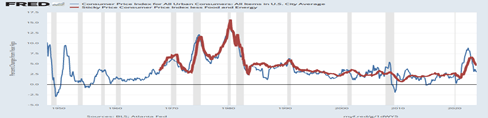
It hasn’t happened yet, but if inflation should drop below the 2 percent Fed target, it has generally meant recession. The CPI plunged to -1.96 percent annually in July 2009 at the end of the Great Recession and dropped to +0.22 percent in May 2020 (gray bar in graph) at the end of the short-lived COVID recession.

Economists are becoming alarmed that the Fed has boosted interest rates too high and too fast. The Fed has raised short-term rates a record 11 times since early 2022, from effectively 0 percent to around 5.25 percent.

Another Nobel Laureate, Joseph Stiglitz, is now added to the list of major economists giving warning. In a study co-authored by Ira Regmi, he believes the Fed is in danger of precipitating another recession if it holds its interest rates too high for too long.

“The pandemic-induced inflation was exacerbated further by Russia’s invasion of Ukraine, which caused a spike in energy and food prices,” said Stiglitz. “But, again, it was clear that prices could not continue to rise at such a rate, and many of us predicted that there would be disinflation — or even deflation (a decline in prices) in the case of oil.”

FREDcpi

And that is happening. The Consumer Price Index for All Urban Consumers (CPI-U) was unchanged in October on a seasonally adjusted basis, after increasing 0.4 percent in September, the U.S. Bureau of Labor Statistics reported today. It dropped to 3.2 percent from 3.7 percent in August. It was as high as 8.9 percent in June 2022.

In fact, the consensus of 34 economists surveyed by the Philadelphia Fed and released Monday is that there may not be any soft landing of the economy at all, but economic growth continuing into next year.

The Survey of Professional Forecasters is the oldest quarterly survey of macroeconomic forecasts in the U.S., having started in 1968.

“The outlook for the U.S. economy looks somewhat better now than it did three months ago,” the survey found, according to a MarketWatch article.

On an annual-average over annual average basis, the forecasters expect real GDP to increase at a 2.4 percent rate this year and slow only marginally to a 1.7 percent rate in 2024.

So the din is growing for the Fed to begin to cut rates early next year, though we wouldn’t know it from Fed Chair Powell’s remarks that the falling inflation numbers might be a ‘head fake’.

Why would Powell want to spoil the party celebrating continued growth? He must still have the 1970’s wage-price inflationary spiral in mind. It was a time of the Arab oil embargo and long lines at American gas stations, with unions attempting to keep up with the wildly fluctuating energy prices.

But Siglitz and Regmi addressed that as well in their study.

“We conclude that with nominal wages already tempered, this does not seem likely. Moreover, declining real wages are typically not a sign of a tight labor market. Weak unions, globalization, and changes in the structure of the economy provide part of the explanation for why wage-price dynamics today may be markedly different from 50 years ago.”

Stocks and bonds are rallying because of today’s good news on inflation, especially REITs (Real Estate Investment Trusts). This is a sign that the real estate market and housing in particular may be on the mend as well.

It also says there is growing optimism among investors that the Fed is done and will not want to obstruct future growth

Harlan Green © 2023

Follow Harlan Green on Twitter: https://twitter.com/HarlanGreen
Posted in Consumers, COVID-19, Economy, Housing, housing market, Weekly Financial News | Leave a comment

Why Not A Return to the ‘Roaring Twenties’?

The Mortgage Corner

“The Roaring Twenties was a decade of economic growth and widespread prosperity, driven by recovery from wartime devastation and deferred spending, a boom in construction, and the rapid growth of consumer goods such as automobiles and electricity in North America and Europe and a few other developed countries such as Australia.”

Does this sound familiar to history buffs? It’s Wikipedia’s take on the ‘Roaring 1920s’, the era of widespread prosperity and women’s rights as the US recovered from World War One and the Spanish Flu pandemic, in which some 650,000 Americans died.

I know I may be way out on a limb but there could be a repeat in this decade, which I’ve been calling the ‘Roaring Twenty-Twenties.’

There are similarities today. We are still recovering from the COVID pandemic that killed one million Americans, for starters. And consumers are spending like there’s no tomorrow.

The Trump and Biden administrations have passed spending bills of more than $6 trillion to aid the recovery and modernize the American economy, which will boost higher growth and household incomes for the rest of this decade.

And while we’re not fighting a world war, spending has picked up because of the Middle East and Ukrainian conflicts, just as it did fighting world wars.

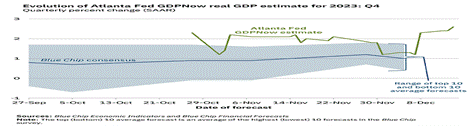
Such unprecedented spending is producing results. Third quarter US economic growth has soared to 4.9 percent after just 2 percent real growth in the first two quarters of 2023.

Predictions of Q4 growth are all over the map, in part because few believe that consumers can keep shopping at the current rate. Maybe not, but does that mean massive layoffs and an abrupt halt to the huge construction boom in infrastructure, the environment and expansion of the social safety net going forward?

No, because the Biden administration has focused on infrastructure, clean energy and semiconductor manufacturing, sectors that produce more high paying jobs, Lael Brainard, director of the National Economic Council, said at a White House press briefing.

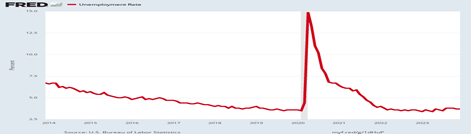
“Despite repeated forecasts that recession is just around the corner, the U.S. recovery is solid, and inflation is down. Unemployment has fluctuated in a narrow band below 4 percent for 17 months in a row—the longest stretch in 50 years (my emphasis),” said Brainard.

And since Biden took office in 2021 it has already spurred nearly $500 billion in private-sector commitments.

Critics, mostly conservatives that want smaller government say, however, that it is the major reason inflation isn’t coming down faster. But Brainard counters that annual core CPI inflation has now fallen and is projected to decline further as rents decelerate.

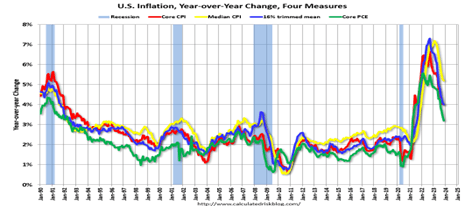
The closely watched category of core non-housing services CPI that Fed Chair Powell has said is most important has run at annualized rate of 3.3 percent over the last six months, close to the 3.2 percent average from the three decades before the pandemic and excluding the financial crisis.

FREDpceinflation

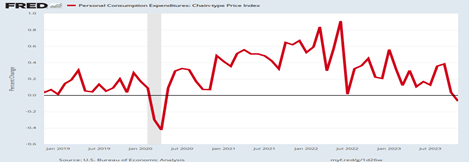
The more general Personal Consumption Expenditure (PCE) inflation indicator, another favored Fed price index is running at 3.4 percent annually per above FRED graph .

The latest economic data confirm the good news. Labor productivity in Q3 jumped to 4.9 percent, the highest in three years, according to the Bureau of Labor Statistics, in part because of more investment in new technologies such as AI, which means an increased supply of things. Production output in the third quarter rose 5.9 percent, hours worked rose just 1.1 percent. 

This is while unit-labor costs, a key measure of wage growth, fell 0.8 percent in the third quarter, the first decline since the fourth quarter of last year, which is another sign of falling inflation since labor costs make up two-thirds of production costs.

So why all the public pessimism that seems to prevail? Economics is a very opaque window to look through in understanding the American economy. The public looks at the cost of everything, and the Fed has raised interest rates at a record pace to slow inflation.

That’s why most Americans are focused on the past and present rather than the future, but this decade has just begun. The Roaring 20’s was a wild ride then, and it will be a wild ride again.

Harlan Green © 2023

Follow Harlan Green on Twitter: https://twitter.com/HarlanGreen

Posted in Consumers, COVID-19, Economy, Keynesian economics, Weekly Financial News | Leave a comment

Where’s the Recession-Part II?

Popular Economics Weekly

We will have to wait longer for a recession. October’s Jobs report showed even the unsettled labor strikes didn’t make much of a dent in the labor market. The usual suspects—leisure activities, healthcare, and a booming construction industry gave the most boost to hiring, but new government jobs were one third of the total 150,00 nonfarm payroll jobs created.

The loss of 33,000 in manufacturing was largely due to the UAW strikes, said the BLS.

MarketWatch.com

The financial markets are loving the slowdown in hiring. Even the past two months were adjusted lower in the report. The change in total nonfarm payroll employment for August was revised down by 62,000, from +227,000 to +165,000, and the change for September was revised down by 39,000, from +336,000 to +297,000.

The Fed likes the report because since their recent lows in April the unemployment rate is rising. The unemployment rate is up by 0.5 percentage point and there are 849,000 more unemployed persons.

Yet calls for an imminent recession are still in the air. Why still?? Firstly, it takes months, sometimes more than one year to call a recession, because a downturn must be long enough that there is a prolonged decline in demand from consumers as well as employers.

Most of the pessimists are taking the Fed’s word that they will keep rates high enough until they reach the 2 percent inflation target. What if that takes another year? Then all bets are off on when a recession might happen.

And this month’s jobs report can’t be taken too seriously on what might happen next because of the ongoing labor strikes, including SAG-AFTRA’s 130,000 members.

And NPR reports, “Altogether, there have been 312 strikes involving roughly 453,000 workers so far in 2023, compared with 180 strikes involving 43,700 workers over the same period two years ago, according to data by Johnnie Kallas, a PhD candidate at Cornell University’s School of Industrial and Labor Relations, and the project director of the ILR Labor Action Tracker.”

Putting most of the striking workers back to work could bring the unemployment rate back down, and the higher wages goose the inflation rate again.

So, who really knows where we will land next year?

Harlan Green © 2023

Follow Harlan Green on Twitter: https://twitter.com/HarlanGreen

Posted in Consumers, COVID-19, Economy, Macro Economics, Weekly Financial News | Leave a comment

Our Budget Deficit Isn’t the Problem

Financial FAQs

Harvard Economics Professor and former Treasury Secretary Larry Summers said Tuesday during an event staged by the Center for American Progress, a Democratic Party-aligned think tank, that the U.S. budget deficit, which came in at $1.7 trillion in 2023, “is probably a more serious problem than it ever has before.”

Really? We have the fastest growing economy in the developed world—up 4.9 percent annually in the third quarter. But the new Republican House Speaker wants to slash spending in the name of cutting the deficit, which is an attempt to cut back on President Biden’s New, New Deal programs that will modernize the American economy by “paying it forward” in the words of Senator Elizabeth Warren for future generations.

So, this is not the time to worry about the budget deficit, though it’s the highest since World War Two.

Professor Summers had been very good at convincing Presidents Clinton and Obama at reducing budget deficits. So much so that President Clinton had four consecutive years of budget surpluses from 1996-2000. That worked when the Soviet Union broke up ending the Cold War and the US was able to make huge cuts in military spending.

But it’s not good advice today as it wasn’t a good idea to limit FDR’s New Deal spending when our government had to re-arm to win World War II. There are two regional wars today, and we’ve had to spend $trillions just to win the COVID world war.

The massive debt accumulated during WWII was paid down quickly when the technological advances spurred by those wartime investments brought soaring economic growth and post-war prosperity.

FREDdebt/GDP

The same will happen today because the $trillions in debt that is modernizing the US economy, the educational system, and our social safety net is investing in future growth.

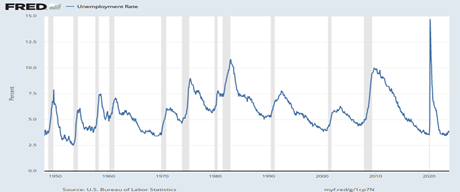
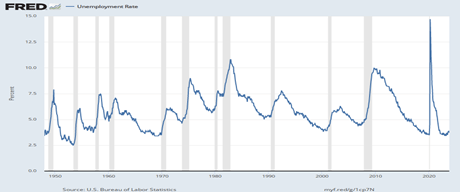
We are already seeing the results with soaring Q3 GDP growth and a historically low unemployment rate, but only if the debt is paid down with growth rather than slashing spending prematurely at the time it is most needed.

The current budget battle is over what to spend. Republicans want to raise the retirement age for Social Security and Medicare and cut benefits, as well as slash spending on money already approved to expand IRS operations, which is meant to collect long overdue taxes, thus improving the deficit.

It’s the Repubs backdoor way of cutting federal spending by reducing tax revenues, thus protecting their wealthy donors who have thrived with all manner of tax shelters.

Their initial proposal is to pay for Biden’s war funding by taking $14 billion away from the IRS budget, which budget analysts say will actually cost $40 billion because of lost tax revenues from the reduction of tax collections.

And what about aiding the democracies fighting two wars and winning the climate change battle, just as we needed to win WWII to survive as a democracy?

Our government must also worry about the Fed. The debate is still when the Fed will begin to lower their short-term rates in time to prevent a recession.

Harlan Green © 2023

Follow Harlan Green on Twitter: https://twitter.com/HarlanGreen
Posted in Consumers, COVID-19, Economy, Keynesian economics, Politics, Weekly Financial News | Leave a comment

Where’s the Recession?

Popular Economics Weekly

Is waiting for the next recession becoming a useless guessing game? Maybe even the event itself has less meaning these days when conditions can change so quickly.

We have declining existing home sales yet surging new-home sales in September. And the first ‘advance’ estimate of third quarter economic growth made a huge jump to 4.9 percent, up from 2.1 percent in Q2.

BEA.gov

Economists and pundits have been calling for a recession since the beginning of this year. Yet the Fed’s rate hikes haven’t dampened consumer spending, which grew 4 percent in Q3. It highlights the fact that American consumers power more than 60 percent of economic activity.

And inflation continued to decline, contrary to the Fed’s expectations, which is a growth booster. The personal consumption expenditures (PCE) price index increased 2.9 percent, compared with an increase of 2.5 percent in Q2, per the GDP report. Yet excluding more volatile food and energy prices, the PCE price index increased 2.4 percent, compared with an increase of 3.7 percent.

So where is the recession? It doesn’t have to be two consecutive quarters of negative GDP growth. The US economy began to expand again in the third quarter of 2022 after two quarters of negative growth per the above BEA graph.

The technical definition of a recession is when basic growth indicators such as nonfarm payrolls, retail sales, and industrial production have peaked and begin a prolonged decline.

That could still happen next year if long-term interest rates remain high. Yet who does that really affect? Companies like to plan ahead so corporations can cut back investing in future growth. but our federal government is spending $trillions on modernizing the economy as well as fighting both hot and cold wars.

And retail sales keep expanding. Seasonally adjusted sales came off ground zero (+0.4 percent) in June 2023 and expanded 3.0 percent in September.

Now is a good time for Fed Chairman Powell to announce that inflation has been conquered, as so many economists are doing. For instance, Nobel Laureate Paul Krugman said recently:

“Growth, both in gross domestic product and in jobs, has remained solid. But standard measures of underlying inflation are now under 3 percent and falling. Fancier statistical models maintained by the New York Fed tell the same story, and say that underlying inflation has fallen by half since its peak last year.”

The reason? The Fed’s anti-inflation policies are working. But there is a time lag for higher interest rates to fully affect consumers and investors. Household wealth as well as incomes continue to stay ahead of inflation.

The Federal Reserve recently announced that the average family’s net worth jumped 37 percent between 2019 and 2022. That’s the largest three-year increase since the Fed began conducting the survey more than three decades ago, according to its latest Survey of Consumer Finances.

It’s not only due to consumers being fully employed but a massive increase in housing values during the pandemic when mortgage rates bottomed.

Both the Great Depression and Great Recession were catastrophic times but how often do such events happen? It doesn’t look like we have as much to fear given the current economic recovery.

Harlan Green © 2023

Follow Harlan Green on Twitter: https://twitter.com/HarlanGreen
Posted in Consumers, COVID-19, Economy, Housing, housing market, Weekly Financial News | Leave a comment

Housing Must Be Saved

The Mortgage Corner

Realtors are loudly crying that holding interest rates at the current high level for a prolonged period is destroying the housing market., I said recently. Existing-home sales are now at the lowest level since the Great Recession, and the danger is a serious housing downturn could lead to another recession.

It has prompted NAR chief economist Lawrence Yun to say, “As has been the case throughout this year, limited inventory and low housing affordability continue to hamper home sales. The Federal Reserve simply cannot keep raising interest rates in light of softening inflation and weakening job gains.”

Why is he so concerned? The 10-year benchmark Treasury yield that determines fixed mortgage rates has just breached 5 percent for the first time since July 2007, causing mortgage rates to soar.

This last happened in the lead up to the busted housing bubble and Great Recession of 2007-2009.

Alan Greenspan’s Federal Reserve at the time had raised their Fed Funds rate to 5.25 percent on August 2006 and held it to June 2007 before easing credit conditions. The Great Recession was determined to have begun in December 2007. There is not as much danger of it happening today because bank reforms have made financial markets more wary, yet past housing market downturns have been predictive of past recessions.

The same confluence of high mortgage rates with the Fed Funds rate is in danger of happening again today, only much more quickly as the real estate market has shrunk drastically during the Fed’s current tightening cycle.

FRED30yr

According to Freddie Mac, the 30-year fixed rate mortgage averaged 7.57 percent as of October 12 (see above FRED graph). That’s up from 7.49 percent the previous week and 6.92 percent one year ago.

Existing-home sales fell even lower in September, according to the National Association of REALTORS®. Among the four major U.S. regions, sales rose in the Northeast but receded in the Midwest, South and West. All four regions registered year-over-year sales declines.

Total existing-home sales1 – completed transactions that include single-family homes, townhomes, condominiums and co-ops – waned 2.0% from August to a seasonally adjusted annual rate of 3.96 million in September. Year-over-year, sales dropped 15.4% (down from 4.68 million in September 2022), said the NAR.

Single-family home sales slipped to a seasonally adjusted annual rate of 3.53 million in September, down 1.9% from 3.6 million in August and 15.8% from the prior year. The median existing single-family home price was $399,200 in September, up 2.5% from September 2022, said the National Association of Realtors (NAR).

Such  a mortgage rate has made housing even less affordable for first-time home buyers. First-time buyers were responsible for 27% of sales in September, down from 29% in August 2023 and September 2022, and pre-pandemic levels closer to 40 percent.

NAR’s 2022 Profile of Home Buyers and Sellers – released in November 2022 – found that the annual share of first-time buyers was 26%, the lowest since NAR began tracking the data.

A record number of multi-family units (apartments) are under construction, as there are now a record number of Americans needing some kind of housing, and more apartments might create more affordable rents.

But it won’t satisfy those still holding the American dream of owning their own home, I said last week. “For the third straight month, home prices are up from a year ago, confirming the pressing need for more housing supply,” Yun said.

Have the Fed Governors learned from their actions leading to the Great Recession? They again reached the 5.25 percent rate recently after raising their interest rate for more than one year. The question will be how long they dare to keep it so high without causing another recession.

Long-term interest rates may stay high because of the unusual flood of Treasury securities on the market that is financing a new industrial resurgence and the need for higher military spending.

But there’s no need for the Fed to continue to restrict credit with inflation in decline. We need higher economic growth more than ever with so much geopolitical uncertainty, and a poor housing market.

Harlan Green © 2023

Follow Harlan Green on Twitter: https://twitter.com/HarlanGreen
Posted in Consumers, COVID-19, Economy, Housing, housing market, Weekly Financial News | Leave a comment

Too Little Growth a Danger

Popular Economics Weekly

Rather than worry about too much inflation still in the pipeline, we should worry about too little economic growth going forward, if we take Chairman Powell at his word in his latest speech at a recent economic forum that the Fed should keep their rates high enough that economic growth will be in the 2 percent range to achieve the Fed’s target inflation rate of 2 percent inflation.

But Realtors are loudly crying that holding interest rates at the current high level is destroying the housing market.

Remarking on the fact that existing-home sales are now at the lowest level since the Great Recession, NAR chief economist Lawrence Yun said ,

“As has been the case throughout this year, limited inventory and low housing affordability continue to hamper home sales. The Federal Reserve simply cannot keep raising interest rates in light of softening inflation and weakening job gains.”

Chairmen Powell’s truism wasn’t always the case. A look at the below FRED graph dating from 1950, shows economic growth was ‘held’ in the 2 percent range only after 1980 and former Fed Chairman Paul Volcker’s era of setting sky high interest rates until the sky high inflation originating in the 1970s was tamed (gray bars are recessions).

But to accomplish it, Volcker’s Federal Reserve believed a massive transfer of wealth from salaried workers to owners of capital (shareholders and corporate CEOs in the main) was necessary. Why? Volcker’s Federal Reserve believed that the economy couldn’t tolerate an inflation rate with average hourly wages rising much more than 2 percent per year.

FREDgdp

This was obviously an overreaction to the 1970s wage-price spiral. Yet prior to 1980 quarterly GDP growth averaged closer to 5 percent, and there was a much more equal distribution of income between employees and employers.

The Fed under Volcker’s successor, Alan Greenspan, had done such a good job of tamping down wage increases that too low inflation was the worry in 2009 after the busted housing bubble and Great Recession. It was the reason his successor, Ben Bernanke, instituted the Quantitative Easing (QE) policies that injected enough money into the system to bring the inflation rate back to its 2 percent target.

Existing-home sales faded in September, according to the National Association of REALTORS®. Among the four major U.S. regions, sales rose in the Northeast but receded in the Midwest, South and West. All four regions registered year-over-year sales declines.

A record number of multi-family units (apartments) are under construction, as there are now a record number of Americans needing some kind of housing, and more apartments might create more affordable rents.

But it won’t satisfy those still holding the American dream of owning their own home. “For the third straight month, home prices are up from a year ago, confirming the pressing need for more housing supply,” Yun said.

Now is not a good time for the Fed to continue to restrict credit. We need higher economic growth now more than ever with so much geopolitical uncertainty, and a poor housing market.

Harlan Green © 2023

Follow Harlan Green on Twitter: https://twitter.com/HarlanGreen

Posted in Consumers, COVID-19, Economy, Housing, housing market, Politics, Weekly Financial News | Leave a comment