
Here’s to a Return of Normal!

Popular Economics Weekly

FREDretailsales

Is it possible after years of pandemic and post-pandemic vicissitudes, the US economy is returning to a normal growth pattern, and Americans can breathe easier about the future?

By that I mean consumers are shopping as they did before the pandemic, industries are producing enough to keep inflation in check, and supply-chains fully stocked, even if the Fed won’t begin to drop interest rates until next year.

I believe so, and July’s retail sales are confirming that consumers are healthy and behaving more normally now that the tax season is over.

It surprised some economists that advanced sales for retail and food services jumped 0.7 percent in July, and 3.2 percent over July 2022, as reported by the Census Bureau. But 3 to 6 percent annual sales’ growth has been the norm going back years, seasonally adjusted but not for inflation, per the FRED graph.

Dining out and travel were the biggest beneficiaries of consumers’ largesse. Sales rose a sharp 1.4 percent at bars and restaurants, a sign that they are happy. Internet sales have risen 10.3 percent over the past year, more than double the rate of inflation.

In fact, the so-called ‘new normal’ of post-pandemic activity is looking more and more like the old normal. Unemployment should stay low for the rest of this year, at least. There are still nine million open job vacancies and wages are now rising faster than overall inflation, which should keep economic growth above 2 percent, the average longer-term US growth rate.

Why is inflation slowing so quickly without rising employment? Many economists believed higher unemployment and job losses were needed to slow consumers spending sufficiently to bring down the inflation rate.

Economists such as Paul Krugman believe that might have occurred if inflation expectations had become imbedded—i.e., in the belief that inflation would continue higher for an extended period.

But economies have recovered much more quickly, thanks in large part to the $trillions spent on the pandemic recovery—the ‘new’ New Deal I’ve been talking about.

So, there wasn’t enough time for inflation to become ‘embedded’ (an economic term) in the minds and expectations of Americans. Other countries haven’t invested as much in their recoveries, so are experiencing higher inflation.

A report just out by the NY Fed confirms that inflation expectations are subsiding. The median inflation expectation fell to 3.5 percent in July from 3.8 percent the previous month, and is the lowest reading since April 2021, the report said.

Consumers also expect home-price growth to slow slightly, said the NY Fed. They also see the cost of gas, food, medical care, college, and rent fall in the year ahead. Expectations for food inflation are at the lowest level since September 2020 (5.2 percent).

Why shouldn’t consumers feel better about their future, and act accordingly?

Harlan Green © 2023

Follow Harlan Green on Twitter: https://twitter.com/HarlanGreen

Posted in Consumers, COVID-19, Economy, Weekly Financial News | Leave a comment

What Caused the Pandemic Inflation?

Financial FAQs

FREDprofits/gdi

The St. Louis Fed (FRED) graph of corporate profits as a percentage of Gross Domestic Income (GDI), a good proxy for gross domestic output (GDP), explains much of what boosted inflation during the COVID pandemic. The product shortages and supply chain shortcomings caused the sudden scarcity of goods, but not the sky-high retail inflation that consumers in particular experienced.

Corporate profits accounted for the largest share of the price hikes experienced since the pandemic. Data from the U.S. Commerce Department shows that 2021 corporate profit margins were the largest they’ve been in 70 years, some 16.7 percent in 2021, the last year annual profit data was available.

That is why consumer CPI inflation surged in 2021 and is slowly returning to more normal levels. You name it—food service and energy companies took advantage of the sudden shortages in their efforts to maximize profits.

BLS.gov

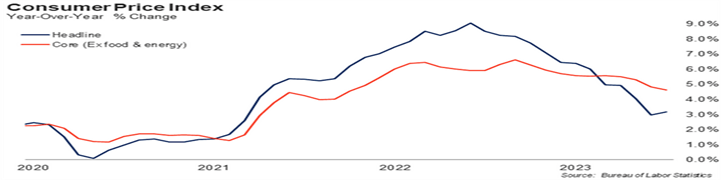
The Consumer Price Index (CPI) rose just 0.2 percent in July, and the yearly rate of inflation rose to 3.2 percent from 3 percent in the prior month, the consumer price index showed. It was the first increase in 13 months.

The core rate without food and energy prices over the past year slowed to 4.7 percent from 4.8 percent and is the lowest rate in almost two years.

However, a large share of the remaining core inflation includes housing rents and used car prices that have remained stubbornly high. Since when is the Fed responsible for bringing down rents and car prices? These prices are controlled by intermediaries like realtors and auto dealers that want to maximize their own profit margins, not by the Fed.

There is also a surge in business productivity reports Brian Bethune, a Boston College economics professor. Business productivity jumped by 3.7 percent while unit-labor costs rose just 1.6 percent.

“At the same time, overall prices increased by 2.2% — well within the U.S. Federal Reserve’s target and the lowest inflation rate since the second quarter of 2020,” said Professor Bethune.

U.S. corporate profit margins have been excessive, said Bethune.

“In other words, there was “profitflation” — also known as “greedflation,” The ability of industry to raise prices aggressively, rather than defensively, is tied to increasing business consolidation and more mergers and acquisitions. Indeed, bank takeovers resurfaced in the first half of 2023 under severe liquidity stresses created by higher short-term interest rates; that story is not yet over.”

The inflation battle has been largely won, and corporate profit margins are declining as supply chains catch up to demand. They were down – 4.1 percent in Q1 2023, according to the Bureau of Economic Analysis (BEA).

Consumer spending is tapering as well that has been the main cause of said demand, so that personal consumption expenditures (PCE) were up 5.4 percent YoY in June, down from the post-pandemic high of 13.1 percent in 2021.

Consumers provided most of the 2.4 percent increase in Gross Domestic Product (GDP) in the ‘advance’ (first of three) estimates of second quarter economic growth.

The story is not over for the Fed’s battle with inflation, either. High interest rates that are crimping corporate profits as well as consumer spending will continue to bring down the inflation rate. But we don’t want outright deflation China is experiencing that is causing massive unemployment among its youth.

We cannot really afford another recession, such as happened in 2007-09, or might happen again if the Fed continues to boost interest rates.

Harlan Green © 2023

Follow Harlan Green on Twitter: https://twitter.com/HarlanGreen
Posted in Consumers, COVID-19, Economy, Macro Economics, Weekly Financial News | Leave a comment

A Guest Opportunity For Podcasters

Answering Kennedy’s Call

About Harlan Green

§ Harlan Russell Green is 2023 Winner of the Peace Corps Writers’ Publisher’s Award Jul 31, 2023

§ Harlan Russell Green (Turkey 1964–66) 2023 Publisher’s Award Building Community: Answering Kennedy’s Call, Harlan Green’s memoir of his years working to build successful communities…

§ Editor and Publisher of PopularEconomics.com, dedicated to “Enhancing the Popular Understanding of Economics”, a financial columnist who has been interviewed by international news outlets, and a documentary filmmaker and photographer. He is also the author of The Mystery of Money, Understanding the Modern Financial World, has a B.S. in Economics from UC Berkeley, and M.S. in Public Communications (COM ’82) from Boston University.

§ A lifelong advocate of livable communities, he was a Peace Corps Volunteer in a rural community development program in Turkish villages, joined the US Environmental Protection Agency at its inception to publicize its activities in the Western Region, and became a member of César Chávez’s United Farmworkers Union during its organizing struggles, before contributing to his own community planning effort that resulted in a new city.

Harlan Green © 2023

Follow Harlan Green on Twitter: https://twitter.com/HarlanGreen

Posted in Macro Economics, Politics, Uncategorized, Weekly Financial News | Leave a comment

Higher Economic Growth Ahead?

Financial FAQs

AtlantaGDPNow

The US economy continues to expand in all sectors—with consumers as well as in manufacturing. But it was consumers that provided most of the 2.4 percent increase in Gross Domestic Product (GDP) in the ‘advance’ (first of three) estimates of second quarter economic growth, I said recently.

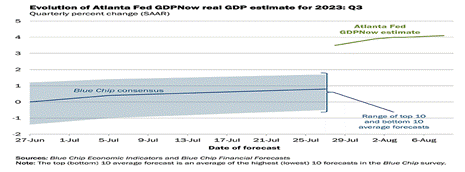
And now the Atlanta Federal Reserve’s advance estimate of third quarter economic growth is confounding the growth pessimistics even more. It predicts third quarter GDP growth could jump to 4.1 percent. Its estimate of Q2 growth was correct. How is that possible with Fed Chair Powell hinting at further rate hikes in his latest remarks?

“The GDPNow model estimate for real GDP growth (seasonally adjusted annual rate) in the third quarter of 2023 is 4.1 percent on August 8, up from 3.9 percent on August 1. After recent releases from the US Census Bureau, the Institute for Supply Management, the US Bureau of Economic Analysis, and the US Bureau of Labor Statistics, an increase in the nowcast of third-quarter real gross private domestic investment growth from 5.2 percent to 8.1 percent was slightly offset by decreases in the nowcasts of third-quarter real personal consumption expenditures growth and third-quarter real government spending growth from 3.5 percent and 2.9 percent, respectively, to 3.2 percent and 2.7 percent, while the nowcast of the contribution of the change in real net exports to second-quarter real GDP growth increased from 0.08 percentage points to 0.11 percentage points.”

This is largely about the huge increase in private sector investing that is being stimulated by yes, as I have been saying, our recent federal legislation that is creating a new industrial policy much like the Great Depression’s New Deal.

And why not? The COVID-19 pandemic did as much damage as the Great Depression when economies worldwide shut down. It took a New Deal then to bring us out of the Great Depression which lasted from 1933-38, and it is taking years to recover from the pandemic shutdown when 8 million jobs were lost, for starters.

Businesses ratcheted up fixed investment at a nearly 5 percent annual pace in Q2. That’s the biggest increase in six quarters. Investment rose at double-digit rates, in percentage terms, for both equipment and structures.

Part of the increase in domestic fixed investment likely stems from the Inflation Reduction Act that gives subsidies and tax credits to businesses that invest in green energy and technology such as chip making.

All of this news should confirm once and for all that no recession is imminent this year. Even if growth in Q3 and Q4 slowed, the overall year’s growth would still be positive., I also said recently.

The inflation rate is cooperating. The PCE price index increased just 2.6 percent, compared with an increase of 4.1 percent in Q1. Excluding food and energy prices, the PCE price index increased 3.8 percent, compared with an increase of 4.9 percent.

There is also a burst in labor productivity, as workers are working even harder while their wages keep rising.

Brian Bethune, a Boston College economics professor in a MarketWatch Op-ed wrote that the U.S. economy has demonstrated “amazing flexibility and resiliency since the pandemic recovery cycle began three years ago.’

Business productivity jumped by 3.7 percent while unit-labor costs rose just 1.6 percent.

“At the same time, overall prices increased by 2.2% — well within the U.S. Federal Reserve’s target and the lowest inflation rate since the second quarter of 2020,” said Professor Bethune.

Economists are also coming around to the view that targeted government spending is necessary for future economic growth. Dani Rodrik in an interesting Project Syndicate opinion piece summarized the research that is refuting so-called ‘free marketers’ views that any domestic industrial policy other than for the military harms economic growth and innovation.

“The results of this research are much more favorable to industrial policy, tending to find that such policies – or historical accidents that mimic their effects – have often led to large, seemingly beneficial long-term effects in the structure of economic activity.”

So why does the Fed want to continue to raise rates? Our biggest economic competitor, China, is now experiencing slowing growth and actual deflation for the first time in two years.

Harlan Green © 2023

Follow Harlan Green on Twitter: https://twitter.com/HarlanGreen
Posted in Consumers, COVID-19, Economy, Keynesian economics, Weekly Financial News | Leave a comment

Jobs Still Plentiful!

Popular Economics Weekly

MarketWatch.com

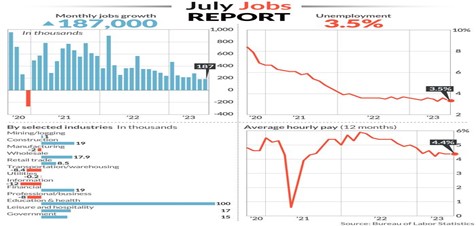
The Fed Governors should be happy with Friday’s unemployment report—nothing has really changed over the past several months, including record low unemployment, inflation continuing to decline, and average hourly wages holding at 4.4 percent.

“Both the unemployment rate, at 3.5 percent, and the number of unemployed persons, at 5.8 million, changed little in July. The unemployment rate has ranged from 3.4 percent to 3.7 percent since March 2022,” said the BLS press release.

We are in August and still no sign of a recession. Gross Domestic Product is estimated to grow even higher this quarter—as high as 3.9 percent from 2.4 percent in the second quarter, according to the latest Atlanta Federal Reserve GDPNow estimate. And companies are struggling to find more workers.

Why the sudden growth spurt? Even Nobel laureate economist Paul Krugman is calling it a Goldilocks economy.

“Economic policy in 2021 was actually pretty good. In fact, given the dislocations associated with a continuing pandemic, we ran what was in effect a Goldilocks economy, one that was neither too cold nor too hot.”

The sustained low unemployment rate is truly historic. Unemployment has declined to 3.5 percent only two other times—in 1955 during the post-WWII boom and 1969, the year of the first moon landing.

Education & healthcare led the report with 100,000 jobs added, but I like the construction jobs numbers best. This is because they show the effects of the recently enacted Infrastructure and Jobs Act and Inflation Reduction Act that are pouring $$trillions into real projects that are creating high-paying jobs. The problem—finding the workers.

Construction employment continued to trend up in July (+19,000), in line with the average monthly gain of 17,000 in the prior 12 months. Over the month, job growth occurred in residential specialty trade contractors (+13,000) and in nonresidential building construction (+11,000), per the BLS press release.

So why the recession worries at this stage of the recovery? It seems to be because of the much talked about inverted Treasury yield curve when short term rates (such as the 2-year Treasury) yield a rate much higher than the 10-year benchmark Treasury for an extended period of time.

It means credit is tighter, because lenders such as banks tend to lead at rates close to the 10-year benchmark Treasury yield, which is currently around 4 percent, but borrow at the usually lower 2-year rate that is now higher at around 4.8 percent.

When their cost to borrow is higher than what they can earn on their loans, lenders simply have less money to lend, hence tighter credit conditions.

FREDdeficit/gdp

That is happening because of the Fed’s credit tightening moves (that have driven up short-term rates). But the federal government is providing many more $$ to spur the economic renewal. Its current quarterly funding request is for $1 trillion to fund all those government projects that will pay for the future health of our economy.

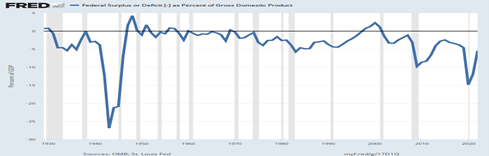
Then why the credit downgrade by Fitch Ratings that has markets worried? Because debt rating agencies worry about unmanageable debt. Yet, as the above FRED graph dating from 1930 shows, the actual annual deficit as a percentage of Gross Domestic Product is more important than the actual debt-to-GDP that has grown to 120 percent, because it shows the US can easily pay for said debt. Its ratio today is 5.8 percent and declining.

Dips below the zero-deficit straight line are deficits in the graph. The deficit has come down sharply from the negative -14.9 percent in 2020 because of the pandemic due to our strong economic growth since the pandemic.

Harlan Green © 2023

Follow Harlan Green on Twitter: https://twitter.com/HarlanGreen
Posted in Consumers, COVID-19, Economy, Macro Economics, Weekly Financial News | Leave a comment

Q3 Economic Growth to Double?

Popular Economics Weekly

AtlantaFedGDPNow

We could have even higher third quarter economic growth, believe it or not, from the second quarter 2.4 percent (advance) growth estimate by the US Bureau of Economic Analysis.

The Atlanta Federal Reserve’s GDPNow model estimates a jump to 3.9 percent growth in Q3 (September to December 2023), a huge leap from its second quarter estimate that actually matched the BEA’s Q2 estimate. So, we should take it seriously, given all the good news about public spending on new infrastructure and the like.

“The GDPNow model estimate for real GDP growth (seasonally adjusted annual rate) in the third quarter of 2023 is 3.9 percent on August 1, up from 3.5 percent on July 28. After this morning’s construction spending release from the US Census Bureau and the Manufacturing ISM Report On Business from the Institute for Supply Management, the nowcasts of third-quarter real personal consumption expenditures growth and real gross private domestic investment growth increased from 3.1 percent and 4.7 percent, respectively, to 3.5 percent and 5.2 percent.”

Construction is surging because of the US Infrastructure Act and Inflation Reduction Act $trillions being spent to modernize the US economy.

As if to emphasize the increased optimism, orders at U.S. factories rose 2.3 percent in June, largely because of more contracts for Boeing planes. Bookings for durable goods climbed 4.6 percent that are mostly consumer goods meant to last at least several years. The overall manufacturing sector is still weak and future orders have been contracting for almost one year.

How can the Atlanta Fed be so optimistic about future growth when Fitch Ratings just downgraded US Sovereign Debt to AA+ from AAA?

Much of it may have something to do with the various programs congress enacted, now being called Bidenomics, because though bipartisan it happened under President Biden’s watch.

Major economists like Nobel Laureate Paul Krugman are jumping on the Bidenomics growth bandwagon.

“It’s hard to overstate how good the U.S. economic news has been lately. It was so good that it didn’t just raise hopes for the future; it led to widespread rethinking of the past. Basically, Bidenomics, widely reviled and ridiculed a year ago, looks a lot better in retrospect. It’s starting to look as if the administration got it mostly right, after all.”

Second quarter consumer spending (i.e., personal consumption expenditures) has held up, though down from its first quarter spike. And real gross private investment is increasing 5 percent annually, thanks to those $trillions government is spending to stimulate private investments that is modernizing almost every area of our economy, from roads and bridges, water treatment facilities, airports, energy grids, to rural Internet hookups.

And more Americans are working than before the pandemic, so why shouldn’t the US economy look even better in Q3?

Harlan Green © 2023

Follow Harlan Green on Twitter: https://twitter.com/HarlanGreen
Posted in Consumers, COVID-19, Economy, Politics, Weekly Financial News | Leave a comment

A Lot of Job Openings!

Financial FAQs

Calculated Risk Blog

It’s hard to reconcile the recent downgrade of US Treasury debt by Fitch Ratings, one of the three major debt rating agencies, to AA+ from AAA, with the US economy still at full employment.

“The repeated debt-limit political standoffs and last-minute resolutions have eroded confidence in fiscal management,” it said. “Several economic shocks” as well as tax cuts and new spending initiatives “have contributed to successive debt increases over the last decade,” reported MarketWatch on the downgrade.

The Bureau of Labor Statistics Job Opening and Labor Turnover Survey (JOLTS) reported an average of 5.9 million hires per month (blue line in graph), and total separations of 5.6 million, while the number of job openings has declined to 9.8 million range (black line).

That’s still a lot of job openings, mostly in government and services. Openings increased in health care and social assistance (+136,000) and in state and local government, excluding education (+62,000). Job openings decreased in transportation, warehousing, and utilities (-78,000), state and local government education (-29,000), and federal government (-21,000), said the Bureau of Labor Statistics press release.

Fitch maintained that “tighter” credit, weakening investment in business, and a “slowdown” in consumption “will push the U.S. economy into a mild recession” in the fourth quarter of this year and the first three months of next year, reported MarketWatch.

This is although most economists now see little danger of any recession at all; maybe just a ‘soft landing’ that slows economic growth once the Fed ends its interest rate hikes.

That doesn’t mean it hasn’t been a wild ride since the pandemic-induced disruptions.

The Calculated Risk graph tells the best tale of the pandemic—what our economy has endured from the effects of COVID-19. There were 13.406 million job layoffs and discharges in March 2020 (red bar spike in graph) during the nationwide shutdown when city streets emptied from the mandatory lock downs and home stays and wild animals roamed the streets.

It resulted in the shortest recession ever—just two months, April-May 2020—then economic growth suddenly reversed, and businesses hired 8 million workers (blue line) in the next couple of months.

The JOLTS report also tells us the difference between hires and total separations has averaged some 300,000 nonfarm payroll jobs, which approximates the average monthly job creations this year.

This is what Bidenomics is all about, the various aid programs and bills enacted by congress to modernize the US economy and reduce global warming. It has created something like six million jobs since President Biden took office, and maybe 3,600,000 more jobs this year.

It also tells us why the US economy continues to expand in all sectors—with consumers as well as in manufacturing. Consumers provided most of the 2.4 percent increase in Gross Domestic Product (GDP) in the ‘advance’ (first of three) estimates of second quarter economic growth.

This should confirm that no recession is imminent this year. Even if growth in Q3 and Q4 slowed, the overall year’s growth would still be positive.

Goldman Sachs chief economist, Jan Hatzius is one of the major economists who trimmed the probability of a recession in the next 12 months to 20 percent from 25 percent — well below the 54 percent median among forecasters who participated in the last Wall Street Journey survey.

“The main reason for our cut is that the recent data have reinforced our confidence that bringing inflation down to an acceptable level will not require a recession,” said Hatzius.

And as I reported earlier, Federal Reserve Chair Powell said the Fed Governors now believe we can avoid a recession at Wednesday’s post-FOMC meeting, after announcing raising the benchmark interest rate to a range of 5.25 percent to 5.5 percent, the highest level in 22 years, in order to combat “elevated” inflation.

Consumers also like the continued growth, according to the Conference Board’s July Confidence Index that jumped from 110.1 to 117.

“Consumer confidence rose in July 2023 to its highest level since July 2021, reflecting pops in both current conditions and expectations,” said Dana Peterson, Chief Economist at The Conference Board. “Headline confidence appears to have broken out of the sideways trend that prevailed for much of the last year. Greater confidence was evident across all age groups, and among both consumers earning incomes less than $50,000 and those making more than $100,000.”

We should wait for Friday’s latest official unemployment report for the most recent unemployment picture, but it looks like Fitch Ratings is an outlier on the soundness of the US economy.

Harlan Green © 2023

Follow Harlan Green on Twitter: https://twitter.com/HarlanGreen

Posted in Consumers, COVID-19, Economy, Macro Economics, Politics, Weekly Financial News | Leave a comment

“The Housing Recession Is Over!”

The Mortgage Corner

One should maybe forgive National Association of Realtor’s chief economist Lawrence Yun’s enthusiasm when he exclaimed “the housing recession is over,” because the NAR’s Pending Home Sales rose for the first time in four months. And this at a time when the Fed’s hit to interest rates had so depressed the housing market, contributing to the severe housing shortage.

“The recovery has not taken place, but the housing recession is over,” said NAR Chief Economist Lawrence Yun, “The presence of multiple offers implies that housing demand is not being satisfied due to lack of supply. Homebuilders are ramping up production and hiring workers.”

The Pending Home Sales Index (PHSI)* – a forward-looking indicator of home sales based on contract signings – rose 0.3% to 76.8 in June. Year over year, pending transactions fell by 15.6%. An index of 100 is equal to the level of contract activity in 2001, said the NAR press release.

The rest of the US economy has been recovering with second quarter 2023 GDP advance estimate growing 2.4 percent. Interest sensitive real estate sales had been hit hardest with the 5.25 percent in Fed rate hikes, and pending sales gives an picture of sales under contract but not yet closed.

FREDnewhomes

I believe Yun’s remarks may be a sign of something more. A housing market recovery has traditionally been the first indication of an general economic recovery, as indicated by the FRED graph of new-home sales. Existing-home sales follow a similar trajectory. New-home sales have ticked up after every recession (gray bars) since 1960, as viewed in the FRED graph. They are up 23.8 percent annually, to 697,000 units over July 2022, and sales were even higher in June when pro-rated annually.

Many other economic indicators are showing recovery in addition to higher Q2 GDP growth, especially consumer spending, which is slowing but gave a boost to second quarter growth.

Even the Federal Reserve has become more optimistic. Federal Reserve Chair Jerome Powell disclosed at Wednesday’s post-FOMC press conference that his staff is no longer forecasting a recession.

“The staff now has a noticeable slowdown in growth starting later this year in the forecast…but, given the resilience of the economy recently, they are no longer forecasting a recession,” Powell told reporters.

Let us hope Yun is right in prognosticating an end to the housing recession, and maybe any recession this year.

Harlan Green © 2023

Follow Harlan Green on Twitter: https://twitter.com/HarlanGreen

Posted in Consumers, COVID-19, Economy, housing market, Weekly Financial News | Leave a comment

It’s Consumer Spending, Stupid! – Part II

Financial FAQs

BEA.gov

The US economy continues to expand in all sectors—with consumers as well as in manufacturing. But it was consumers that provided most of the 2.4 percent increase in Gross Domestic Product (GDP) in the ‘advance’ (first of three) estimates of second quarter economic growth.

This should confirm once and for all that no recession is imminent this year. Even if growth in Q3 and Q4 slowed, the overall year’s growth would still be positive.

And the inflation rate is cooperating. The PCE price index increased 2.6 percent, compared with an increase of 4.1 percent in Q1. Excluding food and energy prices, the PCE price index increased 3.8 percent, compared with an increase of 4.9 percent.

MarketWatch reported spending on services rose three times faster than outlays on goods. Americans are spending more on travel, recreation, dining out and the like now that the pandemic is over.

Businesses, another major leg of the economy, ratcheted up fixed investment at a nearly 5 percent annual pace. That’s the biggest increase in six quarters. Investment rose at double-digit rates, in percentage terms, for both equipment and structures.

Part of the increase likely stems from a 2021 law passed by the Biden administration that gives subsidies and tax credits to businesses that investment in green energy and technology such as chip making.

The list of improving sectors was long:

“The increase in consumer spending reflected increases in both services and goods,” said the BEA. “Within services, the leading contributors to the increase were housing and utilities, health care, financial services and insurance, and transportation services. Within goods, the increase was led by recreational goods and vehicles as well as gasoline and other energy goods. The increase in nonresidential fixed investment reflected increases in equipment, structures, and intellectual property products. The increase in state and local spending reflected increases in compensation of state and local government employees and gross investment in structures. The increase in private inventory investment reflected increases in both farm and nonfarm inventories.”

Goldman’s chief economist, Jan Hatzius, trimmed the probability of a recession in the next 12 months to 20 percent from 25 percent — well below the 54 percent median among forecasters who participated in the last Wall Street Journey survey.

“The main reason for our cut is that the recent data have reinforced our confidence that bringing inflation down to an acceptable level will not require a recession,” said Hatzius.

Federal Reserve Chair Powell said the Fed Governors now believe we can avoid a recession at yesterday’s post-FOMC meeting, after announcing raising the benchmark interest rate to a range of 5.25 percent to 5.5 percent, the highest level in 22 years, in order to combat “elevated” inflation.

As I said last week, it turns out the American consumer is the mainstay of US growth, and we should celebrate that fact.

Harlan Green © 2023

Follow Harlan Green on Twitter: https://twitter.com/HarlanGreen

Posted in Consumers, COVID-19, Economy, Weekly Financial News | Leave a comment

What Is Bidenomics?

The Mortgage Corner

The best way to describe ‘Bidenomics’ now being touted by a growing consensus of economists is best explained in the recent resurgence of construction spending, as portrayed in the FRED graph.

FREDconstructionspend

Nobel Laureate Paul Krugman, among others, has been touting the strength of the post-pandemic economic recovery, which is being called ‘Bidenomics’ in a play on words to compare it to Reaganomics, the 1980s recovery from the 1970’s era of stagflation and double-digit inflation.

“The economy’s resilience in the face of rate hikes suggests that overall demand has been stronger than anyone expected — possibly in part because Biden administration policies appear to have unleashed a huge wave of manufacturing investment,” said Krugman in a NYTimes Op-ed.

The big difference between the two eras is government’s role. President Reagan decreed that government was the problem, so it financed its recovery with tax cuts that inflated the first substantial federal debt since World War Two.

Bidenomics is being financed with tax receipts, private investment, and some increased taxes, but without tax cuts. So, it must pay for itself, and government-funded programs are providing the incentives.

President Joe Biden’s Infrastructure Investment and Jobs Act has become a part of the domestic economy, “driving a boom in large-scale infrastructure,” wrote Ellen Zentner, chief U.S. economist for Morgan Stanley, in a research note out last week cited by MarketWatch.

As a result, Morgan Stanley now projects 1.9 percent economic expansion in the first half of this year. That’s nearly four times the bank’s previous 0.5 percent forecast for growth in gross domestic product in the first half of 2023.

Some $1 trillion in infrastructure spending signed into law in 2021 marked an early legislative win for a president handed only a slim majority in Congress upon his election over then-incumbent Republican Donald Trump in November 2020.

It was followed up by another legislative banner for Biden: the Inflation Reduction Act, a climate-change- and healthcare-focused spending bill signed into law about a year ago. Many of the incentives in the laws are tied to domestic manufacturing and a reason manufacturing activity is beginning to expand again after a period of contraction, per the S&P U.S. manufacturing-sector index that rose to 49 from 46.3 in July, but has been negative for months.

Tomorrow the first estimate of second quarter GDP growth will be released by the US Bureau of Economic Research (BEA). The Atlanta Fed’s latest GDPNow estimate of second quarter GDP growth by Blue Chip economists is 2.4 percent.

Construction spending in manufacturing is soaring, up 76 percent YoY and helping to boost employment, traditionally with higher-paying jobs. So Bidenomics is a win-win solution for both continued economic growth and keeping workers fully employed.

Harlan Green © 2023

Follow Harlan Green on Twitter: https://twitter.com/HarlanGreen

Posted in Consumers, COVID-19, Economy, Weekly Financial News | Leave a comment