Consumer Services Show Growth Rebound

Popular Economics Weekly

TradingEconomics

Why are the likes of Goldman Sachs chief economist Jan Hatzius predicting no looming recession and better economic growth ahead?

It’s partly because of Bidenomics, the boost to growth that the infusion of $billions into renewal of the US economy in infrastructure, CHIPs manufacturing, and the conversion to more climate friendly policies has jump started.

But it is also because consumers feel prosperous enough to continue to shop and enjoy more leisure activities such as dining out and travel.

The latest indicator of said prosperity is the Institute of Supply Management’s monthly survey of service sector industries that show a continuing expansion rather than contraction of these services, with any number above 50 in its index indicating expansion.

The ISM non-manufacturing Services PMI unexpectedly jumped to 54.5 in August 2023, pointing to the strongest growth in the services sector in six months, compared to 52.7 in July and forecasts of 52.5.

“Thirteen industries reported growth in August’” said Anthony Nieves, Chair of the Institute for Supply Management® (ISM®) Services Business Survey Committee.. “The Services PMI®, by being above 50 percent for the eighth month after a single month of contraction and a prior 30-month period of expansion, continues to indicate sustained growth for the sector. The composite index has indicated expansion for all but three of the previous 162 months.”

The service sector comprises more than 60 percent of economic activity, and overall consumer spending now almost 70 percent; even more important because of the shrinking industrial sector that Bidenomics is attempting to revive.

And surprise, surprise, Real Estate, Rental & Leasing were the leading service activities, with Accommodation & Food Services next in line. Does it mean the real estate sector (and housing) is recovering and could lead US out of the current malaise?

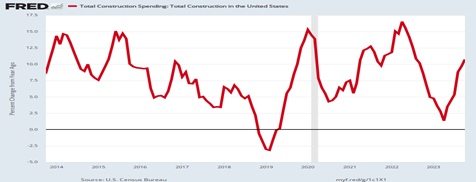
The construction sector, for instance, continues to expand with a total of 67,000 new construction jobs added in just the past three months.

Bidennomics is also helping decrease the growing income inequality, which has poisoned our politics as well as increased drug use and suicide rates among the working age population.

It’s become so bad that the top 1 percent of income earners corralled 19 percent of incomes earned in 2021, per the NYTimes graph, vs. its low of some 10 percent in the 1970s.

NYTimes

In the words of NYTimes David Leonhardt, “He (Biden) has signed laws (sometimes with bipartisan support) spending billions of dollars on semiconductor factories, roads, bridges and clean energy. He has tried to crack down on monopolies. He has encouraged workers to join unions.”

The ISM non-manufacturing survey reported faster increases were seen in business activity (57.3 vs 57.1), new orders (57.5 vs 55), employment (54.7 vs 50.7) and inventories (57.7 vs 50.4). Also, supplier deliveries increased (48.5 vs 48.1). In the last six months, the average reading of 47.7 percent reflects the fastest supplier delivery performance since June 2009.

This all is a sign that the service sector, comprising more than 60 percent of US economic activity is picking up speed, not slowing down.

Harlan Green © 2023

Follow Harlan Green on Twitter: https://twitter.com/HarlanGreen
Posted in Consumers, COVID-19, Economy, Housing, housing market, Politics, Weekly Financial News | Leave a comment

Here’s to a Return of Normal – Part II

Popular Economics Weekly

MarketWatch

Another unemployment report confirms the US economy is returning to normal, and Americans can breathe easier about the danger of a recession.

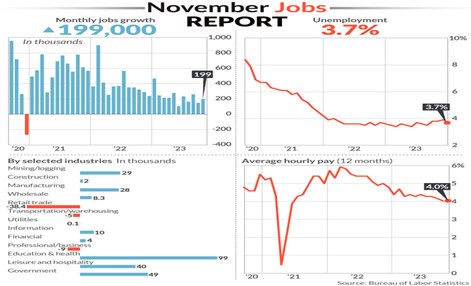
By that I mean adding a more normal 187,000 new jobs in July is a sign the economy is cooling enough to drive inflation lower and maybe keep the Fed from further interest rate increases.

Employment growth has fallen below 200,000 two months in a row for the first time since the onset of the pandemic in 2020, although the unemployment rate rose to 3.8 percent from 3.5 percent, the government said Friday.

June and July payroll hires were revised down 110,000 jobs as well in the report and the number of unemployed persons increased by 514,000 to 6.4 million.

Wall Street jumped on the news, as the financial markets had been fretting for most of August that Fed officials would remain hawkish if businesses kept up their hiring pace.

But there aren’t enough available workers to produce more, so both industrial and service sector growth has slowed. The Transportation/warehousing and Information sectors lost jobs, Education & health added the most jobs (+102,000).

Interest rates are still too high for sectors such as manufacturing and real estate that are the holdouts in this recovery. Longer term bond prices have fallen sharply (ergo, yields rising) in tandem with inflation because bonds with fixed rates lose value when inflation rises and this has .

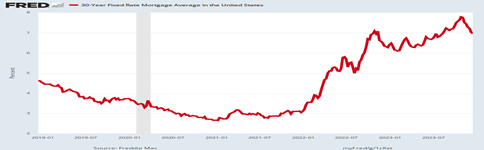
Mortgage rates are putting 30-year conforming fixed rate mortgages above 7 percent, which is keeping many home buyers on the sidelines and holding down a key part of economic activity. Though construction is booming because of the rise in new home starts.

This is important because housing has almost always been a leading indicator that signals expansion or decline of the overall economy even though it is a small part of overall GDP.

FRED30yrfixed

The 30-year fixed rate mortgage average is currently 7.18 percent per FRED in the graph below. It was last this high in March 2002 at the start of the housing bubble that ultimately led to the Great Recession.

However, US pending home sales ticked up again in July by 0.9 percent, rising for the second month in a row despite elevated prices and rising mortgage rates, according to a report released Wednesday by the National Association of Realtors.

“Jobs are being added, thereby enlarging the pool of prospective home buyers,” NAR chief economist Lawrence Yun said. “However, rising mortgage rates and limited inventory have temporarily hindered the possibility of buying for many.”

So, a healthy housing market as well as steady job creation is an important part of our return to more normal times.

Harlan Green © 2023

Follow Harlan Green on Twitter: https://twitter.com/HarlanGreen
Posted in Consumers, COVID-19, Economy, Housing, housing market, Weekly Financial News | Leave a comment

Why the Inflation Confusion?

Financial FAQs

BEA.gov

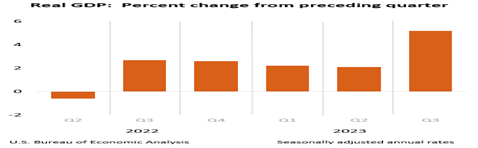
Real gross domestic product (GDP) increased at an annual rate of 2.1 percent in the second quarter of 2023, according to the “second” estimate just released by the Bureau of Economic Analysis (BEA). In the first quarter, real GDP increased 2.0 percent.

This is great news because it showed our economy was still expanding in Q2, April-June.

Also, the price index for gross domestic purchases increased 1.7 percent in the second quarter, a downward revision of 0.2 percentage point from the previous estimate.

This was more good news. It showed that inflation was still declining.

Then why is the Fed still sounding hawkish in maintaining inflation hasn’t been tamed? I know this can be boring information for most readers. But it might help us to understand why the financial markets are so skittish about inflation, and what the Fed may do next concerning the everyday interest rates that govern debt rates for credit cards and car loans.

Because there is a lot of confusion over which inflation rate the Fed should use to acknowledge they have reached their 2 percent target rate.

We will never really know the underlying inflation rate, because it is a magical number decided upon years ago during Fed Chair Bernanke’s reign that developed countries central bankers could agree on, not because it had some intrinsic value. And sure enough, as the Fed began to raise interest rates to bring said inflation down to 2 percent, a recession has invariably followed.

The Fed seems to like the PCE price index, which measures just what consumers spend (rather than GDP, which measures what everyone spends, including governments). Personal Consumption Expenditures (PCE) increased 2.5 percent, a downward revision of 0.1 percentage point in the BEA’s same press release. Excluding food and energy prices, the PCE price index increased 3.7 percent, a downward revision of 0.1 percentage point, but still too high for the Fed.

FREDcpi

But the Consumer Price Index (CPI) that also measures consumer spending is the index used to set social security premiums and most rental leases! It is currently increasing at 3.3 percent.

I maintain that is the reason there is so much confusion over inflation. The Fed is probably correct to concentrate on the behavior of consumers. Food and energy prices directly affect the consumer, where inflation does the most harm to household finances. But it also casts doubt on the Fed’s ability to control inflation!

The bottom line as I said last week is not enough is being produced to satisfy consumer demand, or the military’s demand for more weapons, or Americans’ need to shelter from the effects of ever greater Global warming.

So, the Fed’s policies shouldn’t even be part of this equation in such a time. Inflation will continue to subside on its own as more is produced to satisfy said demands. The above CPI chart shows the decades post-1990 when supply and demand was in balance—until the COVID pandemic upset that balance, which is being gradually restored.

Harlan Green © 2023

Follow Harlan Green on Twitter: https://twitter.com/HarlanGreen
Posted in Consumers, COVID-19, Economy, Weekly Financial News | Leave a comment

No More Rate Hikes?

Financial FAQs

Calculated Risk

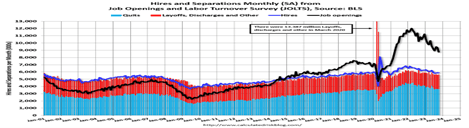
The latest Job Openings and Labor Turnover Survey (JOLTS) report by the BLS shows there are still a lot of job openings, but that should continue to decline from the post-pandemic high of 12 million job vacancies in 2022.

Could that mean no more rate hikes by the Fed this year? Pundits and economists are mixed on that possibility in part because Fed Chair Powell gave mixed signals about their intentions at his annual Jackson Hole speech—from saying the job market is too tight, to the possibility of no recession and a soft-landing scenario maybe next year.

“The number of job openings edged down to 8.8 million on the last business day of July, the U.S. Bureau of Labor Statistics reported today. Over the month, the number of hires and total separations changed little at 5.8 million and 5.5 million, respectively. Within separations, quits (3.5 million) decreased, while layoffs and discharges (1.6 million) changed little.”

The key fact was that the number of job openings (black line in graph) has been declining sharply, and the number of hires is declining slowly (blue line). There were just 187,000 nonfarm payroll jobs added in July’s unemployment report. But retailers are gearing up for the holidays.

Over the month, job openings decreased in professional and business services (-198,000); health care and social assistance (-130,000); state and local government, which had increased the most in last month’s unemployment report. Whereas job openings increased in information (+101,000) and in transportation, warehousing, and utilities (+75,000), jobs in demand over the holidays.

The August unemployment report comes out this Friday, and there’s no real consensus by economists on what it might be.

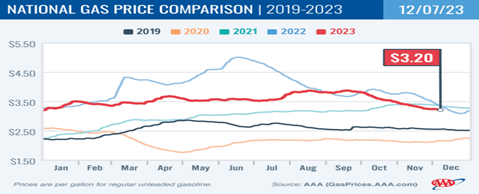
Other news was a big drop in one consumer confidence report by the Conference Board that said consumers are losing confidence because energy and food prices are rising again, just when they thought inflation was being tamed.

Although bad news for consumers, it’s music to the ears of Powell, since it could mean less consumer spending, which in turn could depress the inflation rate without further Fed actions.

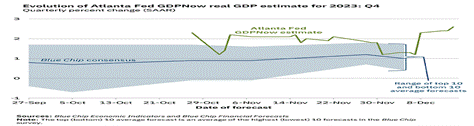
What is making Fed officials nervous is the Atlanta Federal Reserve’s advance estimate of third quarter economic growth jumping to 5.9 percent because of higher third-quarter real gross private domestic investment growth, thought to be an almost unbelievable growth rate just weeks ago.

I said last week that GDP growth is soaring because private capital spending has also picked up, proving that governments must kick start many of those projects that don’t promise enough profits to bring in private investment, i.e., long term projects like roads, bridges that pay for future growth.

But said spending doesn’t have to be inflationary, as inflation hawks maintain. It inflates the budget, but doesn’t have to boost inflation if it’s paid for; i.e., if tax revenues keep up with spending, which is after all a reinvestment in our productivity, just as private industry does with its capital spending.

This is the truth that Wall Street and the inflation hawks don’t like to hear, either. It’s the chicken and the egg problem. Inflation occurs because not enough of something is produced when demand is high for such things. Policies that slow growth are counterproductive, because they seek to dampen demand rather than spend to produce more.

Harlan Green © 2023

Follow Harlan Green on Twitter: https://twitter.com/HarlanGreen
Posted in Consumers, COVID-19, Economy, Macro Economics, Weekly Financial News | Leave a comment

Why Such High Interest Rates?

The Mortgage Corner

I said last month the National Association of Realtor’s chief economist Lawrence Yun’s exclamation “the housing recession is over,” was because the NAR’s Pending Home Sales (i.e., homes under contract but not closed) rose for the first time in four months.

“The recovery has not taken place, but the housing recession is over,” Yun had said at the time.

Calcuated Risk

Yun might not be so optimistic with this month’s existing-home sales, which are down to a six-month low. And we know why. It’s not only a very small number of homes for sale, but the sudden rise in mortgage rates. We can’t blame Yun for his recent enthusiasm since longer-term fixed rates rose suddenly when the financial markets began to take seriously the possibility of accelerating economic growth rather than a recession this year.

Total existing-home sales[1] – completed transactions that include single-family homes, townhomes, condominiums and co-ops – waned 2.2% from June to a seasonally adjusted annual rate of 4.07 million in July. Year-over-year, sales slumped 16.6% (down from 4.88 million in July 2022), said the NAR.

“Two factors are driving current sales activity – inventory availability and mortgage rates,” said Yun. “Unfortunately, both have been unfavorable to buyers.”

The rest of the US economy has been recovering with the second quarter 2023 GDP advance estimate growing 2.4 percent, and the Atlanta Fed is now predicting the possibility that third quarter GDP growth could be as high as 5.8 percent.

Most economists are discounting such a possibility, but the possibility of higher growth has put the fear of higher interest rates in their calculations, and the real estate market is particularly affected by interest rate trends.

There is, however, very little inflation to fear, hence I believe bond traders are overreacting. The best inflation indexes show the retail inflation rate a little above 3 percent, down sharply from last year’s high.

Bond traders are causing the 10-year benchmark Treasury bond yield to rise that fixed mortgage rates use as an index. It is also considered to be a hedge against the possibility of higher inflation, and has risen almost 1 percent in the past few months to 4.3 percent, from its low of 0.54 percent in March 2020.

This was the reason for the sudden jump in existing-home sales to almost 7 million units annualized in 2020 (see above Calculated Risk graph). The 30-year conforming fixed rate mortgage fell as low as 3.5 percent, causing the sudden surge in housing sales.

When will the housing sales decline reverse course? Not very soon, according to Calculated Risk’s Bill McBride. “It now seems likely that in a few months existing home sales will fall below the previous cycle low of 4.00 million in January 2023,”

FREDnewhomes

Some good news is that sales of new single‐family houses in July 2023 were at a seasonally adjusted annual rate of 714,000, according to estimates released jointly today by the U.S. Census Bureau and the Department of Housing and Urban Development as home builders race to add to the depleted housing stock. This is a huge increase–up 4.4 percent above the revised June rate of 684,000 and is 31.5 percent above the July 2022 estimate of 543,000.

It is difficult to see other than a continuing housing bottom now. The cure to the problem is the realization by the Fed and bond traders that inflation has been conquered. There’s no reason for inflation to be higher than the current 3 percent, and maybe trend down to the Fed’s 2 percent target in the not-too-distant future.

Harlan Green © 2023

Follow Harlan Green on Twitter: https://twitter.com/HarlanGreen

Posted in Consumers, COVID-19, Economy, Housing, housing market, Weekly Financial News | Leave a comment

Higher Economic Growth Ahead–Part II

Financial FAQs

AtlantaGDPNow

US economic growth could be accelerating—with manufacturing as well. It was consumers that provided most of the 2.4 percent increase in Gross Domestic Product (GDP) in the ‘advance’ (first of three) estimates of second quarter economic growth, but the manufacturing and construction industries may be taking over in the next phase of this economic recovery.

The Atlanta Federal Reserve’s advance estimate of third quarter economic growth just jumped to 5.8 percent, thought to be an almost unbelievable growth rate just weeks ago. This will confound pundits and economists alike as all those capital infrastructure projects shift into high gear.

GDP growth is soaring because private capital spending has also picked up, proving that governments must kick start many of those projects that don’t promise enough profits to bring in private investment, i.e., long term projects like roads, bridges that pay for future growth. This is the truth that Wall Street doesn’t want to hear, until it meets a worldwide catastrophe like the COVID pandemic.

This has been the case since the Great Depression but never in the scale that has been spurred by the post-pandemic recovery.

“The GDPNow model estimate for real GDP growth (seasonally adjusted annual rate) in the third quarter of 2023 is 5.8 percent on August 16, up from 5.0 percent on August 15. After this morning’s housing starts report from the US Census Bureau and industrial production report from the Federal Reserve Board of Governors, the nowcasts of third-quarter real personal consumption expenditures growth and third-quarter real gross private domestic investment growth increased from 4.4 percent and 8.8 percent, respectively, to 4.8 percent and 11.4 percent,” said the Atlanta Fed.

The jump in housing starts was surprising in the face of higher mortgage rates as bond traders expect that more robust growth will push up longer term interest rates, like the benchmark 10-year Treasury yield now edging above 7 percent.

“With many homeowners choosing to stay in their existing home to preserve their low mortgage rate, demand for new home construction pushed up single-family starts in July even as builders continue to struggle with increased uncertainty stemming from rising rates,” said Alicia Huey, chairman of the National Association of Home Builders (NAHB).”

And manufacturing companies have added 100,000 clean energy jobs in wind and solar energy, EV manufacturing and other clean energy sectors across the country since the Inflation Reduction Act became law,, according to a report by the nonprofit Climate Power. 

As of January 31, 2023, there are over 90 new clean energy projects in small towns and bigger cities nationwide totaling $89.5 billion in new investments, said their study.

This is what it means to pay for the future—for our future health as well as creating better-paying jobs.

Harlan Green © 2023

Follow Harlan Green on Twitter: https://twitter.com/HarlanGreen

Posted in Consumers, COVID-19, Economy, Keynesian economics, Weekly Financial News | Leave a comment

Here’s to a Return of Normal!

Popular Economics Weekly

FREDretailsales

Is it possible after years of pandemic and post-pandemic vicissitudes, the US economy is returning to a normal growth pattern, and Americans can breathe easier about the future?

By that I mean consumers are shopping as they did before the pandemic, industries are producing enough to keep inflation in check, and supply-chains fully stocked, even if the Fed won’t begin to drop interest rates until next year.

I believe so, and July’s retail sales are confirming that consumers are healthy and behaving more normally now that the tax season is over.

It surprised some economists that advanced sales for retail and food services jumped 0.7 percent in July, and 3.2 percent over July 2022, as reported by the Census Bureau. But 3 to 6 percent annual sales’ growth has been the norm going back years, seasonally adjusted but not for inflation, per the FRED graph.

Dining out and travel were the biggest beneficiaries of consumers’ largesse. Sales rose a sharp 1.4 percent at bars and restaurants, a sign that they are happy. Internet sales have risen 10.3 percent over the past year, more than double the rate of inflation.

In fact, the so-called ‘new normal’ of post-pandemic activity is looking more and more like the old normal. Unemployment should stay low for the rest of this year, at least. There are still nine million open job vacancies and wages are now rising faster than overall inflation, which should keep economic growth above 2 percent, the average longer-term US growth rate.

Why is inflation slowing so quickly without rising employment? Many economists believed higher unemployment and job losses were needed to slow consumers spending sufficiently to bring down the inflation rate.

Economists such as Paul Krugman believe that might have occurred if inflation expectations had become imbedded—i.e., in the belief that inflation would continue higher for an extended period.

But economies have recovered much more quickly, thanks in large part to the $trillions spent on the pandemic recovery—the ‘new’ New Deal I’ve been talking about.

So, there wasn’t enough time for inflation to become ‘embedded’ (an economic term) in the minds and expectations of Americans. Other countries haven’t invested as much in their recoveries, so are experiencing higher inflation.

A report just out by the NY Fed confirms that inflation expectations are subsiding. The median inflation expectation fell to 3.5 percent in July from 3.8 percent the previous month, and is the lowest reading since April 2021, the report said.

Consumers also expect home-price growth to slow slightly, said the NY Fed. They also see the cost of gas, food, medical care, college, and rent fall in the year ahead. Expectations for food inflation are at the lowest level since September 2020 (5.2 percent).

Why shouldn’t consumers feel better about their future, and act accordingly?

Harlan Green © 2023

Follow Harlan Green on Twitter: https://twitter.com/HarlanGreen
Posted in Consumers, COVID-19, Economy, Weekly Financial News | Leave a comment

What Caused the Pandemic Inflation?

Financial FAQs

FREDprofits/gdi

The St. Louis Fed (FRED) graph of corporate profits as a percentage of Gross Domestic Income (GDI), a good proxy for gross domestic output (GDP), explains much of what boosted inflation during the COVID pandemic. The product shortages and supply chain shortcomings caused the sudden scarcity of goods, but not the sky-high retail inflation that consumers in particular experienced.

Corporate profits accounted for the largest share of the price hikes experienced since the pandemic. Data from the U.S. Commerce Department shows that 2021 corporate profit margins were the largest they’ve been in 70 years, some 16.7 percent in 2021, the last year annual profit data was available.

That is why consumer CPI inflation surged in 2021 and is slowly returning to more normal levels. You name it—food service and energy companies took advantage of the sudden shortages in their efforts to maximize profits.

BLS.gov

The Consumer Price Index (CPI) rose just 0.2 percent in July, and the yearly rate of inflation rose to 3.2 percent from 3 percent in the prior month, the consumer price index showed. It was the first increase in 13 months.

The core rate without food and energy prices over the past year slowed to 4.7 percent from 4.8 percent and is the lowest rate in almost two years.

However, a large share of the remaining core inflation includes housing rents and used car prices that have remained stubbornly high. Since when is the Fed responsible for bringing down rents and car prices? These prices are controlled by intermediaries like realtors and auto dealers that want to maximize their own profit margins, not by the Fed.

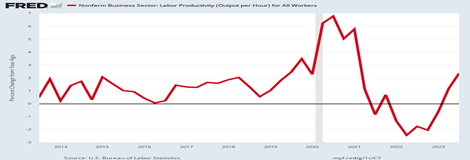
There is also a surge in business productivity reports Brian Bethune, a Boston College economics professor. Business productivity jumped by 3.7 percent while unit-labor costs rose just 1.6 percent.

“At the same time, overall prices increased by 2.2% — well within the U.S. Federal Reserve’s target and the lowest inflation rate since the second quarter of 2020,” said Professor Bethune.

U.S. corporate profit margins have been excessive, said Bethune.

“In other words, there was “profitflation” — also known as “greedflation,” The ability of industry to raise prices aggressively, rather than defensively, is tied to increasing business consolidation and more mergers and acquisitions. Indeed, bank takeovers resurfaced in the first half of 2023 under severe liquidity stresses created by higher short-term interest rates; that story is not yet over.”

The inflation battle has been largely won, and corporate profit margins are declining as supply chains catch up to demand. They were down – 4.1 percent in Q1 2023, according to the Bureau of Economic Analysis (BEA).

Consumer spending is tapering as well that has been the main cause of said demand, so that personal consumption expenditures (PCE) were up 5.4 percent YoY in June, down from the post-pandemic high of 13.1 percent in 2021.

Consumers provided most of the 2.4 percent increase in Gross Domestic Product (GDP) in the ‘advance’ (first of three) estimates of second quarter economic growth.

The story is not over for the Fed’s battle with inflation, either. High interest rates that are crimping corporate profits as well as consumer spending will continue to bring down the inflation rate. But we don’t want outright deflation China is experiencing that is causing massive unemployment among its youth.

We cannot really afford another recession, such as happened in 2007-09, or might happen again if the Fed continues to boost interest rates.

Harlan Green © 2023

Follow Harlan Green on Twitter: https://twitter.com/HarlanGreen
Posted in Consumers, COVID-19, Economy, Macro Economics, Weekly Financial News | Leave a comment

A Guest Opportunity For Podcasters

Answering Kennedy’s Call

About Harlan Green

§ Harlan Russell Green is 2023 Winner of the Peace Corps Writers’ Publisher’s Award Jul 31, 2023

§ Harlan Russell Green (Turkey 1964–66) 2023 Publisher’s Award Building Community: Answering Kennedy’s Call, Harlan Green’s memoir of his years working to build successful communities…

§ Editor and Publisher of PopularEconomics.com, dedicated to “Enhancing the Popular Understanding of Economics”, a financial columnist who has been interviewed by international news outlets, and a documentary filmmaker and photographer. He is also the author of The Mystery of Money, Understanding the Modern Financial World, has a B.S. in Economics from UC Berkeley, and M.S. in Public Communications (COM ’82) from Boston University.

§ A lifelong advocate of livable communities, he was a Peace Corps Volunteer in a rural community development program in Turkish villages, joined the US Environmental Protection Agency at its inception to publicize its activities in the Western Region, and became a member of César Chávez’s United Farmworkers Union during its organizing struggles, before contributing to his own community planning effort that resulted in a new city.

Harlan Green © 2023

Follow Harlan Green on Twitter: https://twitter.com/HarlanGreen

Posted in Macro Economics, Politics, Uncategorized, Weekly Financial News | Leave a comment

Higher Economic Growth Ahead?

Financial FAQs

AtlantaGDPNow

The US economy continues to expand in all sectors—with consumers as well as in manufacturing. But it was consumers that provided most of the 2.4 percent increase in Gross Domestic Product (GDP) in the ‘advance’ (first of three) estimates of second quarter economic growth, I said recently.

And now the Atlanta Federal Reserve’s advance estimate of third quarter economic growth is confounding the growth pessimistics even more. It predicts third quarter GDP growth could jump to 4.1 percent. Its estimate of Q2 growth was correct. How is that possible with Fed Chair Powell hinting at further rate hikes in his latest remarks?

“The GDPNow model estimate for real GDP growth (seasonally adjusted annual rate) in the third quarter of 2023 is 4.1 percent on August 8, up from 3.9 percent on August 1. After recent releases from the US Census Bureau, the Institute for Supply Management, the US Bureau of Economic Analysis, and the US Bureau of Labor Statistics, an increase in the nowcast of third-quarter real gross private domestic investment growth from 5.2 percent to 8.1 percent was slightly offset by decreases in the nowcasts of third-quarter real personal consumption expenditures growth and third-quarter real government spending growth from 3.5 percent and 2.9 percent, respectively, to 3.2 percent and 2.7 percent, while the nowcast of the contribution of the change in real net exports to second-quarter real GDP growth increased from 0.08 percentage points to 0.11 percentage points.”

This is largely about the huge increase in private sector investing that is being stimulated by yes, as I have been saying, our recent federal legislation that is creating a new industrial policy much like the Great Depression’s New Deal.

And why not? The COVID-19 pandemic did as much damage as the Great Depression when economies worldwide shut down. It took a New Deal then to bring us out of the Great Depression which lasted from 1933-38, and it is taking years to recover from the pandemic shutdown when 8 million jobs were lost, for starters.

Businesses ratcheted up fixed investment at a nearly 5 percent annual pace in Q2. That’s the biggest increase in six quarters. Investment rose at double-digit rates, in percentage terms, for both equipment and structures.

Part of the increase in domestic fixed investment likely stems from the Inflation Reduction Act that gives subsidies and tax credits to businesses that invest in green energy and technology such as chip making.

All of this news should confirm once and for all that no recession is imminent this year. Even if growth in Q3 and Q4 slowed, the overall year’s growth would still be positive., I also said recently.

The inflation rate is cooperating. The PCE price index increased just 2.6 percent, compared with an increase of 4.1 percent in Q1. Excluding food and energy prices, the PCE price index increased 3.8 percent, compared with an increase of 4.9 percent.

There is also a burst in labor productivity, as workers are working even harder while their wages keep rising.

Brian Bethune, a Boston College economics professor in a MarketWatch Op-ed wrote that the U.S. economy has demonstrated “amazing flexibility and resiliency since the pandemic recovery cycle began three years ago.’

Business productivity jumped by 3.7 percent while unit-labor costs rose just 1.6 percent.

“At the same time, overall prices increased by 2.2% — well within the U.S. Federal Reserve’s target and the lowest inflation rate since the second quarter of 2020,” said Professor Bethune.

Economists are also coming around to the view that targeted government spending is necessary for future economic growth. Dani Rodrik in an interesting Project Syndicate opinion piece summarized the research that is refuting so-called ‘free marketers’ views that any domestic industrial policy other than for the military harms economic growth and innovation.

“The results of this research are much more favorable to industrial policy, tending to find that such policies – or historical accidents that mimic their effects – have often led to large, seemingly beneficial long-term effects in the structure of economic activity.”

So why does the Fed want to continue to raise rates? Our biggest economic competitor, China, is now experiencing slowing growth and actual deflation for the first time in two years.

Harlan Green © 2023

Follow Harlan Green on Twitter: https://twitter.com/HarlanGreen

Posted in Consumers, COVID-19, Economy, Keynesian economics, Weekly Financial News | Leave a comment