Jobs Still Plentiful!

Popular Economics Weekly

MarketWatch.com

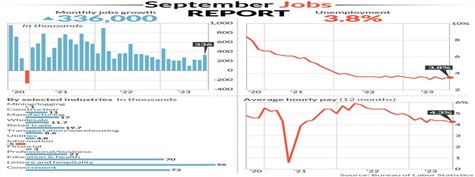
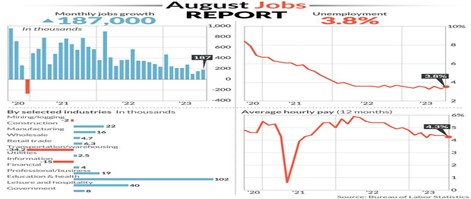
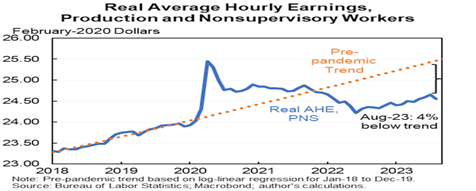
The Fed Governors should be happy with Friday’s unemployment report—nothing has really changed over the past several months, including record low unemployment, inflation continuing to decline, and average hourly wages holding at 4.4 percent.

“Both the unemployment rate, at 3.5 percent, and the number of unemployed persons, at 5.8 million, changed little in July. The unemployment rate has ranged from 3.4 percent to 3.7 percent since March 2022,” said the BLS press release.

We are in August and still no sign of a recession. Gross Domestic Product is estimated to grow even higher this quarter—as high as 3.9 percent from 2.4 percent in the second quarter, according to the latest Atlanta Federal Reserve GDPNow estimate. And companies are struggling to find more workers.

Why the sudden growth spurt? Even Nobel laureate economist Paul Krugman is calling it a Goldilocks economy.

“Economic policy in 2021 was actually pretty good. In fact, given the dislocations associated with a continuing pandemic, we ran what was in effect a Goldilocks economy, one that was neither too cold nor too hot.”

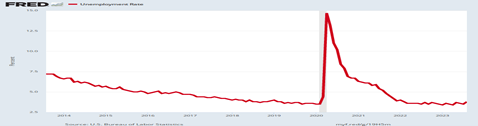
The sustained low unemployment rate is truly historic. Unemployment has declined to 3.5 percent only two other times—in 1955 during the post-WWII boom and 1969, the year of the first moon landing.

Education & healthcare led the report with 100,000 jobs added, but I like the construction jobs numbers best. This is because they show the effects of the recently enacted Infrastructure and Jobs Act and Inflation Reduction Act that are pouring $$trillions into real projects that are creating high-paying jobs. The problem—finding the workers.

Construction employment continued to trend up in July (+19,000), in line with the average monthly gain of 17,000 in the prior 12 months. Over the month, job growth occurred in residential specialty trade contractors (+13,000) and in nonresidential building construction (+11,000), per the BLS press release.

So why the recession worries at this stage of the recovery? It seems to be because of the much talked about inverted Treasury yield curve when short term rates (such as the 2-year Treasury) yield a rate much higher than the 10-year benchmark Treasury for an extended period of time.

It means credit is tighter, because lenders such as banks tend to lead at rates close to the 10-year benchmark Treasury yield, which is currently around 4 percent, but borrow at the usually lower 2-year rate that is now higher at around 4.8 percent.

When their cost to borrow is higher than what they can earn on their loans, lenders simply have less money to lend, hence tighter credit conditions.

FREDdeficit/gdp

That is happening because of the Fed’s credit tightening moves (that have driven up short-term rates). But the federal government is providing many more $$ to spur the economic renewal. Its current quarterly funding request is for $1 trillion to fund all those government projects that will pay for the future health of our economy.

Then why the credit downgrade by Fitch Ratings that has markets worried? Because debt rating agencies worry about unmanageable debt. Yet, as the above FRED graph dating from 1930 shows, the actual annual deficit as a percentage of Gross Domestic Product is more important than the actual debt-to-GDP that has grown to 120 percent, because it shows the US can easily pay for said debt. Its ratio today is 5.8 percent and declining.

Dips below the zero-deficit straight line are deficits in the graph. The deficit has come down sharply from the negative -14.9 percent in 2020 because of the pandemic due to our strong economic growth since the pandemic.

Harlan Green © 2023

Follow Harlan Green on Twitter: https://twitter.com/HarlanGreen
Posted in Consumers, COVID-19, Economy, Macro Economics, Weekly Financial News | Leave a comment

Q3 Economic Growth to Double?

Popular Economics Weekly

AtlantaFedGDPNow

We could have even higher third quarter economic growth, believe it or not, from the second quarter 2.4 percent (advance) growth estimate by the US Bureau of Economic Analysis.

The Atlanta Federal Reserve’s GDPNow model estimates a jump to 3.9 percent growth in Q3 (September to December 2023), a huge leap from its second quarter estimate that actually matched the BEA’s Q2 estimate. So, we should take it seriously, given all the good news about public spending on new infrastructure and the like.

“The GDPNow model estimate for real GDP growth (seasonally adjusted annual rate) in the third quarter of 2023 is 3.9 percent on August 1, up from 3.5 percent on July 28. After this morning’s construction spending release from the US Census Bureau and the Manufacturing ISM Report On Business from the Institute for Supply Management, the nowcasts of third-quarter real personal consumption expenditures growth and real gross private domestic investment growth increased from 3.1 percent and 4.7 percent, respectively, to 3.5 percent and 5.2 percent.”

Construction is surging because of the US Infrastructure Act and Inflation Reduction Act $trillions being spent to modernize the US economy.

As if to emphasize the increased optimism, orders at U.S. factories rose 2.3 percent in June, largely because of more contracts for Boeing planes. Bookings for durable goods climbed 4.6 percent that are mostly consumer goods meant to last at least several years. The overall manufacturing sector is still weak and future orders have been contracting for almost one year.

How can the Atlanta Fed be so optimistic about future growth when Fitch Ratings just downgraded US Sovereign Debt to AA+ from AAA?

Much of it may have something to do with the various programs congress enacted, now being called Bidenomics, because though bipartisan it happened under President Biden’s watch.

Major economists like Nobel Laureate Paul Krugman are jumping on the Bidenomics growth bandwagon.

“It’s hard to overstate how good the U.S. economic news has been lately. It was so good that it didn’t just raise hopes for the future; it led to widespread rethinking of the past. Basically, Bidenomics, widely reviled and ridiculed a year ago, looks a lot better in retrospect. It’s starting to look as if the administration got it mostly right, after all.”

Second quarter consumer spending (i.e., personal consumption expenditures) has held up, though down from its first quarter spike. And real gross private investment is increasing 5 percent annually, thanks to those $trillions government is spending to stimulate private investments that is modernizing almost every area of our economy, from roads and bridges, water treatment facilities, airports, energy grids, to rural Internet hookups.

And more Americans are working than before the pandemic, so why shouldn’t the US economy look even better in Q3?

Harlan Green © 2023

Follow Harlan Green on Twitter: https://twitter.com/HarlanGreen
Posted in Consumers, COVID-19, Economy, Politics, Weekly Financial News | Leave a comment

A Lot of Job Openings!

Financial FAQs

Calculated Risk Blog

It’s hard to reconcile the recent downgrade of US Treasury debt by Fitch Ratings, one of the three major debt rating agencies, to AA+ from AAA, with the US economy still at full employment.

“The repeated debt-limit political standoffs and last-minute resolutions have eroded confidence in fiscal management,” it said. “Several economic shocks” as well as tax cuts and new spending initiatives “have contributed to successive debt increases over the last decade,” reported MarketWatch on the downgrade.

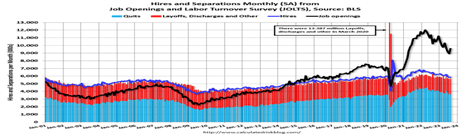
The Bureau of Labor Statistics Job Opening and Labor Turnover Survey (JOLTS) reported an average of 5.9 million hires per month (blue line in graph), and total separations of 5.6 million, while the number of job openings has declined to 9.8 million range (black line).

That’s still a lot of job openings, mostly in government and services. Openings increased in health care and social assistance (+136,000) and in state and local government, excluding education (+62,000). Job openings decreased in transportation, warehousing, and utilities (-78,000), state and local government education (-29,000), and federal government (-21,000), said the Bureau of Labor Statistics press release.

Fitch maintained that “tighter” credit, weakening investment in business, and a “slowdown” in consumption “will push the U.S. economy into a mild recession” in the fourth quarter of this year and the first three months of next year, reported MarketWatch.

This is although most economists now see little danger of any recession at all; maybe just a ‘soft landing’ that slows economic growth once the Fed ends its interest rate hikes.

That doesn’t mean it hasn’t been a wild ride since the pandemic-induced disruptions.

The Calculated Risk graph tells the best tale of the pandemic—what our economy has endured from the effects of COVID-19. There were 13.406 million job layoffs and discharges in March 2020 (red bar spike in graph) during the nationwide shutdown when city streets emptied from the mandatory lock downs and home stays and wild animals roamed the streets.

It resulted in the shortest recession ever—just two months, April-May 2020—then economic growth suddenly reversed, and businesses hired 8 million workers (blue line) in the next couple of months.

The JOLTS report also tells us the difference between hires and total separations has averaged some 300,000 nonfarm payroll jobs, which approximates the average monthly job creations this year.

This is what Bidenomics is all about, the various aid programs and bills enacted by congress to modernize the US economy and reduce global warming. It has created something like six million jobs since President Biden took office, and maybe 3,600,000 more jobs this year.

It also tells us why the US economy continues to expand in all sectors—with consumers as well as in manufacturing. Consumers provided most of the 2.4 percent increase in Gross Domestic Product (GDP) in the ‘advance’ (first of three) estimates of second quarter economic growth.

This should confirm that no recession is imminent this year. Even if growth in Q3 and Q4 slowed, the overall year’s growth would still be positive.

Goldman Sachs chief economist, Jan Hatzius is one of the major economists who trimmed the probability of a recession in the next 12 months to 20 percent from 25 percent — well below the 54 percent median among forecasters who participated in the last Wall Street Journey survey.

“The main reason for our cut is that the recent data have reinforced our confidence that bringing inflation down to an acceptable level will not require a recession,” said Hatzius.

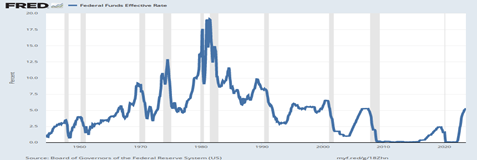
And as I reported earlier, Federal Reserve Chair Powell said the Fed Governors now believe we can avoid a recession at Wednesday’s post-FOMC meeting, after announcing raising the benchmark interest rate to a range of 5.25 percent to 5.5 percent, the highest level in 22 years, in order to combat “elevated” inflation.

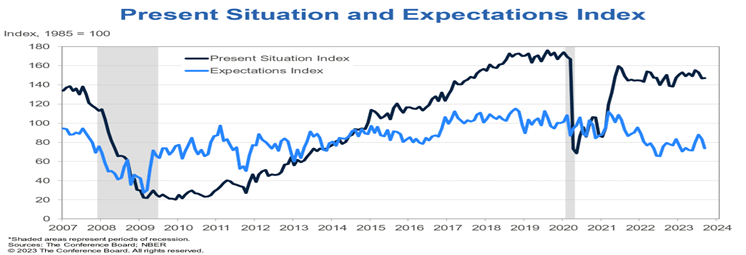
Consumers also like the continued growth, according to the Conference Board’s July Confidence Index that jumped from 110.1 to 117.

“Consumer confidence rose in July 2023 to its highest level since July 2021, reflecting pops in both current conditions and expectations,” said Dana Peterson, Chief Economist at The Conference Board. “Headline confidence appears to have broken out of the sideways trend that prevailed for much of the last year. Greater confidence was evident across all age groups, and among both consumers earning incomes less than $50,000 and those making more than $100,000.”

We should wait for Friday’s latest official unemployment report for the most recent unemployment picture, but it looks like Fitch Ratings is an outlier on the soundness of the US economy.

Harlan Green © 2023

Follow Harlan Green on Twitter: https://twitter.com/HarlanGreen
Posted in Consumers, COVID-19, Economy, Macro Economics, Politics, Weekly Financial News | Leave a comment

“The Housing Recession Is Over!”

The Mortgage Corner

One should maybe forgive National Association of Realtor’s chief economist Lawrence Yun’s enthusiasm when he exclaimed “the housing recession is over,” because the NAR’s Pending Home Sales rose for the first time in four months. And this at a time when the Fed’s hit to interest rates had so depressed the housing market, contributing to the severe housing shortage.

“The recovery has not taken place, but the housing recession is over,” said NAR Chief Economist Lawrence Yun, “The presence of multiple offers implies that housing demand is not being satisfied due to lack of supply. Homebuilders are ramping up production and hiring workers.”

The Pending Home Sales Index (PHSI)* – a forward-looking indicator of home sales based on contract signings – rose 0.3% to 76.8 in June. Year over year, pending transactions fell by 15.6%. An index of 100 is equal to the level of contract activity in 2001, said the NAR press release.

The rest of the US economy has been recovering with second quarter 2023 GDP advance estimate growing 2.4 percent. Interest sensitive real estate sales had been hit hardest with the 5.25 percent in Fed rate hikes, and pending sales gives an picture of sales under contract but not yet closed.

FREDnewhomes

I believe Yun’s remarks may be a sign of something more. A housing market recovery has traditionally been the first indication of an general economic recovery, as indicated by the FRED graph of new-home sales. Existing-home sales follow a similar trajectory. New-home sales have ticked up after every recession (gray bars) since 1960, as viewed in the FRED graph. They are up 23.8 percent annually, to 697,000 units over July 2022, and sales were even higher in June when pro-rated annually.

Many other economic indicators are showing recovery in addition to higher Q2 GDP growth, especially consumer spending, which is slowing but gave a boost to second quarter growth.

Even the Federal Reserve has become more optimistic. Federal Reserve Chair Jerome Powell disclosed at Wednesday’s post-FOMC press conference that his staff is no longer forecasting a recession.

“The staff now has a noticeable slowdown in growth starting later this year in the forecast…but, given the resilience of the economy recently, they are no longer forecasting a recession,” Powell told reporters.

Let us hope Yun is right in prognosticating an end to the housing recession, and maybe any recession this year.

Harlan Green © 2023

Follow Harlan Green on Twitter: https://twitter.com/HarlanGreen
Posted in Consumers, COVID-19, Economy, housing market, Weekly Financial News | Leave a comment

It’s Consumer Spending, Stupid! – Part II

Financial FAQs

BEA.gov

The US economy continues to expand in all sectors—with consumers as well as in manufacturing. But it was consumers that provided most of the 2.4 percent increase in Gross Domestic Product (GDP) in the ‘advance’ (first of three) estimates of second quarter economic growth.

This should confirm once and for all that no recession is imminent this year. Even if growth in Q3 and Q4 slowed, the overall year’s growth would still be positive.

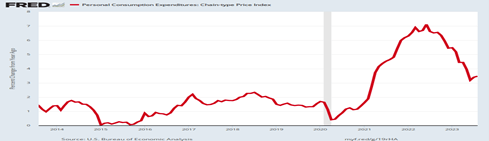
And the inflation rate is cooperating. The PCE price index increased 2.6 percent, compared with an increase of 4.1 percent in Q1. Excluding food and energy prices, the PCE price index increased 3.8 percent, compared with an increase of 4.9 percent.

MarketWatch reported spending on services rose three times faster than outlays on goods. Americans are spending more on travel, recreation, dining out and the like now that the pandemic is over.

Businesses, another major leg of the economy, ratcheted up fixed investment at a nearly 5 percent annual pace. That’s the biggest increase in six quarters. Investment rose at double-digit rates, in percentage terms, for both equipment and structures.

Part of the increase likely stems from a 2021 law passed by the Biden administration that gives subsidies and tax credits to businesses that investment in green energy and technology such as chip making.

The list of improving sectors was long:

“The increase in consumer spending reflected increases in both services and goods,” said the BEA. “Within services, the leading contributors to the increase were housing and utilities, health care, financial services and insurance, and transportation services. Within goods, the increase was led by recreational goods and vehicles as well as gasoline and other energy goods. The increase in nonresidential fixed investment reflected increases in equipment, structures, and intellectual property products. The increase in state and local spending reflected increases in compensation of state and local government employees and gross investment in structures. The increase in private inventory investment reflected increases in both farm and nonfarm inventories.”

Goldman’s chief economist, Jan Hatzius, trimmed the probability of a recession in the next 12 months to 20 percent from 25 percent — well below the 54 percent median among forecasters who participated in the last Wall Street Journey survey.

“The main reason for our cut is that the recent data have reinforced our confidence that bringing inflation down to an acceptable level will not require a recession,” said Hatzius.

Federal Reserve Chair Powell said the Fed Governors now believe we can avoid a recession at yesterday’s post-FOMC meeting, after announcing raising the benchmark interest rate to a range of 5.25 percent to 5.5 percent, the highest level in 22 years, in order to combat “elevated” inflation.

As I said last week, it turns out the American consumer is the mainstay of US growth, and we should celebrate that fact.

Harlan Green © 2023

Follow Harlan Green on Twitter: https://twitter.com/HarlanGreen

Posted in Consumers, COVID-19, Economy, Weekly Financial News | Leave a comment

What Is Bidenomics?

The Mortgage Corner

The best way to describe ‘Bidenomics’ now being touted by a growing consensus of economists is best explained in the recent resurgence of construction spending, as portrayed in the FRED graph.

FREDconstructionspend

Nobel Laureate Paul Krugman, among others, has been touting the strength of the post-pandemic economic recovery, which is being called ‘Bidenomics’ in a play on words to compare it to Reaganomics, the 1980s recovery from the 1970’s era of stagflation and double-digit inflation.

“The economy’s resilience in the face of rate hikes suggests that overall demand has been stronger than anyone expected — possibly in part because Biden administration policies appear to have unleashed a huge wave of manufacturing investment,” said Krugman in a NYTimes Op-ed.

The big difference between the two eras is government’s role. President Reagan decreed that government was the problem, so it financed its recovery with tax cuts that inflated the first substantial federal debt since World War Two.

Bidenomics is being financed with tax receipts, private investment, and some increased taxes, but without tax cuts. So, it must pay for itself, and government-funded programs are providing the incentives.

President Joe Biden’s Infrastructure Investment and Jobs Act has become a part of the domestic economy, “driving a boom in large-scale infrastructure,” wrote Ellen Zentner, chief U.S. economist for Morgan Stanley, in a research note out last week cited by MarketWatch.

As a result, Morgan Stanley now projects 1.9 percent economic expansion in the first half of this year. That’s nearly four times the bank’s previous 0.5 percent forecast for growth in gross domestic product in the first half of 2023.

Some $1 trillion in infrastructure spending signed into law in 2021 marked an early legislative win for a president handed only a slim majority in Congress upon his election over then-incumbent Republican Donald Trump in November 2020.

It was followed up by another legislative banner for Biden: the Inflation Reduction Act, a climate-change- and healthcare-focused spending bill signed into law about a year ago. Many of the incentives in the laws are tied to domestic manufacturing and a reason manufacturing activity is beginning to expand again after a period of contraction, per the S&P U.S. manufacturing-sector index that rose to 49 from 46.3 in July, but has been negative for months.

Tomorrow the first estimate of second quarter GDP growth will be released by the US Bureau of Economic Research (BEA). The Atlanta Fed’s latest GDPNow estimate of second quarter GDP growth by Blue Chip economists is 2.4 percent.

Construction spending in manufacturing is soaring, up 76 percent YoY and helping to boost employment, traditionally with higher-paying jobs. So Bidenomics is a win-win solution for both continued economic growth and keeping workers fully employed.

Harlan Green © 2023

Follow Harlan Green on Twitter: https://twitter.com/HarlanGreen
Posted in Consumers, COVID-19, Economy, Weekly Financial News | Leave a comment

There’s a Housing Shortage

The Mortgage Corner

We know the spring buying season barely got off the ground because of elevated mortgage rates, I said last week. Another reason was elevated prices, due to the housing shortage.

And builders aren’t keeping up with homebuyers’ demand for any residence, new, existing, or rental properties.

Privately‐owned housing construction in June was at a seasonally adjusted annual rate of 1,434,000. This is 8.0 percent below the revised May estimate of 1,559,000 and is 8.1 percent below the June 2022 highpoint of 1,561,000. Single‐family construction is faltering in June (red line in below graph) at a rate of 935,000; this is 7.0 percent below the revised May figure of 1,005,000.

Calculated Risk

The real culprit for slowing starts and sales is sharply higher interest rates Conforming 30-year fixed mortgage rates averaged about 6.4 percent in April and May (for closed sales in June), according to Calculated Risk’s Bill McBride and 30-year rates increased to 6.7 percent in June (closed sales in July will be mostly for contracts signed in May and June).

There was no good reason for fixed rates to be rising at this time, as the inflation rate is about to fall off a cliff. Wholesale PPI inflation is up just 0.1 percent YoY and retail inflation is 3.0 percent YoY in June, so why are traders worrying about higher inflation? Bonds are good predictors and a hedge against inflation, which means they should be falling in line with declining inflation.

Multi-family (apartment) construction is staying ahead of single-family construction (blue line in graph) because most home seekers must rent. There are too few homes being built in the affordable range.

That is why there are currently there are 994 thousand multi-family units under construction.  This ties the record set in July 1973 of multi-family units being built for the baby-boom generation. For multi-family, construction delays are a significant factor. The completion of these units should help with rent pressure.

June existing-home sales were weak as well. Total existing-home sales[1] – year-over-year, were 18.9 percent down from 5.13 million in June 2022.

The wide swings in monthly sales and construction figures are largely due to wildly fluctuating interest rates, as I said. It stymies buyers and makes construction costs more uncertain, hence slows down housing starts.

That is why housing prices are also back up to last year’s high. At $410,200, the median existing-home sales price for June was the second-highest price ever recorded from one year ago of $413,800. It was the third time the monthly median sales price eclipsed $400,000, joining June 2022 and May 2022 ($408,600). 

So it seems the financial markets aren’t yet reacting to the current inflation numbers. There are still some hard-line inflation hawks who believe we are reliving the 1970s, when inflation rose into double digits.

That was a time of scarcities, particularly Middle East wars and an OPEC oil embargo. Those bottle necks also existed briefly with the pandemic and a Ukraine war. But the data today are telling us that’s having little or no effect on current inflation.

Fed Governors should have realized by now the harm any further rate increases will do to our rather desperate housing shortage; particularly for affordable housing.

Harlan Green © 2023

Follow Harlan Green on Twitter: https://twitter.com/HarlanGreen
Posted in Consumers, COVID-19, Economy, Housing, housing market, Weekly Financial News | Leave a comment

“It’s Consumer Spending, Stupid!”

Financial FAQs

FREDretailsales

Consumer spending has markedly slowed due to higher interest rates and depleted savings, but it is growing enough to maintain economic growth. This was confirmed by Tuesday morning’s retail sales report.

“June retail trade sales were up 0.2 percent (±0.5 percent)* from May 2023, and up 0.5 percent (±0.5 percent) above last year. Nonstore retailers were up 9.4 percent (±1.6 percent) from last year, while food services and drinking places were up 8.4 percent (±2.3 percent) from June 2022,” said the US Census Bureau.

“It’s Consumer Spending, Stupid!” is the title of a NYTimes article by Professor James Livingston, an economic historian, written years ago that helps to explain why the pandemic recovery has continued and no recession is on the horizon.

“As an economic historian who has been studying American capitalism for 35 years, I’m going to let you in on the best-kept secret of the last century: private investment — that is, using business profits to increase productivity and output — doesn’t actually drive economic growth. Consumer debt and government spending do. Private investment isn’t even necessary to promote growth.”

Professor Livingston’s column highlighted why without government investing in future growth, US economic growth would have stagnated since 1980.

“Between 1900 and 2000, real gross domestic product per capita (the output of goods and services per person) grew more than 600 percent. Meanwhile, net business investment declined 70 percent as a share of G.D.P. What’s more, in 1900 almost all investment came from the private sector — from companies, not from government — whereas in 2000, most investment was either from government spending (out of tax revenues) or “residential investment,” which means consumer spending on housing, rather than business expenditure on plants, equipment and labor.”

We have been a consumer-driven economy for decades, but because of the $trillions being invested in the US economy today, we may escape a recession altogether—a ‘no landing’ scenario in which economic growth continues unabated this decade.

Goldman’s chief economist, Jan Hatzius, trimmed the probability of a recession in the next 12 months to 20 percent from 25 percent — well below the 54 percent median among forecasters who participated in the last Wall Street Journey survey.

“The main reason for our cut is that the recent data have reinforced our confidence that bringing inflation down to an acceptable level will not require a recession,” said Hatzius.

Add to that the Atlanta Fed GDPNow estimate of second quarter growth is now 2.4 percent.

This was after recent increases in the nowcasts of second-quarter real personal consumption expenditures and real government spending growth from 1.2 percent and 2.4 percent, respectively, to 1.4 percent and 2.8 percent, partially offset by a decrease in the nowcast of second-quarter real gross private domestic investment growth from 10.5 percent to 9.4 percent.

Professor Livingston is brutal in his assessment of the contribution of corporate profits to US economic growth.

“So corporate profits do not drive economic growth — they’re just restless sums of surplus capital, ready to flood speculative markets at home and abroad. In the 1920s, they inflated the stock market bubble, and then caused the Great Crash. Since the Reagan revolution, these superfluous profits have fed corporate mergers and takeovers, driven the dot-com craze, financed the “shadow banking” system of hedge funds and securitized investment vehicles, fueled monetary meltdowns in every hemisphere and inflated the housing bubble.”

Consumer spending is not only the key to economic recovery in the short term; says Livingston, it’s also necessary for balanced growth in the long term. If our goal is to repair our damaged economy, we should bank on consumer culture — and that entails a redistribution of income away from profits toward wages, enabled by tax policy and enforced by government spending. (The increased trade deficit that might result should not deter us, since a large portion of manufactured imports come from American-owned multinational corporations that operate overseas.)

So it turns out the American consumer is the mainstay of US growth, and we should celebrate that fact.

Harlan Green © 2023

Follow Harlan Green on Twitter: https://twitter.com/HarlanGreen
Posted in Consumers, COVID-19, Economy, Macro Economics, Weekly Financial News | Leave a comment

What Happened to Inflation?

Popular Economics Weekly

FREDppifinaldemand

What happened to the inflation problem? The latest wholesale inflation data show the Fed has more than succeeded in its campaign to tame inflation.

The wholesale Producer Price Index (PPI) for final demand in wholesale goods and services barely grew at all (see the FRED graph above) in the Bureau of Labor Statistics latest release.

Wholesale prices rose just 0.1 percent in June, extending a string of weak readings that suggest inflation in the U.S. is likely to continue to decelerate. Over the past 12 months the PPI plunged to 0.1 percent from 1.1 percent in the prior month. That’s the lowest reading since September 2020.

This is while Americans are still fully employed. The Fed consensus had postulated at least a 5 percent unemployment rate would be needed to bring inflation down to their 2 percent target rate. And former Treasury Secretary Larry Summers infamously said unemployment could go as 7 percent with the loss of several million jobs to tame the inflation tiger.

It will only intensify the debate among economists whether there will be a ‘soft landing’, or whether there will be no landing at all—a ‘no landing’ scenario in which economic growth continues to be positive into next year, regardless of the predictions that higher interest rates must ultimately lead to a recession (i.e., negative growth).

In fact, wholesale inflation (mainly the cost of raw materials) is in danger of turning negative, which means retail prices could also fall. (This would be a danger sign if not for other factors, since falling prices are a deflationary trend if passed on to retail prices, which usually means a looming recession.)

But with the current 3.6 percent unemployment rate, and $trillions being invested in modernizing US infrastructure this decade, this is unlikely. Americans will be employed in better-paying jobs for years to come.

Even the so-called core prices the Fed loves to cite as a more stubborn indicator of inflation decelerated to 2.6 percent from 2.8 percent, marking the smallest increase since March 2021.

Why this sudden deceleration in inflation, after all the predictions that it will remain high and become embedded in consumers’ expectations?

Firstly, the supply-chain shortage has disappeared, and every country is racing to resupply themselves from the effects of the pandemic,

I earlier cited a Global Finance Magazine article that touted the increased capital spending everywhere today, not just in the US, since the pandemic:

“Despite concerns that economic growth may slow as central banks tap the brakes to combat inflation, companies around the globe are in a spending boom for capital such as factories and for things like digitalization and automation, 5G networks and the transition to clean energy.”

The other concern has been that wage increases might cause inflation expectations to become ‘embedded’ in prices for years to come.

FREDwagesandsalaries

Yet household incomes haven’t kept up with inflation since the 1970s, as portrayed in the FRED graph dating from 1950. They are now rising at just 1.2 percent quarterly, seasonally adjusted, in the face of full employment, according to the latest FRED data.

So now we have the means and opportunity to begin the process of renewing the American economy with governments spending again, and maybe avoiding any recession with a ‘no landing’ outcome.

Harlan Green © 2023

Follow Harlan Green on Twitter: https://twitter.com/HarlanGreen

Posted in Consumers, COVID-19, Economy, Uncategorized, Weekly Financial News | Leave a comment

Homebuying Season Continues

The Mortgage Corner

We know the spring buying season barely got off the ground because of elevated mortgage rates. But there are enough homes for sale to continue purchases into the summer.

An analysis by Redfin, the national real estate and housing finance entity, showed active listings still high in June, but down -8.1 percent YOY from 2021 and 2022 per the Redfin graph of active listings below.

There is enough supply (2.5 months) that median housing prices fell $50,000 last year in June, from $397,000 to less than $350k in December 2022. But prices rose again this June 2023 to $382,861, so the question is what happens next?

This always depends on supply, and builders have been playing catchup, as I’ve been saying. There are now as many new homes as existing homes for sale.

So, will supply improve enough and interest rates hold steady enough to allow prices a downward trajectory for the rest of this year, as well?

Redfin.com

“There are two things that would jumpstart the housing market: A big drop in mortgage rates and/or a big surge of new listings,” said Redfin Deputy Chief Economist Taylor Marr. “Neither of those things happened this spring; instead, rates rose and new listings dropped to record lows. And with one or two more interest-rate hikes expected this year, mortgage rates are likely to remain elevated at least through the summer, continuing to limit both demand and supply.”

Supplies should increase because groundbreaking on U.S. single-family homebuilding projects surged in May by the most in more than three decades and permits for future construction also climbed, suggesting the housing market may be turning a corner after getting clobbered by Federal Reserve interest rate hikes.

“The May housing starts data and our latest builder confidence survey both point to a bottom forming for single-family residential construction earlier this year,” said NAHB Chief Economist Robert Dietz. “However, due to weakness at the start of the year, single-family housing starts are still down 24% on a year-to-date basis.”

What gives us hope the Fed will slow its rate hikes is consumer inflation continues to decline. U.S. consumer prices rose a modest 0.2% in June. The CPI rate of inflation slowed to the lowest level since 2021. The last time inflation was this low was in March 2021.

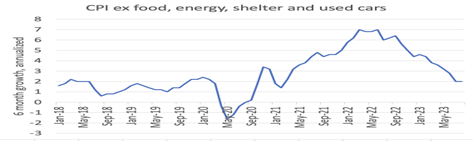
The overall Consumer Price Index inflation rate plunged from 4 to 3 percent in 12 months, its core rate without food and energy prices fell to 4.8 percent.

But even though there wasn’t much of a spring homebuying season this year, there was a spring building season,” Redfin’s Marr said. “That means there’s hope for more listings somewhat soon, with homebuilders working to fill the inventory bucket.”

NAR chief economist Lawrence Yun said in reaction to the good inflation report that falling gasoline prices and healthcare service costs were helpful. Rents are still climbing at a brisk pace, rising by 8.3 percent, but have turned the corner for sure. Rents were rising at 8.8 percent in the early part of the year, so this is the slowest gain in 7 months.

Rents comprise 40 percent of the Consumer Price Index, and with so many apartment units under construction, rents should continue to decline, thus improving the inflation rate and prospect for lower mortgage rates.

Harlan Green © 2023

Follow Harlan Green on Twitter: https://twitter.com/HarlanGreen

Posted in Consumers, COVID-19, Economy, Housing, housing market, Weekly Financial News | Leave a comment