
Americans Still Fully Employed

Popular Economics Weekly

MarketWatch.com

Hiring has been slowing in some business sectors, but government, education & health, and construction kept the BLS unemployment rate at a historic low of 3.6 percent per the MarketWatch graph.

American governments and the construction industry are hiring because the Infrastructure, Inflation Reduction and CHIPS Acts are modernizing the US economy for the first time in more than 70 years.

This is what should happen when the private sector hasn’t been investing in the future. So-called Capex, or capital expenditures, have been low for years and will now invest more when governments come along.

It happened during the 1930’s New Deal and after World War II, before government retreated to mainly support Social Security and Medicare, as well as the mortgage industry to create the post-war housing boom.

FREDcapex

Reaganomics and the conservatives’ “deficits don’t matter” crowd took over in the 1980s with massive tax cuts as well as spending cuts in favor of stock buybacks and enriching corporate CEOS.

Capex spending (funds used by a company to acquire, upgrade, and maintain physical assets such as property, plants, buildings, technology, or equipment) plunged to almost zero (0.8 percent) in Q1 2023 per the St Louis FRED graph, which shows the sharp plunge in capital expenditures after 1980. And no country can take care of its citizens if most of its private capital goes to boosting stock buybacks and corporate profits.

Global Finance Magazine touted the increased capital spending everywhere today, not just in the US, since the pandemic:

“Despite concerns that economic growth may slow as central banks tap the brakes to combat inflation, companies around the globe are in a spending boom for capital such as factories and for things like digitalization and automation, 5G networks and the transition to clean energy.”

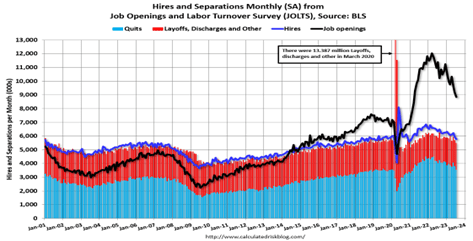
And this spending should continue for the rest of this decade, given the $Trillions allotted to American industry to do the job, and a fully employed economy. Even the government’s latest JOLTS report (Job Openings and Labor Turnover Survey) out last Thursday showed almost 10 million job vacancies waiting to be filled.

Harlan Green © 2023

Follow Harlan Green on Twitter: https://twitter.com/HarlanGreen
Posted in Consumers, COVID-19, Economy, Weekly Financial News | Leave a comment

Consumer Splurge Continues

Financial FAQs

BEA.gov

Consumers continue to spend, and what can the Fed do about it?

This will be debated by market analysts ad nauseum until the next Federal Reserve FOMC meeting in July. And then Chairman Powell, et. al., will probably follow former chair Paul Volcker’s lead; keep raising interest rate maybe another 0.50 percent by December and see then whether the US economy really hits the skids, even as inflation continues to decline.

The Fed’s most important inflation measure, the Personal Consumption Expenditure Price Index (PCE) measure of inflation, fell from 4.3 percent to 3.8 percent, but its core rate excluding food and energy remained higher (4.6 percent) because travel is soaring, keeping service prices from falling as much

Personal outlays (spending) barely moved, up 0.1 percent, while personal income rose 0.4 percent so the savings rate is rising (black line in graph).

Oh yes, we are getting ahead of ourselves because July 4 is coming up and the times are good for most American consumers because they still have lots of savings and nobody is losing their job that wants to keep it.

And after the final first quarter estimate of Gross Domestic Product (GDP) growth rose to 2.0 percent, economists are beginning to predict Q2 may grow as much. Consumer spending rose 4.2 percent from a prior 3.8 percent annual clip, explaining most of the upward increase in first quarter GDP. It was the biggest gain in two years.

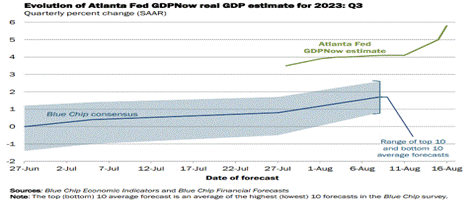
And, the Atlanta Federal Reserve’s GDPNow second quarter estimate of blue-chip economists and its own data research took a sharp upturn.

AtlantaFed

It was largely revised upward to 2.2 percent on June 30, from 1.8 percent on June 27, because of upward revisions to second-quarter real personal consumption expenditures growth (just reported above) and second-quarter real gross private domestic investment growth.

The manufacturing sector keeps contracting, however. The Institute for Supply Management’s manufacturing survey dipped to 46 percent in June from 46.9 percent in the prior month. It was the lowest reading since May 2020.

This is why predictions of a looming recession are still being made. Manufacturing makes up just 11 percent of GDP activity, however.

That’s why consumers are still upbeat, The latest University of Michigan sentiment survey reflected their optimism:

“Consumer sentiment rose 9% this month, a consensus improvement across all demographic groups. The year-ahead economic outlook soared 28% over last month, and long-run expectations rose 11% as well. Overall, this striking upswing reflects a recovery in attitudes generated by the early-month resolution of the debt ceiling crisis, along with more positive feelings over softening inflation,” said survey director Joanne Hsu. 

This Friday’s employment report for June will give more direction for Q2, so why are consumers still so upbeat. It looks like inflation doesn’t bother them as much as the Fed.

Harlan Green © 2023

Follow Harlan Green on Twitter: https://twitter.com/HarlanGreen
Posted in Consumers, COVID-19, Economy, Weekly Financial News | Leave a comment

Big Rise in Q1 Economic Growth

Popular Economics Weekly

BEA.gov

Economic growth in Q1 2023 was much better than pundits and economists predicted. GDP growth rose from its second estimate of 1.3 percent to 2.0 percent growth in the first quarter, largely because consumers spent more.

Exports were also higher, but consumer spending rose a whopping 4.2 percent annually from its second 3.8 percent guesstimate. Governments spent more as well, thanks to the recovery aid pouring into state coffers.

Why the consumer spending spree? Disposable personal income increased $587.9 billion, or 12.9 percent, in the first quarter, an upward revision of 0.5 percent from the previous estimate. And real (after inflation) disposable personal income increased 8.5 percent, an upward revision of 0.7 percentage point.

Also, personal saving was $840.9 billion in the first quarter, an upward revision of $11.6 billion from the previous estimate. The personal saving rate——personal saving as a percentage of disposable personal income—was 4.3 percent in the first quarter, an upward revision of 0.1 percentage point, said the BEA.

So consumers are still feeling flush, which is why consumer confidence is also soaring. The Conference Board’s survey of U.S. consumer confidence jumped to a 17-month high of 109.7 in June, reflecting a slowdown in inflation and fewer worries about a recession.

Now we must worry about a too-hawkish Fed spoiling the party by continuing to boost their interest rates. And that’s because conventional economists such as former Fed Chair Ben Bernanke (who once worried about too little inflation after the Great Recession) are saying even after the price of everything else returns to a 2 percent inflation target, high wages will keep the inflation fires burning.

In a just released working paper co-authored by former World Bank Chief Economist Olivier Blanchard, they said:

“We find that, contrary to early concerns that inflation would be spurred by overheated labor markets, most of the inflation surge that began in 2021 was the result of shocks to prices given wages, including sharp increases in commodity prices and sectoral shortages. However, although tight labor markets have thus far not been the primary driver of inflation, the effects of overheated labor markets on nominal wage growth and inflation are more persistent than the effects of product-market shocks. Controlling inflation will thus ultimately require achieving a better balance between labor demand and labor supply.”

This is once again looking in the rear-view mirror of the seventies when oil prices soared. But the US is no longer dependent on Saudi oil, since we developed our own oil supply, and renewable energy comprises a growing share of energy generation.

And where are inflation expectations? Still anchored at 3 percent longer term.

For instance, the University of Michigan Consumer sentiment survey reported earlier its drop in year-ahead inflation expectations receded to 3.3 percent in June from 4.2 percent in May. The current reading is the lowest since March 2021. In contrast, long-run inflation expectations were little changed from May at 3.0 percent, again staying within the narrow 2.9-3.1 percent range for 22 of the last 23 months.

This is in line with the big drop in the retail Consumer Price Index from 4.9 percent to 4.0 percent, the best news yet that the Fed is winning the inflation battle. It was the smallest 12-month increase since the period ending March 2021. The all items (core) less food and energy index rose 5.3 percent over the last 12 months.

In fact, the so-called labor demand and supply imbalance can only be cured over the longer term by creating smarter immigration policies and modern technologies that improve worker productivity, due to Americans’ lower birth rate.

The Fed has little reason to intervene in what is essentially a Big Business/Labor negotiation.

Harlan Green © 2023

Follow Harlan Green on Twitter: https://twitter.com/HarlanGreen
Posted in Consumers, COVID-19, Economy, Politics, Uncategorized, Weekly Financial News | Leave a comment

US Inflation In Faster Decline

The Mortgage Corner

The Whitehouse Council of Economic Advisors (CEA) has come out with a study that compares US inflation to European inflation, and finds that ours has come down faster, much more apace, in fact.

It found that so-called ‘harmonized’ headline inflation in the US rose earlier & generally peaked earlier in the pandemic than in other G7 nations. As of April 2023, inflation is also lower in the US on a 12-month basis than in the rest of the G7. US inflation declined again in May.

Whitehouse.gov

“In May, Consumer Price Index (CPI) inflation in the United States was four percent year-on-year,” said the CEA. “Inflation in the U.S. has declined substantially since last summer, when its yearly growth peaked at over nine percent. One common question this raises is how U.S. inflation compares to inflation in other advanced countries. Due to a variety of measurement issues, such a comparison is harder than is commonly recognized.”

We first saw the dramatic decline in US inflation in the latest wholesale, PPI numbers that showed raw material prices and final demand services have an almost zero inflation rate.

“In May, the decline in the final demand index can be traced to prices for final demand goods, which fell 1.6 percent. The index for final demand services increased 0.2 percent,” said the BLS. “Prices for final demand less foods, energy, and trade services were unchanged in May after inching up 0.1 percent in April.”

Part of why the U.S. is now seeing lower inflation than the other G7 nations, said the report, is due to the omission of owner-occupied housing costs. Another important factor for headline inflation is the war in Ukraine, which has affected food and energy prices globally but especially in Europe, which has had the broadest exposure to the consequences of the conflict.

These factors should count us lucky to have an ocean between us and the G7 countries, but Chairman Powell and the US Fed needs to acknowledge this. He is now tying himself in knots attempting to justify the Fed’s hawkish stance on inflation when there’s no reason to.

As Powell said just today at an ECB economic conference in Sintra, Portugal, he believes that a soft landing is possible, but will wait to see it confirmed by upcoming inflation data.

I am optimistic of his more dovish outlook because of an oft-forgotten factor—the Fed is also responsible for the soundness of commercial banks, and therefore wants to prevent the failure of more US banks in the modern digital age, where it can happen overnight.

In an Outside the Box MarketWatch opinion piece Laura Veldkamp opined that bank failures were infrequent and tended to happen in waves; until today.

“Between 1941 and 1979, an average of 5.3 banks failed each year. According to Pew, the SVB and Signature failures were the first in more than two years. Yet, the magnitude of this year’s three bank failures surpassed the 25 that occurred during the global financial crisis in 2008.”

Hence my belief that the Fed Governors will perhaps allow a tighter labor market to flourish while they continue to crunch the numbers on inflation, rather than allow further rate increases. Let us hope so.

Harlan Green © 2023

Follow Harlan Green on Twitter: https://twitter.com/HarlanGreen

Posted in Consumers, COVID-19, Economy, Weekly Financial News | Leave a comment

US Inflation In Faster Decline

The Mortgage Corner

The Whitehouse Council of Economic Advisors (CEA) has come out with a study that compares US inflation to European inflation, and finds that ours has come down faster, much faster, in fact.

It found that so-called ‘harmonized’ headline inflation in the US rose earlier & generally peaked earlier in the pandemic than in other G7 nations. As of April 2023, inflation is also lower in the US on a 12-month basis than in the rest of the G7. US inflation declined again in May.

Whitehouse.gov

“In May, Consumer Price Index (CPI) inflation in the United States was four percent year-on-year,” said the CEA. “Inflation in the U.S. has declined substantially since last summer, when its yearly growth peaked at over nine percent. One common question this raises is how U.S. inflation compares to inflation in other advanced countries. Due to a variety of measurement issues, such a comparison is harder than is commonly recognized.

We first saw the dramatic decline in US inflation in the latest wholesale, PPI numbers that showed raw material prices and final demand services have an almost zero inflation rate.

“In May, the decline in the final demand index can be traced to prices for final demand goods, which fell 1.6 percent. The index for final demand services increased 0.2 percent,” said the BLS. “Prices for final demand less foods, energy, and trade services were unchanged in May after inching up 0.1 percent in April.”

Part of why the U.S. is now seeing lower inflation than the other G7 nations, said the report, is due to the omission of owner-occupied housing costs. Another important factor for headline inflation is the war in Ukraine, which has affected food and energy prices globally but especially in Europe, which has had the broadest exposure to the consequences of the conflict.

These factors should count us lucky to have an ocean between us and the G7 countries, but Chairman Powell and the US Fed needs to acknowledge this. He is now tying himself in knots attempting to justify the Fed’s hawkish stance on inflation when there’s no reason to.

As Powell said just today at an ECB economic conference in Sintra, Portugal, he believes that a soft landing is possible, but will wait to see it confirmed by upcoming inflation data.

I am optimistic of his more dovish outlook because of an oft-forgotten factor—the Fed is also responsible for the soundness of commercial banks, and therefore wants to prevent the failure of more US banks in the modern digital age, where it can happen overnight.

In an Outside the Box MarketWatch opinion piece Laura Veldkamp opined that bank failures were infrequent and tended to happen in waves; until today.

“Between 1941 and 1979, an average of 5.3 banks failed each year. According to Pew, the SVB and Signature failures were the first in more than two years. Yet, the magnitude of this year’s three bank failures surpassed the 25 that occurred during the global financial crisis in 2008.”

Hence my belief that the Fed Governors will perhaps allow a tighter labor market to flourish while they continue to crunch the numbers on inflation, rather than allow further rate increases. Let us hope so.

Harlan Green © 2023

Follow Harlan Green on Twitter: https://twitter.com/HarlanGreen

Posted in Consumers, COVID-19, Economy, Uncategorized, Weekly Financial News | Leave a comment

American Consumers Happier

Financial FAQs

American consumers can live with higher inflation, according to the Conference Board’s latest confidence survey, but can the Fed?

Its survey of U.S. consumer confidence jumped to a 17-month high of 109.7 in June, reflecting a slowdown in inflation and fewer worries about a recession, per its release. The important index of consumer thinking increased 7.2 points from a revised 102.5 in May, the Conference Board said Tuesday. It was the lowest in six months.

The Fed has lived with high inflation before, during more prosperous times. But since 1980 and the Volcker era as Fed Chairman it hasn’t tolerated any inflation rate much above 2 percent, as the FRED graph dating from 1950 makes clear. (Gray bars are recessions.)

FREDcpi

That was also when salaried employees had a larger share of the economic pie—from the 1950s to 1970s. But then oil and oil embargoes became a political football, and Big Business decided it wanted a larger share of the economic pie.

Inflation then declined during an era of ‘great moderation’ after 1980 and employees behaved themselves as they lost their bargaining power when so many higher-paying union jobs fled overseas.

There is a reversal of fortunes happening since then thanks to the COVID pandemic when private industry stopped investing and governments had to step in to spur the recovery.

Workers’ salaries are surging, hence the rising confidence of consumers in the latest surveys.

“Consumer confidence improved in June to its highest level since January 2022, reflecting improved current conditions and a pop in expectations,” said Dana Peterson, Chief Economist at The Conference Board. “Greater confidence was most evident among consumers under age 35, and consumers earning incomes over $35,000.

“The expectations gauge continued to signal consumers anticipating a recession at some point over the next six to 12 months,” said Peterson, “but considerably fewer consumers now expect a recession in the next 12 months compared to May.”

Why the dichotomy in consumer thinking? Because we all know the Fed’s propensity to keep raising interest rates, as long as they believe any inflation rate above 2 percent endangers economic growth. And there is a growing consensus that further rate hikes will plunge US into a short recession, at least.

The University of Michigan’s sentiment survey that economists also look at showed more optimism.

Its index lifted 8% in June, reaching its highest level in four months, “reflecting greater optimism as inflation eased and policymakers resolved the debt ceiling crisis,” said survey director Joanne Hsu. “Sentiment is now 28% above the historic low from a year ago and may be resuming its upward trajectory since then,” she said.

The bottom line is that consumers have become wealthier since the pandemic, and are showing it in their buying habits by dining out and traveling more.

The bottom 50 percent, generally households with net worth of $166,000 or less before the pandemic, now hold a bigger share of the nation’s wealth than they’ve had for 20 years, the Federal Reserve estimates. Their collective net worth, $3.73 trillion, has almost doubled in two years and is more than 10 times higher than in 2011, the nadir after the last recession.

So why shouldn’t we be happier?

Harlan Green © 2023

Follow Harlan Green on Twitter: https://twitter.com/HarlanGreen
Posted in Consumers, COVID-19, Politics, Weekly Financial News | Leave a comment

Wrong Lessons Learned From 1970s

Financial FAQs

Much talk has been made of what the Chairman Powell and US Fed officials say they learned from the inflation spiral of the 1970s. Keep employees’ wages from rising too fast, since they are that part of the inflation equation the Fed can control.

That is, by raising interest rates the Fed hopes to pressure employers to restrain hiring practices and wage hikes by making it more expensive to do so.

But the problem is Fed economists know that many other factors affect inflation—e.g., corporations inhibit competition with monopolistic practices, supply-chains are not always dependable providers, and geopolitical events like wars and pandemics create major scarcities, as has happened since 2020.

FREDwagesandsalary

The above St. Louis Fed (FRED) graph dating from 1950 shows how successful the Fed’s main monetary policy has been of suppressing wages to keep inflation moderate.

Wages and salaries rose on average 5-10 percent annually until 1980, when Paul Volcker began his reign as Federal Reserve Chairman. Employees’ incomes then began the long descent to averaging less than 5 percent since.

Inflation was tamed, the inflation battle was won, but at what cost? Did it make most Americans better off? No. There were a series of recessions culminating in the Great Recession of 2017-19 in which they lost a greater share of total wealth generated by their employers.

Inequality.org

The picture is startling per this popular graph.

Income disparities are now so pronounced that America’s richest 1 percent of households (orange line in graph) averaged more than 84 times as much income as the bottom 20 percent in 2019, according to the Congressional Budget Office. Americans in the top 0.01 percent (brown line) tower stunningly higher. With average household income of $43 million, they bring in 1,807 times more income than the bottom 20 percent. 

Of course, globalization and the lowering of trade barriers that moved higher paying wages overseas have been the orthodox explanations for why workers lost such a share of the wealth pie. But also lost in the discussions was the Fed’s monetary hand of quickly raising interest rates when inflation heated up and dropping them when a recession resulted.

That has been the Fed’s pattern since the Volcker era. Keep inflation down at all costs, even if it harms employment. Yet we know since the pandemic that a war and COVID-19 scarcities have been most responsible for the sudden inflation spike.

The post-pandemic era has therefore created new opportunities with the need to rebuild the US economy since the pandemic. $Trillions are being spent in a ‘new’ New Deal era of governments coming to the rescue as they did in the 1930s.

The result is a fully employed American economy with rising wages and salaries for years to come—unless the Fed attempts once again to tamp down this activity with its outdated policy goals.

It could right the imbalance that has always benefited employers in the name of price stability since the 1980s by allowing its mandate of maximum employment to continue and restraining further rate hikes.

Harlan Green © 2023

Follow Harlan Green on Twitter: https://twitter.com/HarlanGreen

Posted in Consumers, COVID-19, Economy, Politics, Weekly Financial News | Leave a comment

Q2 GDP Growth Higher?

Financial FAQs

AtlantaFederalReserve

The Atlanta Fed’s GDPnow graph perfectly illustrates how uncertain are predictions for second quarter economic growth. They go literally from negative growth to 2 percent plus!

Why? Because though manufacturing sector growth has been negative for seven months, the service sector of our economy has been supporting jobs and the US economy, which makes up most of economic activity these days.

The latest reading by the S&P Global “flash” U.S. service sector activity index fell to a 54.1 in June from 54.9 in the prior month, a two-month low. Economists surveyed by the Wall Street Journal had forecast a reading of 53.3.

The S&P Global “flash” U.S. manufacturing sector index, meanwhile, slid to a six-month low of 46.3 from 48.4 in May. Any reading above 50 in the surveys shows continuing growth.

And Treasury Secretary Yellen has been more optimistic of late, though warned about the danger to growth if the US Fed continues to raise interest rates.

“I’m not going to say it’s not a risk, because the Fed is tightening policy,” she added, referring to the Federal Reserve’s series of interest-rate increases.

The Federal Reserve has announced its first rate pause since it began to raise short term rates last year. But it threatened to raise rates twice more this year after a six week pause to study the impact of its policies to date.

The Atlanta Fed’s survey attempts to take in any and all indicators of the growth trajectory, so I am conjecturing economists cannot agree on which is the better model, but the fact is we are still at full employment, which has defied the US Fed’s attempts to slow consumer demand quickly enough to their liking, which they say must mean more joblessness! That was the mistake of Greenspan’s tenure as Fed Chairman that I’ve been harping on ad nauseum. He kept raising rates until it caused the Great Recession!

“The GDPNow model estimate for real GDP growth (seasonally adjusted annual rate) in the second quarter of 2023 is 1.9 percent on June 20, up from 1.8 percent on June 15. After this morning’s housing starts report from the US Census Bureau, the nowcast of second-quarter real residential investment growth increased from -2.1 percent to 2.2 percent.”

I said recently that inflation may have all but disappeared by next year, at least for wholesale goods and services, as the Producer Price Index took a sudden plunge in May to an almost zero inflation rate. And it measures the price of wholesale material costs that go into the PPI.

The Producer Price Index (PPI), the Federal Government’s wholesale inflation indicator, shows the Federal Reserve has already overreacted to the inflation surge. Its index for final demand plunged from 2.3 percent to 1.2 percent YoY in just one month, April to May 2023.

“In May, the decline in the final demand index can be traced to prices for final demand goods, which fell 1.6 percent. The index for final demand services increased 0.2 percent,” said the BLS. “Prices for final demand less foods, energy, and trade services were unchanged in May after inching up 0.1 percent in April.”

These changes will also be reflected in the retail Consumer Price Index in coming months, and we could begin to experience a close to zero overall inflation rate if it continues its downward trend very soon.

And, though I’m in danger of repeating myself too much, another inflation indicator is moving quickly downward, U.S. import prices, which fell 4.6 percent from March 2022 to March 2023. This was their largest over-the-year drop since import prices declined 6.3 percent from May 2019 to May 2020.

This basically means the US economy is at full employment, so why wouldn’t consumers spend more on leisure activities such as dining out and travel?

Compounding the confusion over economic growth, Fed Governors seem as uncertain about the future. Richmond Fed Governor Tom Barkin said it’s too soon to decide on more rate increases.

“I want to reiterate that 2% inflation is our target, and that I am still looking to be convinced of the plausible story that slowing demand returns inflation relatively quickly to that target,” he said Friday in a speech in Maryland.

“If coming data doesn’t support that story, I’m comfortable doing more,” he said. Barkin is not a voting member this year of the Fed’s interest-rate setting panel.

Harlan Green © 2023

Follow Harlan Green on Twitter: https://twitter.com/HarlanGreen
Posted in Consumers, COVID-19, Economy, Politics, Weekly Financial News | Leave a comment

Single-Family Construction Surging

The Mortgage Corner

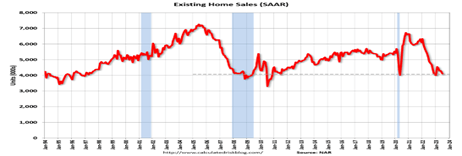
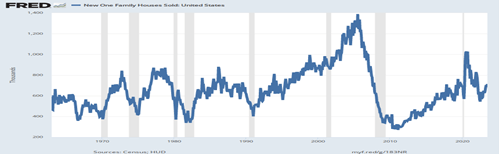
I said last week that higher new home sales and rising homebuilders’ optimism foretell a strong summer sales season if builders and existing-home inventories don’t run out of housing stock. We are now seeing more single-family construction to meet the demand, particularly in the Midwest where housing is more affordable.

The problem has been that not enough existing homes are for sale, hence the below-normal inventory of total homes for sale, which had been spurring higher construction of apartments. We know there is a tremendous housing shortage of all types of residential units.

So the May jump in single-family construction portends a strong summer selling season and bottom to the housing shortage.

“Privately‐owned housing starts in May were at a seasonally adjusted annual rate of 1,631,000. This is 21.7 percent above the revised April estimate of 1,340,000 and is 5.7 percent above the May 2022 rate of 1,543,000,” said the NAR. “Single‐family housing starts in May were at a rate of 997,000; this is 18.5 percent above the revised April figure of 841,000. The May rate for units in buildings with five units or more was 624,000.”

Calculated Risk

“The May housing starts data and our latest builder confidence survey both point to a bottom forming for single-family residential construction earlier this year,” said NAHB Chief Economist Robert Dietz. “There have been some improvements to the supply-chain, although challenges persist for items like electrical transformers and lot availability.”

“However, due to weakness at the start of the year, single-family housing starts are still down 24% on a year-to-date basis.” That’s a shortfall of more than one million existing homes sold in one year, I said recently. So rental housing construction is also surging.

And builder confidence in the market for newly built single-family homes in June rose five points to 55, according to the National Association of Home Builders (NAHB)/Wells Fargo Housing Market Index (HMI) released on Tuesday. This marks the sixth straight month that builder confidence has increased and is the first time that sentiment levels have surpassed the midpoint of 50 since July 2022.

Multi-family starts (blue, 2+ units in graph) increased in May compared to April. Multi-family starts were up 33.2 percent year-over-year in May. Single-family starts (red) increased sharply in May and were down 6.6 percent year-over-year.

This is the second month in a row that starts are up. The pace of construction was the highest since last April, when starts hit a 1.8 million pace. The surge in construction this spring was led by the Midwest.

Keen interest from would-be home buyers is creating strong demand for new homes, say the builders. In fact, a large part of the demand is families with children in spite of the Fed’s threat to continue to boost interest rates this year.

These buyers continue to face a lack of options in the resale market. 

Harlan Green © 2023

Follow Harlan Green on Twitter: https://twitter.com/HarlanGreen
Posted in Consumers, COVID-19, Housing, housing market, Uncategorized, Weekly Financial News | Leave a comment

No More Inflation?

Financial FAQs

FREDppifinaldemand

The Federal Reserve has announced its first rate pause since it began to raise short term rates last year. But it threatened to raise rates twice more this year after a six week pause to study the impact of its policies to date.

Inflation may have all but disappeared by then, at least for wholesale goods and services that took a sudden plunge in May.

The Producer Price Index (PPI), the Federal Government’s wholesale inflation indicator, shows the Federal Reserve has already overreacted to the inflation surge. Its index for final demand plunged from 2.3 percent to 1.2 percent YoY in just one month, April to May 2023.

“In May, the decline in the final demand index can be traced to prices for final demand goods, which fell 1.6 percent. The index for final demand services increased 0.2 percent,” said the BLS. “Prices for final demand less foods, energy, and trade services were unchanged in May after inching up 0.1 percent in April.”

These changes will also be reflected in the retail Consumer Price Index in coming months, and we could begin to experience a close to zero overall inflation rate if it continues its downward trend very soon.

Another inflation indicator is moving quickly downward, U.S. import prices, which fell 4.6 percent from March 2022 to March 2023. This was their largest over-the-year drop since import prices declined 6.3 percent from May 2019 to May 2020.

All signs are now pointing to lessening demand from consumers and businesses. So, do consumers and businesses want to live in a zero-inflation rate environment if the Fed keeps raising interest rates?

No, is the short answer because when prices stop rising they quickly begin to fall in such a consumer-oriented economy as ours. That’s good, isn’t it? But not too much because it’s a sign of falling demand for products, and less demand means businesses see shrinking markets and soon begin to cut jobs.

This hasn’t happened yet but we have a good example in the last decade as it recovered from the Great Recession. PPI for Final Demand was at zero inflation from January 2015 to August 2016 YoY, and quarterly GDP growth was less than 1 percent during the period, per the St. Louis FRED.

It looks like Ian Shepherdson’s remarks are coming true that I quoted recently.

“The forces that drove up inflation since the onset of the Covid pandemic are reversing rapidly,” said Ian Shepherdson, chief economist at Pantheon Economics, in a recent Barron’s article. “Over the next year, both the headline and core rates—the latter excludes food and energy prices—will drop sharply. By the end of 2024, inflation is likely to be below the Federal Reserve’s 2% target, and policy makers will be trying to stop it falling too far.”

The irony is that Fed Chair Powell has said they may have to continue to raise rates even if it causes job losses, if they are to meet their 2 percent inflation target.

He just said inflation has not moved down as much as they would like at his latest press conference. What would it take to convince him and the Fed Governors otherwise, another recession?

Harlan Green © 2023

Follow Harlan Green on Twitter: https://twitter.com/HarlanGreen
Posted in Consumers, COVID-19, Economy, Uncategorized, Weekly Financial News | Leave a comment