Homeowners Have Record Equity

The Mortgage Corner

Meredith Whitney, a noted real estate consultant recently interviewed on CNBC’s Squawk Box, said American homeowners have a record amount of equity in their homes. The average Loan-to-Value (LTV) of mortgages has dropped to 30 percent, which means they have 70 percent equity in their homes.

She asserted, therefore, there is little to no chance of another busted housing bubble as happened in 2007 that led to the Great Recession. Many economists see the real estate sector as a leading indicator of what may happen next to our economy. It could mean there is even less of a chance that a recession may occur this year if it is based on a collapse of real estate values as happened in 2007.

Corelogic

“The average U.S. homeowner now has more than $274,000 in equity — up significantly from $182,000 before the pandemic,” reports CoreLogic Chief Economist Selma Hepp. “Also, while homeowners in some areas of the country who bought a property last spring have no equity as a result of price losses, forecasted home price appreciation over the next year should help many borrowers regain some of that lost equity.”

The U.S. housing market is short more than 300,000 affordable homes for middle-income buyers, according to a new analysis from the National Association of Realtors® and Realtor.com®.

“Middle-income buyers face the largest shortage of homes among all income groups, making it even harder for them to build wealth through homeownership,” said Nadia Evangelou, NAR senior economist and director of real estate research. “A two-fold approach is needed to help with both low affordability and limited housing supply. It’s not just about increasing supply. We must boost the number of homes at the price range that most people can afford to buy.”

Households have another leg to stand on despite rising interest rates. The net worth of U.S. households rose by 2 percent in the first three months of the year to $148.8 trillion, putting it close to a record high and suggesting the economy might have enough fuel to keep growing or at least to avert a steep recession, according to the Federal Reserve’s flow of funds report.

INGeconomics

Most of the increase in net wealth in the first quarter was tied to a rebound in the stock market. The value of equities held by households jumped by $2.4 trillion. The ING graph shows the actual increase in the orange bars above the blue line pre-COVID trend.

Household debt increased at a 2.2 percent annual rate in the first quarter to $19.2 trillion, marking one of the smallest increases in the past decade. Debt had grown as fast as 8 percent as the U.S. emerged from the pandemic, said the Federal Reserve.

Meredith Whitney in another Barron’s interview, said reviving the housing sector from its current slump means finding housing for Gen Z’ers and the second half of millennials that don’t have money. How are they going to become homeowners?

The construction industry is trying to help. Calculated Risk’s Bill McBride reported recently that there are 1.675 million units under construction, just 35 thousand below the all-time record of 1.710 million set in October 2022.

Of these, there are currently 977 thousand multi-family units under construction.  This is the highest level since September 1973, and close to the record of 994 thousand in 1973 (being built for the baby-boom generation).

So builders and home seekers are seeing that the alternative to buying is renting and that has to make up the difference until more affordable housing is constructed.

Harlan Green © 2023

Follow Harlan Green on Twitter: https://twitter.com/HarlanGreen

Posted in Consumers, COVID-19, Economy, Housing, housing market | Leave a comment

Building a ‘Livable’ Climate Change Coalition

CHAPTER ELEVEN

Old Town’s Revival

Chapter Eleven is an excerpt from my memoir that discusses tools needed to form a community consensus. Our effort was dedicated to redevelopment of Old Town Goleta, prior to forming the new City of Goleta.

But such techniques to build consensus could apply to climate change. The Biden administration’s Inflation Reduction Act will begin to implement the new legislation in disadvantaged communities in particular with tax credits and outright grants to start up new projects and clean up their communities of toxic wastes.

The dream of forming a new city of Goleta were revived once its former Old Town center has been approved for redevelopment by Santa Barbara County, but what are the requirements for a livable community?

As recently as 2005, the Institute of American Architects said:

“. . . broadly speaking, a livable community recognizes its own unique identity and places a high value on the planning processes that help manage growth and change to maintain and enhance its community character.”

There had been several unsuccessful efforts to form a city since the 1970s. The Goleta Old Town Revitalization Committee, a mix of local officials and residents that wanted Old Town’s infrastructure and services upgraded, was now created, and I was appointed its chairman.

The Goleta Valley’s Old Town was its 100-year-old historical center that could provide a unique sense of identity to a new city. But how might we create a consensus with its residents of what that might be?  

Hearings were held in Old Town’s Community building so county planners could learn what Goleta’s residents wanted for a future town center. We were following the precepts of community organizing in bringing citizens together to solve some of the problems afflicting such a diverse community.

Goleta in many ways was a microcosm of small-town America and all that had happened to those communities since the sixties: rapid population growth with little concern for the environment. It had an early history combining both rural and urban life with industrial and research centers while being adjacent to the Santa Barbara Airport.

Our new organization (that included several future Goleta city mayors) was more than a redevelopment district because we believed it could aid in giving the Goleta Valley its “own unique identity” that planners and architects deemed requisite for a livable community.

I had read and was influenced by M. Scott Peck’s book The Different Drum, describing the elements that bring a community together to achieve whatever they want. His approach epitomized for me the essence of community development. Dr. Peck, a medical doctor, psychologist, and author of a better-known prequel, The Road Less Traveled, broke down the steps that a community goes through to come together in a meaningful way in The Different Drum.

He warned that the process could take time. Any community usually goes through four stages to reach agreement and to be able to function effectively, whatever its goals. He characterized these stages as Pseudo community, Chaos, Emptiness, and (true) Community.

Pseudo community is the first gathering of any group with the initial pleasantries and avoidance of conflict in the desire to be nice to each other. But it is a false community, because until the second stage of Chaos is reached, individual differences aren’t revealed, and a discussion of the real problems doesn’t surface.

Chaos described the early stages of our hearings when open discussions brought out the conflict between those residents who loved Old Town’s funkiness and cheap rents, and those landlords and landowners who wanted to improve their properties. The goal of the Old Town Advisory Committee was to bring the sides together. There was also a Goleta Beautiful organization that wanted to preserve and restore some of the more historic Old Town structures.

Dr. Peck’s third stage is Emptiness: a time of resignation, when the group or organization gives up their individual prejudices, ideologies, control needs, and begins to see what can be accomplished as a group. In Old Town, it wasn’t until the second year of the hearings that this happened. More Old Town residents were put on the committee, and we began to see a vision of what a revitalized Old Town could be for the Goleta community.

After many hearings and dialogues with planners, architects, developers, and residents that included a weekend Design Charette that I will discuss in a later chapter, the committee members began to have a sense that we were all in this together and would be able to create something beneficial that was a (true) community.

Dr. Peck wrote:

“. . . initially I thought this book’s title should be “Peacemaking and Community”. But that would put the cart before the horse. For I fail to see how we Americans could effectively communicate with the Russians, (or any peoples of other cultures) when we don’t even know how to communicate with the neighbors next door, much less the neighbors on the other side of the tracks.”

In our culture of rugged individualism— in which we generally feel that we dare not be honest about ourselves, even with the person in the pew next to us—we bandy around the word, “community”. . . [but] if we are to use the word meaningfully, we must restrict it to a group of individuals who have learned how to communicate honestly with each other.1

The Old Town Revitalization Committee needed two years and 100 hearings to form the Old Town Revitalization Plan.

_______________________

1 Peck, M. Scott. The Different Drum. Simon & Schuster, 1987. P. 56

Harlan Green © 2023

Follow Harlan Green on Twitter: https://twitter.com/HarlanGreen

Posted in Consumers, Economy, Politics, Uncategorized | Leave a comment

Inflation or Deflation Next Year?

Financial FAQs

FREDpersonalconsumption

The Fed’s favored personal consumption expenditures price index (PCE) has been on a sharp downward trend since June 2022 when it reached its 7 percent inflation high. Both its overall headline indicator (blue line) and core index without gas and energy prices (redline) are now rising in the 4 percent range.

A leading business economist that I like says inflation could plunge below the Fed’s 2 percent inflation target sometime next year. And that would mean a recession, so the Fed should begin to lower interest rates later this year.

“The forces that drove up inflation since the onset of the Covid pandemic are reversing rapidly,” said Ian Shepherdson, chief economist at Pantheon Economics, in a recent Barron’s article. “Over the next year, both the headline and core rates—the latter excludes food and energy prices—will drop sharply. By the end of 2024, inflation is likely to be below the Federal Reserve’s 2% target, and policy makers will be trying to stop it falling too far.”

This happened before under Fed Chair Alan Greenspan when the Fed’s prolonged rate hikes busted the housing bubble in 2007 and precipitated the Great Recession.

The inflation rate then sank below 2 percent for a prolonged period, which required Greenspan’s successor as Fed Chair, Ben Bernanke, to begin the various Quantitative Easing programs that pumped excess dollars into the economy to begin a slow recovery.

The main cause of inflation has been the supply shortages due to worldwide shutdowns from the COVID-19 pandemic. We know what happened to inflate grain and oil prices with the Ukraine War. But auto prices also skyrocketed with the shortage of chip supplies that are in all new cars.

Residential rents also soared, as work-from-home use also increased during and after the pandemic. Now rents are also returning to more normal levels.

To make his point, Shepherdson states, “Almost all of the eightfold increase in global container shipping costs has reversed, and domestic shipping costs also are falling rapidly. Semiconductor supply is back to normal, more or less, so vehicle production in April was higher than before the pandemic. About a third of the increase in auto dealers’ margins already has reversed.”

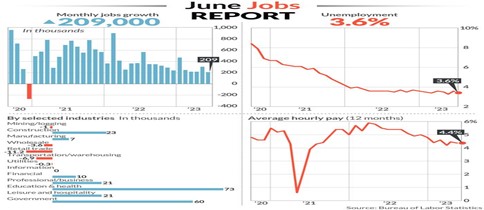
The labor market is the other shoe about to drop. The unemployment rate rose from 3.4 percent to 3.7 percent in May, with 339,000 new nonfarm payroll jobs created. But there are more workers in the workforce now than before the pandemic, which will slow the wage increases, another part of the inflation picture.

Most of the major economic indicators are either flat or declining, so now would be a good time for the Fed to anticipate what will happen next—a growing surplus of supplies as countries ramp up production that will further depress prices—rather than wait too long to react to changes as it did under Greenspan and during the pandemic.

It would be nice if the Fed allowed employees to keep their higher wages by not seeing rising wages in a tight labor market as the main cause of inflation. It would alleviate the record income inequality—the worst in developed countries—which in turn would help to calm the red state-blue state partisan divide, among other benefits.

We now have both hot and cold wars to win, so there’s no good reason to induce another recession.

Harlan Green © 2023

Follow Harlan Green on Twitter: https://twitter.com/HarlanGreen

Posted in Consumers, COVID-19, Economy, Macro Economics, Weekly Financial News | Leave a comment

Huge May Employment Report

Popular Economics Weekly

MarketWatch

How can 339,000 jobs have been created in May when a recession is supposed to happen later this year? And the unemployment rate have risen to 3.7 percent from 3.4 percet last month, confounding all the pundits and many bankers?

Because we are about to enter another industrial age, using a term coined by Christopher Smart in a recent Barron’s Magazine article, a former Senior Treasury official who sees a “golden age of industrial policy” in upcoming years due to a new coordination of economic policies among western developed countries to combat global warming and a new cold war.

The increase in hiring was in all sectors except for manufacturing—in its own recession—and information services. The increases were led by Education & Health (97,000), followed by Professional businesses (64,000). Hiring was also strong in government (56,000), and bars and restaurants (33,000). Employment even rose by 25,000 in construction, a sector that has struggled to find workers, as the real estate sector has also been growing again.

Employment gains in April and March were a combined 93,000 higher than previously reported. The economy averaged a robust 283,000 new jobs in the past three months, but that’s down from 344,000 in the same period in 2022. 

The new debt ceiling agreement gives some of the answer. It preserved both the Infrastructure and Jobs and Inflation Reduction Acts, for starters and lifted the debt ceiling for another two years; until after the 2024 election.

The Inflation Reduction Act (IRA) is the third piece of legislation passed since late 2021 that seeks to improve US economic competitiveness, innovation, and industrial productivity. The Bipartisan Infrastructure Law (BIL), the CHIPS & Science Act, and IRA have partially overlapping priorities and together introduce $2 trillion in new federal spending over the next ten years.

I said last week after a sputtering start, it looks like the U.S. economy is picking up steam. First Quarter GDP growth was revised upward from 1.1 to 1.3 percent in the BEA’s second estimate and Q2 growth is expected to be at or around 2 percent.

The slump in manufacturing activity may not last long, either. Orders for U.S. manufactured goods jumped 1.1 percent in April largely because of the military, but business investment also rose sharply in a positive sign for the economy. Manufacturing output has been shrinking in the last six months.

And I mentioned in an earlier piece that business investment rose a sharp 1.4 percent. What are corporations seeing that induces them to invest more? They are also expecting economic growth to improve.

It really seems to me that this is a prosperity train leaving the station that will be difficult to stop, whatever the continuing Federal Reserve interest rate policy. There’s too many players that want to see a better world ahead.

Harlan Green © 2023

Follow Harlan Green on Twitter: https://twitter.com/HarlanGreen
Posted in Uncategorized | Leave a comment

Debt Ceiling Deal Preserves New Deal

Financial FAQs

FREDusdebt

President Biden said it best concerning the agreement to raise the national debt ceiling for two years, when asked at the G-7 summit if it could cause a recession.

“I know it won’t…Matter of fact, the fact that we were able to cut government spending by $1.7 trillion, that didn’t cause a recession. That caused growth.”

What did he mean?

Federal spending had already been reduced by $1.7 trillion last year with expiration of much of the COVID-19 spending programs. The above FRED graph shows it also reduced the federal debt-to-GDP ratio from 135 percent in Q1 2020 to 119 percent in Q1 2023, a cut of 16 percent.

One of its selling points was that the new debt ceiling and 2023-24 fiscal year budget agreement would continue reducing the deficit as well as growing the economy.

The agreement will continue government programs such as the Inflation Reduction Act and Infrastructure Investment and Jobs Act that are part of the New New Deal, a bevy of government programs generated to recover from the COVID pandemic and modernize the US economy, just as happened in the 1930s with Roosevelt’s New Deal.

The New York Times estimated the agreement should cut some $136 billion in government spending over the next two years by limiting the growth of discretionary spending on such as Food Stamps and early childhood education, part of the Republican wish list.

The G-7 summit President Biden just attended also signaled greater agreement of western nations in supporting a worldwide economic recovery that will aid the US economy as well.

The coordination of G-7 countries in military spending as well as the mitigation of global warming could generate a new industrial age in the words of recent Barron’s columnist and former Senior Treasury official Christopher Smart I cited in a recent column that could “launch a golden age of industrial policy.”

He estimates that the Biden administration will mobilize a stunning $3.5 trillion in public and private money over the next decade that could spur a ‘Roaring 2020s’ (my term) over the rest of this decade.

There are those that continue to believe in a looming recession, but that can only happen if the Fed continues to raise interest rates while enforcing its 2 percent inflation target. The Conference Board’s consumer confidence survey showed higher pessimism among consumers, though it hasn’t stopped their spending in leisure and entertainment activities.

“Consumer confidence declined in May as consumers’ view of current conditions became somewhat less upbeat while their expectations remained gloomy,” said Ataman Ozyildirim, Senior Director, Economics at The Conference Board. “Their assessment of current employment conditions saw the most significant deterioration, with the proportion of consumers reporting jobs are ‘plentiful’ falling 4 ppts from 47.5 percent in April to 43.5 percent in May. Consumers also became more downbeat about future business conditions, weighing on the expectations index.” 

Let us hope the Fed sees some light at the end of its struggle to tame inflation. More data is confirming that the inflation rate will continue to subside, regardless of the Fed’s actions.

It really looks like America will have partners to aid it in this economic recovery. There should be enough available resources to grow a new, New Deal.

Harlan Green © 2022

Follow Harlan Green on Twitter: https://twitter.com/HarlanGreen

Posted in Consumers, COVID-19, Economy, Politics, Weekly Financial News | Leave a comment

U.S. Economic Life Signs Improve

Popular Economics Weekly

FREDpceindex

After a sputtering start, it looks like the U.S. economy is picking up steam. First Quarter GDP growth was revised upward from 1.1 to 1.3 percent in the BEA’s second estimate yesterday.

And the Personal Consumption Expenditure Index (PCE) out today (Friday), the Fed’s favorite inflation indicator, confirmed consumer spending is the main engine of growth. The PCE is the best measure of consumer behavior, and rather than pulling back because of higher inflation and interest rates, spending has kept up with inflation.

Compound this with predictions of up to 2.9 percent GDP growth in Q2, and we could be off to a ‘roaring’ 2023 year and decade I’ve been touting lately.

The result won’t make our Federal Reserve Governors happy who have been hinting at the possibility of a rate pause in June, since the PCE inflation index ticked up from 4.2 to 4.4 percent YoY.

PCE data showed consumer spending sprang back to life in April, rising 0.8%, the largest gain in three months, “surpassing expectations for a 0.5% increase as Americans bought more cars and spent more on services,” said a MarketWatch commentator. Why not, when consumers are fully employed and feeling more secure about their prospects?

Within services, the largest contributors to the PCE increase were spending for financial services and insurance, health care, and “other” services (notably professional and other services). Within goods, spending for motor vehicles and parts (led by new motor vehicles) and “other” nondurable goods (notably pharmaceutical products) were the largest contributors to the increase.

And lastly, orders for U.S. manufactured goods jumped 1.1 percent in April largely because of the military, but business investment also rose sharply in another  positive sign for the economy. Manufacturing output has been shrinking over the last six months.

In a good sign, business investment rose a sharp 1.4 percent. What are corporations seeing that induces them to invest more? They are also expecting economic growth to improve.

The latest results show that consumers are in a tug-of-war with the Fed, which has been outspoken in its efforts to slow consumer spending with boosts to credit card and installment loan interest rates.

Yet Americans remained worried about the future of the economy, especially against the backdrop of another fight in Washington over the debt ceiling.

The University of Michigan sentiment survey final reading in May rebounded slightly to 59.2 from earlier in the month but was still lower than April’s 63.5 final reading.

“Consumer sentiment slid 7% amid worries about the path of the economy, erasing nearly half of the gains achieved after the all-time historic low from last June. This decline mirrors the 2011 debt ceiling crisis, during which sentiment also plunged,” said survey Director Joanne Hsu.

But they can’t be too worried as the post-pandemic surge in prosperity has been cancelling out the bad news.

Harlan Green © 2023

Follow Harlan Green on Twitter: https://twitter.com/HarlanGreen

Posted in Consumers, COVID-19, Economy, Politics, Weekly Financial News | Leave a comment

This Recovery Another ‘Roaring Twenties’?

Financial FAQs

AtlantaFed.org

I wonder if our recovery from the COVID-19 pandemic could repeat the ‘Roaring Twenties’ jazz era of F Scott Fitzgerald. Why not? There are some surprising similarities.

The Roaring Twenties were named for the era that followed the Spanish Flu pandemic of 1920. It was a truly unique history. World War One was over and women had just won the right to vote with passage of the 19th Amendment.

The COVID-19 pandemic wreaked as much havoc as World War One, with many more casualties. It resembled the Spanish flu epidemic in many ways—mask-wearing, business shutdowns, and more the 650,000 Americans dying then vs. the one million estimate of American deaths from COVID-19 and its variants.

And there was a very strong recovery as from today’s pandemic.

“By the dawn of the 1920s, the second Industrial Revolution had transformed the United States into a global economic power and drawn millions of Americans to cities,” said Britannica.

There is a growing chorus that suggests Americans could have a similar result from the COVID pandemic because of $ trillions poured into the U.S. economy as recovery aid as well as future economic growth.

Christopher Smart, a former Senior Treasury official writing in last week’s Barron’s Magazine, estimates that the Biden administration will mobilize a stunning $3.5 trillion in public and private money over the next decade that I believe could spur a ‘Roaring 2020s’ (my term) over the rest of this decade.

He reports that communiqués coming out of the just finished G-7 economic summit in Japan “confirm a rare moment in which leaders gather with both mandate and money to launch a golden age of industrial policy.”

Could it spur a third Industrial Revolution? No, but it will certainly give a boost to the current Information Age that is spawning its own Digital Revolution with $ billions being poured into chip manufacturing and modernizing the U.S. infrastructure.

This is already happening, even in the face of debt ceiling negotiations that could crimp the next fiscal year budget.

For instance, the Atlanta Federal Reserve just announced it had upped its estimate of second quarter GDP growth to 2.9 percent q/q, while other prognosticators have been more cautious, such as Goldman Sachs (2.0 percent q/q) and B of A (1.2 percent q/q)

GDP grew 1.1 percent in Q1 down from 2.6 percent in Q4 2022, according to the US Bureau of Economic Analysis (BEA)., but some indicators are showing stronger growth ahead, rather than a recession.

“The GDPNow model estimate for real GDP growth (seasonally adjusted annual rate) in the second quarter of 2023 is 2.9 percent on May 17, up from 2.6 percent on May 16. After this morning’s housing starts report from the US Census Bureau, the nowcast of second-quarter real residential investment growth increased from -6.3 percent to 0.6 percent.:”

The real estate sector has traditionally been a leading indicator of growth, and it is feeding an extreme housing shortage.

For instance, “Sales in the second half of the year should be notably better than the first half as job gains continue and more favorable mortgage rates are expected,” said NAR chief economist Lawrence Yun. “Sales of new homes are already matching 2019 pre-COVID activity and are expected to increase in 2023, largely due to plentiful inventory in this segment of the market.”

Much of the coming industrial growth touted by the G-7 is already baked into the cake of future spending because the Ukraine war and Chinese belligerence has caused a large increase in military spending, with many countries expending more money and resources on mitigating global warming as well.

In fact, the Ukraine war is also causing a faster switch to alternative energy sources and away from fossil fuels. Who knows what may happen next, but with the West now united in purpose, a younger energetic generation of Americans wanting to be seen and heard, the future has never looked better.

Harlan Green © 2023

Follow Harlan Green on Twitter: https://twitter.com/HarlanGreen
Posted in Consumers, COVID-19, Economy, Housing, housing market, Weekly Financial News | Leave a comment

Existing-Home Sales Still in Decline

The Mortgage Corner

I said last week that higher new home sales and rising homebuilders’ optimism foretell a strong summer sales season if builders and existing-home inventories don’t run out of housing stock.

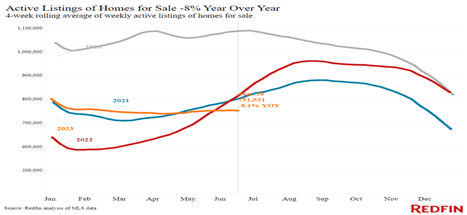
The problem is not enough existing homes are for sale, hence the below-normal inventory of total homes for sale, which has spurred new-home construction. We know there is a tremendous housing shortage.

Total existing-home sales – completed transactions that include single-family homes, townhomes, condominiums, and co-ops – slid 3.4% from March to a seasonally adjusted annual rate of 4.28 million in April. Year-over-year, sales slumped 23.2% (down from 5.57 million in April 2022).

Calculated Risk

That’s a decline of more than one million existing-homes sales in one year.

Calculated Risk’s Bill McBride reported last week that private residential construction spending was down 10.0 percent annually. Non-residential spending is up 21.3 percent year-over-year (i.e., apartments) and public construction spending is up 15.0 percent year-over-year, which is keeping the real estate industry barely alive.

The Calculated Risk graph tell us why. As interest rates rose home sales declined. The sharp rise in interest mirrors the sharp decline in sales over the same time period—beginning January 2022 when everyone knew the Fed was in earnest about suppressing inflation.

There are 1.675 million units under construction, reports McBride, just 35 thousand below the all-time record of 1.710 million set in October 2022.

Of these, there are currently 977 thousand multi-family units under construction.  This is the highest level since September 1973, and close to the record of 994 thousand in 1973 (being built for the baby-boom generation).

For multi-family, construction delays are a significant factor because of supply shortages, such as of electrical equipment. The completion of these units should help to lower rents, which puts downward pressure on inflation. Rents comprise a large part of the retail inflation numbers.

“Home sales are bouncing back and forth but remain above recent cyclical lows,” said NAR Chief Economist Lawrence Yun. “The combination of job gains, limited inventory and fluctuating mortgage rates over the last several months have created an environment of push-pull housing demand.”

Total housing inventory2 registered at the end of April was 1.04 million units, up 7.2 percent from March and 1.0 percent from one year ago (1.03 million), says the NAR. Unsold inventory sits at a 2.9-month supply at the current sales pace, up from 2.6 months in March and 2.2 months in April 2022, still much too low to satisfy the surging demand for more housing.

Econbrowser

The Econbrowser blog puts out an interesting graph that shows what is keeping economic growth from collapsing into recession territory. It’s the rising NFP (nonfarm payroll) number coupled with a surge in industrial production (pink line). Two other sectors that the National Bureau of Economic Research (NBER) business cycle dating committee scrutinizes to call a recession—personal income, consumption, and Mfg. & trade sales—have stalled.

This gives a better picture of how much damage to economic growth and housing industry, has been caused by the Fed’s battle with inflation; as well as what signs to look for in coming months of further declines.

Harlan Green © 2023

Follow Harlan Green on Twitter: https://twitter.com/HarlanGreen
Posted in Consumers, COVID-19, Economy, Housing, housing market, Weekly Financial News | Leave a comment

Retail Sales Still Healthy

Financial FAQs

Calculated Risk/Census Bureau

Why do consumers keep spending with so much news warning of an impending recession? Well, because we’re not even close to a recession yet. NYTimes columnist and Nobel laureate Paul Krugman has been puzzling over it as well.

“America hasn’t yet brought inflation back to prepandemic levels, and we may yet have a hard landing. But so far, at least, we’ve had a stunningly successful recovery from the Covid shock.”

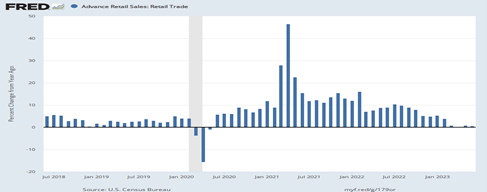
Retail sales are up 3.1 percent YoY, though slowing from its prior highs since the pandemic as shown in the above graph.

“Advance estimates of U.S. retail and food services sales for April 2023, adjusted for seasonal variation and holiday and trading-day differences, but not for price changes, were $686.1 billion, up 0.4 percent (±0.5 percent) from the previous month, and up 1.6 percent (±0.7 percent) above April 2022. Total sales for the February 2023 through April 2023 period were up 3.1 percent (±0.4 percent) from the same period a year ago.”

Consumers won’t let up their spending ways anytime soon with summer approaching, schools are out, and leisure activities still the favorite thing to do.

For instance, so-called nonstore retailers (Internet) were up 8.0 percent (±1.2 percent) from last year, while food services and drinking places were up 9.4 percent (±2.5 percent) from April 2022, a sign that consumers haven’t yet spent those excess savings accumulated during the pandemic.

I am also puzzled by the disconnect between perceptions and reality. Americans know employment is at a record high, even with the baby boomer retirement, and wage increases are keeping up with rising prices.

It could be the debt-ceiling debate and constant bickering between political parties are unnerving the average citizen. Or the Federal Reserve interest rate increases while hammering on the dangers of inflation.

And I believe we are still suffering a hangover from the COVID-19 pandemic that shut down the world economy, a multi-year shock to our collective psyche that will take years to recover from.

The hyper-partisanship and distrust of institutions, including the Federal Reserve, can’t be helping, either.

The uncertainty of a better future is also affecting public opinion—caused by a hot Russian war, a Chinese cold war, a broken border, supply disruptions; you name it.

This contrasts with economic reality. Industrial production increased a very large 1.0 percent in April with motor vehicle production surging 9.3 percent after declining 1.9 percent in March. And the Atlanta Federal Reserve’s GDPNow model predicts 2.6 percent GDP growth in the second quarter after Q1 growth of 1.1 percent

Manufacturing production has been in a 6-month slump, so maybe it is climbing out of its own recession? (There’s that word again.) So what should we make of the bumpy economy we are riding?

Above all, I believe there’s a general anxiety weighing on Americans over their future. Too much change is uncomfortable, but still bearable. What will happen in generations to come?

Harlan Green © 2022

Follow Harlan Green on Twitter: https://twitter.com/HarlanGreen
Posted in Consumers, COVID-19, Economy, Politics, Weekly Financial News | Leave a comment

Wholesale Inflation is Tamed

Financial FAQs

BLS.gov

April’s Producer Price Index for final demand confirmed the wholesale cost of goods and services has already returned to a 2 percent range, which should enable Fed officials to say the battle against COVID-induced inflation is almost won. But will they?

“The Producer Price Index for final demand advanced 0.2 percent in April, seasonally adjusted, the U.S. Bureau of Labor Statistics reported yesterday. On an unadjusted basis, the index for final demand moved up 2.3 percent for the 12 months ended in April.”

April’s Consumer Price Index slowing as well, showing retail prices dropping to a 4.9 percent inflation rate yesterday. It means other factors are keeping retail inflation higher than the wholesale cost of materials.

The so-called PPI should be a more accurate measure of inflation, since it reflects the downward trending costs of stuff that goes into retail goods and services.

Supply chains are being replenished, in other words. Retail inflation has remained higher because corporations today are making record profits by padding their profit margins. They took advantage of the sudden supply shortage during the COVID pandemic.

But as supplies are replenished—particularly in the Asian countries including China that produce most consumer goods—wholesale prices have fallen sharply, forcing corporations to lower their profit margins to a more normal level.

Average hourly wages of employees are also rising faster than normal (4.4 percent), and now the Fed considers higher wages to be the main inflation danger. So, it has prolonged their tightening cycle because it wants corporations to cool the red hot labor market.

Some 80 percent of wholesale costs was in the service sector that caters primarily to consumers that love their leisure activities such as travel and dining out. Over one-third of the April advance in the index for final demand services can be traced to a 4.1-percent rise in prices for portfolio management. The indexes for food and alcohol wholesaling, outpatient care (partial), loan services (partial), hospital inpatient care, and guestroom rental also moved higher.

We can now see clearly why consumers are fearing a recession. The University of Michigan sentiment survey plunged because of such fears.

“Consumer sentiment tumbled 9% amid renewed concerns about the trajectory of the economy, erasing over half of the gains achieved after the all-time historic low from last June,” said survey director Joanne Hsu. “While current incoming macroeconomic data show no sign of recession, consumers’ worries about the economy escalated in May alongside the proliferation of negative news about the economy, including the debt crisis standoff.”

The Fed must pause any further rate hikes while congress works out some kind of debt ceiling compromise. Inflation will continue to plunge in the meantime, which should bring down retail prices as well.

Harlan Green © 2022

Follow Harlan Green on Twitter: https://twitter.com/HarlanGreen
Posted in Consumers, COVID-19, Economy, Politics, Weekly Financial News | Leave a comment