New Home Sales Increasing

The Mortgage Corner

Census.gov

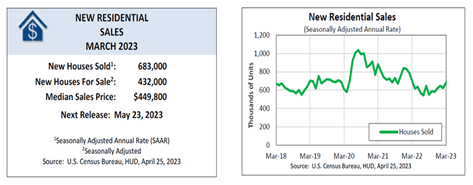
Sales of new single‐family houses in March 2023 were at a seasonally adjusted annual rate of 683,000, according to estimates released jointly today by the U.S. Census Bureau and the Department of Housing and Urban Development.

This is 9.6 percent (±15.2 percent)* above the revised February rate of 623,000, but is 3.4 percent (±12.7 percent)* below the March 2022 estimate of 707,000. The seasonally‐adjusted estimate of new houses for sale at the end of March was 432,000. This represents a supply of 7.6 months at the current sales rate.

That and rising homebuilder’s optimism foretells a strong summer sales season. And it could also mean no imminent recession, since rising sales are largely because mortgage rates have fallen roughly one-half percent.

Builders remained cautiously optimistic in April, as limited resale inventory helped to increase demand in the new home market. Single-family builder confidence in April rose one point to 45, according to the NAHB/Wells Fargo Housing Market Index.

Currently, one-third of housing inventory is new construction, compared to historical norms of around 10%. More buyers looking at new homes, along with the use of sales incentives, have supported new home sales since the start of 2023. Builders note that additional declines in mortgage rates (to below 6%) will further boost demand.

“A lack of resale inventory combined with many builders offering price incentives helped to push new home sales higher in March,” said Alicia Huey, chairman of the National Association of Home Builders (NAHB) and a builder and developer from Birmingham, Ala. “However, sales are down 3.4% compared to a year ago because of the shortage of electrical transformer equipment and building material price volatility.”

“The months of supply decreased in March to 7.6 months from 8.4 months in February,” says Calculated Risk’s Bill McBride. “The all-time record high was 12.2 months of supply in January 2009. The all-time record low was 3.3 months in August 2020.”

And the 30-year conforming fixed rate is still obtainable at 5.75 percent for one origination point in California.

Estimates of first quarter 2023 GDP growth are all over the map, from 0.0 to 2.0 percent. The first estimate comes out this Thursday, which will tell us whether Q1 starts out this year on a positive note.

Harlan Green © 2023

Follow Harlan Green on Twitter: https://twitter.com/HarlanGreen

Posted in Consumers, COVID-19, Economy, Housing, housing market, Weekly Financial News | Leave a comment

Softer Retail Sales Mean What?

Financial FAQs

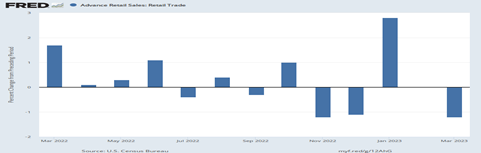
FREDretailsales

Treasury Secretary Janet Yellen said in a recent Fareed Zakariah interview on CNN that she thought an economic soft landing was possible, despite warnings that the recent bank failures could cause banks to tighten in their lending criteria, contributing to a slowing economy.

That is already happening. Retail sales in March posted the biggest decline in four months, largely because of lower auto and gasoline sales. Rising interest rates make car loans more expensive, for starters.

Retail sales aren’t inflation adjusted, so it means an even larger drop if inflation is factored in. Restaurants and bar sales also declined, a sign that consumers are spending less on leisure activities.

In fact, the decline in retail sales was widespread. Receipts at auto dealers dropped 1.6 percent. Furniture store sales fell 1.2 percent, while receipts at electronics and appliance stores tumbled 2.1 percent. Sales at building material and garden equipment supplies dealers plummeted 2.1 percent.

It is a sign that consumers are beginning to seriously cut back on spending, which affects other sectors. The Fed showed manufacturing production dropped 0.5 percent in March after increasing 0.6 percent in February. Durable goods lasting more than three years have been down the past two months.

All of this has been hurting consumer sentiment, despite Americans being fully employed and the percentage of working-age adults entering the workforce are back up to pre-pandemic levels. The index, produced by the University of Michigan, rose from 62 in March to 63.5 in April, from a four-month low.

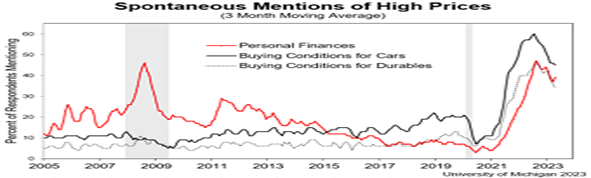
“While consumers have noted the easing of inflation among durable goods and cars, they still expect high inflation to persist, at least in the short run,” said survey director Joanna Hsu.

Inflation is beginning to seriously worry consumers, in other words. One-year inflation expectations increased 4.6 percent in the year ahead, up from 3.6 percent in the prior month, said the Univ. Michigan survey. But in the longer run, expectations were unchanged. Americans think inflation will average 2.9 percent annually in the next five years.

So, when will the Fed pause in its rate hikes? Inflation is now plunging, so effective have been rate hikes from essentially zero percent just one year ago to 4.75 percent today.

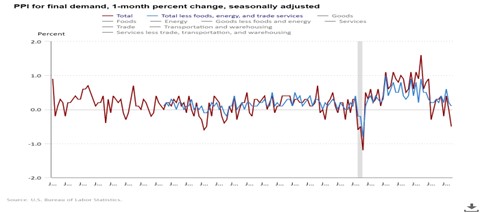
In fact, the Producer Price Index for final demand that measures wholesale goods and services declined -0.5 percent in March, as reported last week. Prices for final demand have risen just 2.7 percent for the 12 months ended in March, from 4.6 percent the previous month. It is now approaching the Fed goal of a 2 percent inflation rate for wholesales goods that end up as consumer products.

Is Janet Yellen right, and will it be a soft landing?

Harlan Green © 2022

Follow Harlan Green on Twitter: https://twitter.com/HarlanGreen

Posted in Consumers, COVID-19, Economy, Politics, Weekly Financial News | Leave a comment

Fed Now Fears a Recession

Financial FAQs

BEA.gov

It is no longer lost on the Fed Governors that the record speed they have raised short-term interest is causing a possible recession. They have even said so in their just released minutes from the latest FOMC minutes.

Three medium-sized regional banks have already failed and several dozen are on the FDIC watchlist, who have overinvested in uninsured assets that are devaluing fast as interest rates have risen.

And inflation is now plunging, so effective have been rate hikes from essentially zero percent just one year ago to 4.75 percent today.

In fact, the Producer Price Index for final demand that measures wholesale goods and services declined -0.5 percent in March. Prices for final demand goods decreased -1.0 percent, and the index for final demand services moved down -0.3 percent—all plunging the largest monthly amount in three years.

So, alarm bells are sounding for the Fed to move in the opposite direction—to not only pause but reverse course, if they believe what they say—and inflation is no longer a problem.

Prices for final demand have risen just 2.7 percent for the 12 months ended in March, from 4.6 percent the previous month. It is now approaching the Fed goal of a 2 percent inflation rate for wholesales goods that end up as consumer products.

It turns out the Fed Governors have been too good at their job, catching banks and regulators flat-footed from the effects of their rate hikes and a probable cause of a recession sometime later this year.

Why? Because Fed officials are now seeing signs that banks are tightening their credit standards as well, following the Fed’s guidance, which will harm business investments and even homebuyers who will find it more difficult to qualify for a loan or mortgage.

“Financial conditions tightened considerably over the intermeeting period as a whole,” said the minutes. “Market contacts observed that the recent developments in the banking system will likely result in a pullback in bank lending, which would not be reflected in most common financial conditions indexes.”

Given their assessment of the potential economic effects of the recent banking-sector developments, the Fed’s staff now sees “a mild recession starting later this year with a recovery over the subsequent two years.”

The minutes also show that “many” officials said that the likely effects of the banking stress had led them to lower their estimate of the peak rate that would be needed to bring inflation under control, according to the minutes of the March 21-22 meeting.

With such fears it would be far wiser to anticipate other inflation indicators plunging as fast. And once that happens what other dominoes may fall?

But instead, FOMC officials ultimately voted to increase the benchmark borrowing rate by 0.25 percentage point, the ninth increase over the past year. That brought the fed funds rate to a target range of 4.75%-5%, its highest level since late 2007.

Other economic sectors are beginning to plunge as well. Sales at retailers dropped 1 percent in March and declined for the fourth time in the past five months, said the Census Bureau. Watch out below if this reflects consumers beginning to close their wallets.

The problem the Fed Governors haven’t understood in their panicked reaction to the initial inflation surge was that conditions outside of the Fed’s control have caused most of the inflation. A historic pandemic that shut down worldwide economic activity and a European war have been the main cause shrinking world-wide production, while governments pumped in excess liquidity to keep their economies afloat.

There is now the real possibility that the Fed intends to cause a recession, which is the only result that will bring down the inflation rate to 2 percent, which they seem fixated on doing, despite the possibility of more bank failures.

Harlan Green © 2022

Follow Harlan Green on Twitter: https://twitter.com/HarlanGreen

Posted in Consumers, COVID-19, Economy, Weekly Financial News | Leave a comment

Americans Still Fully Employed

Popular Economics Weekly

MarketWatch

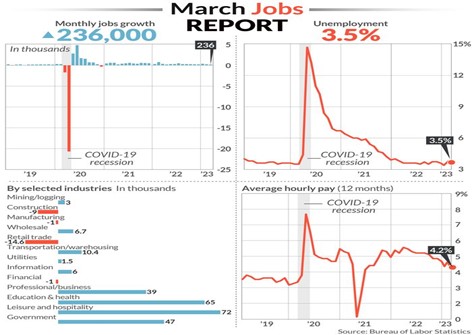
The MarketWatch graph above shows why the US Federal Reserve keeps raising interest rates. The US unemployment rate dropped from 3.6 to 3.5 percent in March. It was 14.7 percent in April 2020. It was last 3.5 percent in February 2020 at the on set of COVID-19.

The U.S. added a robust 236,000 new jobs in March, defying the Federal Reserve’s hopes for a big slowdown in hiring as the central bank struggles to tame high inflation. We have never before seen such a precipitous drop in unemployment. It took ten years—from 2010 to 2020—to reach 3.5 percent after the Great Recession. It took slightly more than two years to return to 3.5 percent again, in July 2022.

Average hourly wages are rising at 4.2 percent, and the labor participation rate of working-age adults is 80.7 percent, back to pre-pandemic levels. Where are more workers to be found to keep up with employers’ job openings?

The decline in the unemployment rate to 3.5 percent was despite 480,000 entering the labor force. The separate Household survey from which the unemployment rate is derived showed employment increasing 577,000 last month.

While the increase in payrolls was the smallest in more than two years, the number of new jobs created last month was still stronger than is normal for this time of year.

Leisure and hospitality added 72,000 jobs in March, lower than the average monthly gain of 95,000 over the prior 6 months. Most of the job growth occurred in food services and drinking places, where employment rose by 50,000 in March.

Government employment increased by 47,000 in March, the same as the average monthly gain over the prior 6 months. Only two sectors shrank in jobs—retail trade and construction services.

If the Fed continues to raise interest rates, those workers in the lowest paying restaurant and leisure sectors will suffer the most, who spend most of their incomes.

The standard Fed mantra is that higher inflation harms low-paying sector workers the most. Really? The Fed’s current stated goal is to raise the unemployment rate at least 1 percent. That means the loss of 1-2 million jobs.

I believe workers, given the choice, would rather pay slightly more for their goods and services than lose their jobs!

Harlan Green © 2023

Follow Harlan Green on Twitter: https://twitter.com/HarlanGreen

Posted in Consumers, COVID-19, Economy, Politics, Weekly Financial News | Leave a comment

More Soft Landing News!

The Mortgage Corner

The banking failures have begun to raise hopes the Fed will take a pause in its rate hikes. Now more signs of a weakening economy have added to that possibility, a real possibility the Fed will cease and desist with its obsession that inflation is still out of control. If so, a so-called ‘soft landing’—the economy slowing, but not entering a recession—is possible.

Calculated Risk

The latest JOLTS report of fewer job vacancies and a shrinking manufacturing sector are two such signs.

“The number of job openings decreased to 9.9 million on the last business day of February, the U.S. Bureau of Labor Statistics reported today. Over the month, the number of hires and total separations changed little at 6.2 million and 5.8 million, respectively. Within separations, quits (4.0 million) edged up, while layoffs and discharges (1.5 million) decreased.”

The gap has therefore narrowed between the number of jobs available (vacancies) and actual hires. There were as many as 11.8 million job vacancies in early 2022.

Another sign of a slowdown is the faltering manufacturing sector. Per the Institute for Supply Management’s manufacturing survey, it dropped to 46.3 percent from 47.7 percent in the prior month. That’s the lowest level since May 2020, when the pandemic slowed down much of the U.S. economy.

The ISM’s service sector has slowed as well from 55.1 but remained positive at 51.2. It has contracted just once in the past 34 months, this past December.

“There has been a pullback in the rate of growth for the services sector,’ said survey director Anthony Nieves, “attributed mainly to (1) a cooling off in the new orders growth rate, (2) an employment environment that varies by industry and (3) continued improvements in capacity and logistics, a positive impact on supplier performance. The majority of respondents report a positive outlook on business conditions.”

And interest rates are finally beginning to decline after their record rise from essentially zero for short-term rates. Falling mortgage rates in particular are boosting the housing market.

The most popular 30-year conforming fixed rate is now down to 5.625 percent for 1 origination point, and 6.0 percent for 0 points for borrowers with excellent credit. That’s a full percentage point drop from its highs.

I reported in a recent blog that housing prices are finally declining in some regions in concert with lower mortgage rates, which has led to an early buying season.

“I’m quite surprised,” Lawrence Yun, chief economist at the National Association of Realtors said. “The recovery is coming stronger, [but] maybe it will deflate again if the mortgage rates get too high… [and] mortgage rates have a very big influence.”

Signs of lower inflation are now cropping up everywhere, which should help the Fed Governors to decide it is a good time for a time out in raising interest rates further.

Harlan Green © 2023

Follow Harlan Green on Twitter: https://twitter.com/HarlanGreen

Posted in Consumers, COVID-19, Economy, housing market, Weekly Financial News | Leave a comment

Big Jump in 2023 Economic Growth?

Financial FAQs

BEA.gov

Why the talk of a recession when predictions are for first quarter GDP growth as high as +3.2 percent?

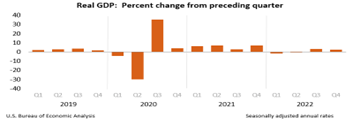
After fourth quarter 2022 GDP growth came in at 2.6 percent in the government’s final estimate (see graph), economists are now predicting higher 2023 growth, despite talk the Fed may raise their fed funds rate another +0.25 percent.

Why? Firstly, the banking crisis is lowering the odds of any ‘hard’ landing this year caused by the Fed, because pushing interest rates any higher could cause more banks to fail that have loaded up with either Treasury or Mortgage-backed securities that lost value when rates rose.

And real consumer spending surged 1.5 percent in January, which makes up 70 percent of GDP growth (see below graph). Personal income (blue bar) has been exceeding outlays (orange bar) since last November, so personal savings have increased, meaning consumers can continue to spend.

Even if real consumer spending remained soft in March, that would not change its sharp upward trajectory for the first quarter, economists said. JPMorgan raised its first-quarter GDP growth estimate to a 3.25 percent rate from a 2.5 percent pace. Goldman Sachs bumped up its estimate by 0.2 percentage points to 2.4 percent.

There was also some good news on inflation, as the Fed’s preferred inflation statistic, the Personal Consumption Expenditures Index (PCE), slipped from 5.3 to 5.0 percent in February, its core rate without food and energy prices falling from 4.7 to 4.6 percent.

It isn’t just interest rates that control growth, but consumers’ confidence in their jobs and future prospects. Both the Conference Board and University of Michigan surveys remain slightly positive in their outlook.

“Driven by an uptick in expectations, consumer confidence improved somewhat in March, but remains below the average level seen in 2022 (104.5). The gain reflects an improved outlook for consumers under 55 years of age and for households earning $50,000 and over,” said Ataman Ozyildirim, Senior Director, Economics at The Conference Board.

The University of Michigan’s survey was slightly less sanguine. “Consumer sentiment fell for the first time in four months, dropping about 8% below February but remaining 4% above a year ago,” said survey director Joanne Hsu. “This month’s turmoil in the banking sector had limited impact on consumer sentiment, which was already exhibiting downward momentum prior to the collapse of Silicon Valley Bank.” 

Other inflation indicators are showing similar declines, so there is hope the inflation scare that has affected confidence in our banking system may soon be over. And once again, the necessity of supporting our banking system should help wage earners, since it will trump any desire by the Fed to harm wage earners by pushing interest rates even higher.

Harlan Green © 2023

Follow Harlan Green on Twitter: https://twitter.com/HarlanGreen

Posted in Consumers, COVID-19, Economy, Weekly Financial News | Leave a comment

Homebuyers on the Move Early

The Mortgage Corner

The home-buying season has begun earlier this year from a large rise in existing-home and new-home sales. It looks like families are already on the move, including retirees and seniors downsizing to more humble quarters.

Calculated Risk

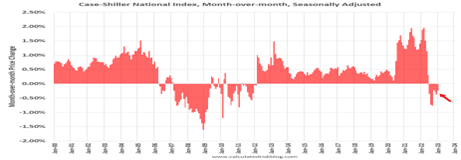
Why? Housing pricing are finally declining in some regions in concert with lower mortgage rates (see above Case-Shiller graph). Homebuyers must be thinking interest rates have topped and the Fed rate hikes will end sometime this summer.

“I’m quite surprised,” Lawrence Yun, chief economist at the National Association of Realtors said. “The recovery is coming stronger, [but] maybe it will deflate again if the mortgage rates get too high… [and] mortgage rates have a very big influence.”

Baby boomers now make up 39 percent of home buyers (ages 58 to 76 years old) – the most of any generation – an increase from 29 percent last year, said the NAR, in its press release.

Maybe rising consumer confidence is another reason home sales are up. The Conference Board’s consumer confidence index rose to 104.2 this month from a reading of 103.4 in February.

The cutoff date for the confidence survey was March 20, 10 days after California-based Silicon Valley Bank collapsed. New York-based Signature Bank failed on March 12, said the Conference Board, so the fact that jobs were plentiful seemed to outweigh banking worries.

And housing prices are stabilizing. “The MoM decrease in the seasonally adjusted Case-Shiller National Price Index was -0.25%. This was the seventh consecutive MoM decrease, and a slightly smaller decrease than in December,” said Bill McBride, quoting its press release.

The biggest surprise was that existing-home sales jumped 14.5 percent in February to a seasonally adjusted annual rate of 4.58 million, snapping a 12-month slide and representing the largest monthly percentage increase since July 2020 (+22.4 percent). Compared to one year ago, however, sales will still down 22.6 percent.

Calculated Risk

Downward price pressure also came from increasing inventories of for sale residences. The total existing-home inventory registered at the end of February grew to 980,000 units, identical to January and up 15.3 percent from one year ago (850,000). Unsold inventory sits at a 2.6-month supply at the current sales pace, up from 1.7 months in February 2022 when the price surge began.

Mortgage rates are also declining along with Treasury security yields, down approximately down -0.50 percent. I spotted a 6 percent rate on a 30-year conforming fixed rate mortgage with low origination points recently, down from 6.50 two weeks ago.

Not so surprising is that twenty-six percent of all buyers were first-time buyers, the lowest since NAR began tracking the data and a decrease from 34 percent last year.

Another sign that the selling season has begun was pending home sales that measure contracts signed but not closed, increased for the third month in a row.

“After nearly a year, the housing sector’s contraction is coming to an end,” said chief economist Yun. “Existing-home sales, pending contracts and new-home construction pending contracts have turned the corner and climbed for the past three months.”

So when will conditions improve for first-timers again? When the Fed reverses course and interest rates decline for real, which I’ve been calling for. New-home inventory is now matching existing-home inventory, which means builders are catching up, maybe in preparation for a more hopeful summer season.

Harlan Green © 2023

Follow Harlan Green on Twitter: https://twitter.com/HarlanGreen

Posted in Consumers, COVID-19, Economy, Housing, housing market, Weekly Financial News | Leave a comment

It’s Time to Raise Fed Inflation Target

Popular Economics Weekly

FREDavghrlypay

In the light of the recent bank failures, and the Fed’s own missteps in fighting inflation, history is telling us that the Fed’s current 2 percent target rate for inflation is too low.

Why? Because Federal Reserve policy since the 1970s has mostly benefited banks and other financial institutions that manage money.

It’s easy to see why. The Fed is in charge of keeping our banking system sound, which is implied in its mandate to maintain price stability and maximum employment. So its primary focus has always been to defend the value of their assets, and inflation diminishes asset values.

But the Fed hasn’t maintained price stability as evidenced by the recent inflation surge and was surprised by three US bank failures, causing doubts as to the soundness of our banking system.

Former FDIC Chairman Sheila Bair highlighted the dangers of such inattention in a MarketWatch interview.

“This is a risk confronting all banks,” she said. “All examiners need to be on alert for how interest-rate risk is being managed. If there is a run, they will need to sell these securities. Those are the kinds of things all-size banks, and all examiners should be worried about in our banking system.”

Current monetary policy has not improved workers’ wages, either, which haven’t kept up with inflation with the wild gyrations caused by the COVID pandemic and some $6 trillion in pandemic aid.

So isn’t it time for Fed monetary policies to focus on bringing down the record income inequality that has prevailed since then and ranked US income inequality the same as Haiti, far below that of other developed countries. per the CIA’s World-Factbook?

Why do we have red and blue states and a divided country, otherwise? Many Americans feel disenfranchised who no longer have jobs that earn what they did in the 1970s when we still had a manufacturing base in the rust belt.

The average hourly earnings of employees has never risen above the 2-3 percent range, per the St. Louis Fed’s above graph of average hourly wages dating from the 2008 Great Recession.

Chairman Powell was explicit in his press conference after the conclusion of the latest FOMC meeting, at which another 0.25 percent rate increase was announced. The labor market is still too hot, he said, and has caused wage growth to accelerate rather than decline, which the Fed deemed was necessary to bring down inflation.

So employees’ earnings have now become the culprit keeping inflation too high, when the latest research has shown excess corporate profits and the Ukraine war jump-started the current inflation surge.

In other words, the Fed has been most successful at keeping employees’ wages at or below the inflation rate since the 1970s as they labored to keep inflation in the 2 percent target range.

This is not a coincidence. Fed Governors since former Fed Chair Paul Volcker have believed conditions that prevailed since the 1970s still rule that caused the wage-price spiral and double-digit inflation of that time.

But globalization policies expanded world trade and developed just-in-time supply-chains that brought in cheaper consumer goods and exported manufacturing jobs to low wage-earning countries. Inflation became so tame during the 1990s that it was termed the Great Moderation.

So why does our Fed have a 2 percent inflation target?

Progressive labor economist Jared Bernstein opined on this matter in the Washington Post shortly after first Bernanke announced the Fed’s decision of a 2 percent target rate.

“The fact is that the target is 2 percent because the target is 2 percent. Were the target 3 percent or 4 percent, you’d be reasonably asking me, why 3 or 4? To the extent that there’s an anti-inflation bias among economic elites (and thus an anti-full-employment bias), and I think that’s often the case, I’d reiterate arguments I made here…that the debates over full employment and Federal Reserve policy are generally dominated by the interests of the minority who worry more about inflation and asset values than those who worry about jobs and paychecks.”

Is there real evidence the current 4.4-4.6 percent average hourly wage increases employees are enjoying that was reported in the February unemployment report inflationary?

No, average hourly wages could be contributing as little as 8 percent to product costs in one recent paper by EPI economist Josh Bivens that I cited above.

There is much that government can do to lessen income inequality, which would in turn lessen the yawning gap between the Haves and Havenots in this country. The Federal Reserve can do its part by lessening the inherent bias of a low inflation target that mainly targets wage earners, which includes 32 million Americans that still live below the poverty line.

Harlan Green © 2023

Follow Harlan Green on Twitter: https://twitter.com/HarlanGreen
Posted in Consumers, COVID-19, Economy, Politics, Weekly Financial News | Leave a comment

The Fed Should Reverse Course

Financial FAQs

FRED10yr

The wild fluctuations of the 10-year Constant Maturity Treasury yield portrayed in the above St. Louis Fed graph should have alerted Federal Governors and Chairman Powell to the dangers of raising interest rates too precipitously.

It is the reason three US banks have failed, who wouldn’t either hedge against or reduce their holdings backed by Treasury securities that lost value as interest rates rose.

It’s also why the Fed should begin to reverse course to lower their overnight rate target that is now at 4.5-4.75 percent.

The decline in confidence of our banking system can in part be attributed to the Fed Governors naiveté, or maybe outright ignorance, of the US banking system they are supposed to regulate.

For instance, Fed Governors did not seem to realize the risk to depositors of banks holding deposits worth more than the $250,000 ceiling set by the FDIC for insured deposits. It was 97 percent in the case of Silicon Valley Bank.

The Fed seems to have been its own worst enemy in not realizing the effect of its policy actions, as evidenced by February’s FOMC minutes.

“With respect to the relationship between monetary policy and financial stability, some participants noted that evidence regarding the link between the policy stance and elevated financial vulnerabilities was limited, with a couple of participants further observing that there were not many episodes of persistently low interest rates.”

Yet Silicon Valley Bank had been on the San Francisco Fed’s watch list for more than one year as the Fed Governors charged ahead with their rate hike policy. “By July 2022,” as reported by the NYTimes, “Silicon Valley Bank was in full supervisory review, and was ultimately rated deficient for governance and controls.”

“In addition,” continued the FOMC minutes, “some past episodes of heightened financial vulnerabilities were associated with excessive risk-taking behavior that did not seem to be very responsive to typical changes in interest rates.”

Really? The NY Times and others have reported on the hands-off attitude of Fed regulators in not doing more to demand that banks—particularly those vulnerable to large uninsured deposits—crack down on such risky behavior.

So the Fed might call a halt to its policy of taming an inflation that is mostly caused by factors outside of the Fed’s control, and focus more on banking supervision that is under its direct control.

A 2022 Gallup survey found that just 27 percent of Americans had a “great deal/quite a lot” of confidence in our banks.

At the very least, the Fed should reverse course and begin to bring down interest rates before more banks fail, and more Americans lose faith in our banking system.

Harlan Green © 2023

Follow Harlan Green on Twitter: https://twitter.com/HarlanGreen
Posted in Consumers, COVID-19, Economy, Politics, Weekly Financial News | Leave a comment

Housing Market Recovery–Part II

The Mortgage Corner

Calculate Risk

Real estate continues its slight recovery with housing starts and new residential permits on the rise in February. Most of the action was in rental housing, as apartment construction is up 9.9 percent YoY in February. Whereas February single-family construction has been falling and is now down 31.6 percent YoY.

It’s easy to see why more multi-family housing is under construction. Single-family affordability has plunged with 30-year conforming fixed rates still around 6.75 percent.

The NAR’s Housing Affordability Index showed that from 2020 to 2022 the income required to qualify for a 90 percent LTV mortgage on an entry-level home had doubled from $49,008 to $92,688 while the 30-year fixed rate rose from 3.17 percent to 6.77 percent.

This puts many more first-time buyers out of the market. Their share of purchases has fallen to 30 percent of existing-home sales, when it was as much as 40 percent before housing prices accelerated in 2021.

Calculated Risk

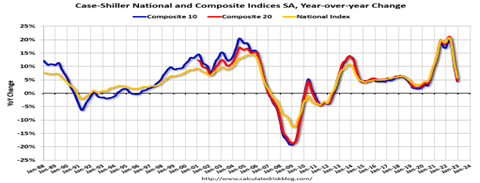
The Case-Shiller Home Price Index also highlights the price fluctuations in existing-home prices that made affordability such a problem in Calculated Risk’s above graph of the Case-Shiller Index dating from 1988.

Price rises peaked in January 2004 and January 2023 when they were rising as much as 20 percent YoY before declining sharply. It was a time of multiple offers and ultra-low interest rates that crowded out first-timers.

The sharp declines in price inflation that followed both times were precipitated by the Federal Reserve’s actions to tighten credit, and the lack of entry-level housing.

One reason that builders are building again is the slow down in inflation, with the S&P Composite Home Price Index now rising in the 4 percent range. There are also a record 1.7 million homes still under construction, which is a tremendous backlog also bringing down prices.

“The cooling in home prices that began in June 2022 continued through year end, as December marked the sixth consecutive month of declines for our National Composite Index,” says Craig J. Lazzara, Managing Director at S&P DJI.

Mortgage rates have been up and down but won’t give much boost to housing until the Fed decides to ease up on the rate increases. Still, signs of life this early in the selling season and without any indication the feds will pause in their rate hikes is difficult to ignore.

Harlan Green © 2023

Follow Harlan Green on Twitter: https://twitter.com/HarlanGreen
Posted in Consumers, COVID-19, Economy, Housing, housing market, Weekly Financial News | 1 Comment