Wartime Will JOLT Job Formation

Financial FAQs

Calculated Risk

The last time we had truly full employment in America was during World War Two. It’s a horrible thought, I know, but we ought to look at the ramifications of Putin’s invasion of Ukraine.

The world was at war then and all hands were needed in in our factories to win the fight. (Remember Rosie the Riveter?) We may need to do so again if the Ukraine war spreads beyond its borders.

The Ukraine invasion could mean the huge demand for workers will continue, and push wages even higher.

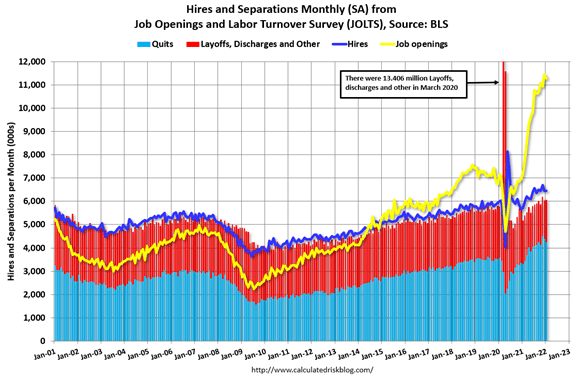
Today’s JOLTS report showed that businesses continue their massive hiring effort in January and may continue to do so for the rest of this year. The Labor Department is reporting that after falling to as low as 4.6 million early in the pandemic, the number of open jobs soared above 10 million last summer for the first time ever. They have remained extremely high since then.

And though the economy has added an average of 614,00 new jobs in each of the past five months, businesses still say it’s hard to attract new employees and retain old ones.

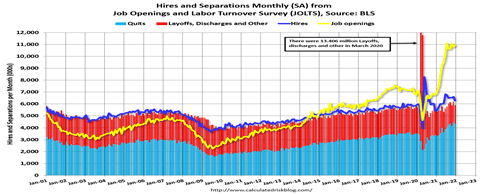
The number of job openings was little changed at 11.3 million on the last business day of January, the U.S. Bureau of Labor Statistics reported today. Hires and total separations were little changed at 6.5 million (blue line in Calculated Risk’s graph) and 6.1 million (red bars), respectively.”

This gives us an idea of the immensity of the U.S. economy, as well as its future direction..

The yellow line on Calculated Risk’s graph shows how high the demand for jobs has risen. And more are quitting their jobs to find better jobs. Some 4.3 million quit their jobs in the month. Quits peaked at 4.5 million in November. Before the pandemic, the number of people quitting jobs averaged fewer than 3 million a month.

There were 6.3 million Hires (blue line in graph) and 6.1 million Layoffs (red bar), so we should look for more job growth this year, in spite of the touted labor shortages.

But why are so many being hired if that is the case? More are re-entering the work force than was expected.

“Some 300,000 people entered the labor market in February, pushing the increase over the past six months to 2.5 million. Perhaps not coincidentally, economists note, the surge in the labor force began around the time that extra federal benefits for the unemployed expired,” said MarketWatch’s Jeffery Bartash recently.

A wider war is probably not in the cards with NATO saying the Ukraine invasion is not “our” war, but even the threat of war has caused economic activity to pick up, historically.

And with the largest number of immigrants fleeing the war zone since World War Two, who knows what can happen next?

Harlan Green © 2022

Follow Harlan Green on Twitter: https://twitter.com/HarlanGreen
Posted in Consumers, COVID-19, Economy, Politics, Uncategorized, Weekly Financial News | Leave a comment

More Super Job Growth!

Popular Economics Weekly

MarketWatch.com

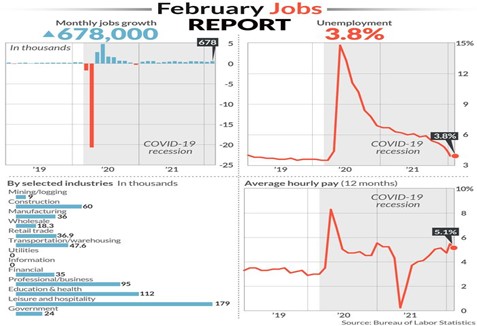
Workers are returning to work in every sector of the U.S. economy. They aren’t waiting any longer because of COVID concerns, or supply-chain problems, as the unemployment rate dropped to 3.8 percent from 4 percent, the government said Friday.

This is great news for economic growth this year. Businesses wouldn’t be hiring at this rate if the demand for their products was fading, or they weren’t finding enough supplies.

President Putin-for-life picked the wrong time to start another Cold War with his invasion of the Ukraine. World growth is accelerating as the pandemic subsides, and worldwide sanctions against anything owned by Putin and his Oligarchs will shrink the Russian economy even further, despite rising gas and oil prices.

The U.S. added a total of 678,000 jobs in February. Restaurants added 124,000 new jobs last month and hotels hired 28,000 people. Hiring also rose strongly at white-collar professional jobs (95,000), health care (64,000), construction (60,000) and transportation and warehousing (48,000).

Why are so many returning to work? The Omicron infection rate has very quickly returned to pre-Omicron levels, as I said last week, and mask mandates have been removed in most states. Consumers aren’t cowed by the Omicron, or any other variant, anymore.

Even hiring in January and December was stronger than previously reported. Job gains in the last two months were raised by a combined 92,000. 

The change in total nonfarm payroll employment for December was revised up by 78,000, from +510,000 to +588,000, and the change for January was revised up by 14,000, from +467,000 to +481,000.

That’s 1,747,000 jobs added in just the past three months. This will help supply chains as more jobs means more is produced. And inflation may be slowing, as average weekly pay increased just $0.01 cents.

Will ongoing inflation hurt future job growth? Consumers and businesses have been ignoring high inflation over the past year. Why should it slow them down now?

“We are probably about 1½ million jobs away from getting back to the pre-pandemic levels for the labor market,” said a commentator cited by MarketWatch. “With 11 million job openings and seemingly every business in the country desperately trying to hire, the economy can absorb those extra 1.5 million workers without blinking an eye — and probably will over the next few months.” —Stephen Stanley, chief economist at Amherst Pierpont Securities

Will Putin’s Oligarchs find a way to pull Putin out of his dream of another Czarist Russian Empire? Who knows how long can Russians endure the sanctions that are improverishing them?

Harlan Green © 2022

Follow Harlan Green on Twitter: https://twitter.com/HarlanGreen
Posted in Consumers, COVID-19, Economy, Politics, Weekly Financial News | Leave a comment

What is Our State of the Union?

Financial FAQs

CDC.gov

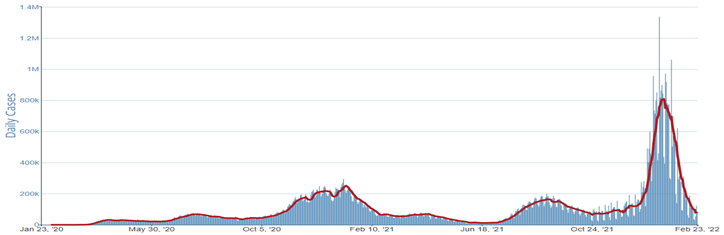
This is really all we need to know about Americans’ State of the Union’ that President Biden touted last Tuesday in his annual address. Just look how low COVID infection rates have fallen in the CDC’s most recent data graph.

The CDC reported “As of February 23, 2022, the current 7-day moving average of daily new cases (75,208) decreased 37.7% compared with the previous 7-day moving average (120,761).”

Those Americans still holding back from work because they are caring for children or elderly parents, or for a myriad of other reasons due to fears from contagions, need no longer to do so. The Omicron variant has been tamed, and there are no other variants on the horizon at the moment.

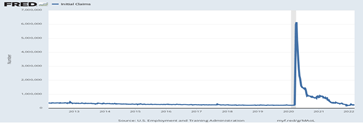
The latest initial unemployment claim stats confirm that work is the best place to be now that the US economy is roaring again, wages are rising and almost 11 million job openings beckon.

FREDinitialclaims

New applications for unemployment benefits fell by 18,000 to a two-month low of 215,000 in the last week of February, pointing to a pickup in hiring and declining layoffs as the economy rebounded from an omicron-induced lull.

The 10-year FRED graph of initial unemployment claims shows just how normal the claims’ numbers have become. Initial jobless claims declined from a revised 233,000 in the prior week,  the Labor Department said Thursday.

Now that serious sanctions are in place, what will happen? Oil prices will surge

And inflation may be prolonged, which is another reason unemployed workers won’t remain on the sidelines much longer.

And what about the Russian Oligarchs support of Putin’s war with Ukraine? How much longer can they hold out? France just announced the first seizure of an Oligarch’s yacht In Marseille, and Treasury Secretary Yellen just announced she will be doing the same.i

“We have made it a priority to go after oligarchs or Russian elites who are key to President Putin’s corrupt power,” Yellen said. She added that Treasury, along with the Justice Department and U.S. allies, plans to “uncover, freeze and seize their wealth around the world.”

Inflation won’t recede soon with soaring oil prices, but that is also a sign that higher economic growth is in the cards for the New Year, as consumers and business continue to spend their excess savings.

Both Institute of Supply Management surveys for the U.S. service and manufacturing sectors are still in the mid-fifties, signaling that they could even go higher if it wasn’t for the supply and labor shortages.

So let’s see how long Putin’s oligarchs can hold out and support his killing of Ukrainians, which seems to be the only thing that could stop him? My guess is not for long.

Harlan Green © 2022

Follow Harlan Green on Twitter: https://twitter.com/HarlanGreen
Posted in Consumers, COVID-19, Economy, Weekly Financial News | Leave a comment

What Happens to Economic Growth This Year?

Financial FAQs

BEA.gov

We now have a looming Cold War with Russia due to its invasion of the Ukraine, as well as inflation to worry about this year. What will it do to economic growth and jobs?

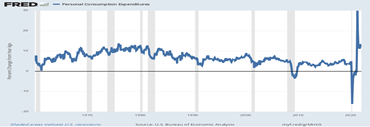
Inflation won’t recede soon with soaring oil prices, but higher economic growth is in the cards for the New Year. The Fed’s favorite indicator of consumption, the Personal Consumption Expenditure price index (PCE) gained 6.1 percent year-over-year in January, the largest gain since 1982, and consumer spending in January rose 2.1 percent month-over-month, better than the expected forecast of 1.5%.

“At least for now, consumers aren’t pulling back much on their spending in light of high inflation,” said one commentator.

Other indicators of growth aren’t slowing, either. according to the flash IHS Markit flash surveys of the manufacturing and service sectors. Both surveys have risen to the mid-50s, a strong sign of future growth in both sectors.

And Q4 GDP growth was revised slightly higher in its second estimate to 7 percent, the highest growth rate in 40 years. Job creation will also continue to grow as the Omicron variant recedes.

There is more good news on jobs. Initial jobless benefit claims fell by 17,000 to 232,000 in the week ended Feb. 19, the Labor Department said Thursday. The number of people already collecting jobless benefits fell by 112,000 to 1.48 million in the week ended Feb. 12. These so-called continuing claims are at their lowest level since March 1970, which means new job creation exceeds those being laid off or quitting.

The main issue is what all this does to continuing job growth, with the Omicron variant infections returning to pre-Omicron levels. The CDC news is also good on that front.

CDC.com

The CDC said, “as of February 16, 2022, the current 7-day moving average of daily new cases (121,665) decreased 43.0% compared with the previous 7-day moving average (213,625). A total of 78,060,327 COVID-19 cases have been reported in the United States as of February 16, 2022.

The elephant in the room that could cancel the good news is effects from the invasion of the Ukraine, of course, especially sanctions that might prolong the high inflation numbers.

Excluding volatile gas and vehicle sales, the PCE price index quoted above rose 5.2 percent, and consumers in the latest University of Michigan sentiment survey don’t see prolonged inflation.

So with the Omicron variant receding, the duration of higher inflation will depend on what is happening in the Ukraine. That will be hard to predict with a Russian dictator who seems to have lost touch with reality. Does he really want to start another Cold War with the Western world united against him?

I don’t think so.

Harlan Green © 2022

Follow Harlan Green on Twitter: https://twitter.com/HarlanGreen
Posted in Consumers, COVID-19, Economy, Weekly Financial News | Leave a comment

Most Homes Under Construction in 49 Years!

The Mortgage Corner

Calculated Risk

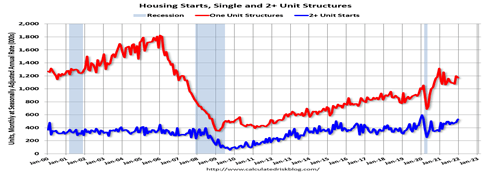
Builders are trying to catch up to demand. Calculated Risk’s Bill McBride per the US Census Bureau reports the largest number of homes under construction since 1973.

Privately‐owned housing starts in December were at a seasonally adjusted annual rate of 1,702,000. This is 1.4 percent above the revised November estimate of 1,678,000 and is 2.5 percent (±13.8 percent) above the December 2020 rate of 1,661,000. Single‐family housing starts in December were at a rate of 1,172,000; this is 2.3 percent below the revised November figure of 1,199,000. The December rate for units in buildings with five units or more was 524,000.

McBride also said that currently there are 750 thousand multi-family units under construction.  This is the highest level since July 1974! For multi-family, construction delays are probably also a factor. The completion of these units should help with rent pressure, with rents rising more than 7 percent annually.

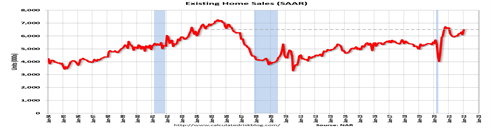
Why so much residential construction? Existing-home sales continued to use up available inventory, surging to 6.5 million annualized units in January. Since we are in mid-winter when sales are usually at a low point, why the surge?

“Buyers were likely anticipating further rate increases and locking-in at the low rates, and investors added to overall demand with all-cash offers,” said Lawrence Yun, NAR’s chief economist. “Consequently, housing prices continue to move solidly higher.”

Calculated Risk

Total existing-home sales,1 https://www.nar.realtor/existing-home-sales, completed transactions that include single-family homes, townhomes, condominiums and co-ops, climbed 6.7% from December to a seasonally adjusted annual rate of 6.50 million in January. Year-over-year, sales fell 2.3% (6.65 million in January 2021), said the Realtors.

The inventory of homes for sale has dropped to just 1.6 months at the current torrid sales rate. This is squeezing out homebuyers that can afford homes below $500,000, said Yun.

“There are more listings at the upper end – homes priced above $500,000 – compared to a year ago, which should lead to less hurried decisions by some buyers,” Yun added. “Clearly, more supply is needed at the lower-end of the market in order to achieve more equitable distribution of housing wealth.”

This has pushed housing prices even higher. The S&P CoreLogic Case-Shiller 20-city price index posted a 18.6 percent year-over-year gain in December, up slightly from 18.3 percent the previous month.

This tells us in spite of labor and building material shortages, builders are finding ways to start new construction in the face of red hot demand. There are plenty of potential homebuyers out there with the record surge in job creation over the past year.

Harlan Green © 2021

Follow Harlan Green on Twitter: https://twitter.com/HarlanGreen
Posted in Consumers, COVID-19, Housing, housing market, Weekly Financial News | Leave a comment

Surprise Retail Sales Growth!

Popular Economics Weekly

FREDretailsales

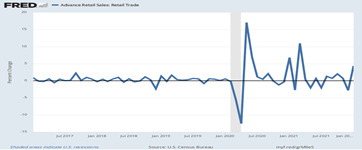
The New Year brought in another surprise. Sales at U.S. retailers such as Amazon and Best Buy jumped 3.8 percent in January. Americans bought more things: cars, furniture, consumer electronics in a sign that consumers are no longer fazed by the Omicron variant.

Why? The Omicron infection rate is fast returning to pre-Omicron levels.

Retail sales have tracked the pandemic, per the FRED graph. It plunged from May to November 2020 as the coronavirus did its worst, up and down with the Delta variant, then plunging again in March 2021 as Omicron hit. Sales began to recover again in December 2021.

The January increase in sales was the largest since last March, when Americans spent a good chunk of their stimulus money from the government.

Auto sales rose sharply for the second month in a row, the government said Wednesday. Auto sales account for about one-fifth of overall retail spending. Other than autos, retail sales still advanced a strong 3.3 percent last month. Sales also rose sharply at internet retailers (14.5 percent), furniture stores (7.2 percent), department stores (9.2 percent) and home centers (4.1 percent).

CDC

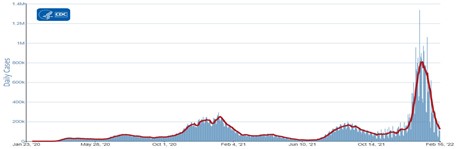
And the CDC reported as of February 9, 2022 in its weekly update that the current 7-day moving average of daily new cases (215,418) decreased 42.8% compared with the previous 7-day moving average (376,855). A total of 77,179,255 COVID-19 cases have been reported in the United States as of February 9, 2022.

The surge in industrial production was another good sign. It increased 1.4 percent in January, largely because of unusually cold weather that boosted the output of utilities, reports the Federal Reserve. At 103.5 percent of its 2017 average, total industrial production in January was 4.1 percent higher than its year-earlier level and 2.1 percent above its pre-pandemic (February 2020) reading.

This could be a surprising year and the beginning of a surprising decade, I said last week; if President Biden, the EU, and Vladimir Putin work out their differences.

We should still worry about emerging signs of irrational exuberance in the financial markets and with consumers, that former Fed Chair Greenspan also worried about more than two decades ago. It is pushing the inflation rate to uncomfortable levels.

But can we blame Americans for wanting to celebrate the looming end of more than two years of uncertainty due to the worst pandemic in 100 years?

Harlan Green © 2022

Follow Harlan Green on Twitter: https://twitter.com/HarlanGreen
Posted in Consumers, COVID-19, Economy, Weekly Financial News | Leave a comment

What Makes Americans Happy?

The Mortgage Corner

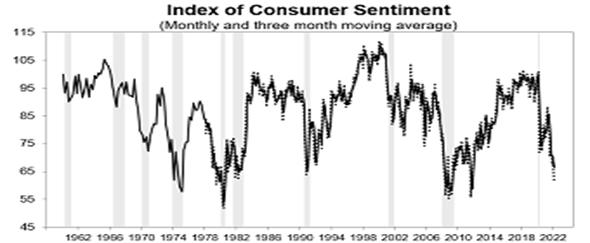
Why do economists and pundits like to focus so much on consumer confidence, which fluctuates wildly, as the U Michigan sentiment survey graph shows? It rose as high as 112 in February 2000 during the heady Clinton years, when the cold war with Russia seemed to be over, and has fallen to 61.7 in its February take while the Omicron variant is still rampant.

UnivMichigan

The gray bars portray recessions, and so it shows how consumers see themselves before and after recessions. Right now, it’s the double-whammy of Omicron and high inflation they say worries them most.

“Sentiment continued its downward descent, reaching its worst level in a decade,” said its chief economist, Richard Curtin, “falling a stunning 8.2% from last month and 19.7% from last February. The recent declines have been driven by weakening personal financial prospects, largely due to rising inflation, less confidence in the government’s economic policies, and the least favorable long term economic outlook in a decade.”

So how does that square with actual economic conditions? Not very well. The US economy expanded at its fastest pace in 40 years last year—6.9 percent in December and 5.7 percent for all of 2021—with consumers spending like there was no tomorrow.

And more than 6.7 million jobs were created in 2021 with 1.62 million jobs added in just the past three months.

FREDcpi

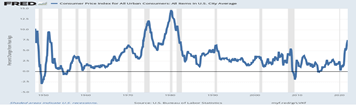
The inflation rate itself has fluctuated as much, especially the Consumer Price Index for retail prices (per FRED graph), which the Federal Reserve pays less attention to because of its volatility.

So why such pessimism about their economic conditions, when the Fed and most economists maintain the current inflation rate is mostly due to the ongoing pandemic and should begin to subside by mid-summer?

The University of Michigan survey team attempted to explain the divergence from reality last year in a terrific report entitled, The Partisan Economiy. It’s largely because of events that have overwhelmed our broken political system.

“Two developments have been responsible for the rise of the partisan economy: growing income inequality and the repeated crises whose solutions demanded extraordinary governmental intervention (9/11 for Bush, the Great Recession for Obama, and the covid pandemic for Trump and Biden).

“Unfortunately, the size of the partisan divide in expectations has completely dominated rational assessments of ongoing economic trends,” the report continues, “This situation is likely to encourage poor decisions by consumers and policy makers alike. While there have always been differences in preferred policies, the overwhelming size and persistence of the partisan gap has generated substantial economic uncertainty.”

It is convenient to blame covid, but I prefer to blame something just as real; the abysmal level of current political discourse among our political leaders that resulted in the January 6 attempted insurrection.

Until our leaders find a common language that both political parties understand, consumers will continue to lack confidence in government and a more favorable economic outlook.

Harlan Green © 2022

Follow Harlan Green on Twitter: https://twitter.com/HarlanGreen
Posted in Consumers, COVID-19, Economy, Politics, Weekly Financial News | Leave a comment

Inflation is Not So Scary

Financial FAQs

FREDcpi

It can be no surprise that retail prices have risen 7.5 percent in a year. Yet COVID-19 has scared financial markets and some 3 million workers from returning to their pre-pandemic jobs. The question is what can be done about it?

“The all items index rose 7.5 percent for the 12 months ending January, the largest 12-month increase since the period ending February 1982, said the BLS. The all items less food and energy index rose 6.0 percent, the largest 12-month change since the period ending August 1982. The energy index rose 27.0 percent over the last year, and the food index increased 7.0 percent.”

Part of the confusion is what has made this inflation surge unique. Studies show that it’s mainly worker shortages due to Omicron, countries slow to recover that are part of the disrupted supply chains, and consumers with lots of savings due to the pandemic aid.

The hope is that the Fed can tame some of the inflation by raising interest rates, making borrowing more expensive, which is the conventional tool to cool down activity.

Covid Tracker

But the ultimate inflation cure is if and when the Omicron and any other COVID-19 variant eventually morphs from a pandemic into an endemic virus, like the flu.

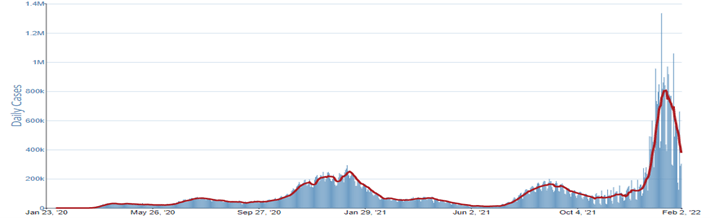
In fact, Omicron variant infections are declining faster than expected. As of February 2, 2022, the current 7-day moving average of daily new cases (378,015) decreased -37.6 percent compared with the previous 7-day moving average (605,735), reports the CDC’s Covid Tracker. Omicron infections are sharply down from the more than 800,000 at its peak in January.

At this tempo, it could be back to last October’s rate of approximately 100,000 average new cases in March, per the CDC graph.

More good news is that the U.S. added 467,000 jobs in January and hiring was much stronger at the end of 2021 than originally reported, The U.S. added 510,000 jobs in December instead of 199,000. And employment rose by 647,000 in November compared to the prior estimate of 249,000.

That’s 709,000 more jobs added to nonfarm payrolls in the past two months, so more workers are returning to work. Leisure and hospitality jobs are increasing, which also means more consumers feel free enough to lead a more normal lifestyle.

There are many parts to the inflation puzzle, but it’s probably safe to say that once the fear of Omicron begins to subside and more economic activity kicks in that will further boost employment—such as from infrastructure spending over the next five years that repairs and upgrades the roads, bridges, energy grids, and water systems, inflation will subside.

That leaves the housing problem with soaring rents as well as housing prices. Approximately one-third of the CPI Index is rising housing costs, a much more difficult problem to solve with the current housing shortage. So perhaps the best cure for lingering inflation should be more $$ invested in housing?

I think we should call the next Build Back Better bill, the Build Back Better Housing bill, if we are really serious about wanting housing to be more affordable.

Harlan Green © 2022

Follow Harlan Green on Twitter: https://twitter.com/HarlanGreen
Posted in Consumers, COVID-19, Economy, Housing, Weekly Financial News | Leave a comment

Surprise January Jobs Growth!

Popular Economics Weekly

MarketWatch.com

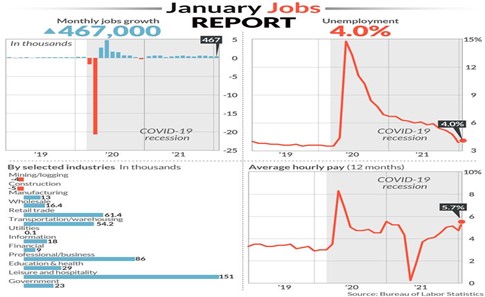
In another surprise that will confound the pessimists who see a looming recession, the U.S. added 467,000 jobs in January and hiring was much stronger at the end of 2021 than originally reported.

The U.S. also added 510,000 jobs in December instead of 199,000. And employment rose by 647,000 in November compared to the prior estimate of 249,000. That’s 709,000 more jobs added to nonfarm payrolls in the past two months.

‘Total nonfarm payroll employment rose by 467,000 in January, and the unemployment rate was little changed at 4.0 percent, the U.S. Bureau of Labor Statistics reported today. Employment growth continued in leisure and hospitality, in professional and business services, in retail trade, and in transportation and warehousing.”

It’s easy to see why. Average hourly wages are rising at 5.7 percent, the fastest in decades, luring workers back into the employment fold. This is especially true in the Leisure and hospitality, Education & healthcare, Transportation, and Retail sectors where 295,000 jobs were added.

So, companies apparently ramped up hiring just as effects of the Omicron variant are subsiding.

Actually, this hiring surge shouldn’t be such a surprise, since GDP grew at 5.7 percent last year, a 40-year high. The economy is running red-hot, but more employees returning to work will begin to bring down inflation.

In fact, could it be that the Omicron variant is subsiding faster than expected? The U.S. is reporting an average of 354,399 new COVID-19 infections a day, sharply down from the more than 700,000 in mid-January, according to a Reuters analysis of official data.

Covid Tracker

It looks like the Omicron variant has actually spurred higher growth, as I said last week. Fourth quarter GDP growth exploded to 6.9 percent, surpassing most estimates of 5 to 6 percent, as GDP got a big lift at the end of last year from businesses scrambling to restock empty shelves in time for the holiday season and warehouses hit by disruptions during the pandemic.

This could be a surprising year, and the beginning of a surprising decade. There hasn’t been this much support for governments and working folk for decades, maybe even since the New Deal.

Harlan Green © 2021

Follow Harlan Green on Twitter: https://twitter.com/HarlanGreen

Posted in Consumers, COVID-19, Economy, Keynesian economics, Weekly Financial News | Leave a comment

Too Many Job Openings

Financial FAQs

Calculated Risk

The Labor Department’s JOLTS report showed the labor market as tight as ever in January, which could be bad news for new job creation in Friday’s Labor Department unemployment report.

Employers can’t hire enough employees in several industries, with the largest increase in openings in accommodation and food services (+133,000), information (+40,000), and nondurable goods manufacturing and state and local government education (+31,000 each). Job openings decreased in finance and insurance (-89,000) and in wholesale trade (-48,000).

It means there is still a huge gap between the supply of workers willing to work and what businesses have been able to hire in many industries.

“The number of job openings was little changed at 10.9 million on the last business day of December, the U.S. Bureau of Labor Statistics reported today. Hires and total separations decreased to 6.3 million and 5.9 million, respectively. Within separations, the quits rate was little changed at 2.9 percent. The layoffs and discharges rate was little changed at 0.8 percent, a series low.”

The growing demand for workers in leisure activities, however, is a good sign that consumers are beginning to venture out as the Omicron variant wanes.

This is while manufacturing activity has slowed ever so slightly per the ISM’s Institute for Supply Management Manufacturing Index, slipping to a 14-month low of 57.6 percent in January from 58.8 percent because of the Omicron variant and ongoing shortages of labor and supplies that have slowed production.

The index of new orders dropped 3.1 points to 57.9 percent, the lowest level in a year and a half, and reflecting higher costs. The supply bottlenecks are reflected in the index of prices paid that rose to 76.1 percent from 68.2 percent in December, erasing some of the big decline at the end of 2021.

The U.S. economy is glowing red-hot now, and maybe overheating with soaring prices if supplies don’t catch up to demand soon. GDP grew 5.6 percent last year, the fastest growth rate in 40 years, and predicted to grow as much as 4 percent in 2022. This is far above the 2 percent average growth rate that prevailed since the end of the Great Recession in 2009.

AtlantaFed

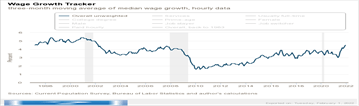
The worker shortage is boosting workers’ wages, per the Atlanta Fed, as mentioned recently by Nobel Laureate Paul Krugman. A 3-month average of hourly wages has been growing at 4.5 percent, more than double the 2 percent rise that prevailed since 2010.

Will inflation cool because consumers spend less in the New Year as the pandemic aid dries up, and supply chains speed up deliveries, or must the Fed raise interest rates in the hope of taming it?

So what happens next?

Today’s ADP private payrolls report showed -301,000 jobs were lost in its January survey that precedes Friday’s unemployment report, with most losses in leisure activities due to the Omicron variant. This will surely downgrade current estimates of an additional 150,000 nonfarm payroll jobs in Friday’s report.

Harlan Green © 2022

Follow Harlan Green on Twitter: https://twitter.com/HarlanGreen
Posted in Consumers, COVID-19, Economy, Weekly Financial News | Leave a comment