
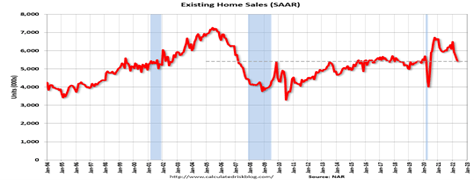
Home Sales Returning to Normal

Financial FAQs

FREDcalculatedrisk

The home sales frenzy that has prevailed since COVID and rock bottom interest rates is finally subsiding.

Existing-home sales retreated for the fourth consecutive month in May, according to the National Association of Realtors®. Month-over-month sales declined in three out of four major U.S. regions, while year-over-year sales slipped in all four regions.

This is slowing rising prices, though the national median price just topped $400,00 for single-family homes, up 15 percent in a year. But it also means annual sales are returning to the range that prevailed since the Great Recession in 2007, as can be seen in Calculated Risk’s above graph.

Calculated Risk’s Bill McBride predicts that housing supplies will increase this year because a record number of homes will be completed due to a record number of housing units under construction—some 1.7 million residential units.

“Supply constraints have lengthened the time from start to completion. We can see the impact of supply constraints by looking at the gap between single family starts and completions. It usually only takes about 6 months between starting a single-family home and completion, but it has taken longer during the pandemic,” said McBride.

Total existing-home sales,1 https://www.nar.realtor/existing-home-sales, completed transactions that include single-family homes, townhomes, condominiums and co-ops, fell 3.4 percent from April to a seasonally adjusted annual rate of 5.41 million in May. Year-over-year, sales receded 8.6 percent (5.92 million in May 2021).

“Home sales have essentially returned to the levels seen in 2019 – prior to the pandemic – after two years of gangbuster performance,” said NAR Chief Economist Lawrence Yun. “Also, the market movements of single-family and condominium sales are nearly equal, possibly implying that the preference towards suburban living over city life that had been present over the past two years is fading with a return to pre-pandemic conditions.”

Total housing inventory registered at the end of May was 1,160,000 units, an increase of 12.6% from April and a 4.1% decline from the previous year (1.21 million). Unsold inventory sits at a 2.6-month supply at the current sales pace, up from 2.2 months in April and 2.5 months in May 2021.

The problem is that first-time buyers have an even more difficult time in purchasing a residence, hence the surge in apartment construction.

First-time buyers were responsible for 27 percent of sales in May, down from 28 percent in April and down from 31 percent in May 2021. NAR’s 2021 Profile of Home Buyers and Sellersreleased in late 2021 – reported that the annual share of first-time buyers was 34 percent.

In fact, first-timers have made up to 40 percent of purchases when interest rates were lower, so will either now have to wait for either changes in zoning laws that allow a greater housing density near transportation hubs, something that communities should encourage that want to attract more working folk to their towns, or the next time interest rates come down.

Harlan Green © 2022

Follow Harlan Green on Twitter: https://twitter.com/HarlanGreen

Posted in Consumers, COVID-19, Housing, housing market, Weekly Financial News | Leave a comment

What is a Livable City?

Building Community Answering Kennedy’s Call

Chapter Twelve

I and several others living in Santa Barbara and the Goleta Valley were interested in a more ecologically friendly and less auto-dependent community. Drs. Susanne Lennard, architect, and her husband, child psychologist Henry Lennard, were two disciples of “livable cities”. They influenced our thinking.

The Lennards founded the Making Livable Cities organization in 1986. It began holding Livable Cities conferences, hosting mayors and urban planners from throughout the world.

In one of those conferences that I attended, the Dean of Urban Planning from Venice, Italy, extolled the virtues of pedestrian-friendly Venice and Venice’s many public spaces that created its close-knit community. He even offered his listeners a personal tour of Venice, should we decide to visit him one day!

Mayors and planners from as far away as India, South America, and Singapore attended and presented papers—all wanting to show off their cities’ people-friendly plans that had evolved over centuries of traditional living.

Central to their ideas was that communities had to be safe from crime, with sustainable economic growth that did little environmental damage. This was achieved by creating town centers built around squares, or plazas that became central community meeting places.

The Greeks and Romans had their public forums and amphitheaters that served their communities. Traditional European cities have open squares or plazas surrounded by shops and apartments from which families can watch their children while doing their own work.

The safety of children must be paramount. Its website, MakingCitiesLivable.org, states:

To be sustainable, a neighborhood, town or city must SUSTAIN ITS CHILDREN [their emphasis]. It must provide a physical environment that ensures children’s health, develops their faculties, and fosters their love for community, and for nature. In this way, children grow up to become agents of sustainability.

It is a messianic statement, but saving cities from themselves is a messianic endeavor. These conferences were tremendously exciting for those interested in building sustainable communities that combined good jobs with a human-scale environment. Dr.

Henry Lennard had developed the concept of child-centered communities where children are able to roam and explore their neighborhoods on their own. They could get to school on streets safe for children without being ferried around by a soccer mom, or anyone in a car that prevented them from exploring their surroundings, creating a sense of autonomy and personal responsibility so important for success in later life.

Many Goleta residents were idealistic former UC Santa Barbara students opposed to anything that hinted at urban; that might disturb the largest Monarch Butterfly Preserve in the west coast, for example. Their vision had to be included in a community plan. Similarly, Goleta and the South Coast in general was becoming another Silicon Valley with major tech startups like Mentor and Citrix corporations located there.

Goleta had also been a major aerospace center in the 1970s and 1980s with Raytheon, General Motor’s Delco and other defense contractors. UC Santa Barbara’s technical expertise was nearby, as was Vandenberg Air Force Base where spy and weather satellites were launched into north-south polar trajectories.

How could we accommodate all this diversity in a well- functioning city?

Harlan Green © 2022

Follow Harlan Green on Twitter: https://twitter.com/HarlanGreen
Posted in Housing, Politics, Uncategorized | Leave a comment

Higher Inflation Doesn’t Mean Stagflation

Financial FAQs

The current headlines would have us believe the bipartisan $1.9 trillion American Rescue Plan and $1.2 trillion American Infrastructure Investment and Jobs Act approved overwhelmingly by both Democrats and Republicans in 2021 will cause prolonged inflation and perhaps lead to a recession.

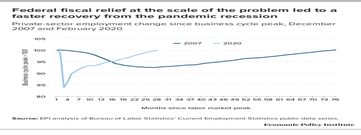
What the twin 2021 bills have done instead is create record employment, with full employment achieved 26 months after the COVID recession, vs. the 76 months it took to reach full employment after the Great Recession, which was because congress shortchanged the prior recovery with too little aid.

EPI.org

Former Fed Chair Ben Bernanke said on Fareed Zakaria’s GPS Sunday that he doubts the current inflation surge might turn into another stagflationary episode. The 1970’s stagflation was caused by 14 years of high inflation, whereas we are suffering from just 6 months of higher inflation, after 40 years with very little inflation since the 1970s.

A recurrence of the stagflation of the 1970s is only possible if rising interest rates engineered by the Fed cause a prolonged slowdown in business activity and consumers spending. The 1970’s inflationary spiral was caused by policies that enabled workers to push up wages every time there was a spike in inflation. Workers’ salaries today are barely keeping up with inflation and declining, rather than staying ahead of it.

The rate of inflation over the past year, based on the more reliable PCE Index, slowed to 6.3 percent in April from a 40-year high of 6.6 percent in March, the first decline in a year and a half.

May’s U.S. CPI surge of 8.6 percent was concentrated in three categories: airfares, used car prices and shelter costs, all in the service industries. Most of the inflation to date is in the goods sector. Surging shelter costs will be the most worrisome trend and that the Fed will watch most closely.

Higher inflation is occurring all over the world from the same factors, which signals that it’s mostly about rising food and energy prices affected by panicky traders worried about food and energy shortages. For example, Russia’s inflation rate is currently18 percent, Turkey’s 70 percent and the EU inflation rate is 8 percent.

The Russian invasion of Ukraine and the sanctions that it triggered account for more than a third of the 40-year high CPI annual inflation of 8.6 percent, according to Mark Zandi, chief economist at Moody’s Analytics, as reported by MarketWatch.

The real question is whether longer term inflation is embedded in consumers’ expectations as happened in the 1970s, which took 14 years, as Bernanke said. But that would mean the so-called ‘supply-shocks’ from COVID, China, and the Ukraine war that are the main cause of the current inflation surge don’t eventually subside, and doesn’t seem likely.

Harlan Green © 2022

Follow Harlan Green on Twitter: https://twitter.com/HarlanGreen

Posted in Consumers, COVID-19, Economy, Weekly Financial News | Leave a comment

May’s Strong Jobs Report

Popular Economics Weekly

MarketWatch.com

“U.S. stocks fell Friday after better-than-expected May payrolls data reinforced expectations for a series of interest rate rises by the Federal Reserve in coming months,” was MarketWatch’s headline re May’s unemployment report.

The employment report showed 390,000 payroll jobs and the unemployment rate holding at 3.6 percent, with almost all sectors adding jobs. Restaurants and hotels added 84,000 jobs in the unemployment report, as summer vacation time approaches. More people are going out to eat, traveling or taking a vacation. Employment also rose by 75,000 at professional businesses, 47,000 in transportation and warehousing and 36,000 in construction.

It was a very good report and a total of 8.1 million jobs have been added to payrolls since January 2020.

So, why did stocks fall with the good news? Friday’s selloff was caused by the fear that the Fed would now raise rates sooner and higher, so markets could no longer rely on almost free borrowed money to trade that had prevailed during the pandemic with the record low interest rates.

Or, markets had not been listening to the Fed’s change in monetary policy. Former Fed Chair Bernanke’s most recent remarks in Barron’s Magazine highlighted just how much the Fed has changed its monetary policies. It now considers its other mandate, full employment, as important as stable prices. It considers inflationary spikes a lesser danger, especially when caused by the current supply-side shocks from factors it has no control over—the pandemic, a Ukrainian war, and China’s COVID problems.

Ever since Paul Volcker’s Fed and the stagflation of the 1970s, the Fed had reacted too quickly to any hint of inflation in raising their interest rates, such as rising wages, “even in the absence of inflation,” said Bernanke. The result was wages and economic growth barely growing above inflation, averaging just 2 percent since then with higher unemployment rates.

The Fed has “foresworn such preemptive strikes” when it initiated its new monetary framework, which it called flexible average inflation targeting, or FAIT, in August 2020, said Bernanke.

So the actual slowdown in job growth could be a good sign, since it might mean less inflationary pressures and thus the need for the Fed to raise interest rates too high too soon.

There was another sign of slowing growth in the service-sector ISM survey as well. One headline reported, “Service-sector expands at slowest pace since early 2021.”

But the ISM index showed that activity dropped only slightly from 56.7 to 55.9, where any number above 55 means very strong expansion. The decline was led by a decline in business activity and slowing supplier deliveries.

The non-partisan Congressional Budget Office (CBO) that ‘scores’ existing legislation for its effect on economic activity concurs with the Fed’s optimistic scenario. It said U.S. economic growth will exceed 3 percent in 2022, while “roaring inflation has topped and will cool each month to around 2 percent by some point in 2024,” according to a government forecast published last week.

All-in-all, we must look beneath the headlines to understand what is really happening this year with the mix of conflicting bad and good news. Unfortunately, the financial markets aren’t helping matters with their fear of what the Fed might do next.

Harlan Green © 2022

Follow Harlan Green on Twitter: https://twitter.com/HarlanGreen
Posted in Consumers, COVID-19, Economy, Weekly Financial News | Leave a comment

An Uncertain Jobs Market

The Mortgage Corner

Calculated Risk

The financial markets will be watching tomorrow’s unemployment report closely to see if job growth remains strong, or weakens in the face of the many uncertainties plaguing markets, such as soaring inflation and rising interest rates.

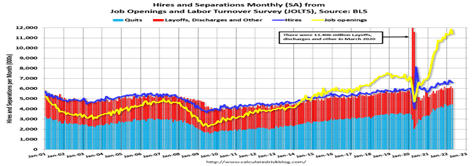
Yesterday’s JOLTS report that measured the number of job openings and hires in the Labor Department’s Job Openings and Labor Turnover Survey provides a hint of what’s to come. Most headlines touted that the 11.4 million job openings in May was a “severe” drop from 11.9 million vacancies in April, signaling more weakness.

But the 11.9 million April number was revised from the original estimate of 11.4 million, which really meant that April to May job vacancies were in essence unchanged showing openings and new hires (6.6 million) were still at record levels.

So, I very cautiously predict Friday’s U.S. unemployment report will also look better than predicted, and above initial estimates of just 250,000 new nonfarm payroll jobs in May.

No wonder markets are confused. What does one believe—certainly not the headlines. We would be better when reading between the lines!

The consumer confidence indicators are showing that consumers are also confused but aren’t yet convinced we are headed for a recession, which is probably why consumers have yet to cut back on their spending ways.

The Conference Board Consumer Confidence Index® decreased slightly in May, following a small increase in April. The Index now stands at 106.4 (1985=100), down from 108.6 in April (after an upward revision). The Present Situation Index—based on consumers’ assessment of current business and labor market conditions—declined to 149.6 from 152.9 last month. The Expectations Index—based on consumers’ short-term outlook for income, business, and labor market conditions—declined to 77.5 from 79.0.

(But) “By contrast, views of current business conditions—which tend to move ahead of trends in jobs—improved. Overall, the Present Situation Index remains at strong levels, suggesting growth did not contract further in Q2,” said Lynn Franco, Senior Director of Economic Indicators at The Conference Board.

The Institute of Purchasing Managers’ ISM Manufacturing Index also climbed, indicating that the manufacturing sector continued to expand, further reinforcing beliefs that the U.S. economy is still in a very robust growth mode.

Economic activity in the manufacturing sector grew in May, with the overall economy achieving a 24th consecutive month of growth, say the nation’s supply executives in the latest Manufacturing ISM® Report On Business®, said Lynn Franco, Senior Director of Economic Indicators at The Conference Board.

Oh yes, and the weekly initial unemployment claims which give the most immediate picture of the jobs market fell by 11,000 last week to 200,000, reflecting the lowest layoffs on record and the strongest labor market in decades.

New filings slid to a 54-year low of 166,000 in March and have hovered near 200,000 since the beginning of the year, government figures show.

So, who or what should one believe about the jobs market? We will know more tomorrow morning with the release of the Labor Department’s ‘official’ May unemployment report.

Harlan Green © 2022

Follow Harlan Green on Twitter: https://twitter.com/HarlanGreen
Posted in Consumers, COVID-19, Economy, Weekly Financial News | Leave a comment

America’s (Ongoing) Civil War

Answering Kennedy’s Call

Why should it be a surprise that Americans are still fighting the Civil War? Though it is no longer Generals Ulysses S Grant vs. Robert E Lee, it is still being fought with guns, as the latest Uvalde and Buffalo Supermarket carnage with military style assault rifles makes plain.

This is while Canadian Prime Minister Justin Trudeau has just banned the sale of handguns because of rising run violence in Canada! He said, ‘There is no reason anyone in Canada should need guns in their everyday lives’.

The signs of a active civil war are everywhere; with red states wanting almost anyone over 18 years of age to own an assault rifle in the name of a well-armed militia (Florida is the exception at 21 years old after the Parkland, Marjory Stoneham Douglas High shooting); with most of the Republican Party, the party of Lincoln, fomenting theories that colored peoples are inferior in some way; and their denial of President Biden’s win.

And then we have the last President’s followers’ blatant attempt on January 6 to overturn the election results.

It has been states’ rights vs. the Federal government since our founding: with red states keeping most of its citizens poor by denying benefits such as expanded federal health care and union organizing efforts with right to work laws that would boost wages .

Nobel Prize-winner Paul Krugman once highlighted why the poorest states tend to elect conservative politicians, who have not enhanced the economic opportunities of their own constituents.

“And what these severe conservatives hate, above all, is reliance on government programs,” says Krugman. “Rick Santorum declares that President Obama is getting America hooked on “the narcotic of dependency.” Mr. Romney warns that government programs “foster passivity and sloth.” Representative Paul Ryan, the chairman of the House Budget Committee, requires that staffers read Ayn Rand’s “Atlas Shrugged,” in which heroic capitalists struggle against the “moochers” trying to steal their totally deserved wealth, a struggle the heroes win by withdrawing their productive effort and giving interminable speeches.”

But perhaps we have suffered the most casualties in our ongoing civil war from the COVID pandemic.

A NY Times article by Damien Caves highlighted a study of how Australia, a country very similar to the U.S. in demographics, had a much better outcome from the COVID-19 pandemic. In Australia and in the United States, the median age is 38. Roughly 86 percent of Australians live in urban areas, compared with 83 percent of Americans.

It was as much about having a culture of trust, he said, a culture that recognizes caring for others is as important as caring for oneself because it saves more lives, especially during disasters.

“If the United States had the same Covid death rate as Australia,’ said Cave, “about 900,000 lives would have been saved (vs. one million American lives lost to date). The Texas grandmother who made the perfect pumpkin pie might still be baking. The Red Sox-loving husband who ran marathons before Covid might still be cheering at Fenway Park.”

Instead of trusting each other to do the right thing, many Americans, and past-President Trump as a matter of policy, chose to distrust science and advocate every kind of snake oil cure, as if we were still living in the 1800s.

“In global surveys, Australians were more likely than Americans to agree that “most people can be trusted” — a major factor, researchers found, in getting people to change their behavior for the common good to combat Covid, by reducing their movements, wearing masks and getting vaccinated. Partly because of that compliance, which kept the virus more in check, Australia’s economy has grown faster than America’s through the pandemic,” continued Cave.

Every country has probably had a civil war sometime in its past, as part of its growing pains. Europe has certainly had it share, such as The Hundred Years War. And civil wars have always pitted brothers and sisters against each other.

But why have a civil war that has lasted 157 years and caused so many casualties, since 1865 and the abolition of slavery. Isn’t it time for US to put our guns away and make peace with each other?

Harlan Green © 2022

Follow Harlan Green on Twitter: https://twitter.com/HarlanGreen
Posted in Politics, Uncategorized | Leave a comment

Consumers Disregard Latest Inflation Data

Financial FAQs

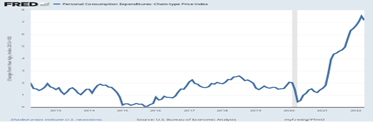
FREDpersonalconsumption

The Federal Reserve’s Personal Consumption Expenditures Index (PCE), its preferred inflation indicator, rose just 0.2 percent in April to mark the smallest increase in a year and a half, aided by a decline in gas prices.

The rise in the so-called personal consumption price index was the smallest since November 2020 and is cheering the financial markets as a first sign that the inflation burden may be easing.

The rate of inflation over the past year, based on the PCE, slowed to 6.3 percent in April from a 40-year high of 6.6 percent in March. It was also the first decline in a year and a half.

This is while consumers’ personal consumption expenditures have risen 6 percent in a year—see the above FRED graph. This graph in one picture shows how much consumer spending has skyrocketed since the pandemic—after just 2 percent average annual growth rates since the Great Recession. It is the highest spending increases since 1980 caused by the record inflation of the 1970s.

But maybe inflation will not be such a problem this time? If inflation continues to moderate—despite the Ukraine war and China’s slowdown—consumers could continue to be the engine of growth without the sky-high inflation of the 1970s that plagued Americans, then. Most of the supply shortages are temporary shocks caused by the pandemic and above-mentioned issues. The U.S. now leads even China (temporarily) as the world’s fastest growing economy while China wrestles with its own COVID crisis.

That is the big question. Corporations have been reporting record profits, and able to pass most of their increased product costs onto consumers. Will they continue to hire more workers at the torrid pace since the pandemic recovery, which will keep consumers happy and continuing their spending ways?

The number of Americans filing new claims for unemployment benefits fell more than expected last week as the labor market remains tight amid strong demand for workers despite rising interest rates and tightening financial conditions.

And with a record 11.5 million job openings at the end of March, layoffs are likely to be minimal and people who lose a job can easily find another one.

The minutes of the Fed’s May 3-4 meeting published on Wednesday showed officials commenting that “demand for labor continued to outstrip available supply across many parts of the economy and that their business contacts continued to report difficulties in hiring and retaining workers.” Many expected the labor market to remain tight and wage pressures to stay elevated for some time.

We must now wait to see what the Fed’s push to raise interest rates will do to future growth. Will it slow consumers spending and help to slow the prices increases further, and avert re-occurrence of a 1970’s-style stagflation?

Harlan Green © 2022

Follow Harlan Green on Twitter: https://twitter.com/HarlanGreen
Posted in Consumers, COVID-19, Economy, Weekly Financial News | Leave a comment

U.S. Economy Resumes Growth in Q2

Popular Economics Weekly

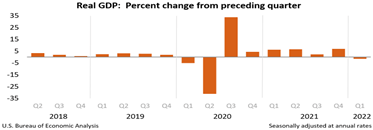
The panic selling in financial markets of late is in part because first quarter 2022 GDP growth contracted after last year’s huge 5.6 percent growth surge, triggering worries of an imminent recession.

The U.S. economy shrank by a 1.5 percent annual rate in Q1, new government figures show, largely because of a record trade deficit. And corporate profits fell for the first time in five quarters.

But corporate profits are still at record levels, up 12.5 percent YoY, and GDP is still growing 10.5 percent annually. So quarterly statistics that financial markets follow can fluctuate wildly, which isn’t very helpful in looking at longer term trends.

BEA.gov

The BEA attributes the first quarter decline in GDP to temporary factors and most economists predict a second quarter resumption in economic activity.

“In the first quarter, an increase in COVID-19 cases related to the Omicron variant resulted in continued restrictions and disruptions in the operations of establishments in some parts of the country,” said the BEA. “Government assistance payments in the form of forgivable loans to businesses, grants to state and local governments, and social benefits to households all decreased as provisions of several federal programs expired or tapered off.”. 

In fact, the non-partisan Congressional Budget Office (CBO) that ‘scores’ current legislation for its effect on economic activity said U.S. economic growth will exceed 3 percent in 2022, while “roaring inflation has topped and will cool each month to around 2 percent by some point in 2024,” according to a government forecast published Wednesday.

The CBO estimated that real gross domestic product, or GDP, will be driven by consumer spending and demand for services, according to the report. It revised its estimates for GDP growth in 2023 and 2024 upward to 2.2 percent and 1.5 percent, respectively.

“In CBO’s projections, the current economic expansion continues, and economic output grows rapidly over the next year,” the CBO said in its report. “To fulfill the elevated demand for goods and services, businesses increase both investment and hiring, although supply disruptions hinder that growth in 2022.”

One reason the CBO has become more optimistic about stronger growth—the shrinking budget deficit from the increased activity.

The U.S. budget deficit will shrink dramatically to $1.036 trillion for fiscal 2022 from $2.775 trillion last year as a strong recovery prompts a surge in revenues and lower outlays, but slowing growth will start to reverse the trend due to higher inflation and rising interest rates, the Congressional Budget Office said.

FREDcorpprofits

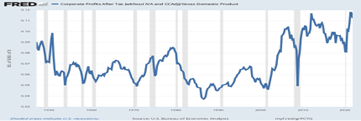
U.S. corporations are making record profits as a percentage of GDP—in fact, the highest profits since World War Two, per the St Louis FRED historical graph from 1950 that I discussed in my last blog. During the pandemic it dropped briefly to 8 percent of GDP, but quickly rose to its current 11.2 percent, the best on record.

And consumers are still shopping as if there’s no tomorrow, so the saying goes, that make up some 70 percent of economic activity. So once again, why should investors be held hostage by shorter-term, quarterly projections that only become valid over the longer term, anyway?

Harlan Green © 2022

Follow Harlan Green on Twitter: https://twitter.com/HarlanGreen
Posted in Consumers, COVID-19, Economy, Weekly Financial News | 1 Comment

Leading Indicators Show Moderate Growth

Popular Economics Weekly

ConferenceBoardLEI

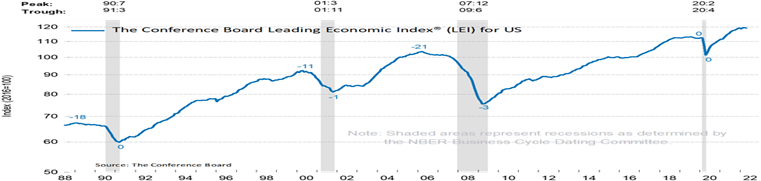
The Conference Board Leading Economic Index® (LEI) for the U.S. decreased by 0.3 percent in April to 119.2 (2016 = 100), following a 0.1 percent increase in March. (But) The LEI is now up 0.9 percent over the six-month period from October 2021 to April 2022.

Not many economists cite the Conference Board’s Index of Leading Economic Indicators (LEI) that are good at predicting future economic activity. It’s much better than the projected earnings estimates Wall Street traders tend to follow who are pressing the panic button that a recession in imminent.

So why the current doom and gloom with corporations still making record profits and unemployment at record lows?

The LEI is a good predictor of recessions as the above graph shows, with gray bars indicating past recessions and the LEI’s immediate up trend at the end of each recession.

“The US LEI declined in April largely due to weak consumer expectations and a drop in residential building permits,” said Ataman Ozyildirim, Senior Director of Economic Research at The Conference Board…A range of downside risks—including inflation, rising interest rates, supply chain disruptions, and pandemic-related shutdowns, particularly in China—continue to weigh on the outlook. Nevertheless…The Conference Board still projects 2.3 percent year-over-year US GDP growth in 2022.”

FREDcorpprofits

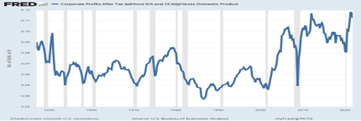
U.S. corporations are making record profits as a percentage of GDP—in fact, the highest profits since World War Two, as the St Louis FRED historical graph from 1950 shows. During the COVID pandemic it dropped briefly to 8 percent of GDP, but quickly rose to its current 11.2 percent, the best on record.

And because corporations made record profits over the past year, earnings growth will slow to more historical levels this year, as the law of averages requires. So rather than focus on quarterly trends (i.e., short-term profits), serious investors and fund managers need to focus on the long term, when their investors approach retirement age.

U.S. economic growth must also come down from its 5.6 percent high last year when consumers and businesses burst out of the pandemic; essentially starting from a ground zero of economic shutdowns during March-April 2020.

The flood of new money from the $trillions in aid and record rescue packages have goosed that growth, causing the current inflationary surge. But such spending and inflation will also slow for the same reason.

Prices had stalled at ground zero back then, even fallen into negative territory. So, the law of averages rules once again—demand will slow from its artificially boosted high, while supplies will catch up from their artificially-induced scarcities.

Fed Chair Powell has been attempting to tell us that in his latest press conferences, so why won’t the financial markets believe him? Settling for moderate growth means sustainable longer term growth.

Harlan Green © 2022

Follow Harlan Green on Twitter: https://twitter.com/HarlanGreen
Posted in Consumers, COVID-19, Economy, Macro Economics, Weekly Financial News | Leave a comment

Booming Retail Sales Belie Recession Worries

Financial FAQs

FREDretailsales

The St Louis Federal Reserve graph of April retail sales tells us more than a thousand words that there is no imminent recession. Maybe not even next year either, because consumers continue to shop, with auto sales up 2.2%, restaurants and bar sales up 2% in the month.

Gas station sales were down -2.7% because gas prices eased during a war that is about energy supplies. Consumers are shopping as if there is no war or another COVID scare., or supply shortages

The gray bar in the graph is the very short March-April 2020 recession. Consumers have ignored the pundits and doom-sayers since then, ans the inflation hawks that said consumers wouldn’t continue to boost economic growth, which now looks to be on the upswing after the Q1 plunge in Gross Domestic Product.

Sales at U.S. retailers rose a huge 0.9% in April. And the increase in sales in March, was raised to 1.4% from an original 0.7%, the government reported Tuesday.

What does the surge in auto sales and leisure activities tell us? There’s a lot of pent up demand from Americans that don’t want to stay at home any longer with jobs plentiful and salaries surging. Why should they?

Consumers also seem to be ignoring their own consumer confidence surveys, which say they are pessimistic about the future. Both the Conference Board and University of Michigan indexes have been trending downward, of late, because of the fears of rising inflation.

“Consumer sentiment declined by 9.4% from April, reversing gains realized that month,” said Richard Curtin, Director of the U. of Michigan survey. “These declines were broad based–for current economic conditions as well as consumer expectations, and visible across income, age, education, geography, and political affiliation–continuing the general downward trend in sentiment over the past year.”

The Conference Board’s was more in line with actual behaviors. ““Consumer confidence fell slightly in April, after a modest increase in March,” said Lynn Franco, Senior Director of Economic Indicators at The Conference Board. “The Present Situation Index declined, but remains quite high, suggesting the economy continued to expand in early Q2. Expectations, while still weak, did not deteriorate further amid high prices, especially at the gas pump, and the war in Ukraine.”

But both surveys don’t seem to reflect the ebullient behavior of actual consumers. So once again, we have to take any survey with that grain or two of salt by looking at actual behavior.

We are at a classic top of the business cycle when the demand for products and services is sky high and all the factors that restrict supply are causing red hot inflation numbers, as I said last week.

That hasn’t changed, but with summer and vacation travel looming, it doesn’t look like consumers are bothered by rising prices. That could change, of course, as the Fed begins to raise interest rates further.

So why are consumers misbehaving, ignoring their own sentiment surveys? The most obvious answer is we are at full employment and salaries are rising, as I said.

The unemployment rate remained unchanged at 3.6 percent and 428,000 more jobs were created in April, according to the US Labor Dept. so no real sign of weakening employment, one of the first signs of a recession. Industrial production and business investments are also high and show little signs of slowing.

Recessions take a long time to happen, I also said last week, so we need to read what consumers do, if we want to know more, rather than what they say.

Harlan Green © 2022

Follow Harlan Green on Twitter: https://twitter.com/HarlanGreen

Posted in Consumers, COVID-19, Economy, Weekly Financial News | Leave a comment