
Most Homes Under Construction in 49 Years!

The Mortgage Corner

Calculated Risk

Builders are trying to catch up to demand. Calculated Risk’s Bill McBride per the US Census Bureau reports the largest number of homes under construction since 1973.

Privately‐owned housing starts in December were at a seasonally adjusted annual rate of 1,702,000. This is 1.4 percent above the revised November estimate of 1,678,000 and is 2.5 percent (±13.8 percent) above the December 2020 rate of 1,661,000. Single‐family housing starts in December were at a rate of 1,172,000; this is 2.3 percent below the revised November figure of 1,199,000. The December rate for units in buildings with five units or more was 524,000.

McBride also said that currently there are 750 thousand multi-family units under construction.  This is the highest level since July 1974! For multi-family, construction delays are probably also a factor. The completion of these units should help with rent pressure, with rents rising more than 7 percent annually.

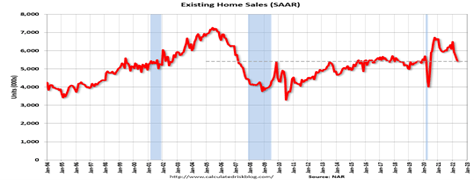
Why so much residential construction? Existing-home sales continued to use up available inventory, surging to 6.5 million annualized units in January. Since we are in mid-winter when sales are usually at a low point, why the surge?

“Buyers were likely anticipating further rate increases and locking-in at the low rates, and investors added to overall demand with all-cash offers,” said Lawrence Yun, NAR’s chief economist. “Consequently, housing prices continue to move solidly higher.”

Calculated Risk

Total existing-home sales,1 https://www.nar.realtor/existing-home-sales, completed transactions that include single-family homes, townhomes, condominiums and co-ops, climbed 6.7% from December to a seasonally adjusted annual rate of 6.50 million in January. Year-over-year, sales fell 2.3% (6.65 million in January 2021), said the Realtors.

The inventory of homes for sale has dropped to just 1.6 months at the current torrid sales rate. This is squeezing out homebuyers that can afford homes below $500,000, said Yun.

“There are more listings at the upper end – homes priced above $500,000 – compared to a year ago, which should lead to less hurried decisions by some buyers,” Yun added. “Clearly, more supply is needed at the lower-end of the market in order to achieve more equitable distribution of housing wealth.”

This has pushed housing prices even higher. The S&P CoreLogic Case-Shiller 20-city price index posted a 18.6 percent year-over-year gain in December, up slightly from 18.3 percent the previous month.

This tells us in spite of labor and building material shortages, builders are finding ways to start new construction in the face of red hot demand. There are plenty of potential homebuyers out there with the record surge in job creation over the past year.

Harlan Green © 2021

Follow Harlan Green on Twitter: https://twitter.com/HarlanGreen
Posted in Consumers, COVID-19, Housing, housing market, Weekly Financial News | Leave a comment

Surprise Retail Sales Growth!

Popular Economics Weekly

FREDretailsales

The New Year brought in another surprise. Sales at U.S. retailers such as Amazon and Best Buy jumped 3.8 percent in January. Americans bought more things: cars, furniture, consumer electronics in a sign that consumers are no longer fazed by the Omicron variant.

Why? The Omicron infection rate is fast returning to pre-Omicron levels.

Retail sales have tracked the pandemic, per the FRED graph. It plunged from May to November 2020 as the coronavirus did its worst, up and down with the Delta variant, then plunging again in March 2021 as Omicron hit. Sales began to recover again in December 2021.

The January increase in sales was the largest since last March, when Americans spent a good chunk of their stimulus money from the government.

Auto sales rose sharply for the second month in a row, the government said Wednesday. Auto sales account for about one-fifth of overall retail spending. Other than autos, retail sales still advanced a strong 3.3 percent last month. Sales also rose sharply at internet retailers (14.5 percent), furniture stores (7.2 percent), department stores (9.2 percent) and home centers (4.1 percent).

CDC

And the CDC reported as of February 9, 2022 in its weekly update that the current 7-day moving average of daily new cases (215,418) decreased 42.8% compared with the previous 7-day moving average (376,855). A total of 77,179,255 COVID-19 cases have been reported in the United States as of February 9, 2022.

The surge in industrial production was another good sign. It increased 1.4 percent in January, largely because of unusually cold weather that boosted the output of utilities, reports the Federal Reserve. At 103.5 percent of its 2017 average, total industrial production in January was 4.1 percent higher than its year-earlier level and 2.1 percent above its pre-pandemic (February 2020) reading.

This could be a surprising year and the beginning of a surprising decade, I said last week; if President Biden, the EU, and Vladimir Putin work out their differences.

We should still worry about emerging signs of irrational exuberance in the financial markets and with consumers, that former Fed Chair Greenspan also worried about more than two decades ago. It is pushing the inflation rate to uncomfortable levels.

But can we blame Americans for wanting to celebrate the looming end of more than two years of uncertainty due to the worst pandemic in 100 years?

Harlan Green © 2022

Follow Harlan Green on Twitter: https://twitter.com/HarlanGreen

Posted in Consumers, COVID-19, Economy, Weekly Financial News | Leave a comment

What Makes Americans Happy?

The Mortgage Corner

Why do economists and pundits like to focus so much on consumer confidence, which fluctuates wildly, as the U Michigan sentiment survey graph shows? It rose as high as 112 in February 2000 during the heady Clinton years, when the cold war with Russia seemed to be over, and has fallen to 61.7 in its February take while the Omicron variant is still rampant.

UnivMichigan

The gray bars portray recessions, and so it shows how consumers see themselves before and after recessions. Right now, it’s the double-whammy of Omicron and high inflation they say worries them most.

“Sentiment continued its downward descent, reaching its worst level in a decade,” said its chief economist, Richard Curtin, “falling a stunning 8.2% from last month and 19.7% from last February. The recent declines have been driven by weakening personal financial prospects, largely due to rising inflation, less confidence in the government’s economic policies, and the least favorable long term economic outlook in a decade.”

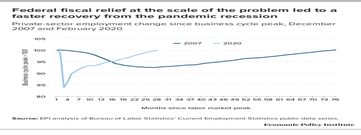
So how does that square with actual economic conditions? Not very well. The US economy expanded at its fastest pace in 40 years last year—6.9 percent in December and 5.7 percent for all of 2021—with consumers spending like there was no tomorrow.

And more than 6.7 million jobs were created in 2021 with 1.62 million jobs added in just the past three months.

FREDcpi

The inflation rate itself has fluctuated as much, especially the Consumer Price Index for retail prices (per FRED graph), which the Federal Reserve pays less attention to because of its volatility.

So why such pessimism about their economic conditions, when the Fed and most economists maintain the current inflation rate is mostly due to the ongoing pandemic and should begin to subside by mid-summer?

The University of Michigan survey team attempted to explain the divergence from reality last year in a terrific report entitled, The Partisan Economiy. It’s largely because of events that have overwhelmed our broken political system.

“Two developments have been responsible for the rise of the partisan economy: growing income inequality and the repeated crises whose solutions demanded extraordinary governmental intervention (9/11 for Bush, the Great Recession for Obama, and the covid pandemic for Trump and Biden).

“Unfortunately, the size of the partisan divide in expectations has completely dominated rational assessments of ongoing economic trends,” the report continues, “This situation is likely to encourage poor decisions by consumers and policy makers alike. While there have always been differences in preferred policies, the overwhelming size and persistence of the partisan gap has generated substantial economic uncertainty.”

It is convenient to blame covid, but I prefer to blame something just as real; the abysmal level of current political discourse among our political leaders that resulted in the January 6 attempted insurrection.

Until our leaders find a common language that both political parties understand, consumers will continue to lack confidence in government and a more favorable economic outlook.

Harlan Green © 2022

Follow Harlan Green on Twitter: https://twitter.com/HarlanGreen
Posted in Consumers, COVID-19, Economy, Politics, Weekly Financial News | Leave a comment

Inflation is Not So Scary

Financial FAQs

FREDcpi

It can be no surprise that retail prices have risen 7.5 percent in a year. Yet COVID-19 has scared financial markets and some 3 million workers from returning to their pre-pandemic jobs. The question is what can be done about it?

“The all items index rose 7.5 percent for the 12 months ending January, the largest 12-month increase since the period ending February 1982, said the BLS. The all items less food and energy index rose 6.0 percent, the largest 12-month change since the period ending August 1982. The energy index rose 27.0 percent over the last year, and the food index increased 7.0 percent.”

Part of the confusion is what has made this inflation surge unique. Studies show that it’s mainly worker shortages due to Omicron, countries slow to recover that are part of the disrupted supply chains, and consumers with lots of savings due to the pandemic aid.

The hope is that the Fed can tame some of the inflation by raising interest rates, making borrowing more expensive, which is the conventional tool to cool down activity.

Covid Tracker

But the ultimate inflation cure is if and when the Omicron and any other COVID-19 variant eventually morphs from a pandemic into an endemic virus, like the flu.

In fact, Omicron variant infections are declining faster than expected. As of February 2, 2022, the current 7-day moving average of daily new cases (378,015) decreased -37.6 percent compared with the previous 7-day moving average (605,735), reports the CDC’s Covid Tracker. Omicron infections are sharply down from the more than 800,000 at its peak in January.

At this tempo, it could be back to last October’s rate of approximately 100,000 average new cases in March, per the CDC graph.

More good news is that the U.S. added 467,000 jobs in January and hiring was much stronger at the end of 2021 than originally reported, The U.S. added 510,000 jobs in December instead of 199,000. And employment rose by 647,000 in November compared to the prior estimate of 249,000.

That’s 709,000 more jobs added to nonfarm payrolls in the past two months, so more workers are returning to work. Leisure and hospitality jobs are increasing, which also means more consumers feel free enough to lead a more normal lifestyle.

There are many parts to the inflation puzzle, but it’s probably safe to say that once the fear of Omicron begins to subside and more economic activity kicks in that will further boost employment—such as from infrastructure spending over the next five years that repairs and upgrades the roads, bridges, energy grids, and water systems, inflation will subside.

That leaves the housing problem with soaring rents as well as housing prices. Approximately one-third of the CPI Index is rising housing costs, a much more difficult problem to solve with the current housing shortage. So perhaps the best cure for lingering inflation should be more $$ invested in housing?

I think we should call the next Build Back Better bill, the Build Back Better Housing bill, if we are really serious about wanting housing to be more affordable.

Harlan Green © 2022

Follow Harlan Green on Twitter: https://twitter.com/HarlanGreen

Posted in Consumers, COVID-19, Economy, Housing, Weekly Financial News | Leave a comment

Surprise January Jobs Growth!

Popular Economics Weekly

MarketWatch.com

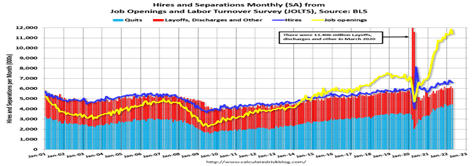
In another surprise that will confound the pessimists who see a looming recession, the U.S. added 467,000 jobs in January and hiring was much stronger at the end of 2021 than originally reported.

The U.S. also added 510,000 jobs in December instead of 199,000. And employment rose by 647,000 in November compared to the prior estimate of 249,000. That’s 709,000 more jobs added to nonfarm payrolls in the past two months.

‘Total nonfarm payroll employment rose by 467,000 in January, and the unemployment rate was little changed at 4.0 percent, the U.S. Bureau of Labor Statistics reported today. Employment growth continued in leisure and hospitality, in professional and business services, in retail trade, and in transportation and warehousing.”

It’s easy to see why. Average hourly wages are rising at 5.7 percent, the fastest in decades, luring workers back into the employment fold. This is especially true in the Leisure and hospitality, Education & healthcare, Transportation, and Retail sectors where 295,000 jobs were added.

So, companies apparently ramped up hiring just as effects of the Omicron variant are subsiding.

Actually, this hiring surge shouldn’t be such a surprise, since GDP grew at 5.7 percent last year, a 40-year high. The economy is running red-hot, but more employees returning to work will begin to bring down inflation.

In fact, could it be that the Omicron variant is subsiding faster than expected? The U.S. is reporting an average of 354,399 new COVID-19 infections a day, sharply down from the more than 700,000 in mid-January, according to a Reuters analysis of official data.

Covid Tracker

It looks like the Omicron variant has actually spurred higher growth, as I said last week. Fourth quarter GDP growth exploded to 6.9 percent, surpassing most estimates of 5 to 6 percent, as GDP got a big lift at the end of last year from businesses scrambling to restock empty shelves in time for the holiday season and warehouses hit by disruptions during the pandemic.

This could be a surprising year, and the beginning of a surprising decade. There hasn’t been this much support for governments and working folk for decades, maybe even since the New Deal.

Harlan Green © 2021

Follow Harlan Green on Twitter: https://twitter.com/HarlanGreen
Posted in Consumers, COVID-19, Economy, Keynesian economics, Weekly Financial News | Leave a comment

Too Many Job Openings

Financial FAQs

Calculated Risk

The Labor Department’s JOLTS report showed the labor market as tight as ever in January, which could be bad news for new job creation in Friday’s Labor Department unemployment report.

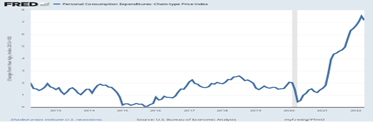
Employers can’t hire enough employees in several industries, with the largest increase in openings in accommodation and food services (+133,000), information (+40,000), and nondurable goods manufacturing and state and local government education (+31,000 each). Job openings decreased in finance and insurance (-89,000) and in wholesale trade (-48,000).

It means there is still a huge gap between the supply of workers willing to work and what businesses have been able to hire in many industries.

“The number of job openings was little changed at 10.9 million on the last business day of December, the U.S. Bureau of Labor Statistics reported today. Hires and total separations decreased to 6.3 million and 5.9 million, respectively. Within separations, the quits rate was little changed at 2.9 percent. The layoffs and discharges rate was little changed at 0.8 percent, a series low.”

The growing demand for workers in leisure activities, however, is a good sign that consumers are beginning to venture out as the Omicron variant wanes.

This is while manufacturing activity has slowed ever so slightly per the ISM’s Institute for Supply Management Manufacturing Index, slipping to a 14-month low of 57.6 percent in January from 58.8 percent because of the Omicron variant and ongoing shortages of labor and supplies that have slowed production.

The index of new orders dropped 3.1 points to 57.9 percent, the lowest level in a year and a half, and reflecting higher costs. The supply bottlenecks are reflected in the index of prices paid that rose to 76.1 percent from 68.2 percent in December, erasing some of the big decline at the end of 2021.

The U.S. economy is glowing red-hot now, and maybe overheating with soaring prices if supplies don’t catch up to demand soon. GDP grew 5.6 percent last year, the fastest growth rate in 40 years, and predicted to grow as much as 4 percent in 2022. This is far above the 2 percent average growth rate that prevailed since the end of the Great Recession in 2009.

AtlantaFed

The worker shortage is boosting workers’ wages, per the Atlanta Fed, as mentioned recently by Nobel Laureate Paul Krugman. A 3-month average of hourly wages has been growing at 4.5 percent, more than double the 2 percent rise that prevailed since 2010.

Will inflation cool because consumers spend less in the New Year as the pandemic aid dries up, and supply chains speed up deliveries, or must the Fed raise interest rates in the hope of taming it?

So what happens next?

Today’s ADP private payrolls report showed -301,000 jobs were lost in its January survey that precedes Friday’s unemployment report, with most losses in leisure activities due to the Omicron variant. This will surely downgrade current estimates of an additional 150,000 nonfarm payroll jobs in Friday’s report.

Harlan Green © 2022

Follow Harlan Green on Twitter: https://twitter.com/HarlanGreen
Posted in Consumers, COVID-19, Economy, Weekly Financial News | Leave a comment

Q4 Economic Growth Explodes

Popular Economics Weekly

BEA.gov

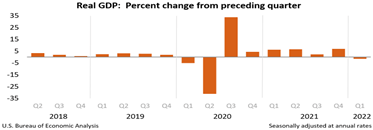
It looks like the Omicron variant has actually spurred higher growth. The fourth quarter GDP ‘first estimate’ of growth  exploded to 6.9 percent, surpassing most estimates of 5 to 6 percent. GDP got a big lift at the end of last year from businesses scrambling to restock empty shelves in time for the holiday season and warehouses hit by disruptions during the pandemic.

Massive government stimulus spending was a big help as GDP increased by 5.7 percent for the full year, before tapering in the final quarter. That’s the biggest gain since 1984.

The BEA said, “The increase in real GDP primarily reflected increases in private inventory investment, exports, personal consumption expenditures (PCE), and nonresidential fixed investment that were partly offset by decreases in both federal and state and local government spending. Imports, which are a subtraction in the calculation of GDP, increased.”

Both businesses and consumers spent more, but the 24.5 percent increase in Q4 exports was the biggest surprise. It means other countries are buying more of our products and services, which is in turn a sign that their economies are recovering as well.

And consumer spending that powers two-thirds of economic activity rose a remarkable 3.3 percent in the fourth quarter, vs. 2 percent in the third quarter.

The value of inventories soared by $240 billion — one of the biggest increases in decades — as companies ramped up production to try to meet higher demand.

What does this tell us? That the main cause of inflation isn’t too many Federal Reserve $$ in circulation that has put pressure on the Fed to raise interest rates sooner rather than later.

The BEA noted that government aid has in fact decreased. Inflation should decline as the shortages of workers and supplies are reduced. Businesses will eventually catch up to the demand that is outstripping the supply of goods and services, in part because of new technologies such as 5G communication services coming online and chip shortages that are crimping the production of vehicles as well as other products dependent on said computer chips.

FREDpce

So although inflation is rising at 6.5 percent in December, according to the Personal Consumption expenditure (PCE) price index used by the Fed to measure inflation, businesses are racing to satisfy sizzling demand.

Will inflation keep rising, squeezing consumers, or return to a more normal range this year?

MarketWatch’s Jeffry Bartash says predictions are,

“…that the U.S. will grow strongly again — around 4% or so — in 2022 despite the end of government stimulus, especially if the coronavirus is kept at bay. The chief obstacles? Ongoing shortages of labor and supplies that have boosted inflation to a nearly 40-year high. Inflation-adjusted incomes actually fell at a 5.8% annual pace in the fourth quarter.”

But surging exports are a sign of a worldwide recovery in demand for American products and services, and that the supply bottlenecks will soon be a thing of the past.

It’s as if the Omicron variant is becoming a mere blip on the screen of future growth.

Harlan Green © 2021

Follow Harlan Green on Twitter: https://twitter.com/HarlanGreen
Posted in Consumers, COVID-19, Economy, Weekly Financial News | Leave a comment

Best Home Sales in Years

The Mortgage Corner

Home sales are holding up and prices slowly moderating, even with limited inventories. December new-home sales jumped 12 percent in a year, according to the US Census Bureau. Also in 2021, existing-home sales totaled 6.12 million – an increase of 8.5 percent from the prior year and the highest annual level since 2006.

“Sales of new single‐family houses in December 2021 were at a seasonally adjusted annual rate of 811,000, according to estimates released jointly today by the U.S. Census Bureau and the Department of Housing and Urban Development.  This is 11.9 percent (±20.3 percent) above the revised November rate of 725,000, but is 14.0 percent (±16.6 percent)* below the December 2020 estimate of 943,000. An estimated 762,000 new homes were sold in 2021. This is 7.3 percent (±5.1 percent) below the 2020 figure of 822,000.”

Census.gov

New-home sales have been rising steadily since the end of the Great Recession and housing bubble in 2009, as the Census graph shows. Why not, with so few homes for sale, according to the Realtors?

“Buyer competition alone is unrelenting, but home seekers have also had to contend with the negative impacts of supply chain disruptions and labor shortages this year,” said NAR chief economist Lawrence Yun. “These aspects, along with the exorbitant prices and a lack of available homes, have created a much tougher buying season.”

The inventory of unsold existing homes fell to an all-time low of 910,000 at the end of December,, which is equivalent to 1.8 months of the monthly sales pace, also an all-time low since January 1999.

This is while last week, on a year-over-year basis, private residential construction spending is up 16.3 percent. Non-residential spending is up 6.7 percent year-over-year. Public spending is down 0.8 percent year-over-year.

That’s why the inventory of homes under construction at 263,000, is the highest since 2007.

Calculated Risk

Housing prices are beginning to slow their climb as can be seen in the above Calculated Risk graph. CR’s Bill McBride recently commented on the price moderation:

“The MoM increase in Case-Shiller was at 1.14%; still historically high, but lower than the increases in the 2nd half of 2020 and first half of 2021. House prices started increasing sharply in the Case-Shiller index in August 2020, so the last 16 months have all been historically very strong. But the peak of MoM growth is behind us – and the year-over-price growth is starting to decelerate.”

So let us hope that for sale inventories continue to grow and housing prices continue to moderate in 2022, so that more homes become affordable. The demand for housing is at an all-time high and consumers’ personal savings still at a historic high.

There is no better time to recover from COVID-19’s many variants.

Harlan Green © 2021

Follow Harlan Green on Twitter: https://twitter.com/HarlanGreen
Posted in Consumers, COVID-19, Housing, housing market, Weekly Financial News | Leave a comment

Consumers Confident in New Year

Conference Board

Why are consumers confident of their prospects in January with Omicron still infecting so many, according to the Conference Board’s latest Consumer Confidence survey?

The Omicron variant may be waning, for starters. As of January 19, 2022, the current 7-day moving average of daily new cases (744,616) decreased 5.0% compared with the previous 7-day moving average (783,922). 

Covid Tracker

And there are plenty of available jobs with rising salaries. There were 10.6 million job openings at the end of November, reports the Labor Department.

“Reuters said of the Conference Board survey: “The job availability indexes remained near the exceptionally strong levels of recent months, and perceptions about current business conditions in general improved.  Other household sentiment indicators on balance have been softer this month, but that gloom did not extend to the Conference Board survey.”

The share of consumers planning to buy a motor vehicle over the next six months was the largest in six months. Buying intentions for household appliances like television sets and refrigerators also rose, though plans to purchase washing machines and clothes dryers fell, according to the survey.

So, consumers are still in a spending mood. The US Census Bureau reported last week that retail sales were up 14.4 percent YoY in December, seasonally adjusted.

The Omicron variant and high inflation (and rising interest rates) are still worrisome to consumers, however. Inflation as measured by the retail CPI index has risen 7.1 percent in December YoY, its highest rate in 40 years.

And the financial markets are worried about effects of a possible war in Eastern Europe that could slow growth in the European Union.

So what is keeping consumers in the game, from not crawling back into their winter shelters with so much to worry about? Maybe it is fans wanting to attend their favorite athletic events again, such as the upcoming Super Bowl! Why are football stadiums packed, even with freezing temperatures, as in Green Bay with snow on the ground?

Americans seemed to want to return to a more normal way of life, amid growing evidence that the worst of the pandemic is over.

Harlan Green © 2022

Follow Harlan Green on Twitter: https://twitter.com/HarlanGreen
Posted in Consumers, COVID-19, Economy, Weekly Financial News | Leave a comment

Will Omicron Slow Economic Growth in 2022?

Popular Economics Weekly

BEA.gov

Surprise, surprise, the latest data show that the Omicron variant has done little damage to economic growth.

The current predictions for fourth quarter growth are 5-6 percent, more than making up for the 2.3 percent Q3 slowdown, as effects from Omicron’s infection rate wane.

The Atlanta Fed just announced that its Q4 GPNow model estimate for real GDP growth (seasonally adjusted annual rate) in the fourth quarter of 2021 is 5.1 percent on January 19, up from 5.0 percent on January 14. This is the most up to date prediction.

They attributed the upward growth adjustment to “…this morning’s housing starts report from the US Census Bureau (a very large increase).”

Privately‐owned housing starts in December were at a seasonally adjusted annual rate of 1,702,000, said the Census Bureau. This is 1.4 percent above the revised November estimate of 1,678,000 and is 2.5 percent (±13.8 percent) * above the December 2020 rate of 1,661,000.

Calculated Risk

As many as 1,800,000 units were authorized at the height of the housing bubble in 2006. And an estimated 1,724,700 housing units were authorized by building permits in 2021, close to the 2006 high, which was 17.2 percent (±0.6 percent) above the 2020 figure of 1,471,100. So, builders are racing to catch up to the soaring demand for housing, which is already boosting economic growth

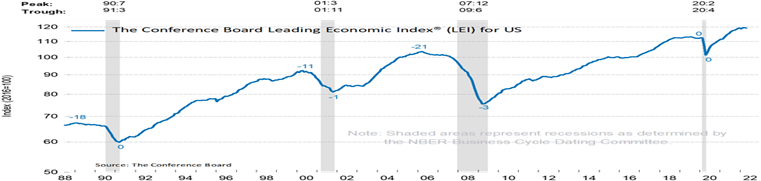
And the Conference Board Index of Leading Economic Indicators (LEI), made up of 10 economic indicators such as interest rate trends, building permits and manufacturing new orders that purports to predict growth six months ahead, rose 0.8 percent, also a very large number.

“The U.S. LEI ended 2021 on a rising trajectory, suggesting the economy will continue to expand well into the spring,” said Ataman Ozyildirim, Senior Director of Economic Research at The Conference Board. “For the first quarter, headwinds from the Omicron variant, labor shortages, and inflationary pressures—as well as the Federal Reserve’s expected interest rate hikes—may moderate economic growth.”

Where is that moderation most expected? Nobel Laureate Paul Krugman has pointed out several times that red states have lower vaccination rates than in the blue states, and Omicron infection rates are highest among the unvaccinated. It’s Republicans wanting to oppose anything the Biden administration is doing. And in doing so, it will cost more lives and slower job growth among their own constituents.

However, the need to vanquish COVID-19; or at least tame it so that it acts more like a seasonal flu; has united enough Americans to put money where it will do the most good—into infrastructure and family pocketbooks, rather than speculators’ pockets, as was happening before the pandemic.

That said, the $trillions in pandemic aid should mitigate concerns that higher inflation, or the Omicron variant will do much harm to consumers and economic growth in most states. The current inflation numbers are a sign of robust growth, so let’s get everyone vaccinated and the supply chains unclogged.

Harlan Green © 2021

Follow Harlan Green on Twitter: https://twitter.com/HarlanGreen
Posted in Consumers, COVID-19, Economy, Housing, Weekly Financial News | Leave a comment