
Retail Sales Stay Strong

Financial FAQs

FREDretailsales

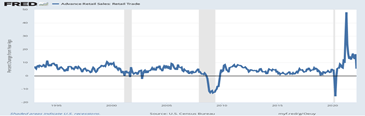
Sales at U.S. retailers such as Target and Amazon sank 1.9 percent in December — the biggest drop in 10 months — as the Omicron variant spread like wildfire and shoppers confronted higher prices and shortages of some popular products.

Yet they were up 14.4 percent YoY in December, seasonally adjusted, as shown in the FRED graph. Retail sales are still booming, so what should we worry about in 2022?

There are two reasons to worry: the Omicron variant and rising inflation (hence interest rates). Inflation as measured by the retail CPI index has risen 7.1 percent in December YoY, its highest rate in 40 years.

But they are really connected, and curing the Omicron variant will also cure the inflation problem.

CovidTracker

And as of January 12, 2022, the current 7-day moving average of daily new COVID cases (782,766) increased 33.2% compared with the previous 7-day moving average (587,723). A total of 63,397,935 COVID-19 cases have been reported in the United States as of January 12, 2022, so Omicron infection rates have yet to come down.

The high inflation rate is causing the Fed to begin to tighten credit with the first of its predicted interest rate hikes in March. But not everyone is in agreement with that move.

Chinese President Xi Jinping, of all people, asked Fed Chair Jerome Powell at the Davos Switzerland virtual economic summit to please not lift interest rates just yet!

“If major economies slam on the brakes or take a U-turn in their monetary policies, there would be serious negative spillovers. They would present challenges to global economic and financial stability, and developing countries would bear the brunt of it,” said Xi, according to a transcript of his remarks on Monday.

(China is gearing up for the Winter Olympics and doesn’t want our Federal Reserve rocking the economic boat right now.)

I don’t believe inflation will be as much of a problem this year because experts expect Omicron variant infections to quickly subside by mid-year, so-much-so that it will become more flu-like in its effects and be treated like an annual problem.

Inflation won’t be the problem it was in the 1970s, since it came on so suddenly due to the pandemic that caused the shortage of goods, rather than from a decade-long wage-price spiral.

The Omicron variant is the culprit keeping people from returning to work, and countries from untangling their supply chains.

So no, this isn’t the time to worry about inflation, which is a sign of robust economic growth and consumers with lots of savings from the pandemic aid packages.

Harlan Green © 2022

Follow Harlan Green on Twitter: https://twitter.com/HarlanGreen
Posted in Consumers, COVID-19, Economy, Weekly Financial News | Leave a comment

A Softer Landing for Inflation?

Popular Economics Weekly

FREDcpi

Will inflation keep rising, squeezing consumers, or return to a more normal range this year? The Consumer Price Index (CPI) that measures retail goods rose to 7.1 percent in December and has forced the Fed to promise to raise interest rates several times to ‘tame’ a rising inflation rate that seems to worry the pundits and bankers more than most consumers.

That’s because once the Fed starts taking money out of circulation by selling the $4 trillion plus in securities it’s holding, the money supply should shrink and thus take away the punch bowl of easy money that has prevailed during the pandemic and pushed the financial markets to record highs.

So, the debate du jour is can the Fed take away the punchbowl without sinking the economy into another recession? There’s a lot of money in circulation, thanks to all the pandemic aid, but what happens when it’s withdrawn? The hope is for what is called a ‘soft landing’, a slowing of economic activity that doesn’t morph into an economic slump.

It would be nice if inflation could tame itself without too much government intervention. Inflation could moderate this year because consumers annually cut back on spending after the holidays to pay down their credit cards and save for the income tax season.

But even so, the Fed must act to look like it’s on the ball by making noises that it’s ready to raise the price of borrowed money by acting preemptively. That is supposed to lower inflation expectations and thus dis-incentivize consumers and businesses from rushing to buy before the next price rise.

Do such expectations of future inflation really affect consumers’ behavior? That’s still an open question among economists.

And the answer is much more complicated today because this inflation is caused by a serious shortage—of goods, services, and employees to manufacture and distribute them.

So all of this is in turn dependent on the course of the ongoing COVID pandemic that is keeping workers away from work, and causing the supply chain bottlenecks.

As a side note, a recent study by two UC Davis Labor economists in Econofact.org — Labor Shortages and the Immigration Shortfall, posits that part of the labor shortage is due to a shortfall in immigrants over the past two years—some 2 million working age adults—due to restrictions placed on immigration from the pandemic.

And approximately 1 million are college-educated, which could impact productivity and employment over the longer term.

They cite other causes for the labor shortage, such as increased retirement and increased bargaining power of workers as playing an important role.

The authors also contend, “While more generous unemployment and welfare benefits introduced during the crisis may have discouraged workers from taking low-paying jobs in 2020 and early 2021, they do not seem to be the cause of current shortages, since most of those benefits expired by mid-2021. Recent anecdotal and preliminary evidence finds a push by workers for more job-flexibility, safety and, generally, better conditions causing resignations and contributing to unfilled job openings.”

So the labor shortage could last for years, unless Washington and Congress get their immigration act together. Immigration has historically been a major source of U.S. population and job growth.

In fact, we shouldn’t forget that we are a nation of immigrants that has always been dependent on immigrants, and the effect of the immigration shortfall is much more worrisome than inflation because studies show they bring a high level of skills that are good for economic growth.

So even speeding up approval of a backlog of 460,000 entry visas cited by the State Department as still unprocessed could make this a softer landing.

Harlan Green © 2022

Follow Harlan Green on Twitter: https://twitter.com/HarlanGreen

Posted in Consumers, COVID-19, Economy, Politics, Weekly Financial News | Leave a comment

We Are So Close to Full Employment

Popular Economics Weekly

MarketWatch

It is uncanny that just 199,000 nonfarm payroll jobs were created in one Labor Department establishment survey, while a separate and smaller household survey showed that 651,000 people found jobs in December after a 1.1 million gain in November.

This kind of variability is typical when the U.S. economy is nearing full employment. That and the soaring inflation rate (6.8 percent of late) show that the demand for goods and services is far outstripping supply at the moment.

The unemployment rate dropped to 3.9 percent from 4.2 percent—just above the fully employed 3.6 percent level before COVID-19 shut down the economy. So, the American economy is close to full employment even with the Omicron variant still scaring workers from returning to work.

The other question is when will producers catch up to soaring demand because the U.S. economy is showing a classic case of overheating at the moment.

Calculated Risk

The above Calculated Risk graph shows how quickly we have closed in on full employment—much faster than the 2001 and 2007 recessions (blue and brown lines in graph), for instance.

Supply will have a chance to catch up to demand and tame inflation when the Omicron variant is tamed.

The U.S. economy regained 6.5 million jobs in 2021, but employment is still short of the pre-pandemic peak by almost 4 million jobs. The U.S. employed 152.5 million people just before the pandemic erupted. Total employment rose to 148.9 million at the end of last year

Average hourly pay has risen 4.7 percent in 2021, which tells us that companies will pay whatever it takes to hire more workers.

Where are they hiring? Leisure and hospitality added 53,000 jobs, which means more people are eating out and traveling over the holidays. Professional businesses hired 43,000 people, manufacturers added 26,000 jobs, construction employment rose by 22,000 and transportation and warehouse firms beefed up payrolls by 19,000.

It’s good news that Americans are continuing to return to work and the economy is nearing full capacity. Let that picture sink in before the Fed begins to raise interest rates, which would slow more job growth.

So, we should begin to enjoy the fact that this economic recovery has just begun, rather than worry about its growing pains.

Harlan Green © 2022

Follow Harlan Green on Twitter: https://twitter.com/HarlanGreen
Posted in Consumers, COVID-19, Economy, Weekly Financial News | Leave a comment

Are Home Prices Moderating?

The Mortgage Corner

There are small signs of a slowdown in the rise of housing prices. Core Logic, a real estate data provider, sees some moderation in this New Year.

“As we close 2021, housing market indicators, including S&P CoreLogic Case-Shiller Index, suggest that the housing market will have another strong year in 2022. While the expected slowing of home price growth suggests overall annual appreciation in 2022 will fall shorter than that of 2021, the annual average of 7% is still higher than the average 5% seen between 2010 and 2020.”

CensusBureau-CalculatedRisk

Housing’s annual price appreciation is slowing in part because new construction is making up some of the housing shortage.

Calculated Risk reports that on a year-over-year basis, private residential construction spending is up 16.3% (red line in graph). Non-residential spending is up 6.7% year-over-year. Public spending is down 0.8% year-over-year.

This is resulting in single‐family housing starts in November to jump 11.3 percent above the revised October figure of 1,054,000.

But inventories are still at rock bottom, with unsold inventory at a 2.1-month supply in November, the lowest since January. That’s even lower than 2.3 months in the same month last year, and a 4-to-6-month supply of homes for sale during more normal times.

That is making NAR chief economist Lawrence Yun cautious about affordability in the New Year:

“Buyer competition alone is unrelenting, but home seekers have also had to contend with the negative impacts of supply chain disruptions and labor shortages this year,” he said. “These aspects, along with the exorbitant prices and a lack of available homes, have created a much tougher buying season.”

How long could it take for the supply of homes available to purchase catch up the demand? It depends on when more working age adults return to the workforce and suppply chains become unchained.

The labor shortages may improve this New Year. As a predictor of Friday’s unemployment report private payrolls rose by 807,000 in December, according to the ADP National Employment Report released Wednesday. That’s the strongest gain since May.

Service sector providers added 669,000 jobs in December. Leisure and hospitality added 246,000 workers. Meanwhile, goods producers added 138,000 jobs, the strongest gain of the year. Manufacturing added 74,000 jobs.

This could begin to improve the housing supply.

Then we must wait for the supply-chains to recover as countries ramp up production and the various trade tariffs reduced that have driven up the cost of building materials, with lumber prices still higher than in pre-pandemic times.

Harlan Green © 2021

Follow Harlan Green on Twitter: https://twitter.com/HarlanGreen
Posted in Consumers, COVID-19, Economy, Housing, housing market, Weekly Financial News | Leave a comment

Hires Increase in November JOLTS Report

Financial FAQs

Calculated Risk

The Bureau of Labor Statistics reported that job openings decreased in November to 10.6 million from 11.1 million in October (yellow line in above graph).

It’s a sign that more workers are returning to work. So huge is the U.S. job market that hiring rose by 191,000 jobs to 6.7 million in November. The hiring rate rose to 4.5 percent from 4.4 percent in the prior month.

The BLS said:

“On the last business day of November, the number and rate of job openings decreased to 10.6 million (-529,000) and 6.6 percent, respectively. Job openings decreased in several industries with the largest decreases in accommodation and food services (-261,000); construction (-110,000); and nondurable goods manufacturing (-66,000). Job openings increased in finance and insurance (+83,000) and in federal government (+25,000). The number of job openings decreased in the South and Midwest.”

This suggests that hiring in both the service and manufacturing sectors is picking up, a good sign for continuing job growth in 2022.

The number of job openings (yellow) were up 56 percent year-over-year. Quits were up 37 percent, year-over-year. The JOLTS report showed that people quitting their jobs rose by 370,000 to 4.5 million in November.  The quits rate rose to 3 percent from 2.8 percent in October, matching the highest quits rate of the pandemic era.

The U.S. unemployment reports comes out this Friday and will give a better picture of the New Year, but the JOLTS report gives a preliminary indication, though it lags almost one month behind the unemployment report.

Another indicator of future job prospects is the decline in weekly initial jobless claims for unemployment as unemployment benefits expire.

FREDinitialclaims

Weekly claims are down from their high of 6 million during the pandemic to 198,000 in the latest week. Salaried employees can’t wait much longer to return in greater numbers in the New Year after spending the excess savings accumulated during the pandemic.

Nobel laureate Paul Krugman has the last word this week in a recent NY Times column, in comparing the swiftness of this jobs recovery to President Reagan’s 1982 recovery which Reagan called “morning in America” that boosted his 1984 reelection.

“Yes, by this measure (and many others) we’re in the middle of another morning in America, despite the drag caused by a lingering pandemic and supply-chain disruptions,” said Professor Krugman.

With this kind of a jobs recovery, what should economic growth look like going forward?

The Atlanta Federal Reserve’s GDPNow model estimate for real GDP growth (seasonally adjusted annual rate) in the fourth quarter of 2021 is 7.4 percent on January 4, down from 7.6 percent on December 23, says their press release.

So overall, 2021 real GDP growth could be upwards of 5 percent. The last time it reached this height was in the 1980s. And since this is the beginning of another year, we can call it the morning of a successful 2022 New Year.

Harlan Green © 2022

Follow Harlan Green on Twitter: https://twitter.com/HarlanGreen

Posted in Consumers, COVID-19, Economy, Weekly Financial News | Leave a comment

Here’s To a Lasting Housing Recovery!

The Mortgage Corner

Since it is the holidays, I want to propose a New Year’s toast to a lasting housing recovery.

Firstly, home builders are beginning to play catchup with the housing shortage that has plagued those wanting a place to live since the end of the Great Recession and busted housing bubble. That’s when construction ground to a halt because one million more homes were built than were needed at the time.

Does this mean the housing market could begin a decade-long recovery as has happened in the past? It’s possible. Consumers are flush with cash from the pandemic aid and the personal savings rate is still at a post-recession high (6.9 percent).

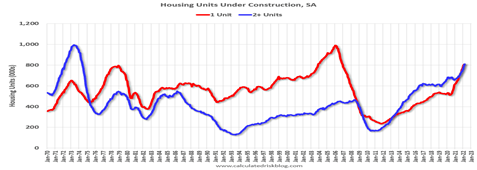
More than 1,800,000 housing units per year were constructed during the height of the housing bubble in 2006 (see below graph), which fell to just 400,000 units annually during the Great Recession in 2008 (gray bar), which is part of the reason for the current housing shortage.

The last two recoveries lasted approximately 10 years. So why not toast the possibility that this may be a housing recovery that might last, if the other roadblocks to a housing recovery, labor material shortages should ease next year?

CalculatedRisk

Construction is booming, which should begin to fill the very low inventory of homes for sale, despite the labor and material shortages.

“Single‐family housing starts in November were at a rate of 1,173,000; this is 11.3 percent above the revised October figure of 1,054,000. The November rate for units in buildings with five units or more was 491,000,” according to the Census Bureau.

Calculated Risk

Rising existing-home sales are also helping to fill the housing void. Existing-home sales rose 1.9 percent to a seasonally adjusted annual rate of 6.46 million in November, the National Association of Realtors said Wednesday. That is the third straight monthly gain. And there is room to grow more sales.

More than 7 million existing homes were sold in 2005 at the height of the housing bubble, per the above existing-home sales graph but sales declined to 4 million in 2008 during the Great Recession (gray bar in graph).

Unsold existing inventory is at a 2.1-month supply in November, the lowest since January. That’s down from 2.3 in the same month last year, and a 4-6 month supply of homes for sale during more normal times.

“Supply-chain disruptions for building new homes and labor shortages have hindered bringing more inventory to the market,” said NAR chief economist Lawrence Yun. “Therefore, housing prices continue to march higher due to the near record-low supply levels.”

There’s better economic news as well that may help to cure the housing crunch. Third quarter GDP growth was revised up slightly to 2.3 percent, and Q4 growth is projected to be even higher.

Consumer confidence is also on the rise again with the holidays. The index of consumer confidence rose to 115.8 in December from a revised 111.9 in the prior month, The Conference Board said Wednesday.

Lynn Franco, Senior Director of Economic Indicators at The Conference Board said, “The Present Situation Index dipped slightly but remains very high, suggesting the economy has maintained its momentum in the final month of 2021. Expectations about short-term growth prospects improved, setting the stage for continued growth in early 2022. The proportion of consumers planning to purchase homes, automobiles, major appliances, and vacations over the next six months all increased.”

So this is a good time to raise a toast to a continued housing recovery—and a Happier New Year!

Harlan Green © 2021

Follow Harlan Green on Twitter: https://twitter.com/HarlanGreen
Posted in Consumers, COVID-19, Housing, housing market, Weekly Financial News | Leave a comment

This Inflation Can’t Last

FREDcpi

Why the feverish speculation that higher inflation could last beyond next year, and dampen economic growth, when the American economy should otherwise return to a semblance of normalcy? The COVID-induced recession of 2020 lasted just two months and caused one of the deepest economic contractions in history.

The recovery is also one of the fastest in history, so it is causing a temporary climb in inflation. Firstly, consumers and businesses are flush with cash for the holidays. Why wouldn’t they want to spend it now, regardless of the rising prices sure to follow? Expectations are usually high during the holidays.

In May 2020 the CPI, seasonally adjusted inflation rate for consumers was a mere 00.22 percent and in November 2021 had risen to 6.9 percent, seasonally adjusted. But there is usually a New Year drop off in spending because consumers want to pay down their credit bills and save for the April tax season. So prices should also subside substantially, as most retail businesses know after the holiday shopping splurge.

There are a few caveats to this forecast, however. The Biden administration is not helping to lower inflation by reducing the Trump trade tariffs. Raising tariffs made more sense when the economy was booming before the pandemic, and we wanted to repatriate U.S. businesses to our homeland to boost American jobs.

But if the supply-chain slowdown is to be improved, smart economic policy says that tariffs should be lowered to increase the flow of international trade, and ease the supply bottlenecks.

Also, Biden’s ‘Buy America”, and “Made in the USA” emphasis will certainly keep prices from falling faster with products made in the USA, as it’s more expensive to produce things in America, vs. overseas.

But is that a reason for markets to panic, so that the Federal Reserve may overreact by raising interest rates too soon next year? I don’t think so.

Economists such as Larry Summers worry about what is called “stagflation”, a holdover from the 1970s fast rising prices for oil and other commodities that caused unions to follow suit and the Federal Reserve to maintain policies (such as keeping interest rates low) that tolerated higher wages and salaries.

That’s not the case anymore, mainly because unions are much weaker so that wage and salary increases have been kept down, which is a large part of any inflationary spiral.

So the other causes of higher inflation—supply-chain bottlenecks and a shortage of workers—could still be problems.

Nobel Laureate Paul Krugman cites Biden’s Council of Economic Advisors in a recent NY Times Op-ed who believe that this bout of higher inflation most resembles that of 1946-48, when the American economy hadn’t yet geared up to meet soaring consumer demand when also flush with cash from WWII savings.

But there won’t be such a wholesale conversion from a wartime to a peacetime economy in the pandemic recovery. In fact, we will be fast forwarding to an enhanced digital economy with much more reliance on 5G networks and Artificial Intelligence, and less dependence on workers to produce things.

As if to presage such a future the Conference Board’s latest Index of Leading Economic Indicators predicts good growth ahead, with or without the availability of more workers.

“The Conference Board Leading Economic Index® (LEI) for the U.S. increased by 1.1 percent in November to 119.9 (2016 = 100), following a 0.9 percent increase in October and a 0.3 percent increase in September,” stated its latest press release.

“The U.S. LEI rose sharply again in November, suggesting the current economic expansion will continue into the first half of 2022,” said Ataman Ozyildirim, Senior Director of Economic Research at The Conference Board. “Inflation and continuing supply chain disruptions, as well as a resurgence of COVID-19, pose risks to GDP growth in 2022. Still, the economic impact of these risks may be contained. The Conference Board forecasts real GDP growth to strengthen in Q4 2021 to about 6.5 percent (annualized rate), before moderating to a still healthy rate of 2.2 percent in Q1 2022.”

This prediction of a huge jump in future growth is based on 12 hard data indicators such as stock prices, interest rate spreads, and consumer credit flows, which lends more credence to its prediction of future trends—and to the fact that supply-chain disruptions and future employment trends may not be major factors affecting inflation next year.

So worrying about some kind of long-lasting inflationary spiral doesn’t make sense to me

Harlan Green © 2021

Follow Harlan Green on Twitter: https://twitter.com/HarlanGreen

Posted in Consumers, COVID-19, Economy, Weekly Financial News | Leave a comment

Are Interest Rates Too Low?

The Mortgage Corner

Should home buyers worry about the record-low interest rates in the near or distant future?

Because interest rates are at post-World War II lows, the super cheap money is helping to drive up annual home price rates into double digits, resulting in a loss of affordability for many prospective homebuyers and even renters.

And the Federal Reserve is reluctant to raise interest rates, fearing it will collapse the recovery with COVID variants not yet vanquished.

FRED30yrmortgage

The 30-year conforming fixed mortgage rate favored by most home buyers has been declining since the early 1980s, and has hovered around 3 percent since the start of the pandemic, per the above Federal Reserve Bank of St. Louis (FRED) graph.

It is a major reason the S&P CoreLogic Case-Shiller U.S. National Home Price NSA Index of single-family, same home, price changes reported a 19.5 percent annual gain in September 2021, though slightly down from 19.8 percent in August. The S&P Index is a 3-month average for 20 metropolitan areas, so in some cities home prices are rising even faster.

“It’s unprecedented for us to get a massive run-up in home prices during a recession,” says Freddie Mac’s chief economist, Sam Khater. “It’s clear that [mortgage] rates matter even more than unemployment rates.”

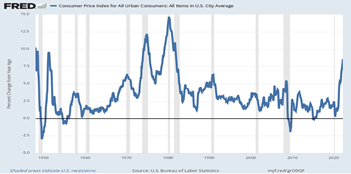
Another reason for the price run-up is that inflation is soaring as well. The retail Consumer Price Index, seen below in the 2nd FRED graph, is up 6.8 percent in November Y-o-Y when it has averaged just 2 percent since the Great Recession.

FREDcpi

And if said inflation remains much higher than interest rates (3 percent vs. 6.8 percent inflation), it means in effect negative interest rates since higher inflation reduces the value of the loan principal over time. And that pours gas on the exploding home prices.

This is not an easy concept to understand, but it happened during the housing bubble when housing prices were also rising in the double digits annually.

Soaring inflation is the other problem, and that probably won’t decline until the labor and supply-chain shortages subside sometime next year.

So should home buyers wait for this housing price bubble to subside to buy a home? The National Association of Realtors hasn’t much helping advice.

“Home sales remain resilient, despite low inventory and increasing affordability challenges,” said Lawrence Yun, NAR’s chief economist. “Inflationary pressures, such as fast-rising rents and increasing consumer prices, may have some prospective buyers seeking the protection of a fixed, consistent mortgage payment.”

Is there any good news? The Federal Reserve released the Q3 2021 Flow of Funds report on Thursday: Financial Accounts of the United States. It stated that American households’ net worth is at a record high as a percentage of GDP (more than 600 percent of GDP), increasing $2.3 trillion in Q3, thanks to government spending for the COVID pandemic that is approaching $5 trillion to date with more to come when the Build Back Better Act finally passes.

MarketWatch’s Steve Goldstein cites James Knightley, chief international economist at ING, who put a positive spin on the latest report. From the low point of the first quarter of 2020, household wealth has surged by $35.5 trillion. Combine this wealth rise with employment growth, and wage gains, and the U.S. consumer looks to be in good shape.

The “further massive accumulation of wealth only adds to the potential spending ammunition of the household sector, which gives us more confidence that the U.S. economy can expand by more than 4% in 2022,” says Knightley.

But there’s still a housing shortage that some economists predict could last 10 years. So this has happened before, and only a concerted effort of governments and builders will lessen the housing crunch we are currently experiencing.

Harlan Green © 2021

Follow Harlan Green on Twitter: https://twitter.com/HarlanGreen
Posted in Consumers, COVID-19, Economy, Housing, housing market, Weekly Financial News | Leave a comment

Has COVID-19 Made US Richer?

Financial FAQs

FREDdisposalbleincome

More Americans are richer, thanks to the COVID-19 pandemic, believe it nor not. The pandemic has spurred congress and the Biden administration to act as if we are coming out of another Great Depression.

The U.S. is growing faster than other developed countries that haven’t invested as much in the recovery. And those investments are going to Americans that need it the most.

Just since the American Rescue Plan passed in March 2020, 4.3 million more people have found employment. Wages and real disposable income are up, especially for low-wage workers, who are disproportionately women and people of color and who have experienced consistent wage growth since April 2021, say Rose Khattar and Andres Vinelli of the Center For American Progress, a progressive think tank.

It’s the New Deal all over again, but instead of the 1930s and a looming World War Two, congress and the Biden administration have acted to save the U.S. economy from the worst pandemic since the Spanish flu pandemic of 1918.

FREDgdp

“The U.S. is the only leading advanced economy to have exceeded its pre-pandemic levels, according to the Organization for Economic Co-Operation and Development,” say Khattar and Vinelli. “In fact, data from the most recent quarter shows that our real GDP—which is GDP adjusted for inflation—is around 13% larger than the end of the COVID-19 recession.”

It is largely due to Biden’s American Rescue Plan of last March that especially raised the lowest income brackets. Economist Gene Sperling, its White House Coordinator, says such growth not only helps lower-income folk, but children most of all with the child tax credit that alone has halved the child poverty rate.

And don’t forget the $1400 payments sent out to most Americans at a time when the pandemic lockdowns were in full force.

More evidence of the record post-pandemic growth is that service-oriented businesses making up two-thirds of economic activity—such as banks, retailers and drug stores—grew in November at the fastest pace on record, even as companies grappled with major shortages of labor and supplies.

The Institute for Supply Management’s services PMI climbed to 69.1 percent last month from 66.7 percent in October, when 50 percent is break-even growth, marking the biggest increase on record.

In a rarity, all 18 of the service sectors tracked by ISM said they grew in November. The biggest problem is supplying all the services that customers want. Companies can’t find enough people to fill a near-record number of open jobs. They’ve also struggled to obtain badly needed supplies.

“It goes back to the pent-up demand,” said Anthony Nieves, Chair of the Institute for Supply Management® Services Business Survey Committee. “You can look at other tangible things such as mall traffic and online distribution increasing, which are contributing factors to business activity being up. Many people are going back to work, and consumer confidence is up.”

And if the newest Omicron variant proves less deadly, as initial test results are showing, then there’s nothing to hold back consumers and businesses from building America back better than ever.

Harlan Green © 2021

Follow Harlan Green on Twitter: https://twitter.com/HarlanGreen
Posted in Consumers, COVID-19, Economy, Keynesian economics, Weekly Financial News | Leave a comment

Are We Nearing Full Employment?

Popular Economics Weekly

Calculated Risk

Are we nearing full employment, at least among of those that want to return to work? That may be a strange question to ask when the just-arrived Omicron COVID variant is creating more uncertainty about future US job growth.

But the latest unemployment surveys out today showed that the unemployment rate dropped to 4.2 percent from 4.6 percent, and 537,000 more workers joined the labor force.

I like the Calculated Risk graph above that portrays where we are in the job recovery from 2020 peak employment (red line). We are fast approaching what was full employment then, as opposed to the slow job recovery from the 2007 Great Recession (blue line).

However, just 210,000 new payroll jobs were added to payrolls in the separate Establishment survey, which is seasonally adjusted, and means 210,000 more jobs were created above what is normal for this time of year.

“Total nonfarm payroll employment rose by 210,000 in November, and the unemployment rate fell by 0.4 percentage point to 4.2 percent, the U.S. Bureau of Labor Statistics reported today. Notable job gains occurred in professional and business services, transportation and warehousing, construction, and manufacturing. Employment in retail trade declined over the month.”

But the change in total nonfarm payroll employment for September was revised up by 67,000, from +312,000 to +379,000, and the change for October was revised up by 15,000, from +531,000 to +546,000, so employment in September and October combined is 82,000 higher than previously reported.

We are nearing full employment because most of the job increase was in leisure and hospitality, which had lagged job creation in the durable goods sector earlier in the recovery.

The leisure and hospitality sector gained 23,000 jobs in November. In March and April of 2020, leisure and hospitality lost 8.22 million jobs, and are now down 1.33 million jobs since February 2020. It has now added back about 84 percent of the jobs lost in March and April 2020, says BLS.

MarketWatch

Construction employment increased 31,000, and manufacturing also added 31,000 jobs. State and Local education lost 16,000 jobs, seasonally adjusted, which was a major reason fewer Establishment survey jobs were created.

Nonfarm employment has increased by 18.5 million since April 2020 but is down by 3.9 million, or 2.6 percent, from its pre-pandemic level in February 2020.

So which of the two Labor Department’s surveys—the Establishment vs. the Household surveys—is the most accurate picture of U.S. employment? The Household survey also showed a much larger 1.14 million people found work in November, though it is a smaller survey than the Establishment survey and isn’t seasonally adjusted.

The Labor Department also reported that In November, 3.6 million persons had been unable to work because their employer closed or lost business due to the pandemic–that is, they did not work at all or worked fewer hours at some point in the four weeks preceding the survey due to the pandemic.

So COVID-19 is still putting a big dent in the employment picture, and we must now wait to see what happens this winter with any new variants, to see if the COVID-19 pandemic is tamed and we are able to return to full employment.

Harlan Green © 2021

Follow Harlan Green on Twitter: https://twitter.com/HarlanGreen
Posted in Consumers, COVID-19, Economy, Weekly Financial News | Leave a comment