Manufacturing, Service Sector Growth Prolong Recovery

Financial FAQs

FREDmanufacturing

U.S. manufacturing and service sector activity continued to climb, despite the price hikes and supply bottlenecks. And we are just at the beginning of the holiday shopping season. Both economic sectors per the ISM supply managers’ indexes show a continuing red-hot demand for goods and services.

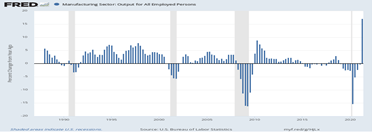
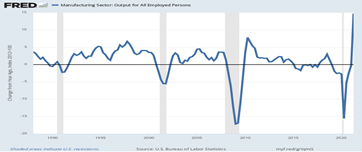
Inflation worriers can worry less, as production speeds up. Manufacturing output alone increased 14.8 percent in the second quarter YoY (see FRED graph), reducing price pressures. Eventually resolving the supply-chain issues of clogged ports and container shipments will cause supplies to catch up to the demand for goods.

Timothy R. Fiore, ISM Manufacturing Chair, said “Business Survey Committee panelists reported that their companies and suppliers continue to deal with an unprecedented number of hurdles to meet increasing demand. All segments of the manufacturing economy are impacted by record-long raw materials lead times, continued shortages of critical materials, rising commodities prices and difficulties in transporting products. Global pandemic-related issues — worker absenteeism, short-term shutdowns due to parts shortages, difficulties in filling open positions and overseas supply chain problems — continue to limit manufacturing growth potential.”

The ISM services index measuring economic activity in industries such as Retail Trade; Transportation & Warehousing; Real Estate, Rental & Leasing; Arts, Entertainment & Recreation; jumped to an all-time high of nearly 67 in October, the Institute for Supply Management said Wednesday. The Business Activity and New Orders indexes reached 69.8 percent.

“In October, strong growth continued for the services sector, which has expanded for all but two of the last 141 months,” said ISM chair Anthony Nieves in a statement. “However, ongoing challenges — including supply chain disruptions and shortages of labor and materials — are constraining capacity and impacting overall business conditions.”

Though the huge obstacles to supply are causing some uncertainty, any figure above the 50 percent ISM survey breakeven point shows expansion. This is a sign that businesses are just beginning the replacement cycle of plants and equipment, rather than any imminent slowdown of activity caused by the bottlenecks and labor shortages.

As a side note, the number of Americans who applied for unemployment benefits in late October fell to yet another pandemic low in the latest week, reflecting an urgent need by companies to hold onto to current employees and find new ones. New jobless benefit claims dropped by 14,000 to 269,000 in the seven days ended Oct. 30, the government said Thursday.

Some five million have not returned to work that were employed before the pandemic and there are 10 million job openings, so it’s not yet possible to know when and if the current labor shortage will continue to put a drag on growth.

But, in a way, this might cool demand enough that economic growth doesn’t overheat and bring on another asset bubble, and maybe tame the inflation tiger as well.

Harlan Green © 2021

Follow Harlan Green on Twitter: https://twitter.com/HarlanGreen
Posted in Consumers, COVID-19, Economy, Macro Economics, Weekly Financial News | Leave a comment

Home Prices Keep Rising

The Mortgage Corner

Calculated Risk

I said last month the housing market was cooling with the fall weather, but maybe not yet. Because housing prices are still rising in double digits, although they may be leveling off.

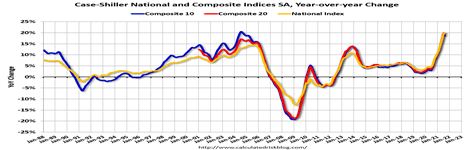
The S&P CoreLogic Case-Shiller U.S. National Home Price NSA Index of single-family price changes, covering all nine U.S. census divisions, reported a 19.8 percent annual gain in August, remaining the same as the previous month. It’s a 3-month average for 20 metropolitan areas of same-home prices, so in some cities’ prices are rising even faster.

Phoenix led the way with a 33.3 percent year-over-year price increase, followed by San Diego with a 26.2 percent increase and Tampa with a 25.9 percent increase. Eight of the 20 cities reported higher price increases in the year ending August 2021 versus the year ending July 2021.

How about that for some irrational exuberance in the housing market? Are we seeing a repeat of the housing bubble, when prices rose double-digits in the early 2000s and again in 2014 (see above graph)?

I don’t think so. While Fed Chair Greenspan was pushing interest rates close to zero then to finance GW’s wars on terror, credit conditions today are much tighter and lenders no longer offer so-called liar loans that hid the real interest rate.

It’s not good news for those having difficulty in finding affordable housing, given the low for-sale inventory. But interest rates still remain at record lows, with 30-year conforming and super-conforming fixed rates around 3.0 percent.

Will housing prices eventually stabilize? Only when enough residences are built to satisfy the pent-up demand that came from a steep drop in new housing construction since the end of the Great Recession.

The Commerce Department said sales of new single-family homes surged 14.0 percent to a seasonally adjusted annual rate of 800,000 units in September, so there’s some hope for increasing supply. But sales were as high as 1,400,000 per year during the height of the housing bubble.

Unfortunately, Calculated Risk reports that just 36,000 new homes were available for sale in September, while106,000 new homes have yet to be completed. That leaves a 0.5- month inventory, close to a record low, when 3 to 4 months was the norm.

Calculated Risk

Existing-home sales also rebounded in September after seeing sales wane the previous month, according to the National Association of Realtors®. Each of the four major U.S. regions witnessed increases on a month-over-month basis.

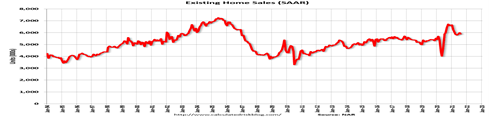
The NAR reported total existing-home sales,1 https://www.nar.realtor/existing-home-sales, completed transactions that include single-family homes, townhomes, condominiums and co-ops, rose 7.0 percent from August to a seasonally adjusted annual rate of 6.29 million in September. However, sales decreased 2.3 percent from a year ago (6.44 million in September 2020).

“Some improvement in supply during prior months helped nudge up sales in September,” said Lawrence Yun, NAR’s chief economist. “Housing demand remains strong as buyers likely want to secure a home before mortgage rates increase even further next year.”

“The housing sector is clearly settling down,” said Yun, who described the surge of home buying in late 2020 and early 2021 as an anomaly.

Home sales last peaked in 2020 at the beginning of the pandemic, but inventories are now at historic lows. Housing prices began their current steep climb at the same time. Unless builders and governments find ways to build more affordable housing, the housing shortage could continue for years and leave a whole generation wanting a home.

Harlan Green © 2021

Follow Harlan Green on Twitter: https://twitter.com/HarlanGreen

Posted in Uncategorized | Tagged , | Leave a comment

No Real Slowdown in US Recovery

Popular Economics Weekly

FRED

The latest survey of US businesses shows little diminishing of economic activity in the near future. A survey of senior business executives in service-oriented companies, such as retailers and banks, rebounded to a three-month high of 58.2 from 54.9 in September, IHS Markit said Friday.

A similar survey of manufacturing activity slipped to 59.2 from 60.7, but it was still quite high. Any reading over 50 signals growth and numbers are above 55 are exceptional.

So now pundits and some economists worry about overheating and a prolonged inflation cycle that might short circuit long term growth prospects. But consumers are sensing the danger and acting rationally without the need for the Federal Reserve to raise interest rates prematurely; at least according to recent sentiment surveys.

“U.S. private sector businesses recorded a sharp and accelerated upturn in output led by the service sector during October, with growth the strongest for three months, albeit still much weaker than seen earlier in the year,” said IHS Markit’s press release.

GDP grew,+16.75 percent year-over-year in the second quarter 2021. It had declined -8 percent in Q2 2020 from its pre-pandemic high such was the impact of the pandemic lockdowns.

We have seen nothing like this GDP recovery since 1980; the recovery from the decade of the Arab Oil Embargo; or the 1950s recovery from World War Two, as shown in the above graph.

What does such growth mean for American consumers and businesses? Firstly, it means rising wages and benefits for employees. There are currently two million more job vacancies than workers looking for work because the demand for goods and service has grown so quickly since last summer and the decline in infection rates.

Secondly, it should mean a continued high level of growth for several years as businesses ramp up capital expenditures for a rebuild of the American economy transformed by the pandemic.

Am I being rash in predicting such growth? I don’t think so, since all US economic sectors are not only playing catch up because of the pandemic, but they see good prospects for years to come.

The worry about ongoing labor shortages and supply bottlenecks is actually helping to cool down the red-hot demand that is causing the current inflation surge, thus tempering price increases that would put a brake on sustained growth.

Conference Board

Hence the recent decline in consumer confidence.

“Consumer confidence dropped in September as the spread of the Delta variant continued to dampen optimism,” said Lynn Franco, Senior Director of Economic Indicators at The Conference Board. “Concerns about the state of the economy and short-term growth prospects deepened, while spending intentions for homes, autos, and major appliances all retreated again.”

This is while actual retail sales are up a huge 12 percent in a year, and home prices are rising in double digits annually. It might be a good thing if consumers retreat slightly, as an antidote to the irrational exuberance that is currently infecting the financial and real estate markets.

Fed Chair Janet Yellen just reported that she sees inflation returning to a more normal level next year.

When asked by CNN’s Jake Tapper when inflation would fall back to around the 2 percent, longer-term target area, Yellen said: “Well, I expect that to happen next year …  On a 12-month basis, the inflation rate will remain high into next year because of what’s already happened. But I expect improvement … by the middle to end of next year, second half of next year.”

Consumers are in fact acting rationally if they pause and allow the markets to cool down. By preventing prolonged overheating (and possible asset bubbles forming), their actions will prolong this growth cycle.

Harlan Green © 2021

Follow Harlan Green on Twitter: https://twitter.com/HarlanGreen

Posted in Uncategorized | Tagged , , | Leave a comment

Retail Sales Confirm Holiday Rally

Financial FAQs

FRED

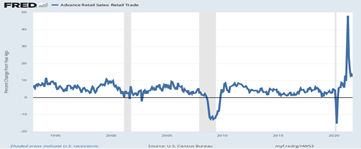
September retail sales and food services presage a holiday season worth celebrating, despite supply shortages, worker shortages, and the pandemic. Seasonally adjusted retail sales are up 12 percent over last September, which means that the demand for goods is at a historical high.

So the shortages are due to consumers and businesses buying more than ever, more than last year and all the years before, in spite of the supply shortages.

There’s little evidence of production shortages, per se, as much as a slowdown in getting to their destinations in ports such as Los Angeles and Long Beach, where more than half of all imports to the U.S. arrive.

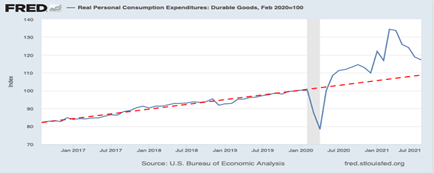
NY Times Paul Krugman put up a FRED graph that illustrates the huge surge in the demand for durable goods—goods like appliances and vehicles that last more than three years. It tells us that said demand can continue above the average dotted trend line into the year end holidays.

FRED

The demand for services such as leisure activities and travel is lagging because the pandemic has kept many consumers at home. But that will pick up as well once the Pandemic is subdued.

And what if the Infrastructure and Build Back Better bills pass would add additional $ trillions to programs that boost businesses and improve consumers’ lives? Then the boost in demand for goods and services could be prolonged for…years.

Should we worry about inflation because too much money is in circulation, driving up prices? Not if it’s put to productive uses, as I’ve been saying. Both physical and so-called social infrastructure spending go into increasing productivity, hence a greater supply of goods and services, not excessive speculation in the financial markets as have past tax cuts from which the wealthiest most benefited.

Studies have shown that parents in such states as California that have some of the social infrastructure proposals in President Biden’s Build Back Better Act, such as paid family leave and child care, allow them more family time and resources to raise their children, thus reducing the number of children trapped in a cycle of poverty.

And better physical infrastructure will help to cure the supply bottlenecks. “In the longer run, investments in infrastructure could help much more: U.S. ports, rail lines and so on are shabby compared with their counterparts in other countries and could be much improved.” says Krugman.

So we really need to grow what one political scientist has termed our social capital as much as physical infrastructure, if we want a sustainable recovery. It can be done by improving people’s lives.

Harlan Green © 2021

Follow Harlan Green on Twitter: https://twitter.com/HarlanGreen

Posted in Uncategorized | Tagged , | Leave a comment

JOLTS Report Shows Improved Jobs Market

Financial FAQs

Calculated Risk

Job openings are plentiful as ever in the Labor Department’s Job Openings and Labor Turnover Survey (JOLTS) report for September. It gives the best picture of job growth, better than last Friday’s punk unemployment report (with just 194,000 new nonfarm payroll jobs), because it reports actual numbers rather than seasonally adjusted figures reporting changes that deviate from a typical month.

There were 10.5 million job openings (yellow line) in September. Employers are begging for workers because they see a rising demand for goods and services.

There were actually 6.3 million new hires, and 6 million separations, which means workers are leaving their current job in droves to find a better job. The so-called (voluntary) Quits rate, for instance, is up 43 percent YoY, an all time high.

The Calculated Risk graph shows that there was a slight drop in job openings and hires, but because Quits and Layoffs are increasing (light blue and red bars), it’s a sign of an improving jobs market.

As evidence, weekly jobless benefit claims sank to a new pandemic low and fell below 300,000 for the first time in a year and a half, amid a frantic effort by companies to hire more workers. New jobless claims sank by 36,000 to 293,000 in the seven days ended Oct. 9 from a revised 329,000 in the prior week, the government said Thursday

Much has been written about workers not returning to work because of the pandemic, but the out of work number is slowly declining as the vaccine mandates kick in that have brought down the infection rate.

Calculated Risk cites yesterday’s CDC report on the decline in infection rates: “…14 states and D.C. have achieved 60% of total population fully vaccinated: Connecticut at 69.6%, Maine, Rhode Island, Massachusetts, New Jersey, Maryland, New York, New Mexico, New Hampshire, Washington, Oregon, Virginia, District of Columbia,  Colorado, and California at 60.0%.”

Inflation has peaked at the moment with the Consumer Price Index above 5%, but U.S. wholesale prices rose in September at the slowest pace in ninth months, which means the supply-chain slowdown that has caused the spike in raw materials could be easing.

This reinforces my belief that we are about to enter a decade of very good growth with plenty of good, available jobs.

Some say that there could be a temporary slowdown if the Democrats can’t get their act together over the twin infrastructure and build back better social bills, or even a longer-term debt ceiling agreement past December.

But that’s hard to believe when it means so much for the party and our country; whatever the final dollar cost.

Harlan Green © 2021

Follow Harlan Green on Twitter: https://twitter.com/HarlanGreen
Posted in Consumers, COVID-19, Economy, Weekly Financial News | Leave a comment

Why So Few Jobs?

Popular Economics Weekly

NPR.org

Is hiring cooling off with the cooler weather? We really don’t know, in spite of the punk employment numbers. Economists don’t agree on why employers added just 194,000 jobs in September, according to the Labor Department’s unemployment report. There is too much mystery in the jobs number.

The NY times’ Ben Casselman posits, “The pandemic’s resurgence delayed office reopenings, disrupted the start of the school year and made some people reluctant to accept jobs requiring face-to-face interaction. At the same time, preliminary evidence suggests that the cutoff in unemployment benefits has done little to push people back to work.”

Also, figures are seasonally adjusted, which means, that although government payrolls shrank by -123,000 jobs on an unadjusted basis, mostly in education, federal, state and local government employment actually grew by close to 900,000 workers in September. Because that’s fewer than in a typical September, the seasonal adjustment formula interprets it as a loss in jobs.

Schools are just now re-opening and not yet hiring enough teachers and staff; which has kept more mothers at home; and the Delta variant has cut back on leisure and hospitality services.

Most people (7 in 8) who lost federal aid in June were not reemployed by early August, according to a paper authored by researchers at Columbia University, Harvard University, the University of Massachusetts Amherst and the University of Toronto last month, cited by CNN.

Census surveys show the number of people who aren’t working because they have children at home has dropped from nearly 8 million in midsummer to about 5 million today.

That’s far below the hiring rate earlier in the summer when employers were adding around a million jobs a month, says NPR. And their graph shows we are still five million jobs below the job level at the start of the pandemic in February 2020.

The endurance of the pandemic is still the elephant in the room. A full recovery depends on it being vanquished. The U.S. has been slow to institute vaccine mandates, whereas Canadian federal employees will be required to declare their full vaccination status through an online portal by Oct. 29.

“These travel measures, along with mandatory vaccination for federal employees, are some of the strongest in the world,” Canadian Prime Minister is Trudeau told reporters recently. “If you’ve done the right thing and gotten vaccinated, you deserve the freedom to be safe from COVID.”

And Canada is back to prepandemic employment levels in September, writes David Rosenberg of Rosenberg Research, because 90 percent of eligible Canadians have at least one shot and 82 percent are fully vaccinated.

CDC.gov

The CDC reports the current 7-day moving average of daily new cases (95,448) decreased 11.6% compared with the previous 7-day moving average (107,953). A total of 43,997,504 COVID-19 cases have been reported as of October 6, 2021.

The bottom line is that a full jobs recovery and success of President Biden’s Build Back Better agenda now hinge on a full recovery from COVID-19.

Harlan Green © 2021

Follow Harlan Green on Twitter: https://twitter.com/HarlanGreen
Posted in Consumers, COVID-19, Economy | Leave a comment

Why Have a Debt Ceiling Debate?

Financial FAQs

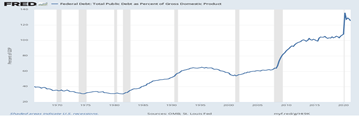
FREDdebtgdp

We might have just been saved from an immediate default on the national debt with all of its consequences. Senate Minority Leader Mitch McConnell late on Wednesday made a new offer to the Democratic-run Senate as lawmakers struggled to end a standoff over the federal borrowing limit.

Republicans will “allow Democrats to use normal procedures to pass an emergency debt limit extension at a fixed dollar amount to cover current spending levels into December,” McConnell, a Kentucky Republican, said in a statement.

But that only kicks the debt ceiling can down the road. Why should there be a congressionally mandated debt ceiling? If the U.S. congress was serious about putting a cap on public spending, then it would require that any new spending be paid for, as has been done in the past.

It is beyond silly to have have a debt ceiling, otherwise. Because the debt incurred is from past spending. But, alas, congress has not been able to agree on an acceptable formula for reinstituting what has been called pay-to-play budget resolutions.

The above FRED graph shows the amount of public debt as a percentage of GDP owed by the federal government is today. The largest growth in U.S. public debt occurred because of the last two recessions (gray columns in graph)—the Great Recession caused by lax regulation of Wall Street lenders that led to the housing bubble, and the COVID-19 pandemic, respectively.

The pandemic recession lasted just two months, and public debt soared mainly because of the $trillions in emergency spending passed by congress during the Trump and Biden administrations that wasn’t paid for. In fact, the Trump administration pushed through massive tax cuts on corporations and lowered the maximum tax rate on personal income in 2017. Some $7.8 trillion was added to the public debt during his term.

Even the current level of public debt ($22.7 trillion) is less of a danger to growth than the debate over raising the debt ceiling.

This is because as Josh Bivens of the Economic Policy Institute points out, and I have discussed in past columns, over the past 25 years debt service payments (required interest payments on debt) shrank almost in half, from 3.0 percent of GDP to 1.8 percent, as the nominal federal debt rose from $5 trillion to $22.7 trillion. And it has averaged 3 percent of GDP, historically.

The main danger to economic growth is that a debt ceiling exists at all. Fed Chairwoman Janet Yellen just warned that the U.S.could fall into a recession if the debt ceiling isn’t raised in congress by October 18.

“It is utterly essential that this be done,” Yellen said, in recent congressional testimony. She called Oct. 18 “the deadline.”

In fact, we are at the beginning of a new growth cycle. Doubts about the direction of growth after the pandemic arise from outdated economic models—models that can be lumped under supply-side, or more derisively, trickle-down economic theories.

Conservative economists tend to be stuck in what has been called the golden years of Reaganomics—or supply-side economics–when stimulating the supply of ever more goods and services by lowering government oversight and reducing taxes was the ticket to prosperity.

But explained simply, having excess aggregate demand, or effective demand, which we have today, stimulates greater growth rather than an excess of supply. And businesses are following that formula with record amounts of private and public investments in capital goods. Total capital expenditures in the second quarter are up 25 percent from a year ago, per the Federal Reserve Bank of St. Louis (FRED).

Lord JM Keynes understood this in the 1930s, which is why he thought it more important to stimulate greater demand with public investments when private investment disappeared during recessions. That was the lesson we learned from the Great Depression.

And it is the lesson we need to carry forward with the current infrastructure legislation winding its tortured way through congress that will stimulate a longer lasting growth cycle.

Then our debt will pay for itself.

Harlan Green © 2021

Follow Harlan Green on Twitter: https://twitter.com/HarlanGreen

Posted in Consumers, COVID-19, Economy, Keynesian economics, Politics, Weekly Financial News | Leave a comment

U.S. Manufacturing Output Surging

Financial FAQs

FREDmanuoutput

Growth in the U.S. manufacturing sector is exploding, according to the Institute for Supply Managers Report on Business. Output is up 17 percent in Q2 2021 YoY. It is a great sign of overall economic growth for the rest of this year, in spite of supply shortages and higher prices for raw materials.

Reporting growth in September were 16 of the 17 manufacturing industries. The top seven — in the following order — were: Furniture & Related Products; Petroleum & Coal Products; Machinery; Electrical Equipment, Appliances & Components; Computer & Electronic Products; and Chemical Products.

“The orders index was unchanged at the prior month’s very high level of 66.7 and the supplier delivery index rebounded by four points to 73.4.  The overall result was a 1.2-point increase to 61.1.  Any number over 50 percent indicates that a majority of those surveyed saw increases, and reaching 60 for any length of time is highly unusual,” according to the ISM survey announcement.

“There have been 15 ISM composite index readings of 60 or more in the past thirty years.  Seven of them have come in the past ten months,” said Reuters. This is in spite of the supply-chain delays and soaring product prices. The ISM Prices Index registered 81.2 percent. In September, 17 of 18 industries reported paying increased prices for raw materials.

Reuters

Even better news is that consumer spending is holding up, which powers some two-thirds of economic activity. This may be because consumers are paying less attention to the pandemic as the infection rate falls and the third Pfizer booster shot becomes available.

Consumer spending grew at a robust 12.0 percent rate in the April-June quarter. The Commerce Department also said construction spending increased 8.9 percent on a year-on-year basis in August. Separately, the University of Michigan’s Consumer Sentiment Index rose to a final reading of 72.8 in September from 70.3 in August.

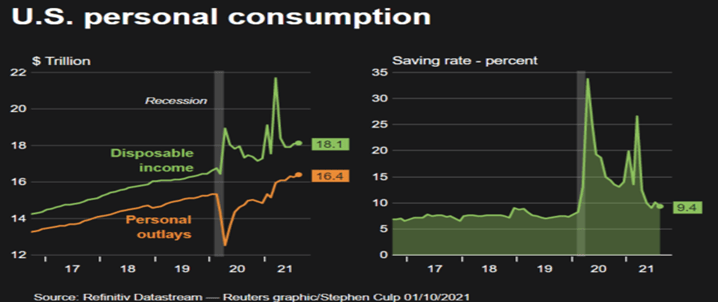
Another sign of robust future growth (as shown in the Reuters graph) is that Disposable income was $2 trillion higher than Personal outlays–$18 billion vs. $16 billion, respectively—which is why the personal savings rate is holding at a high 9.4 percent.

And the NY Times just reported drug maker Merck announced Friday that its pill to treat Covid-19 was shown in a key clinical trial to halve the risk of hospitalization or death when given to high-risk people early in their infections. It probably won’t be available until late next year, however.

The supply-chain delays and healthy consumer pocketbooks show there is a very strong demand for goods and services that should last, even with the ongoing uncertainty over the coronavirus pandemic.

Now let us see what congress will do with the Biden administration proposals for infrastructure and social investments, no matter the final Dollar amount. If passed, I see a very prosperous decade for Americans.

Follow Harlan Green on Twitter: https://twitter.com/HarlanGreen

Harlan Green © 2021

Posted in Consumers, COVID-19, Economy, Politics, Weekly Financial News | Leave a comment

What Happened to the Civil War?

Answering Kennedy’s Call

NPR.org

Removal of the largest Robert E. Lee statue from its prominent place in central Richmond, Virginia is a sign of the times.

We are no longer fighting what has been called a ‘cold’ civil war. Not the majority of Americans, anyway. The outcome of California Governor Gavin Newsome’s recall election reaffirmed that our defacto civil war between North and South, red states and blue states, is over by a two-to-one margin.

The LA Times Michael Hiltzick commented on it in a recent column.

“The truth is that America is nothing like a polarized country. Large majorities agree on the most pressing issues of the day: They favor abortion rights, stricter gun controls and more COVID-related restrictions, especially on unvaccinated people. You might not be aware of this if you listen to programs on Fox News or even the average political commentary in our leading newspapers or on CNN.”

California has always given Americans a picture of the future, with the sixth largest economy in the world. Silicon Valley is the most obvious example of our technological future, but California also has one of the best-in-country social welfare programs paid for with higher taxes. That is why California’s latest budget surplus was $76 billion, which it is using to cure its worst-in-the country housing shortage, as well as record poverty levels.

“…depictions of an America wracked by irreconcilable disagreement is daily fare. But they’re not reporting a genuine schism in American politics; they’re reporting on a divide pitting a majority in broad agreement against a boisterous minority,” continues Hiltzick.

So why does this “boisterous minority” still grab headlines? I attribute it to what I have called the Bully Mentality, a state of mind attributed to bullies who want to continue to fight a civil war they have already lost. It is bullying behavior adopted by one political party in recent decades to indoctrinate and intimidate voters—particularly minorities and immigrants—by ‘dumbing down’ their electorate to the real world.

The NY Times put it succinctly in a recent front page article by David Leonhardt that examined the vaccination divide between red and blue states.

“What distinguishes the U.S. (from much of the rest of the world) is a conservative party—the Republican Party—that has grown hostile to science and empirical evident in recent decades.”

Hiltzick attributes this hostility towards facts to President Nixon and Republicans’ switching to culture wars when they began to lose voters. For instance, its anti-abortion stance was an attempt to lure Catholic voters away from Democrats. I remember it happening when many Republicans signed onto Ralph Reeds (Protestant) Christian Coalition, with its denial of evolution and replacement with creationism theories and a literal reading of the Bible.

So why do conservatives continue to even attempt to keep this un-civil war alive? 

I recently mentioned Kennedy economist John Kenneth Galbraith’s answer, in speaking of France’s Ancien Régime that preceded the French Revolution: “The privileged feel that their privileges, however egregious, they may seem to others, are a solemn, basic, God-given right.”

And we know how that revolution turned out.

Harlan Green © 2021

Follow Harlan Green on Twitter: https://twitter.com/HarlanGreen

Posted in Economy, Politics, Uncategorized | Leave a comment

How Do We Build More Housing?

The Mortgage Corner

Calculated Risk

The housing market is cooling as is the fall weather. It’s not good news for those needing to live somewhere, given the low for sale inventory. But interest rates still remain at record lows, with 30-year conforming and super-conforming fixed rates still below 3 percent and affordable for a majority of home buyers.

The construction of multi-family rental housing is also booming, which is good news for renters. It could bring down rental rates, which have been rising as well. Building more rental units may be the best way to cure the present housing shortage, given all the constraints in labor, building materials, and the supply of buildable lots.

Total existing-home sales,1 https://www.nar.realtor/existing-home-sales, completed transactions that include single-family homes, townhomes, condominiums and co-ops, fell 2.0 percent from July to a seasonally adjusted annual rate of 5.88 million in August. Year-over-year, sales dropped 1.5 percent from a year ago (5.97 million in August 2020), reported the NAR.

“Sales slipped a bit in August as prices rose nationwide,” said Lawrence Yun, NAR’s chief economist. “Although there was a decline in home purchases, potential buyers are out and about searching, but much more measured about their financial limits, and simply waiting for more inventory.”

So patience is a virtue with the slowing price rises. The median sales price of a single-family home was $356,700, still up 14.9 percent from last August.

Competition among home buyers has been behind the skyrocketing prices, driving the annual growth rate to a high of 23.6% in May. Since June, the rate has been steadily dropping, decelerating to 23.4% in June and 17.8% in July,” said Shaina Mishkin of MarketWatch.

“The housing sector is clearly settling down,” said chief economist Lawrence Yun, who described the surge of home buying in late 2020 and early 2021 as an anomaly.

Total housing inventory2 at the end of August totaled 1.29 million units, down 1.5% from July’s supply and down 13.4% from one year ago (1.49 million), said the Realtors. Unsold inventory sits at a 2.6-month supply at the current sales pace, unchanged from July but down from 3.0 months in August 2020.

Total housing starts increased 3.9 percent to a seasonally adjusted annual rate of 1.62 million units, according to a report from the U.S. Department of Housing and Urban Development and the U.S. Census Bureau.

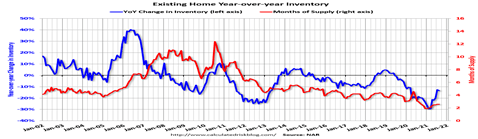
The second Calculated Risk graph portrays years of supply and YoY inventory changes in red and blue lines, respectively. In January 2021 they reached a bottom of -30 percent below January 2020 and have been rising ever since.

Calculated Risk

So housing construction will have to play catch-up. The good news is single-family housing starts on a year-to-date basis are about 24 percent higher than the same period in 2020, reports the NAHB.

And help is on the way for renters, as I said. The National Association of Home Builders (NAHB) reports strong multifamily production helped push overall housing starts up in August as single-family starts edged lower due to ongoing supply chain issues and labor challenges.

The multifamily sector, which includes apartment buildings and condos, increased 20.6 percent to a 539,000 pace, whereas single-family starts decreased 2.8 percent to a 1.08 million seasonally adjusted annual rate, but are up 23.8 percent year-to-date.

“More inventory is coming for a market that continues to face a housing deficit,” said NAHB Chief Economist Robert Dietz. “The number of single-family homes under construction in August — 702,000 — is the highest since the Great Recession and is 32.7% higher than a year ago. While some building materials, like lumber, have seen easing prices, delivery delays and a lack of skilled labor and building lots continue to hold the market back.”

And though more homes are being built, just 29 percent of sales were for so-called first-timers, the entry-level buyers lowest in age and starting new families. This is the real void looming over an acceptable housing supply.

Unless builders and governments find ways to reduce housing costs, the housing shortage could continue for years and leave a whole generation without the benefits of home ownership.

Harlan Green © 2021

Follow Harlan Green on Twitter: https://twitter.com/HarlanGreen
Posted in Consumers, COVID-19, Housing, housing market, Weekly Financial News | Leave a comment