Q3 Economic Growth Still Strong

Financial FAQs

image

Econoday.com

Q3 real GDP growth was up 3.5 percent, according to the U.S. government Bureau of Economic Analysis. “With this second estimate for the third quarter, the general picture of economic growth remains the same; upward revisions to nonresidential fixed investment and private inventory investment were offset by downward revisions to personal consumption expenditures (PCE) and state and local government spending,” said the BEA.

Consumer spending is up 3.6 percent, and there is virtually no inflation. Prices are rising 1.7 percent annually per the GDP price deflator that measures the prices of all final goods and services produced domestically.

image

Econoday

Soaring corporate profits weren’t a big help to growth, however, as most of the profits are being spent on stock buybacks, though there was a slight increase of capital expenditures. Investment in equipment climbed 3.5 percent vs. virtually no increase in the preliminary estimate.

And spending on structures such as office buildings and drilling rigs fell 1.7 percent instead of -8 percent in the first estimate. Profits were up 19.4 percent after taxes, and tax payments fell 32.9 percent from last year. Corporates profits are therefore up 10.3 percent in a year, the best showing since 2012.

We also now have the Fourth National Climate Assessment, which is much more accurate than the previous reports from 13 federal agencies in pinning down the damage to economic growth. If nothing is done to mitigate its effects on coastal cities’ flooding from rising sea levels, increasing wildfires in drought-stricken regions, and the increasing frequency and ferocity of hurricanes and tornadoes, economic growth will suffer substantially.

“In the absence of significant global mitigation action and regional adaptation efforts, rising temperatures, sea level rise, and changes in extreme events are expected to increasingly disrupt and damage critical infrastructure and property, labor productivity, and the vitality of our communities.”

Need we say more about ignoring physical reality in all its forms? Profits must be invested where they will do the most good. If corporations won’t heed the looming threats to not only the environment but livelihoods as well, then government will find a more beneficial use for the $trillions being hoarded in the private sector.

Harlan Green © 2018

Follow Harlan Green on Twitter: https://twitter.com/HarlanGreen

Posted in Economy, Macro Economics, Weekly Financial News | Tagged , , , | Leave a comment

Beware the Shrinking US Dollar!

Popular Economics Weekly

image

Econoday.com

Barron’s Magazine reported that the Fed is shrinking credit too quickly, and it will slow not only U.S. economic growth, but growth in the rest of the world as well. Why? Because the U.S. Dollar is the world’s main reserve currency that covers more than 60 percent of world trade.

And since the Fed is taking circulating $$ out of the economy by selling some of those $4 trillion in securities it has been holding since Fed Chair Ben Bernanke’s term–$50 billion per month—it is reducing the amount of dollars in circulation, leaving fewer dollars to pay for transactions via the world’s banks and clearing houses.

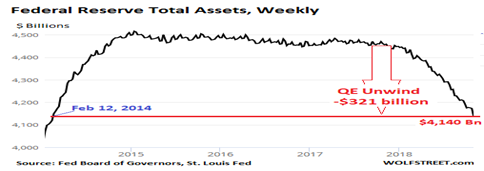
Over the four-week period from October 3 through October 31, reports Wolf Street, the Federal Reserve shed $35 billion in assets, according to the Fed’s weekly balance sheet released last Thursday afternoon. This brought the balance sheet to $4,140 billion, the lowest since February 12, 2014. Since October 2017, when the Fed began its QE unwind, or “balance sheet normalization,” it has now shed $321 billion:

image

wolfstreet.com

And that could mean that China’s Yuan (Renminbi) and the euro would begin to replace it as reserve currencies, meaning that fewer transactions would flow through US banks and economy. It also means that the US then has less control over trade rules, and yes, sanctions it wants to impose on other countries, like Iran. This is because other countries don’t like economic bullying that isn’t in their interests, and will seek to use other currencies, such as the euro in place of the dollar.

The dollar leads all other currencies in supplying the functions of money for international transactions. It is still the most important unit of account (or unit of invoicing) for international trade. It is the main medium of exchange for settling international transactions. It is also the principal store of value for the world’s central banks, said a recent Bank of England Quarterly Bulletin.

But what can happen next, as worldwide growth slows, which is sure to happen as dollar reserves and credit shrink?? Trump’s trade war is happening at a very bad time, in other words. Economist and Project Syndicate columnist Jeffery Sachs has outlined the possibilities of trade policies that harm, rather than help economic growth.

“The most consequential and ill-conceived of Trump’s international economic policies are the growing trade war with China and the re-imposition of sanctions vis-à-vis Iran. The trade war is a ham-fisted and nearly incoherent attempt by the Trump administration to stall China’s economic ascent by trying to stifle the country’s exports and access to Western technology. But while U.S. tariffs and non-tariff trade barriers may dent China’s growth in the short term, they will not decisively change its long-term upward trajectory.

“More likely, they will bolster China’s determination to escape from its continued partial dependency on U.S. finances and trade, and lead the Chinese authorities to double down on a military build-up, heavy investments in cutting-edge technologies, and the creation of a yuan-based global payments system as an alternative to the dollar system.”

This is hardly making US safer, in a world that has outgrown dependence on US economic and geopolitical power. The U.S. currently produces around 22 percent of world output measured at market prices, and around 15 percent in purchasing-power-parity terms (i.e., actual volume). Yet the dollar accounts for half or more of cross-border invoicing, reserves, settlements, liquidity, and funding.

We could be punching above our weight, as the saying goes, if we continue to bully our economic allies, as well as our adversaries. There are now other Heavyweights in the ring.  

Harlan Green © 2018

Follow Harlan Green on Twitter: https://twitter.com/HarlanGreen
Posted in Economy, Macro Economics, Politics, Weekly Financial News | Tagged , , , | Leave a comment

Home Sales Rise for the Holidays

The Mortgage Corner

image

Econoday.com

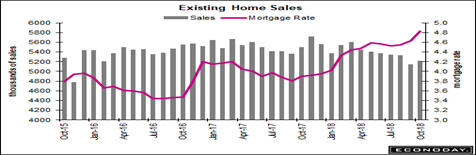
Existing-home sales increased in October after six straight months of decreases, according to the National Association of Realtors. Three of four major U.S. regions saw gains in sales activity last month.

Lawrence Yun, NAR’s chief economist, says increasing housing inventory has brought more buyers to the market. “After six consecutive months of decline, buyers are finally stepping back into the housing market,” he said. “Gains in the Northeast, South and West – a reversal from last month’s steep decline or plateau in all regions – helped overall sales activity rise for the first time since March 2018.”

It’s really been almost a year (November 2017) since sales last peaked. And that was when interest rates had dipped to 4.0 percent for 30-year conforming fixed rates. So it is further evidence that sales are interest-rate sensitive, and homebuyers will wait for a dip in mortgage rates.

Today’s benchmark 10-year T Bond has fallen back to 3.06 percent, for instance, and the 30-year conforming fixed rate to 4.375 percent for those with the best credit scores.

It’s another manifestation of the flight to quality from a very unstable stock market worried about trade wars and outright wars, as the Trump administration stirs up the domestic and geopolitical temperatures again. Unilateral withdrawals from trade and Intermediate Nuclear Missile treaties do not hearten confidence this administration is interested in keeping the peace.

“Total existing-home sales, https://www.nar.realtor/existing-home-sales, which are completed transactions that include single-family homes, townhomes, condominiums and co-ops, increased 1.4 percent from September to a seasonally adjusted rate of 5.22 million in October. Sales are now down 5.1 percent from a year ago (5.5 million in October 2017), said the NAR.

This may be due to increased inventories of homes for sale, as Yun said. Buying has slowed, but new-home building has increased. Total housing inventory at the end of October decreased from 1.88 million in September to 1.85 million existing homes available for sale, but that represents an increase from 1.80 million a year ago. Unsold inventory is at a 4.3-month supply at the current sales pace, down from 4.4 last month and up from 3.9 months a year ago.

image

Econoday.com

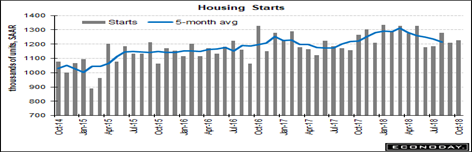
Meanwhile nationwide housing starts rose 13.7 percent in October to a seasonally adjusted annual rate of 1.29 million units after a slight upward revision to the September reading, according to newly released data from the U.S. Department of Housing and Urban Development and the Commerce Department. This is the highest housing production reading since October 2016, when total starts hit a post-recession high of 1.33 million.

“We are seeing solid, steady production growth that is consistent with the National Association of Homebuilders forecast for continued strengthening of the single-family sector,” said NAHB Chief Economist Robert Dietz. “As the job market and overall economy continue to firm, we should see demand for housing increase as we head into 2018.”

Single-family production rose 5.3 percent in October to a seasonally adjusted annual rate of 877,000. Year-to-date, single-family starts are 8.4 percent above their level over the same period last year. Multifamily starts jumped 36.8 percent to 413,000 units after a weak September report.

Hurricane Michael hit Florida and Georgia in October though existing-home sales in the South nevertheless managed a 1.9 percent monthly rise. Sales in the West were strongest at plus 2.8 percent with the Northeast at plus 1.5 percent but the Midwest at minus 0.8 percent.

“Sales may have gotten a boost from discounting as the median price fell 0.6 percent to $255,400, said Econoday. “Year-on-year, the median is up 3.8 percent which is sizably above the decline in sales which points to further discounting ahead.”

More price discounting and lower (not higher) interest rates and inflation may lie ahead, as real estate becomes the more dependable asset in such times of uncertainty.

Harlan Green © 2018

Follow Harlan Green on Twitter: https://twitter.com/HarlanGreen
Posted in Consumers, Housing, housing market, Weekly Financial News | Tagged , , , | Leave a comment

Retail Sales Surge While Consumers Pay Down Debt

Popular Economics Weekly

image

Econoday.com

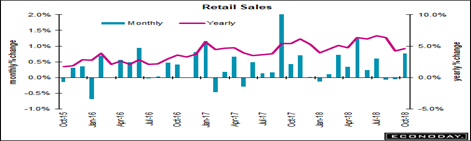
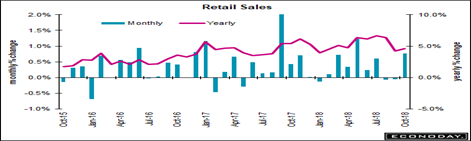
U.S. retail sales rebounded sharply in October as purchases of motor vehicles and building materials surged, likely driven by rebuilding efforts in areas devastated by Hurricane Florence.

CBS News reports an economic consulting firm says Hurricane Florence may result in between $17 billion and $22 billion in lost economic output and property damage. That would put Florence in the Top 10 of costliest hurricanes to hit the U.S.

The Commerce Department said last Thursday retail sales increased 0.8 percent as households also bought more electronics and appliances. September sales were revised down, sales slipping 0.1 percent instead of nudging up 0.1 percent as previously reported; the month Hurricane Florence made landfall.

Autos were very strong in October, rising 1.1 percent following several months of weakness. Building materials were up nearly as much as autos, up 1.0 percent in what is a good indication for residential investment, said Econoday. Gasoline sales jumped 3.5 percent in the month though this reading for November due very likely fluctuating oil prices, which have been declining of late.

image

Econoday

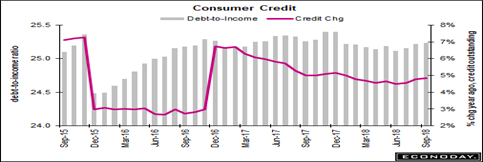
But consumers are spending less overall, as consumer credit slowed more than expected to just $10.9 billion in September, below Econoday’s consensus range and less than half of the upwardly revised $22.9 billion August increase. Growth slowed in nonrevolving credit, which rose $11.2 billion in September versus $18.3 billion previously, while growth in revolving credit stalled completely and posted a marginal decline of $0.3 billion. Gains in nonrevolving credit reflect vehicle financing and student loans while gains in revolving credit reflect credit-card debt. 

image

St Louis FRED

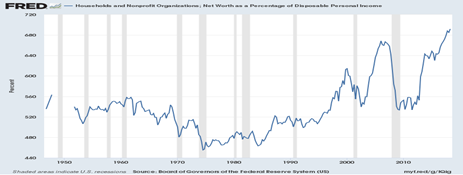
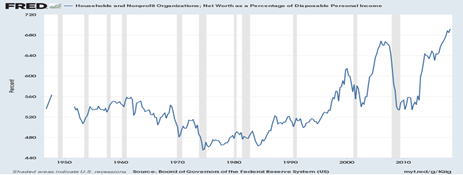
Consumers are paying down their overall debt, in other words. “Household net worth just hit $107 trillion and in relative terms it is at an all-time high of 5.23x nominal GDP. What is significant about this is it is coming during a cycle that has been characterized by household de-leveraging,” said economists from RBC Capital Markets in a MarketWatch interview.

“It took bubbles of epic proportions in the past to boost net worth/GDP significantly (tech, housing). This time around we have a household balance sheet where liabilities relative to net worth are sitting at a 33-year low. Pristine balance sheets coupled with significant momentum from tight labor markets (firming wage growth) and tax reform (firming after-tax income) puts the consumer in a position to continue carrying this cycle for a while,” said RBC.

So how long does the second-longest business cycle, now in its 10th year, last? That’s the question on everyone’s mind. The 10-yr Treasury bond yield just plunged to 3.05 percent, flattening the so-called yield curve once again.

So if the Fed keeps raising short term rates as promised, it could seriously compromise growth next year by restricting credit and so consumer spending that makes up two-thirds of economic activity.

Harlan Green © 2018

Follow Harlan Green on Twitter: https://twitter.com/HarlanGreen
Posted in Uncategorized | Tagged , , , | Leave a comment

Retail Sales Surge While Consumers Pay Down Debt

Popular Economics Weekly

image

Econoday.com

U.S. retail sales rebounded sharply in October as purchases of motor vehicles and building materials surged, likely driven by rebuilding efforts in areas devastated by Hurricane Florence.

CBS News reports an economic consulting firm says Hurricane Florence may result in between $17 billion and $22 billion in lost economic output and property damage. That would put Florence in the Top 10 of costliest hurricanes to hit the U.S.

The Commerce Department said last Thursday retail sales increased 0.8 percent as households also bought more electronics and appliances. September sales were revised down, sales slipping 0.1 percent instead of nudging up 0.1 percent as previously reported; the month Hurricane Florence made landfall.

Autos were very strong in October, rising 1.1 percent following several months of weakness. Building materials were up nearly as much as autos, up 1.0 percent in what is a good indication for residential investment, said Econoday. Gasoline sales jumped 3.5 percent in the month though this reading for November due very likely fluctuating oil prices, which have been declining of late.

image

Econoday

But consumers are spending less overall, as consumer credit slowed more than expected to just $10.9 billion in September, below Econoday’s consensus range and less than half of the upwardly revised $22.9 billion August increase. Growth slowed in nonrevolving credit, which rose $11.2 billion in September versus $18.3 billion previously, while growth in revolving credit stalled completely and posted a marginal decline of $0.3 billion. Gains in nonrevolving credit reflect vehicle financing and student loans while gains in revolving credit reflect credit-card debt. 

image

St Louis FRED

Consumers are paying down their overall debt, in other words. “Household net worth just hit $107 trillion and in relative terms it is at an all-time high of 5.23x nominal GDP. What is significant about this is it is coming during a cycle that has been characterized by household de-leveraging,” said economists from RBC Capital Markets in a MarketWatch interview.

“It took bubbles of epic proportions in the past to boost net worth/GDP significantly (tech, housing). This time around we have a household balance sheet where liabilities relative to net worth are sitting at a 33-year low. Pristine balance sheets coupled with significant momentum from tight labor markets (firming wage growth) and tax reform (firming after-tax income) puts the consumer in a position to continue carrying this cycle for a while,” said RBC.

So how long does the second-longest business cycle, now in its 10th year, last? That’s the question on everyone’s mind. The 10-yr Treasury bond yield just plunged to 3.05 percent, flattening the so-called yield curve once again.

So if the Fed keeps raising short term rates as promised, it could seriously compromise growth next year by restricting credit and so consumer spending that makes up two-thirds of economic activity.

Harlan Green © 2018

Follow Harlan Green on Twitter: https://twitter.com/HarlanGreen
Posted in Consumers, Economy, Weekly Financial News | Tagged , , , | Leave a comment

Higher Interest Rates Ahead?

Popular Economics Weekly

image

Econoday.com

The benchmark 10-year Treasury Bond Yield that determines mortgage and other long term rates ended at 3.13 percent today from 3.11 percent last week with the continued stock market selloff. It was as high as 3.22 percent at times. The Fed is on track to raise short term interest rates another one-quarter percent in December, which will boost the Prime Rate used for credit card and installment debts to 5.50 percent. What does that mean for continued job and economic growth?

The jury is out on the answer. Consumer confidence is booming, but stocks are fluctuating madly because investors are fretting over what happens next year, which is what investors always attempt to predict—i.e., how much to discount future corporate earnings. A majority of S&P 500 companies reported higher earnings than predicted in Q3, so there should be a minimal discount. And corporations are using most of their extra profits from the December tax cut to buy back stock. But that is one-time booster shot that investors worry will soon end the stimulus.

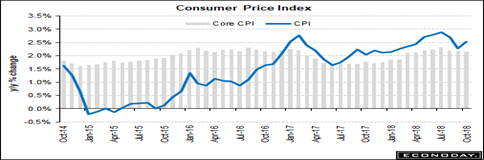
If interest rates continue to rise, it will cut into consumer spending, while bond traders worry about incoming inflation. But the Producer Price Index and Consumer Price Index show inflation are remaining below 3 percent—hardly levels that could diminish asset valuations. Both indexes continue to hover around 2.5 percent before seasonal adjustment and inflation are factored in.

image

Econoday

The U.S. economy isn’t overheating, in other words. The US Bureau of Economic Analysis reported that the Personal Consumption Expenditure Index of inflation has been basically flat for months; at 2.0 percent, right on the Fed’s inflation target. Robust growth with little inflation is the Goldilocks economy we all yearn for, and the stock market should be applauding, not fearing.

And consumers’ holiday spirits are high, with the U. of Michigan sentiment survey close to its 12-month high. “Inflation expectations are mixed with the year-ahead reading down 1 tenth to 2.8 percent, said Econoday, “but the 5-year outlook up 2 tenths to 2.6 percent. These levels have been steady all year and, for the Federal Reserve, confirm that inflation expectations remain fully anchored.”

What about jobs? The economy looks to be fully employed for another year, at least. The Labor Department’s most recent JOLTS report indicates the gap between openings and hires, which had been widening in previous months and reached a record high of 1.386 million in August, shrank in September—to a still wide 1.265 million. 

That means 1.265 million jobs lack applicants, which could put a brake on future growth. Employers aren’t finding enough qualified workers to expand production, and wages are finally rising above inflation.

What’s not to like about this economy? Even the National Federation of Independent Businesses (NFIB); made up mainly of the small business owners that create most new jobs; reported record-high optimism in its October survey.

“Small business optimism continued its two-year streak of record highs, according to the NFIB Small Business Optimism Index October reading of 107.4,” per its press release. “Overall, small businesses continue to support the three percent-plus growth of the economy and add significant numbers of new workers to the employment pool. Owners believe the current period is a good time to expand substantially, are planning to invest in more inventory, and are reporting high sales figures.”

It seems U.S. consumers aren’t yet reacting to the higher tariffs on imported wash machines and stoves hit by rising aluminum and steel prices. But higher vehicle prices are sure to follow. Total vehicle sales are booming at the moment, topping 18 million units in October, according to the St. Louis Fed.

What can go wrong, you ask??

Harlan Green © 2018

Follow Harlan Green on Twitter: https://twitter.com/HarlanGreen
Posted in Consumers, Economy, Weekly Financial News | Tagged , , , , , , , | Leave a comment

What Happens to 1% with Demo’s Blue Wave?

The Mortgage Corner


Washington Post

Now that the Democrats will be taking back the US House of Representatives in January, can they enact programs that improve the record income inequality in America? American citizens have the least equal incomes in the developed world, as the EPI graph shows. And that has been a major reason for the sluggish recovery from the Great Recession, when 25 percent of Americans still live below the poverty line for a family of four, incredible as that may seem.

The Economic Policy Institute, a labor think-tank reports newly available wage data for 2017 show that annual wages grew far faster for the top 1.0 percent (3.7 percent) than for the bottom 90 percent (up only 1.0 percent). The top 0.1 percent saw the fastest growth, up 8.0 percent—far faster than any other wage group.

This fast wage growth for the top 0.1 percent reflects the sharp 17.6 percent spike upwards in the compensation of the CEOs of large firms, thanks to the massive stock buyback programs.

There is much evidence that the Republicans’ December 2017 tax cuts are largely responsible for the surge in buybacks. That has been little noticed because of the initial 3.5 percent GDP growth estimate for Q3, when consumer spending shot up 4 percent, and inventories were replenished that boosted growth.

Apple, for instance, in May announced a $100 billion share repurchase program and so far in 2018 it’s tripled its share repurchases over the first half of last year. S&P 500 companies are on track to return a record $1 trillion (via buybacks and dividends) to shareholders.

Cisco Systems said earlier it would bring back to the United States $67 billion of overseas cash in response to the tax package, using $25 billion to finance additional share repurchases. Alphabet, the parent company of Google, authorized up to $8.6 billion in stock purchases. PepsiCo announced a fresh $15 billion in planned buybacks. Chip gear maker Applied Materials disclosed plans for a $6 billion program to buy shares. And late last month, home improvement retailer Lowe’s unveiled plans for $5 billion in purchases.

Nancy Pelosi, who will be returning as the House Majority Leader, has said one of the Democrat’s priorities is a new infrastructure bill that would require $1 trillion of federal spending. Where would that money come from with a projected federal deficit of $1 trillion in coming years due to reduced tax revenues from the Republican tax cuts?

Another Democratic House leader has said they will want to boost the nominal corporate tax cut from its current 21 percent rate. In fact, the actual tax rate is far below that for most major corporations, because of the various loopholes and tax shelters available to corporations, including having headquarters in low taxation countries, such as Ireland.

Josh Bivens, the EPI research director, estimated that “the effective rate will all but surely dip below 15 percent and get close to 10 percent.” An analysis from the University of Pennsylvania’s Wharton School Budget Model, the average effective tax rate for corporations will be about 9 percent in 2018 but go up to 18 percent by 2027, thanks to some of the provisions that will expire over the next 10 years.

There are in fact many other ways to divert federal funds from overfunded programs, such as reducing the defense budget. Estimated U.S. military spending is $716 billion, according to the Washington Post, now 17 percent of the $4 trillion federal budget. That’s part of the spending bill signed by President Trump on August 13, 2018. It covers the period October 1, 2018 through September 30, 2019. Military spending is the second largest item in the federal budget after Social Security.  The United States spends more on defense than the next nine countries combined.

More important was the 3.1 percent rise in wages in the Q3 GDP report that may mitigate the record income inequality, as do the various minimum wage boosts is some cities and states. But the overall picture remains bleak, as the EPI graph shows, unless other labor friendly legislation is enacted to strengthen, for instance, collective bargaining rights of unions in right-to-work states enacted by Republican legislatures since 2010.

Harlan Green © 2018

Follow Harlan Green on Twitter: https://twitter.com/HarlanGreen
Posted in Uncategorized | Tagged , , , , , | Leave a comment

On Tyranny

Answering The Kennedys Call

image

Amazon.com

Whether or not President Donald Trump ever owned a copy of Hitler’s Mein Kampf, stories abound of its existence with followers such as Steve Bannon, who was reported to have gifted him a signed copy when part of Trump’s campaign.

What is most disturbing to Ph.D. Timothy Snyder, Housum Professor of History at Yale University and a scholar of the Holocaust, is that so many of Donald Trump’s supporters espouse Hitler’s program of white (instead of Aryan) nationalism, which could lead to a similar outcome if such a demagogue ever rose to power in the United States of America.

You say that’s not possible with our 229-year old democratic institutions enshrined in the U.S. Constitution?

Professor Snyder writes in his Prologue: “History does not repeat, but it instructs…Americans today are no wiser than the Europeans who saw democracy yield to fascism, Nazism, or communism in the twentieth century. Our one advantage is that we might learn from their experience.”

And he has listed 20 signs that help us to learn how to remain free from past tyrannies:

  1. 1. Do not obey in advance.
  2. 2. Defend institutions.
  3. 3. Beware the one-party state.
  4. 4. Take responsibility for thr face of the world.
  5. 5. Remember professional ethics.
  6. 6. Be wary of paramilitaries.
  7. 7. Be reflective if you must be armed.
  8. 8. Stand out.
  9. 9. Be kind to your language.
  10. 10. Believe in truth.
  11. 11. Investigate.
  12. 12. Make eye contact and small talk
  13. 13. Practice corporeal politics.
  14. 14. Establish a private life.
  15. 15. Contribute to good causes.
  16. 16. Learn from peers in other countries.
  17. 17. Listen for dangerous words.
  18. 18. Be calm when the unthinkable arrives.
  19. 19. Be a patriot.
  20. 20. Be as courageous as you can.

Many of these maxims may seem self-evident, but are necessary for a participatory democracy to exist. “Believe in truth” may seem to be self-evident, but only works if one is willing to “Investigate” untruths, or truthiness, or alternative facts; terms coined by Trump administration officials to deny reality—whether it be the reality of damage done by Republican tax cuts, trade wars, and immigrant caravans that are made up mostly of women and children fleeing terror in their own countries, rather than criminals.

“To abandon facts is to abandon freedom,” says Professor Snyder. “If nothing is true then no one can criticize power.”

“Be kind to your language” is a corollary maxim, which means think for yourself and not be bound up in mass media language and thoughts. Read books, rather than be mesmerized by the Internet. Radio was the medium Hitler’s propaganda chief Goebbels used to hypnotize the German people with Hitler’s speeches.

“Listen for dangerous words” is another corollary. Words have meanings. How many times have we heard President Trump use the words ‘extremists’ and ‘terrorists’ to mischaracterize Muslims and Hispanic immigrants? They give license to President Trump to invoke emergency declarations, which justified his use of emergency powers to slap aluminum and steel tariffs on our allies, while withdrawing from existing trade agreements that in fact protected us from unfair competition, and call up U.S. Troops to supposedly defend our southern border from the approaching immigrant caravans.

“Modern tyranny is terror management,” says Professor Snyder. “Be calm when the unthinkable arrives…The sudden disaster that requires the end of checks and balances, the dissolution opposition parties, the suspension of expression.”

Nothing is more dangerous to Democracy than an immoral and lawless leader who cares only to enhance his own power and wealth, or an adult citizen that doesn’t vote.

Harlan Green © 2018

Follow Harlan Green on Twitter: https://twitter.com/HarlanGreen
Posted in Uncategorized | Leave a comment

U.S. Wages At 9-Year High

Popular Economics Weekly

image

MarketWatch.com

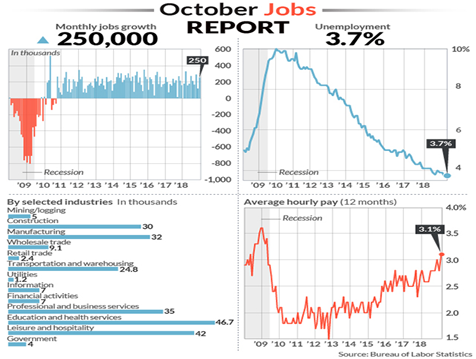
Total nonfarm payroll employment rose by 250,000 in October, and the unemployment rate was unchanged at 3.7 percent, the U.S. Bureau of Labor Statistics reported today. Job gains occurred in health care, in manufacturing, in construction, and in transportation and warehousing—in basically all sectors of the U.S. economy.

“The rapidly growing economy generated a sizzling 250,000 new jobs in October, keeping the unemployment rate at a 48-year low and pushing the increase in worker pay to the highest level in more than nine years,” said MarketWatch’s Jeffery Bartash.

The large increase in worker pay highlighted the unemployment report, as did government reports such as the BLS Job Openings and Labor Turnover Survey (JOLTS) that showed more than 7 million job openings, and a high Quits rate of voluntary separations that usually means workers are finding better jobs.

“The number of job openings reached a series high of 7.1 million on the last business day of August, the U.S. Bureau of Labor Statistics reported in October. Over the month, hires and separations were little changed at 5.8 million and 5.7 million, respectively. Within separations, the quits rate was unchanged at 2.4 percent and the layoffs and discharges rate was little changed at 1.2 percent.”

The 5.8 million hires really highlights the incredible jobs turnover rate each month in the $20.7 trillion U.S. economy. A major component of the unemployment report was the 32,000 new manufacturing jobs created in October that was highlighted in the BEA’s report on new factory orders.

image

Econoday.com

“Up a higher-than-expected 0.7 percent, factory orders in October added to September’s very strong gain which is now revised 3 tenths higher to 2.6 percent,” said Econoday. “October’s increase for durable goods, also at 0.7 percent, is revised 1 tenth lower from last week’s advance report with orders for non-durable goods, which are the fresh data in today’s report, up 0.6 percent reflecting gains for petroleum and chemical products.”

Why the lowest unemployment rate in many years? A major reason is the percentage of able-bodied Americans in the labor force from the ages 25 to 54 rose to 82.3 percent in October from 81.8 percent in the prior month. That marks the highest level since April 2010.

How about interest rates? The 10-year Treasury Bond yield rose to 3.15 percent once again, and the Fed is sure to raise their Fed Funds rate another one-quarter percent in December to 2.25 to 2.50 percent, which means the Prime rate will go to 5.50 percent. That hasn’t dented consumer spending yet, but it might in the New Year.

What with the election uncertainty, trade wars, jittery financial markets, and an administration fearful of its own survival, we don’t see how 2018 can be much better.

Harlan Green © 2018

Follow Harlan Green on Twitter: https://twitter.com/HarlanGreen

Posted in Consumers, Economy, Weekly Financial News | Tagged , , , , | Leave a comment

The Budget Buster-In-Chief Wants to Scare US

The Mortgage Corner

image

Federal Budget

The Treasury is on track to issue $1.34 trillion in new debt this year, more than double the amount in 2017. The Trump tax cuts and higher government spending are leading to higher borrowing needs, and Federal Reserve’s response is to continue to raise borrowing costs, which threatens to slow down consumer spending at holiday time.

Trump and Republicans cut $1.5 trillion in taxes with the promise it would pay down the national debt. Instead, our national debt is ballooning during a booming economy—not a good sign when the economy eventually slows down and revenues decline.

That’s why former Fed Chairwoman Janet Yellen said Tuesday that she’s worried about the longer-term deficit outlook. She called for entitlement reform and tax hikes to bring down the federal deficit.

Tax hikes?? That won’t happen with this administration that has built in benefits for just the top 10 percent income earners, and corporations, of course. It is something Repubs don’t want to talk about, which is why President Trump throws out misinformation about amending the 14th Amendment with an Executive Order; the amendment that allows citizenship for births in the U.S. to undocumented residents.

Amend the Constitution with an Executive Order?? Can’t happen without three-quarters of the states ratifying it, as anyone knows that has attended a civics class during their school years. Even educated Trump supporters have to know that fact.

Most developed countries also allow this for good reason. It replenishes the shrinking workforce in developed countries that have declining birthrates. The shrinking workforce is a big problem because it is population + labor productivity growths that determine economic growth.

The budget deficit is widening in a big way. In the first 11 months of the fiscal year, the deficit was $895 billion, which is $222 billion more than the previous year. Outlays have climbed 7 percent while revenue rose just 1 percent, and the national debt has climbed to $21.2 trillion.

The Congressional Budget Office reports, “Corporate taxes have plummeted by 30 percent this fiscal year, both because of the lower rate as well as the expanded ability to immediately deduct the full value of equipment purchases. Individual income and payroll taxes have climbed 4 percent, as increasing wages — mostly, due to more people having jobs — offset a lower withholding rate.”

Spending on Social Security and Medicare have also climbed 4 percent as more baby boomers retire, outlays on net interest on the debt have jumped 19 percent in part due to a higher rate of inflation triggering more payments to inflation-protected securities holders, and defense spending has jumped 6 percent.

image

U.S. total national debt has already reached 100 percent of GDP. Scary isn’t it? That’s why President Trump is trying to scare us even more with an “invasion” of several thousand Central Americans fleeing their countries’ poor economies and gang violence. But our national debt is scarier because it harms the prosperity of future generations.

“By 2028, America’s government debt burden could explode from this year’s $15.5 trillion to a staggering $33 trillion—more than 20 percent bigger than it would have been had Trump’s agenda not passed,” said a recent Forbes article. “At that point, interest payments would absorb more than $1 in $5 of federal revenue, crippling the government’s capacity to bolster the economy, and constraining the private sector too.”

Halloween is the time we scare children. But unless we return to responsible budgeting, it means a scarier future for everyone.

Harlan Green © 2018

Follow Harlan Green on Twitter: https://twitter.com/HarlanGreen
Posted in Consumers, Economy, Politics, Uncategorized | Tagged , , , , , | Leave a comment