August Jobs Report No Big Deal

Popular Economics Weekly
image

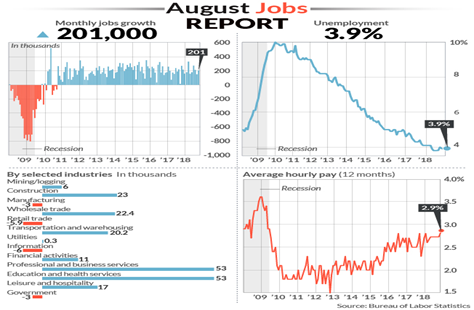
Graph: MarketWatch

Total nonfarm payroll employment increased by 201,000 in August, and the unemployment rate was unchanged at 3.9 percent, the U.S. Bureau of Labor Statistics reported today. Job gains occurred in professional and business services, health care, wholesale trade, transportation and warehousing, and mining.

Very little happened with the August Unemployment report. Average hourly wages rose slightly, and more service sector jobs were created, but fewer new jobs were in the more highly-skilled manufacturing and high tech sectors.

White-collar professional firms filled 53,000 positions, bringing the total created over the past 12 months to more than half a million, which includes both the professional and business services, and health care. These are the fastest growing jobs in the country. Health-care providers hired 33,000 people, transport firms added 20,000 jobs and construction companies hired 23,000 workers.

Employment fell by 3,000 in manufacturing, the first decline in 13 months. U.S. tariffs and a scarcity of (higher paid) skilled laborers may finally being felt by employers. And gains for July and June were revised down by a combined 50,000, the Labor Department said Friday.

This could be a sign that economic activity is peaking, although wholesale trade, transportation and warehousing job growth was robust.

The (other) Household Survey that actually measures the unemployment rate—a smaller telephone survey of households that is slightly less accurate—held steady at 3.9 percent though the labor participation rate slipped 2 tenths to 62.7 percent.

This was because the number of people in the labor force went down by a half of million, to 161.8 million from 162.3 million reflecting a decrease in the number of employed which in this survey, in contrast to the BLS Establishment survey, includes the self-employed.

The big news was the 2.9 percent rise in average hourly earnings, the highest since December 2007 and the beginning of the Great Recession, according to Econoday.

The Labor Department also reported the number of persons employed part time for economic reasons (sometimes referred to as involuntary part-time workers), at 4.4 million, changed little over the month but down by 830,000 over the year. “These individuals, who would have preferred full-time employment, were working part time because their hours had been reduced or they were unable to find full-time jobs,” said Labor.

The fall in part-time employment tells us why wages are finally rising above the inflation rate—most have found full-time work. This may cause the inflation rate to rise, since workers’ salaries are about two-thirds of product costs. Inflation is still tame, however, with the Fed’s preferred ‘core’ PCE inflation index holding at 2 percent. We believe the Fed will raise short term interest rates by another 1/8 percent at its next FOMC meeting, anyway, in spite of President Trump’s tendency to berate Fed Governors to hold interest rates down; because higher interest rates make imported goods more expensive for consumers.

In other words, inflation is only this low because of the slow rise in hourly wages. It means a majority of new jobs being created are either in those warehousing and transportation sectors, or leisure services that still pay barely subsistence wages.

There was nothing else of note in the August jobs report. Consumers seem to be happy, with consumer confidence and retail spending at their highest levels in years, which should mean continued high GDP growth for the rest of this year.

That’s because neither consumers nor investors seem to be taking rising import and export prices very seriously, yet.

Harlan Green © 2018

Follow Harlan Green on Twitter: https://twitter.com/HarlanGreen
Posted in Consumers, Economy, Weekly Financial News | Tagged , , , , | Leave a comment

Important Unemployment Report Tomorrow?

Financial FAQs

image

Graph: Econoday

Tomorrow’s U.S. unemployment report is predicted to drop the unemployment rate to 3.8 percent, according to MarketWatch. But that may be misleading, as almost one million job openings remain unfilled, which could boost the payroll jobs total much higher. Even though just 157,000 payroll jobs were created in July, it may have been because so many work seekers were in vacation, and didn’t choose to take up a new job.

Tomorrow is important because it could foretell whether economic growth is slowing due to the trade war uncertainties. The just revised Q2 GDP growth estimate was left unchanged at 4.2 percent, a good showing.

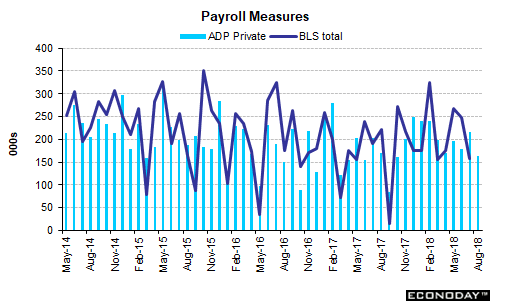
Meanwhile, initial weekly jobless claims have fallen to 203,000, the lowest since 1969, which is another sign fewer workers are being laid off. Today’s August ADP private payrolls survey reported 163,000 jobs created. It is sometimes a predictor of the U.S. jobs report, as the above graph shows, but usually underestimates the U.S. Labor Department report.

image

Graph: Econoday

Another sign of economic strength is the just released August ISM non-manufacturing survey of Supply Managers. ISM’s non-manufacturing sample reports sharp acceleration in overall growth during August, at an index of 58.5 vs July’s 55. Strength is centered in orders with both new orders, at 60.4, and backlog orders, at 56.5, posting strong monthly gains. And new export orders are up 2.5 points to 60.5, a special plus and one that underscores the importance of service exports for the U.S. economy, says Econoday.

“Export orders expanded at stable levels,” commented Timothy R. Fiore, Chair of the Institute for Supply Management® (ISM®) Manufacturing Business Survey Committee. “Prices pressure continues, but the index softened for the third straight month and remains above 70. Demand is still robust, but the nation’s employment resources and supply chains continue to struggle. Respondents are again overwhelmingly concerned about tariff-related activity, including how reciprocal tariffs will impact company revenue and current manufacturing locations. Panelists are actively evaluating how to respond to these business changes, given the uncertainty.”

Prices are rising for parts as well as finished products, in other words. But companies are not yet passing said costs on to consumers; maybe because of the recent tax cuts. That is, except for the two industries reporting contraction in August: Wood Products and Primary Metals, which are already subject to higher tariffs.

Corporate profits are surging almost 8 percent at present because of the tax cuts. But corporations are not yet boosting employees’ wages and salaries above the inflation rate. How is that possible in such a tight labor market? This may be clearer with tomorrow’s unemployment report.

A recent National Bureau of Economic Research Working Paper that surveyed union historical records showed during maximum membership years from 1940-70 unions offered a larger wage premium to less-skilled workers, so that unions have had an important equalizing effect on income distribution to the extent that they are successful in organizing the less-skilled.

But that effect has diminished as union membership shrank and lower numbers of low-skilled workers have joined union since then, which is also keeping wages from rising faster. Still, union membership has historically offered greater benefits to union workers than non-union workers.

Harlan Green © 2018

Follow Harlan Green on Twitter: https://twitter.com/HarlanGreen

Posted in Consumers, Economy, Uncategorized, Weekly Financial News | Tagged , , , , , | Leave a comment

What Happens When Poverty Exists In the Valley of Plenty?

ANSWERING THE KENNEDYS CALL TO ACTION

image

Poverty in the Valley of Plenty is a documentary film that then California Congressman Richard Nixon and growers in the San Joaquin successfully sued to have banned for defamation. It was about the working conditions that early post-WWII farmworkers still suffered under. I was able to show a banned copy of the film to the United Farmworkers of America that had been produced by the Hollywood trade unions when I was a member of the UFW

In 1948, the National Farm Labor Union and Hollywood filmmakers who hated the virulently anti-union big farm grower DiGiorgio Fruit, the largest grape, plum, and pear grower in the world, made the film titled Poverty in the Valley of Plenty to expose the terrible conditions of the farmers. In 1947, DiGiorgio responded to a strike by firing all the strikers and replacing them with a combination of Filipinos, undocumented workers, and migrants coming to the U.S. through the Bracero Program. The last of these was an illegal move against the agreement between the U.S. and Mexico that explicitly stated braceros were not to be used as strikebreakers. The unions hated DiGiorgio so much that they waived all their wage and hour contracts to get the film made.

The conditions of farmworkers in the 1950s were such as portrayed in John Steinbeck’s The Grapes of Wrath during the Great Depression The film portrayed poor farmers from the Dustbowl that could only find work in California’s crop-filled valleys—under conditions that aren’t much different from many of today’s lower income workers.

We have today as much of a problem for at least 25 percent of working Americans that earn no more than the poverty rate for a family of four–$25,100/year in 2018, according to the U.S. Department of Health and Human Services.

Who are they? Many are single-adult families with children—mostly mothers barely making ends meet in menial jobs. The Oxford economist Robert Allen recently estimated needs-based absolute poverty lines for rich countries that are designed to match more accurately the $1.90 line for poor countries, and $4 a day is around the middle of his estimates. When we compare absolute poverty in the United States with absolute poverty in India, or other poor countries, we should be using $4 in the United States and $1.90 in India.

“Once we do this, there are 5.3 million Americans who are absolutely poor by global standards. This is a small number compared with the one for India, for example, but it is more than in Sierra Leone (3.2 million) or Nepal (2.5 million), about the same as in Senegal (5.3 million) and only one-third less than in Angola (7.4 million). Pakistan (12.7 million) has twice as many poor people as the United States, and Ethiopia about four times as many.”

Author Robert Putnam (Bowling Alone), in his book “Our Kids: The American Dream In Crisis,” looks at another angle: the way income inequality is trickling down to our public education system.

Putnam points out that Americans of different classes and educational backgrounds are increasingly living apart from each other: either in educated, wealthy enclaves or the inverse—poverty again in the valley of plenty. That has a negative and stratifying effect on schools, particularly on schools in poor areas.

“What we know very well is that when rich kids go to school, in their backpack they bring their parents’ aspirations, their parents’ resources, their parents’ trips to France, their allusions to Proust or whatever, and that benefits all the kids in town,” Putnam said..”

“When poor kids go to school, they’re bringing in their backpack gang violence—even if they’re not personally involved—they’re coming from very poor neighborhoods, they bring disarray from home, hunger at home, and those factors affect everyone else,” he continued in a PBS interview on TV interview.

The Nation Magazine cites a recent Education Law Center and Rutgers Graduate School of Education report that exposes the tremendous inequality in educational opportunities of elementary school students within wealthy and poor school districts and states. It highlights Professor Putnam’s central thesis; by worsening the the chances of success of lower-income children; already hindered living in poor neighborhoods within dysfunctional family structures; it hurts all Americans.

Putnam cites the findings of Clive Belfield, an associate professor of economics at Queens College, City University of New York: “The aggregate lifetime burden of failure to face the woes of poor youth is $1.59 trillion for taxpayers and $4.75 trillion for the larger society in lost earnings, lower economic growth and lower tax revenue beyond direct costs in welfare.”

An inadequately educated public diminishes the chances democracy itself will survive, as well .

Harlan Green © 2018

Follow Harlan Green on Twitter: https://twitter.com/HarlanGreen

Posted in Politics, Uncategorized | Tagged , , , , | Leave a comment

What Really Is Fair Trade?

Popular Economics Weekly

image

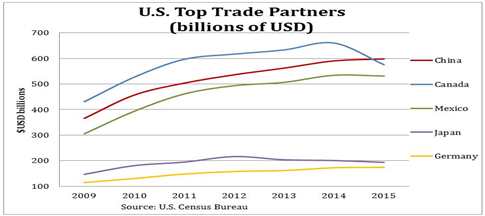
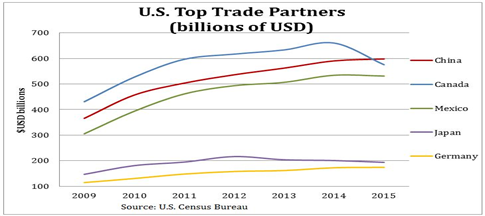
China is our trading partner with the largest deficit; $506 billion in exports to the US vs. $130 billion in imports from US for a -$376 billion trade deficit in 2017. Canada is the 2nd largest partner with American consumers buying $300 billion in imports from Canada vs. $282 billion in exports for a -$18 billion trade deficit, according to the latest U.S. Census Bureau data.

Mexico is the third largest partner, with a -$71 billion trade deficit in exports vs. imports. The only partners with which the US has a trade surplus of exports over imports are Brazil and The Netherlands, ranked 12th and 13th, respectively, of the top 15 US trading partners.

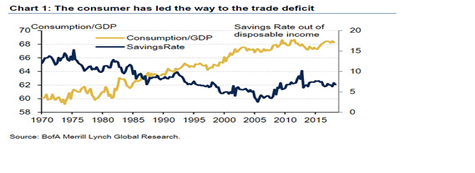
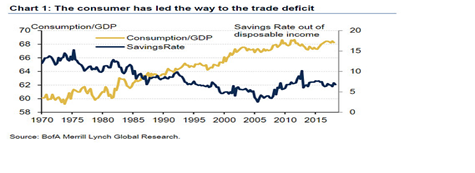
The culprit is American consumers that now account for almost 70 percent of economic activity, versus 60 percent in the early 1980s, according to Bank of America’s Merrill Lynch analysts.

image

Consumers spend almost as much as they save, thanks in part to historically low interest rates that make it easy to borrow. The personal savings rate is now 6.7 percent and inflation is ticking above 2 percent, the Fed’s preferred inflation rate, so look for more interest rate hikes in coming months.

Why is President Trump picking a trade war with two of our top three trading partners that accounted for 29 percent of our trading volume in 2017? Is there a better way than a trade war to cure the deficit problem that doesn’t threaten to elevate prices further to an already escalating inflation rate?

Attempting to correct those imbalances is the major reason President Trump launched tariff wars with our largest trading partners. But he crippled himself at the same time by withdrawing from the 12-member Trans-Pacific Partnership—called TPP—at the beginning of his administration. Though it wasn’t perfect (didn’t boost US job formation), the trade alliance lowered tariffs on thousands of goods and gave US the power to oppose China’s unfair trade practices.

Obama economic advisor Austun Goolsbee tweeted recently:

“E.g. TPP cut tariffs on 18,000 us products—to zero for $90b of US autos & $35b of IT, big cuts for US beef, pork, dairy, poultry, forced fairness for US service exports, established free intl movement of data, killed regulatory barriers to us export, limited state owned enterprises.

“TPP had strongest labor rules of any agreement ever (ban forced labor, child labor, discrimination, required freedom to unionize, minimum wage, hour limits, wkr safety) & the strongest enviro (ship pollution, ozone chem, illegal fishing, illegal logging, wildlife trafficking)movement of data, killed regulatory barriers to US export, limited state owned enterprises.”

“And Mexico and Canada signed TPP so Trump’s nafta “deal” is demonstrably worse for the US than what Canada and Mexico already agreed to,” said Professor Goolsbee.”

The trade deficit has been with US since the 1970s, when roaring inflation and several recessions meant consumers wanted cheaper-foreign-made goods over those made in the USA, due in part to several Arab oil embargos that drove up oil prices and caused long lines at gas stations due to gasoline shortages.

On the macro (national) economic level, the US made it easy for American multi-national corporations to build their factories overseas with anti-labor policies that suppressed union collective bargaining and US wages, in their quest to expand international trade by opening US borders via lower import tariffs.

So a greater fair trade world would require major policy changes to correct the trade imbalances, needless to say. American consumers would pay more for Made in USA products and not always seek discounted foreign goods, for starters, if their incomes improved. They would then pay more taxes, increasing government revenues, which would lessen demand for massive federal government borrowing to cover the huge annual federal budget deficit that is projected to reach $1.5 trillion in 10 years.

Really fair trade is just basic economics 101 that would require fairer labor policies.

Harlan Green © 2018

Follow Harlan Green on Twitter: https://twitter.com/HarlanGreen
Posted in Uncategorized | Tagged , , , , | Leave a comment

What Really Is Fair Trade?

Popular Economics Weekly

image

China is our trading partner with the largest deficit; $506 billion in exports to the US vs. $130 billion in imports from US for a -$376 billion trade deficit in 2017. Canada is the 2nd largest partner with American consumers buying $300 billion in imports from Canada vs. $282 billion in exports for a -$18 billion trade deficit, according to the latest U.S. Census Bureau data.

Mexico is the third largest partner, with a -$71 billion trade deficit in exports vs. imports. The only partners with which the US has a trade surplus of exports over imports are Brazil and The Netherlands, ranked 12th and 13th, respectively, of the top 15 US trading partners.

The culprit is American consumers that now account for almost 70 percent of economic activity, versus 60 percent in the early 1980s, according to Bank of America’s Merrill Lynch analysts.

image

Consumers spend almost as much as they save, thanks in part to historically low interest rates that make it easy to borrow. The personal savings rate is now 6.7 percent and inflation is ticking above 2 percent, the Fed’s preferred inflation rate, so look for more interest rate hikes in coming months.

Why is President Trump picking a trade war with two of our top three trading partners that accounted for 29 percent of our trading volume in 2017? Is there a better way than a trade war to cure the deficit problem that doesn’t threaten to elevate prices further to an already escalating inflation rate?

Attempting to correct those imbalances is the major reason President Trump launched tariff wars with our largest trading partners. But he crippled himself at the same time by withdrawing from the 12-member Trans-Pacific Partnership—called TPP—at the beginning of his administration. Though it wasn’t perfect (didn’t boost US job formation), the trade alliance lowered tariffs on thousands of goods and gave US the power to oppose China’s unfair trade practices.

Obama economic advisor Austun Goolsbee tweeted recently:

“E.g. TPP cut tariffs on 18,000 us products—to zero for $90b of US autos & $35b of IT, big cuts for US beef, pork, dairy, poultry, forced fairness for US service exports, established free intl movement of data, killed regulatory barriers to us export, limited state owned enterprises.

“TPP had strongest labor rules of any agreement ever (ban forced labor, child labor, discrimination, required freedom to unionize, minimum wage, hour limits, wkr safety) & the strongest enviro (ship pollution, ozone chem, illegal fishing, illegal logging, wildlife trafficking)movement of data, killed regulatory barriers to US export, limited state owned enterprises.”

“And Mexico and Canada signed TPP so Trump’s nafta “deal” is demonstrably worse for the US than what Canada and Mexico already agreed to,” said Professor Goolsbee.”

The trade deficit has been with US since the 1970s, when roaring inflation and several recessions meant consumers wanted cheaper-foreign-made goods over those made in the USA, due in part to several Arab oil embargos that drove up oil prices and caused long lines at gas stations due to gasoline shortages.

On the macro (national) economic level, the US made it easy for American multi-national corporations to build their factories overseas with anti-labor policies that suppressed union collective bargaining and US wages, in their quest to expand international trade by opening US borders via lower import tariffs.

So a greater fair trade world would require major policy changes to correct the trade imbalances, needless to say. American consumers would pay more for Made in USA products and not always seek discounted foreign goods, for starters, if their incomes improved. They would then pay more taxes, increasing government revenues, which would lessen demand for massive federal government borrowing to cover the huge annual federal budget deficit that is projected to reach $1.5 trillion in 10 years.

Harlan Green © 2018

Follow Harlan Green on Twitter: https://twitter.com/HarlanGreen
Posted in Consumers, Economy, Macro Economics, Weekly Financial News | Tagged , , , , | Leave a comment

Labor Productivity is the Golden Fleece

Financial FAQs

image

Graph: Econoday

Rising labor productivity is the golden fleece of economic growth, the pot of gold at the end of the rainbow, because major economists maintain it is really the only way workers can raise their standard of living. This means raising incomes above the inflation rate, which is where average household incomes have been stuck since the end of the Great Recession.

The sheep’s fleece was an ancient Greek method of extracting placer gold from flowing streams.  The heavier gold flakes would stick to the fleece, hence the Greek myth of Jason bringing home the Golden Fleece came to signify the accumulation of wealth and power.

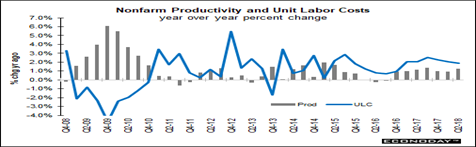
For that reason it’s good news that labor productivity seems finally to be recovering. Workers’ output rose at a very hot 4.8 percent rate in the second quarter, up from an already solid 2.6 percent rate in the first quarter. Hours worked rose at a 1.9 percent rate vs. the first quarter’s 2.6 percent.

But we don’t see its benefits being passed on to wage and salary earners. Wages have stagnated and income inequality increased because workers’ productivity hadn’t risen substantially since 2010, as the graph shows; when benefits from ARRA, the $831 billion American Recovery and Reinvestment Act enacted during the first year of President Obama’s administration, petered out. It was much too inadequate to help restore states’ and consumers’ personal wealth from the worst recession since the Great Depression.

“Obama officials and Congress clearly made a big mistake early in the recession by focusing more intently on saving banks — and, thus, bankers and investors — and much less on directly helping families facing foreclosures and layoffs,” says a recent NY Times Op-ed. “Later in the recovery, the decision by Republican leaders in Congress to oppose every Obama proposal prevented the government from doing much to help people regain what they had lost or to heat up the tepid recovery with infrastructure spending and other stimulus measures.”

More government public sector aid was necessary, in other words, because the private sector was recovering from their losses and had little money to invest.

And “Government puts a lot of money into basic research, whereas businesses tend to fund late-stage development that can be quickly commercialized,” says MarketWatch’s Rex Nutting. “However, federal funding for research hasn’t kept pace with the growth in the economy; in the past 10 years, federal R&D investments have risen just 0.3 percent per year after adjusting for inflation.”

A major reason for the rise in productivity at the moment has to be that companies are investing more in new plants and equipment; in part because of the Republican tax cut in corporations’ nominal tax rate, but also because there is a huge deficit in skilled workers that has required businesses to invest more heavily in technologies that replace those missing workers. There are now about one million more job openings than jobs being created each month.

So workers aren’t really benefiting from the productivity increase, as nominal compensation fell to a 2.0 percent rate from 3.7 percent in the first quarter, according to Econoday. When adjusting for inflation, real compensation rose 0.3 percent and was little changed from the first quarter’s 0.2 percent rate.

image

Why?? Firstly, many more low-paying service sector jobs are being created than manufacturing jobs; which have been shipped overseas by corporations where wage and benefit costs are a fraction of Americans’. It is a major reason President Trump has initiated tariff increases in the hope foreign manufactures become less competitive in a bid to bring home some of those manufacturing jobs.

But that may or may not succeed, as a burgeoning trade war with higher tariffs would probably raise prices and inflation to a level that would nullify any benefits from more domestic jobs. Nobel economist Paul Krugman has said that it could eliminate 8 to 9 million jobs from companies that would shrink as a result of the increased tariffs, due to foreign businesses looking elsewhere for cheaper products not affected by the tariffs.

Increasing the national minimum wage from $7.25/hour last set in the 2009 would definitely help the lower wage sector, which Big Business has been resisting. Workers are producing more than ever, at present. But that doesn’t mean their standard of living will rise because of it, unless employers pass on more of the productivity increase to their employees

Harlan Green © 2018

Follow Harlan Green on Twitter: https://twitter.com/HarlanGreen
Posted in Consumers, Economy, Keynesian economics, Weekly Financial News | Tagged , , , , , | Leave a comment

Where Goes the Housing Market?

The Mortgage Corner

image

Graph: Econoday

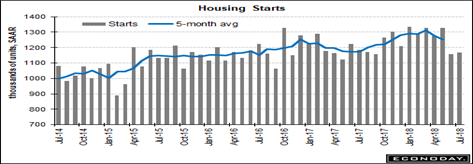
We definitely have a housing shortage. Housing construction is unable to keep up with the demand for single-family homes, in particular. Year-on-year, starts are down 1.4 percent with completions, at a 1.188 million rate, down 0.8 percent and homes not started, at 175,000, up 23.2 percent, nationally. The lack of available construction labor and high costs for lumber, which are tied in part to tariffs, are negative factors, say Realtors and home builders.

“Given the chronic lack of affordable housing and rapidly escalating home prices, it is worrisome that on a per capita basis, the country is producing new single-family housing stock at a rate that is similar to the trough of a typical recession,” Sam Khater, chief economist at Freddie Mac, told Reuters.

This is not good news for entry-level homebuyers looking to buy affordable homes, needless to say. Even though mortgage rates are still at post-recession (historic) lows, with the 30-year conforming mortgage rate stuck at 4.0 percent for a one point origination fee among the most competitive California lenders.

Some new-home projects are seeing construction delays due to those cost concerns, according to the National Association of Home Builders. The NAHB also notes the number of single-family units that are authorized but have not started is up 25 percent since July 2017.

And we have the aforementioned tariff wars raising the price of building materials—Canadian lumber in particular. “Supply-side challenges, including increases in material prices and chronic labor shortages, are affecting affordability in many markets,” says Robert Dietz, the NAHB’s chief economist. “However, consumer demand remains strong, due to a growing economy and job market and favorable demographics.”

Showing much less weakness are permits, up 1.5 percent in the month to 1.311 million. Year-on-year, permits are up 4.2 percent with strength centered where it should be and that’s single-family homes where permits are up a very solid 6.4 percent. Multi-family permits are up 0.2 percent year-on-year, reflecting the rise in renters that can’t afford to buy.

What can be done to ease what is fast becoming a housing crisis? The tariff wars with Canada and the EU are definitely not in our national security interest, as housing inflation is already a problem. But there is also a construction workers shortage in this fully employed economy. Many of those workers are recently-arrived immigrants being deported by the Trump administration, rather than offered a path to citizenship; which is also harming agriculture.

The national median existing-home value is now $217,300, an increase of 8.3 percent on the year and 8.4 percent above the bubble-era peak. In 21 of the nation’s 35 largest markets, the median home value is now at an all-time high reports Zillow, the housing information specialist.

And continuing a years-long trend, says Zillow, the number of U.S. homes for sale in June fell 4.8 percent to 1.2 million, the 41st month in a row of annual inventory declines. Inventory of homes in the top value tier dropped 5.4 percent, while the number of homes for sale in the bottom value tier fell 3.6 percent.

Even though homeownership is rising from its Great Recession trough, the share of people renting their home, rather than owning it, has also increased in all 50 of the largest cities in the country between 2006 and 2016, reports Zillow.   Renter households now represent the majority in 29 of those 50 cities — back in 2006 at the start of the housing crisis, only 16 had renter-household majorities.

So we are seeing the inevitable result of the busted housing bubble, when as many as one million excess homes were built. But even more damage was done during the succeeding recovery, when policies were not instigated to cure the loss of incomes that resulted from the loss of jobs and homes.

It will require many more public-funded programs to cure the housing shortage, including affordable housing tax breaks, remedy of the massive infrastructure deficit, and tax cuts and spending programs (such as on health care and education) that benefit the middle and working classes, rather than Wall Street and the corporations.

Harlan Green © 2018

Follow Harlan Green on Twitter: https://twitter.com/HarlanGreen
Posted in Consumers, Economy, Housing, housing market, Weekly Financial News | Tagged , , , , , , , | Leave a comment

Interest Rates Dangerously Low?

Popular Economics Weekly

image

Graph: FRED

Why should historically low interest rates be a problem, you say?  Doesn’t that help consumer demand by enabling consumers to buy more by borrowing more cheaply, and economic growth by encouraging companies to create more jobs?  Not when rates have remained this low for so long.

Interest rates are far too low this late in the recovery from the Great Recession. It isn’t only because the Treasury Yield Curve slope has been steadily declining since 2014 that measures the difference between the 10-year and 2-year Treasury bond yields.

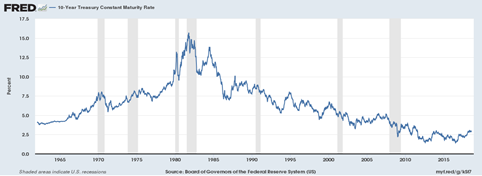
The Benchmark 10-year Treasury yield itself hasn’t risen above 3 percent in at least one year. It was this low for sustained periods during the Great Recession, when it dipped below 2 percent. But it shouldn’t be as low today (2.85 percent at this writing). In fact, interest rates haven’t recovered from the Great Recession. It normally ranges from 4 to 5 percent during prosperous times when there is a greater demand for money—e.g., from 2000 to 2008—as the FRED graph shows.

It signals a significant weakness in aggregate demand for goods and services; which is the sum of demand by consumers, investors, government spending and net exports, (and somewhat mirrors the weak 2 percent GDP growth since then). This could means we are dangerously close to another recession, if economic shocks such as the Turkish Lira plunge, or a full-fledged trade war occurs.

Consumer spending is perking along above 3 percent only because of excessive borrowing due to the low interest rates, rather than rising incomes, so it won’t be sustainable. And capital spending is half of what it should be with the stimulus from the Republican tax cuts and $1.3 trillion in additional federal spending.

Exports—another component of aggregate demand—is momentarily rising, but it could be a one-time surge in orders to escape rising costs from the trade war. And there is always the threat of cuts to government entitlement programs like food stamps, Medicare and Medicaid, which increases costs of many low and middle-income consumers.

So we could be teetering on the edge of an economic slowdown, no matter what the pundits are saying about full employment and the latest 4.1 percent GDP 2nd quarter growth, with excessive government and private debt providing little cushion for support should geopolitical and financial problems worsen.

However, there is a caveat to this dismal scenario. It may not be a recession for all Americans. Household debt — including mortgages, credit cards, auto loans, student loans and other credit — grew for the 16th consecutive quarter in the April-to-June period, rising by 0.6%, or $82 billion, to $13.29 trillion, the New York Fed reported Tuesday.

image

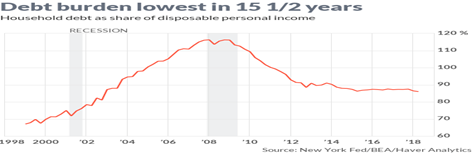
That’s because the recovery has really benefited just the top 10 percent income-earners, who have been able to pay down their debts. With personal disposable incomes at a $15.46 trillion annual rate in the quarter, the debt-to-income ratio dipped to 86 percent. That’s the lowest, by a tiny amount, since the fourth quarter of 2002. At the height of the credit bubble in 2008, debts topped at 116 percent of disposable income.

And we have government debt approaching 100 percent of GDP by 2020, according to the watchdog Congressional Budget Office. The sad denouement of this scenario could be that another downturn will hurt those most dependent on the federal government for protection, as has happened in the past.

Harlan Green © 2018

Follow Harlan Green on Twitter: https://twitter.com/HarlanGreen
Posted in Consumers, Economy, Politics, Weekly Financial News | Tagged , , , | Leave a comment

Loneliness in America is a Public Health Problem

ANSWERING THE KENNEDYS CALL

image

As part of our series on community-building I am reporting on what happens to Americans as a result of the breakdown of community, which Robert Putnam first documented in his best-seller, “Bowling Alone: the Collapse and Revival of American Community.”

This MarketWatch article forwards a report by Cigna Health on the damage done to individuals by living in a society that encourages little face-to-face human contacts in our high-stress, and very unequal society:

“ A recent Cigna survey of 20,000 U.S. adults found that nearly half of people suffer from feelings of loneliness. The evaluation of loneliness was measured by an often-used score of 43 or higher on the University of California, Los Angeles “Loneliness Scale,” a 20-item questionnaire developed to measure feelings of loneliness and social isolation. Loneliness is both a health issue and a social issue and, often, subjective.

“We view a person’s physical, mental and social health as being entirely connected,” David Cordani, president and chief executive officer of Cigna, said in a statement. “We’re seeing a lack of human connection, which ultimately leads to a lack of vitality,” he said, “or a disconnect between mind and body.”

Why such a disconnect of Americans? “Mandatory overtime and involuntary long hours are a growing problem particularly for some segments of the labor force,” according to “Overworked America,” a 2016 report from the Washington Center for Equitable Growth, a left-leaning research center. Workers who are not paid overtime are more than twice as likely to report working more than 40 hours a week,” it said.

image

European Union members, such as The Netherlands and Denmark, have lower workweek hours with universal healthcare, tuition-free colleges and report much fewer health problems.

The toll of loneliness has even affected our youngest generation—the Gen X’ers. “Generation X-ers are struggling to keep up with a loss of wealth and income since the Great Recession,” says the study, “and have less time to spend with family. As wages play catchup with inflation, many people work overtime or two jobs to make ends meet.”” The U.S. is one of the few countries in the industrialized world that does not require employers to offer paid parental leave.”

“More people live (and eat) alone. More than half of all meals (57 percent) are eaten alone, a 2014 study by market researcher NPD Group concluded. And 34 percent of Americans spend dinner time alone. Nearly 30 percent of households in the U.S. are comprised of one person. It’s the second most common household type after married couples without children.”

How can we decrease our loneliness (and health) problem? Exercise and good sleep habits are a start. But much more is needed, given the fact that America is the only developed country without universal health care, paid parental leave to raise healthier children, and an educational system that heavily in debts college students. It requires a society and government willing to care for all citizens.

The current state of loneliness is not sustainable. It is why Americans’ health outcomes are measurably worse than in other developed countries; with higher infant mortality, less longevity, an intractable Opioid/drug epidemic, and rampant gun violence, for starters.

There is no reason why Americans can’t create better functioning communities, create a sense that we are all in this together and care more for each other, rather than remain divided among races and political ideologies.

We do know how to combat loneliness. Be willing to reach out to others when it’s an inconvenience, even with a smile.

Harlan Green © 2018

Follow Harlan Green on Twitter: https://twitter.com/HarlanGreen

Posted in Consumers, Economy, Uncategorized | Tagged , , , , | Leave a comment

Why aren’t Wages Growing Faster?

Popular Economics Weekly

image

Graph: FRED

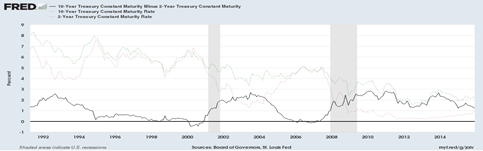
Interest rates are far too low for this late in the recovery from the Great Recession. We know this because the Treasury Yield Curve has been falling that measures the difference between the 10-year and 2-year Treasury bond yields. The difference is just 1 percent, when it has been around 2 percent during other prosperous times, as the FRED graph shows. It last was this low just before the last 2 recessions (gray columns in graph).

Why are interest rates still low? The simplest answer is there isn’t sufficient demand for what is being produced that would cause more borrowing, thus causing interest rates to rise. And though the Republican tax cuts have juiced profits of corporations and their stock holders, it hasn’t boosted the wages of ordinary consumers that power two-thirds of economic activity.

Consumers’ personal incomes are rising at the inflation rate on average, which means they don’t have sufficient income or savings that would cause them to increase their spending habits. It’s a difficult and maybe counter-intuitive concept. If prices are rising as fast as incomes, then consumers are also playing catchup in what they need to maintain their standard of living.

That is why economists worry that such low long term interest rates in particular could be a sign of another incipient recession. Banks cannot lend as much when their profit on loans is the difference between their cost of money and what they can lend at longer-term loan rates (such as mortgages and installment loans). So it means a shrinkage in the available credit.

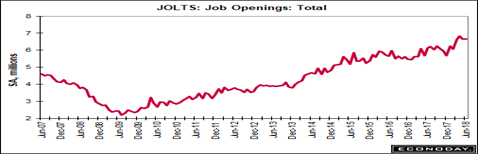
The good news is that job openings are still soaring in the Labor Department’s JOLTS Report, which should boost wages. It is a survey of available jobs, vs. how many jobs have been created in June.

There were 6.662 million in June vs. an upwardly revised 6.659 million in May, reports the BLS. Year-on-year, the number of job openings was up 8.8 percent. The number of hires remained well below job openings at 5.651 million in June, down from May’s 5.747 million, while separations, which includes quits, layoffs and discharges, rose to 5.502 million from 5.419 million.

 image

Graph: Econoday

That means there were more than 1 million jobs that remained unfilled, which has to put more pressure on employers to boost wages. So will inflation behave enough to allow an increase in real wages, which should be rising above the rate of inflation this late in the recovery from the Great Recession?

That has been the problem since the 1970s, really. The Fed wants to keep inflation low, so it raises interest rates whenever there is a sign that workers’ wages are rising faster than inflation. But this puts a damper on consumer spending, which in turn keeps economic growth in the 2-3 percent range, which isn’t enough to either pay down personal or government debts.

And social security trustees calculate the $3 trillion social security trust fund will be depleted by 1934, which would mean taxes must be raised to maintain current benefits before then. Does anything believe Congress will allow said benefits to shrink, with voting seniors just daring them to cut their benefits?

It’s much easier for the Fed to allow inflation to rise above its 2 percent target range before raising their interest rates to allow faster wage growth, which in turn boosts tax revenues. The social security trustees use a mid-range GDP growth rate of approximately 2.6 percent to calculate longevity of the SS trust fund.

But GDP growth has averaged 3.5 percent since the 1930s, including the Great Depression. Why have inflation hawks at the Federal Reserve so slowed growth since the 1970s by boosting interest rates at the slightest hint of higher inflation, which in turn has kept GDP growth below its long-range potential?

The real answer is that pro-business, pro-corporate administrations since 1980 have severely limited collective bargaining and other pro-labor laws in the name of globalization, thus limiting wage growth.

That’s why such policies are called trickle-down economics. Very little of the national wealth created since then has trickled down to the 80 percent that are the real wage earners.

Harlan Green © 2018

Follow Harlan Green on Twitter: https://twitter.com/HarlanGreen
Posted in Consumers, Economy, Politics, Weekly Financial News | Tagged , , , , , | Leave a comment