
Popular Economics Weekly
“Consumer confidence edged downward in May as the inflationary impacts of the war in the Middle East intensified,” said Dana M Peterson, Chief Economist, The Conference Board. “Consumer appraisals of current business conditions and the current labor market were moderately less positive compared to last month.” Conference Board
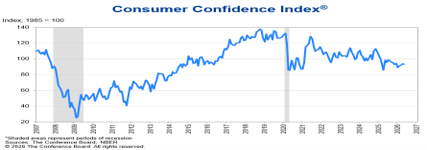
American consumers are more worried than ever. The Conference Board and University of Michigan’s surveys are at historic lows; back to levels not seen since the COVID-19 pandemic.
Confidence then peaked in 2021 during the pandemic recovery and has been declining ever since. This is while financial market indexes are reaching unsustainable levels on the hope that the next big thing (A.I.) may bring in another Age of Enlightenment.
But beware, we have had such periods before. It looks like another period of mass hysteria over the possibilities of A.I. as companies invest $trillions, mostly in borrowed money, that is creating another asset bubble like the Dot-com and housing bubbles.
We called it Irrational Exuberance in the 1990s. It’s over enthusiastic investors over-investing in artificial intelligence.
The U. of Michigan reported,“Sentiment is now just below the previous historical trough seen in June 2022. The cost of living continues to be a first-order concern, with 57% of consumers spontaneously mentioning that high prices were eroding their personal finances, up from 50% last month.”
And consumers know why finances are eroding. Inflation can only go higher with the Iran war shortages, and tariff levels settling at 1930 pre-Great Depression levels with no formal treaties (which choked supply chains at the onset of the Great Depression).
There is no relief for either consumers or producers in sight amid the chaos that is being generated. The biggest worry is the rank naivete of a Republican Party that won’t hold its leader’s craziness to account. Americans are beginning to realize that the Trump administration has lost the Iran war, and the tariff hikes were illegal. It’s also showing up in the record lows in the polls.
In wanting to play the autocrat, Trump has booted the intelligent advisors who gave him intelligent advice. Iran can now keep the Hormuz Strait closed, while intelligence agencies are reporting Iran has enough missiles and drones to decimate the infrastructure of the other border countries, if the U.S. should try a land invasion to open the Strait.
A.I. is beginning to alarm economists, such UC Berkeley Professor Brad Delong in his Grasping Reality blog:
“The current $1.5T AI arms race: are hyperscalers building utopia, building dystopia, building digital god, or simply lighting trillions of dollars on fire in a dollar auction?”
Said $Trillions are chasing the next big thing, in other words, which happens when our government holds too much debt instead of paying it down. This results in an excess money supply sloshing around the economy looking for the next big deal, instead of investing in what Americans most need that Republicans have been intent on abolishing: (e.g, , programs to improve healthcare, environmental protection, education, climate prediction, alternative energy).
So consumers are right to be worried. This is the time for such programs that were created in the Biden administration to prepare Americans for the future, rather than a return to the past.
Can we do it without bursting the A.I. bubble that turns into another recession?
Harlan Green © 2026
Follow Harlan Green on Twitter: https://twitter.com/HarlanGreen


